University of New Orleans University of New Orleans
ScholarWorks@UNO
ScholarWorks@UNO
University of New Orleans Theses and
Dissertations Dissertations and Theses
12-20-2009
Cognitive-Affective Processes as a mediator of the Relationship
Cognitive-Affective Processes as a mediator of the Relationship
between Responsive Parenting and Preschool Children's
between Responsive Parenting and Preschool Children's
externalizing Behavior
externalizing Behavior
Kathleen McGoron University of New Orleans
Follow this and additional works at: https://scholarworks.uno.edu/td
Recommended Citation Recommended Citation
McGoron, Kathleen, "Cognitive-Affective Processes as a mediator of the Relationship between Responsive Parenting and Preschool Children's externalizing Behavior" (2009). University of New Orleans Theses and Dissertations. 1011.
https://scholarworks.uno.edu/td/1011
This Thesis is protected by copyright and/or related rights. It has been brought to you by ScholarWorks@UNO with permission from the rights-holder(s). You are free to use this Thesis in any way that is permitted by the copyright and related rights legislation that applies to your use. For other uses you need to obtain permission from the rights-holder(s) directly, unless additional rights are indicated by a Creative Commons license in the record and/or on the work itself.
Cognitive-Affective Processes as a mediator of the Relationship between Responsive Parenting and Preschool Children‟s externalizing Behavior
A Thesis
Submitted to the Graduate Faculty of the University of New Orleans
in partial fulfillment of the requirements for the degree of
Master of Science in
Psychology
Applied Developmental Psychology
by
Kathleen McGoron
B.S., Eastern Michigan University 2006
ii
Acknowledgement
I would like to thank many people in helping me complete this thesis. First I would like
to thank everyone in the Mother‟s and Preschoolers lab for all their efforts collecting, organizing,
coding, and entering the data necessary for this project. I would especially like to thank the
coding teams that made this project possible. For emotion regulation, I would like to thank
Martha, Tralana, Chloe, and Genevieve. These were the first coders I ever supervised and I thank
them for their hard work and attention to detail. Running this coding team was a great learning
experience! I would also like to thank Melissa Barnett who made it possible to complete the
parenting coding necessary for this project. My gratitude also goes out to my major professor,
Laura Scaramella, and my thesis committee, Robert Laird and Paul Frick. Their feedback and
suggestions taught me a lot throughout this process. Finally, I would like to thank my fiancé,
Alex Bohl and my friend Allison Marks for their support and frequent help throughout the thesis
iii
Table of Contents
List of Tables & Figure ...iv
Abstract ...v
Introduction ...1
Method ...16
Results ...27
Discussion ...37
References ...50
Appendix A: IRB Approval Form ...60
Appendix B: Global parenting codes for matching task ...61
Appendix C: Micro-social child emotion regulation codes ...62
iv
Lists of Figures and Tables
v Abstract
Responsive parenting is characteristically child-centered and creates a climate where children‟s
needs are met. While responsive parenting has been studies less than harsh parenting, initial
evidence supports a negative relationship between responsive parenting and children‟s
externalizing problems. The current study sought to identify mechanism by which responsive
parenting reduces risk for externalizing problems in the preschool years. Specifically, the study
sought to evaluate the extent to which children‟s language development and children‟s emotion
regulation skills mediate the expected negative relationship between responsive parenting and
children‟s externalizing problems. While responsive parenting was found to be negatively related
to children‟s externalizing problems, support for mediation was not found. Results are discussed
in terms of what may account for the lack of support for study hypotheses.
Keywords: Parenting, preschool, language development, emotion regulation, problems
1 Introduction
Repeatedly, harsh parenting practices have been linked with the emergence of problem
behaviors during early childhood (Kimonis et al., 2006; Laible, Carlo, Torquati, Ontai, & 2004;
Strassberg, Dodge, Pettit, & Bates, 1994; Weiss, Dodge, Bates, & Pettit, 1992). Comparatively
less work has considered how more positive parenting practices, such as responsive parenting,
reduces children‟s risk for problem behaviors during early childhood. While harsh parenting
directly models and reinforces externalizing behaviors, the process by which responsive
parenting reduces risk of externalizing problems may be less direct. That is, initial evidence
suggests that responsive parenting, or parenting which is characterized by clear, consistent, and
sensitive parent behavior, is associated with fewer externalizing problems during early childhood
(Miner & Clarke-Stewart, 2008; Owens & Shaw, 2003; Pettit, Bates, & Dodge, 1997; Shaw,
Keenan, & Vondra, 1994). Furthermore, responsive parenting also has been linked to more
sophisticated language development (Sohr-Preston, Scaramella, Neppl, Ontai, & Conger, 2008)
and emotional competence (Denham, 1997; Denham, Mitchell-Copeland, Standberg, Auerbach,
& Blair, 1997) during the preschool period. Quite possibly, responsive parenting effectively
teaches children language and emotion regulation skills that provide children with tools to
manage frustrating situations in socially competent ways.
Figure 1 depicts the theoretical model guiding the current study. Two mechanisms are
proposed to explain the process by which responsive parenting reduces children‟s risk for
externalizing problems during the preschool period. First, responsive parenting is expected to
reduce children‟s risk for externalizing problems by enhancing their language development;
children with a more sophisticated vocabulary are expected to be better able to understand
2 a
d
Figure 1, paths a and b). Second, responsive parenting also may provide an environment that is
maximally suited to developing emotion regulation skills, thereby reducing the likelihood of
experiencing behavior problems that are linked to poor emotion regulation, like externalizing
problems (see Figure 1, paths c and d; Frick & Morris, 2006). Alternatively, both mechanisms
may reduce risk for externalizing problems. That is, responsive parenting may enhance both
language skills and emotion regulation skills and that competence in one domain, such as
language skills, also is associated with more competence in another domain, such as emotion
regulation. The simultaneous effect of both language skills and emotion regulation skills also
will be considered (see Figure 1). The following sections first discuss normative change in
externalizing behaviors during the preschool period and then will review the theoretical and
empirical research regarding each of these three pathways.
Figure 1
Language skills and emotion regulation as mediators of the association between responsive parenting and externalizing behavior problems.
Responsive Parenting
Language Development
Emotion Regulation
Externalizing Problems b
c
3
Externalizing Problems during the Preschool Years: Disentangling Problems from Normative
Change
The toddler period has been referred as the “terrible twos” primarily due to the high rates
of externalizing problems which typify this developmental period (e.g., Shaw & Bell, 1993).
Early childhood externalizing problems often include elevated levels of aggression,
impulsiveness, defiance, hyperactivity, inattention, whining, and non-compliance (Gilliom &
Shaw, 2004; Miner & Clarke-Stewart, 2008; Pierce, Ewing, & Campbell, 1999). Disentangling
normative levels of externalizing problems from risk for more pervasive behavior problems is
challenging. Longitudinal studies indicate that externalizing problems peak between the ages 2
and 3 years of age and decline steadily thereafter (Gilliom & Shaw, 2004; Miner &
Clarke-Stewart, 2008), indicating that levels of externalizing problems during the preschool period are
lower than during the toddler period. Boys with elevated levels of externalizing problems across
the toddler and preschool period have been found to be at greater risk for conduct problems
during middle childhood (Pierce et al., 1999; Shaw, Lacourse, & Nagin, 2004). Moreover, high
levels of externalizing problems during early childhood have been identified as a risk factor for
later problem behavior (e.g., Shaw, Gilliom, Ingoldsby, & Nagin, 2003). Consequently, while
externalizing problems may be somewhat normative during the toddler period, children
experiencing above average levels of externalizing problems during the preschool years may be
at increased risk for problem behaviors across middle childhood and into adolescence.
By definition externalizing problems include difficulty controlling and expressing
negative emotions in socially acceptable ways, both emotional control and language skills may
be associated with elevated levels of externalizing problems during the preschool period. In other
4
evidence less sophisticated language skills and poorer emotional control abilities. While the
quality of parenting has frequently been linked to elevated levels of externalizing behaviors,
parenting characteristics may influence levels of externalizing problems in part because of the
effect of parenting on children‟s language development and emotional control abilities. The goal
of the current study is to consider how language skills and emotional control abilities may
mediate the association between parenting and children‟s externalizing problems during the
preschool period. The impact of parenting quality on children‟s levels of externalizing problems
during the preschool period will now be discussed.
The Role of Responsive Parenting in Reducing Risk for Externalizing Problems
Characteristically, parents who use responsive parenting practices create a climate in
which children‟s needs are adequately met. Responsive parenting involves responding to
children‟s needs sensitively and appropriately (Kochanska, 1997). Kochanska (1995) argues that
responsive parenting creates a context in which children want to please their parents and
demonstrate compliance with parental standards due to the positive emotion that exists between
children and parents. Importantly, children of parents who interact with them in a responsive
manner seem to be more willing to internalize parents‟ standards and behavioral expectations,
and subsequently comply with parental demands (Kochanska, 1995).
The operational definition of responsive parenting changes with development. During
infancy, responsive parenting includes parents use of prompt, appropriate, and sensitive
responses to children‟s signaling or distress, such a predictable pattern of responding teaches
children that the environment is safe and their needs will be met (Smith, Landry, & Swank,
2008). During the toddler period, responsive parenting is characterized by selective
5
rewarding positive behavior (e.g., Shaw, Winslow, Owens, Vondra, Cohn, & Bells, 1998).
During the preschool years, responsive parenting includes parents‟ active awareness of their
children‟s emotional and behavioral states as well as responding contingently to their children in
ways that still preserves their children‟s autonomy (Whitside-Mansell, Bradley, Owen,
Randolph, & Cauce, 2003).
Across the early childhood years, higher levels of responsive parenting have been
associated with lower levels of child externalizing problems (Miner & Clarke-Stewart, 2008;
Shaw, Keenan, & Vondra, 1994). Longitudinally, responsive parenting observed during early
childhood has been found to predict fewer externalizing problems during middle childhood
(McCarty, Zimmerman, Digiuseppe, & Christakis, 2005). Conversely, parenting that is marked
with high levels of coerciveness and low responsiveness has been linked to higher levels of
externalizing problems during early childhood (Pettit, Bates, & Dodge, 1993).
Understanding Mechanisms by Which Responsive Parenting Reduces Risk for Externalizing
Problems: The Role of Language Development
One mechanism that may account for the low levels of externalizing problems among
children with parents who use more responsive parenting is language development. The early
childhood period is a time for rapid language development (Hoff, 2006a). From infancy through
the preschool period, children‟s vocabulary expands rapidly such that by age 4, children are
typically able to produce and understand complex sentences (Hoff, 2006a). Learning the
meaning of words is the first step in language development and essential for reaching all other
language milestones (Huttenlocher, Haight, Bryk, Seltzer, & Lyons, 1991). Essentially, if
children do not know the meaning of words, they will be unable to form sentences or engage in
6
development varies by level of environmental stimulation (Hoff, 2006b). The number of words
to which children are exposed is directly related to their vocabulary growth (Huttenlocher et al.,
1991). Responsive parenting may promote language growth because such parents closely
monitor their children‟s activities and respond promptly to their children‟s linguistic efforts
(Tamis-LeMonda, Bronstein, & Baumwell, 2001).
An abundance of empirical research supports the idea that responsive parenting enhances
language development during infancy (e.g. Baumwell, Tamis-LeMonda, & Bornstein, 1997;
Karass & Braungart-Rieker, 2003; Landry, Smith, Miller-Loncar, & Swank, 1997; Paavola,
Kunnari, & Moilanen, 2005; Tamis-LeMonda, Bornstein, & Baumwell, 2001). Although fewer
studies have examined the association between responsive parenting and language development
during the toddler years, those that have similarly report that responsive parenting is positively
associated with language development (Raviv, Kessenich, & Morrison, 2004; Tamis-LeMonda,
Bornstein, Baumwell, & Damast, 1996; Tamis-LeMonda et al., 2004). Preliminary evidence
suggests that the process by which responsive parenting influences language development may
be similar during the preschool years as in earlier developmental periods. For example,
continuity in responsive parenting from infancy through the preschool years has been found to be
associated with better language development during the preschool years (Landry, Smith, Swank,
Assel, & Vellet, 2001). Interestingly, high levels of responsive parenting at any point during
early childhood have been linked with better language development than no responsiveness. For
instance, La Paro, Justice, Skibbe, and Pianta (2004) found that unresponsive parenting predicted
continuity of language delays from 3 to 4 years of age.
Children who lack the requisite language skills upon entry into preschool may be at
7
problems. That is, children who are unable to understand requests and demands from teachers
and who are unable to communicate their needs to their teachers may become frustrated during
interactions with their teachers. Similar processes may emerge during interactions and conflicts
with peers. Children with language delays have been found to experience more social isolation as
they seem to be less likely to be picked to play with peer and to have trouble forming friendships
(e.g., Fujiki, Spackman, Brinton, & Hall, 2004).
A number of studies have linked language delays with higher levels of externalizing
problems among school-aged children (Camarata, Hughes, & Ruhl, 1988; Cohen, Menna,
Vallence, Barwick, Im, & Horodensky, 1998; Fujiki, Brinton, Isaacson, & Summers, 2001;
Gallagher, 1999). School-aged children with language delays seem to have higher levels of
immaturity, hyperactivity, impulsivity, frustration, aggression, conduct disorders, low
self-esteem, low self-confidence, social withdrawal, depression, and anxiety (Gallagher, 1999).
Although there are clear, established links between language delays and externalizing problems
during the elementary school years, evidence is mixed during earlier developmental periods.
During the toddler years, some studies have found a relationship between language delays and
behavior problems (Carson, Klee, Perry, Muskins, & Donaghy, 1998; Caulfield, Fischel,
DeBaryshe, & Whitehurst, 1989), while others have not (e.g. Rescorla, Ross & McClure, 2007).
For instance, Carson and colleagues (1998) studied 64 toddler aged children and found
significantly higher levels of externalizing problems among language delayed children as
compared to normal developing peers, although the mean internalizing and externalizing scores
did not reach clinical significance for either group. In contrast, Reascorla, Ross and McClure
(2007) assessed the relationship between language development behavior problems among 18-35
8
behavior problems emerged, language delayed children were more likely to experience social
withdrawal, which could contribute to the development of behavior problems.
As compared to the toddler period, the preschool years may be a time when language
delays become more consistently linked to serious behavior problems. Using a parenting report
measure of children‟s behavior problems, Kaiser, Hancock, & Qui (2000) found a marginally
significant relationship between children‟s language delay and externalizing problems. Results of
past studies, however, are more robust when looking at teacher‟s reports of behavior problems.
For instance, preschool-aged children with specific language impairment seem to be rated by
teachers and parents as being less socially competent and having more behavior problems (e.g.,
McCabe, 2005). Additionally, Qui and Kaiser (2004) found that preschool-aged children with
language delay had significantly higher disruptive behaviors scores, as rated by their teachers,
during structured activities than non-language delayed children. Kindergarten, language delays
have been found to be significantly related to both school functioning and behavior problems,
with school functioning mediating the relationship between language delay and behavior
problems (Bowman, Barnett, Johnson, & Reeve, 2006). Taken together, results suggest that
language problems evidenced during early childhood increase children‟s risk for developing
problem behaviors during later developmental periods.
Emotion Regulation as a Mediator of the Association between Responsive Parenting and Less
Externalizing Problems
Although language skills are one possible mechanism by which responsive parenting
reduces children‟s risk for externalizing problems, children with externalizing problems
characteristically have difficulty regulating their angry emotions. The second pathway
9
between responsive parenting and children‟s externalizing problems. Emotion regulation has
been defined as the internal and external processes involved in coping with heightened levels of
positive and negative emotions including joy, pleasure, distress, anger, fear and other emotions
(Frick & Morris, 2004; Grolnick, Bridges, & Connell, 1996; Kopp, 1989). Emotion regulation
skills begin to develop during infancy when infants become aware that their different emotional
states can alert their caregivers‟ behavior (Kopp, 1989). Since infants do not have the skills to
regulate their own emotions, they rely heavily on their parents for regulation. The toddler period,
however, is marked by increases in autonomous regulation. For the first time, parents begin to
expect children to differentially control their expression of emotions across different
environmental contexts (Kopp, 1989). According to Kopp (1989), increases in parental
expectations for emotional control coincide with children‟s ability to understand cause and
effect. That is, during the toddler years children become increasingly aware that they can
behaviorally control when and how their emotions are expressed.
According to Stansbury and Sigman (2000), by the third year of life, children‟s
regulatory strategies become more complex. That is, children shift from using comfort objects to
sooth themselves to using more instrumental behaviors, such as requesting a wanted object or
cognitive regulation, such as viewing a negative situation as positive. By the fourth year of life,
children are expected to become more successful in using strategies to regulate their emotions
and can manage their emotional expression in a variety of contexts. During the preschool years,
children become more proficient in actively managing and coping with their emotions in
constructive ways; children who constructively cope with emotionally laden situations may
10
Effective strategies preschool-aged children use to cope with frustrating situations
include: distracting themselves from the situation, sitting and waiting for the end of a frustrating
episode, or trying clarify the cause of the problem and eliminate the source of frustration
(Gilliom, Shaw, Beck, Schonberg, & Lukon, 2002; Stansbury & Sigman, 2000). However, not
all children develop such age-appropriate ways of dealing with their emotions. Instead of using
such socially appropriate strategies for coping with frustration, some children fail to regulate
their emotions in socially acceptable ways and respond to frustrating situations by intensifying
their negative emotion (Denham, Blair, Demulder, Levitas, Sawyer, & Auerbach-Major, 2003).
Empirical evidence suggests that the degree to which children use effective or
constructive emotion regulation strategies is directly tied to the quality of parenting they receive.
For instance, responsive parenting has been found to influence children‟s acquisition of emotion
regulation skills (Morris, Silk, Steinberg, Myers, & Robinson, 2007). Quite possibly, parents‟
use of responsive parenting could affect the emotional climate of the home (Morris et al., 2007).
That is, responsive parents may model positive emotion and well controlled responses to
frustration. Parents‟ appropriate responses to emotions may model how to respond to emotional
situations and thus make emotionally laden situations less threatening for children (Davidov &
Grusec, 2006; Eisenberg, Cumerbland & Spinrad, 1998). For instance, Davidov and Grusec
(2006) found that parents‟ responsiveness to distress was related to effective regulation of
distress during early childhood. Parents‟ responsiveness to non-distress also seems to be
important in that mother‟s who are more responsive to children‟s positive emotion have children
with lower levels of negative emotional expression (Feng, Shaw, Skuban, & Lane, 2007).Parents
who comfort their children in times of distress and share opportunities for positive emotion are
11
emotion during interactions with peers (Denham, 1997; Denham, Mitchell-Copeland, Standberg,
Auerbach, & Blair, 1997). Taken together, the way parents‟ respond to children‟s distress plays
an important role in helping children develop emotional competence
Conversely, high levels of harsh parenting, or parenting that is emotionally negative or
controlling, interferes with children‟s ability to regulate their emotions (Scaramella & Leve,
2004). That is, parents who rely on harsh parenting may respond to negative emotions by
matching or intensifying children‟s emotional state and are more likely to increase children‟s
distress to levels which make it too difficult for children to self regulate; moreover, such parents
lose opportunities to teach children constructive strategies for decreasing emotional arousal
(Scaramella & Leve, 2004). Consistent with this expectation, Fabes, Leonard, Kupanoff, and
Martin (2001) found that parents who used high levels of harsh parenting in response to
children‟s negative emotional reactions had preschool children who experienced more difficulty
controlling their negative emotions in other situations. Thus, responsive parenting, rather than
harsh parenting, may promote children‟s acquisition of emotion regulation strategies that enable
them to autonomously control their negative emotions.
Acquiring basic skills to regulate emotions during early childhood is critically important
because difficulties regulating emotions have been implicated in many forms of childhood
problem behaviors, including externalizing problems, and psychopathology (Cicchetti,
Ackerman, & Izard, 1995). Interestingly, definitions of externalizing problems often include an
inability to regulate negative emotional reactions, such as aggression, angry outburst, and verbal
expressions of frustration such as whining (Gilliom & Shaw, 2004; Miner & Clarke-Stewart,
2008; Pierce, Ewing, & Campbell, 1999). By definition, then, children with externalizing
12
et al., 2001). Lacking requisite emotion regulation skills may place children on a trajectory for
externalizing problems because this deficit affects the way in which they perceive social
situation and are perceived by their peers (Frick & Morris, 2004). Consistent with this
expectation, preschool-aged children who have developed skills to appropriately control their
emotions have been found to exhibit fewer externalizing problems (Gilliom et al., 2002; Hill,
Degnan, Calkins, & Keane, 2006).
To summarize, responsive parenting may reduce children‟s risk for developing
externalizing problems, in part, because such parenting seems to promote children‟s
development of competent and autonomous emotion regulation. Children who learn to control
their emotions during the preschool years are expected to be better at managing frustrating
experiences that typify early childhood. One goal of the current study was to evaluate the extent
to which emotion regulation fully or partially mediates the expected negative association
between responsive parenting and child externalizing problems (see Figure 1, paths c and d).
The Relationship between Child Language Development and Emotion Regulation
Children‟s language and emotion regulation skills do not develop in isolation; instead the
development of each skill is dependent on the development of both skills (e.g., Kopp, 1989). As
children‟s language develops, for instance, children are better able to communicate their
emotional states, to solicit information and to seek help from others during distressing situations.
Similarly, the process by which children regulate their emotions relies heavily on language skills.
Children‟s ability to ask for information about a frustrating event has been found to effectively
reduce emotional distress (e.g., Gilliom et al.,2002).Language also provides a mechanism by
which children can think how to deal with a frustrating event, communicate their understanding
13
Very little empirical research has examined links between language development and
emotion regulation. Using a sample of 6 to 13 year old children, Fujuiki, Brenton, and Clarke
(2002) found that children with a selective language impairment received lower emotion
regulation scores from teachers than their normal language developing peers. In addition,
Stansbury and Zimmerman (1999) evaluated the extent to which mothers‟ socialization of
emotion regulation influenced children‟s use of emotion regulation strategies and preschool-aged
children‟s behavior problems. Children‟s receptive and expressive language skills were found to
affect how mother‟s socialized emotion regulation. Mothers of children with less sophisticated
language skills were less involved and effective in helping their children regulate distress and
their children spent more time in distress (Stansbury & Zimmerman, 1999). In contrast, mothers
of children with more sophisticated language skills were more likely to socialize children using
developmentally appropriate emotion regulation strategies and children spent less time in distress
(Stansbury & Zimmerman, 1999). Given the interdependence of language and emotion
regulation skills, the possibility that both emotion regulation and language skills, rather than
either in isolation, mediates associations between responsive parenting and externalizing
problems was evaluated.
Socioeconomic Disadvantage as a Risk Factor for Less Responsive Parenting, Language Delays,
and Poor Emotion Regulation
One important limitation of empirical research examining the impact of responsive
parenting on children‟s adjustment is that these studies often rely on middle class samples and
rarely consider the impact of responsive parenting among more at risk children (e.g., Miner &
Clarke-Stewart, 2008; Tamis-LeMonda, Bornstein, Baumwell, & Damast, 1996). In contrast,
14
adjustment, while excluding more positive parenting practices (e.g., Dodge et al., 1992; Kimonis
et al., 2006; Strassberg et al., 1994). While socially economically disadvantaged children are at
increased risk for experiencing harsh parenting (e.g. emotionally negative or controlling), such
children also are at risk for experiencing a range of adjustment problems, including behavior
problems (Kaiser, Cai, Hancock, & Foster, 2002) and language delay and impairment (Hoff,
2003; Kaiser, Hancock, & Cai, 2000). Since socioeconomically disadvantaged families are often
the target of intervention efforts (e.g. Reid, Webster-Stratton, & Beauchaine, 2001), clarifying
the process by which responsive parenting practices reduces risk for children‟s development of
problem behaviors may enhance prevention and intervention efforts.
Responsive parenting likely influences children‟s development in similar ways across
various socioeconomic circumstances. Low-income mothers have been found to be less
responsive, to speak to their children less often, to respond contingently to their children less
often, to show less verbal and physical affection to their children, and to use more corporal
punishment than more affluent mothers (Bradley, Corwyn, McAdoo, & Coll, 2001). When
low-income parents maintain a responsive interaction style, children‟s risk for behavior problems is
reduced (Bradley, Corwyn, McAdoo, & Coll, 2001; Koblinsky, Kuvalanka, & Randolph, 2006)
and children‟s language skills (Tamis-LeMonda, Shannon, Cabera, & Lamb, 2004) and social
competence improves (Koblinsky et al., 2006; McGroder, 2000). Taken together, preliminary
evidence suggests that responsive parenting may demonstrate the same positive effects on
children‟s adjustment among socially disadvantaged as in more socially affluent groups. The
current study will seeks to add to this work by considering how mechanisms by which
15
preschool period among a sample of very socioeconomically disadvantaged mothers and
children.
Consideration of Bidirectional Effects
Although responsive parenting may indirectly influence externalizing problems by
affecting language and emotional control skills, alternatively children‟s characteristics may elicit
certain parenting styles (e.g. Shaw, Bell, & Gilliom, 2000). Bidirectional theories propose that in
addition to parent effects, children‟s characteristics, such as negative emotionality, irritability,
and aversive behaviors influence the level of parent responsiveness during early childhood
(Shaw et al., 2000). Consistent with a bidirectional approach, preschool children‟s level of
language development, emotion regulation skills, and externalizing problems may affect the
level of responsive parenting they receive.
Interestingly, empirical research examining bidirectional parent-child influences tend to
focus on temperamental characteristics of children and parenting styles. In contrast, very little
empirical research has considered the effects of children‟s emotion regulation on parenting.
While parenting seems to be correlated with children‟s emotion regulation, none of this work
seems to test whether parenting affects children‟s emotion regulation or vice versa (e.g., Power
2004). As Power (2004) argues, children who use constructive coping strategies are easier to
parent, as they express more positive and less negative emotion. Parents may find it more
reinforcing and less aversive to interact with children that display high levels of positive emotion
and be avoidant of children who display high negative emotion, and thus be more responsive to
emotionally regulated children.
Similar processes may be in operation with regard to the role of children‟s language skills
16
their mothers‟ efforts and mothers in turn seem to interact with their children more sensitively
(Bornstein, Hendricks, Haynes, & Painter, 2007). Bornstein and colleagues (2007) argue that
language gives mothers and children a clear means of interaction and the ability to extend
interactions. Quite possibly, parents find interactions with children with more language
development to be reinforcing and thus are more eager and able to interact with children who are
able to reciprocate their efforts.
Goals of the Current Study
The goal of the current study was to empirically evaluate the theoretical model presented
in Figure 1. Specifically, two processes were expected to explain the association between
responsive parenting and levels of externalizing problems. First, responsive parenting was
expected to reduce children‟s risk for problem behaviors by enhancing children‟s language
development. Second, responsive parenting was expected to promote emotional regulatory
competence because such parenting creates an environment that is not overly distressing for
children. Children who use effective emotion regulation strategies were expected to exhibit
fewer externalizing problems. An alternative hypothesis was also considered; namely, that both
language and emotion regulation skills mediate the relationship between responsive parenting
and level of externalizing problems among preschool-aged children and that these two facets of
development are positively related.
Methods
Participants
This study was approved by the Institutional Review Board at the University of New
Orleans (Appendix A). Participants in the current study come from the Mothers and Preschoolers
17
child, and a 2-year old sibling. Families were recruited from 13 Head Start Centers located in the
Orleans and Jefferson Parishes in Louisiana. Only families with a Head Start enrolled child and a
child who would turn 2 years of age during the study period were eligible to participate. All
preschool-aged children were enrolled in Head Start at the time of data collection. Families
participate in three annual assessment within two months of the youngest children‟s second, third
and fourth birthday. Only data from the mothers and their preschool-aged children collected
when the youngest children were 2 years of age are used in the current study.
Participating mothers averaged 25.33 years of age at the time of their first assessment.
Preschool-aged children average 3.5 years of age and 57.5 percent of the children were female.
Families are primarily African American (90.8%), followed by White (6.2%). Average reported
per capita income at the first assessment was $4, 547.
Procedures
Recruitment for the study took place at Head Start parent orientation meetings and when
parents registered their children for Head Start. All interested mothers completed a brief
recruitment screener in order to determine eligibility. Mothers with eligible children and who
indicated their willingness to participate were contacted by project staff and the study was
explained to them in greater detail. Interviews were scheduled for interested mothers. Interviews
mainly took place in the families‟ homes, but a few were conducted in a lab setting or at Head
Start centers at mother‟s requests. Interviews lasted approximately 2.5 hours. Interviews
consisted of three parts: a videotaped structured interview, a questionnaire completed by
mothers, and a language assessment of the preschool-aged child. Mothers received $100 for
18
The structured interview included a number of observational tasks, two of which are
relevant for the current study. First, the locked box task involves presenting the preschool-aged
child with a clear, locked box that is filled with small, attractive toys. Children were given a set
of keys and were instructed to use the keys to open the box and pick one toy to keep.
Interviewers left children alone for three minutes and mothers were instructed not to interact with
their children. None of the keys unlock the box. After three minutes, interviewers returned,
apologize for the error, and give children the correct keys. Interviewers provided any help
children need to open the box. Once the box was opened, children picked out a toy to keep. This
task was designed to elicit frustration and negative affect and is used to measure emotion
regulation (see also Calkins, Gill, Johnson, & Smith, 1999).
Second, the matching game involves mothers and both participating children. The game
began with mothers and their 2-year old children. Mothers were instructed to teach their 2-year
old children how to play the matching game. The matching game consists of a plastic jar filled
with 12 pretend Oreo cookies. The cookies come apart with one side consisting of only a
chocolate cookie and the other has the cream filling. On the cream side of the cookie, a shape is
cut out while the cookie side has a raised shape. The two halves fit together to create a whole
Oreo cookie. Interviewers first separated the cream filled sides were divided between the two
players, with each receiving 6 cookie halves. The cookie sides were placed in the jar. Players
take turns selecting a cookie and making matches. A match occurs when the player selects a
cookie shape that fits within one of their cream shapes. When players do not have a match, the
cookie goes back in the jar and the next player takes a turn. Mothers have three minutes to teach
19
After three minutes, the preschool-aged child joins the game. Mothers are instructed to
teach their preschool-aged children how to play the game and then to let the two children play
together for three minutes. Mothers moderate the play and keep score. Since the game is much
easier for the preschool-aged child as compared to the 2-year-old younger sibling, managing the
play between the two children of different developmental levels is challenging for mothers.
Mothers‟ behaviors towards their preschool-aged child were coded for responsive parenting and
the preschool-aged children‟s expressive language.
Two independent teams of trained undergraduate observational coders rated all
interactions. One team of coders rated children‟s emotion regulation strategies and a separate
team rated mothers‟ responsive parenting and children‟s expressive language abilities. All coders
were blind to the identity of families and to study hypotheses.
Emotion regulation coding procedures are based on the work of Gilliom and colleagues
(2002; see Appendix C for list of codes). Like the present study, Gilliom and colleagues (2002)
measured emotion regulation among socially-economically disadvantaged preschool aged
children. Adding to the usefulness of the Gilliom and colleagues (2002) coding procedures, the
emotion regulation codes predicted externalizing problems. Emotion regulation behaviors and
definitions used by Gilliom and colleagues (2002) provided the basis for the current coding
system. Modifications from the Gilliom and colleagues (2002) procedures were based on unique
task characteristics. For instance, a code for help-seeking was added because the task was
designed so that children could not complete the demands of the task and mothers were in the
home. Thus, the unique demands of the task increased the probability that children would solicit
20
Both the occurrence (event) and duration of an emotion regulation behavior were coded.
Duration codes were used to measure the amount of time children spent using each emotion
regulation strategy and event codes were used to mark the exact occurrence of behaviors. For
duration codes, behaviors less than three seconds were not coded. Duration codes include:
physical seeking, distraction, and passive waiting. Event Codes include: verbal
help-seeking and information gathering. Coding was completed using Noldus Observer 7.0 (Noldus
Information Technology, 2007).
Prior to coding, each emotion regulation coder received a minimum of 20 hours of
training and achieved an average inter-rater reliability estimate of .70 on pilot interactions.
Twenty-five percent of all tasks were double coded to estimate inter-rater reliability. To monitor
ongoing adherence to the coding procedures, coders attended weekly reliability meetings, and
disagreements in coding were resolved.
Responsive parenting coding procedures were based on the NICHD Early Childcare
coding system for responsive parenting (NICHD ECCRN, 1999). Global codes were used to
measure how characteristic a specific behavior is of mothers during the entire three minute
matching game. Three global codes were used to measure responsive parenting:
sensitivity/supportive presence, intrusiveness (reverse scored), and detachment/disengagement
(reverse scored). In addition, coders also rated preschool-aged children‟s expressive language
abilities. Parenting and language coders received a minimum of 40 hours of training and had to
achieve an average inter-rater reliability estimate of .80 on training interactions before coding the
matching task. In order to monitor the inter-rater reliability of the parenting/language coders, 25
percent of interactions were coded by two independent raters. Twenty-five percent of all tasks
21
coding to ensure that all coders maintained acceptable (ICC > .80) reliability and adhered to
coding guidelines.
In general, higher inter-rater reliability estimates were expected for global as compared to
event and duration coding procedures. Global ratings incorporate both the quality and quantity of
behaviors. Consequently, scores for all global codes are assigned for every task regardless of the
frequency of behavior. In contrast, micro-social event and duration coding is dependent on the
frequency of actual behaviors observed. The cost of „missing‟ one behavior is much greater in
tasks with very little child behavior as compared to tasks with a high rate of child behavior.
Measures
Responsive parenting. Responsive parenting is operationally defined as parents‟
well-timed, non-intrusive, and contingent responses to children‟s cues for assistance
(Whitside-Mansell et al., 2003). Three global codes were used to measure responsive parenting (see
Appendix B for a description codes). First, the sensitivity/supportive presence code measures
mothers‟ behaviors that are child-centered rather than mother-centered. The code includes
evidence of mothers‟ awareness of their children's needs, moods, interests, and capabilities as
well as mothers‟ contingent responses to children‟s distress and non-distress. Second,
intrusiveness measures mothers‟ over controlling behaviors that are mother-centered rather than
child-centered. Intrusiveness includes mothers‟ extreme concern over completing the task and
not allowing their children to explore and set the pace for the task. The
detachment/disengagement code measures the degree to which mothers appear emotionally
uninvolved or unaware of their children‟s needs for interaction. Scores for sensitivity were found
22
Scores for intrusiveness and detachment were no found to be significantly correlated (r = .11,
n.s.).
To create the responsive parenting score, the intrusiveness and detachment/
disengagement codes were reverse scored. Then, an overall responsive parenting score was
computed by averaging across the three codes. The average of the three scores was used in
analyses.
Inter-rater reliability computed for the three codes was very good with inter-class
correlation coefficients of .82 for sensitivity/supportive presence, .83 for intrusiveness, and .82
for detachment/disengagement. The means and standard deviations for the responsive parenting
score can be found in Table 1. The average responsive parenting score for this sample is 4.20
(SD = 1.05) indicating modest levels of responsive parenting and good variability around the
mean
Language development. Children‟s language development was assessed using a
standardized measure of receptive vocabulary and an observational measure of expressive
language. Children‟s receptive language development was measure using The Peabody Picture
Vocabulary Test-III (PPVT-III; Dunn & Dunn, 1997). Receptive language, or children‟s
comprehension of spoken words, was assessed by asking the respondent to identify the picture
that corresponds to the word spoken by the administrator. The words the children need to
identify become progressively harder. The PPVT-III is easily interpreted and there are published
norms available. The PPVT-III raw scores were converted to the age appropriate standardized
PPVT-III score. The age standardized scores were used in the analyses.
The PPVT-III is a valid and reliable measure of receptive vocabulary in preschool-aged
23
Vance, & Henrichsen, 1999) and satisfactory test-retest reliability (Dunn & Dunn, 1997).
Washington and Craig (1999) found the PPVT-III to be an appropriate measure of receptive
vocabulary for low-income, at-risk African American children.
Expressive language, or children‟s amount of spoken language, was measured using
observer ratings of children‟s verbal dialogue during the matching task. The expressive language
code measures the degree to which the children use words to express intentions, desires, and
observations as well as the sophistication of these utterances. Expressive language scores are
rated on a 7-point Likert scale ranging from no evidence of any verbal expression (1) to fluent
and sophisticated speech marked with frequent complex sentences (7).
Means and standard deviations for receptive and expressive language scores are reported
in Table 1. The PPVT-III is normed such that a score of 100 represents the average score for
children. The standard deviation for this measure is 15 indicating that the majority of children‟s
scores fall between 85 and 115. A score one standard deviation below the mean represents mild
impairment with a score two standard deviations below the mean indicating moderate
impairment. In the current sample of preschool-aged children, the average PPVT-III score was
84.92 with a standard deviation of 12.27. Thus, most of the children‟s scores ranged from mild
impairment to normal average (SD = 12.27). Although Washington and Craig‟s (1999) study
reported average PPVT-III scores among their low-income, African American children at 91, this
score was still within the normal average. The children participating in the present study had
scores that fell slightly below the average cutoff indicating greater language deficits.
Interestingly, while the PPVT-III scores indicated that most children were delayed in
their receptive vocabulary skills, the observed expressive language scores indicated that children
24
with a standard deviation of 1.04. No significant relationship was found between children‟s
receptive and expressive language (r = .12). Due to the ceiling effect, the low variability in the
expressive language scores, and the lack of relationship with receptive language, expressive
language scores were not used in the main analyses but were evaluated in alternative analyses.
Child emotion regulation. Emotion regulation measures the proportion of time children
use strategies which generally decrease their frustration. Two event codes and three duration
codes were coded. Event codes include: verbal help-seeking and information gathering. Verbal
help-seeking measures each instance in which children ask for help while information gathering
measures each instance in which children ask questions about the task. Duration codes include:
physical help-seeking, distraction, and passive waiting. Physical help-seeking measures the
amount of time children spend physically seeking help to complete the frustrating task.
Distraction measures the length of time in which children have focused their attention away from
the frustrating object (the locked box) and occupied their attention with some other behavior.
Passive waiting measures the amount of time children spend sitting or standing quietly not
engaged in any activity.
Event codes and duration codes were scored differently. Scoring the event codes involved
converting the overall frequency of a verbal help-seeking and information gathering into a score
that reflected the rate-per-minute a child used verbal help seeking or information gathering. The
rate-per-minute score was computed by dividing the summed total of the overall frequency each
behavior occurred by the task length. Since both verbal help-seeking and information gathering
measured children‟s task related inquiries, the verbal help-seeking and information gathering
scores were summed and a rate-per-minute score was computed for the combined score
25
children spent in physical help-seeking, distraction, and passive waiting by the task length.
Separate duration scores were computed for each of the three codes.
Inter-rater reliability estimates indicated that the emotion regulation codes were highly
reliable. Cohen‟s kappa coefficient was computed to estimate inter-rater reliability and the kappa
averaged.72 across all codes. Additionally, the work of Gilliom and colleagues (2002) indicates
that these items are a valid measure of emotion regulation in preschool-aged children. For
instance, Gilliom and colleagues (2002) found that information gathering, distraction, and
passive waiting were significantly associated with decreases in expressed negative affect.
Relevant to the present study, Gilliom and colleagues (2002) demonstrated that higher scores on
information gathering, distraction and passive waiting were associated with lower externalizing
behaviors as predicted in the current study. Gilliom and colleagues (2002) also demonstrated the
long term predictive utility of these behaviors as use of distraction and passive waiting was
found to be related to be negatively related to externalizing problems at age six.
Descriptive statistics for emotion regulation scores are reported in Table 1. The average
rate per minute for verbal help-seeking/information gathering was .34 (SD = .71) indicating that
children used these behaviors relatively infrequently. Similarly, children spent very little time
using each regulatory strategy. On average children spent 4.38 percent of the task time using
physical help-seeking (SD = 8.62) and only .9.23 percent of the task using distraction (SD =
18.65) and 2.25 percent of the task in passive waiting (SD = 8.22). Only approximately 33
percent of children used the strategy verbal help-seeking/information gathering, while 36 percent
used physical help-seeking, 40 percent used distraction, and only 16.6 percent used passive
waiting. Verbal help-seeking/information gathering was positively correlated with children‟s use
26
among duration codes, which was not surprising since the amount of time using one strategy
restricts the amount of time available to use another strategy.
Externalizing behavior problems. Children‟s externalizing problems include elevated
levels of aggression, impulsiveness, defiance, hyperactivity, inattention, whining, and
non-compliance (Gilliom & Shaw, 2004; Miner & Clarke-Stewart, 2008; Pierce, Ewing, & Campbell,
1999). Externalizing behavior problems were measured using mothers‟ reports on the Child
Behavior Checklist (CBCL; Achenbach, 1991). Mothers rate 26 items on a three point Likert
scale (0 = not true, 1 = sometimes/somewhat true, 2 = very true/mostly true) indicating how
much each statement describes their children‟s behavior during the past 2 months. Externalizing
scores were computed by summing across the 26 items.
The CBCL is a widely used measure of child behavior problems that has been shown to
have good reliability in measuring young children‟s behavior problems and has been extensively
validated with Cronbach‟s alpha coefficients ranging from .89 to .96 for the externalizing, and
total scales (Achenbach, 1991). For the current study, internal consistency was found to be
excellent with a Cronbach‟s alpha coefficients of .91. Descriptive statistics for children‟s
externalizing problems scores can be found in Table 1. The average externalizing score for the
current sample was 14.02 (SD = 9.07). Approximately 28% of children were reported to have
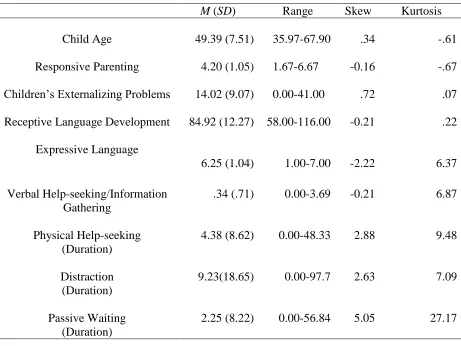
27 Table 1
Means, Standard Deviations, Ranges, Skew, and Kurtosis for all Measures (n = 167)
M (SD) Range Skew Kurtosis
Child Age 49.39 (7.51) 35.97-67.90
0
.34
- .-.61
Responsive Parenting 04.20 (1.05) 01.67-6.6700 -0.16 -.67
Children‟s Externalizing Problems 14.02 (9.07) 00.00-41.000 0.72 -.07
Receptive Language Development
Expressive Language
84.92 (12.27) 58.00-116.00 -0.21 -.22
6.25 (1.04) 01.00-7.00 -2.22 6.37
Verbal Help-seeking/Information Gathering
00.34 (.71) 00.00-3.69 -0.21 6.87
Physical Help-seeking (Duration)
04.38 (8.62) 00.00-48.33 2.88 9.48
Distraction (Duration)
09.23(18.65) 0.00-97.7 2.63 7.09
Passive Waiting (Duration)
02.25 (8.22) 00.00-56.84 5.05 27.17
Results
Data analytic plan
The first step in analyzing the data was to compute a set of preliminary analyses to
evaluate the data for univariate skew, multivariate skew, missing data, and outliers. In addition,
means, standard deviations, and ranges were examined for all constructs to ensure that all
variables have scores within the expected ranges. Although gender and age were not expected to
be related to study constructs, the effect of these potential confounds was empirically evaluated.
Next, study hypotheses were tested using linear regression. Correlations among study constructs
28
expected to be statistically significantly and negatively related to children‟s externalizing
problems and statistically significantly and positively related to children‟s emotion regulation
and language skill. Given a statistically significant correlation between responsive parenting and
externalizing problems, regression equations were used to empirically test for mediation.
Specifically, both language and emotion regulation scores were expected to mediate the
relationship between responsive parenting and children‟s externalizing problems. The following
section first describes the results of the preliminary data analysis, followed by a discussion of the
hypothesis testing.
Preliminary Data Analyses
Means, standard deviations, ranges, levels of skew, and levels of kurtosis are reported in
Table 1. Responsive parenting met assumptions of normality. While child receptive language
development had acceptable levels of skew, one univariant outlier emerged (i.e., a score of 40 on
receptive language). However, the results did not differ when the outlier was included or
excluded. In order to maximize sample size, the outlier was included in analyses. The emotion
regulation strategies did not meet normality assumptions, which is not surprising given the
manner in which these strategies were coded. Traditional coding methods typically use global
ratings which have a predefined range (i.e., 1 to 7) and measure how much a specific code
characterizes an individual or activity. In contrast, event or duration codes measure the frequency
of actual observed behavior or the amount of time an individual was engaged in a specific act.
Since behaviors are rare events, individual differences in the occurrence of specific behaviors or
actions are preserved. However, one drawback of event and duration coding is that the scores are
likely to be skewed and kurtotic. In the present study, passive waiting had unacceptable levels of
29
the interpretability of the scores, no transformation was performed Externalizing problems were
found to have acceptable levels of skew and kurtosis. Finally, five cases were found to have
multivariate skew. Analyses were computed with and without these cases and results did not
change; consequently, the five cases were retained in the sample.
Due to the fact that duration scores for emotion regulation (Physical Help-Seeking,
Distraction, and Passive Waiting) did not meet assumptions of normality, two separate set of
analyses were completed. The first set of analyses used the duration scores. In an alternative set
of analyses, the scores for Physical Help-Seeking, Distraction, and Passive Waiting were
dichotomized where a score of zero indicated that score was not used and a score of one meant
the score was used. Correlations between dichotomized variables emotion regulation variables
and other study constructs can be found in Table 2. Using the dichotomized variables did not
change results. Therefore, the following reported analyses were done with the duration scores for
all emotion regulation variables.
Effects of Children’s Age and Gender
The effects of age were examined by correlating children‟s age with all study constructs.
Two statistically significant associations emerged, age was significantly correlated with physical
help-seeking (r = -.25, p < .01) and receptive language development (r = .23, p < .01). Since age
was significantly correlated with two study constructs, regression analyses were computed in two
ways, both controlling for age and not controlling for age. Controlling for children‟s age did not
change the results of the regression equations and the results presented do not include age as a
statistical control. Gender effects were evaluating by computing a series of t-tests to evaluate
whether the means for boys and girls were significantly different from one another. Of the six
30
significantly higher for girls (M = 4.50; SD = 0.99) and than for boys (M = 3.83, SD = 1.00); t
[160] = -4.24, p < .01). Analyses were computed in two ways, one in which gender was included
as a control and one in which gender was not included as a statistical control. No differences in
the results of the regression equations emerged. Since gender differences were not hypothesized
and were not the focus of the study, final analyses do not control for gender.
Correlational Analyses
Before testing the hypotheses with linear regression, bivariate correlations were
computed among study constructs to evaluate the pattern of associations. Results of these
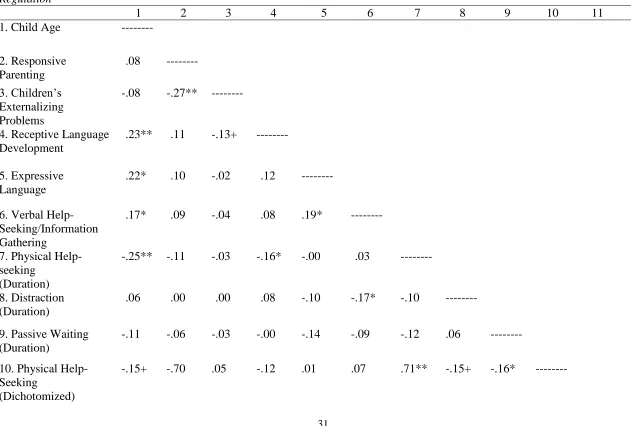
correlations are presented in Table 2. Consistent with expectations, responsive parenting and
children‟s externalizing problems were significantly and negatively correlated (r = -.27, p < .01).
In contrast with expectations, responsive parenting and children‟s externalizing problems were
not significantly correlated with children‟s language or emotion regulation scores. The lack of
statistical significance among the parenting and externalizing behavior scores and the language
and emotion regulation scores reduces the likelihood that language or emotion regulation skill
31 Table 2
Correlations among Child’s Age, Responsive Parenting, Children’s Externalizing Problems, Language Development and Emotion Regulation
1 2 3 4 5 6 7 8 9 10 11 12
1. Child Age ---
2. Responsive Parenting
-.08 ---
3. Children‟s Externalizing Problems
-.08 -.27** ---
4. Receptive Language Development
-.23** -.11 -.13+ ---
5. Expressive Language
-.22* -.10 -.02 -.12 ---
6. Verbal Help-Seeking/Information Gathering
-.17* -.09 -.04 -.08 .19* ---
7. Physical Help-seeking
(Duration)
-.25** -.11 -.03 -.16* -.00 -.03 ---
8. Distraction (Duration)
-.06 -.00 -.00 -.08 -.10 -.17* -.10 ---
9. Passive Waiting (Duration)
-.11 -.06 -.03 -.00 -.14 -.09 -.12 .06 ---
10. Physical Help-Seeking
(Dichotomized)
32 11. Distraction
(Dichotomized)
-.06 -.03 .01 -.04 -.12 -.06 .04 .63** .06 -.01 ---
12. Passive Waiting (Dichotomized)
-.07 -.06 .10 -.01 -.16+ -.07 -.15 .27** .74** -.19* .11 ---
33 Hypothesis Testing: Linear Regression Analyses
The methods of Baron and Kenny (1986) were used to empirically evaluate whether
children‟s language and emotion regulation skill mediated the association between responsive
parenting and externalizing problems. Consistent with this procedure, mediation is tested by
computing four linear regressions and four conditions must be met. First, the relationship
between independent variable (responsive parenting) and the outcome variable (externalizing
problems) must be established with a statistically significant linear regression. Next, a
statistically significant relationship between the independent variable (responsive parenting) and
the mediators (receptive language development and emotion regulation) must be demonstrated,
as indicated with statistically significant beta coefficients. In the third step, a statistically
significant relationship between the mediators (receptive language development and emotion
regulation) and the outcome variable (externalizing problems) must be demonstrated, as
indicated with statistically significant beta coefficients. If the first three conditions are met, a
fourth linear regression is computed estimating the amount of variance associated with outcome
variable (externalizing problems) that the independent variable (responsive parenting) explains
once the mediator is statistically controlled. Full mediation occurs when the beta coefficient
associated with independent variable (responsive parenting) is no longer statistically significant
once the variance associated with the mediators has been estimated. Partial mediation occurs
when the strength of the beta coefficient associated with independent variable (responsive
parenting) has been decreased but remains statistically significant after the variance associated
with the mediator has been estimated. Additionally, following the methods of Holmbeck (2002)
further testing of mediation was planned by conducting a Sobel test. This test measures whether
34
dependent variable. Receptive language development and emotion regulation were examined
separately. Results of regression analyses can be found in Tables 3 and 4.
Step 1: Establishing the statistical relationship between responsive parenting and
externalizing problems. In order to establish the basis for mediation, a linear regression was
computed in which children‟s externalizing problems was regressed onto responsive parenting.
The beta coefficient associated with responsive parenting was statistically significant and
negative (see Table 2; β = -.27, p <.01). Responsive parenting explained 7.5% of the variance
associated with children‟s externalizing problems.
Hypothesis 1: Language skill mediates the association between responsive parenting and
children’s externalizing problems. Since higher levels of responsive parenting were associated
with significantly fewer externalizing problems, the next step was to evaluate whether receptive
language skills explained this association. First, children‟s receptive language was regressed onto
responsive parenting; the beta associated with responsive parenting was not statistically
significant (see Table 2; β = .11). Although mediation was not possible without a statistically
significant association between responsive parenting and children‟s receptive language
development, the possibility that language skills explained unique portions of the variance
associated with externalizing behaviors was considered. In this second step, externalizing
behavior scores were regressed onto children‟s receptive language. In this regression equation, a
trend towards statistical significance emerged such that the beta coefficient associated with
receptive language skills was marginally significant (see Table 2; β = -.13, p < .10). The lack of
statistical significance indicated that receptive language skills did not mediate the relationship
between responsive parenting and children‟s externalizing problems, thus further steps were not
35
Hypothesis 2: Emotion regulation mediates the association between responsive parenting
and externalizing problems. Given the statistically significant relationship between responsive
parenting and children‟s externalizing problems, the possibility that children‟s emotion
regulation mediated the association between responsive parenting and children‟s externalizing
problems was evaluated next. Each emotion regulation strategy was estimated separately in
relation to responsive parenting and children‟s externalizing problems using the methods
previously described. In the first step to demonstrate mediation, each emotion regulation strategy
was regressed onto responsive parenting. In the second step, children‟s externalizing problems
were regressed onto each emotion regulation strategy. Results are presented separately for each
strategy. Results of the linear regressions are also presented in Tables 3 and 4.
Verbal seeking/Information gathering. First, children‟s use of verbal
help-seeking/information gathering was regressed onto responsive parenting. Contrary to study
hypotheses, no statistically significant relationship was found between responsive parenting and
children‟s use of verbal help-seeking/information gathering (see Table 2; β = .09). Although
mediation was not possible, the relationship between children‟s use of verbal
help-seeking/information gathering and children‟s externalizing problems was considered next. In
this second step, children‟s externalizing problems was regressed on children‟s use of verbal
help-seeking/information gathering. No relationship was found between children‟s use of verbal
helpseeking/information gathering and children‟s externalizing problems, (see Table 2; β =
-.04). Due the non-significant relationships, further analyses were not computed to test for
mediation.
Physical help-seeking. Next, the role of physical help-seeking was evaluated as a possible