44
The Acute Effects of Foam Rolling on Ankle and Knee Range of
Motion, Hamstring Flexibility, Agility, and Vertical Jump Height
Carley J. Henning1, Olivia Stovern1, John P. Porcari1, Blaine E. Arney1, Scott Doberstein1, Kari Emineth1, Carl Foster1 1Department of Exercise and Sport Science, University of Wisconsin-La Crosse, La Crosse, WI, USA
Abstract
Introduction: Foam rolling (FR) has become a very popular modality to provide self-myofascial release.
FR is often used during the warm-up period or cool-down period and can purportedly improve range of motion (ROM), flexibility, and a variety of performance measures. Purpose: This study evaluated the acute effects of FR on ankle and knee ROM, hamstring flexibility, agility, and vertical jump height.
Methods: Nineteen subjects (8 male, 11 female) completed a 15-minute FR session and a control
condition (sitting quietly), on two separate days. Pre and post-testing evaluation included ankle dorsiflexion ROM, knee flexion ROM, a sit-and-reach test to assess hamstring flexibility, agility, and vertical jump height. Subjects also filled out a perceived benefits questionnaire. Results: There were no statistically significant differences for any of the criterion measures (p<.05), although knee ROM (p=.08) and hamstring flexibility (p=.07) approached significance. Subjectively subjects felt that FR increased ROM at the ankle and knee and improved their flexibility. Conclusions: FR, as conducted in this study, did not provide any physiologic benefit when used as a warm-up modality. However, FR may provide some psychological benefit as subjects perceived it to be beneficial.
Key Words: Self-Myofascial Release, Warm-up, Cool-down
Introduction
Moshé Feldenkrais reportedly created the foam roller (FR) in the early 1970s1.
Feldenkrais is widely known for the
Feldenkrais method, which aims to reduce
pain, increase mobility, and improve physical function through awareness of one’s own body1. In 1987, a physical therapist and
student of Feldenkrais, Sean Gallagher, began
to use a FR as a self-massage modality1. Since
that time, FRs have become increasingly popular for self-myofascial release (SMR), which is listed 14th on the list of Top 20 Worldwide Fitness Trends for 20192.
45
also be used as a rehabilitative device. An individual places the FR under tender or stiff areas of the body and rolls back and forth, using their body weight to exert pressure on those body parts. The friction generated between the tissue and the FR causes warming of the fascia. This increase in temperature causes the tissue to become more fluid-like (known as thixotropic property), which purportedly reduces adhesions and scar tissue3. At a cellular and
physiological level, FR has been shown to alleviate arterial stiffness, improve vascular endothelial function, and increase blood flow4. It is also reported that FR can correct
muscular imbalances, alleviate muscle soreness, relieve joint stress, improve neuromuscular efficiency, and increase range of motion (ROM)5.
A number of studies have investigated the acute effects of FR. However, the results are inconclusive. Su and colleagues6 compared
the acute effects of FR, static stretching, and dynamic stretching during warm-up on flexibility and strength in young adults. They found that FR increased flexibility of the quadriceps and hamstrings to a greater degree than either static or dynamic stretching, and also increased isokinetic knee extension strength. MacDonald et al.3 also
investigated the acute effects of FR before physical activity. It was found that FR resulted in significant increases in knee joint ROM at 2 (10%) and 10 (8%) minutes post-FR, respectively. Another study by MacDonald et al.5 examined the effects of FR as a recovery
tool after an intense bout of physical activity. They concluded that FR was beneficial for decreasing muscle soreness, while at the
same time improving vertical jump height, muscle activation, and passive and dynamic ROM. Couture, Karlik, Glass, and Hatzel7
studied the effect of FR duration on hamstring ROM. They found no significant differences between baseline knee extension ROM and the ROM after either short (2 sets of 10 seconds) or long (4 sets of 30 seconds) FR sessions. Škarabot, Beardsley, and Štirn8
compared the effects of FR and static stretching on ankle dorsiflexion ROM in adolescent athletes. Subjects were randomized into one of three conditions: FR, static stretching, or static stretch plus FR. They found that static stretching increased ROM by 6.2% and FR plus static stretching increased ROM by 9.1%. However, there were no increases in ROM with FR alone.
Because the results of previous studies are inconclusive, the purpose of this study was to investigate the acute effects of FR on ankle and knee ROM, hamstring flexibility, agility, and vertical jump height.
Methods
Participants
46
provided written informed consent before undergoing any testing or training procedures. The protocol was approved by the University of Wisconsin-La Crosse Institutional Review Board for the Protection of Human Subjects.
Procedures
All subjects attended an initial orientation session where the purpose and procedures of the study were explained. At this session, subjects practiced all of the tests that were to be administered as part of the study. On the first testing day, height was measured using a wall-mounted stadiometer and body weight was assessed using a Rice Lake 150-10-7 Floor Level Digital Scale (The Rice Lake Weighing System, Rice Lake, WI). Subjects completed a 5-minute warm-up on a Schwinn Airdyne (Nautilus Inc., Vancouver, WA) bike at a self-selected speed. Following the warm-up, subjects were immediately assessed for ankle and knee ROM, hamstring flexibility, vertical jump height, and agility. All the tests were administered in the order listed above and the order was the same for all subjects.
Ankle dorsiflexion and knee flexion, on the right leg, were measured using a Medigauge 900105 Dual-scale Electronic Digital Goniometer (Taylor Toolworks LLC, Columbia, MO). To measure ankle dorsiflexion, subjects sat on a table in an upright position with their legs straight, while their ankles were off the edge of the table. Subjects were instructed to dorsiflex their ankle as far back as possible. Measurements were taken when they could not go any further. The test was performed three times and the two closest measurements were averaged and used for
data analysis. To measure knee flexion, subjects laid in a prone position with their knees at the edge of the table. The subjects were instructed to flex their knee as far back as possible. Measurements were taken when they could not go any further. The test was performed three times and the closest two measurements were averaged for data analysis.
Flexibility of the hamstrings was measured using a sit-and-reach test. Subjects removed their shoes and sat with their hips against a wall, legs extended straight out in front of them, with their feet flat against the sit-and-reach box (Novel Products Inc., Addison, IL). The subject slowly reached forward as far as possible with their hands stacked on top of each other. Instructions were given to not lead with one hand or use jerky movements in an attempt to reach further. The investigator placed her hands on the subject’s knees to ensure the legs did not bend or leave the ground during the reach9. The test was
performed three times and the average of the two closest measurements was used in the data analysis.
47
jump. The two closest measurements were averaged and used for data analysis.
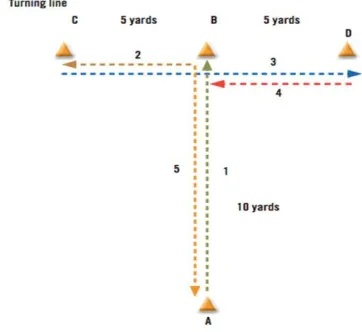
Agility was measured using a T-test10, which
includes forward, lateral, and backward movements (See Figure 1). Cones were set up at each point. Subjects were told to start behind the first cone. Subjects would sprint from cone A to cone B, side step from cone B to cone C, side step from cone C to cone D, side step from cone D to cone B, and backpedal from cone D to cone A, all as fast as possible. The subjects were told to touch each cone and were advised to not cross their feet when sidestepping. Timing was measured using an Accusplit 740mx Turbo stopwatch triggered by an IRD Wire (Brower Timing Systems, Draper, UT). The test was performed three times with a 2-minute rest period between trials. The average of the two closest times was used for data analysis.
Figure 1. T-test testing pattern.
Following the pre-testing, subjects performed a FR session or the control condition. The two conditions were held on different days, separated by at least 48 hours. For the FR
condition, subjects participated in an instructor-led FR session for 15 minutes. The foam roller used during this study was a 5.5” x 13” GRID foam roller (TriggerPoint, Durham, NC). Prior to performing the FR condition, subjects were given specific instructions on how to foam roll each body part and were given time to practice. All of the subjects had previous experience using FR. Subjects then foam rolled their lower back, bilateral gluteus maximus, quadriceps, hamstrings, calves, and iliotibial band. Each body part was foam rolled for 20 seconds. The entire sequence was repeated three times. For the control condition, subjects were instructed to sit quietly in a chair for 15 minutes. After each condition was completed, subjects performed the same tests as were administered during the pre-test. Additionally, subjects in the FR condition were asked to fill out a Perceived Performance Improvement Questionnaire that consisted of the six questions listed in Table 3.
Statistical analyses
Differences in age, height, and weight were compared between males and females using independent samples t-tests. A two-way (pre-post x condition) ANOVA with repeated measures was used to determine differences for each variable between conditions (FR vs. sitting quietly). Significance was set at p<0.05 to achieve statistical significance. All analyses were conducted using the Statistical Package for the Social Sciences (SPSS, Version 25; SPSS Inc., Chicago, IL).
Results
48
subject did not complete the study due to an unrelated illness. Descriptive characteristics of the subjects who completed the study, subdivided by gender, are presented in Table
1. Males and females were similar in age, but the males were significantly taller and weighed more than the females.
Table 1. Descriptive characteristics of subjects (N=19).
Males (n=8) Females (n=11)
Age (yrs) 21.5 ± 1.77 20.2 ± 1.54
Height (cm) 179.4 ± 2.69 165.6 ± 6.64*
Weight (kg) 81.9 ± 8.13 64.0 ± 7.64*
Values represent mean ± standard deviations. *Significantly different than males (p<.05).
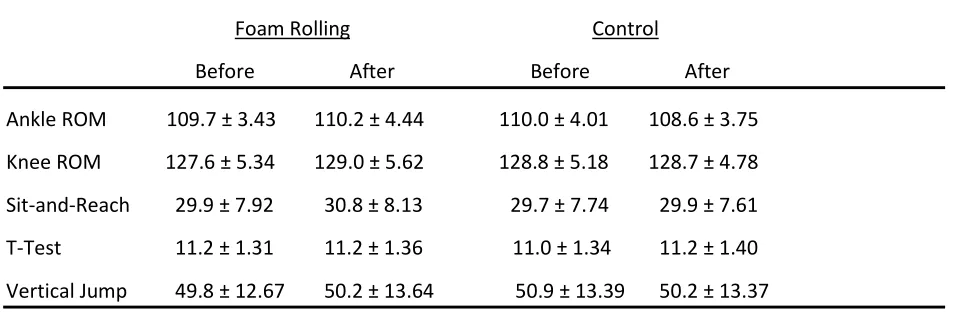
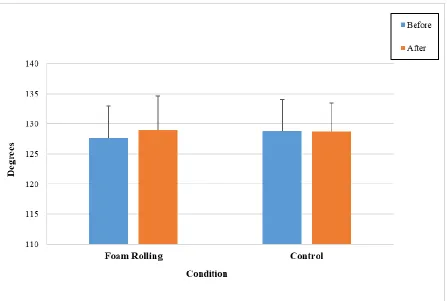
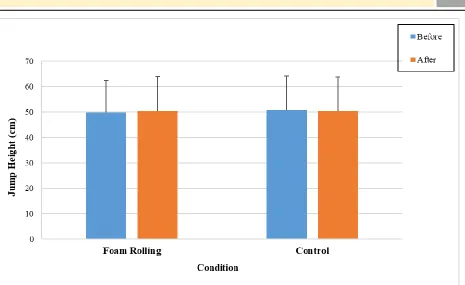
There were no significant differences in the responses between males and females, thus data were collapsed across gender. Aggregate data are presented in Table 2 and Figures 2 through 6, respectively. There were no significant differences in ankle and knee
ROM, sit-and-reach scores, agility, or vertical jump height consequent to either condition. However, the between group comparison for knee ROM (p=.08) and sit-and-reach (p=.07) both approached statistical significance.
Table 2. Difference before and after an acute bout of foam rolling.
Foam Rolling Control
Before After Before After
Ankle ROM 109.7 ± 3.43 110.2 ± 4.44 110.0 ± 4.01 108.6 ± 3.75
Knee ROM 127.6 ± 5.34 129.0 ± 5.62 128.8 ± 5.18 128.7 ± 4.78
Sit-and-Reach 29.9 ± 7.92 30.8 ± 8.13 29.7 ± 7.74 29.9 ± 7.61
T-Test 11.2 ± 1.31 11.2 ± 1.36 11.0 ± 1.34 11.2 ± 1.40
49
Figure 2. Ankle dorsiflexion range of motion before and after foam rolling vs. sitting quietly (control).
50
Figure 4. Sit-and-reach scores before and after foam rolling vs. sitting quietly (control).
51
Figure 6. Vertical jump height before and after foam rolling vs. sitting quietly (control).
Answers to the Perceived Performance Improvement Questionnaire are presented in Table 3. Following the FR condition,
subjects felt more flexible and felt like they had greater ROM in their ankles and knees.
Table 3. Questionnaire responses after a single session of foam rolling.
Yes No
I feel more flexible 16 3
I feel more agile (T-test) 7 12
I feel like I have more ROM in my ankle 15 4
I feel like I have more ROM in my knee 15 4
I feel stronger 7 12
I feel like I can jump higher 7 12
Discussion
The purpose of this study was to evaluate the acute effects of FR on ankle and knee ROM, hamstring flexibility, agility, and vertical jump
52
hamstring flexibility to improve, however the improvement did not reach statistical significance when compared to the control condition.
Our results are in agreement with a number of studies that found no statistical differences in ankle or knee ROM following FR. Škarabot, Beardsley, and Štirn8 found no difference in
ankle ROM following a 30-second session of FR to the calf region. However, they did find an increase in ankle ROM when FR was combined with a static stretching protocol. Similarly, Macgregor, Fairweather, Bennett, and Hunter11 found no improvement in knee
flexion ROM immediately, 15 minutes, or 30 minutes after a FR training session.
In contrast to the findings of the present study, a study by MacDonald et al.3 did find
that FR significantly increased knee ROM 2 minutes (10%) and 10 minutes (8%), post-intervention. Differences between the current study and those of MacDonald et al. may be because researchers passively flexed the subject’s knee to the point of discomfort when making their measurements. It is unknown how much pressure the researchers exerted when flexing the knee. The current study had subjects actively perform knee flexion as far as possible, without researchers making contact with the subject. The duration of FR may also have affected results. Subjects in the study by MacDonald et al. completed two, 60-second sessions of FR for each body part, whereas the current study had subjects perform three, 20-second sessions of FR per body part. Su et al.6 also reported an increase
in knee ROM following a combined dynamic stretching and FR protocol. Knee flexion angle
was measured using a modified Thomas test, whereby researchers again passively flexed the subject’s knee to the point of discomfort.
Even though there was a tendency for hamstring flexibility to increase in the current study, it was not significant. Several other studies assessed hamstring flexibility and concluded that SMR using a FR had no beneficial effect on hamstring flexibility7,12. It
should also be noted that the study by Couture et al.7 compared varied durations of
FR treatments on hamstring flexibility. There were no significant differences following either short (2 sets of 10s) or long (4 sets of 30s) bouts of FR. In contrast to the findings of the current study, several studies did find significant improvements in hamstring flexibility. Su et al.6 found an increase in
hamstring flexibility assessed using a sit-and-reach test. The difference between that study and the present study could be due to the fact subjects rolled the localized muscle groups (hamstring and quadriceps) for a longer duration than the current study (30 seconds vs. 20 seconds). MacDonald et al.5
also found significant improvements in passive hamstring flexibility following FR. Once again, these differences could be due to methodological differences between studies. MacDonald et al.5 used straps and braces to
stabilize the subject while the investigator passively flexed the hip for the subject, and subjects completed longer FR sessions than the current study (i.e., two, 60-second repetitions vs. three, 20-second repetitions). Peacock et al.13 examined the potential
53
was used in conjunction with a dynamic warm-up, versus a dynamic warm-up alone.
We found no changes in agility, as assessed by the T-test. Agility was assessed in a study by Healey et al.14 using a 5-10-5 yard shuttle
run. There were no improvements in agility following either FR or planking interventions. In contrast, Peacock et al.13 did find significant
improvements in agility, using both an 18.3-meter pro-agility test and a 37-18.3-meter sprint test. It is possible that the type of subjects used could have influenced test results. That study included only males who were currently competing or competed in division I and II athletics. Subjects in the current study were not competitive athletes and were only required to be recreationally active.
The current study also failed to find improvements in vertical jump height. Healey et al.14 and Abels15 also assessed vertical jump
height and failed to find significant improvements in jump height after an acute bout of FR. However, three studies did find significant increases in vertical jump height consequent to FR interventions5,13,16. The
difference in results between studies could be due to a number of factors. The study by Stewart16 may have found differences due to
the type of foam roller used. They used a more rigid foam roller than was used in the current study and previous research has shown that a more rigid foam roller may provide a greater degree of myofascial release17. The study by Peacock et al.13
measured vertical jump height using a Vertec device. Subjects jumped up and reached as far as they could with their dominant hand to tap the vanes. The current study used a force
plate and had subjects perform a countermovement movement with their arms, which had them reach up with both hands, eliminating the possible dominance of one side of the body.
There were several limitations of the current study, and to studies on FR in general, which could influence conclusions regarding the benefits of FR. The duration of FR used in the current study may have been a limitation compared to other studies. The present study had subjects foam roll each muscle group for 20 seconds, which was repeated three times. Studies which saw improvements typically used longer rolling times. In many studies which saw benefits, the ROM measurements were made while the researchers passively moved the joint into position before measurements were made. In the current study, subjects actively flexed the joint as far as possible prior to the measurement being made. Many of the studies, including the current study, had subjects perform an active warm-up of some sort prior to making the pretesting measurements. Whether this affected the results is difficult to determine. Typically, individuals do not utilize an active warm up (e.g., riding a stationary cycle) prior performing FR.
Conclusions
54
negatively affect performance and may be beneficial from a psychological aspect. Anecdotally, subjects enjoyed FR and felt as though it was beneficial. As FR becomes increasingly popular in the fitness industry, additional studies are needed to explore the potential benefits of using a FR for SMR. Future research may want to standardize testing methodology prior to evaluating different FR protocols (i.e., how long to FR each body part, number of repetitions for each body part, etc.) in order to determine the true benefits of FR.
Disclosures
This study was funded by the American Council on Exercise (ACE). However, ACE was not involved in the design of this study, collection or analysis of the data, or the preparation of this manuscript.
Address for Correspondence
John Porcari, Ph.D., Department of Exercise and Sport Science, 141 Mitchell Hall, University of Wisconsin- La Crosse, La Crosse, WI, United States, 54601. Phone: 608-785-8684; Email: [email protected].
References
1. Heffernan C. (2016). The history of the foam roller. Retrieved by:
https://physicalculturestudy.com/2016/02/02/the-history-of-the-foam-roller/
2. Thompson WR. (2018). Worldwide survey of fitness trends for 2019. ACSMs Health Fit J, 22, 10-17.
3. MacDonald GZ, Penney MDH, Mullaley ME, Cuconato AL, Drake CDJ, Behm DG, Button DC. (2013). An acute bout of self-myofascial release increases range of motion without a subsequent decrease in muscle activation or force. J
Strength Cond Res, 27, 812-821.
4. Okamoto T, Masuhara M, Ikuta K. (2014). Acute effects of self-myofascial release using a foam roller on arterial function. J Strength Cond Res, 28, 69-73.
5. MacDonald GZ, Button DC, Drinkwater EJ, Behm DG. (2014). Foam rolling as a recovery tool after an intense bout of physical activity. Med Sci Sports Exerc, 46, 131-142. 6. Su H, Nai-Jen C, Wen-Lan W, Lan-Yuen G, I-Hua C. (2017). Acute effects of foam rolling, static stretching, and dynamic stretching during warm-ups on muscular flexibility and strength in young adults. J Sport Rehabil, 26, 469-477.
7. Couture G, Karlik D, Glass SC, Hatzel BM. (2015). The effect of foam rolling duration on hamstring ROM. Open Orthop
J, 9, 450-455.
8. Škarabot J, Beardsley C, Štirn I. (2015). Comparing the effects of self‐myofascial release with static stretching on ankle range‐of‐motion in adolescent athletes. Int J Sports
Phys Ther, 10, 203.
9. Riebe, D. (2017). ACSM’s Guidelines for Exercise Testing
and Prescription (10th ed). Philadelphia, PA:
Wolters-Kluwer.
10. American Council on Exercise. (2014). T-test. Retrieved from:
https://www.acefitness.org/ptresources/pdfs/TestingProt ocols/T-Test.pdf
11. Macgregor L, Fairweather M, Bennett R, Hunter A. (2018). The effect of foam rolling for three consecutive days on muscular efficiency and range of motion. Sports Med, 4, 26. 12. Morton R, Oikawa S, Phillips S, Devries M, Mitchell C.
(2015). Self-myofascial release does not improve functional outcomes in ‘tight’ hamstrings. Int J Sports
Physiol Perform, 11, 658-663.
13. Peacock C, Krein D, Silver T, Sanders G, von Carlowitz KP. (2014). An acute bout of self-myofascial release in the form of foam rolling improves performance testing. Int J
Exerc Sci, 7, 202-211.
14. Healey KC, Hatfield DL, Blanpied P, Dorfman LR, Riebe D. (2013). The effects of myofascial release with foam rolling on performance. J Strength Cond Res, 28, 61-68.
15. Abels K. (2013). The impact of foam rolling on explosive strength and excitability of the motor neuron pool. The University of Texas at Austin.
16. Stewart CJ. (2016). The acute effect of self-myofascial release on the counter movement jump. St. Mary’s University-Twickenham, London.
17. Curran PF, Fiore RD, Crisco JJ. (2008). A comparison of the pressure exerted on soft tissue by 2 myofascial rollers. J