of peer-reviewed research and commentary in the population sciences published by the Max Planck Institute for Demographic Research Konrad-Zuse Str. 1, D-18057 Rostock · GERMANY www.demographic-research.org
DEMOGRAPHIC RESEARCH
VOLUME 22, ARTICLE 33, PAGES 1037-1056
PUBLISHED 08 JUNE 2010
http://www.demographic-research.org/Volumes/Vol22/33/ DOI: 10.4054/DemRes.2010.22.33
Research Article
Health and socio-demographic conditions as
determinants of marriage and social
mobility: Male partner choice in Sardinia,
late 19
th-early 20
thcenturies
Marco Breschi
Matteo Manfredini
Stanislao Mazzoni
This publication is part of the proposed Special Collection “Social Mobility and Demographic Behaviour: A Long-Term Perspective”, organized by Guest Editors Cameron Campbell, Jan Van Bavel, and Martin Dribe.
© 2010 Marco Breschi, Matteo Manfredini & Stanislao Mazzoni.
This open-access work is published under the terms of the Creative Commons Attribution NonCommercial License 2.0 Germany, which permits use, reproduction & distribution in any medium for non-commercial purposes, provided the original author(s) and source are given credit.
1 Introduction 1038
2 Sources and data 1039
3 A brief outline of Alghero 1041
4 Socioeconomic structure and social mobility in Alghero at the turn
of the 19th century 1043
5 Relationship between marriage, physical characteristics, and social
mobility: An individual analysis 1049
6 Conclusive remarks 1051
Research Article
Health and socio-demographic conditions
as determinants of marriage and social mobility:
Male partner choice in Sardinia, late 19
th-early 20
thcenturies
Marco Breschi1
Matteo Manfredini2
Stanislao Mazzoni3
Abstract
This paper makes use of data collected from military registers and marriage certificates for the population of Alghero, in Sardinia, for the period 1866-1925, with the aim of investigating the role played by physical characteristics and health in the possibility of social mobility through marriage.
Our findings demonstrate that, whereas physical defects and ill health had little impact on the chances of marrying an illiterate woman, these factors did have a negative effect on the chances of marrying a woman who was literate. In a context in which intergenerational social mobility remained limited and the family had the final say on marriage arrangements, it is likely that only healthy individuals were selected for marriages regarded as strategic for the purposes of forming and strengthening family alliances, and/or improving the social position within the community.
1 Department of Economics, University of Sassari. E-mail: [email protected]
1. Introduction
The selection of a mate is a behavioural process that involves both socioeconomic factors and physical elements. In evolutionary and adaptive terms, this choice is driven by the desire to maximise reproductive success and ensure the good health of future generations (Epstein and Guttman 1984). As many studies have shown, somatic traits play an important role in this choice, and may include facial beauty and symmetry (Cornwell et al. 2006; Thornhill and Gangestad 1993), height (Cavelaars et al. 2000; Silventoinen 2003), colour of hair and eyes (Frost 2006; Swami, Furnham, and Joshi 2008), and skin tone (Frost 1994; Aoki 2002). It follows that unhealthy individuals, especially those with evident signs of ill health, should have the lowest chances of marriage, and thus of reproduction.
However, physical appearance, beauty, and manifest signs of illness and well-being can also be seen as closely associated with socioeconomic status (SES). Therefore, from a theoretical point of view, both SES and physical attractiveness should concur in partner choice. In other words, people tend to choose spouses whose physical appearance and social status portray and evoke the capacity to provide sufficient economic support to family members, thereby guaranteeing their good health and standards of living. The two physical characteristics most frequently and directly associated with these are height (Alter, Neven, and Oris 2004; Murray 1997; Steckel 2005) and body mass (Whaples 1995). In other words, the investment in marriages likely to guarantee healthy progeny could be considered strategic for various reasons, depending on the family. The rich used marriage as a means of creating new and/or reinforcing old family networks, whereas the poor relied on robust and strong male descendants to farm the land and secure future agricultural contracts.
consideration in marriage strategies. Physical features, such as strength, vigour, and the absence of any manifest defects, are likely to have been regarded as qualities that would ensure the production of numerous and healthy heirs. On the other hand, marriage criteria for the lower classes were more closely connected to somatic traits such as eye and hair colour, which are not directly associated with socioeconomic conditions.
These issues raise an additional question regarding marriage choice. If physical characteristics, such as stature and general state of health, were determinants of marriage choices of historical populations, did they also affect the chances of social mobility upon marriage? Is it possible that these elements represented a means of ascending the social ladder? Our hypothesis is that unhealthy individuals, when not totally excluded from marriage, were sometimes persuaded by the family to marry down. In turn, we also argue that only healthy contenders were proposed for marriages that the family deemed strategic for the purposes of forming alliances and gaining social position within the community.
The aim of this paper is to study the determinants of partner choice based on an analysis of data recorded in the military registers on the late 19th-century male population of Alghero, Sardinia (Italy), with the intention of clarifying whether physical characteristics and general health were determinant elements in promoting social mobility upon marriage.
This paper is a revised and updated version of the paper presented at the IUSSP Seminar on Social Mobility and Demographic Behaviour: A Long Term Perspective, held in Los Angeles in 2008. The paper is divided into four parts. The first provides a description of our sources and data, while the second gives a brief outline of the community of Alghero. The third presents a number of descriptive analyses using military registers, with a specific focus on the degree of social mobility present in Alghero at the time. The fourth and final section is devoted to an individual-level analysis of the relationship between marriage, physical characteristics, and social mobility.
2. Sources and data
marriage by proxy through the education level of spouses. Information taken from civil registers was supplemented with entries from parish registers in order to include data on religious-only marriages.4
This information was then superimposed upon data taken from military registers concerning the birth cohorts 1856-19005. The drawing up of military registers was a
complex operation conducted by the responsible Military Office on the basis of data provided by the local Civil Registry Office6. First, the inscription list identified all
current 20-year-old resident males7 and men who had been absent for any reason from
the conscription lists of the previous year(s). Second, those who were called up had to undergo a medical examination, the outcome of which was reported in the various
conscription lists compiled by the army corps to which the men were assigned. While we were able to retrieve the medical records for those men destined to join the National Army, there is, unfortunately, a lack of such documentation on navy conscripts, who amounted to around 30% of inscriptions. This group consisted mainly of sons of fishermen and sailors, only a small fraction of whom went on to be enlisted in the army (8%, see Table 1). However, given that sailors and fishermen constituted a select group made up primarily of people originating from Naples—who are known to have displayed culturally specific behaviours, such as tendencies to enter into endogamous marriages and to isolate from the rest of the population (Mondardini Morelli 1988; Manfredini, Breschi, and Mazzoni 2010)—the absence of records for this group probably has little impact on the results in any case.
After undergoing a medical examination, each man was classified as “fit,” “unfit,” or “temporarily unfit” for military service (which meant having to undergo the exam again the following year). Despite having access to data on the medical examinations for the birth cohorts 1856-1900, our analysis concentrated on the period 1866-1885. The lower limit of 1866 was selected because data on SES, reasons for discharge, and the literacy levels of all conscripts are only available from that year onwards; while the upper limit of 1885 was selected because it is impossible to study the marriage behaviour of the adult population up to the age of 40 after that year. We also excluded
4 After 1866 it becomes essential to supplement the information taken from civil marriage certificates with
that from parish registers. In fact, in 1867, the new Italian Kingdom only considered civil marriages as legal. However, in keeping with long-standing traditions, many couples continued to marry in church, legalising their status some time after by re-marrying in the town hall. For a discussion on the consequences of such behaviour, see Breschi et al. (2008b). Here, again, we wish to emphasise the fact that it was the integration of these two sources that allowed us to reconstruct the entire picture of weddings celebrated in Alghero.
5 For a detailed description of the military registers of Alghero, see Cau, Merella, and Pozzi (2007). 6 Military lists and documentation of the Civil Registry Office come from the ‘Archivio Storico del Comune
di Alghero’ (Historical Archive of the Municipality of Alghero) and from the ‘Archivio di Stato di Sassari’ (Sassari State Archive).
the records regarding medical re-examination from our analysis in order to obtain homogeneous data on 20-year-olds.8
For the purposes of our investigation, the information concerning suitability for military service is one of the most important elements in the conscription lists, since the reasons for temporary or permanent discharge from military service often depended on ill health and/or particular physical characteristics, such as low stature. The criteria for being discharged and the age for conscription changed over time, and were certainly relaxed during important conflicts (see Cau, Merella, and Pozzi (2007) for changes in height restrictions).
Almost all the single military files record both the individual’s occupation at the moment of call-up, as well as that of his father. We grouped these occupations into four professional categories: farmers and shepherds; sailors and fishermen; tradesmen, artisans, and shopkeepers; and white collar workers and the bourgeoisie. Finally, another relevant piece of information reported in these military registers is the conscripts’ literacy skills, or their ability to read and write.
From a methodological point of view, we devised log-linear models to evaluate the degree of intergenerational social mobility in Alghero (Van Leeuwen and Maas 1991) and logistic regression models to measure the impact of physical characteristics and health status on the likelihood of marrying up or down.
3. A brief outline of Alghero
Alghero is a costal town in the north-western part of Sardinia. The 1861 Italian census shows that it is the second largest town in the province of Sassari, with 8,419 inhabitants, a figure which had risen to 12,510 by 1921.
The pattern that emerges from civic marriage records9 regarding male occupation
reflects the regional economic structure, with the addition of specifically sea-related activities, given Alghero’s coastal location (about 15%-20% of male spouses). At the turn of the 19th century, the Sardinian economy was based on agriculture,
sheep-8 Unfortunately, we are unable to comment on or investigate emigration, as our sources provide no
information on the subject. We excluded from our analysis individuals who could be assumed to be
emigrants. We classified individuals as emigrants if they were still unmarried at the age of 40, and if we could find no trace of any kind in Alghero’s civil records of them or of their close relatives. For a full discussion of this issue, see Manfredini, Breschi, and Mazzoni (2010).
9 The published censuses provide detailed information on occupation, education, etc. for the “Circondario”
farming (probably the most productive sector), and mining, which employed almost two-thirds of the male population. Farming was not intensive because of the island’s under-population, and was traditionally limited to olives, vines, fruits, cereals, and legumes. The cultivation and production techniques were extremely rudimentary, giving rise to poor yields and unprofitable produce. Land use was organised according to a long-standing, semi-feudal land tenure system that was still prevalent in the final decades of the 19th century. Farmers had especially low standards of living, and were
often obliged to supplement their modest earnings with additional activities, such as sheep-farming or handicrafts. The quality of these handicrafts was sufficient for domestic consumption only, while most external trading was controlled by outsiders resident on the island (Coda 1977).
Sardinia was also characterised by very low levels of education: even in 1881, more than 75% of the population over six years of age could neither read nor write. Accordingly, illiteracy proves to be a significant social component in Alghero during this period: almost half of the (civil) marriage certificates were not signed by either spouse, 26% were signed by one spouse only, and a mere 23% were signed by both. Although this indicator has some intrinsic limits, it does demonstrate the ineffectiveness of the various contemporary national laws regarding compulsory schooling in alleviating the pronounced cultural lag of the Sardinian population (Zamagni 2007).
In the pre-transitional period, Sardinia had some very unusual demographic characteristics. Despite being situated at the very heart of the Mediterranean, Sardinia is, paradoxically, the least “Mediterranean” of all the Italian regions. The population’s family formation system and reproductive behaviour patterns do not fit any of the models put forward by Laslett (1983; 1988) and Hajnal (1982). The Mediterranean model par excellence – i.e., joint patrilocal household with early female marriage and high fertility levels – is a far cry from the situation that prevailed in Sardinia, which was characterised by neo-locality and late marriage for both sexes, and thus strongly resembled models typical of north-western Europe (Viazzo 2003).
Unlike other regions, the demographic history of Sardinia remains somewhat unexplored. Nominative studies are practically non-existent, especially on the period prior to the 19th century. Our initial explorative analyses on the population of Alghero
depict a demographic system consistent with what we know on the regional scale (Livi Bacci 1977). Levels of both overall and marital fertility were notably low in this context compared to other continental Italian communities of the mid-19th century (Breschi et al. 2008b). A late and non-universal marriage associated with low levels of infant mortality were among the most important determinants of such fertility pattern.
differentials by SES, although this was apparent from civil marriage certificates only, and solely for the male population. The occupational category that was found to have the earliest access to marriage was that of sailors and fishermen (with a mean age of 26), especially in the case of marriage within the same group; and, conversely, the group with the highest age at first marriage was that of the bourgeoisie and white collar workers (32.4). Another important feature of the town’s marriage patterns was the modest exogamy rate. Between 1866 and 1925, a mere 7.6% of marriages involved one or both spouses who were not resident in Alghero, which is fairly surprising for a fishing port with a long-standing tradition of trade with mainland Italy and France. One possible reason for these high levels of endogamy may lie in the town’s relative geographical isolation. To the north it was protected by a desolate, marshy, and scarcely inhabited area called Nurra. The nearest community to the south was the village of Villanova Monteleone (25 km away, perched on a hill 567m above sea level), while the nearest community to the west was the small village of Olmedo, about 15 km away. Another significant factor is that Alghero was under Spanish rule for so long that it had become a Catalan cultural-linguistic enclave within Sardinia. Many local historians hold this cultural and socio-political peculiarity to be the main reason for the specificity and isolation of Alghero’s population.
4. Socioeconomic structure and social mobility in Alghero at the turn
of the 19
thcentury
The inscription lists record a total of 2,080 males born in Alghero between 1866 and 1885. Only 1,443 (69.4%) of these conscripts actually went on to be medically screened for the army, because 489 (23.5%) were enlisted in the navy (with a specific examination elsewhere), and 148 (7.1%) failed to report for assessment. Of those who underwent this medical check, around 35% were declared to be fit and were recruited immediately, 32.6% were declared to be temporarily unfit and were discharged for a year, and 32.4% were declared to be permanently unfit and were discharged for good (Table 1).
Table 1: Inscription list and conscription list of the Army National Service, with final statement of suitability for military service
by profession (%) – Birth cohorts 1866-85
Profession Inscription list Conscription list
N % Fit Temporarilyunfit
Permanently unfit N Farmer / Shepherd 1006 48.4 30.1 32.4 37.5 914 Sailor / Fisherman 364 17.5 31.0 31.0 37.9 29 Shopkeeper / Artisan 392 18.9 37.6 36.7 25.6 324 Bourgeoisie / Upper class 157 7.5 59.7 26.6 13.7 139
Unknown 161 7.7 43.2 24.3 32.4 37
Total 2080 100.0 35.0 32.6 32.4 1443
Table 2: Reasons for temporary or permanent discharge,
Birth cohorts 1866-85
Motive N %
Insufficient chest circumference 146 15.8
Eye disease 166 18.0
Insufficient height 369 40.1
Physical debilitation & malaria 166 18.0
Other health problems 73 7.9
Total 920 100.0
Source: Conscription list of the Army National Service
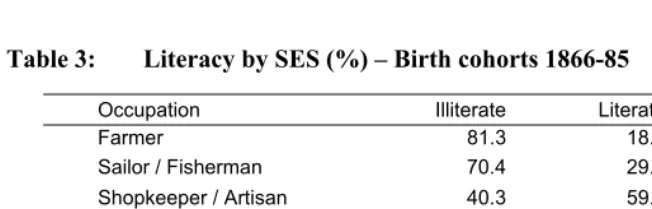
higher the social status, the lower the rate of illiteracy. Whereas only 18.7% of farmers could read and write, all those belonging to the upper class were fully literate.10
Table 3: Literacy by SES (%) – Birth cohorts 1866-85
Occupation Illiterate Literate N
Farmer 81.3 18.7 797
Sailor / Fisherman 70.4 29.6 27
Shopkeeper / Artisan 40.3 59.7 273
Bourgeoisie / Upper class 0.0 100.0 129
Unknown 63.2 36.8 19
Total 63.4 36.6 100.0
N 789 456 1245
Source: Conscription list of the Army National Service
Since the information on the bride’s SES in the marriage certificates is unreliable, we chose to analyse intergenerational social mobility. To be more precise, we used the professions of those called up for military service, as well as their fathers’ occupations, to assess the pattern of intergenerational social mobility in Alghero at the turn of the 19th century. The inscription list covered the entire population of 20-year-old males, but
to maximise the numbers for analysis, we broadened the cohort sample, from 1856 to 1891. Individuals whose personal occupation or whose father’s occupation was missing were excluded from the analysis.11 At first glance, the socioeconomic formation of
Alghero’s population appears to be rather immobile, with more than 80% of sons following in their father’s professional footsteps in the two cohort periods of 1856-73 and 1874-91 (Table 4). This can be considered an initial, rough indication that the socioeconomic fabric of this community had remained largely unchanged in the last intergenerational period.
10 We wish to clarify that the proportion of people involved in sea-related activities with literacy skills is
based on the few cases of those who actually joined the army. However, this figure (29.6%) is quite close to that based on the information recorded on marriage certificates for grooms from the same occupational group (27.4%).
11 These individuals account for about 11% of the total number recorded in the inscription list. This
Table 4: Intergenerational social mobility by son’s cohort, 1856-1891
Intergenerational occupational heterogamy
Cohort % N
1856-73 18.7 1530
1874-91 19.6 1615
Total 19.2 3145
Source: Military service inscription list.
Note: Only father/son couples with information on both
However, in order to arrive at a more detailed picture of social mobility, we devised a series of log-linear models to study the association between the son’s profession at age 20, and that of his father. One of the prerequisites of log-linear models is that socio-occupational categories need to be ordered to a scale. It would have been possible to determine this order from the literacy rate by SES as shown in Table 3, but we chose to use a variant of Goodman’s homogenous equal row and column effects model II. This is a log-linear model whose parameters are useful not only in ranking SES groups, but also in estimating the distances between them on the basis of off-diagonal elements only (Goodman 1979; Guveli and De Graaf 2007; Van Bavel, Peters, and Matthijs 1998)12. Table 5 presents the order and relative scores of the occupational classes resulting from this quasi-equal row and column model. The quite pronounced distances which emerge between them confirm our previous division into four occupational categories. As expected, the bourgeoisie was at the top of the social ladder, farmers were at the bottom, and those involved in sea-related activities13 and
artisans were in the middle.
The first log-linear model used was the so-called Independence model, which was also the foundation for our three next models. First we used our Inheritance model, which corrected for the usual excess of cases in the main diagonal cells. A further parameter was thus estimated in the assumption of equal social immobility across the groups. Then we employed the less restrictive Quasi-Independence model, which assumes that intergenerational social immobility varies across groups. And, finally, the
Quasi-Uniform Association model was applied to eliminate the constraint of independence between the fathers’ and the sons’ occupations for off-diagonal cells by
12 For a discussion of this model and its application to historical data, see Van Leeuwen and Maas (1991). 13 It is worth stressing that this analysis was based on the inscription list, thereby including the entire
presupposing their shared association. The degree of this association is assumed to be equal (uniform) across all social groups.
Table 5: Intergenerational social mobility by son’s cohort, 1856-1891. Adjusted scores of the relative positions of occupational classes
Occupational class Father’s and son’s profession at son’s marriage
Farmers -0.623
Sailors / Fishermen -0.251
Artisans 0.149 Bourgeoisie 0.725
Source: Military service inscription list.
Note: Only father/son couples with information on both
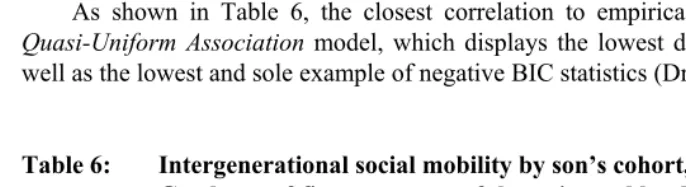
As shown in Table 6, the closest correlation to empirical data result from the
Quasi-Uniform Association model, which displays the lowest deviance value (G2), as
well as the lowest and sole example of negative BIC statistics (Dribe and Lundh 2005).
Table 6: Intergenerational social mobility by son’s cohort, 1856-1891. Goodness-of-fit parameters of the estimated log-linear models
Model Father’s and son’s profession at son’s marriage
G2 df BIC
Independence 3298.4 9 3225.9
Inheritance 219.9 8 155.5
Quasi-independence 79.5 5 39.2
Quasi-Uniform Association 18.9 4 -13.3
Source: Military service inscription list.
Note: Only father/son couples with information on both
and sailing activities undoubtedly played a key role in the local economy of Alghero, and were secure occupations passed down from father to son over many generations. The fact that the vast majority of these sailors came from outside Sardinia, in particular Naples, supports the hypothesis of a socially isolated and closed group inclined towards the preservation of its particular traditions and social role. We can also observe that the
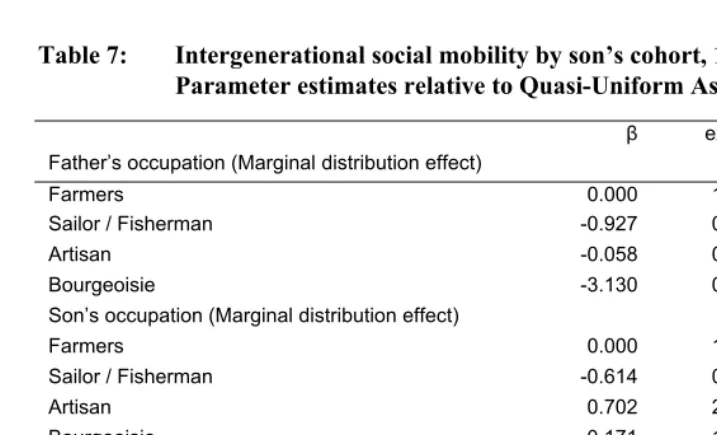
Uniform Association parameter differs significantly from zero, with a coefficient that indicates the increasing difficulty of changing socio-occupational class in proportion to the distance between them.
Table 7: Intergenerational social mobility by son’s cohort, 1856-1891. Parameter estimates relative to Quasi-Uniform Association model
β exp(β) p-value Father’s occupation (Marginal distribution effect)
Farmers 0.000 1.000
Sailor / Fisherman -0.927 0.396 0.000
Artisan -0.058 0.944 0.645
Bourgeoisie -3.130 0.044 0.000
Son’s occupation (Marginal distribution effect)
Farmers 0.000 1.000
Sailor / Fisherman -0.614 0.541 0.000
Artisan 0.702 2.017 0.000
Bourgeoisie 0.171 1.186 0.170
Social Immobility (Main diagonal effect)
Farmers 2.012 7.478 0.000
Sailor / Fisherman 3.215 24.903 0.000
Artisan 0.977 2.655 0.000
Bourgeoisie 1.365 3.914 0.000
Uniform association 1.001 2.720 0.000
n° of cases 3,145
Source: Military service inscription list.
5. Relationship between marriage, physical characteristics, and
social mobility: An individual analysis
In this section, we investigate whether certain negatively perceived physical characteristics (such as low stature) and ill health affected men’s chances of social mobility on marriage. More precisely, we are interested in knowing if such factors favoured downward social mobility, or, at the very least, blocked upward social mobility. In the case of families consenting to unhealthy and/or short men marrying, we wish to know if they were ever barred from access to marriages that were thought to represent upward social mobility, either from a social or an educational point of view. Equally, we wish to know whether tall and/or healthy people were given greater opportunities to improve their social position through marriage. Naturally, upward social mobility was limited for already wealthy individuals, who could at best hope to preserve the status quo by marrying a woman from the same class. Wealthy people could, however, face downward social mobility. Our hypothesis is that wealthy but unhealthy men would have been more likely to marry beneath them than their healthy counterparts.
Due to the impossibility of determining women’s SES from marriage certificates, we made use of spouses’ literacy levels as a proxy, based on the strong association between literacy and SES highlighted in Table 3. Marrying an illiterate woman is regarded as downward social mobility for wealthy men, and failed social advancement for the poor. Conversely, marrying a literate woman is considered upward social mobility for the poorest strata of the population, and as maintenance of social status for the richest.
In order to test this relationship, we devised logistic competing-risk models with the outcome of marriage to women who were either literate or illiterate. The dependent variable indicates whether a man who underwent a military medical examination at the age of 20 married an illiterate or an literate woman before the age of 40. We naturally excluded from our analysis cases in the military registers which lacked reference to health status – i.e., navy conscripts and those who failed to report for service – along with men who died while still unmarried before the age of 40. We devised two operative models for each alternative outcome: Model 1 looks at only the final assessment for suitability for military service, while Model 2 goes into more detail, taking the specific reasons for discharge into account.
suggests behaviour that entails a class-oriented partner choice, indicating that social homogamy in marriage was widely practiced within the upper class.
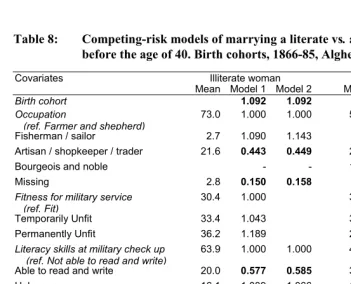
Whereas the chances of marrying an illiterate woman do not appear to have been affected by any differential risk by suitability for military service, ill health, and/or physical defects, these factors did have a marked influence on the chances of marrying a literate woman. In particular, men of a stature that was below the military standard, or who had symptoms of malaria (or physical debilitation), or who suffered from splenic cancers or other serious long-term health problems, were significantly less likely to marry a literate woman before the age of 40 than were individuals classed as fit for military service (47%, 36%, and 60% respectively).
Table 8: Competing-risk models of marrying a literate vs. an illiterate woman before the age of 40. Birth cohorts, 1866-85, Alghero
Covariates Illiterate woman Literate woman
Mean Model 1 Model 2 Mean Model 1 Model 2
Birth cohort 1.092 1.092 1.104 1.103
Occupation
(ref. Farmer and shepherd)
73.0 1.000 1.000 57.1 1.000 1.000
Fisherman / sailor 2.7 1.090 1.143 1.8 0.791 0.752 Artisan / shopkeeper / trader 21.6 0.443 0.449 26.5 0.839 0.789
Bourgeois and noble - - 12.0 0.311 0.295
Missing 2.8 0.150 0.158 2.6 0.216 0.199
Fitness for military service (ref. Fit)
30.4 1.000 39.1 1.000
Temporarily Unfit 33.4 1.043 33.5 0.732
Permanently Unfit 36.2 1.189 27.4 0.576
Literacy skills at military check up (ref. Not able to read and write)
63.9 1.000 1.000 49.1 1.000 1.000
Able to read and write 20.0 0.577 0.585 37.4 1.332 1.353
Unknown 16.1 1.039 1.066 13.4 0.776 0.778
Reasons for unfitness (ref. Fit)
30.4 1.000 39.1 1.000
Insufficient chest circumference 9.1 1.285 9.3 0.722
Eye disease 9.6 0.972 13.7 1.064
Insufficient height 30.5 1.191 21.2 0.534
Physical debilitation and malaria 15.9 1.329 12.3 0.643
Other health reasons 4.5 0.672 4.4 0.404
Individuals 710 767
Marriages 382 376
Note: In bold coefficients statistically significant at p<0.05
6. Conclusive remarks
Previous studies have already demonstrated that men suffering from ill health and/or with specific physical characteristics were disadvantaged in many demographic respects. Not only were they more likely to die in early adulthood (Breschi et al. 2008a), but they were also less likely to marry before the age of 40 (Manfredini, Breschi, and Mazzoni 2010). Here we have taken this research one step further by investigating whether these factors influenced not only the quantitative, but also the qualitative aspects of marriage. In other words, we have analysed the possible effects of physical characteristics and health on partner choice in terms of social mobility on marriage.
References
Alter, G., Neven, M., and Oris, M. (2004). Stature in Transition: A Micro-Level Study from Nineteenth-Century Belgium. Social Science History 28(2): 231-247.
doi:10.1215/01455532-28-2-231.
Aoki, K. (2002). Sexual selection as a cause of human skin colour variation: Darwin’s
hypothesis revisited. Annals of Human Biology 29(6): 589-608.
doi:10.1080/0301446021000019144.
Arcaleni, E. (1998). La statura dei coscritti italiani delle generazioni 1864-1976.
Bollettino di Demografia Storica 29: 23-59.
Arcaleni, E. (2006). Secular trend and regional differences in the stature of Italians, 1854-1980. Economics & Human Biology 4(1): 24-38. doi:10.1016/j.ehb.
2005.06.003.
Baten, J., and Murray, J.E. (1998). Women’s stature and marriage markets in preindustrial Bavaria. Journal of Family History 23(2): 124-135.
doi:10.1177/036319909802300202.
Breschi, M., Fornasin, A., Manfredini, M., Mazzoni, S., Melis, P.M., and Pozzi, L. (2008a). Socioeconomic Status, Health and Mortality from Birth to Early Adulthood, Italy 19th and 20th Centuries. Paper presented at the IUSSP Seminar “The emergence of social differences in mortality: Time trends, causes and reactions”, Alghero, Italy, May 29-30, 2008.
Breschi, M., Manfredini, M., Mazzoni, S., and Pozzi, L. (2008b). Fertility and socio-cultural determinants at the beginning of demographic transition. Sardinia, 19th and 20th Centuries. Paper presented at the Annual Meeting of the Social Science History Association, Miami, USA, October 23-26, 2008.
Cau, P., Merella, C., and Pozzi, L. (2007). Lo stato di salute della popolazione di Alghero fra ’800 e ’900. Uno studio condotto attraverso i registri militari. In: Breschi, M., and Pozzi, L. (eds.). Salute, malattia e sopravvivenza in Italia fra ’800 e ’900. Udine: Forum: 135-156.
Cavelaars, A., Kunst, A.E., Geurts, J.J.M., Crialesi, R., Grotvedt, L., Helmert, U., Lahelma, E., Lundberg, O., Mielck, A., Rasmussen, N.K., Regidor, E., Spuhler, T., and Mackenbach, J.P. (2000). Persistent Variations in Average Height between Countries and between Socioeconomic Groups: An Overview of 10
European Countries. Annals of Human Biology 27(4): 407-421.
Coda, L. (1977). La Sardegna nella crisi di fine secolo. Aspetti dell’economia e della società sarda nell’ultimo ventennio dell’Ottocento. Sassari: Dessì.
Cornwell, R.E., Law Smith, M.J., Boothroyd, L.G., Moore, F.R., Davis, H.P., Stirrat, M., Tiddeman, B., and Perrett, D.I. (2006). Reproductive strategy, sexual development and attraction to facial characteristics. Philosophical Transaction of the Royal Society B – Biological Sciences 361(1476): 2143-2154.
doi: 10.1098/rstb.2006.1936.
Derosas, R. (2003). A family affair: marriage, mobility, and living arrangements in nineteenth-century Venice. In van Poppel, F., Lee, J.Z., and Oris, M. (eds.). The Road to Independence. Leavers and Stayers in the Household in Europe. Bern: Peter Lang: 143-196.
Dribe, M., and Lundh, C. (2005). Finding the right partner: Rural homogamy in nineteenth-century Sweden.International Review of Social History 50: 149-177.
doi:10.1017/S0020859005002105.
Epstein, E., and Guttman, R. (1984). Mate selection in man: evidence, theory, and outcome. Social Biology 31(3-4): 243-278.
Frost, P. (1994). Geographic distribution of human skin colour: A selective compromise between natural selection and sexual selection? Human Evolution 9(2): 141-153.
doi:10.1007/BF02437260.
Frost, P. (2006). European hair and eye colour. A case of frequency-dependent sexual selection? Evolution and Human Behavior 27(2): 85-103. doi:10.1016/
j.evolhumbehav.2005.07.002.
Giuffrida Ruggeri, V. (1918). A sketch of the anthropology of Italy. The Journal of the Royal Anthropological Institute of Great Britain and Ireland 48: 80-102.
doi:10.2307/2843504.
Goodman, L.A. (1979). Simple models for the analysis of association in cross-classifications having ordered categories. Journal of the American Statistical Association 74(367): 537-552. doi:10.2307/2286971.
Guveli, A., and De Graaf, N.D. (2007). Career Class (Im)mobility of the Social-Cultural Specialists and the Technocrats in the Netherlands. European Sociological Review 23(2): 185-201. doi:10.1093/esr/jcl028
Hacker, J.D. (2008). Economic, demographic, and anthropometric correlates of first marriage in the mid-nineteenth-century United States. Social Science History
Hajnal, J. (1982). Two Kinds of Preindustrial Household Formation System. Population and Development Review 8(3): 449-494. doi:10.2307/1972376.
Laslett, P. (1983). Family and Households as Work Group and Kin Group: Areas of Traditional Europe Compared. In: Wall, R., Robin, J., and Laslett, P. (eds.).
Family Forms in Historic Europe. Cambridge: Cambridge University Press: 513-563.
Laslett, P. (1988). Family, Kinship and Collectivity as Systems of Support in Pre-industrial Europe: A Consideration of the ‘Nuclear Hardship’ Hypotheses.
Continuity and Change 3: 153-175. doi:10.1017/S026841600000093X.
Livi Bacci, M. (1977). A History of Italian Fertility during the Last Two Centuries. Princeton: Princeton University Press.
Manfredini, M., Breschi, M., and Mazzoni, S. (2010). Spouse selection by health status and physical traits. Sardinia, 1856-1925. American Journal of Physical Anthropology 141(2): 290-296. doi:10.1002/ajpa.21150.
Mondardini Morelli, G. (1988). Insediamenti e abitazioni dei pescatori di Sardegna. La ricerca folklorica 17: 95-102. http://www.jstor.org/stable/1479516.
Murray, J.E. (1997). Standards of the present for people of the past: Height, weight, and mortality among men of Amherst College, 1834-1949. The Journal of Economic History 57(3): 585-606. http://www.jstor.org/stable/2951191.
Silventoinen, K. (2003). Determinants of variation in adult body height. Journal of Biosocial Science 35: 263-85. doi:10.1017/S0021932003002633.
Steckel, R. (2005). Health and nutrition in the pre-industrial era: Insights from a millennium of average heights in northern Europe. In: Allen, R., Bengtsson, T., and Dribe, M. (eds.). Living standards in the past. New perspectives on well-being in Asia and Europe. New York: Oxford University Press: 227-253. Swami, V., Furnham, A., and Joshi, K. (2008). The influence of skin tone, hair length,
and hair colour on ratings of women’s physical attractiveness, health and
fertility. Scandinavian Journal of Psychology 49(5): 429-437.
doi:10.1111/j.1467-9450.2008.00651.x.
Thornhill, R., and Gangestad, S.W. (1993). Human facial beauty: Averageness, symmetry, and parasite resistance. Human Nature 4(3): 237-269.
Van Bavel, J., Peters, H., and Matthijs, K. (1998). Connections between intergenerational and marital mobility – A case study: Leuven, 1830-1910.
Historical Methods 31(3): 122-134. doi:10.1080/01615449809601195.
Van Leeuwen, M.H.D., and Maas, I. (1991). Log-linear analysis of changes in mobility patterns. Historical Methods 24(2): 66-79. http://www.uu.nl/uupublish/ content/1991Loglinear.PDF.
Viazzo, P.P. (2003). What’s so special about the Mediterranean? Thirty years of research on household and family in Italy. Continuity and Change 18(1): 111-137. doi:10.1017/S0268416003004442.