8
A Model for Real-time Concurrent Interaction Protocols
in Component Interfaces
Van Hung Dang
∗, Trinh Dong Nguyen, Hoang Truong Anh
VNU University of Engineering and Technology, Hanoi, Vietnam
Abstract
Interaction Protocol specification is an important part for component interface specification. To use a component, the environment must conform to the interaction protocol specified in the interface of the component. We give a powerful technique to specify protocols which can capture the constraints on temporal order, concurrency, and timing. We also show that the problem of checking if a timed automaton conforms to a given real-time protocol is decidable and develop a decision procedure for solving the problem.
Received 16 January 2017; Accepted 27 February 2017
Keywords: Interaction Protocol, Timed Automata, Region Graph, Component Interface.
1. Introduction*
Component-based system architectures have been an efficient divide-and-conquer design technique for the development of complex real-time embedded systems. A key role in this technique is component interface modeling and specification. There have been many significant progresses towards a comprehensive theory for interfaces, see for example [2, , 3, 5, 6, 7]. In those works different aspects of interfaces have been modeled and specified such as interaction protocols, contracts, concurrency, relations, synchnony and asynchrony. An approach that integrates all those aspects has been introduced in [4]. However, there has not been an intuitive and powerful model for real-time interaction protocols. This kind of model plays an crucial role in systems where a service from a component may take long time to finish.
_______
*Corresponding author. E-mail.: [email protected] https://doi.org/10.25073/2588-1086/vnucsce.154
An interaction protocol specified in the interface of a component is a precondition on the temporal order on the use of services from the component. Fail to satisfy this precondition may lead to a system deadlock [2]. In real-time systems, when a service from a component takes a considerable time to carry out, too frequently calling to this service may lead to the error state too. So, we need to specify the minimum duration between two consecutive calls to the services that takes time, and this also plays a role of precondition on the consecutive calls to those services in the interaction protocols. Another possibility that we need to consider when specifying this kind of time constraints is that a component may be able to provide services in parallel. In this case, time constraints do not apply to concurrent services.
file, one needs to open it, and after use one needs to close it. Accesses to different files can be done in parallels, and access can be reads and writes such that all the reads should be before writes. Let us denote by 𝑂𝑝, 𝑅𝑝, 𝑊𝑝 and
𝐶𝑝 the accesses open, read, write and close for
the file 1 (for products), and by 𝑂𝑐, 𝑅𝑐, 𝑊𝑐 and
𝐶𝑐 the accesses open, read, write and close for
the file 2 (for customers). To use the component we need to activate it by action 𝐴, and we need to deactivate it by action 𝐹 after use. The interaction protocol could be specified by two regular expressions to express the condition on the temporal order between actions on each file. These regular expressions could be (𝐴(𝑂𝑝𝑅𝑝𝑊𝑝𝐶𝑝)∗𝐹)∗ and (𝐴(𝑂𝑐𝑅𝑐𝑊𝑐𝐶𝑐)∗𝐹)∗.
Does the execution 𝐴𝑂𝑝𝑂𝑐𝑅𝑝𝑅𝑐𝑊𝑐𝑊𝑝𝐶𝑝𝐶𝑐𝐹
conform to this protocol? It does because it satisfies the restriction on the temporal order for each file. Now, assume that it takes 1 second for the read accesses, then the execution will satisfy the protocol if the delays between 𝑅𝑝
and 𝑊𝑝 (not 𝑅𝑝 and 𝑅𝑐; these can be done in
parallel), and 𝑅𝑐 and 𝑊𝑐 are more than 1
second.
In this work, we propose a technique to specify real-time concurrent interaction protocols for component interfaces that is an efficient formalization of the specification from the example mentioned above, and define formally what we mean by saying a real-time execution conforms to an interaction protocol in our model. Then we develop a technique to check if a real-time system modeled by a timed automaton satisfies a real-time concurrent interaction protocol specified in the interface of a component.
The paper is organized as follows. The next section presents our general model for real-time concurrent interaction protocols. Section 3 presents an algorithm to check if a timed automaton satisfies a protocol specification. The last section is the conclusion of our paper.
2. General protocol model
Let Σ𝑖, 𝑖 = 1, … , 𝑘 be alphabets of service
names for a component 𝒞, and let Ω = ⋃𝑘𝑖=1 Σ𝑖
be the alphabet of all service names that the component provides. Our intention is that services in each Σ𝑖 need to be executed
sequentially, and services in different Σ𝑖 and Σ𝑗
can be executed in parallel. Each Σ𝑖, 𝑖 = 1, … , 𝑘
can overlap another, but they must not be included in each other, i.e. Σ𝑖 is a maximal set
of services that need to be executed in sequence. When 𝑘 = 1 there is no concurrency for the component. Each service in Ω may take time to finish. We specify this fact by a function 𝛿: Ω → ℝ≥. So, a service 𝑎 ∈ Ω takes
𝛿(𝑎) time units to finish. An interaction protocol specifies a constraint on the temporal order on the services in each separate Σ𝑖, and
this is modeled efficiently by a regular expression on Σ𝑖. Therefore, we define:
Definition 1 (Real-time interaction protocol) A real-time interaction protocol 𝜋 is a tuple 〈(𝛴1, 𝑅1), … , (𝛴𝑘, 𝑅𝑘), 𝛿〉, where
𝛿: ⋃𝑘𝑖=1 𝛴𝑖 → ℝ≥, and 𝑅𝑖 is a regular expression
on 𝛴𝑖 for 𝑖 = 1, … , 𝑘.
Example. In the example introduced in the Introduction of this paper,
(Σ1, 𝑅1) = ({𝐴, 𝑂𝑝, 𝑅𝑝, 𝑊𝑝, 𝐶𝑝, 𝐹},
(𝐴(𝑂𝑝𝑅𝑝𝑊𝑝𝐶𝑝)∗𝐹)∗) 𝑎𝑛𝑑,
(Σ2, 𝑅2) = ({𝐴, 𝑂𝑐, 𝑅𝑐, 𝑊𝑐, 𝐶𝑐, 𝐹},
(𝐴(𝑂𝑐𝑅𝑐𝑊𝑐𝐶𝑐)∗𝐹)∗).
𝛿(𝑅𝑝) = 𝛿(𝑅𝑐) = 1, and 𝛿(𝑋) = 0 for all
other services 𝑋.
Let, in the sequel, for the simplicity of the presentation, for a regular expression 𝑅 we overload 𝑅 to denote also the language generated by 𝑅, and when 𝑅 is the language generated by 𝑅 can be understood from the context. Note that a regular expression can always be represented by an automaton.
we need to define what to mean by saying a real-time execution conforms to a protocol in our model. We will use a timed automaton as our system model, and therefore, use a timed language to represent the behavior of our system.
A timed word over an alphabet Ω is a sequence 𝑤 = (𝑎1, 𝑡1)(𝑎2, 𝑡2) … (𝑎𝑛, 𝑡𝑛), where
𝑡𝑖−1≤ 𝑡𝑖 for 0 < 𝑖 ≤ 𝑛, 𝑡0 = 0. The intuition
of this representation for a behavior is that the action 𝑎𝑖 takes place at time 𝑡𝑖. Given a
protocol 𝜋 as in Definition 1, how to mean that 𝑤 conforms to 𝜋? Let us denote 𝑢𝑛𝑡𝑖𝑚𝑒𝑑(𝑤) = 𝑎1𝑎2… 𝑎𝑛. For a word 𝑥 ∈ Ω∗
we denote 𝑥|Σ𝑖 the projection of 𝑥 on Σ𝑖, i.e. the
word obtained from 𝑥 by removing all the characters that do not belong to Σ𝑖.
Definition 2 (Conformation) A timed word 𝑤 = (𝑎1, 𝑡1)(𝑎2, 𝑡2) … (𝑎𝑛, 𝑡𝑛) conforms
protocol 𝜋, denoted by 𝑤 ⊧ 𝜋, iff for all 𝑖 ≤ 𝑘 1. 𝑢𝑛𝑡𝑖𝑚𝑒𝑑(𝑤)|Σ𝑖∈ 𝑅𝑖, and
2. let 𝑢𝑛𝑡𝑖𝑚𝑒𝑑(𝑤)|Σ𝑖 = 𝑎𝑗1… 𝑎𝑗𝑚𝑖, then
𝑡𝑗𝑙+1− 𝑡𝑗𝑙≥ 𝛿(𝑎𝑗𝑙) for all 𝑙 < 𝑚𝑖.
The first condition in the definition says that the temporal order between sequential services is allowed by the component and reach an acceptance state of the component, and the second condition says that the component has been given enough time for providing the services. According to this definition, the behavior
(𝐴, 0)(𝑂𝑝, 0)(𝑂𝑐, 0)(𝑅𝑝, .5)(𝑅𝑐, 1)(𝑊𝑐, 2)
(𝑊𝑝, 2)(𝐶𝑝, 2)(𝐶𝑐, 2)(𝐹, 3)
conforms to the protocol in Example 2. However,
(𝐴, 0)(𝑂𝑝, 0)(𝑂𝑐, 0)(𝑅𝑝, .5)(𝑅𝑐, 1)(𝑊𝑐, 1.5)
(𝑊𝑝, 2)(𝐶𝑝, 2)(𝐶𝑐, 2)(𝐹, 3)
does not as 1.5 − 1 < 𝛿(𝑅𝑐).
From the semantics of a protocol 𝜋, when no services can be executed in parallel 𝑘 = 0, and when there is no constraint for temporal order on Σ𝑖 and acceptance state the regular
expression 𝑅𝑖 = Σ𝑖∗.
Given a component 𝒞 with the protocol specification 𝜋 in its interface, a design of a
system, in order to use the services from 𝒞, all the accepted behaviors of the system design need to conform to 𝜋. The best model of real-time systems is real-timed automata model [1] to the best of our knowledge. Now the question of the pluggability of a real-time environment to component 𝒞 is to decide whether all the members of the timed language of a given timed automaton 𝒜 conform to the protocol 𝜋. If it is the case, we write 𝒜 ⊧ 𝜋 for short.
3. Checking the pluggability
In this section we present a technique to solve the problem mentioned in the last section. Namely, we will prove that it is decidable if all the accepted behaviors of a timed automaton 𝒜 conform to a real-time concurrent interaction protocol 𝜋. Then we develop an algorithm to check if 𝒜 ⊧ 𝜋. The algorithm serves for answering the question if the component 𝒞 can fit to our design. For simplicity, we now restrict ourselves to the case that the value of function 𝛿 in 𝜋 is integers.
Since the concept of timed automata may not be familiar to some readers, we recall this concept from [1]. A timed automaton is a finite state machine with an additional set of clock variables 𝑋 and an additional set of clock constraints. A clock constraint 𝜙 over 𝑋 is defined by the following grammar:
𝜙 =
̂ 𝑥 ≤ 𝑛 | 𝑥 ≥ 𝑛 | ¬𝜙 | 𝜙
1∧ 𝜙
2,
where
𝑥 ∈ 𝑋
and
𝑛
stands for a natural
number. Let
Φ(𝑋)
denote the set of all
clock constraints over
𝑋
.
Definition 3 (Timed automata) A timed automaton 𝑀 is a tuple
〈𝐿, 𝑠
𝐼, Σ, 𝑋, 𝐸, ℱ〉
, where
• 𝐿is a finite set of locations, • 𝑠𝐼∈ 𝐿is an initial location,• Σ is a finite set of labels, • 𝑋is a finite set of clocks,
location𝑠′, labeled with 𝑎; 𝑠 and 𝑠′ are called source and target locations of 𝑒, and denoted by 𝑒⃖and𝑒⃗respectively; 𝜙 is a clock constraintover 𝑋 that must be satisfied when the transition 𝑒 is enabled, and 𝜆 ⊆ 𝑋 is the set of clocks to be reset by 𝑒 when it takes place. In the sequel, we will use the subscript 𝑒 with 𝜙 and 𝜆 to indicate that 𝜙
and 𝜆 are associated
to 𝑒.
• ℱ ⊆ 𝐿is the set of acceptance locations.
In this paper, for simplicity, we only consider the deterministic timed automata, i.e. those timed automata which do not have more than one 𝑎-labeled edge starting from a location 𝑠 for any label 𝑎 ∈ Σ.
A clock interpretation 𝜈 for a set of clock 𝑋 is a mapping 𝜈: 𝑋 → 𝑅𝑒𝑎𝑙𝑠, i.e. 𝜈 assigns to each clock 𝑥 ∈ 𝑋 the value 𝜈(𝑥). A clock interpretation represents the values of all clocks in 𝑋 at a time point. We adopt the following denotations. 𝜈0always denotes the clock
interpretation which maps from 𝑋 to {0}. For a clock interpretation 𝜈 and for 𝑡 ∈ 𝑅, 𝜈 + 𝑡 denotes the clock interpretation which maps each clock 𝑥 ∈ 𝑋 to the value 𝜈(𝑥) + 𝑡. For 𝜆 ⊆ 𝑋, [𝜆 ↦ 0]𝜈 is the clock interpretation which assigns 0 to each 𝑥 ∈ 𝜆 and agrees with 𝜈 over the rest of the clocks.
A state of a timed automaton 𝑀 is a pair 〈𝑠, 𝜈〉, where 𝑠 ∈ 𝐿 and 𝜈 is a clock interpretation for 𝑋. The fact that 𝑀 is in a state 〈𝑠, 𝜈〉 at a time instant means that 𝑀 stays in location 𝑠 with all clock values agreeing with 𝜈 at that instant.
The behavior of timed automata can be represented by timed words (or timed-stamped transition sequences). A behavior 𝜎 is a timed word
𝜎 = (𝑒1, 𝜏1)(𝑒2, 𝜏2) … (𝑒𝑚, 𝜏𝑚), where 𝑚 ≥
1 and 𝑒𝑖 ∈ 𝐸, 𝑒⃗⃗⃗⃗⃗⃗⃗⃗ = 𝑒𝑖−1 ⃖⃗⃗⃗𝑖 for 1 ≤ 𝑖 ≤ 𝑚 (with the
convention 𝑒⃗⃗⃗⃗ = 𝑠0 𝐼), and where 0 = 𝜏0≤ 𝜏1≤
𝜏2≤ ⋯ ≤ 𝜏𝑚, such that (𝜈𝑖−1+ 𝜏𝑖− 𝜏𝑖−1)
satisfies 𝜙𝑒𝑖 for all 1 ≤ 𝑖 ≤ 𝑚, where 𝜈𝑖 =
[𝜆𝑒𝑖↦ 0](𝜈𝑖−1+ 𝜏𝑖− 𝜏𝑖−1) for 1 ≤ 𝑖 ≤ 𝑚.
So, a behavior 𝜎 expresses that 𝑀 starts from the initial location 𝑠𝐼, transits to 𝑒⃗⃗⃗⃗1by
taking 𝑒1 at time 𝜏1, then transits to 𝑒⃗⃗⃗⃗2 by
taking 𝑒1 at time 𝜏2, and so on, and at last
transits to 𝑒⃗⃗⃗⃗⃗⃗𝑚 at time 𝜏𝑚. Note that (𝜈𝑖−1+
𝜏𝑖− 𝜏𝑖−1) is the value of the clock variables
just before 𝑒𝑖’s taking place, and 𝜈𝑖 is the value
of the clock variables just after 𝑒𝑖’s taking
place. The behavior 𝜎 expresses also that the system 𝑀 stays in the location𝑒⃖⃗⃗⃗𝑖for 𝜏𝑖− 𝜏𝑖−1
time units, and then transits to by 𝑒⃖⃗⃗⃗⃗⃗⃗⃗𝑖+1for (1 ≤
𝑖 ≤ 𝑚). If 𝜎 = (𝑒1, 𝜏1)(𝑒2, 𝜏2) … (𝑒𝑚, 𝜏𝑚) is a
behavior of timed automaton 𝑀, we call 𝑒⃗⃗⃗⃗⃗⃗𝑚 a
reachable location of 𝑀 and 〈𝑒⃗⃗⃗⃗⃗⃗, 𝜈𝑚 𝑚〉 a
(discrete) reachable state of 𝑀. A behavior of timed automaton 𝑀 is accepted iff 𝑒⃗⃗⃗⃗⃗⃗ ∈ ℱ𝑚 . Let
𝑠𝑖 = 𝑒⃗⃗⃗⃗𝑖, for 1 ≤ 𝑖 ≤ 𝑚, and 𝑠0= 𝑠𝐼. Then the
run corresponding to 𝜎 is the sequence:
〈𝑠
0, 𝜈
0〉 →
𝜏𝑒11〈𝑠
1
, 𝜈
1〉 →
𝜏2𝑒2
…
→
𝜏𝑒𝑚𝑚〈𝑠
𝑚
, 𝜈
𝑚〉.
The finite language of 𝑀 is the set of all accepted behaviors of 𝑀.
In order to solve the emptiness problem for a timed automaton, Alur and Dill [1] have introduced a finite index equivalence relation over the state space of the automaton. The idea is to partition the set of the clock interpretations into a number of regions so that two clock interpretations in the same region will satisfy the same set of clock constraints.
For each 𝑥 ∈ 𝑋, let 𝐾𝑥 be the largest integer
constant occurring in a clock constraint for the clock variable 𝑥 of the timed automaton 𝑀, i.e. 𝐾𝑥 = max{𝑎|𝑒𝑖𝑡ℎ𝑒𝑟𝑥 ≤ 𝑎 or
𝑥 ≥ 𝑎occursinaclockconstraint of𝜙ofatransition𝑒 }.
.
Let 𝐾𝑋 = max𝑥∈𝑋𝐾𝑥.
1. For all x ∈ X either ν(x) > Kx∧ ν′(x) >
Kxor ⌊ν(x)⌋ = ⌊ν′(x)⌋.
2. For all x, y ∈ X such that ν(x) ≤ Kx and
ν(y) ≤ Ky, frac(ν(x)) ≤ frac(ν(y)) iff
frac(ν′(x)) ≤ frac(ν′(y)).
3. For all x ∈ X such that ν(x) ≤ Kx,
frac(ν(x)) = 0 iff frac(ν′(x)) = 0.
When 𝜈 ≅ 𝜈′, it is not difficult to see that for any clock constraint 𝜙 occurring in a transition 𝑒 = 〈𝑠, 𝑎, 𝜙, 𝜆, 𝑠′〉 ∈ 𝐸, 𝜈 satisfies 𝜙 iff 𝜈′ satisfies 𝜙.
A clock region for 𝑀 is an equivalence class of the clock interpretations induced by ≅. We denote by [𝜈] the clock region to which a clock interpretation 𝜈 belongs. From the definition of ≅, a region is characterized by the integer part of the value of each clock 𝑥 when it is not greater than 𝐾𝑥, by the order between the
fraction part of the clocks when they are different from 0. Therefore, the number of clock regions is bounded by |𝑋|! ⋅ 2|𝑋|⋅ ∏𝑥∈𝑋 (2𝐾𝑥+ 2). A configuration is defined as
a pair 〈𝑠, 𝛼〉 where 𝑠 ∈ 𝐿 and 𝛼 is a clock region. Based on the clock regions, the region automaton of 𝑀, whose states are configurations of 𝑀, and whose transitions are the combination of a time transition and a action transition from 𝑀. There is a time transition from 〈𝑠, 𝛼〉 to 〈𝑠, 𝛽〉 iff 𝛽 = 𝛼 + 𝑡 for some 𝑡 (here for 𝛼 = [𝜈] we define 𝛼 + 𝑡 = [𝜈 + 𝑡]).
Definition 4 (Region automata) Given a timed automaton 𝑀 as in Definition 3, the region automaton of 𝑀 is the automaton ℛ(𝑀) = 〈𝐿′, 𝑠′𝐼, 𝛴, 𝐸′, ℱ′〉, where
• The set of states 𝐿′ consists of all configurations of 𝑀,
• 𝑠′𝐼 = 〈𝑠𝐼, [𝜈𝜃]〉where𝜈𝜃 is the clock
valuation that assigns 0 to all clock variables in 𝑋,
•
𝐸′
is the set of transitions of
ℛ(𝑀)
such
that a transition
((𝑠, 𝛼), 𝑎, (𝑠′, 𝛽)) ∈ 𝐸′
iff there is a timed transition from
〈𝑠, 𝛼〉
to
〈𝑠, 𝛼′〉
and a transition in
𝑀〈𝑠, 𝑎, 𝜙, 𝜆, 𝑠′〉
such that
𝛼′
satisfies
𝜙
and
𝛽 = [𝜆 ↦ 0]𝛼′
,
•
ℱ′ ⊆ 𝐿′
such that
𝑠′ ∈ ℱ′
iff
𝑠′ = 〈𝑠, 𝛼〉
where
𝑠 ∈ ℱ
and
𝛼
is a clock region.
Note that
ℛ(𝑀)
is a ‘untimed’automaton,
and we also denote its (untimed) language
by
ℒ(ℛ(𝑀))
.
We can simplify the automata 𝑀 and ℛ(𝑀) such that all states (locations) are reachable and all states can lead to an acceptance state.
We recall some results from the timed automata theory [1] that will be used in our checking procedure later. Let ℒ(𝑀) denote the 𝜔-timed language (language of infinite timed words) generated by 𝑀 (by adding 𝜀-transitions from a final state to itself we can extend the finite language of 𝑀 to the 𝜔 language).
Theorem 1
1.For the timed automaton 𝑀,
𝑢𝑛𝑡𝑖𝑚𝑒𝑑(ℒ(𝑀)) = ℒ(ℛ(𝑀)). Therefore, the emptiness problem for 𝑀 is decidable
.
2. If 〈𝑠0, 𝜈0〉 →𝜏1𝑒1
〈𝑠1, 𝜈1〉 →𝜏2
𝑒2
… →𝜏𝑚
𝑒𝑚
〈𝑠𝑚, 𝜈𝑚〉is
a run from the initial state of 𝑀 then 〈𝑠0, [𝜈0]〉 →𝑒1 〈𝑠1, [𝜈1]〉 →𝑒2… →𝑒𝑚 〈𝑠𝑚, [𝜈𝑚]〉
is a run of ℛ(𝑀), and reversely, if 〈𝑠0, [𝜈0]〉 →𝑒1 〈𝑠1, [𝜈1]〉 →𝑒2… →𝑒𝑚 〈𝑠𝑚, [𝜈𝑚]〉
is a run in ℛ(𝑀) then there are 𝜏1, … , 𝜏𝑚
such that
〈𝑠0, 𝜈0〉 →𝜏1
𝑒1 〈𝑠
1, 𝜈1〉 →𝜏2
𝑒2… →
𝜏𝑚
𝑒𝑚 〈𝑠
𝑚, 𝜈𝑚〉 is
a run from the initial state of 𝑀.
Let in the sequel, for an automaton 𝑀 the size of 𝑀 (the number of transitions and locations) be denoted by |𝑀|.
Now, we return to the problem to decide if 𝑢𝑛𝑡𝑖𝑚𝑒𝑑(ℒ(𝒜))|Σ𝑖 ⊆ 𝑅𝑖 for a given timed
automaton 𝒜. It turns out that this problem is solvable, and just a corollary of Theorem 1.
Theorem 2 Given a regular expression 𝑅𝑖
and a timed automaton 𝒜 the problem 𝑢𝑛𝑡𝑖𝑚𝑒𝑑(ℒ(𝒜))|𝛴𝑖 ⊆ 𝑅𝑖 is decidable in
𝒪(|ℛ(𝒜)|. |𝑅𝑖|) time.
Proof. Let ℬ be an automaton that
recognizes all the strings on Σ𝑖 that do not
the complement 𝑅̅𝑖 of 𝑅𝑖. The synchronized
product ℬ ×Σ𝑖ℛ(𝒜) recognizes the language
𝑅̅𝑖||ℒ(ℛ(𝒜)) ({𝑤 | 𝑤|Σ𝑖∈ 𝑅̅𝑖∧ 𝑤|Σ′∈
ℒ(ℛ(𝒜))}). It follows Theorem 1 that 𝑅̅𝑖||ℒ(ℛ(𝒜)) = 𝑅̅𝑖||𝑢𝑛𝑡𝑖𝑚𝑒𝑑(ℒ(𝒜)). The
emptiness of the language generated by ℬ × ℛ(𝒜) is decidable in 𝒪(|ℛ × ℛ(𝒜)|) time. But 𝑅̅𝑖||𝑢𝑛𝑡𝑖𝑚𝑒𝑑(ℒ(𝒜)) is empty if and
only if 𝑢𝑛𝑡𝑖𝑚𝑒𝑑(ℒ(𝒜))|Σ𝑖⊆ 𝑅𝑖. Hence, the
theorem is proved.
Now we consider the problem to decide if all the strings generated by 𝒜 satisfy the second item of Definition 2. Let 𝒜 = 〈𝐿, 𝑠𝐼, Σ, 𝑋, 𝐸, ℱ〉.
Let Σ𝑖 ⊆ Σ. Let 𝑐𝑖 be a new clock variable,
𝑐𝑖 ∈ 𝑋. Define 𝒜′ to be the automaton that is
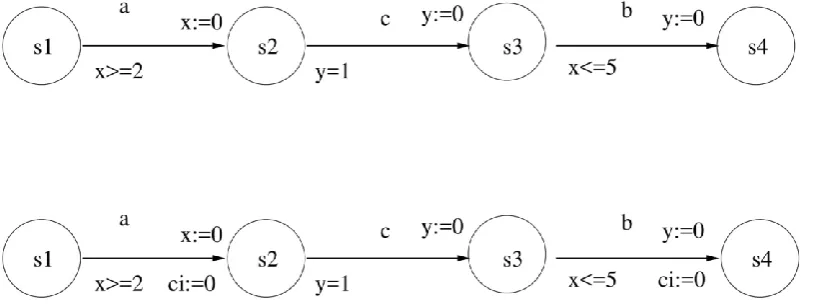
the same as 𝒜 except that transitions with label in Σ𝑖 will have to reset the clock 𝑐𝑖 as well, i.e.
𝒜′ = 〈𝐿, 𝑠𝐼, Σ, 𝑋 ∪ {𝑐𝑖}, 𝐸′, ℱ〉, and 𝐸′ = {𝑒′ =
(𝑠, 𝑎, 𝜙, 𝐶 ∪ {𝑐𝑖}, 𝑠′) | 𝑒 = (𝑠, 𝑎, 𝜙, 𝐶, 𝑠′) ∈ 𝐸 ∧
𝑎 ∈ Σ𝑖} ∪ {𝑒′ = (𝑠, 𝑎, 𝜙, 𝐶, 𝑠′) | 𝑒 =
(𝑠, 𝑎, 𝜙, 𝐶, 𝑠′) ∈ 𝐸 ∧ 𝑎 ∈ Σ𝑖}We illustrate the
difference of transitions in 𝒜 and 𝒜′ in Fig. 1.
Since clock variable 𝑐𝑖 does not appear in
any guard 𝜙 of 𝒜, the automaton 𝒜′ generates the same timed language as 𝒜 does. Adding the clock variable 𝑐𝑖 is just for the purpose of
counting time between two (consecutive) transitions in Σ𝑖. A clock valuation for 𝒜′ now
is of the form 𝜈 ∪ {𝑐𝑖 ↦ 𝑣} for some 𝑣 ∈
𝑅𝑒𝑎𝑙𝑠. Now we construct the region graph ℛ(𝒜′) for 𝒜′, and analyze this graph to see if the second condition of Definition 2 is violated
by a timed word from ℒ(𝒜). If 𝛿(𝑎) = 0 for all 𝑎 ∈ Σ𝑖, then the second condition for 𝑖 is satisfied
trivially. Otherwise, Theorem 1 gives that this condition is violated if and only if there is a run
〈𝑠0, [𝜈0]〉 →𝑒1 〈𝑠1, [𝜈1]〉 →𝑒2… →𝑒𝑚 〈𝑠𝑚, [𝜈𝑚]〉
in ℛ(𝒜′) in which there are two transitions 𝑒𝑙
and 𝑒𝑙+ℎ corresponding to resetting clocks 𝑐𝑖 in
𝒜′: 𝑒𝑙= (〈𝑠𝑙, [𝜈𝑙]〉, 𝑎, 〈𝑠𝑙+1, [𝜈𝑙+1]〉 where 𝑎 ∈
Σ𝑖, 𝜈𝑙+1(𝑐𝑖) = 0, and 𝑒𝑙+ℎ =
(〈𝑠𝑙+ℎ, [𝜈𝑙+ℎ]〉, 𝑏, 〈𝑠𝑙+ℎ+1, [𝜈𝑙+ℎ+1]〉 where 𝑏 ∈
Σ𝑖, 𝜈𝑙+ℎ+1(𝑐𝑖) = 0, and transitions
𝑒𝑙+1, … , 𝑒𝑙+ℎ−1 do not have label in Σ𝑖 (not
corresponding to transitions in 𝒜′ resetting clock 𝑐𝑖) that makes the following condition
satisfied: Let the run in 𝒜′ according to Theorem 1 corresponding to that path be
〈𝑠𝑙, 𝜈𝑙〉 →𝜏𝑙
𝑒𝑙… →
𝜏𝑙+ℎ−1
𝑒𝑙+ℎ−1
〈𝑠𝑙+ℎ, 𝜈𝑙+ℎ〉 →𝜏𝑙+ℎ
𝑒𝑙+ℎ
〈𝑠𝑙+ℎ+1, 𝜈𝑙+ℎ+1〉
Then, 𝜈𝑙+ℎ(𝑐𝑖) + 𝜏𝑙+ℎ < 𝛿(𝑎). This implies the
following: After having removed all non-reachable states from ℛ(𝒜′), and adding time transitions (labeled with “time”) to ℛ(𝒜′), we have that there is also a path in ℛ(𝒜′)
〈𝑠𝑙, [𝜈𝑙]〉 →𝑒𝑙 … →𝑒𝑙+ℎ−1
〈𝑠𝑙+ℎ, [𝜈𝑙+ℎ]〉 →𝑡𝑖𝑚𝑒
〈𝑠𝑙+ℎ, [𝜈𝑙+ℎ+ 𝜏𝑙+ℎ]〉 →𝑒𝑙+ℎ 〈𝑠𝑙+ℎ+1, [𝜈𝑙+ℎ+1]〉
in which 𝜈𝑙+ℎ(𝑐𝑖) + 𝜏𝑙+ℎ< 𝛿(𝑎) where 𝑎
is the label of 𝑒𝑙, and 𝑒𝑙+ℎ has label in Σ𝑖. A
path in ℛ(𝒜′) satisfying this condition is called “violation” path. Now, checking for the
violation of the second condition of Definition 2 from 𝒜 is done by searching in the graph of ℛ(𝒜′) for a single path (not containing a loop) from 𝑒𝑙 to 𝑒𝑙+ℎ with the violation property as
mentioned above (we call it violation path). If no such a path found, then the timed language ℒ(𝒜) satisfies the condition. This can be done in 𝒪(|ℛ(𝒜′)|2) time. Therefore, we have:
Theorem 3 The problem “if a given timed automaton 𝒜 conforms to a real-time concurrent interaction protocol 𝜋” is decidable in time 𝒪(|ℛ(𝒜′)|2).
We sumarizes our results in the following deciding procedure:
Algorithm (Deciding if a timed automaton satisfies a real-time interaction protocol)
Input:A real-time protocol 𝜋 = 〈(Σ1, 𝑅1), … , (Σ𝑘, 𝑅𝑘), 𝛿〉,
where 𝛿: ⋃𝑘𝑖=1 Σ𝑖 → ℕ≥, and 𝑅𝑖 is a regular
expression on Σ𝑖 for 𝑖 = 1, … , 𝑘.
A timed automaton 𝒜 = 〈𝐿, 𝑠𝐼, Σ, 𝑋, 𝐸, ℱ〉 that
satisfies Σ𝑖 ⊆ Σ for all 𝑖 ≤ 𝑘.
Output: “Yes” if ℒ(𝒜) ⊧ 𝜋, “no” otherwise.
Methods:
1. Construct the region automaton of 𝒜, namely the automaton ℛ(𝒜).
2. For each 𝑖 = 1, … , 𝑘 construct automata ℬ𝑖 that recognizes regular language 𝑅̅𝑖.
Then, construct the synchronized product ℛ(𝒜) ×Σ𝑖ℬ𝑖 and check if ℒ(ℛ(𝒜) ×Σ𝑖ℬ𝑖)
is empty. If ℒ(ℛ(𝒜) ×Σ𝑖𝐵𝑖) is not empty
for some 𝑖, stop with output “no”.
3. If there is no time constraint in 𝜋, i.e. 𝛿 is 0 mapping on Σ, stop with output “yes”. 4. For each 𝑖 = 1, … , 𝑘, where 𝛿 is not a 0 -mapping on Σ𝑖, construct the timed
automaton
𝒜′ = 〈L, sI, Σ, X ∪ {ci}, E′, ℱ〉, where E′ =
{e′ = (s, a, ϕ, C ∪ {ci}, s′) | e =
(s, a, ϕ, C, s′) ∈ E ∧ a ∈ Σi} ∪ {e′ =
(s, a, ϕ, C, s′) | e = (s, a, ϕ, C, s′) ∈ E ∧ a ∈ Σi}, and then construct the region graph
ℛ(𝒜′). Add all “time” transitions to ℛ(𝒜′) and simplify it by removing all
nonreachable states. Search in ℛ(𝒜′) for a single violation path. If such a path is found for some i, stop with the output “no”. 5. Stop with the output “yes”.
Note that a concurrent real-time system can be modeled as a timed automata network which is a synchronized product of a number of timed automata, where the concurrency can be expressed explicitly. A synchronized product of a number of timed automata is also a timed automaton, and hence, our algorithm works also on timed automata networks.
4. Conclusion
We have proposed a simple but powerful technique to specify interaction protocols for the interface of components. Our model can specify many aspects for interaction: the temporal order between services, concurrency for services, and timing constraints. We also have shown that the problem of checking if a timed automaton conforms to a given real-time protocol is decidable, and developed a decision procedure for solving the problem. The complexity of the procedure is proportional to the size of the region graph of the input timed automaton which is acceptable for many cases (like the way that the tool UPAAL handles systems). We will incorporate this technique to our model for real-time component-based systems in our future work. We believe that our results can be extended to the cases in which systems are modeled by timed automata with parameters, i.e. timed automata where a parameter can appear in guards and can be reset by a transition.
Acknowledgments
References
[1] R. Alur and D.L. Dill. A Theory of Timed Automata. Theoretical Computer Science, pages 183-235, 1994.
[2] Luca de Alfaro and Thomas A. Henzinger. Interface Automata. In ACM Symposium on Foundation of Software Engineering (FSE), 2001. [3] Jifeng He, Zhiming Liu, and Xiaoshan Li.
rCOS: A refinement calculus of object systems. Theor. Comput. Sci., 365(1-2):109-142, 2006. UNU-IIST TR 322.
[4] Dang Van Hung and Hoang Truong. Modeling and specification of real-time interfaces with UTP. In Theories of Programming and Formal Methods - Essays Dedicated to Jifeng
He on the Occasion of His 70th Birthday, pages 136-150, 2013.
[5] Hung Ledang and Dang Van Hung. Timing and concurrency specification in component-based real-time embedded systems development. In TASE, pages 293-304. IEEE Computer Society, 2007.
[6] Stavros Tripakis, Ben Lickly, Thomas A. Henzinger, and Edward A. Lee. On relational interfaces. In EMSOFT’09, pages 67-76. ACM, 2009.