ISSN 2373-2156 (Print) 2373-2164 (Online) Copyright © The Author(s). All Rights Reserved. Published by American Research Institute for Policy Development DOI: 10.15640/jpesm.v6n2a10 URL: https://doi.org/10.15640/jpesm.v6n2a10
Effectiveness of A P.N.F. Based Rehabilitation Program on Balance Parameters after Total
Knee Replacement
Antonis Fetlis
1,8, Chrysa Alectoridou
2, Paris Iakovidis
3, Illias Kallistratos
4, Thomas Apostolou
5,
Nikos Kofotolis
6, Eleftherios Kellis
7Abstract
Purpose: the purpose of the study was to determine relationships between a PNF based rehabilitation program and its results on the parameters affecting balance, on patients undergone Total Knee Replacement (TKR).
Methods: Fifty four patients (N=54) submitted to TKR at public hospitals of Thessaloniki Greece in 2018-2019, divided into two groups, one (N=27) followed a classic golden standard rehabilitation protocol and the other (N=27) additionally followed a PNF based protocol. Risk of falls was estimated by the Berg Balance Scale, while sagittal and coronal displacement was estimated by the usage of S-plate foot recorder.
Analysis: data were analyzed using t-test paired or independent samples wherever normality was found and Mann-Whitney U or Wilcoxon test wherever it did not. Correlations were determined by Pearson’s r.
Results: the PNF based rehabilitation program has shown statistically important differences on balance parameters specifically on the risk of falls (p,000), sagittal (p ,001) and coronal (p ,000) axis displacement. Keywords: TKR, proprioceptive, PNF, therapeutic exercise
Introduction Knee joint damages
Lower extremity joints are important for human functionality. Loads developed at these joints are huge, first due to the overall weight and second due to closed kinetic chains. These loads can be multiplied regarding individual’s kinetic condition. Anatomic element’s integrity on the knee is important for the joint’s functionality. Even tiny loads can lead to serious capsule alternations as the damages they cause act cumulatively. Furthermore numerous pathogenic parameters can cause damages to the various joint elements, eventually causing pain and dysfunction. Therapeutic exercise is crucial to arthropathy treatment, especially on the knee and can be a key element for rehabilitation. Throughout the bibliography, exercise’s positive impact on muscle strength, functionality and pain has been widely demonstrated. (Evcik et all 2002,Penninx et all 2001, Bischoff et all 2003, Miyaguchi et all 2003,Thomas et all 2003, Bellometti et all 2002,Topp et all 2002 ). Proprioceptive Neuromuscular Facilitation uses body’s receptors which are responsible for carry the information about position and movement in order to facilitate muscle and nerve coordination, making movement more efficient.
1Department of Physical Therapy, IHU 2Department of Nursing, IHU
3Department of Physical Therapy, IHU 4Department of Physical Therapy, IHU 5Department of Physical Therapy, IHU
6School of Physical Education And Sports Science At Serres,Auth Laboratory of Neuromecanics 7School of Physical Education And Sports Science At Serres,Auth Laboratory of Neuromecanics
Review
Research data indicate aging of the population. A study of 2005 predicts that the average population above 65 years will be doubled until 2025 (Diracoglou et al, 2005).
Furthermore, osteoarthritis is the most common musculoskeletal disease. The knee is the most common joint affected. Incompetence from osteoarthritis can be a major deficit of functionality and has a negative effect on life quality of the patients. Proprioception is a major factor for normal functionality as it affects both balance and neuromuscular coordination. At the knee proprioception appears to be decreasing as age is increasing. There seems to be an additional reduction on proprioception following osteoarthritis. (PaiY et al, 1997)
It’s not clearly obvious if this reduction provokes joint degeneration due to pathological neuromuscular function that affects proper load distribution or if it comes as a result of the joint’s receptors’ distraction caused by osteoarthritis (Skinner et al,1994). There are indications that muscle dysfunction is caused by the receptor’s malfunction (Messier et al, 2002). Pain is a factor affecting both muscle’s and receptor’s function (Hassan et al, 2002). Studies indicate that articular sensibility and balance is an important predictive factor for a program’s effectiveness (Simmons et al, 1996). There are controversial reports for articular sensibility also. There is a study that indicates no increasing on proprioception after surgery (Skinneretal, 1984). Proprioception appears to be a major factor for rehabilitation. It’s function providing information about movement’s speed and positioning, is a key element for the correct coordination.
Methods
Fifty four patients (N=54) submitted to the same technique Total Knee Replacement in hospitals of Thessaloniki, Greece were divided into two match up groups. The first group (N=27) was submitted to a classic golden standard eight weeks therapeutic exercise program. The other group (N=27) wassubmitted to an also eight weeks program as well additionally based on PNF. To estimate balance levelsan S-plate foot recorder used, for both sagittal and coronal displacement. There was three measurements, first theone upon the beginning of the program, the second at the end of it at eight weeks and the final in the sixth month post operative.
Results
There was an initial equality control to insure that both groups were equalregarding the risk of falls (Z -,260 p ,795), sagittal (Z -1,298 p ,194) and coronal (Z -1,242 p ,124) displacement (table 1).
TestStatisticsa
Bergscoretotal initial x balanceinitial y balanceinitial
Mann-Whitney U 349,500 290,500 293,000
Wilcoxon W 727,500 668,500 671,000
Z -,260 -1,298 -1,242
Asymp. Sig. (2-tailed) ,795 ,194 ,214
a. GroupingVariable: team
Table 1. initial control check for both groups.
As for the risk of fallsthetest group demonstrated statistically important improvement on the second measurement, at the end of the eight weeks program (Z 2,835 p ,005), and in comparison to the control group (Z -2,522 p ,012). These findings reserved on the final measurement also (Z -2,638 p,001) (histogram 1). Logistic regression revealed that functionality levels of the knee affected Berg Balance Test Score at 25,5 % (p,000).
Histogram 1. Risk of falls comparison.
As for sagittal displacement both groups started on equal levels (Z -1,298 p,194). Test group showed statistically important reduction of sagittal movement (Z -2,634 p,001) in comparison to the control group, and maintained this reduction at the final measurement too (Z-2,567 p,001) (histogram 2).Sagittaldisplacement as shown, affected knee functionality at 19,4%. Effect sizes were,63 and ,47 for test and control group respectively. That indicates better impact for the PNF group (table 2).
x balance
test control
N Mean Std.
Deviation N Mean Std. Deviation
x balanceinitial 27 4,052 ,4478 27 4,012 ,1949
x
balanceindermediate 27 3,081 ,2940 27 3,489 ,2100
x balancefinal 27 3,025 ,2896 27 3,289 ,2100
Valid N (listwise) 27 27
Table 2.Sagitall displacement measures
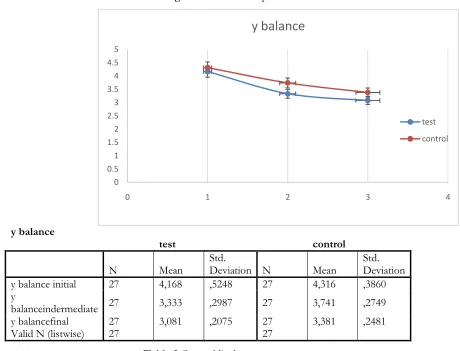
As for coronal displacement both groups began on equal levels (Z -1,242 p,214). There was statistically important difference for the test group (Z-4,705 p,000) at the end of the program. That difference was also maintained at the final measurement (Z -4,705 p,000) (histogram 3).Coronal displacement affected knee functionality at 23,4%.
Histogram 2. Comparison of sagittal displacement.
0 0.5 1 1.5 2 2.5 3 3.5 4 4.5
0 1 2 3 4
x balance
test control 0
5 10 15 20 25 30 35 40 45 50
0 1 2 3 4
berg score
Effect sizes were ,65 and ,42 for test and control groups respectively. This indicates better influence for the PNF group (table 3).
Histogram 3. Coronal displacement.
y balance
test control
N Mean Std. Deviation N Mean Std. Deviation
y balance initial 27 4,168 ,5248 27 4,316 ,3860
y
balanceindermediate 27 3,333 ,2987 27 3,741 ,2749
y balancefinal 27 3,081 ,2075 27 3,381 ,2481
Valid N (listwise) 27 27
Table 3.Coronaldisplacementmeasures.
There was a correlations analysis by Pearson’s r for the dependent variable «functionality» and the independent «risk of falls» «x displacement» and «y displacement»(table 4). Analysis shown significant correlation between functionality and risk of falls (r,519 p ,000) sagittal displacement (r,457 p,001) and coronal displacement (r,499 p,000).
Correlations
Koosscore final Dropdanger x balancetotal y balancetotal
Koosscore τελικό PearsonCorrelation 1 ,519** -,457** -,499**
Sig. (2-tailed) ,000 ,001 ,000
N 54 54 54 54
dropdanger PearsonCorrelation ,519** 1 -,304* -,321*
Sig. (2-tailed) ,000 ,025 ,018
N 54 54 54 54
x balancetotal PearsonCorrelation -,457** -,304* 1 ,572**
Sig. (2-tailed) ,001 ,025 ,000
N 54 54 54 54
y balancetotal PearsonCorrelation -,499** -,321* ,572** 1
Sig. (2-tailed) ,000 ,018 ,000
N 54 54 54 54
**. Correlation is significant at the 0.01 level (2-tailed). *. Correlation is significant at the 0.05 level (2-tailed).
Table 4. Correlation analysis
0 0.5 1 1.5 2 2.5 3 3.5 4 4.5 5
0 1 2 3 4
y balance
Discusion
Articular sensitivity is reduced at osteoarthritis knees. Researchers suggested that joint positioning sense improved compared to the opposite leg after rehabilitation program. Atfield et al (1996) measured proprioception and reported significant changes (p,001) six months postoperative. This agrees with our findings. Articular sensitivity rehabilitation mechanism after TKR has to do with the elimination of a various incriminating parameters in elderly and osteoarthritic patients (Barracketal 1983, Skinneretal 1991, Kleinbartetal ,1992, Kokmenetal 1978, Alexiadesetal 1989, Kaplanetal 1985, Alice et al 2015). Reduction of joint sensitivity reported on those patient has to do with the lose of mechanoreceptors, pain receptors, inflammation and reduction of functionality levels due to arthropathy(Barrack et al 1983, Kaplan et al 1985, Sharma et al 1997,Skinner et al 1984, Hall et al 1995, Lephart et al 1996, Petrella et al 1997, Safran et al 1996, Kim et al 2015).After TKR soft tissue tension, pain and inflammation reduced and functionality levels were increased (Tilbury et al 2016). These changes can affect the reaction of motor receptors to the articular cartilage and muscles and tendons, increasing both articular positioning and movement’s perception (O’ ReillyCS1999, Kramer et al 2003).Our study has also demonstrated this through out theincreased knee functionality and consecutive improvement of life quality parameters.
The sense of articular position and movement is crucial for balance maintaining. Reduced articular sensitivity is a factor leading to balance deficits both in elderly and osteoarthritis patients (Petrellaetal 1997, Overstalletal 1977, Wegeneretal 1997, Lordetal 1991, Iakovidisetal 2017).These balance deficits have to do with reduced articular functionality and as a result they are increasing danger of falls(Overstalletal 1977, Wegeneretal 1997,Sjoveian et al 2017).Our study indicates that PNF improves balance capability and thus reduces danger of falls. Improvement of proprioception indicates that PNF increases neuromuscular control and joint stability. The test group demonstrated better positioning and movement perspective and this way they achieved better balance scores. This resulted to better neuromuscular coordination and more efficient static and dynamic balance. It’s also an indication of better motor sensory coordination postoperative. The potential clinical benefit of this suggests that PNF is improving the motor sensory characteristics that are necessary for dynamic joint stability, reducing danger of falls.
Conclusion
A PNF based program after TKR demonstrated statistically important differences in balance parameters and in particular to risk of falls (p,000) sagittal (p,001) and coronal displacement (p,000). There was also statistical important relation between functionality levels of the knee and balance parameters such as risk of falls (r ,519 p,000), sagittal (r,457 p,001) and coronal displacement (r ,499 p ,000). Effect sizes demonstrated better impact for the PNF group to the rehabilitation program.
References
Alexiades M, Scuderi G, Vigorita V, Scott WN. (1989) A histologic study of the posterior cruciate ligament in the arthritic knee. Am J Knee Surg.;2:153-9.
Alice BM, Stéphane A, Yoshisama SJ. (2015) Evolution of knee kinematics three months after total knee replacement. Gait Posture. ;41(2):624–29.
Attfield S., Wilton J., Pratt D, Sambatakakis A. (1996).Soft-tissue balance and recovery of proprioception after total knee replacementJ Bone Joint Surgery Br; 78(4): 540-545.
Barrack RL, Skinner HB, Brunet ME, Cook SD. (1983). Joint laxity and proprioception in the knee. Phys Sports Med.;11:130-5.
Bellometti S., Berte F., Richelmi p., Tassoni T., Galzigna L. (2002). Bone remodelling in osteoarthrosic subjects undergoing a physical exercise program.ClinChimActa; 325(1-2):97-104
Bischoff H., Roos E. (2003).The effectivenes and safety of strengthening, aerobic and coordination exercises for patients with osteoarthritis.CurrOpin Rheumatol;15(2):141-4
Evcik D., Sonel B. (2002).Effectiveness of a home-based exercise therapy and walking program on osteoarthritis of the knee. Springer-Verlag15(2):141-4.
Hall MG, Ferrell WR, Sturrock RD, Hamblen DL, Baxendale RH. (1995). The effect of the hypermobility syndrome on knee joint proprioception. Br J Rheumatol. 1995;34:121-5.
Iakovidis P, Apostolou T, Markopoulos N, Mavromoustaos S, Kottaras S, Kallistratos I, Takidis N. (2017). The effects of physiotherapeutic intervention on the static balance of elderly for secondary prevention of falls. PhyTherRehab2017;4:15
Kaplan FS, Nixon JE, Reitz L, Rindfleish L, Tucker J. (1985). Age-related changes in proprioception and sensation of joint position. ActaOrthop Scand.;56:72-4.
Kim MC, Kim NJ. (2015) Validity and reliability of the knee joint proprioceptive sensory measurements using a smartphone. J Korean SocPhys Med. ;10(4):15–23
Kleinbart F, Vigorita VJ, Evangelista J, Scott WN, Bryk E.( 1992). Histological comparison of posterior cruciate ligaments harvested from arthritic and from agecontrolled knee specimens. Orthop Trans.;16:583.
Kleinbart F, Vigorita VJ, Evangelista J, Scott WN, Bryk E.( 1992). Histological comparison of posterior cruciate ligaments harvested from arthritic and from agecontrolled knee specimens. Orthop Trans.;16:583.
Kokmen E, Bossemeyer RW Jr, Williams WJ. (1978). Quantitative evaluation of joint motion sensation in an aging population. J Gerontol.;33:62-7.
Kramer JF, Speechley M, Bourne R. (2003). Comparison of clinic-and home-based rehabilitation programs after total knee arthroplasty. ClinOrthopRelat Res. ;410:225–34.
Lephart SM, Perrin DH, Fu FH, Gieck JH, McCue FC, Irrgang JJ. (1992). Relationship between selected physical characteristics and functional capacity in the anteriorcruciate-insufficient athlete. J Sport Phys Ther.;16:174-81.
Lord SR, Clark RD, Webster IW. (1991) Physiological factors associated with falls in an elderly population. J Am Geriatr Soc.;39:1194-200.
Messier SP, Glasser JL, Ettinger WH Jr. (2002). Declines in strength and balance in older adults with chronic knee pain: a 30-month longitudinal, observational study. Arthritis Rheum.;47:141–148.
Miyaguchi M., kobayashi A., Kadoya Y. (2003).Biochemical change fluid after isometric quadriceps exercise for patients with osteoarthritis of the knee.Osteoarthritis and cartilage;11(4):252-259
Nilsdotter AK, Toksvig-Larsen S, Roos EM. (2009) Knee arthroplasty: are patients' expectations fulfilled? A prospective study of pain and function in 102 patients with 5-year follow-up. Acta Orthop;80(1):55–61. Overstall PW, Exton-Smith AN, Imms FJ, Johnson AL. (1977). Falls in the elderly related to postural imbalance. Br
Med J.;1:261-4.
O’Reilly SC, Muir KR, Doherty M. (1996) Screening for knee pain in osteoarthritis: which question? Ann Rheum Dis;55:931–3.
Pai YC, Rymer WZ, Chang RW, Sharma L. (1997) Effect of age and osteoarthritis on knee proprioception. Arthritis Rheum;40:2260-5.
PenninxB., Messier S., Rejeski J., Williamson J., Dibari M.(2001) .Physical Exercise and thePrevention of Disability in Activities of daily living in older persons with osteoarthritis.Archives of Physical Internal Medicine;161(19):2309-2316.
Petrella RJ, Lattanzio PJ, Nelson MG. (1997) Effect of age and activity on knee joint proprioception. Am J Phys Med Rehabil. ;76:235-41.
Safran MR, Allen AA, Lephart SM, Borsa PA, Giraldo J, Fu FH, Harner CD (1996). Contribution of posterior cruciate ligament mechanoreceptors to knee proprioception. Read at the Annual Meeting of the American Academy of Orthopaedic Surgeons; Feb 22-26; Atlanta, GA.
Sharma L, Pai YC.( 1997). Impaired proprioception and osteoarthritis.CurrOpin Rheumatol.;9:253-8.
Sharma L., Dunlop D., Cahue S., Song J., Hayes K. (2003).Quadriceps strength and osteoarthritis progression on malaligned and lax knees.Ann Intern Medicine;138(8):678-9
Simmons S, Lephart S, Rubash H, Borsa P, Barrack RL.(1996). Proprioception following total knee arthroplasty with and without the posterior cruciate ligament. J Arthroplasty;11:763-8.
Skinner HB, Barrack RL. (1991) Joint position sense in the normal and pathologic knee joint. J ElectromyogrKinesiol.;1:180-90.
Skinner H., Barrack R., Cook S., Haddad R, (1984). Joint position sense in total knee arthroplasty. J orthop Res;1(3): 276-83.
Sjoveian AKH, Leegaard M. (2017) Hip and knee arthroplasty - patient's experiences of pain and rehabilitation after discharge from hospital. Int J Orthop Trauma Nurs. ;27:28–35.
Thomas N.,Pfegerl E., Erhart J.,Vescei V. (2003). Primary total knee arthroplasty for periarticular fractures. The Journal of Arthroplasty; 18(8): 968 71.
Tilbury C, Haanstra TM, Leichtenberg CS, Verdegaal SH, Ostelo RW, de Vet HC. (2016) Unfulfilled expectations after total hip and knee arthroplasty surgery: there is a need for better preoperative patient information and education. J Arthroplast. ;31(10):2139–2145.
Topp R, Woolley S, Hornyak J (2002). The effect of dynamic versus isometric resistance training on pain and functioning among adults with osteoarthritis of the knee. Arch Phys Med Rehabil.;83:1187–1195.
Wegener L, Kisner C, Nichols D. (1997). Static and dynamic balance responses in persons with bilateral knee osteoarthritis. J Orthop Sports Phys Ther.;25:13-8.