International Journal of Advances in Engineering Research
SECURE SYSTEM FOR SECURITY PROTOCOL IN
TRAFFIC
Mr. Arjun Kumar
[email protected] ABES Engineering College, Ghaziabad
Master of Computer Application
ABSTRACT
Today security is a very big problem in IT industry. Internet used Local area network and wide area network for communication and transaction purpose. The Internet has emerged as a medium for wide-scale electronic communication involving financial transactions and other sensitive information. In Transaction time data are encrypted mode for data security. Security protocols provide rules that govern such encrypted exchanges. In my paper describes a system for transaction time detecting intrusions on encrypted exchanges over public networks by recognizing the characteristics of security protocols and attacks on them.
INTRODUCTION
A Network is the inter-connection of communications media, connectivity equipment, and electronic devices for the purpose of sharing data and resources. Today is very challenging task of network security, because there are a variety of threats, there is no single solution. We need multiple layers of security, so that if one fails, the attacker would have to deal with the next layer. Network Security Systems are usually composed of many components of both software and hardware which are designed to work together to improve security and minimize maintenance. Our paper combines two common security technologies to provide protection for electronic information exchange over public networks.
SECURITY PROTOCOLS
International Journal of Advances in Engineering Research
content and order of exchanges between the communicating principals. Unfortunately, encryption backed by carefully crafted and thoroughly tested security protocols may still not be sufficient to prevent sophisticated intruders from compromising secure communication. So many paper published in journal and so many scientist work but till now data security is very challenging task. So my paper focuses on cryptographic and security protocol verification and principles for devising secure protocols. While progress has been made, the end is nowhere in sight, as evidenced by the pointed observation in [10]. It is clear that another level of protection must be provided for encrypted data exchanges to detect attacks on the security protocols.ATTACK DETECTION SYSTEM
The Attack Detection System (ADS) [6] is a system that can detect attacks on security protocols within an enclave of valid and recognized parties that communicate using a public network. In this environment, security protocol activity based on the message exchanges between two systems so how transfer the secure message to another user.
A S : A, B, Na
S A : E(Kas: Na, B, Kab, E(Kbs : Kab, A)) A B : E(Kbs : Kab, A)
B A : E(Kab : Nb) A B : E(Kab : Nb – 1)
Chart 1
1. Characteristics of Security Protocol
The our goal is any how detect hackers is to show that formal definitions of attacks on security protocols can be represented as signatures that can be stored in a knowledge base and compared against ongoing activity to detect attacks. This is done using specific characteristics of protocols. When
A B S Public Network ATTACK Activity IDE Monitor
International Journal of Advances in Engineering Research
Chart 2Our system recognizes a specific signature of activity that corresponds to a known attack; we signal that an attack has occurred. Additionally, because of the characteristics of our system, we are also able to identify suspicious behavior that may or may not represent an attack.
2. 1CONSTRUCTING SIGNATURES OF ATTACKS
An important feature of the our technique is that the detection mechanism does not rely upon knowledge of the payload of the messages exchanged between the principals during protocol sessions. This is because the IDE detects attacks based upon the characteristics of the security protocols themselves. The signatures constructed from protocols and their known attacks are represented by:
(1) Protocol used
(2) The principals (originator and recipient) involved (3) Data sender
(4) Data received
(5) The concurrent sessions that occurs
Consider the canonical Needham and Schroeder Conventional (symmetric) Key Protocol
(NSCKP) [5] shown in chart 1. This protocol requires three principals: A, B and the trusted third
party server S. The aim of NSCKP is to establish a secret key Kab that is to be used by the
principals A and B to encrypt their future exchanges. At the end of a correct run of the protocol, both principals should be in possession of the secret key, Kab, newly generated by the server S. The NSCKP can be represented by the signature given in chart 3 Protocol Session Message # Action Sender Receiver
NSCKP x 1 send A S NSCKP x 1 receive A S NSCKP x 2 send S A NSCKP x 2 receive S A NSCKP x 3 send A B NSCKP x 3 receive A B
Chart 3
Each step of the signature is considered an event. Ram sending a message to Mohan is
International Journal of Advances in Engineering Research
inform the activity monitor of SEADS about this. Since a public network is being used for the message transfer between Ram and Mohan on insecure lines, the message may be lost or may be intercepted by an intruder. In either case Mohan will not inform the monitor that it actually received a message from Ram. Thus, the sequence of events logged in the monitor will show a message sent by Ram to Mohan, but not received by Mohan, as evident by the lack of the receive notification by Mohan to the monitor. Thus, suppose a previously distributed key Kab has been compromised, through cryptanalysis or other means, and is known by a malicious intruder, Mallory. If Mallory monitored and recorded message three of the corresponding protocol run, consisting of E(Kbs: Kab, A), he can now fool Bob into accepting the key as new by the protocol given in chart 4.(3) *M(A) B : E(Kbs : Kab, A) (4) B M(A) : E(Kab : Nb) (5) M(A) B : E(Kab : Nb –1)
Chart 4
After affecting the attack, Bob believes he is following the correct protocol. Mallory is able to form the correct response in (5) because she knows the compromised key Kab. She can now engage in a communication with Bob using the compromised key and masquerade as Ram. We can generate a signature recognizable by the IDE for the above attack on the Needham and Schroeder protocol. The signature is comprised of only three events; two receive events and a send event as shown in chart 5.
Protocol Session Message # Action Sender Receiver NSCKP x 3 receive A B
NSCKP x 4 send B A NSCKP x 5 receive A B
Chart 5
Since the malicious intruder (M), is not part of the secure enclave, it will not co-operate with the activity monitor and, hence, will not inform the monitor whenever it sends or receives messages. Thus the above attack signature will consist only of events reported by Bob (a valid principal) to the monitor.
THE RECOGNITION MACHINE
International Journal of Advances in Engineering Research
begin PROTNAME SIGNUM ATTACKTYPEINITIALSTATE principal (/) principal NEXTSTATE msgNum sessNum PREVIOUSSTATE principal (/) principal NEXTSTATE msgNum sessNum end
Chart 6
Each time the IDE receives an originating event from the monitor (i.e. an event that corresponds to the first event of a new protocol session) the IDE constructs a finite state machine recognizer for each signature stored in the knowledge base for that particular protocol. These recognizers remain active until an event occurs that invalidates the signature.
BASED ON KNOWLEDGE DEFINE SIGNATURE
Each signature is stored in the Knowledge Base as a procedure defining a finite state machine. Information in the first line identifies the entry, followed by the state identifiers and the transitions that occur. Chart 6 is a symbolic representation of a signature.
CONSTRUCTION OF THE FINITE STATE MACHINE
When a session begins, the IDE constructs a Finite State Machine (FSM) recognizer for each signature stored in the knowledge base, corresponding to the protocol used in that session. The state transition diagram for attack signature #1 on the NSCKP protocol (as described in section 2.1) is shown in Table 1. Initially the recognizer will be in the start state (SS). As the IDE receives events from the monitor for this particular protocol session it advances the FSM for this signature if the arriving events match those in the attack signature. Upon a transition to the final state in any of the finite state machines corresponding to the attack signatures of the protocol, the IDE signals an attack notification.
Current State
Event Protocol Session Sender Receiver Message Number
Next State
SS receive NCCKP X A B 3 S1 S1 send NCCKP X B A 4 S2
International Journal of Advances in Engineering Research
HOW DETECT ATTACKER
The IDE uses distinct detection methodologies for protocol attacks depending on the number of sessions used in each specific attack. Attacks on security protocols may be over only a single session of the protocol or may utilize information gleaned from multiple runs of the protocol.
Thus, attacks may be classified as Single session attacks or Multi-session attacks.
SINGLE SESSION ATTACKS
Single session attacks are those attacks which may occur in a single session. The signature of such an attack may differ from the protocol itself in only something so subtle as a missing receive statement. In our environment, these subtle differences are easily recognized. Interestingly, we consider the attack on the Needham and Schroeder Conventional Key Protocol (NSCKP) a single session attack even though the attack depends on a previously compromised key from another session. The telling factor is that the attack can be detected by recognition of a single protocol session.
MULTI-SESSION ATTACKS
Multi-session attacks are those attacks that use information extracted from more than one previous or concurrent protocol sessions. We make the reasonable assumption that such attack sessions must use the information within a certain time period of the reference session(s), from which the information is taken in order to subvert the protocol. For multi-session attacks, the IDE classifies them as either Replay Attacks or Parallel Session Attacks.
PARALLEL SESSION ATTACKS
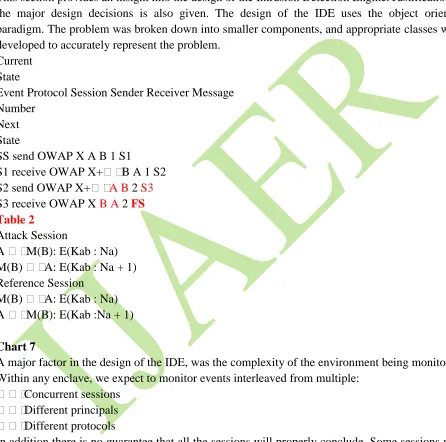
A parallel session attack occurs when two or more protocol runs are executed concurrently and messages from one run (the reference session) are used to form spoofed messages in another run (the attack session). As a simple example consider the following One-Way Authentication Protocol (OWAP) [1]:
A B : E(Kab : Na) B A : E(Kab : Na + 1)
International Journal of Advances in Engineering Research
against the attack signatures. The telling factor in this case is the omission of any information from Ram's partners in either session, as reflected in the signature in Table 2.DESIGN OF THE INTRUSION DETECTION ENGINE
This section provides an insight into the design of the Intrusion Detection Engine. Justification of the major design decisions is also given. The design of the IDE uses the object oriented paradigm. The problem was broken down into smaller components, and appropriate classes were developed to accurately represent the problem.
Current State
Event Protocol Session Sender Receiver Message Number
Next State
SS send OWAP X A B 1 S1
S1 receive OWAP X+B A 1 S2
S2 send OWAP X+A B 2 S3
S3 receive OWAP X B A 2 FS
Table 2 Attack Session
A M(B): E(Kab : Na) M(B) A: E(Kab : Na + 1) Reference Session
M(B) A: E(Kab : Na) A M(B): E(Kab :Na + 1)
Chart 7
A major factor in the design of the IDE, was the complexity of the environment being monitored. Within any enclave, we expect to monitor events interleaved from multiple:
Concurrent sessions
Different principals
Different protocols
In addition there is no guarantee that all the sessions will properly conclude. Some sessions may be suspended abnormally and messages may be lost.
ARCHITECTURAL DESIGN
International Journal of Advances in Engineering Research
sessions of different protocols executing within the enclave. The sessions may consist of the same or different principals. The Intrusion detection engine must be able to keep track of the different protocol sessions executing within the enclave in order to detect any attacks or suspicious activity. Not all attacks on security protocols occur over a single session. As described earlier, multi-session attacks such as replay attacks or parallel attacks may occur within the enclave. These multi-session attacks span multiple different protocol sessions. The Intrusion detection engine must provide a means to keep track of such executing sessions and detect any attacks. Additionally, the detection of attacks has to be communicated to the person or system monitoring the enclave. Detailed reports of all attacks or suspicious behavior must be generated by the IDE. Such reports provide in-depth information about the type of attack and principals participating in the protocol session. The Intrusion Detection Engine receives crucial inputs from the Activity Monitor and from the Knowledge base of protocol signatures. It is important to ensure that interfaces with the Monitor and the Knowledge base are well-defined and reliable.THE GRAPHICAL USER INTERFACE
In our research, a Graphical User Interface (GUI) was implemented for an overall view of the attacks and suspicious activities detected within the enclave. The GUI allows the reporting of attacks to the user. The user can specify the time duration and the protocol name to obtain a detailed report of all the attacks (on the specific protocol) that took place during that period. The report will include the name of the protocol subject to attack, the principals involved in the session, attack time and other relevant information which will allow the user monitoring the system to research the occurrence of attacks within the system.
The GUI also allows the user to back up the active attack report file to another file.
TESTING
Upon completion of each significant milestone, the IDE was tested to ensure that the product functioned correctly. We approached the testing from four standpoints:
(1) Detection of attacks against protocols in all three categories of single session, replay, and parallel session
(2) Detection of suspicious activity
(3) Effective operation in a highly concurrent environment (4) Effective user interface.
International Journal of Advances in Engineering Research
Wait forEvents Create New Thread Channel the event to the relevant monitoring thread Advance FSM
Advance FSM
Continue Monitoring for attacks
Notify and write to attack log file Stop FSM /Suspicious No
Time out
Event: (B->A,NSCKP, session #, message #) Yes
Yes
CONCLUSION
We have designed and implemented a Knowledge-Based Intrusion Detection Engine to detect attacks on security protocols executing within a secure enclave. This research provides an necessary extra level of protection for encrypted exchanges.
Extensive research on the characteristics of security protocols enabled this detection methodology to achieve its desired functionality. Extracting the description of security protocols into sequences of events allows the IDE to detect attacks on those protocols.
The IDE will detect any attacks or suspicious activity on security protocols executed by valid principals operating within a secure enclave. The detection of the IDE compares protocol activity gathered by the Monitor against the attack signatures stored in the Knowledge base.
International Journal of Advances in Engineering Research
REFERENCES
[1] John Clark & Jeremy Jacob, “Attacking Authentication Protocols”, High Integrity Systems 1(5):465-474, August 1996.
[2] H.Debar, M.Dacier, A.Wespi, “Towards a Taxonomy of Intrusion Detection Systems”, Elsevier Science B.V 31 (1999) 805-822
[3] Dorothy E. Denning, “An Intrusion-Detection Model”, From 1986 IEEE computer Society Symposium on Research in Security and Privacy.
[4] Dorothy Denning and G.Sacco, “Timestamps in Key Distribution Protocols”, Communications of the ACM, 24(8), August 1981, pp. 533-534.
[5] Roger M. Needham and Michael Schroeder, “Using Encryption for Authentication in Large Networks of Computers”, Communications of the ACM, 21(12), Dec. 1978, pp. 994-995. [6] Alec Yasinsac, “Detecting Intrusions in Security Protocols”, Proceedings of First Workshop on Intrusion Detection Systems, in the 7th ACM Conference on Computer and
communications Security, June 2000, pp. 5-8.
[7] National Bureau of Standards (NBS). Data Encryption Standard. Dederal Infor-mation Processing Standard, Publication 46, NBS, Washington, D.C., January 1977
[8] R.L Rivest, A. Shamir, L. M. Adleman, "A Method for Obtaining Digital Signatures and Public Key Cryptosystems", CACM, Vol. 21, No. 2, Feb 1978, pp. 120-126
[9] Otwy, D., and Rees, O. 'Efficient and timely mutual authentication'. Operating Systems Review 21, 1(Jan. 1987), pp. 8-10