51
ISSN 2250 – 2688
Received: 24/04/2015 Revised: 28/05/2015 Accepted: 09/06/2015
Pushkal Gupta, Ashwani Mishra, Anupam Pathak
Department of Pharmacy, Barkatullah University, Bhopal. 462026.
Correspondence Ashwani Mishra
Department of Pharmacy, Barktullah University Bhopal
E mail : [email protected]
Preparation and Evaluation of Bi-layer Floating Tablet of
Hydrochlorothiazide and Propranolol HCl
Pushkal Gupta, Ashwani Mishra and Anupam Pathak
ABSTRACT
Bi-layer tablets consist of two layers which contain one or more drug. Sometimes it can be used to get modified release profile of the formulation by formulating individual layers using different sort of polymer. In this work attempt was made to formulate a tablet having one floating layer of Propranolol HCl and immediate release layer of Hydrochlorothiazide. Different concentration of carbopol, microcrystalline cellulose, sodium bicarbonate, citric acid sodium starch glycolate and Hydroxy propyl methyl cellulose were used to formulate bi layer tablets. Prepared formulations were evaluated for weight variation, friability, hardness, floating time and in vitro drug release .The best formulation F6 which passes all the evaluations was consider as the promising formulation of hydrochlorothiazide and Propranolol HCl.
Keywords: Quinazolinone, Schiff base, chalcone, anti-inflammatory activity. .
1. INTRODUCTION
Floating formulations retained in the stomach and released the drug in a desired way so that the drug could be available on absorption sites and give better bioavailability. This reduces drug waste, and improves therapeutic index. Floating formulations is also suitable for local drug delivery to the stomach and proximal small intestines. The need for gastro-retentive dosage forms (GRDFs) has led to extensive efforts in both academics and Industry towards the development of such drug delivery systems.1
There are following approaches used to formulate gastro-retentive dosage forms (a) Low density form buoyant in gastric fluid.
(b) High density dosage form retained in the bottom of the stomach.
(c) Expansion by swelling or unfolding to a large size which limits emptying of the dosage forms through the pyloric sphincter.2
Advantage of bi-layer floating tablets-
These advantages of the bi-layer floating tablet over the other conventional preparations of oral solid dosage forms include:
1. This improves the bioavailability of the drug.
2. Maintained the plasma drug concentration always constant, which ultimately provide a more effective action.
3. The safety margin of high potency drugs can be increased and the local and systemic adverse effects can be reduced insensitive patients.
52
Bi-layer tablets consist of two layers which contain one or more drug. Sometimes layers can be modified to get the desired release profile by changing the excipients of individual layer of Bi-layer tablets. 6-7As blood flows through arteries it pushes against the inside artery walls. The more pressure the blood exerts on the artery walls, the higher the blood pressure will be. 8 It is written as 120/80 mm Hg. Blood pressure is expressed in two numbers: the higher number is systolic blood pressure and the lower number is the diastolic blood pressure. Normal blood pressure provides sufficient blood flow into the vital organs.9
After studying the above facts an attempt was made to formulate and evaluate Bi-layer floating tablet of Hydrochlorothiazide and Propranolol HCl.
2. MATERIALS AND METHODS
Hydrochlorothiazide and propranolol HCl were obtained as a Gift sample from Cipla and all the other polymers and Chemical were obtained from Central Drug House Delhi. All the solvents used were of analytical grade.
2.1 Preparation of Immediate release layer
Granules were prepared by wet granulation method. Manitol and Hydrochlorothiazide powder were mixed homogeneously using glass mortar and pestle. Isopropyl alcohol solution (1%) was used as granulating agent. Granules were prepared by passing the wet coherent mass through a #20 sieve. Then granules were dried in hot air oven at a temperature of 600C±0.50C for 15 min. Dried granules sieved through #40 sieves and mixed with sodium starch glycolate and microcrystalline cellulose in different concentration as per formulation than add magnesium stearate and talc 4-5 minute before compression.
2.2 Preparation of floating layer
Polymers (Hydroxypropylemethylcellulose k15 and Corbopol 934) are mixed homogeneously using glass mortar pestle in different concentration along with propranolol HCL .Isopropyl alcohol (1%) was used as granulating agent. Granules were prepared by passing the wet coherent mass through a #20 sieve. The granules were dried in hot air oven at a temperature of 600C±0.50Cfor 5 min. Dried granules sieved through #40 sieves and mixed with sodium bi carbonate and citric acid used as gas generating agent and lubricated with magnesium stearate and talc 4-5 minute before compression
2.3 Evaluation of Flow properties of Granules
2.3.1 Angle of repose
5g of granules were poured through the wall of a funnel, Funnel was fixed at a position by clump in such a way that its lower tip was at a height of exactly 2cm. above from plan surface. The granules were poured till the time when upper tip of the pile surface touched the lower tip of the funnel.
tanθ= h/r
θ = angle of repose,h = height of the heap,r = radius of the heap
2.3.2 Bulk density and Tapped density
Granules were poured gently through a glass funnel into a graduated cylinder. The cylinder was then tapped from a height of 2.0 cm. until the time when there was no more decrease in the volume. Bulk density and Tapped density was calculated.
Bulk density = Weight of sample in g/final volume in cm3 of the sample contained In cylinder
Tapped density=Weight of sample in g/final volume in cm3 after tapped in cylinder
2.3.3 Carr’s compressibility index
Used for compare the bulk Density and tapped density.
Carr’s compressibility index=Tapped density--bulk density/tapped densityX100
2.3.4 Hausner ratio
Hausner ratio= Tapped density/Bulk density
2.4 Evaluation of Tablets
2.4.1 Weight Variation
For the determination of weight variation 20 tablet were weighed individually then theiraverage weight was calculated and compared to the individual tablet weights. The tablets meet the USP test if not more than 2 tablets are outside the percentage acceptable limit and if no tablet differs by more than 2 times the percentage acceptable limit.
53
Hardness of tablets measured by Monsanto hardness tester. It was measured on Friability apparatus -A pre-weighed tablets sample was placed in friabilator which was then operated for 100 revolutions for 4 minutes. After 4 minutes tablets were weighed again .Tablet showed less than 1.0 % of their weight loss were considered acceptable.2.4.3 Buoyancy/Floating Tablets
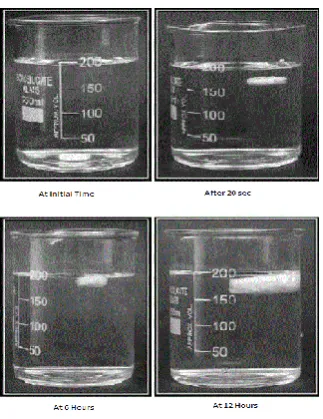
The tablet was placed in 200 ml beaker containing 0.1 N HCL and the time required for the tablet to rise to the surface and time until it floats was recorded.
2.5 In vitro Dissolution Studies for immediate release layer (hydrochlorothiazide)
The in vitro release study for all the formulations was
carried out by USP dissolution test apparatus type-2.The temperature of dissolution medium (0.1N HCL, 900 ml) was maintained at 370C+0.50C with a stirring rate of 50 rpm. This study was done for 1 hrs. At different time interval 15,30,45 and 60 min , 5 ml of samples were withdrawn. The volume of dissolution fluid was adjusted every time by adding fresh buffer media.
Aliquot were suitably analysed spectrophotometrically at λ max= 273 nm in UV spectrophotometer (Jasco double beam) against blank and then drug concentration was calculated.
2.6 In vitro Dissolution Studies for floating layer (propranolol HCl)
The in vitro release study for all the formulations carried
out in USP dissolution test apparatus type-2.The temperature of dissolution medium (0.1N HCL, 900 ml) was maintained at 37 +0. 5 0C with a stirring rate of 50 rpm.
This study was done for 12 hrs. At time of 1,2,3,4,5,6,7,8,9,10,11and 12 hr, 5 ml of aliquots was withdrawn. The volume of dissolution fluid was adjusted every time by adding fresh buffer media. Sample were suitably assayed spectrophotometrically at λ max=290 nm UV and spectrophotometer (Jasco double beam) against blank. The drug concentration was calculated using standard calibration curve.
3. RESULTS AND DISCUSSION
Preformulation Studies for the selected
Propranolol HCl and Hydrochlorothiazide were conducted. The physical appearance and melting point of drugs were found to be concordant with IP. Solubility of Propranolol HCl and Hydrochlorothiazide were determined in various aqueous and non-aqueous solvents. The Propranolol HCL was found to be soluble in water and ethanol (95%), slightly soluble in chloroform, generally
insoluble in Ether and Hydrochlorothiazide was found to be soluble in dilute ammonia slightly soluble in acetone , ether and also very slightly soluble in water.
Absorption maxima of the drugs were determined by UV Spectrophotometer (jasco V530 shimatzu). The λmax for drugs were
290 nm and 273 nm in 0.1 N HCl
Different formulations were prepared by using various concentration of sodium starch glycolate, Mg stereates , HPMC K15M or carbopol 934 .It was found that as the concentration of polymer increased, the release of the drug from the matrix system was decreased .It was also observed that formulation F6, containing 80mg of HPMC polymer in formulation was able to produce desire formulation which released 73.62% Propranolol HCl in 12 hrs and superdisintegrants sodium starch glycolate was able to produce 86.54% Hydrochlorothiazide in 30 min. All the formulations showed good flow properties, Tapped Density, Bulk Density ,Hausners ratio and carr’s index as shown in table no 2 .
The different models of data treatment obtained from in vitro drug release study are shown in table no 7. The data were treated according to zero order, first order, Higuchi square root law and Korsemeyer’s equation pattern. As clearly indicated that kinetic data of the formulation showed first order release pattern. The various concentration of HPMC K15 M or CARBOPOL 934 were used to formulate formulations which sustained the release of Propanolol HCl for 12 hrs. The reason behind choosing the HPMC polymer was its low density. which on contact with water form hydrogel layer act as a gel layer boundary for the delivery of drug. HPMC K 15 provide several advantages i.e. sustained release, good stability in varying pH values and moisture levels. Thus, Propranolol HCl were prepared by using hydrophilic polymer, HPMC K15M alone to study the release kinetics and the effect of polymer concentration.
Friability of all the formulations were determined which revealed that all the formulations were within the acceptable limit less that 1%.
Results obtained from floating lag time study revealed that formulations F6,F7 and F8 showed best result among all the prepared formulation as shown in Table no 3.
In vitro dissolution study of formulation batches F6,F7 F8
was conducted. Formulation F6 released 73.6% at 12th hour as shown in table no 5, which provide more controlled release than other two formulations and its release data was used to determine order of release .
54
4. CONCLUSION
From the above result we concluded that bi-layer floating tablet of HCTZ and PHCl for hypertension is better alternative form of bi-layer formulation which could be used as promising formulation to get the best therapeutic efficacy.
5. ACKNOWLEDGEMENT
I am thankful to Dr A.K Pathak H. O. D. Department of Pharmacy, to carryout research work. I am also thankful to Dr Ashwani Mishra Lecturer, Barkatullah Universit, Bhopal for constant support and guidance.
REFERENCES
1. Vyas S P and Khar RK. Controlled drug delivery concepts and advances. First edition. Vallabh Publisher .Delhi (2002) 296-213.
2. Arora S, Ali J, Ahuja A, Khar R K, Baboota S. Floating Drug Delivery Systems: A Review. AAPS PharmSciTech.2005; 47: E272-E290. 3. Garg D, Gupta G D. Progress in controlled gatroretentive delivery
systems. Trop J Pharma Res. 2008; 7: 1055-1066.
4. Patel DM, Patel NM, Pandya NN, Jogani PD. Gastroretentive drug delivery System of Carbamazepine: Formulation optimization using Simplex lattice design: A Technical Note. AAPS PharmSciTech.2007; 8: E1-E9.
5. Sheth PR, Tossounian JL. Novel sustained release tablet formulations. Sept 1979. US patent 4,167,558.
6. Bass P .Gastric emptying differences among liquid ,fibres, polymer and solid dosage forms. Capsules Symposium Series.1993; 21-33.
7. Patel S, Ray S, Thakur RS. Formualtion and evaluation of floating drug delivery system containing Clarithromycin for Helicobacter Pylori. Acta Poloniac Pharmaceutica. 2006; 66: 53-61
8. Tripathi KD. Pharmacology. 4th edition. Jaypee Publisher, New Delhi (1996)139.
55
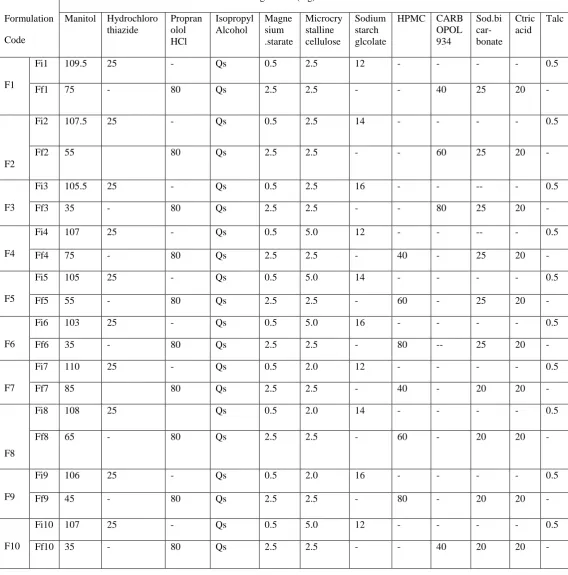
Table No.1 Different batches of bi-layer tabletsIngredients(mg) Formulation
Code
Manitol Hydrochloro thiazide
Propran olol HCl
Isopropyl Alcohol
Magne sium .starate
Microcry stalline cellulose
Sodium starch glcolate
HPMC CARB OPOL 934
Sod.bi car-bonate
Ctric acid
Talc
F1
Fi1 109.5 25 - Qs 0.5 2.5 12 - - - - 0.5
Ff1 75 - 80 Qs 2.5 2.5 - - 40 25 20 -
F2
Fi2 107.5 25 - Qs 0.5 2.5 14 - - - - 0.5
Ff2 55 80 Qs 2.5 2.5 - - 60 25 20 -
F3
Fi3 105.5 25 - Qs 0.5 2.5 16 - - -- - 0.5
Ff3 35 - 80 Qs 2.5 2.5 - - 80 25 20 -
F4
Fi4 107 25 - Qs 0.5 5.0 12 - - -- - 0.5
Ff4 75 - 80 Qs 2.5 2.5 - 40 - 25 20 -
F5
Fi5 105 25 - Qs 0.5 5.0 14 - - - - 0.5
Ff5 55 - 80 Qs 2.5 2.5 - 60 - 25 20 -
F6
Fi6 103 25 - Qs 0.5 5.0 16 - - - - 0.5
Ff6 35 - 80 Qs 2.5 2.5 - 80 -- 25 20 -
F7
Fi7 110 25 - Qs 0.5 2.0 12 - - - - 0.5
Ff7 85 80 Qs 2.5 2.5 - 40 - 20 20 -
F8
Fi8 108 25 Qs 0.5 2.0 14 - - - - 0.5
Ff8 65 - 80 Qs 2.5 2.5 - 60 - 20 20 -
F9
Fi9 106 25 - Qs 0.5 2.0 16 - - - - 0.5
Ff9 45 - 80 Qs 2.5 2.5 - 80 - 20 20 -
F10
Fi10 107 25 - Qs 0.5 5.0 12 - - - - 0.5
56
Table no. 2: Flow property of granules of both layer Table no 3: Comparison of physical parameters of tablet obtained by wet granulation techniques.
FORMULA
CODE
FRIABILITY (%)
HARDNESS (kg/cm2)
Floating lage time (sec.)
Total floatin g time (hr.)
F1 0.88 4.8 58 08
F2 0.84 4.6 59 10
F3 0.79 4.3 64 11
F4 0.81 4.8 44 12
F5 0.84 4.6 45 12
F6 0.77 4.3 46 14
F7 0.78 4.8 46 12
F8 0.74 4.6 45 11
F9 0.83 4.3 49 11
F10 0.87 4.2 48 08
Figure 1: % drug release of HCTZ of F5,F6,F7 FORMULATION
CODE
ANGLE OF REPOSE (ϴ) OF BOTH LAYER
BULK DENSITY (g/cm3)
TAPPED DENSITY (g/cm3)
57
Table no 4: Cumulative % release for different formulations
Figure 2: %Drug release of Propanolol HCL of formulation F4 to F8
Table no 5: In vitro Drug Release Studies of F6
Figure 3: Study of floating behaviour of Formulation F6
FORMULATION CODE
Ff4 Ff5 Ff6 Ff7
%Cumulative Drug Release
1 hr 16.56 12.44 13.72 21.45
2 hr 26.98 24.53 16.87 32.82 3 hr 34.80 30.54 23.72 40.63 4 hr 40.97 36.28 31.87 47.44 5 hr 51.91 48.12 39.76 57.12 6 hr 57.82 54.59 47.50 66.92 7 hr 66.79 62.32 55.57 76.15 8 hr 73.06 67.74 62.66 78.96 9hr 75.23 69.25 68.25 83.15 10hr 80.27 74.38 72.87 85.18 11hr 83.15 77.29 73.56 87.27 12hr 86.28 82.34 73.62 88.35
S.No. Time
(Hr)
% CMD
1 1 13.72
2 2 16.87
3 3 23.72
4 4 31.87
5 5 39.76
6 6 47.50
7 7 55.57
8 8 62.66
9 9 68.25
10 10 72.87
11 11 73.56