33 | P a g e M4-1-1-4-2014
1. INTRODUCTION
Wireless sensors networks have are being used for monitoring applications such as traffic and seismic monitoring and fire detection. Such networks consist of a group of nodes, with signal processing sensing and wireless communication capabilities and limited battery energy [6].The nodes must quickly report the results to a data collection node or access point i.e. we can call it as a base station. Now these nodes are battery- powered, the medium access control (MAC) protocol is critical in determining network lifetime. We can share the communication media fairly and effectively between sensor nodes by using MAC protocol, and is one of the key protocols that ensure high-performance communications in WSN. According to different sensor network application, researchers have proposed various MAC protocols in terms of distinct situations.MAC protocols like S-MAC, which grows from IEEE 802.11, enhances the energy efficiency, while it may result in a non-deterministic per-hop delay [1]. Time Division Multiple Access (TDMA) MAC protocol doesn’t have a problem of retransmission caused by collision. In a TDMA-based MAC protocol, time is divided into equal intervals referred to as
Journal homepage: www.mjret.in
ISSN:2348 - 6953
Deepak C Mehetre
Department of Computer Engineering, Sathyabama University ,
Research Scholar Chennai, India. [email protected]
Dr.Sanjeev Wagh
Research Guide, Sathyabama University, Chennai.
Principal, KJCOEMR, Pune [email protected]
Edge Coloring Scheduling Algorithm
for Wireless Sensor Network using
TDMA based Mac Protocol
Abstract
In wireless sensor network generally people concentrate on minimization of energy consumption. Also, on reducing end-to-end delay and energy saving. This paper also proposes a TDMA-based protocol scheme that will balance energy saving and end-to-end delay. This is achieved by path scheduling assigned by graph coloring method. Our approach consist of three phases: in first phase, we have used Genetic Algorithm for graph coloring strategy to color each path of the networks; then we use this solution to schedule and third phase retrace the path if there are some failed links. In this way, the scheme is also fault tolerant which reduces packet loss.34 | P a g e M4-1-1-4-2014
timeframes, and each timeframe is further split into slots of equal length referred to as timeslots. Timeslots can be allocated to either the nodes or the edges. We concentrate on timeslot assignment to edges rather than to nodes due to concurrency of transmissions, bandwidth proportional to potential requirement, and energy conservation. Our approach consists of two phases: in first phase, we are using Genetic Algorithm for the graph coloring strategy, and we will use this scheme to color each edge of the networks; then, we will use the solution of the edge-coloring to assign timeslots. The main task in designing a TDMA schedule is to allocate time slots depending on the topology and the node packet generation rates. A good schedule not only helps to avoid collisions by silencing the interferers of every receiver node in each time slot but also minimizes the number of time slots hence the latency: The larger latency may require a higher data rate (and hence higher energy consumption) to satisfy a deadline [4]. We therefore try to find a TDMA schedule that minimizes the number of time slots. The remainder of the paper is organized as follows: A brief overview of the related work is presented in Section II. Section III is about motivation for the project. Section IV introduces our scheduling algorithm. Simulation results i.e. the analysis of energy efficiency and analysis of end to end delay are described in section V. Conclusions and future works for research are provided in section VI.
2. RELATED WORK
Yan Zhang, ShijueZheng, ShaojunXiong proposed scheme consists of two phases: in first phase, they used Genetic Algorithm to get the graph coloring strategy; then, they used this solution of the edge-coloring to schedule [1]. This proposed scheme achieves the reduction of the end-to-end delay caused by sleep state while it maximizes the energy savings at the same time.
N.A. Pantazis et al., proposed a TDMA scheduling scheme for energy efficiency in order to construct an appropriate transmission schedule that which will achieve high levels of power conservation and at the same time it will reduce the end-to-end transmission time from the sensors to the gateway [3]. Several power conservation schemes have been proposed in the literature for prolonging the lifetime of sensor networks, either by trying to reduce the number of transmissions through efficient routing, or by taking advantage of the sleep mode capabilities of sensor nodes.
S. Gandham et al proposed link scheduling algorithm involves two phases [2]. In the first phase, he assigned a color to each edge in the network such that no two edges of same color incident on the same node. He proposed a distributed edge coloring algorithm that needs at most (δ+1) colors, where he considered δ is the maximum degree of the graph.
35 | P a g e M4-1-1-4-2014
compared three algorithms, which are PSO algorithm, node based scheduling algorithm and max degree first coloring algorithm.
J. Misra, D. Gries proposed that the graph is valid if and only if all the edges of a graph of
maximum degree less than N can be colored using N colors [5]. The proof they gave consists
of showing how to color an arbitrary uncolored edge of a valid graph [3], and this procedure can be repeated until all edges are colored. Hence, the uncolored edge that is to be colored is found by following this procedure.
S.C. Ergen, P. Varaja proposed schemeis based on the assumption that there are many independent point-to-point flows in the network [6]. In sensor networks however often data are transferred from the sensor nodes to a few central data collectors. So the scheduling problem is to find out the smallest length conflict-free assignment of slots during which the packets generated at each node reach their destination.
Sinem Çöler proposed a scheme in PEDAMACS: power efficient and delay aware medium access protocol for sensor networks. PEDAMACS is a Time Division Multiple Access (TDMA) scheme that extends the common single hop TDMA to a multi hop sensor network, using a high-powered access point for synchronizing the nodes and to schedule their transmissions [7]. This protocol first enables the access point to gather topology information. A scheduling algorithm then determines when each node should transmit and receive data, and then access point will announce the transmission schedule to the other nodes.
3. MOTIVATION
We have gone through many papers related to this topic. We have read the concepts and technologies which researchers used and proposed. After going through the work done by them we motivated to do some research on this topic. We found that there is some space for future work in edge coloring scheme. The work can be done in this direction also so we started to look in this topic with more interest, and the results we found after are researches are discussed here.
4. THE PROPOSED SCHEDULING ALGORITHM
This algorithm follows three phases in first phase we apply edge coloring scheme, in second phase we will assign timeslots and in third phase we make the scheme fault tolerant.
A. Phase 1: edge-coloring scheme
Misra and Gries described a constructive proof of Vizing’s theorem. As we have discussed earlier considering finite graphs without self-loops and multiple edges, they prove that all the edges of a graph of maximum degree less than N can be colored using N colors so that the graph is valid. Therefore, we implement a valid edge coloring using at most (k+1) colors (k is the degree of the graph) with no self-loops and no multiple edges. The detail of our approach will be provided in the following [1].
36 | P a g e M4-1-1-4-2014
We consider a wireless sensor network as a figure
G= (V, E), we divide E into (E0, E1, E2,…,Ek), which haven’t same edges, so that we can use
k+1 colors to color each classification respectively. Two arbitrary edges in each Ei (i=0, 1,
2… k) don’t have any same node, while the number of each classification should be similar. Every individual in the initial population is generated by the following:
(E0, E 1, E 2,…, E k) ,where E i(i=0, 1,2,…, k) is a integer number, that ranges from 1 to k+1. When a k-coloring scheme is found, the value of k is subtracted by 1, and new population should generate by a new value by k, until we find a scheme, whose k can’t be reduced to get a valid edge-coloring.
2) Fitness function
For every individual E= (E0, E 1, E 2… E k), a penalty function is established as bellow:
P(E)= ∑ q(Ei,Ej), (1)
i=1,j=1
Where, m is nothing but the total number of the edges.
Where p (E) has been defined above, k (E) is the number of colors which current E has used. In other words, whenever a scheme using less color has been found, the objective function will change.
B. Phase 2: timeslots assignment
This part bases on the following results in [1].
Theorem1: Suppose, if a path P in Gghas an even number of edges with color g, then the first node and the last node in P have the same sign in a valid signing of P.
Theorem2: If a path P in Gghas an odd number of edges with color g, then the first node and the last node in P have opposite signs in a valid signing of P.
Theorem3: All the nodes in a cycle C in Ggcan be given a valid sign if and only if there is an even number of edges with color g in C.
Theorem4: If the signing algorithm cannot assign a valid sign to some node i in Gg, i belongs to a cycle C which has odd number of edges with color g.
Theorem5: Given a valid sign assignment of a graph Gg(Vg, Eg), we can obtain another valid sign assignment by reversing the sign of each node.
C. Phase 3: Fault tolerance
We have introduced new protocol. Due to which, if a link failure occurs after the edge coloring and timeslots assignments has been done then the path will be traced again. All the data is first collected at base station. When the node asks for information the reply from the Base Station is sent. If any link fails during the data transmission then the path is again traced by requesting for the new path to base station and again the packet is sent to reach the
destination node.
37 | P a g e M4-1-1-4-2014
Step 1: First the node requests the path of destination for packet transmission. Step 2: This request is then passed to base station.
Step 3: The acknowledgement is sent to the node who have requested for the path. Step 4: The path is traced by the base station using by scheduling scheme which firstly performs the edge coloring and the path is then assigned the timeslot for transmission of packet from source to destination.
Step 5: Suppose, in this path any link fails, then the error message is sent to base station. Step 6: Base station would find out the alternative path and then this path is scheduled for transmission of packet to destination.
In this way, we minimized the probability of losing the packets.
Pseudo code:
First of all, we need to create a simulator object. This is done with the following command Set ns [new simulator]
#Create a simulator object set ns [new Simulator] #Open the nam trace file set nf [open out.nam w] $ns namtrace-all $nf
#Define a 'finish' procedure proc finish {} {
Global ns nf $ns flush-trace
#Close the trace file close $nf
#Execute nam on the trace file exec namout.nam&
exit 0 } do {
slot = new Slot ();
send_collision_set = null; recv_collision_set = null; for each node in nodelist { if (node->recv==0 &&
(node not in send_collision_set) && (node->dest not in recv_
collision_set)) {
slot[node] = ‘‘SEND’’; slot[node->dest] = ‘‘RECV’’;
send_collision_set.add(node->dest->neighbors) send_collision_set.add(node->dest)
recv_collision_set.add(node->neighbors) node->dest->recv--;
nodelist.remove(node); }}
frame.add(slot);
} while (slot.length> 0)
38 | P a g e M4-1-1-4-2014
To evaluate the performance of our proposed algorithm, we established the simulation on a non mobile wireless sensor network in a 400×400 meter square area. The number of nodes in the network was 100, while the max degree of the network is no more than 10. The simulation was accomplished by the way of NS2.We have used NS2 which has some basic tools. The NS2 i.e. Network Simulator2 can be defined as a powerful tool, but unfortunately it will not provide any tools for getting results. It simply simulates the network, and then provides a trace file of all the events that have occurred. This means that everyone have to go out and write their own tools to parse through these files. Basically we create here tcl files and we call other files in it.
In order to implement energy efficiency, four statements, that are send mode, receive mode, sleep mode, and idle mode, are set to every edge. Therefore, each edge can transmit information in the send time and sleep mode, while they could consume less power in the idle mode, and little power in the sleep mode. In addition, the energy consumption can be compute by the following equation:
P=Pb {send} P + Pb {rec} P + Pb {idle} P + Pb {sleep} Psleep + , (3)
where Pb{send}, Pb{rec}, Pb{idle}, and Pb{sleep} are the probabilities of the transmitter of the edge being in stats send, receive, idle, sleep, respectively, and Psend, Prec, Pidle, Psleep
are the amounts of energy consumed when the edge is the corresponding state. Here, is
used to keep the high accuracy.
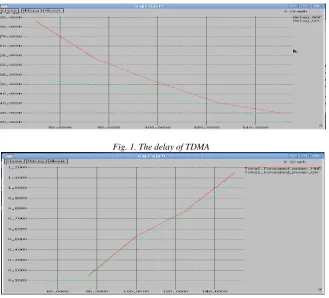
Fig. 1. The delay of TDMA
39 | P a g e M4-1-1-4-2014
We have compared the results of our protocol with S-MAC, Fig. 1 shows the latency of the scheduling. As it shows, we found that TDMA-based MAC protocol generated a very low receivable delay which was because of the fault tolerance of the proposed system. Fig. 2 shows that our TDMA based protocol consumes comparatively lower power than S-MAC
6. DISCUSSION
The study of Vizing’s theorem was begun by E.W. Dijkstra and the ATAC (Austin Tuesday Afternoon Club) at he request of Bob Tarjan, who had found the existing proofs of the theorem too confusing and complex. A constructive proof, as explained by J. Mao is also complicated than this algorithm used. The simple view of the algorithm presented here. The proposed algorithm does not have branches at its top level and which makes it simple. The algorithm, which we looked at after completing our proof, is similar to ours but more complicated. In his algorithm the inversion and rotation occur in a different order. J Misra and David Gries proof is only one page long, the shortness being achieved through omission of necessary arguments. We have proposed the algorithm which is similar to technique provided by Yan Zhang, ShijueZheng, ShaojunXiong but they haven’t introduced any scheme for fault tolerant we have worked on that topic also.
7. CONCLUSIONS
We have proposed a scheduling algorithm which consists of three phases: in the first phase, we have used Genetic Algorithm for getting the graph coloring strategy, and we will use this scheme to color the each edge of the networks; and then, we use the solution of edge coloring to assign timeslots. Then we will trace the path. The simulation shows this approach can consume lower power with low latency. Also, the failure node is found and the alternative path is determined so possibility of losing data is minimized.
8. FUTURE WORK
Our future works include studying other performance improvement techniques including
adaptive tuning strategy in PSO and problem-specific operators in GA. In additional, more situations in TDMA scheduling problem will be considered, such as bi-direction transmission, multiple access points, and more constraints in sensor networks.
REFERENCES
[1]. Yan Zhang, ShijueZheng, ShaojunXiong, ”A Scheduling Algorithm for TDMA-based MAC Protocol in Wireless Sensor Networks”, IEEE DOI 10.1109/ETCS.2009.558, 2009.
[2]. S. Gandham, M. Dawande, and R. Prakash, “Link scheduling in wireless sensor networks: Distributed edge-coloring revisited”, Journal of Parallel Distributed computing 68, pp.1122- 1134, 2008.
[3]. N.A. Pantazis, D.J. Vergados, D.D. Vergados, C. Douligeris, “Energy efficiency in wireless sensor networks using sleep mode TDMA scheduling”, Ad Hoc Networks, 2008, doi:10.1016/j.adhoc.2008.03.006.
[4]. Jianlin Mao, Zhiming Wu, Xing Wu, “A TDMA scheduling scheme for many-to-one communications in wireless sensor networks”, Computer Communications30, 2007, pp.863-872. [5] J. Misra, D. Gries, A constructive proof of Vizing’s theorem, Information Processing Letters 41, pp.131-133, 1992.
[5]. S.C. Ergen, P. Varaja, “TDMA scheduling algorithms for sensor networks”, University of California, Berkley, and Technical Report July 2, 2005. Available at: http://paleale.eecs.erkeley.edu /~varaiya /papers_ps.dir/
tdmachedule.pdf.