IJPAR |Vol.6 | Issue 4 | Oct - Dec -2017 Journal Home page: www.ijpar.com
Research article Open Access
Formulation and evaluation of sulfasalazine tablets for colon targeting using 3
3response surface method
Mohd. Rawoof *
1, 2, K. Rajnarayana
1, M. Ajitha
31
MAK College of Pharmacy, Moinabad, Ranga Reddy, Telangana. India.
2Jawaharlal Nehru Technological University, Kukatpally, Hyderabad-500072, Telangana, India.
3Centre for Pharmaceutical sciences, IST- JNTUH, Kukatpally, Hyderabad-500072, Telangana, India.
*Corresponding Author: Mohammed RawoofEmail: [email protected]
ABSTRACT
The aim of the study was to develop colon targeted tablets of Sulfasalazine (SSZ) by wet granulation method using 33 Response surface method with Design of experiment software and Eudragit RS 100, Eudragit RL 100-55, Ethyl cellulose and PVP K-30 as pH dependent polymers. All the formulations (F1 to F27) were evaluated for the physicochemical parameters and were subjected to in vitro drug release studies. The amount of Sulfasalazine released from tablets at different time intervals was estimated by UV spectrophotometer. The formulation F17 shown 98.21±1.15 of Sulfasalazine after 24h, where as marketed product drug release was 96.21±1.87 after 1 h. The results of the study showed that formulation F17 is the best formulation on the basis of drug release and other evaluation parameters and the pH dependent tablet system is a promising vehicle for preventing rapid hydrolysis in gastric environment and improving oral bioavailability of Sulfasalazine for the treatment of disease at colon region.
Keywords:
Sulfasalazine, Colon targeting, Crohn's disease, Eudragit, pH dependent polymers.INTRODUCTION
Colon targeted Drug Delivery system (CTDDS) may be follow the concept of sustained or controlled drug delivery system, for CTDDS oral route of administration has received most attention. This is because of the flexibility in dosage form designed for oral than parenteral route. Patient acceptance for the oral administration of the drug is quite high. It is relatively safe route of drug administration compared
with parenteral route and potential damage at site of administration is minimal [1].
Most of the conventional drug delivery systems for treating the colonic disorder such as Inflammatory bowel diseases i.e. Ulcerative colitis, Cohn’s diseases, Colon cancer and Amoebiasis are failing as drug do not reach the site of action in appropriate concentration. For effective and safe therapy of these colonic disorders, colon specific drug delivery is
necessary. Today, colon specific drug delivery is challenging task to pharmaceutical technologists.
Therapeutic advantages of targeting drug to the diseased organ include a) The ability to cut down the conventional dose, b) Reduced the incidence of adverse side effects and c) Delivery of drug in its intact form as close as possible to the target sites [2].
Colon targeted delivery systems have been the focus point of formulation laboratories because the colon is considered as a suitable site for delivery of both conventional and labile molecules, and it is also a site for some specific diseases, such as, ulcerative colitis, Crohn’s disease, bowel cancer, some infections, and constipation, which require local delivery of the drug. The most critical challenge in such drug delivery approach is to preserve the formulation during its passage through the stomach and about first six meters of the small intestine [4]. To develop a reliable colonic drug delivery system, the transit time of dosage forms through the gastrointestinal (GI) tract needs to be understood very well. The transit of per orally administered formulation through the GI tract is highly variable and depends on various factors. For example, factors like disease state of the lumen (diarrhea, diabetes, peptic ulcer etc) concomitant administration of other drugs (domperidone, cisapride, metoclopromide etc), body posture (vertical or supine) and food type (fat and protein content) can influence the gastric emptying rate [5].
Sulfasalazine, sold under the trade name Azulfidine among others, is a medication used to treat arthritis, ulcerative, and Crohn's disease [6]. It is often considered as a first line treatment in rheumatoid arthritis [7]. It is taken by mouth. It belongs to a class of drugs called sulfa drugs and is used in the treatment of rheumatoid arthritis (RA) and some other autoimmune conditions. It is a combination of salicylate (the main ingredient in aspirin) and a sulfa antibiotic. Sulfasalazine is also known as a disease modifying antirheumatic drug (DMARD), because it not only decreases the pain and swelling of inflammatory arthritis, but may also prevent damage to joints. In addition, it may reduce the risk of long term loss of function. Because of the high rate of intolerance with sulfasalazine, 5-ASA agents are commonly used as first-line agents for the treatment of mild to moderate ulcerative colitis. These drugs are also commonly used for the treatment of mild to moderately active Crohn's disease, although their
efficacy in Crohn's disease is uncertain. Significant side effects occur in about 25% of people. Commonly these include loss of appetite, nausea, headache, and rash. Severe side effects include bone marrow suppression, liver problems, and kidney problems [7]. It should not be used in people allergic
to aspirin or sulfonamide [6]. Use
during pregnancy appears to be safe for the baby [6]. Sulfasalazine is in the disease-modifying antirheumatic drugs (DMARDs) family of medications [7]. It is unclear exactly how it works but is broken down into sulfapyridine and 5-aminosalicylic acid [6]. Sulfasalazine is a DMARD (Disease-modifying Antirheumatic drugs). DMARDs work to decrease pain and inflammation, reduce/prevent joint damage, and preserve joint mobility. So, Sulfasalazine treats swelling, pain, and stiffness in inflammatory arthritis. However, it is not entirely clear how this medication works for RA.
MATERIALS & METHODOLOGY
Sulfasalazine was generous gift sample from Valens molecules Pvt Ltd, Hyderabad. Eudragit RL 100, Eudragit RL 100-55, HPMC K4M and EC were obtained from Aurobindo Pharma Ltd, Hyderabad. All other chemicals and solvents are of analytical grade.
Preparation of colon tablets of sulfasalazine
Twenty-seven formulations (F1-F27) were prepared by wet granulation method using 33 Response surface method (3 variables and 3 levels of polymers) by using Design of experiment software with polymers like Eudragit RS 100, Eudragit RL 100-55 and Ethyl Cellulose. All the formulations were varied in concentration of polymers, magnesium stearate constituted in all the formulations. All the ingredients were passed through sieve no 85# and were mixed uniformly. Granulation was carried out with sufficient quantity of binder solution (PVP K 30 - 5% in Isopropyl alcohol). The wet mass was passed through sieve no 12# and dried at 450C for 2 hr. Dried granules were sized by sieve no.18# and add magnesium stearate and talc [8]. Granules obtained were compressed with 10 mm flat punch (Cadmach, Ahmedabad, India).
Response Surface Methodology
compression method using 33 Response surface method where 33 indicates 3 variables and 3 levels of polymers of Eudragit RS 100, Eudragit RL 100-55 and Ethyl Cellulose (low, middle and high concentrations) by
using Design of experiment software with the design type of central compositeand quadratic design mode [9, 10, 11].
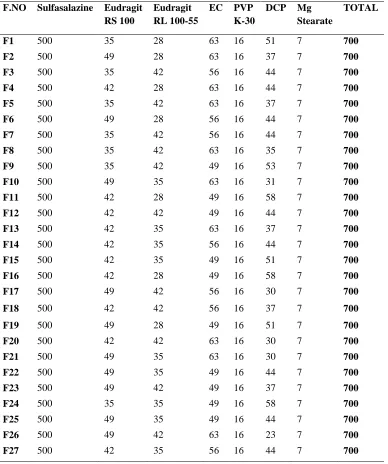
Table 1: Composition of Sulfasalazine tablets F.NO Sulfasalazine Eudragit
RS 100
Eudragit RL 100-55
EC PVP K-30
DCP Mg Stearate
TOTAL
F1 500 35 28 63 16 51 7 700
F2 500 49 28 63 16 37 7 700
F3 500 35 42 56 16 44 7 700
F4 500 42 28 63 16 44 7 700
F5 500 35 42 63 16 37 7 700
F6 500 49 28 56 16 44 7 700
F7 500 35 42 56 16 44 7 700
F8 500 35 42 63 16 35 7 700
F9 500 35 42 49 16 53 7 700
F10 500 49 35 63 16 31 7 700
F11 500 42 28 49 16 58 7 700
F12 500 42 42 49 16 44 7 700
F13 500 42 35 63 16 37 7 700
F14 500 42 35 56 16 44 7 700
F15 500 42 35 49 16 51 7 700
F16 500 42 28 49 16 58 7 700
F17 500 49 42 56 16 30 7 700
F18 500 42 42 56 16 37 7 700
F19 500 49 28 49 16 51 7 700
F20 500 42 42 63 16 30 7 700
F21 500 49 35 63 16 30 7 700
F22 500 49 35 49 16 44 7 700
F23 500 49 42 49 16 37 7 700
F24 500 35 35 49 16 58 7 700
F25 500 49 35 49 16 44 7 700
F26 500 49 42 63 16 23 7 700
F27 500 42 35 56 16 44 7 700
EVALUATION TESTS
Micromeretic properties
Angle of Repose
This is the maximum angle possible between the surface of pile and the horizontal plane. The frictional forces in the lose powder can be measured by angle of
repose. The tangent of angle of repose is equal to the coefficient friction (µ) between the particles. Hence the rougher & more irregular the surface of particles the greater will be angle of repose.
Bulk Density
Tapped Density
The measuring cylinder containing a known mass of blend was tapped for a fixed time (around 250). The minimum volume (Vt) occupied in the cylinder and the
weight (M) of the blend was measured.
Compressibility Index (Carr’s Index)
The simplest way for measurement of free flow of powder is compressibility, an indication of the ease with which a material can be induced to flow is given by compressibility index (C.I)
Hausner’s Ratio
Hausner’s ratio is an index of ease of powder flow [12, 13, 14].
Evaluation of post compression parameters
Weight Variations
Twenty tablets were randomly selected, and average weight was determined. Then individual tablets were weighed and percent deviation from the average was calculated.
Thicknesses
Control of physical dimensions of the tablets such as size and thickness is essential for consumer acceptance and tablet-tablet uniformity. The diameter size and punch size of tablets on the die and punches selected for making the tablets. The thickness of tablet is measured by Vernier Calipers scale.
Hardness
The strength of tablet is expected as tensile strength (Kg/cm2). The tablet crushing load, which is the force required to break a tablet into pieces by compression. It was measured using a tablet hardness tester. Three tablets from each formulation batch were tested randomly and the average reading noted.
Friability
Friability of the tablets was determined using Roche Friabilator (Electrolab, India). This device consists of a plastic chamber that is set to revolve around 25 rpm for 4 minutes dropping the tablets at 6 inches with each revolution. Pre-weighed sample of 20 tablets was placed in the friabilator and were subjected to 100 revolutions. Tablets were dusted using a soft muslin cloth and reweighed.
Content Uniformity
20 tablets were randomly selected, and average weight was calculated. Tablets were powdered in a glass mortar. Powder equivalent to 10 mg was weighed and dissolved in 100 ml of Phosphate buffer pH 7.2 filtered and drug content analyzed spectrophotometrically in UV spectrophotometer at 246 nm.
In Vitro Swelling Studies
The degree of swelling of polymer is an important factor affecting adhesion. For conducting the study, a tablet was weighed and placed in a petri dish containing 5 ml of phosphate buffer pH 7.2 in 12 h at regular intervals of time (1, 2, 4,8,10 and 12 h), the tablet was taken carefully by using filter paper.
In Vitro Drug Dissolution Study
In vitro drug release studies for developed sulfasalazine tablets were carried out by using dissolution apparatus II paddle type (Electrolab TDL-08L). The drug release profile was studied in 900ml of acidic buffer pH 1.2 (first 2 Hrs), Phosphate buffer pH6.8 (next 4 Hrs) and Phosphate buffer pH 7.2 at 37±0.50C temperature with 100 rpm. The amount of drug release was determined at different time intervals upto 24h by UV visible spectrophotometer (Shimadzu UV 1800) at 246nm [15, 16, 17].
Kinetic Model Fitting
Over the recent years, the in vitro dissolution has been recognized as an important tool in drug development. In vitro dissolution has been recognized as an important parameter in quality control and under certain conditions, it can be used as a surrogate for the assessment of bio-equivalence or prediction of Bioequivalence. Guidance recommends USP dissolution apparatus 1, 2, 3 or 4 for modified release dosage forms and generally this equipment is satisfactory. However, modifications of current dissolution equipment or completely new agitation, changing the media, and holding the dosage form in the media without interfering with the release mechanism require careful planning [18, 19, 20].
Introduction to Design of Experiments (DOE)
thereby facilitating design optimization. This article introduces the concept of DOE. Future articles will cover more DOE fundamentals in addition to applications and discussion of DOE analyses accomplished with a ReliaSoft software product [21, 22, 23].
Drug-excipient compatibility studies
Fourier transform infrared spectroscopy (FTIR)
The spectral analysis can be used to identify the functional groups in the pure drug and drug-excipient compatibility. Pure Sulfasalazine FTIR spectra, physical mixtures and optimized formulation were recorded by using FTIR (SHIMADZU). Weighed quantity of KBr and drug-excipients were taken in the
ratio 100: 1 and mixed by mortar. The samples were made into pellet by the application of pressure. Then the FTIR spectra’s were recorded in the wavelength region between 4000 and 400 cm−1.
Stability studies
Stability testing was conducted at 40°C ± 2°C/75% RH ± 5% RH for 3 months using stability chamber (Thermo Lab, Mumbai). Samples were withdrawn at predetermined intervals 0, 30, 60 and 90 days period according to ICH guidelines. Various in vitro parameters like % yield, entrapment efficiency and in vitro release studies were evaluated.
RESULTS AND DISCUSSION
The prepared tablets of Sulfasalazine was shown in Figure 1.
Figure 1: Sulfasalazine colon targeted tablets
Physical parameters of prepared Sulfasalazine powder blends
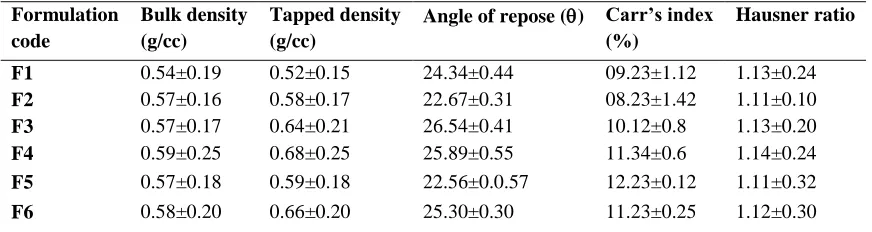
Table 2: Physical properties of prepared powder blends of colon tablet
Formulation code
Bulk density (g/cc)
Tapped density (g/cc)
Angle of repose () Carr’s index (%)
Hausner ratio
F1 0.54±0.19 0.52±0.15 24.34±0.44 09.23±1.12 1.13±0.24
F2 0.57±0.16 0.58±0.17 22.67±0.31 08.23±1.42 1.11±0.10
F3 0.57±0.17 0.64±0.21 26.54±0.41 10.12±0.8 1.13±0.20
F4 0.59±0.25 0.68±0.25 25.89±0.55 11.34±0.6 1.14±0.24
F5 0.57±0.18 0.59±0.18 22.56±0.0.57 12.23±0.12 1.11±0.32
F7 0.51±0.14 0.64±0.16 22.56±0.57 10.34±0.31 1.14±0.20
F8 0.54±0.16 0.68±0.17 23.67±0.60 09.11±0.24 1.12±0.25
F9 0.65±0.18 0.61±0.19 25.56±0.44 09.45±1.15 1.13±0.70
F10 0.66±0.25 0.67±0.18 23.66±0.31 13.45±1.3 1.15±0.20
F11 0.51±0.17 0.68±0.16 22.34±0.37 14.23±1.5 1.13±0.16
F12 0.55±0.16 0.64±0.20 25.99±0.70 11.34±1.25 1.12±0.12
F13 0.56±0.19 0.66±0.18 23.14±0.50 09.67±1.55 1.09±0.14
F14 0.52±0.13 0.66±0.17 22.09±0.57 10.23±1.55 1.14±0.15
F15 0.51±0.18 0.63±0.16 24.78±0.77 10.45±1.5 1.15±0.15
F16 0.52±0.13 0.61±0.15 23.45±0.80 09.681.3 1.18±0.18
F17 0.58±0.13 0.68±0.19 21.09±0.86 09.47±1.09 1.12±0.15
F18 0.56±0.16 0.67±0.20 23.05±0.75 14.99±1.20 1.14±0.15
F19 0.54±0.18 0.61±0.16 26.06±0.67 12.45±1.45 1.13±0.15
F20 0.58±0.17 0.64±0.17 23.78±0.57 13.12±1.45 1.15±0.17
F21 0.59±0.13 0.63±0.18 25.34±0.70 11.09±1.07 1.16±0.20
F22 0.58±0.15 0.67±0.12 25.12±0.35 14.34±1.06 1.17±0.30
F23 0.55±0.14 0.64±0.21 26.45±0.37 10.67±1.25 1.14±0.35
F24 0.54±0.16 0.64±0.12 25.56±0.31 09.68±1.35 1.14±0.15
F25 0.52±0.19 0.68±0.14 23.67±0.44 13.24±0.24 1.11±0.16
F26 0.51±0.19 0.65±0.16 24.12±0.16 09.39±0.25 1.17±0.18
F27 0.54±0.20 0.64±0.13 22.56±0.43 12.05±0.31 1.18±0.15
Above parameters are communicated as Average ± Standard Deviation; (n=3)
The results of bulk densities formulations bearing F1 to F27 reported being in the range of 0.51g/cc to 0.66g/cc. The findings of tapped density formulations
was found to be 21.09 having good flow property. The compressibility index values were found to be in the range of 8 to 15 %. These findings indicated that the all the batches of formulations exhibited good flow properties. The Hausner’s ratio values in the range of 1.11 to 1.18 %. These findings indicated that the all the batches of formulations exhibited good flow properties (Table 2).
Physico-chemical properties of sulfasalazine
tablets
The prepared tablets were evaluated for different physicochemical properties and the results are found to be within the pharmacopoeial limits, which depicted in Table 3.
Table 3: Physico-chemical parameters of sulfasalazine tablets F. No *Weight variation
(mg)
#Thickness (mm)
#Hardness (Kg/Cm2)
#Friability (%)
#Content uniformity (%) #Swelling index (%)
F1 700.12±0.20 8.1±104 7.1±0.13 0.51±0.08 97.23±1.23 88±0.27
F2 699.23±0.24 8.0±1.16 7.0±0.33 0.54±0.09 98.04±1.03 87±0.53
F3 698.08±0.15 8.1±1.05 7.3±0.13 0.63±0.07 96.56±0.94 86±0.51
F4 701.09±0.70 8.2±1.09 7.2±0.10 0.56±0.05 97.11±0.63 86±0.93
F5 701.89±0.50 8.1±1.37 7.1±0.10 0.61±0.07 95.23±0.81 85±0.43
F6 700.34±0.20 8.2±1.11 7.2±0.10 0.67±0.09 96.45±0.32 80±1.04
F7 700.23±0.60 8.0±1.61 7.0±0.15 0.54±0.02 95.11±1.17 88±0.64
F8 699.12±0.50 8.2±1.03 7.2±0.15 0.67±0.02 97.23±0.45 80±0.60
F9 700.23±0.48 8.2±0.45 7.2±0.19 0.56±0.02 97.13±1.17 89±0.64
F10 700.24±0.20 8.1±0.25 7.1±0.21 0.77±0.07 96.23±0.49 85±0.65
F11 701.45±0.97 8.1±0.70 7.4±0.10 0.76±0.05 98.97±0.95 84±0.75
F12 702.03±0.54 8.4±0.25 7.6±0.15 0.73±0.08 98.45±0.35 86±0.51
F13 701.04±0.30 8.5±0.60 6.8±0.18 0.52±0.09 96.85±0.24 94±0.78
F14 698.23±0.35 8.1±0.56 7.2±0.10 0.72±0.02 96.18±0.13 81±0.83
F15 699.34±0.25 8.5±0.70 7.6±0.08 0.71±0.20 97.25±1.21 89±0.63
F16 701.12±0.55 8.1±0.40 7.2±0.21 0.78±0.9 97.45±1.30 86±0.43
F17 700.23±0.50 8.3±0.17 7.7±0.04 0.51±0.04 99.94±1.31 97±0.97
F18 701.67±0.30 8.2±0.40 7.6±0.14 0.82±0.03 98.56±1.36 94±0.87
F19 699.13±0.45 8.0±0.17 7.0±0.12 0.84±0.01 97.29±1.31 89±1.13
F20 699.45±0.55 8.3±0.96 7.5±0.10 0.63±0.03 97.18±1.36 88±1.23
F21 698.12±0.70 8.2±0.50 7.3±0.12 0.66±0.03 96.27±1.30 90±1.27
F22 701.45±0.80 8.0±0.63 7.0±0.10 0.72±0.015 96.34±1.16 91±0.83
F23 700.23±0.55 8.3±0.78 7.8±0.17 0.76±0.04 96.14±1.46 87±1.21
F25 699.14±0.75 8.1±0.57 7.6±0.15 0.67±0.07 96.23±0.84 93±0.92
F26 700.18±0.15 8.3±0.63 7.7±0.18 0.72±0.03 97.34±1.16 95±0.18
F27 700.23±0.75 8.4±0.98 6.9±0.05 0.89±0.04 97.10±1.11 93±1.25
*Values are expressed in mean± SD :( n=20) #Values are expressed in mean± SD :( n=3)
The Weight variation of all formulations within the limit because weight variation deviation is ± 5 for tablet and weight above 700mg. The measured hardness of the tablets of each batch of all formulations i.e. F1 to F27 was ranged between 6.0 to 7.0 Kg/cm2 and the results are shown in Table 3. The thickness of the tablets was found to be almost uniform in all formulations F1 to F27. The thickness of all the formulations between the ranges 7.4 - 8.6 mm. The friability of all prepared formulations was found to be 0.51- 0.89%.
The drug content of all formulation is in between 95.00-99.94%, drug content depends on the angle of
repose since the angle of repose indicates uniform flow nature of powder blend which makes the drug to evenly distribute in all the formulation and to maintain content uniformity in all batches.
The Swelling study of colon sulfasalazine tablets was given in Table 3, showed that the swelling index of the tablet increases with increase in time upto 12 hours, this may be attributed to the fact that the erosion of ethyl cellulose. This indicates that the drug will remain in intestinal region till drug is released completely from the delivery system and promotes evacuation after its release.
Table 4: In vitro Drug Release Profile for colon sulfasalazine tablets F1-F7 Time
(Hrs)
F1 F2 F3 F4 F5 F6 F7
0 0±0 0±0 0±0 0±0 0±0 0±0 0±0
2 03.11±0.88 03.84±1.52 04.71±0.88 05.05±0.32 05.15±0.22 04.95±0.22 03.12±0.12
4 18.58±0.45 23.86±2.44 26.29±0.68 25.60±0.98 24.86±0.21 28.93±2.15 20.23±1.45
6 24.40±1.75 29.95±0.35 32.24±0.69 38.30±1.75 35.18±1.18 40.09±0.32 32.34±0.32
8 35.37±1.65 38.86±0.62 35.80±0.89 48.40±1.55 44.81±1.44 50.72±0.98 44.12±2.26
12 48.89±1.28 46.94±0.75 49.50±0.86 54.50±1.75 53.49±1.51 61.77±1.42 55.72±0.18
16 60.44±1.22 58.68±1.65 56.69±0.59 60.76±1.78 64.57±0.05 72.36±1.59 66.45±1.19
20 78.20±1.34 77.14±1.75 75.69±0.85 77.27±0.18 79.21±1.11 81.23±0.78 78.56±0.52
24 94.38±2.15 93.14±1.55 90.81±1.86 93.08±0.58 94.04±0.78 92.31±0.11 91.89±2.32
Figure 2: In vitro Drug Release Profile for colon sulfasalazine tablets F1-F7
Table 5: In vitro Drug Release Profile for sulfasalazine tablets F8-F13 Time
(hr)
F8 F9 F10 F11 F12 F13 F14
0 0±0 0±0 0±0 0±0 0±0 0±0 0±0
2 05.11±0.15 04.09±1.65 03.17±1.77 04.08±1.16 02.15±1.61 06.95±0.25 03.77±0.85
4 25.74±1.51 21.79±0.6 19.90±0.54 27.76±1.54 29.86±0.72 23.93±0.52 23.64±1.15
6 35.50±1.78 31.76±0.28 30.75±0.85 38.89±1.75 40.18±0.52 32.09±1.35 33.54±2.21
8 44.32±1.54 40.43±0.32 41.08±1.24 48.87±0.78 51.81±0.18 40.72±1.62 40.58±2.22
12 52.81±1.75 50.97±0.75 49.50±1.26 55.97±0.85 59.49±1.18 54.77±1.78 52.28±1.18
16 60.80±1.86 58.89±0.58 58.09±1.48 64.76±1.32 64.57±2.21 70.36±2.22 63.54±1.85
20 78.88±2.14 70.78±0.32 74.79±2.01 74.69±1.45 76.21±0.18 84.23±1.78 75.78±2.15
24 93.59±0.18 84.63±1.98 92.35±0.88 86.51±1.17 87.23±0.33 92.34±0.85 90.46±1.16
Above parameters are communicated as Average ± Standard Deviation; (n=3)
0 2 4 6 8 10 12 14 16 18 20 22 24 0
10 20 30 40 50 60 70 80 90 100
Time (Hours)
C
u
m
u
la
ti
v
e
%
D
ru
g
R
el
ea
se
d
Figure 3: In vitro Drug Release Profile for sulfasalazine tablets F8-F14
Table 6: In vitro Drug Release Profile for sulfasalazine tablets F14-F21 Time
(h)
F15 F16 F17 F18 F19 F20 F21
0 0±0 0±0 0±0 0±0 0±0 0±0 0±0
2 03.77±0.04 02.14±1.85 03.03±0.32 04.05±1.32 04.68±1.78 05.46±0.18 04.12±0.22
4 16.04±0.15 18.26±1.66 24.17±1.96 15.60±0.48 21.54±1.68 28.87±0.59 19.23±0.96
6 30.24±0.18 29.45±1.52 33.78±1.28 31.30±1.88 31.76±0.18 39.97±0.46 32.34±0.28
8 42.78±1.85 37.86±1.63 41.08±1.11 42.40±1.56 42.89±1.15 50.67±0.61 46.12±0.17
12 56.98±2.24 48.04±1.98 54.56±1.23 51.50±1.86 53.98±1.98 61.89±0.86 58.72±1.85
16 65.44±1.18 61.18±1.78 68.98±1.28 62.76±1.28 62.43±1.77 72.67±0.19 68.45±1.72
20 76.88±1.29 77.14±2.18 84.38±0.52 76.27±1.28 78.90±1.65 79.78±0.32 71.56±1.11
24 88.07±1.75 87.27±1.85 98.21±1.15 90.58±1.32 87.32±0.52 91.45±0.11 92.58±0.45
Above parameters are communicated as Average ± Standard Deviation; (n=3)
0 2 4 6 8 10 12 14 16 18 20 22 24
0 10 20 30 40 50 60 70 80 90 100
Time (Hours)
C
u
m
u
la
ti
v
e
%
D
ru
g
R
el
ea
se
d
Figure 4: In vitro Drug Release Profile for sulfasalazine tablets F15-F21
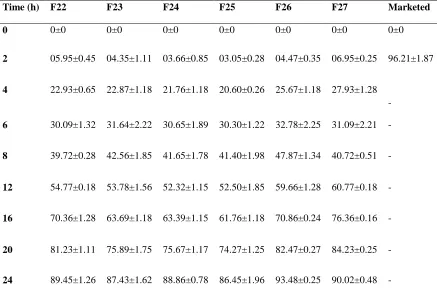
Table 7: In vitro Drug Release Profile for sulfasalazine tablets F22-F27
Time (h) F22 F23 F24 F25 F26 F27 Marketed
0 0±0 0±0 0±0 0±0 0±0 0±0 0±0
2 05.95±0.45 04.35±1.11 03.66±0.85 03.05±0.28 04.47±0.35 06.95±0.25 96.21±1.87
4 22.93±0.65 22.87±1.18 21.76±1.18 20.60±0.26 25.67±1.18 27.93±1.28 -
6 30.09±1.32 31.64±2.22 30.65±1.89 30.30±1.22 32.78±2.25 31.09±2.21 -
8 39.72±0.28 42.56±1.85 41.65±1.78 41.40±1.98 47.87±1.34 40.72±0.51 -
12 54.77±0.18 53.78±1.56 52.32±1.15 52.50±1.85 59.66±1.28 60.77±0.18 -
16 70.36±1.28 63.69±1.18 63.39±1.15 61.76±1.18 70.86±0.24 76.36±0.16 -
20 81.23±1.11 75.89±1.75 75.67±1.17 74.27±1.25 82.47±0.27 84.23±0.25 -
24 89.45±1.26 87.43±1.62 88.86±0.78 86.45±1.96 93.48±0.25 90.02±0.48 -
Above parameters are communicated as Average ± Standard Deviation; (n=3)
0 2 4 6 8 10 12 14 16 18 20 22 24 0
10 20 30 40 50 60 70 80 90 100
Time (Hours)
C
u
m
u
la
ti
ve
%
D
ru
g
R
el
ea
se
d
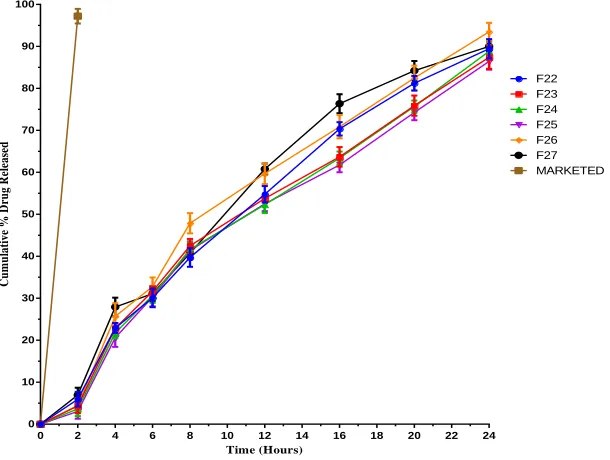
Figure 5:In vitro Drug Release Profile for sulfasalazine tablets F22-F27
In vitro drug release studies
The In vitro drug release studies of 27 different formulations of Sulfasalazine along with marketed product were carried out and the results are depicted in Table 4, 5, 6 & 7 and Figure 2, 3, 4, &5. The highest drug release was found in the formulation F17 i.e. 98.21±1.15% within 24 hrs. F17 was found to be optimized formulation based on the dissolution and other evaluation parameters. The in vitro drug release profile from marketed conventional tablet was found to be 96.21±1.87% within 60min.
Mathematical modeling of optimized formula
(F17) of Sulfasalazine tablets
In the present study drug release mechanism of optimized Sulfasalazine tablets F17 were best fitting to zero order and Higuchi model because regression coefficient was seen closest to 1 in these models which conforms diffusion assisted mechanism of release. Further the n value obtained from the Korsmeyer-Peppas plots i.e. 0.817 indicating non Fickian (anomalous) transport thus it projected that delivered its active ingredient by coupled diffusion and erosion. The reference standard release was explained by first order kinetics as the plot showed highest linearity as the drug release was best fitted in first order kinetics. The results are summarized in Table 8.
Table 8: Release kinetics of optimized formulation of sulfasalazine matrix tablets
Formulation Code Zero Order First Order Higuchi Korsmeyer-Peppas
R2 n R2 n R2 n R2 n
F17 0.994 8.02 0.842 0.119 0.946 29.41 0.988 0.817
Marketed product 0.923 4.87 0.967 0.088 0.925 27.05 0.945 0.823 0 2 4 6 8 10 12 14 16 18 20 22 24
0 10 20 30 40 50 60 70 80 90 100
Time (Hours)
C
u
m
u
la
ti
ve
%
D
ru
g
R
el
ea
se
d
Design of Experiment
This method is mainly used to explain the effect of one factor on other factor. Whether this effect is significant or not. If significant how it influence the
response. In this present work the effect of one factor (Ethyl Cellulose) on other two factors (Eudragit RS 100, Eudragit RL 100-55) is explained.
Figure 6: Response surface plot showing the influence of amount of polymer on the release profile of sulfasalazine colon tablets for Cumulative % Drug Released.
In the above graph the effect of Ethyl Cellulose on % cumulative drug release is examined and it clearly indicates that there is a very significant effect of Ethyl Cellulose on % cumulative drug release. The formulations with all 3 factors shown
% cumulative drug release in between 82.48-98.21 but when Ethyl Cellulose is in low concentrations from the formulations the maximum % CDR is near 82.48.This is the effect of factor (Ethyl Cellulose)
on response (Figure 6).
There is a negligible effect on Swelling Index of formulations because all formulations have excellent Swelling property and there is slightly
influence on Swelling Index by Ethyl Cellulose (Figure 7).
Drug-excipient compatibility studies
Fourier transform infrared spectroscopy (FTIR)
Figure 8: FTIR spectrum of pure drug Sulfasalazine
Figure 10: FTIR spectrum of optimized formulation (F17) of Sulfasalazine tablets
The FTIR Spectrum of Sulfasalazine pure drug, physical mixture and optimized formulation were shown in Figure 8, 9 & 10. The FTIR spectrum of Sulfasalazine optimized formulation F17exhibited
characteristic bands consistent with the molecular structure of Sulfasalazine which indicated that no chemical interaction occurred between the drug and excipients used in the formulation.
Stability study
Table 9: Parameters after Accelerated Stability Study of Formulation F17
Parameters
Temperature Maintained at 40±20C ;
Relative Humidity (RH) Maintained at 75%±5%RH
Initial After 1 month After 2 months After 3 months
Drug Content (%) 99.94±0.14 98.83±0.68 98.10±0.37 97.62±0.22
In Vitro Drug Release (%) 98.21±1.15 97.87±1.53 97.15±1.42 9
96.11±1.35
Swelling Index 97.34±0.64 96.20±0.56 96.13±0.67 97.11±0.23
Hardness 7.7±0.84 7.7±0.34 7.6±0.25 7.5±0.13
After subjecting the optimized formulation (F17) to the accelerated stability studies, there were no major changes observed in drug content, In Vitro drug release, Swelling index and hardness of the formulation, hence the formulation was found to be stable, the results are depicted in Table 9.
CONCLUSION
In present work attempt was made to formulate and evaluate colon tablets of sulfasalazine. Twenty-seven formulations (F1-F27) were prepared by wet granulation method using 33 Response surface method. All the physico-chemical properties of the
formulations were within the limit. The formulation F17 was selected as optimized formulation because it showed minimum release in stomach (Acidic buffer pH 1.2) and small intestine (Phosphate buffer pH 6.8) and a maximize release in proximal colon (Phosphate buffer pH 7.2).
approach for the delivery of sulfasalazine for the treatment of ulcerative colitis and Crohn's disease.
REFERENCES
[1]. Vinay K Gupta, G. Gnanarajan1, Preeti Kothiyal. The Pharma Innovation a Review Article on Colonic Targeted Drug Delivery System, 7, 2012, 14-24.
[2]. Pranjal Kumar Singh, Sanjoo Kumar, T.S.Easwari, V.K.Shukla, Guru Sharan. Formulation Development and Evaluation of Colon Targeted Dosage Form of Ibuprofen, International Journal of Pharma Sciences and Research (IJPSR) January 3, 2001, 268-278.
[3]. Peppercorn MA, Goldman P. The Role of Intestinal Bacteria in The Metabolism of Salicylazosulfapyridine,J Pharmacol Exp Ther, 181, 1972. 555.
[4]. Ordás I, Eckmann L, Talamini M. Ulcerative Colitis. Lancet, 380, 2012, 1606.
[5]. Pragnesh Patel, Anup kumar Roy. Formulation and Evaluation of Colon Targeted Tablets of Ornidazole for the Treatment of Amoebiasis, International Journal of Drug Delivery & Research, 3(1), 2011, 52-61.
[6]. Montgomery, Douglas C, Design and Analysis of Experiments Response Surface Method And Designs, John Wiley and Sons, Inc, New Jersey, 2005, 210-256.
[7]. Schwartz BJ, Connor RE, Optimization Technique in Pharmaceutical Formulations and Processing, J Drugs Pharm Sci Modern Pharm, 72, 1996, 727-54.
[8]. Nair Rahul, Sevukarajan.M, Vishnu Priya K, Arun Kumar K.S. Response Surface Methodology for The Optimization OF Ethyl Cellulose Microspheres, International Journal Of PharmTech Research, 3(2), 775-783. [9]. Friend DR, Phillips S, Mcleod A, Tozer TN. Relative Anti Inflammatory Effect Of Oral
Dexamathasoneß-D-Glucoside And Dexamathasone In Experimental Inflammatory Bowel Disease, J Pharm Pharmacol, 43, 1991, 353–355.
[10]. Fukui E, Miyamura N, Uemura K, Kobayashi M. Preparation Of Enteric Coated Timed Release Press-Coated Tablets And Evaluation Of Their Function By In Vitro And In Vivo Tests For Colon Targeting, Int J Pharm, 204, 2000, 7 - 15.
[11]. Gardner N, Haresign W, Spiller R, Faraj N, Wiseman J, Norbury H, Illum L. Development And Validation Of A Pig Model For Colon-Specific Drug Delivery, J Pharm Pharmacol, 48, 1996, 689–693.
[12]. Gazzaniga A, Bussetti C, Moro L, Sangali ME, Giordano F. Time Dependent Oral Delivery System For Colon Targeting, STP Pharm Sci, 5, 1995, 83-88.
[13]. Raosaheb S, Shendge, Fatima J. Sayyad. Development of Colon Specific Drug Delivery of Aceclofenac by Using Effective Binder System of Ethyl Cellulose, International Journal of Biomedical and Pharmaceutical Sciences, 3, 2010, 1-5.
[14]. Mayur M. Patel, Santnu Et Al., A Synchronous Colon Specific Drug Delivery System for Orally Administered Mesalamine, Acta Pharmaceutical Science, 51, 2009, 251-260
[15]. Asghar LF, Chandran S. Design and Evaluation of Matrices of Eudragit With Polycarbophil And Carbopol For Colon-Specific Delivery, Journal of Drug Targeting, 16(10), 2008, 741-57.
[16]. Soad A. Yehia, Ahmed Elshafeey. Optimization of Budesonide Compression-Coated Tablets for Colonic Delivery, AAPS Pharmaceutical Sciences And Technology, 10(1), 2009, 147-156.
[17]. Nykanen P, Kragars K, Sakkinen M. Organic Acids as Excipients in Matrix Granules for Colon-Specific Drug Delivery, International Journal of Pharmaceutics, 184, 1999, 251-261.
[18]. M. Harris Shoaib, Jaweria Tazeen, Hamid A. Merchant and Rabia Ismail Yousuf, Evaluation of Drug Release Kinetics From Ibuprofen Matrix Tablets Using HPMC, Pakistan Journal Of Pharmaceutical Sciences, 19(2), 2006, 119-124.
[19]. Suvakanda Dash, Padala Narasimha Murthy, Lilakanta Nath and Prasanta Chowdhary. Kinetic Modeling on Drug Release From Controlled Drug Delivery Systems, Acta Poloniae Pharmaceutical, Drug Research, 67(3), 2010, 217-23.
[21]. Landgraf W, N.H. Li and J.R. Benson. New Polymer Enables Near Zero Order Release Of Drugs, Drug Deliv, Technol., 5, 2005, 48-55.
[22]. Nauna Kettanech-Wold. Use of Experimental Design in The Pharmaceutical Industry, Journal of Pharmaceutical and Biomedical Analysis, 9(8), 1991, 605-610.