Department of Mechanical Engineering Department of Mechanical Engineering Saintgits College of Engineering, Kottayam Saintgits College of Engineering, Kottayam
Jijo Abraham
Department of Mechanical Engineering Saintgits College of Engineering, Kottayam
Abstract
This project deals with the development of multifunctional unit which can provide hot water, cold water along with regular space/air conditioning. The design mainly consists of compressor, condenser, evaporator, expansion valve, copper coil, temperature and pressure gauges and tumblers. The refrigerant is used as the medium which absorbs and removes heat from the space to be cooled and subsequently rejects that heat elsewhere. This heat of the refrigerant is used to cool the water, which can be then used for drinking purposes. This work investigates the performance of a domestic refrigerator when a propane/butane mixture is used as a possible replacement to the traditional refrigerant R134a which possess high global warming potential (GDP). The used hydrocarbon mixture comprises 64% propane, 36% butane. The hydrocarbons are cheap and possesses an environmentally friendly nature with no ODP (ozone depletion potential) and GDP.
Keywords: Air Conditioning, Propane/Butane Mixture, ODP, GWP
_______________________________________________________________________________________________________
I. INTRODUCTION
In tropical countries such as India, small split type air conditioners are generally used in residential and commercial buildings. In such establishments, electric water heaters are often used to generate hot water and water coolers to generate cold water. Air conditioner, electric water heater and electric water cooler are generally the major energy consuming devices in the buildings.
Waste heat from air conditioners may be used to produce hot water. The benefits of doing this are twofold. One is elimination of the need to install an electric water heater, and the other is saving of electrical energy otherwise used in the electric water heater and water cooler.
The need for the development of an integrated air conditioning cum water dispenser system at low cost was overcome by using a common compressor for both the systems. The use of common compressor eliminates the use of a separate electrical energy for the operation of water heaters and water coolers. A parallel connection can be bypassed from the compressor of a normal air conditioner in order to make the system suitable for all the three purposes i.e. water heating, water cooling and space conditioning.
Domestic Refrigerator
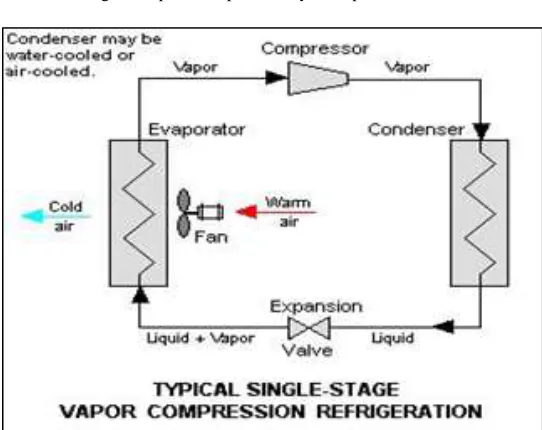
A domestic refrigerator work upon vapour compression refrigeration cycles. In vapour compression cycles are basically four basic process:
1) Isentropic compression process 2) Isobaric heat rejection process 3) Isenthalpic expansion and
Fig. 1: Vapour compression cycle in ph coordinates
Fig. 2: Parts of typical vapour compression refrigeration
History of Refrigerants
The working fluid used to transfer the heat from low temperature reservoir to high temperature reservoir is called refrigerant. There are different types of refrigerant which are dissuasion below.
CFC:
They are molecules composed of carbon, chlorine and fluorine. It contributes to the destruction of the ozone layer. These are R11, R12, R113, R500, R502 etc.
HCFC:
They are molecules composed of carbon, chlorine, fluorine and hydrogen. They are less stable than CFCs, destroy ozone and to a lesser extent. These are R22, R123, R124, R401a etc.
HFC:
They are molecules composed of carbon, fluorine and hydrogen. They do not contain chlorine and therefore do not participate in the destruction of the ozone layer. But it has a high Global Warming Potential (GWP).
Hydrocarbons (HC):
This is primarily propane (R290), butane (R600) and isobutene (R600a). These fluids have good thermodynamic properties, but are dangerous because of their flammability
Table – 1 Properties of refrigerants
Refrigerant Chemical Composition Critical Temp. [°C] Critical pressure [MPa] ODP GWP
R134a CH2FCF3 101.1 4.059 0 1300
Propane (R6000 C4 H10 152 3.79 0 20
refrigeration, Stirling cycle refrigeration, pulse tube refrigeration, Malone cycle refrigeration, absorption refrigeration, adsorption refrigeration, and compressor driven metal hydride heat pumps.
M. Fatouh, M. El Kafafy (2006) The possibility of using hydrocarbon mixtures as working fluids to replace R134a in domestic refrigerators has been evaluated through a simulation analysis in the present work. The performance characteristics of domestic refrigerators were predicted over a wide range of evaporation temperatures (35-100C) and condensation temperatures (40–600C) for various working fluids such as R134a, propane, commercial butane and propane/iso-butane/n-butane mixtures with various propane mass fractions. The results showed that pure propane could not be used as a drop in replacement for R134a in domestic refrigerators because of its high operating pressures and low COP. The coefficient of performance of the domestic refrigerator using a ternary hydrocarbon mixture with propane mass fractions from 0.5 to 0.7 is higher than that of R134a.
III. DESIGN AND EXPERIMENTAL SETUP
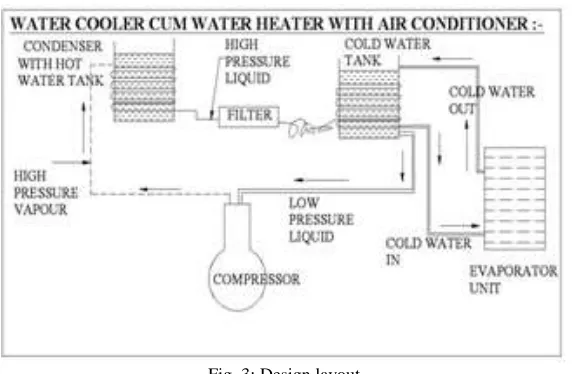
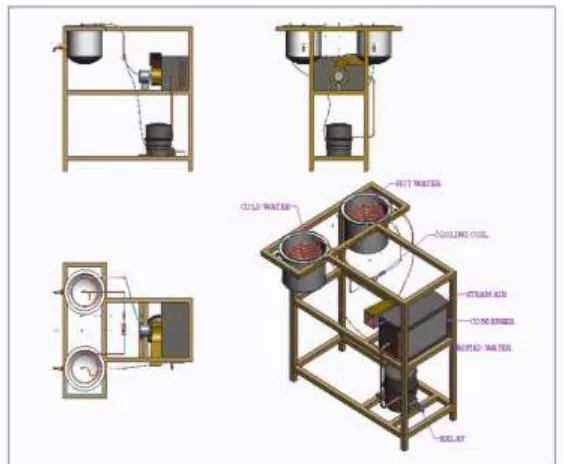
Fig. 3: Design layout
The basic elements in the experimental setup are 1) Fans – for moving air
2) Filters – for cleaning air, either fresh, recirculated or both.
3) Condenser – for exchanging heat with the surrounding atmosphere and provides hot air 4) Compressor–for compressing the refrigerant at high pressure and temperature
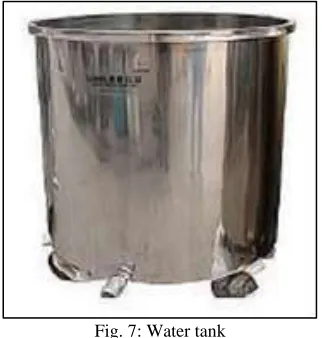
5) Water tank – the acts as hot water and cold water chambers.
Component Description
Frame
The frame is the only structure that is going to support the all the components mounted. This is made up of mild steel material. The whole parts are mounted on this frame structure with the suitable arranged such as nuts and bolts. Spot welds are used to join different sections in the frame.
Compressor
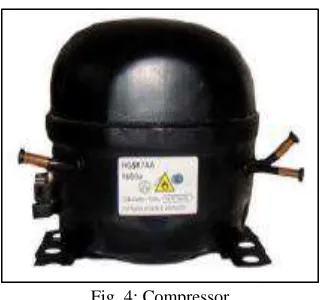
Fig. 4: Compressor
Specifications of the compressor used is listed below: Type – Reciprocating.
No. of stages - One Motor Power - 100 KW
Operating Voltage - 3 Phase, 415 V Condenser
The function of the condenser is to provide a heat transfer surface through which heat passes from the refrigerant to the condenser medium which is either water or air. Air condenser used in the residential and small offices applications is employed in the system.
Fig. 5: Condenser Expansion Device
Its function is to supply a proper amount of refrigerant to the evaporator after reducing its pressure considerably so that the refrigerant may take sufficient amount of heat from the refrigerated space during evaporation. Here capillary tube made up of copper having 1 mm diameter is used for the expansion of the refrigerant.
Fig. 7: Water tank
Fan and Motor Unit
Fan is used to facilitate the movement of air across the conditioned space. The cooled refrigerant is passed to the evaporator where in when air at room-temperature is passed over and a heat exchange takes place leading to evaporation of the refrigerant and thus the air is cooled which is passed to the outlet terminals.
Specifications of the motor used is listed below: Rated power - 3hp
Supply voltage - 230volts Rated speed - 900 rpm
Filter
It is incorporated in the liquid line between hot water chamber and capillary tube. It cleans the refrigerant and prevents it from clogging which may frost the liquid line.
Final Design of Prototype
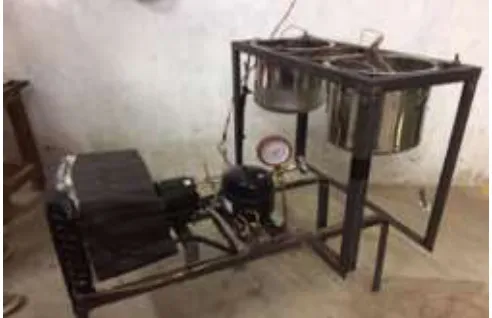
Fig. 9: Final design of the prototype
Calculations
Heat Transferred by Condenser
where, Q= heat transferred by condenser in W K = Thermal conductivity of copper = 386 W/m k
hr = convective heat transfer coefficient of refrigerant = 25w/m2 k hw = convective heat transfer coefficient of water = 100w/m2k r2 = outside radius = 3.35mm
r1 = inside radius =2.35mm
Th = Temperature of refrigerant = 640C Tw = Temperature of water = 330C
= 12.16 W
Effectiveness of Condenser (ε)
((m x Cp x (Thi -Tho))/(m x Cp x (Thi -Tw)) where, m= mass flow rate of refrigerant in kg/sec Thi = Condenser inlet temperature = 64 0C Thi = Condenser inlet temperature = 640C
Tho = Condenser outlet temperature = 530C Tw = Temperature of water = 480C Cp = Specific heat at constant pressure =1.697KJ/Kg K
ε = ((64-53)/(64-48))= 0.6875 = 68.75% ε = 0.6875 = 68.75%
Heat Transferred by Evaporator
where, Q= heat transferred by condenser in W K= Thermal conductivity of copper = 386W/m k
Tw = Temperature of water = 15.5C
Cp = Specific heat at constant pressure =2.47 KJ/Kg K ε = ((11-13)/(11-15.5))
ε = 0.444 = 44.44% ε = 0.444 = 44.44%
Coefficient of Performance (C.O.P)
C.O.P = (h1-h4)/(h2-h1) where h1 = Enthalpy at inlet of compressor in KJ/Kg
h2 = Enthalpy at outlet of compressor in KJ/Kg h4 = Enthalpy at outlet of evaporator in KJ/Kg
hmix=mp x hp + mb x hb Where, mp – mass fraction of propane in mixture
hp – enthalpy of propane
mb, hb –corresponding values of butane From PH charts of propane and butane, p1= pressure at compressor inlet = 44 psi = 3.033 bar
p2 = pressure at compressor outlet = 255 psi = 17.58 bar
h1 = Enthalpy at p=3.033 bar and T=270C = 0.64 x 950 + 0.36 x -35 = 595.4 KJ/Kg h2 = Enthalpy at p=17.58 bar and T=64 0c = 0.64 x 975 +0.36 x 60 = 645.6 KJ/Kg h3= Enthalpy at p=17.58 bar and T= 53 0c = 0.64 x 670 + 0.36 x 30 = 439.6 KJ/Kg C.OP= (595.4 - 439.6)/ (645.6 - 595.4) =3.103 C.O.P =3.103
Working Of Air Conditioner cum Water Dispenser
The process is based on vapour compression refrigeration cycle the refrigerant (propane/butane mixture) is compressed in the reciprocating compressor. It compresses the refrigerant, to increase the pressure of the refrigerant which makes the refrigerant to pass all over the system.
The compressed refrigerant then moves into condenser where the heat is absorbed by the water in the tank and gets heated. Then, from the condenser it moves into expansion device where the refrigerant is going to expand.
The phase of the refrigerant changes in this process from vapour state to liquid state. From the expansion device it enters to evaporator and phase change occurs from liquid state to vapour state.
The copper tube is surrounded to water tank through which the refrigerant passes. It utilizes a small percentage of the refrigerant capacity to cool the water and the remaining refrigerant effect utilized by the air conditioner where the refrigerant passes through the cooling coil.
IV. RESULTS AND DISCUSSION
The prototype showing the working of portable air conditioner cum water dispenser using hydrocarbon mixture satisfies the needs for providing hot and cold water along with air conditioning simultaneously from a single compressor. It can be implemented and can be installed in houses, schools, colleges etc.
The prototype is very compact in design. Maintenance requirements are minimized. Simplicity and temperature requirements were all considered at the same level of importance
The testing of the equipment has been carried out in room temperature where the values are tabulated and the corresponding data is tabulated and the graphs are plotted.
Table – 2
Readings obtained after testing
SL.No. Time min Delivery pressure (psi) Cold water temp (0C ) Hot water temperature (0C)
1 0 210 15.5 40.2
2 10 255 12.9 51.2
3 20 290 12.5 60
4 30 310 12 64
Initially the delivery pressure is low as the system starts to work the delivery pressure goes on increasing.
After 10 minutes the temperature of the water in the cold water chamber reduces to 15.50C and that of water n the hot water chamber increases to 40.20C. The temperature of the water in the cold water chamber reduces further and reaches 120C and temperature of water in the hot water chamber increases to 640C after 30 minutes of operation.
It was noted that further temperature rise or drop cannot be achieved the device will be overloaded. The main advantage of this device is that it is capable of producing the desired level of cold and hot water within 10-20 minutes. Thus helps to minimize electricity usage and fuel.
Fig. 11: Variation of hot water temperature
Fig. 12: Variation of cold water temperature
Table – 3
Distribution of refrigerant capacity
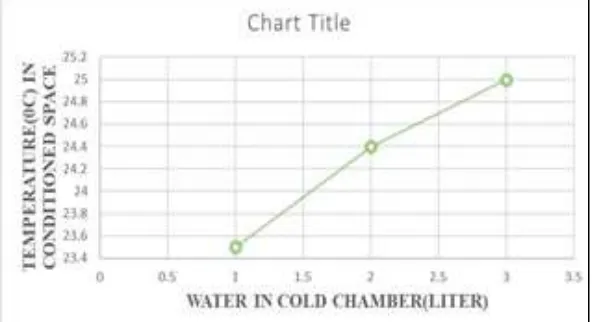
SL.No. Water in hot chamber (liter) Water in cold chamber (liter) Temperature inside Air conditioned space (0C)
1 5 3 25
2 5 2 24.4
Fig. 13: Variation of temperature inside conditioned space
V. CONCLUSION
The air-conditioner cum water dispenser was manufactured for air, water & air-water cycle combined.
R134a is a HFC refrigerant and it contributes to global warming because of the fluorine content. Ozone depletion and total climate change depends on both global warming potential and ozone depletion potential. So, there is a need to find out alternatives of R134a under Kyoto protocol and Montreal protocol.
A good efficiency in terms of coefficient of performance was obtained using propane/butane mixture. Also according to Montreal and Kyoto protocols R600a, R290 and blends of R290 and R600a are the better option for the replacement of R134a in domestic refrigerator, due to their low global warming potential (GWP) and zero ozone depletion potential(ODP).
REFERENCES
[1] P.Techarungpaisan,S.Theerakulpisut,S.Priprem.,”Mode ling of a split type air conditioner with integrated water heater,” Energy Conversion and Management,
2007, volume 48, pages 1222–1237
[2] Pradeep Bansal, Edward Vineyard, Omar Abdelaziz, “Status of not-in-kind refrigeration technologies for household space conditioning, water heating and
food refrigeration”, International Journal of sustainable built environment, 2012, volume 1, pages 85-101
[3] M.Fatouh, M.El Kafafy., ”Assessment of propane/commercial butane mixtures as possible alternatives to R134a in domestic refrigerators”, Energy
Conversion and Management , 2006, volume 47, pages 2644–2658.