Journal of Biological Sciences and Medicine
Available online at www.jbscim.com
ISSN: 2455-5266
7
Review Article
Open Access
Effect of temperature on nitrifying microbes, emphasizing on
ammonia oxidizing archaea and bacteria
Cherita Devi Khangembam*
Aqua Research Lab, Department of Zoology, University of Delhi, Delhi 110007, India
*Corresponding author: [email protected]
ARTICLE INFO ABSTRACT
Article History: Received 6 April 2016
Accepted 6 May 2016
Available online 30 June 2016
Nitrification is a biochemical process that involves the conversion of toxic ammonia to the lesser toxic form i.e., nitrate, mainly studied in wastewater treatment plants, soil samples and different aquaculture units. The first step of nitrification is carried out by ammonia oxidizers, ammonia oxidizing archaea (AOA) and ammonia oxidizing bacteria (AOB). The metabolic activities of these organisms are affected by the changes of temperature. The effect of temperature in the growth of ammonia oxidizing microbes has been discussed widely. Interestingly, temperature changes also induce the alteration of the expression of ammonia monoxygenase (amoA) gene. Different species of these microbes in different habitats have been studied which emphasizes that the degree of effect in different species is different leading to the dynamicity of community structure in nitrifying microbial population. The optimum temperature of these microbes is depended upon the habitats, reflecting the atmospheric temperature, attaining a lower optimum temperature in colder region compared to the population of warmer region. Effects of temperature has been widely reported in combination with other factors such as dissolved oxygen, substrate concentration etc. The reports on the effect of temperature are also extended towards nitrite oxidizing bacteria and the impact on the establishment of ammonia oxidizing microbes.
Key words: Nitrification; Recirculating Aquaculture System; Temperature; Ammonia Oxidizing Archaea; Ammonia Oxidizing Bacteria; Ammonia
Monooxygenase (amoA)
Copyright: © 2016 Khangembam. This is an open access article distributed under the terms of the Creative Commons Attribution License, which permits unrestricted use, distribution, and reproduction in any medium, provided the original author and source are credited.
Introduction
Nitrification is one of the most important step in the ecological nitrogen-cycle that converts the toxic nitrogen-metabolites into lesser toxic substances and the usable form. The nitrification process consists of two major reactions, first being the ammonia oxidation which converts ammonia into nitrite; and second being the nitrite oxidation
which converts ammonia into nitrate
(http://nitrification.org/). Different microbes act on different stages of the reaction. Among them, ammonia oxidizing microbes (archaea and
8 unit due to excess uneaten feed as well as excreta produced by cultured organisms (McGee and Cichra 2000). Hence, the success of this system totally relies on the performances of nitrifying microbes, especially the ammonia oxidizing archaea and bacteria. The activities of these microbes are very much affected by the variation of environmental factors.
In the normal temperature range, the activity of microorganisms increases with the increasing temperature (Shammas 1986). Nitrification rate expressed by the Monod equation has a linear relationship with temperature within a certain range as discussed by Randall and Buth (1984). Effect of temperature on the function and activity of nitrifying bacteria has been studied since long-back. Wortman and Wheaton (1991) analysed the effect of temperature on biodrum (a biofilter type) performance at controlled air and water temperatures (7-35°C) by measuring influent and effluent ammonia, nitrite and nitrate concentrations and found the performance of biodrum was linearly related to temperature in the range 140-400 mg NH4+-N oxidized/l of filter/day. Effect of temperature on activity is also contributed by other factors like total ammonia nitrogen (TAN) and dissolved oxygen (Zhu and Chen 2002). They evaluated the impact of temperature on nitrification rate in fixed film biofilters, where impact of temperature was differently responded under different conditions (DO and TAN) limitations. The nitrification rate was increased by 1.10 and 4.275%/°C under DO and TAN limited conditions, respectively. They consequently analysed the effect of temperature on microbial growth of the fixed and suspended film, and higher rate was reported in fixed film compared to the suspended film. In view of the significance of these microbes in various biological and environmental processes and their plausible sensitivities to temperature changes, an attempt has been made to throw some light on the effect of temperature on different aspects of these microbes.
Effect on abundance and
community-structure of archaeal and bacterial
amoA
Tourna et al. (2008) determined the influence of temperature on the response of ammonia oxidizing bacteria and archaea in nitrifying soil microcosms using two approaches, involving analysis of transcriptional activity of 16S rRNA genes and of a key functional gene
amoA. There was little evidence of changes in
relative abundance or transcriptional activity of ammonia oxidizing bacteria during nitrification. In contrast, denaturing gradient gel electrophoresis analysis of crenarchaeal 16S rRNA and crenarchaeal amoA genes provided strong evidence of changes in community structure of active archaeal ammonia oxidizers. The effect of temperature also affected to the genetic level in ammonia oxidizers, amoA and nirK gene derived from 30 and 55% soil water-filled pore space (WFPS), analysis revealed increasing abundance of bacterial ammonia oxidizers (AOB) with increasing soil temperature and a decrease in the abundance of archaeal ammonia oxidizers (AOA) in wet soil at 25°C (Szukics et al. 2010). Shifts in the community structure was also pronouncedly seen among AOA, whereas, distinct adaptation of the AOB communities required 5 weeks which indicated that AOA populations were more dynamic than AOB.
Community composition and abundance of ammonia oxidizing microbes (AOB and AOA) of lake microcosms have been investigated through
amoA gene, incubating under different
temperatures, 15, 25 and 40°C for 40 days (Zeng et al. 2014). Temperature does not always affect the abundance and diversity of ammonia monooxygenase gene in the same manner. Elevated temperature increases the abundance of archaeal amoA, whereas bacterial amoA
abundance decreased. The reverse case was reported in case of diversity, with the record of highest bacterial diversity at temperature 25°C, whereas, the lowest diversity of archaeal amoA
9 studies on freshwater lake microcosms have also been done by (Wu et al. 2013). Sediments collected from freshwater Lake Taihu, a eutrophic freshwater incubated at different temperatures (4°C, 15°C, 25°C, and 37°C) for 8 weeks, revealed accumulation of nitrate in microcosms, negatively correlated with temperature, while ammonium depletion was the same suggestive of an enhanced activity of other nitrogen transformation processes. The change in community structure and increase in abundance of AOB amoA was recorded after 8-week incubation period. Nitrosomonas sp. strain Is79A3 and Nitrosomonas communis
lineages dominated at low and high temperatures, respectively, indicating a niche differentiation of active bacterial ammonia oxidizers along the temperature gradient. Shore et al. (2012) analyzed the impact of temperature in higher range (35-45°C) on the community structure in moving bed biofilm reactor (MBBR) as a tertiary treatment step for ammonia removal. More than 90% of the influent ammonia (up to 19 mg/l NH3-N) in both the synthetic and industrial wastewater was successfully removed, whereas activity was not recorded beyond 45°C and recovered when the temperature was lowered to 30°C. As a result of community shift, different phenotypes of ammonia and nitrite oxidizing bacteria at elevated temperatures were quantified and Nitrosomonas
oligotropha was found to be the dominant
ammonia oxidizing bacterium in the biofilm in the first phases of reactor operation followed by
Nitrosomonas nitrosa in the later phases indicating
the population dynamics in the reactor. Nitrite accumulation was also observed at some instances revealing the low population of nitrite oxidizing bacteria (NOB). In contrast to the reports on changes in the community structure or composition with the changes of temperature, Kim (2013) reported that the Nitrosomonas
europaea/eutropha and Nitrosomonas nitrosa
remained the dominant AOB, indicating resistance to the influences of a changing environment in a full-scale wastewater treatment plant (WWTP). They further studied the optimums of ammonia
oxidizing rate (AORs) and reported that the rates were reflected through the seasonal changes, higher at warm and lower at colder season. In addition, this optimal condition for AOR can be
adjusted to accommodate to changing
environmental conditions, relying on the acclimatization of a stable AOB community to given conditions, without any visible shift in the AOB community. A broader range of temperature (6-50°C) had been considered in fixed-bed reactors, treating saline wastewater along with variations of salinity, ammonia and nitrous acid concentrations (Sudarno et al. 2011). Ammonia oxidation rates (AOR) and nitrite oxidation rates (NOR) were measured and found increased in the temperature range of 12.5-40°C. However, they reported the rate decreased at 6°C and almost zero at 50°C, where no recovery of nitrification was obtained after incubation at 50°C, whereas nitrification was restorable after incubation at 6°C.
Guo et al. (2010) studied the short and long-term effects of temperature on partial nitrification in a sequencing batch reactor, treating domestic wastewater and found that the specific AOR was decreased by 1.5 times with the temperature decreasing from 25-15°C, however, the low temperature did not deteriorate the stable partial nitrification performance. Nitrite accumulation ratio was always above 90%, even slightly higher (above 95%) at low temperatures.
Effect of temperature on ammonia
oxidizers in colder region
It has been reported that the optimum temperature of nitrification is depended on the environmental temperature. Jung et al. (2011) collected the soil-microcosms from the colder region, Antartica and showed that fungal and archaeal communities were diminished in response to warming temperatures (10°C). Quantification with real time PCR results revealed that the abundance of AOB amoA was higher than AOA
amoA in this Antartic soil. Abundance of archaeal
10 soils were from the King George Island, Antarctic Peninsula, the King Sejong Station to see the effects of elevated temperatures (Han et al. 2013). These soil samples were incubated at elevated temperatures of 5 and 8°C for 14 days. In contrast with the previous report of archaeal dominance in many other habitats, they found that bacterial
amoA dominated over archaeal amoA. Increased
temperature appeared to assist AOA and AOB to proliferate and result in 3.18 and 31.17-fold increase of bacterial amoA and 5.19 and 24.61-fold increase of archaeal amoA in 5 and 8°C. Phylogenetic diversity and species richness of ammonia oxidizing microbes associated with aquarium bio filtration systems in cold temperature has also been reported, where the phylogenetic diversity and species richness of
ammonia oxidizing archaea (AOA) were
recounted greater than ammonia oxidizing bacteria (AOB) (Urakawa et al. 2008). The diversity of both AOA and of AOB was minimized in cold-water aquaria compared to the coastal fish tank, indicating that the role of temperature influencing the population structure and diversity of AOA and AOB in aquarium biofiltration systems.
The study of nitrifying activity doesn’t limit only to the soil microcosms and aquarium but also the shallow moss constructed wetland. Wang et al. (2012) constructed a shallow moss wetland using a specific type of moss (Bryum
muehlenbeckii) and ornithogenic soil collected
from polar-regions, Fildes Peninsula, in the Shetland Islands in West Antarctic, to enhance nitrogen treatment performance at cold temperatures. They divided the experiment into four stages- temperature was set at 20°C during the start-up period of stage one; 12°C during stage two; and 5°C during stage three; at 20°C, the removal efficiency of NH4+-N was 92% in the moss wetland and 56% in the control wetland; at 5°C, the removal rates were 83 and 17%, respectively. Effects of temperature on the filters treating drinking water at cold conditions were evaluated on two different filter media: an opened superstructure wood-based activated carbon and a
closed superstructure activated carbon-based on bituminous coal at two levels: pilot scale (first-stage filters) and full-scale (second-(first-stage filters). The results indicated a strong temperature impact on nitrification activity and 40 - 90% ammonia removal in pilot scale was reported, whereas more than 90% ammonia was removed in the full-scale filters above 10°C, ammonia removal capacity reduces below 30% in both pilot- and full-scale filters below 4°C (Andersson et al. 2000).
Effect of temperature in combination
with other factors
Lee et al. (2011) developed two equations on the effect of temperature and other variables (zinc concentration, microbial population) on acclimation (lag phase) and ammonia oxidation rate (growth of AOB) in a steel industry wastewater treatment plant. A significant interaction between AOB concentration and temperature for both lag period and ammonia oxidation rate was reported showing the effect in the length of lag phase by variation of AOB concentration (<1.5X10⁷ copies/ml) and decrease-temperature (<28°C).
11 incompletely removes the AOB population and concluded that nitrification is inadequately inhibited in lower temperature. The effects of temperature and free ammonia of landfill leachate on nitrification and nitrite accumulation were investigated with a semi-pilot scale biofilm airlift reactor (Kim et al. 2006). Nitrification rate of landfill leachate increased with temperature when free ammonia in the reactor was below the inhibition level for nitrifiers. Zhang et al. (2009) studied pilot-scale moving-bed biofilm reactor (MBBR) for biological treatment of micro-polluted raw water was operated over 400 days to investigate the responses of biofilm characteristics and nitrification performance to variations in temperature and NH4+-N loading rate.
Effect
of
temperature
on
nitrite
oxidizing bacteria
The effects of temperature also extended to nitrite oxidizing bacteria (NOB). Alawi et al. (2009) collected the samples from activated sludge, from the municipal waste water treatment plant in Hamburg, seeded with mineral nitrite medium and incubated at 10, 17 and 28°C. They observed a temperature-dependent shift in the population structure; interestingly the novel nitrite oxidizer was enriched at temperatures of 10 and 17°C. The authors also reported that the different species was found to grow at different temperature, such as representatives of Nitrospira
were able to grow in a broad temperature range between 10°C- 28°C and members of Nitrobacter
were enriched during incubations at 17°C and 28°C.
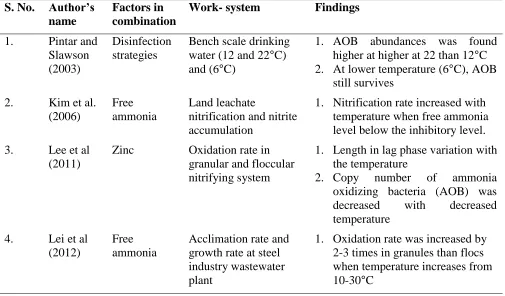
Table 1: Effect of temperature on nitrifying microbes in combination with other factors
S. No. Author’s name
Factors in combination
Work- system Findings
1. Pintar and
Slawson (2003)
Disinfection strategies
Bench scale drinking water (12 and 22°C) and (6°C)
1. AOB abundances was found
higher at higher at 22 than 12°C 2. At lower temperature (6°C), AOB
still survives
2. Kim et al.
(2006)
Free ammonia
Land leachate
nitrification and nitrite accumulation
1. Nitrification rate increased with temperature when free ammonia level below the inhibitory level.
3. Lee et al
(2011)
Zinc Oxidation rate in
granular and floccular nitrifying system
1. Length in lag phase variation with the temperature
2. Copy number of ammonia
oxidizing bacteria (AOB) was
decreased with decreased
temperature
4. Lei et al
(2012)
Free ammonia
Acclimation rate and growth rate at steel industry wastewater plant
12
Effect of temperature on activity and
kinetics
Immediate and adaptive effects of temperature were recorded in soil samples by Gödde and Conrad (1998). Samples were pre-incubated at 25°C and then exposed to gradually increasing temperatures (starting at 47°C and finishing at 40-45°C) which is referred as “temperature shift experiment”. In the second approach, the soil samples were pre-incubated at different temperatures (4°C-35°C) for 5 days and then tested at the same temperatures and referred as “discrete temperature experiment”. Under both these conditions, the effect of temperature changes was assessed and the results on the pattern of NO and N2O productions were differently recorded in both the above conditions. In the first experiment, NO release was increased steadily with increasing temperature in both soils; whereas, this production was minimum at intermediate temperature (13-25°C) in the second experiment and showed more than 95% contribution of nitrification in nitrite production at 25°C. However, nitrification remains dominant contributor in “temperature shift experiment” also but there was a lack of correlation between this rate and temperature change.
Horak et al. (2013) derived Michaelis-Menten kinetics curve for ammonia oxidation and measured the Km for ammonia oxidation of naturally found ammonia oxidizing archaea incubating at the temperature range from 8-20°C. They observed the value of Km as 98 ± 14 nmol/l was lower but close to that for cultivated AOA representative Nitrosopumilus maritimus SCM1, in addition the ammonia oxidation rate was not affected by the temperature in case of AOA, unlike AOB. In an another example it was found that the kinetic constants were dropped when temperatures ranged from 20°C -5°C (Wang et al. 2012).
Temperature also has impact on the microbial establishment. Biofilm development was primarily monitored using AOB abundance and nitrite concentrations (Pintar and Slawson
2003). They set-up the bench-scale system, which was initially operated under typical North American summer (22°C) and fall (12°C)
temperatures. AOB establishment also
investigated at suboptimal winter of 6°C and the establishment was recorded at all examined temperatures. It can be summarized from the different studies that nitrification may not be adequately inhibited during the winters, which may result in more advanced stages of nitrification during the following seasons. A short list has been provided Effect of temperature on nitrifying microbes in combination with other factors.
Conclusion
Temperature has major role in maintenance of global nitrogen cycle, affecting the microbial activities beyond the optimum ranges. Like any-other reaction, the rate of oxidation of ammonia by microbes is also affected by the seasonal/ global temperature fluctuations. The above studies discussed the effect of temperature on ammonia oxidizing microbes on activity, growth and the community structures on various habitats. The effects are also extended upon the expression of genetic level of microbes causing a change in community structure in the microbial population.
Conflicts of interest
All contributing authors declare no conflicts of interest.
Acknowledgments
The author is thankful to University Grants Commission, New Delhi for providing fellowship and to University of Delhi, Delhi for providing the fund under Research and Development Grant.
References
Alawi M, Off S, Kaya M, Spieck E (2009) Temperature influences the population structure of nitrite-oxidizing bacteria in activated sludge. Environ Microbiol Rep 1:184-190. doi:10.1111/j.1758-2229.2009. 00029.x
13
nitrification in biological activated carbon (BAC) filters used for drinking water treatment. Water Res 35:2923-34. doi:10.1016/S0043-1354(00)00579-0 FAO (Food and Agriculture Organization of the United
Nations) (2015) A Guide to Recirculation Aquaculture. An introduction to the new environmentally friendly and highly productive closed fish farming systems. Author: Jacob Bregnballe pp 1-100
Gödde M, Conrad R (1999) Immediate and adaptational temperature effects on nitric oxide production and nitrous oxide release from nitrification and denitrification in two soils. Biol Fertil Soils 30:33-40. doi:10.1007/s003740050584
Guo J, Peng Y, Huang H, Wang S, Ge S, Zhang J, Wang Z (2010) Short- and long-term effects of temperature on partial nitrification in a sequencing batch reactor treating domestic wastewater. J Hazard Mater 179:471-479. doi: 10.1016/j.jhazmat.2010.03.027 Han J, Jung J, Park M, Hyun S, Park W (2013) Short-term
effect of elevated temperature on the abundance and diversity of bacterial and archaeal amoA genes in Antarctic Soils. J Microbiol Biotechnol 23:1187-1196 Horak REA, Qin W, Schauer AJ, Armbrust EV, Ingalls AE, Moffett, JW, Stahl DA, Devol AH (2013) Ammonia oxidation kinetics and temperature sensitivity of a natural marine community dominated by Archaea. ISME J 7:2023-2033. doi:10.1038/ismej.2013.75 Jung J, Yeom J, Kim J, Han J, Lim HS, Park H, Hyun S, Park
W (2011) Change in gene abundance in the nitrogen biogeochemical cycle with temperature and nitrogen addition in Antarctic soils. Res Microbiol 162:1018-1026. doi: 10.1016/j.resmic.2011.07.007
Kim DJ, Lee DI, Keller, J (2006) Effect of temperature and free ammonia on nitrification and nitrite accumulation in landfill leachate and analysis of its nitrifying bacterial community by FISH. Bioresour Technol 97:459-468.
Kim YM (2013) Acclimatization of communities of ammonia oxidizing bacteria to seasonal changes in optimal conditions in a coke wastewater treatment plant. Bioresour Technol 147:627- 631. doi: 10.1016/j.biortech.2013.08.062
Kowalchuk GA, Stephen JR (2001) Ammonia-Oxidizing Bacteria: A Model for Molecular Microbial Ecology. Annu Rev Microbiol 55, 485–529.
Lee S, Cho K, Lim J, Kim W, Hwang S (2011) Acclimation and activity of ammonia-oxidizing bacteria with respect to variations in zinc concentration,
temperature, and microbial population. Bioresour Technol 102:4196 – 4203.
McGee MV, Cichra, C (2000) Principles of water
recirculation and filtration in aquaculture. University of Florida Cooperative Extension Service, Institute of Food and Agriculture Sciences, EDIS.
Pintar KDM, Slawson RM (2003) Effect of temperature and disinfection strategies on ammonia-oxidizing bacteria in a bench-scale drinking water distribution system. Water Res. 37:1805-1817. doi:10.1016/S0043-1354(02)00538-9
Randall, CW, Buth, David (1984) Nitrite build up in activated sludge resulting from temperature effects. J Water Pollut Control Fed 56:1039.
Shammas NK (1986) Interactions of temperature, pH and biomass on the nitrification process. J Water Pollut Control Fed 58:52-59.
Shore JL, M’Coy WS, Gunsch CK, Deshusses MA (2012) Application of a moving bed biofilm reactor for tertiary ammonia treatment in high temperature industrial wastewater. Bioresour Technol 112:51-60. doi: 10.1016/j.biortech.2012.02.045
Sudarno U, Winter J, Gallert C (2011) Effect of varying salinity, temperature, ammonia and nitrous acid concentrations on nitrification of saline wastewater in fixed-bed reactors. Bioresour Technol 102:5665-5673. doi: 10.1016/j.biortech.2011.02.078
Szukics U, Abell G, Hödl V, Mitter B, Sessitsch A, Hackl E, Zechmeister-Boltenstern S (2010) Nitrifiers and denitrifiers respond rapidly to changed moisture and increasing temperature in a pristine forest soil. FEMS Microbiol Ecol 72:395-406.
doi:10.1111/j.1574-6941.2010. 00853.x
Tourna M, Freitag, TE, Nicol GW, Prosser JI (2008) Growth, activity and temperature responses of ammonia-oxidizing archaea and bacteria in soil microcosms. Environ Microbiol 10:1357-1364. doi:10.1111/j.1462-2920.2007. 01563.x
Urakawa H, Tajima Y, Numata Y, Tsuneda S (2008) Low temperature decreases the phylogenetic diversity of ammonia-oxidizing archaea and bacteria in aquarium biofiltration systems. Appl Environ Microbiol 74: 894-900. doi:10.1128/AEM.01529-07
Wang F, Liu Y, Ma Y, Wu X, Yang H (2012) Characterization of nitrification and microbial community in a shallow moss constructed wetland at cold temperatures. Ecol Eng 42:124-129.
doi:10.1016/j.ecoleng.2012.01.006
14
biodrum nitrification. Aquacult Eng 10:183-205 Wu Y, Ke X, Hernández M, Wang B, Dumont MG, Jia Z,
Conrad R (2013) Autotrophic growth of bacterial and archaeal ammonia oxidizers in freshwater sediment microcosms incubated at different temperatures. Appl Environ Microbiol 79:3076- 3084. doi:10.1128/AEM.00061-13
Zeng J, Zhao D, Yu Z, Huang R, Wu QL (2014) Temperature Responses of Ammonia- Oxidizing Prokaryotes in Freshwater Sediment Microcosms. PloS one 9:p.e100653. doi.10.1371/journal.pone.0100653 Zhang L, Wei C, Zhang K, Zhang C, Fang Q, Li S (2009)
Effects of temperature on simultaneous nitrification and denitrification via nitrite in a sequencing batch biofilm reactor. Bioprocess Biosyst Eng 32:175 – 182. doi:10. 1007/s00449-008-0235-3