Volume 2009, Article ID 965436,12pages doi:10.1155/2009/965436
Research Article
Adaptive V/UV Speech Detection Based on
Characterization of Background Noise
F. Beritelli,
1S. Casale,
1A. Russo,
1and S. Serrano
21Dipartimento di Ingegneria Informatica e delle Telecomunicazioni, Universita’ degli Studi di Catania, Viale Andrea Doria, 6, 95125 Catania, Italy
2Dipartimento di Fisica della Materia e Ingegneria Elettronica, Universita’ di Messina, Salita Sperone, 31, 98166 Messina, Italy
Correspondence should be addressed to S. Serrano,[email protected]
Received 9 October 2008; Revised 24 February 2009; Accepted 24 June 2009
Recommended by Gerhard Rigoll
The paper presents an adaptive system for Voiced/Unvoiced (V/UV) speech detection in the presence of background noise. Genetic algorithms were used to select the features that offer the best V/UV detection according to the output of a background Noise Classifier (NC) and a Signal-to-Noise Ratio Estimation (SNRE) system. The system was implemented, and the tests performed using the TIMIT speech corpus and its phonetic classification. The results were compared with a nonadaptive classification system and the V/UV detectors adopted by two important speech coding standards: the V/UV detection system in the ETSI ES 202 212 v1.1.2 and the speech classification in the Selectable Mode Vocoder (SMV) algorithm. In all cases the proposed adaptive V/UV classifier outperforms the traditional solutions giving an improvement of 25% in very noisy environments.
Copyright © 2009 F. Beritelli et al. This is an open access article distributed under the Creative Commons Attribution License, which permits unrestricted use, distribution, and reproduction in any medium, provided the original work is properly cited.
1. Introduction
The issue of Voicing Detection Algorithms (VDAs) has been one of the topics most analysed in the field of speech processing research during the last three decades [1,2].
The correct Voiced/Unvoiced (V/UV) classification of a sound is essential in several speech processing systems. Interest in voicing detection algorithms originally arose in the field of speech coding (in particular low bit rate, multimode, and multiband speech coding) but then spread to various other fields of application such as speech anal-ysis, speech synthesis, automatic speech recognition, noise suppression and enhancement, pitch detection, voice activity detection, speaker identification, and the recognition of speech pathologies.
Voiced speech is produced by a quasiperiodic air flow generated by the vibration of the vocal cords, while unvoiced speech is produced by a turbulent air flow crossing some constriction in the vocal tract. The signal of a voiced sound is more or less periodic, while an unvoiced signal is noise-like. In general there are various aspects to be analysed and taken into consideration in developing a voiced/unvoiced detection system: the complexity of the algorithm, the delay
introduced (and thus the duration of the analysis window in which the decision is made), robustness to noise (which is mainly channel and/or background noise), the overall performance of the system, any other phonetic classes to be considered (silence/background noise, mixed sounds, etc.), and the training and testing database used to design and test the algorithm (in particular the duration, the number of different speakers, the number of languages, the types of digitally added noise, the sampling frequency, etc.).
typically stationary, narrow-spectrum, and low frequency, on the performance of an automatic speech recognition system is obviously different from that of street noise, which is nonstationary and has a spectrum covering the whole range of speech signal frequencies. Knowledge of the type of noise altering the characteristics of the speech signal is fundamental in order to adapt the speech processing system dynamically, thus making it even more robust to background noise. It would be interesting to introduce an adaptive V/UV detection approach to evaluate any improvement in performance in the presence of background noise as compared with that of a nonadaptive system. In [6] we proposed a new approach for noise robust V/UV detection based on adaptive noise classification and SNR estimation. In this paper we present an extended version of this work. Specifically, the performance of the classification system is compared with that of other V/UV classifiers: the V/UV detection system in the ETSI ES 202 212 v1.1.2 and the speech classification in the Selectable Mode Vocoder (SMV) algorithm. The performance of the system is also tested using an extended set of noises. Comparative results with fixed methods showed that the adaptive system proposed outperforms the traditional solutions.
2. Previous Works
Various methodologies and approaches have been adopted in V/UV detection techniques. All of the proposed methods have their merits, and preference for one over another is primarily determined by the particular application in which such systems are to be used. There are, however, two main categories [2]: the first comprises VDA techniques used in conjunction with Pitch Determination Algorithms (PDA) in which the V/UV decision is made as part of the pitch determination problem, whereas the second includes solutions based on the value of some parameter or feature extracted from the speech frame analysed. Atal and Rabiner [7] consider the methods belonging to the first category to be of little practical interest. For pitch detection, in fact, a large speech segment, 30–40 miliseconds long, is necessary, while by separating the V/UV decision from pitch detection, it is possible to perform the V/UV decision on a much shorter speech segment. In general the VDAs belonging to the second category detect segments of silence as well as the two phonetic classes of V/UV sounds.
The following is a brief chronological survey of the main work published in the field of voicing detection, highlighting the techniques used and the performance obtained.
The first VDAs mainly took account of the need for low computational complexity and were therefore based on pattern recognition techniques based on simple parameters extracted from the signal such as energy, zero crossing rate, first autocorrelation coefficient, first predictor coefficient, and the energy of the prediction error. In [7] the method proposed was found to provide reliable classification with clean speech segments as short as 10 miliseconds, while in [8] a spectral characterization of each class of signal was obtained during a training session, and an LPC distance
measure and an energy distance were nonlinearly combined to make the final V/UV discrimination. The algorithm was tested using a number of different speakers, telephone lines and utterances, obtaining an overall error rate of about 5%. In [1] the training phase was accomplished using a nonparametric, nonstatistical technique obtaining an error rate of less than 1% for clean speech sequences. In [9] the principal features of the VDA proposed are simplicity of realization and operation in real time with delays of less of 5 miliseconds. In [10] an adaptive V/UV decision method for noisy speech is proposed. The paper presents a method for estimating the probability density function of correlation peak values and also estimating the optimal threshold of the V/UV decision for speech corrupted by nonstationary noise. In [11] the voiced-unvoiced-silence classification algorithm is based on a multilayer feedforward network. The feature vector for the classification is a combination of cepstral coefficients and waveform features. Results indicated that an error rate of less than 4% was obtained. In [12] an improved cepstrum-based voicing detection algorithm is presented. The V/UV decision is based on multifeature statistical analysis (cepstrum peak, zero-crossing rate, and energy of short time segments of speech). A white Gaussian noise was added to clean speech, and the performance was about 1% at 10 dB in both V-to-UV and UV-to-V misclassification and about 4% at 0 dB.
In [16] a speech periodicity-harmonic function (SPHF) is proposed to manifest distinctive characteristics between voiced and unvoiced regions. A composite feature vector is developed by combining a periodicity measure obtained from the SPHF with some energy measures such as zero-crossing rate-weighted RMS energy, Kaiser-Teager frame energy, and the normalized low-frequency energy ratio. Unlike the conventional hard threshold, a signal-dependent initial-threshold (SDIT) for each feature is determined based on its statistical properties. The SDIT is exploited to develop a logical expression that returns an objective score regarding the V/UV region. Additional voicing criteria are introduced to remove artifacts that may exist due to overlapping between decision regions. White Gaussian noise (WGN) is added to clean speech to have a range of SNRs from clean to 0 dB. Performance in terms of total error ranges from 6% to 11% for SNRs at 0 dB.
In [17] a low-complexity and efficient speech classifier for noisy environments is presented. The proposed algo-rithm utilizes the advantage of time-scale analysis of the Wavelet decomposition to classify speech frames into voiced, unvoiced, and silent classes. The classifier uses only one single multidimensional feature which is extracted from the Teager energy operator of the wavelet coefficients. The fea-ture is enhanced and compared with quantile-based adaptive thresholds to detect phonetic classes. Furthermore, to save memory, the adaptive thresholds are replaced by a slope tracking method on the filtered feature. These algorithms are tested with the TIMIT database and additive white, car and factory noise at different SNRs (30, 20, 10, 5 dB). In this research, the closure and release frames of plosives are not counted because they cannot be clearly determined as voiced or unvoiced sounds. The average error rate obtained for the clean case is about 7%, while at an SNR of 5 dB the average total error is about 14% for white noise, 18% for car noise, and 21% for factory noise.
In [18] a method for estimation of the voicing character of speech spectra is presented. It is based on calculation of a similarity between the shape of the short-term signal magnitude spectra and the spectra of the frame-analysis window, which is weighted by the signal magnitude spectra. The experimental results in terms of false acceptance and false rejection show errors of less than 5% for speech corrupted by white noise at the local SNR of 10 dB. The main novelties introduced in this work in relation to the state of art are: the adaptation of V/UV as a function of background noise and SNR, the use of a large initial set of features,s and the use of Genetic Algorithms (GAs)for feature selection.
3. Adaptive V/UV Detection Proposed
A block diagram of the adaptive V/UV detector proposed in this paper is shown in Figure 1. A Voice Activity Detector (VAD) classifies the input speech signal between talkspurt and background noise. The VAD detector adopted is based on the algorithm proposed in [3]. According to the char-acteristics of the background noise it is possible to select the set of parameters and the matching blocks dynamically, so as to optimize their performance by selecting the best
configuration for that particular level and type of noise. The matching phase of the adaptive V/UV system is based on neural networks. A method for optimal choice of the architecture of an NN does not exist. As shown in [11], a neural network with 3 layers is capable of achieving performance similar to that of a network with a larger number of layers to solve the problem of V/UV classification. For this reason a 3-layer FFNN was chosen. As indicated in the previous section, various parameters have been proposed as the starting point for V/UV speech classification. We chose to use a vector of only a few parameters because the main aim of the paper is to evaluate the increase in performance that can be obtained by using an system capable of adapting to the type of noise and the SNR rather than a nonadaptive system. 5 parameters were chosen, in agreement with [7] where a V/UV speech classification system using pattern recognition techniques is proposed for the first time. We calculated the number of nodes in the hidden layer using an approach similar to that followed by the authors of [11]. In the clean case alone we calculated performance using 5 networks with a number of hidden layer nodes ranging between 5 and 30. The 5-15-1 architecture was chosen because it achieved the best tradeoffbetween performance and system complexity (the gain in terms of performance obtained by using networks with more than 15 nodes in the hidden layer was negligible and did not justify the increase in complexity). The V/UV detector for every class uses a 3-layer neural network with 5 nodes in the input layer, 15 nodes in the hidden layer, and a single output node. In the training phase the resilient backpropagation algorithm was used: each node uses the tansig (hyperbolic tangent) activation function. The networks were trained to give an out-put value of 1 for voiced speech frames and −1 for unvoiced speech frames. The noise classifier was trained to distinguish between N = 4 different classes of noise (car, office, restaurant, and street noise), while the SNR estimation block distinguishes between M = 5 values (0 dB, 5 dB, 10 dB, 15 dB, 20 dB). Considering that when the SNR estimate exceeds a certain maximum value, the signal is considered to beclean,and so it is not necessary to distinguish between the various types of noise, there will be a total of 21 blocks. 21 neural networks were trained, each with a set of parameters selected for a specific combination of noise type and SNR. During operations, the adaptive V/UV system decides which noise category each frame belongs to and estimates the SNR. On the basis of this information, the system extracts the set of parameters selected for that class and activates the corresponding neural network. Classification is performed using the output of the neural network selected.
Background noise classification
Speech
signal
SNR estimation
VAD
<
SNR
1
>
SNR
1
<
SNR
2
Clean
Type 1
Block (1, 1)
Block (1, 2)
Block
(1, N)
Block (2, 1)
Block
(M−1, 1)
Block
(M−1, 2)
Block
(M−1, N)
Block (2, 2)
Block
(2, N)
Type 2 · · · Type N
···
Talkspurt
Background
noise
>
SNR
M
−
2
<
SNR
M
−
1
>
SNR
M
−
1
V/UV classifier for SNR 0.5×(SNR1+ SNR2)
and noise type 2
Figure1: Block diagram of the adaptive V/UV detector.
Table1: Voiced/Unvoiced phoneme classification.
Voiced
Semivowels and Glides (l r w y hh hv el) Vowels (iy ih eh ey ae aa aw ay ah ao oy ow
uh uw ux er ax ix axr) Voiced stops (b d g)
Voiced affricates (jh) Voiced fricatives (z zh v dh) Nasals (m n ng em en eng nx) Flap dx (dx)
Unvoiced
Closure symbols for the stops b, d, g, p, t, k (bcl dcl gcl pcl tck kcl)
Closure portions of jh (bjh) Closure portions of ch (tcl) Devoiced-schwa ax-h (ax-h) Glottal stop q (q)
Unvoiced fricatives (s sh f th) Unvoiced stops (p t k) Unvoiced affricates (ch)
DC-signal: a fullrange sinusoid has a level of −3 dBovl). Noise of the car, office, restaurant and street types was added to the clean speech waveforms to create noisy speech waveforms. The noise was digitally added to the signal in such a way as to obtain a mean SNR of 0, 5, 10, 15, and
0 0 2
J1
4 6 8
50 100
(epochs)
150 200 250
20 features
5 features
300
Figure 2: Separation index versus generational cycles (epochs). Dashed line: 20 features; solid line: 5 features.
4. Adaptive Voiced/Unvoiced
Classification System
The first aim of the work was the determination of speech parameters which will allow a more robust classification between voiced and unvoiced frames in the presence of various types of background noise and with different SNRs. Various parameters were extracted from each frame:
(i) 4 LPC Spectrum based FormantsF1−4,
(ii) 16 Mel-Cepstral based parameters MFCC1−16, (iii) 16 Real Cepstrum based parameters RCEPS1−16,
(iv) the Energy Level logE,
(v) the estimate of the Pitch (autocorrelation based)F0, (vi) 13 Autocorrelation Coefficients AC1−13,
(vii) 12 Linear Prediction Coefficients LPC1−12, (viii) 12 Reflection Coefficients PARCOR1−12,
(ix) 13 Log Area Ratio Coefficients LAR1−13,
(x) 12 Line Spectral Frequency Coefficients LSF1−13, (xi) 13 LPC Cepstral based parameter LPCC1−13, (xii) the Zero Crossing Rate ZCR,
(xiii) the variance of the Linear Prediction ErrorσE2LPC.
Also the first- and second-order time differences are computed as [4,20]
Δx(n)=x(n+ 1)−x(n−1), ΔΔx(n)=Δx(n+ 1)−Δx(n−1).
(1)
For each frame the selection system thus had 345 values to work on. To obtain the best subset of m variables out of a total of nfor classification between voiced and unvoiced in noisy conditions a certain separation criterion has to be defined. Indiscriminant analysisof statistics,within-classand
between-classscatter matrices are used to formulate criteria of class separability [21]. Thewithin-class scatter-matrixshows the scatter of samples around their respective expected class vectors:
Sw= L
i=1PiE
(X−Mi)(X−Mi)T |ωi
=L
i=1PiΣi, (2)
where Pi is the a priori probability for class i, X is the
parameter vector,Miis the mean vector for classi,Σiis the
covariance matrix for classi,ωirepresents classi, andLis the
number of classes. Thebetween-class scatter matrixrepresents the scatter of the expected vectors around the mixture mean as
Sb= L
i=1
Pi(Mi−M0)(Mi−M0)T, (3)
where M0 = E{x} = L
i=1PiMi represents the expected
vector of the mixture distribution. The separation index used J1was calculated from the scatter matrixes on the basis of the following relation
J1=trS−1
w Sb
. (4)
The aim was to determine an optimal subset of parameters for classification between voiced and unvoiced frames. It is too complex to do this via analysis of all the possible com-binations (withn=345 components in the original vector, wishing to construct a vector comprisingm=5 components there are 3.9561·1010possible combinations). We therefore used a suboptimal technique based on genetic algorithms (GAs) [22] obtaining subsets containing 5 parameters for every noise and SNR combination. The fitness function used to run the genetic algorithm was equal to the inverse of the separation index,J1−1.Having set the number of individuals making up the initial population,NIND =86 (equal to 1/4 of the number of components, an heuristic choice that is typically used for genetic algorithms), the first chromosome is randomly generated, comprising a matrix of sizeNIND·
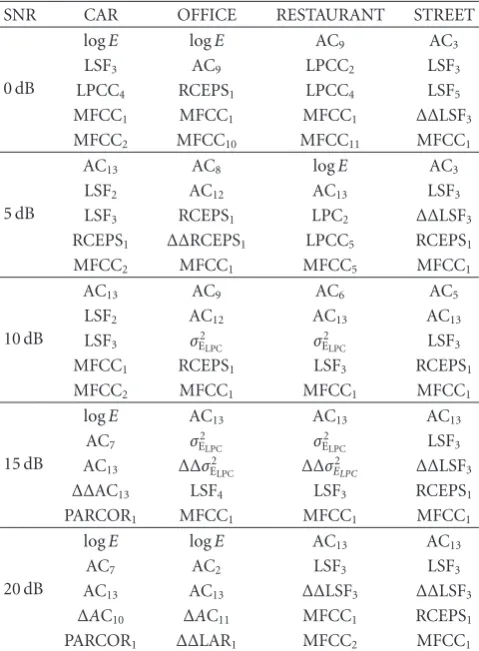
n, in which each element is either 0 or 1 and such that the number of 1s in each row is equal to m; a selective reproduction operator (Selch) selects a new chromosome from the old one on the basis of the fitness functions for each row; the new chromosome is of the same size and has a number of 1 s per row equal tom; the crossover and mutation operators are applied to this new chromosome. The positions of the 1 s in the row with the lowest fitness value indicate thembest parameters for each generation. The generational cycle is repeated a certain number of times, and at each generation the system stores the set of mparameters with the best performance in terms of the separation index. At the end of the generational cycle the set chosen is the one with the best separation index.Table 2shows the features selected by the GA forclean speech, whileTable 3shows the features selected by the GA for every noise and SNR combination.
5. Automatic Noise Classification
Table2: List of features selected for clean speech.
CLEAN
ΔlogE
LSF2
ΔΔLSF2
RCEPS1 MFCC1
Table 3: List of features selected for every noise and SNR combination.
SNR CAR OFFICE RESTAURANT STREET
0 dB
logE logE AC9 AC3
LSF3 AC9 LPCC2 LSF3
LPCC4 RCEPS1 LPCC4 LSF5
MFCC1 MFCC1 MFCC1 ΔΔLSF3
MFCC2 MFCC10 MFCC11 MFCC1
5 dB
AC13 AC8 logE AC3
LSF2 AC12 AC13 LSF3
LSF3 RCEPS1 LPC2 ΔΔLSF3
RCEPS1 ΔΔRCEPS1 LPCC5 RCEPS1
MFCC2 MFCC1 MFCC5 MFCC1
10 dB
AC13 AC9 AC6 AC5
LSF2 AC12 AC13 AC13
LSF3 σE2LPC σ
2
ELPC LSF3
MFCC1 RCEPS1 LSF3 RCEPS1
MFCC2 MFCC1 MFCC1 MFCC1
15 dB
logE AC13 AC13 AC13
AC7 σE2LPC σ
2
ELPC LSF3
AC13 ΔΔσE2LPC ΔΔσ 2
ELPC ΔΔLSF3
ΔΔAC13 LSF4 LSF3 RCEPS1
PARCOR1 MFCC1 MFCC1 MFCC1
20 dB
logE logE AC13 AC13
AC7 AC2 LSF3 LSF3
AC13 AC13 ΔΔLSF3 ΔΔLSF3
ΔAC10 ΔAC11 MFCC1 RCEPS1 PARCOR1 ΔΔLAR1 MFCC2 MFCC1
the V/UV classification of each frame (Section 4). In the training phase 4 different noise types were used (car, office, restaurant, and street) which include both stationary (car, street) and highly nonstationary (office, restaurant) noises. To develop the classification system 3-minute recordings were used for each noise type. As inSection 4all the available parameters were extracted from each frame, obtaining vectors of 345 components. Once again the separation index used was J1, obtained from the scatter matrices Sw andSb
as in (2) and (3). Unlike voiced/unvoiced classification, in this case the system works onL =4 classes to discriminate between the 4 different types of noise. To determine the number of components needed for correct classification 20 components were initially selected and then 5 components.
Figure 2illustrates the trend of the separation index in the
0 2
dB
1 3
1
0
Time (s) CAR-0
dB CAR-0
s(n)
−
0 1 2 3
Time (s)
1
20
0
SNR
(n)
−20
Figure3: SNR estimate in the case of CAR noise with average SNR set to 0 dB.
two cases considered. The parameters selected by the GA to make up the noise classification vector were
(i) 20 components: logE, F0, ΔΔF0, ΔΔAC13, LPC4, PARCOR1, LAR1, LSF1, LPCC9,ΔΔLPCC9, RCEPS13, RCEPS14, MFCC1, MFCC2, MFCC3, MFCC4, MFCC10, MFCC16,ΔΔMFCC2,ΔΔMFCC10,
(ii) 5 components: AC13, ΔΔAC13, LPCC9, MFCC2, ΔΔMFCC2.
Table4: Misclassification using a 20-input neural network.
car street office restaurant
Car 0.9192 0 0.0784 0.0024
Street 0.0130 0.8128 0.0024 0.1717 Office 0.0481 0.0174 0.8236 0.1110 Restaurant 0.0102 0.0618 0.0408 0.8872
type inoise performance. Given the greater complexity of the 20-input network, and to standardise the number of parameters used for noise classification with those used for voiced/unvoiced classification, for noise classification we decided to use the neural network block using 5 components as the input vector. The noise classification block has to be activated exclusively during periods of speech inactivity so as to avoid classification errors due to the presence of speech. For this reason the functioning of the block is supported by the presence of an algorithm capable of detecting speech activity (VAD). In general, recent VAD algorithms are robust to background noise [3, 23–26]. The VAD used for this purpose was theSigmaVAD illustrated in [3]. Classification of the noise present in a segment of speech activity is performed by analysing the signal frames not containing speech activity that precede the segment of speech activity. More specifically, in the presence of speech inactivity, and for each type of noise, the output of a bank of FIR filters is computed according to the following relation:
yi(n)= N
j=1
hj·xi
n−j, (5)
wherei = 1. . .4 is the index relating to the class of noise, hj are the coefficients of a smoothing window obtained
considering the coefficients from N + 1 to 2N + 1 of a Hamming window with 2N+1 points, andxi(n) is the output
of nodeiin the neural noise classification network calculated for frame n. The presence of smoothing by means of half a Hamming window makes it possible to compensate for misclassification of noise types by implementing a hangover mechanism. Considering that a change in noise type is a relatively slow process, the system response regarding noise type is based on an analysis of 500 miliseconds of signal. The half of a Hamming window used makes it possible to give more weight to the neural network output for the current frame and progressively less weight to past frames. During the speech activity phase noise classification is performed by determining the index for the FIR filter bank output with the highest value, according to the following relation:
noiseindex(n)=
⎧ ⎪ ⎨ ⎪ ⎩
noiseindex(n−1), yi(n)=0∀i,
arg max4
i=1 yi(n), otherwise,
(6)
and we set noiseindex(0) =1. The condition noiseindex(n)= noiseindex(n − 1) if yi(n) = 0 for alli, together with
noiseindex(0) = 1, makes it possible to assume CARnoise when the classifier has not yet given a valid output.
Table5: Misclassification using a 5-input neural network.
car street office restaurant
Car 0.8689 0 0.1277 0.0033
Street 0.0052 0.6881 0.0031 0.3035 Office 0.1668 0.0068 0.6303 0.1960 Restaurant 0.0098 0.0762 0.1092 0.8048
0 2
dB
1 3
1
0
Time (s) CAR-5
dB CAR-5
s(n)
−
0 1 2 3
Time (s)
1
20
0
SNR
(n)
−20
Figure4: SNR estimate in the case of CAR noise with average SNR set to 5 dB.
6. Automatic SNR Estimation
Automatic SNR estimation is also performed with the aid of the algorithm implemented bySigmaVAD. With reference to [3], it is useful to recall that the system has two adaptive thresholds, σdown and σup. Before the hangover block the system assumes that the signal contains exclusively background noise if the output is below the thresholdσdown and that it contains speech activity if the output is above the thresholdσup. The occurrence of one of these situations is used as a condition to update the parameters estimated by the algorithm. Intermediate situations are solved by the hangover block. To update the SNR estimation two autoregressive filters were used: one to calculate the average power of the signal in the presence of speech activity and one to calculate the average signal power when there is no speech activity. For each frame the signal powerlis calculated. If the output of theSigmaVADsystem before the hangover block is above the thresholdσup, the signal power estimate in the presence of speech activity is updated using the following relation:
lN+A(n)=kN+A·lN+A(n−1) + (1−kN+A)·l. (7)
If the output of theSigmaVAD system before the hangover block is below the thresholdσdown, the signal power estimate in the absence of speech activity is updated using the following relation:
0 0 5 10
V/UV e
rr
o
r
(%)
15 20 25 30 35 40
5 10
SNR (dB)
15 20
(a) Car
0 0 5 10
V/UV e
rr
o
r
(%)
15 20 25 30 35 40
5 10
SNR (dB)
15 20
(b) Office
0 0 5 10
V/UV e
rr
o
r
(%)
15 20 25 30 35 40
5
Clean
No-adaptive VUV
A_VUV
10 SNR (dB)
15 20
(c) Restaurant
0 0 5 10
V/UV e
rr
o
r
(%)
15 20 25 30 35 40
5
Clean
No-adaptive VUV
A_VUV
10 SNR (dB)
15 20
(d) Street
Figure5: Performance comparison between Adaptive VUV and Nonadaptive VUV in different noise conditions.
The initial value for the background noise estimate was assumed to be (lN(0)), equal to−46 dBovl, and the initial
value for the signal power estimate in the presence of speech activity was assumed to be (lN+A(0)), equal to
−25.9568 dBovl (in this way we initially assume an SNR of 20 dB and an average speech signal power level of
−26 dBovl). The values of the constants of the autoregressive filters were set, respectively, tokN+A=0.95 andkN =0.75 to
obtain a faster update of the background noise estimate and a slower update of the level of presence of speech activity (so as to smooth level variations due to utterance of the different types of phonemes). The two are only valid whenln+a > ln,
so
SNR(n)=
⎧ ⎪ ⎨ ⎪ ⎩
10 log10ln+a/10−10ln/10
−ln, ln+a> ln,
SNR(n−1), otherwise,
(9)
Figures 3 and 4 show the SNR in the case of CAR noise with an average SNR in activity segments of 0 dB and 5 dB, respectively. From analysis of the figures it can be observed that in segments where speech activity is present the estimated SNR value follows the preset value quite faithfully. In order to actually choose the classifier to use on the basis of the SNR estimated, the estimation interval was subdivided into 5 classes: C0 dB : SNR < 2.5 dB, C5 dB : 2.5 dB ≤ SNR < 7.5 dB,C10 dB : 7.5 dB ≤ SNR < 12.5 dB,C15 dB : 12.5 dB ≤ SNR < 17.5 dB,C20 dB : SNR ≥
17.5 dB. When the SNR estimated falls into classCiwe will
use the parameter selected and the neural network trained corresponding to the average SNR set for activity segments equal to i (together with the information obtained by the noise classifier).
7. Experimental Results
0 0 10 20
V/UV e
rr
o
r
(%)
30 40 50 60 70
5 10
SNR (dB)
15 20
(a) Car
0 0 10 20
V/UV e
rr
o
r
(%)
30 40 50 60 70
5 10
SNR (dB)
15 20
(b) Office
0 0 10 20
V/UV e
rr
o
r
(%)
30 40 50 60 70
5 10
SNR (dB)
15 20
A_VUV ETSI SMV
(c) Restaurant
0 0 10 20
V/UV e
rr
o
r
(%)
30 40 50 60 70
5 10
SNR (dB)
15 20
A_VUV ETSI SMV
(d) Street
Figure6: Performance comparison in terms of VuV ER% versus SNR in different noise conditions.
VuV ER%, which represents the percentage of erroneous segments as compared with the overall number of segments in the speech signal. This covers both V-to-UV and UV-to-V errors.
The validity of the system was first compared with that of a nonadaptive system. The graphs in Figure 5 illustrate the trend followed by three curves. The first (labelled with the symbol “square”) indicates the VuV ER% obtained using a nonadaptive system: in any background noise and SNR conditions, this system uses for classification the vector of 5 components obtained in the clean case and the network trained in the clean case. The second curve (labelled with an “asterisk”) indicates the VuV ER% obtained using the adaptive system proposed. The third and last curve (labelled with a “circle”) was inserted into the graphs as a reference for comparison between the performance of the V/UV classification system in thecleancase and the various noisy
cases. As can be seen inFigure 5the adaptive system gives a clear improvement in performance with all types of noise and SNR values. In the case of nonbabble noise (car, street) the error is on average halved, while in the case of babble noise (office, restaurant) there is less improvement as in these conditions the noise may contain periodic components that increase UV-to-V misclassification.
The performance of the proposed classification system was then compared with that of other V/UV classifiers used in two important speech coding standards: the V/UV detection system in the ETSI ES 202 212 v1.1.2 and the speech classification in the SMV algorithm.
0 0 10 20
V/UV e
rr
o
r
(%)
30 40 50 60 70
5 10
SNR (dB)
15 20
(a) Construction
0 0 10 20
V/UV e
rr
o
r
(%)
30 40 50 60 70
5 10
SNR (dB)
15 20
(b) Factory
A_VUV ETSI SMV 0 0 10 20
V/UV e
rr
o
r
(%)
30 40 50 60 70
5 10
SNR (dB)
15 20
(c) Shop
A_VUV ETSI SMV 0 0 10 20
V/UV e
rr
o
r
(%)
30 40 50 60 70
5 10
SNR (dB)
15 20
(d) Station
Figure7: Performance comparison in terms of VuV ER% versus SNR in different noise conditions using noise types other than those used during training.
“nonstationary voiced” and “stationary voiced”. In order to compare the performance of these algorithms with that of the system proposed here, it was necessary to regroup the various frames classified. More specifically, in the case of the classification system in the ETSI front-end frames classified as “nonspeech”, “unvoiced,” and “mixed voiced” were identified as “unvoiced”, and frames classified as “mixed voiced” and “fully voiced” as “voiced”. A frame classified as “mixed-voiced” will therefore always be correctly classified. In the classification system present in the SMV algorithm the grouping was such that frames classified by the systems as “nonstationary voiced,” and “stationary voiced” were classified as “voiced”, whereas frames classified as “silence”, “noise like”, “stationary unvoiced”, “nonstationary unvoiced,” and “onset” were classified as “unvoiced”.
Performance was initially compared for the 4 noise types (car, office, restaurant, and street) and with the 5 SNRs used to train the system. As the graph in Figure 6
shows, the performance of the proposed system is better in comparison with the ETSI and SMV classification systems with low SNRs (0 dB and 5 dB) or at least comparable with higher SNRs. To evaluate the capacity for generalisation of the adaptive system proposed, its performance was also assessed in the presence of noise types other than those used during the training phase. Figure 7shows the results obtained considering construction, factory, shop, and station noise. Analysis of these results confirms the improvement in performance given by the classification system proposed in this paper. With these types of noise the improvement is as much as 25% in very noisy environments (0 dB). Figure 8
0 0 10 20
V/UV e
rr
o
r
(%)
30 40 50 60 70
5 10
SNR (dB)
15 20
(a) Airport
0 0 10 20
V/UV e
rr
o
r
(%)
30 40 50 60 70
5 10
SNR (dB)
15 20
(b) Babble
0 0 10 20
V/UV e
rr
o
r
(%)
30 40 50 60 70
5 10
SNR (dB)
15 20
A_VUV ETSI SMV
(c) Pool
0 0 10 20
V/UV e
rr
o
r
(%)
30 40 50 60 70
5 10
SNR (dB)
15 20
A_VUV ETSI SMV
(d) Stud
Figure8: Performance comparison in terms of VuV ER% versus SNR in different noise conditions using noise types other than those used during training.
8. Conclusions
The paper has presented the results of a new adaptive approach to V/UV speech classification in noisy environ-ments when the system is tested with noises and SNRs other than those used in the training phase. The idea is to determine the set of features and neural networks that will allow the best V/UV classification with different types of noise and SNRs. The features were selected by genetic algo-rithms. The adaptive system outperformed the main V/UV detectors recently standardized in the field of speech coding. The adaptive system is particularly suitable in applications featuring the presence of highly noisy environments, that is, with SNRs lower than 10 dB.
References
[1] L. J. Siegel, “A procedure for using pattern classification techniques to obtain a voiced/unvoiced classifier,”IEEE
Trans-actions on Acoustics, Speech and Signal Processing, vol. 27, no. 1, pp. 83–89, 1979.
[2] W. J. Hess, “Pitch and voicing determination,” inAdvances in Speech Signal Processing, S. Furui and M. Sondhi, Eds., pp. 3– 48, Marcel Dekker, New York, NY, USA, 1991.
[3] F. Beritelli, S. Casale, and S. Serrano, “A low-complexity speech-pause detection algorithm for communication in noisy environments,”European Transactions on Telecommunications, vol. 15, no. 1, pp. 33–38, 2004.
[4] J. C. Junqua and J. P. Haton,Robustness in Automatic Speech Recognition: Fundamentals and Applications, Kluwer Academic Publishers, Dordrecht, The Netherlands, 1996.
[5] F. Beritelli, “A modified CS-ACELP algorithm for variable-rate speech coding robust in noisy environments,”IEEE Signal Processing Letters, vol. 6, no. 2, pp. 31–34, 1999.
[6] F. Beritelli, S. Casale, and S. Serrano, “Adaptive V/UV speech detection based on acoustic noise estimation and classifica-tion,”Electronics Letters, vol. 43, no. 4, pp. 249–251, 2007. [7] B. S. Atal and L. R. Rabiner, “A pattern recognition approach
speech recognition,”IEEE Transactions on Acoustics, Speech, and Signal Processing, vol. 24, no. 3, pp. 201–212, 1976. [8] L. R. Rabiner and M. R. Sambur, “Application of an LPC
distance measure to the voiced-unvoiced-silence detection problem,”IEEE Transactions on Acoustics, Speech, and Signal Processing, vol. 25, no. 4, pp. 338–343, 1977.
[9] S. G. Knorr, “Reliable voiced/unvoiced decision,”IEEE Trans-actions on Acoustics, Speech and Signal Processing, vol. 27, no. 3, pp. 263–267, 1979.
[10] H. Kobatake, “Optimization of voiced/unvoiced decisions in nonstationary noise environments,”IEEE Transactions on Acoustics, Speech, and Signal Processing, vol. 35, no. 1, pp. 9– 18, 1987.
[11] Y. Qi and B. R. Hunt, “Voiced-unvoiced-silence classifications of speech using hybrid features and a network classifier,”IEEE Transactions on Speech and Audio Processing, vol. 1, no. 2, pp. 250–255, 1993.
[12] S. Ahmadi and A. S. Spanias, “Cepstrum-based pitch detection using a new statistical V/UV classification algorithm,”IEEE Transactions on Speech and Audio Processing, vol. 7, no. 3, pp. 333–338, 1999.
[13] Y. Gao, E. Shlomot, A. Benyassine, J. Thyssen, H. Su, and C. Murgia, “The SMV algorithm selected by TIA and 3GPP2 for CDMA applications,” inProceedings of the IEEE Interna-tional Conference on Acoustics, Speech and Signal Processing (ICASSP ’01), vol. 2, pp. 709–712, Salt Lake City, Utah, USA, May 2001.
[14] ETSI, Tech. Rep. ETSI ES 202 212 v1.1.2, November 2005. [15] D. Arifianto and T. Kobayashi, “Voiced/unvoiced
determina-tion of speech signal in noisy environment using harmonicity measure based on instantaneous frequency,” in Proceedings of the IEEE International Conference on Acoustics, Speech, and Signal Processing (ICASSP ’05), vol. 1, pp. 877–880, Philadelphia, Pa, USA, March 2005.
[16] C. Shahnaz, W.-P. Zhu, and M. O. Ahmad, “A multifeature voiced/unvoiced decision algorithm for noisy speech,” in Proceedings of IEEE International Symposium on Circuits and Systems (ISCAS ’06), pp. 2525–2528, Island of Kos, Greece, May 2006.
[17] T. Van Pham and G. Kubin, “Low-complexity and efficient classification of voiced/unvoiced/silence for noisy environ-ments,” inProceedings of the 9th International Conference on Spoken Language Processing (ICSLP ’06), vol. 5, pp. 2198–2201, Pittsburgh, Pa, USA, September 2006.
[18] P. Janˇcoviˇc and M. K¨ok¨uer, “Estimation of voicing-character of speech spectra based on spectral shape,” IEEE Signal Processing Letters, vol. 14, no. 1, pp. 66–69, 2007.
[19] X. Huang, A. Acero, and H. Hon,Spoken Language Processing, chapter 2, Prentice Hall PTR, Englewood Cliffs, NJ, USA, 2001. [20] S. Young, et al., The HTK Book (for HTK Version 3.3), Engineering Department, Cambridge University, Cambridge, UK, 2005.
[21] K. Fukunaga,Introduction to Statistical Pattern Recognition, chapter 10, Academic Press, New York, NY, USA, 1990. [22] D. F. Goldberg, Genetic Algorithms in Search, Optimization
and Machine Learning, Addison-Wesley, Reading, Mass, USA, 1989.
[23] M. Fujimoto and K. Ishizuka, “Noise robust voice activity detection based on switching Kalman filter,”IEICE Transac-tions on Information and Systems, vol. E91-D, no. 3, pp. 467– 477, 2008.
[24] M. Fujimoto, K. Ishizuka, and T. Nakatani, “A voice activity detection based on the adaptive integration of multiple speech features and a signal decision scheme,” in Proceedings of
IEEE International Conference on Acoustics, Speech, and Signal Processing (ICASSP ’08), pp. 4441–4444, Las Vegas, Nev, USA, March-April 2008.
[25] K. Li, M. N. S. Swamy, and M. O. Ahmad, “An improved voice activity detection using higher order statistics,” IEEE Transactions on Speech and Audio Processing, vol. 13, no. 5, pp. 965–974, 2005.