The Thirty-Third AAAI Conference on Artificial Intelligence (AAAI-19)
Very Hard Electoral Control Problems
Zack Fitzsimmons
College of the Holy CrossWorcester, MA 01610
Edith Hemaspaandra
Rochester Inst. of TechnologyRochester, NY 14623
Alexander Hoover
University of ChicagoChicago, IL 60637
David E. Narv´aez
Rochester Inst. of TechnologyRochester, NY 14623
Abstract
It is important to understand how the outcome of an election can be modified by an agent with control over the structure of the election. Electoral control has been studied for many elec-tion systems, but for all these systems the winner problem is in P, and so control is in NP. There are election systems, such as Kemeny, that have many desirable properties, but whose winner problems are not in NP. Thus for such systems control is not in NP, and in fact we show that it is typically complete forΣp2 (i.e.,NP
NP
, the second level of the polynomial hier-archy). This is a very high level of complexity. Approaches that perform quite well for solving NP problems do not nec-essarily work forΣp2-complete problems. However, answer set programming is suited to express problems inΣp2, and we present an encoding for Kemeny control.
Introduction
The study of elections often deals with trade-offs for dif-ferent properties that an election system satisfies. Elections have a wide range of applications from voting in political elections to applications in artificial intelligence (see, e.g., Brandt et al. (2016)). And given the role of elections in mul-tiagent system settings, it is important that we study the com-putational properties of election systems.
Attacks on the structure of an election, referred to as con-trol, were introduced by Bartholdi, Tovey, and Trick (1992) and model natural scenarios where an agent, with control over the structure of an election, modifies the structure (e.g., by adding candidates) to ensure that their preferred candi-date wins. It is important to study how these types of attacks on the structure of an election can affect the outcome and how computationally difficult it is to determine if such an attack exists.
The complexity of electoral control has been studied for many different natural elections systems and has been an important line of research in computational social choice (see, e.g., Faliszewski and Rothe (2016)). However, for all of those systems the winner problems are in P, and so the standard control problems are in NP. To go beyond what can easily be encoded for SAT solvers, we need to look at election systems with harder winner problems. But even for
Copyright c2019, Association for the Advancement of Artificial Intelligence (www.aaai.org). All rights reserved.
election systems whose winner problems are in NP, the most common control problems are still in NP.
There are election systems that have many desirable social-choice properties, but whose winner problems are not
in NP (assuming NP 6= coNP). One important example
is the Kemeny rule (Kemeny 1959), whose winner prob-lem is Θp2-complete (i.e., complete for parallel access to NP) (Hemaspaandra, Spakowski, and Vogel 2005) and so the complexity of the standard control problems for Kemeny are allΘp2-hard and thus also not in NP. For election sys-tems with Θp2-complete winner problems, control is inΣp2
(i.e.,NPNP, the second level of the polynomial hierarchy), and we show that control is typicallyΣp2-complete for such systems.
This is a very high level of complexity. And so a natural question to ask is how Kemeny control can be solved. We mention here that there has been a long line of work that considers ways to solve hard election prob-lems. This includes work on computing Kemeny winners (see, e.g., (Conitzer, Davenport, and Kalagnanam 2006; Betzler et al. 2008; Ali and Meil˘a 2012; Betzler, Bredereck, and Niedermeier 2014)) and on solving election-attack prob-lems (see, e.g., Rothe and Schend (2013)). The work on solving hard election-attack problems has been restricted to problems in NP, and such approaches do not work forΣp2 -complete problems. Answer set programming (ASP) is an approach that has been recently applied for winner deter-mination in voting, including for systems with hard winner problems (Charwat and Pfandler 2015). ASP is suited to ex-pressΣp2 problems. However, encodingΣp2-complete prob-lems in ASP requires the use of more advanced techniques than encoding computationally easier problems. We present an encoding of Kemeny control using these advanced tech-niques and discuss other related approaches.
We make the following main contributions.
• We obtain the first natural Σp2-completeness results for elections.
• We define several new natural and simple Σp2-complete graph problems to prove our results, and these problems compare favorably in naturalness and simplicity to other
Σp2-complete problems, and so in usefulness as problems to reduce from.
sys-tems with Θp2-complete winner problems, including the Kemeny rule, that control is typicallyΣp2-complete.
• We build upon recent work on combining ASP with vot-ing (Charwat and Pfandler 2015) by encodvot-ing our Σp2 -complete control problems using advanced ASP tech-niques.
Preliminaries
An election consists of a set of candidatesC, and a set of votersV, where each voter has a vote that strictly ranks each candidate from most to least preferred. An election system,
E, maps an election (C, V)to a set of winners, where the winner set can be any subset of the candidate set. The winner problem for an election system,E-Winner, is defined in the following way. Given an election(C, V)and a candidatep∈
C, ispa winner of the election using election systemE? We consider the most important election systems with
Θp2-complete winner problems: Kemeny, Young, and Dodg-son.
A candidate is a Kemeny winner if it is the most-preferred candidate in a Kemeny consensus (Kemeny 1959), which is a total order “>” that minimizes the sum of Kendall’s Tau distances (i.e., number of pairwise disagreements) with the voters in an election, i.e., minimizesP
a,b∈C,a>bk{v ∈
V |b >va}k,where>vdenotes the preference of voterv.
A candidate is a Young winner if it can become a weak Condorcet winner (a candidate that beats-or-ties every other candidate pairwise) by deleting the fewest voters (Young 1988).
A candidate is a Dodgson winner if it can become a Con-dorcet winner (a candidate that beats every other candidate pairwise) with the fewest swaps between adjacent candi-dates in the voters’ rankings (Dodgson 1876).
Electoral control models the actions of an agent, referred to as the election chair, who modifies the structure of the election (e.g., the voters) to ensure that their preferred can-didate wins (in the constructive case) (Bartholdi, Tovey, and Trick 1992) or that their despised candidate does not win (in the destructive case) (Hemaspaandra, Hemaspaandra, and Rothe 2007).1(These two papers define the standard control
actions.) We formally define constructive control by adding candidates (CCAC) below, which models the real-world sce-nario of an election chair adding spoiler candidates to an election to ensure that their preferred candidate wins.
Name:E-CCAC
Given:A set of registered candidatesC, a set of unregistered candidatesD, a set of votersV having preferences overC∪
D, an addition limitk, and a preferred candidatep∈C. Question:Does there exist a setD0 ⊆Dsuch thatkD0k ≤
kandpis a winner of(C∪D0, V)using election systemE?
1
We mention here that early work that considered electoral con-trol generally used the unique winner model whereas we allow mul-tiple winners. This rarely makes a difference in the complexity for concrete systems.
Computational Complexity Our results concern the complexity classes Θp2 and Σp2. The class Θp2 was intro-duced in (Papadimitriou and Zachos 1983), named in (Wag-ner 1990), and shown to be equivalent to PNP
|| , the class
of problems that can be solved by a polynomial-time ma-chine with parallel access to an NP oracle, in (Hemachandra 1989). Σp2 = NPNP is the class of problems solvable by a nondeterministic polynomial-time machine with access to an NP oracle, and is the second level of the polynomial hi-erarchy (Meyer and Stockmeyer 1972; Stockmeyer 1976). Note thatNP∪coNP⊆Θp2⊆PNP⊆Σp2.
Complexity Results
In this section we show that control problems for Kemeny, Young, and Dodgson elections are typicallyΣp2-complete.
Observation 1 For an election systemE, the complexity of each standard control action is inNPE-Winner.
It is easy to see that the above observation holds. For a given election, guess the control action of the chair (e.g., the set of candidates to be added) and then use the oracle to check that the preferred candidate is a winner (or that the despised candidate is not a winner). In the case of partition control, which will not be discussed further in this paper, the oracle will also be used to determine which candidates participate in the runoff.
The winner problems for Kemeny, Young, and Dodg-son are each in Θp2 (in factΘp2-complete (Hemaspaandra, Spakowski, and Vogel 2005; Rothe, Spakowski, and Vo-gel 2003; Hemaspaandra, Hemaspaandra, and Rothe 1997)), and so the complexity of each standard control action is in
NPΘp2 = Σp 2.
2
Corollary 2 For Kemeny, Young, and Dodgson elections, the complexity of each standard control action is inΣp2.
As mentioned in Brandt et al. (2015), these control prob-lems inheritΘp2-hardness from their winner problems.
We will now show that these control problems are typ-icallyΣp2-complete. OurΣp2-completeness results are sum-marized in Table 1 and we conjecture that for Kemeny, Young, and Dodgson elections, the complexity of each stan-dard control action isΣp2-complete.3
We mention here that there are far fewer completeness results for Σp2 than there are for NP (see Schaefer and Umans (2002) for a list of completeness results in the poly-nomial hierarchy). An important reason why proving Σp2 -hardness is difficult is the scarcity of “simple”Σp2-complete problems to reduce from. For example, scoring versions of Kemeny, Young, and Dodgson are proven NP-hard by reduc-tions from simple NP-complete problems such as Vertex-Cover, but prior to this paper there were no Σp2-complete simple versions of Vertex-Cover that were suitable to show that related control-by-adding problems areΣp2-hard.
2
Note thatΣp2 = NP NP⊆
NPΘp2 ⊆NPPNP = NPNP= Σp
2.
3
Table 1: Summary of ourΣp2-completeness results for con-trol. Kemeny0refers to a natural variant of Kemeny defined in (Dwork et al. 2001) and (∗) refers to the variant of control where the chair can delete only certain candidates.
Adding Deleting
Voters Young (Thm 10)
Young (Thm 9) Kemeny0(Thm 7)
Candidates Kemeny (Thm 6) Kemeny (∗) (Thm 5)
Dodgson (Thm 11) Dodgson (Thm 11)
Below we define simple and naturalΣp2-complete versions of Vertex-Cover (and the analogous Independent-Set ver-sions are alsoΣp2-complete). We will see that these problems are particularly useful to show that our control problems are
Σp2-hard. Of course, we need to show that our new simple problems are Σp2-hard, which is difficult. But we can then reuse our simple problems to obtain simplerΣp2-hard proofs for multiple other problems.
The following problem (and its closely related
Independent-Set analogue) is particularly useful to re-duce to control-by-adding problems. For example, we will see that this problem quite easily reduces to Kemeny-CCAC and that the Independent-Set analogue of this problem reduces quite easily to Young-CCAV (control by adding voters).
Name:Vertex-Cover-Member-Add
Given:GraphG= (V ∪V0, E), set of addable verticesV0, addition limitk, and vertexvˆ∈V.
Question: Does there exist a set W ⊆ V0 of at most k addable vertices such thatvˆis a member of a minimum ver-tex cover4of(V ∪W, E)?
Theorem 3 Vertex-Cover-Member-Add isΣp2-complete.
To show the essence of the argument of the proof of Theorem 3 and avoid some of the more finicky details of the proof, we prove that Vertex-Cover-Member-Select isΣp2 -complete, and then briefly discuss how this proof can be adapted for Vertex-Cover-Member-Add.5
Name:Vertex-Cover-Member-Select
Given:GraphG= (V, E), a setV0 ⊆V of deletable ver-tices, delete limitk, and vertexvˆ∈V.
Question: Does there exist a set W ⊆ V0 of at most k deletable vertices such that ˆv is a member of a minimum vertex cover ofG−W?
Lemma 4 Vertex-Cover-Member-Select isΣp2-complete.
Proof. Membership inΣp2is easy to see: Guess at mostk deletable vertices to delete, then guess a vertex cover con-tainingˆv and use the NP oracle to check that the guessed vertex cover is a minimum vertex cover.
4
A vertex cover of a graph is a set of vertices such that every edge is incident with at least one vertex in the set.
5
We can easily prove Vertex-Cover-Member-Select Σp2 -hard by reducing the Σp2-complete problem Generalized-Node-Deletion (Rutenburg 1994) to it. However, this proof does not gen-eralize to Vertex-CoMember-Add. For details, see the full ver-sion.
To show hardness, we reduce from the following
Σp2-complete problem, QSAT2 (Stockmeyer 1976;
Wrathall 1976): all true formulas of the form
∃x1· · · ∃xn¬(∃y1· · · ∃ynφ(x1, . . . , xn, y1, . . . , yn)),
whereφis a formula in 3cnf.6
We first recall the standard reduction from 3SAT to Vertex-Cover (Karp 1972). LetGbe the graph constructed by this reduction onφ(x1, . . . , xn, y1, . . . , yn), whereφis in
3cnf. Letφ=ψ1∧ψ2∧ · · · ∧ψmand for eachi,1≤i≤m,
ψi =ci,1∨ci,2∨ci,3. GraphGconsists of4n+ 3m ver-tices: a vertex for eachxi,xi,yi, andyiand for each clause
i,1 ≤i≤m, three verticesci,1,ci,2, andci,3, and the fol-lowing edges:
• for eachi,1≤i≤n, the edges{xi, xi}and{yi, yi},
• for eachi,1 ≤i≤m, the edges{ci,1, ci,2},{ci,1, ci,3}, and {ci,2, ci,3}, (i.e., the complete graph on three ver-tices),
• and for each vertexci,jwe have an edge to its
correspond-ing vertex candidate (e.g., ifci,j =xtinφthen we have
the edge{ci,j, xt}).
An example of this construction will follow.
Note that every vertex cover of Gcontains at least one of each{xi, xi}, at least one of each{yi, yi}, and at least
two of each {ci,1, ci,2, ci,3}, soG does not have a vertex cover of size less than2n+2m. The properties below follow immediately from the proof from (Karp 1972).
1. If X is a vertex cover of size 2n + 2m, then X ∩
{xi, xi, yi, yi | 1 ≤ i ≤ n} corresponds to a satisfying
assignment forφ.
2. Ifαis a satisfying assignment forφ, then there is a vertex coverXof size2n+2msuch thatX∩{xi, xi, yi, yi|1≤
i≤n}corresponds to this assignment.
Below we include an example of this construction given the formulaφ= (x1∨x1∨y1)∧(x1∨y1∨y1)∧(x1∨y1∨y1).
x1 y1 y1
c1,2
c1,1 c1,3
c2,2
c2,1 c2,3
c3,2
c3,3
c3,1
x1
In the figure above vertices that are in a minimum vertex cover are shaded in gray, and this corresponds to the satisfy-ing assignmentx1= 0,y1= 1forφ.
For the reduction from QSAT2to Vertex-Cover-Member-Select, we construct the graphH, which is a modified ver-sion of the graphG. For each clausei,1 ≤i ≤m, instead of the complete graph on three vertices,{ci,1, ci,2, ci,3}, we add an extra vertexdiand have the complete graph on four
vertices,{ci,1, ci,2, ci,3, di}, and we connect the fourth
ver-texdi of each clause gadget to a special new vertex ˆv. So
our graphHconsists of4n+ 4m+ 1vertices and the edges
6
as just described. Below we give the graph corresponding to the same formula as the previous example.
Note that every vertex cover ofH contains at least one of each{xi, xi}, at least one of each{yi, yi}, and at least
three of each{ci,1, ci,2, ci,3, di}. SoHdoes not have a
ver-tex cover of size less than2n+ 3m, and there is a vertex cover of size2n+ 3m+ 1that includesˆv. Note thatH has the following properties.
1. IfX is a vertex cover of size2n+ 3m, thenˆv 6∈X and X∩{xi, xi, yi, yi|1≤i≤n}corresponds to a satisfying
assignment forφ.
2. Ifαis a satisfying assignment forφ, then there is a vertex cover of size2n+ 3msuch thatX∩ {xi, xi, yi, yi|1≤
i≤n}corresponds to this assignment.
Below we include an example of this construction given the formula∃x1¬(∃y1φ(x1, y1)), where as before
φ= (x1∨x1∨y1)∧(x1∨y1∨y1)∧(x1∨y1∨y1).
x1 y1 y1
c1,2
c1,1
d1
c1,3
c2,2
c2,1
d2
c2,3
c3,2
c3,3
d3
c3,1
ˆ
v x1
Note that in the figure whenx1 is removed (i.e., setting x1= 0) a minimum-size vertex cover (shaded in gray) is of sizen+ 3m= 10and thatφ(0, y1)is satisfied withy1= 1. We have repeated the same graph below, except now the vertexx1is removed (i.e., settingx1= 1).
x1 y1 y1
c1,2
c1,1
d1
c1,3
c2,2
c2,1
d2
c2,3
c3,2
c3,3
d3
c3,1
ˆ
v x1
The vertices shaded in gray above correspond to a minimum-size vertex cover of sizen+ 3m+ 1 = 11. Note thatφ(1, y1)is not satisfiable and that this vertex cover in-cludesˆv.
We will show that ∃x1· · · ∃xn¬(∃y1· · · ∃ynφ(x1, . . . , xn, y1, . . . , yn))if and only if we can delete at mostn
ver-tices in{xi, xi |1 ≤ i ≤n}such thatvˆis a member of a
minimum vertex cover ofH-after-deletion.
From the listed properties ofH and the above example, it is not too hard to see that the statement above holds as long as the vertices deleted fromHcorrespond to an assign-ment to thex-variables. However, it is possible for the set of deleted vertices to contain neither or both of{xi, xi}. We
handle these cases in the full version. q
To prove Theorem 3, we use a similar reduction to show that Vertex-Cover-Member-Add isΣp2-hard. The main
dif-ference is that we need an edge and two vertices for eachxi
and for eachxi. For the proof, see the full version
(Fitzsim-mons et al. 2018).
Vertex-Cover-Member-Select reduces to the correspond-ing Kemeny control problem Kemeny-CCDC∗.
Name:E-CCDC∗
Given: An election (C, V), a set of deletable candidates D⊆C, a delete limitk, and a preferred candidatep∈C. Question: Does there exist a set D0 ⊆ D of at most k deletable candidates such thatpis a winner of(C−D0, V)
using election systemE?
Note that E-CCDC∗ is more structured than E-CCDC (where the set of deletable candidates isC), since the chair can only delete from a subset ofC.
Theorem 5 Kemeny-CCDC∗isΣp2-complete.7
Proof Sketch. Bartholdi, Tovey, and Trick (1989) showed that Kemeny-Score is NP-hard by a reduction from Feedback-Arc-Set, which was shown to be NP-hard by Karp (1972) by a reduction from Vertex-Cover. Both these reductions are straightforward. To show the Θp2-hardness of Kemeny-Winner, Hemaspaandra, Spakowski, and Vo-gel (2005) define Θp2-complete versions of Vertex-Cover and Feedback-Arc-Set, namely Vertex-Cover-Member and Feedback-Arc-Set-Member. They show that Vertex-Cover-Member isΘp2-complete. They then show that Vertex-Cover-Member reduces to Feedback-Arc-Set-Vertex-Cover-Member, which then reduces to Kemeny-Winner. These two reductions are sim-ilar to the NP reductions and also straightforward. The same happens in ourΣp2case: Vertex-Cover-Member-Select easily and straightforwardly reduces to Feedback-Arc-Set-Member-Select, which easily and straightforwardly reduces to Kemeny-CCDC∗. For details, see the full version. q
Vertex-Cover-Member-Add easily and similarly reduces to Feedback-Arc-Set-Member-Add (see the full version) and then to Kemeny-CCAC.
Theorem 6 Kemeny-CCAC isΣp2-complete.
When we try to similarly show that Kemeny-CCAV is
Σp2-complete, it is easy to show that Feedback-Arc-Set-Member-Add-Arcs, where we add arcs instead of vertices, isΣp2-complete. The problem is that in the reduction from Feedback-Arc-Set to Kemeny-Score, each arc corresponds to two voters. However, we were able to show this result for what we here call Kemeny0, the natural variant of Kemeny from (Dwork et al. 2001) where the voters do not necessarily list all of the candidates in their votes and unlisted candidates in a vote do not contribute to the distance to the Kemeny consensus and so do not increase the Kemeny score. In this case, one arc will correspond to one voter.
Theorem 7 Kemeny0-CCAV isΣp2-complete.
We now turn to Young elections. We will explain how Independent-Set-Member-Delete, the Independent-Set ana-logue of Vertex-Cover-Member-Delete, which is also Σp2 -complete, is useful to show Young-CCDV isΣp2-complete.
7
Name:Independent-Set-Member-Delete
Given:GraphG= (V, E), delete limitk, and vertexvˆ∈V. Question:Does there exist a setW ⊆V such thatkWk ≤k andˆvis a member of a maximum independent set ofG−W?
Theorem 8 Independent-Set-Member-Delete is Σp2 -complete.
We reduce this problem to Young-CCDV to get the fol-lowing result.
Theorem 9 Young-CCDV isΣp2-complete.
The proofs of the above two theorems can be found in the full version. The same construction as used in this proof gives a reduction to Young-CCAV.
Theorem 10 Young-CCAV isΣp2-complete.
Previous complexity results for Dodgson elections do not reduce from problems related to Vertex-Cover or Independent-Set. However, in Dodgson there is more flex-ibility in how to construct the voters in a reduction, and so we were able to directly reduce QSAT2to Dodgson-CCDC and Dodgson-CCAC, though the constructions are quite in-volved. The proofs can be found in the full version.
Theorem 11 Dodgson-CCDC and CCAC areΣp2-complete.
Encoding Control Problems with ASP
When faced with a computationally difficult problem at the NP level there are several different possible ways to en-code the problem to harness the power of solvers for hard problems. For example, problems in NP are often encoded for Boolean satisfiability solvers. When a problem is Σp2 -complete there are far fewer tools to use. However, we can encode our problem for an answer set programming (ASP) solver.Answer set programming is a paradigm for encoding computationally difficult problems in a declarative way (see, e.g., Brewka et al. (2011)). Using modern ASP input lan-guages like the one in the Gringo grounder (Gebser et al. 2015), which extends conventional ASP with aggregates
functions like #sum and #count, we can use variable
names and predicates. A descriptive naming scheme usually leads to natural encodings of problems when compared to other approaches such as encoding into Boolean satisfiabil-ity problems.
Using ASP to solve computational problems in voting was first proposed by Konczak (2006). Recent work by Charwat and Pfandler (2015) provides winner-problem encodings for many election systems, including systems with hard winner problems, and mentions encoding control problems as future work. The predicates used in their encodings are arguably self-explanatory and the use of aggregates provides succinct representations of the different voting rules they consider.
Since encoding a problem in ASP can lead to natural en-codings of a problem and since ASP can encode problems inΣp2(Eiter, Gottlob, and Mannila 1997), we discuss how to encode our control problems in ASP and present our com-plete encoding for Kemeny-CCAC. However, we mention here that although ASP encodings for NP problems (and in
fact evenPNPproblems) are fairly straightforward and com-mon in the literature, encoding problems inΣp2typically re-quires more advanced (and less intuitive) techniques such as saturation (Eiter, Ianni, and Krennwallner 2009). We con-sider how this saturation technique can be used for our prob-lems and present an ASP encoding of Kemeny-CCAC that uses saturation. We also discuss and compare other encoding approaches for problems at this high level of complexity.
Preliminaries on Answer Set Programming
We briefly state the relevant definitions from ASP
for our encoding. (See Gebser et al. (2012) for
more detailed definitions.) A disjunctive logic
pro-gram is comprised of a finite set of rules of the form a1|. . .|ah ← b1, b2, . . . , bm, notbm+1, . . . ,notbnwhere
each ofa1, . . . , ah, b1, . . . , bn are atoms and each atom is a
constant or a predicate of the formp(t1, . . . , tk)such that
k ≥ 1and eachti is a constant or a variable. We indicate
that pis ak-ary predicate by writingp/k. The left side of the “←” is the head of the rule and the right side is the body of the rule. In the rule, “|” denotes disjunction, “,” denotes conjunction, and “not” refers to default negation. Uppercase characters are used to denote variables. Aground
program is a program that contains no variables. A subset S of the ground atoms satisfies a rule if{b1, . . . , bm} ⊆S
and {bm+1, . . . , bn} ∩S = ∅ implies ai ∈ S for some 1 ≤ i ≤ h. Amodelis a subset of the ground atoms that satisfies each rule. Ananswer setis a minimal model with respect to set inclusion.
Afactis a rule with no body and anintegrity constraint
is a rule with no head. So, a fact occurs in every answer set, and an integrity constraint eliminates answer sets where its body is satisfied. We additionally use choice rules with car-dinality constraints, which can be used to generate subsets of ground atoms within a given bound, and aggregates such as #countand #sum that count/sum ground atoms in a statement.
It is customary to encode a decision problem as a logic program such that the answer sets of this program corre-spond to certificates for “yes” answers to the problem. Un-der this approach, a “no” answer is certified by the lack of an answer set. However, there are circumstances in which a “no” answer must be certified by an answer set (e.g., prob-lems in coNP). The saturation technique (see, e.g., Eiter et al. (2009)) achieves this by designing a logic program that has a unique answer set including a special token atom if and only if the answer to the original decision problem is “no.” This answer set also contains the set S of all atoms that would be candidate certificates for “yes” answers. Rules are added so that every time the token atom is generated, all atoms inS are generated as well, thus “saturating” the model. Informally, this allows us to encode a “coNP check” into our program, which along with an “NP guess,” allows us to encode problems inΣp2.
Encoding Kemeny-CCAC in ASP
candidates, the addition limit, the preferred candidate, and facts that describe the voters. For the voters, we follow the approach used in Democratix (Charwat and Pfandler 2015), where each distinct vote(c1 >i · · · >i cm)is represented
bymatoms of the formp(i, j, c)meaning candidatecis the jth-preferred candidate by votei. The corresponding count is represented by votecount(i, k), meaning k voters have votei.
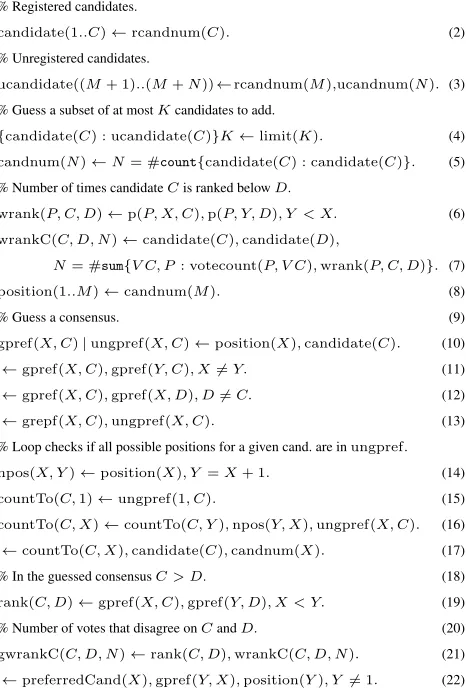
We present our complete encoding for Kemeny-CCAC by presenting all of the rules of the encoding, split into “guess,” “check,” and “saturate” parts, and explaining the crucial as-pects of each part. Informally, the guess part will guess a subset of unregistered candidates to add and a consensus such that the preferred candidate wins. The check part (along with the saturate part) ensures that for the guessed set of added candidates, no candidate beats the preferred candi-date.
preference(1..P)←prefnum(P). (1)
% Registered candidates.
candidate(1..C)←rcandnum(C). (2)
% Unregistered candidates.
ucandidate((M+ 1)..(M+N))←rcandnum(M),ucandnum(N). (3) % Guess a subset of at mostKcandidates to add.
{candidate(C) : ucandidate(C)}K←limit(K). (4)
candnum(N)←N= #count{candidate(C) : candidate(C)}. (5) % Number of times candidateCis ranked belowD.
wrank(P, C, D)←p(P, X, C),p(P, Y, D), Y < X. (6)
wrankC(C, D, N)←candidate(C),candidate(D),
N= #sum{V C, P: votecount(P, V C),wrank(P, C, D)}. (7)
position(1..M)←candnum(M). (8)
% Guess a consensus. (9)
gpref(X, C)|ungpref(X, C)←position(X),candidate(C). (10)
←gpref(X, C),gpref(Y, C), X6=Y. (11)
←gpref(X, C),gpref(X, D), D6=C. (12)
←grepf(X, C),ungpref(X, C). (13)
% Loop checks if all possible positions for a given cand. are inungpref.
npos(X, Y)←position(X), Y=X+ 1. (14)
countTo(C,1)←ungpref(1, C). (15)
countTo(C, X)←countTo(C, Y),npos(Y, X),ungpref(X, C). (16)
←countTo(C, X),candidate(C),candnum(X). (17) % In the guessed consensusC > D. (18)
rank(C, D)←gpref(X, C),gpref(Y, D), X < Y. (19) % Number of votes that disagree onCandD. (20)
gwrankC(C, D, N)←rank(C, D),wrankC(C, D, N). (21)
←preferredCand(X),gpref(Y, X),position(Y), Y 6= 1. (22)
Figure 1: Rules of the guess part of Kemeny-CCAC.
Figure 1 shows guess part of Kemeny-CCAC that assumes an input as described in Democratix (Charwat and Pfandler 2015), but extended with predicates for the control prob-lem. We start by guessing (with a choice rule) a subset of
at mostKof the unregistered candidates to add to the elec-tion and we update the number of candidates (candnum/1). We then define predicateswrank/3andwrankC/3to define the number of times that a candidate is ranked “worse” than another in the given election, and we guess a consensus. This generally follows what is done in Democratix (Charwat and Pfandler 2015). Specifically, we follow the naming conven-tions for different predicates, and rules 6, 7, 19, and 21 are from Democratix. However, our rules to guess a consensus (gpref/2) are more involved, since we use a head disjunc-tion.
% Guess another consensus.
gpref0(X, C)|ungpref0(X, C)←position(X),candidate(C). (23)
sat←gpref0(X, C),gpref0(Y, C), X6=Y. (24)
sat←gpref0(X, C),gpref0(X, D), D6=C. (25) % Loop checks if all possible positions for a given cand. are inungpref0.
sat←gpref0(X, C),ungpref0(X, C). (26)
countTo0(C,1)←ungpref0(1, C). (27)
countTo0(C, X)←countTo0(C, Y),npos(Y, X),ungpref0(X,C). (28) % Saturate if all possible positions for a given candidate are inungpref0, % which means a candidate is not ranked in the guess.
sat←countTo0(C, X),candidate(C),candnum(X). (29) % In the guessed consensusC > D.
rank0(C, D)←gpref0(X, C),gpref0(Y, D), X < Y. (30) % Number of votes that disagree onCandD. (31)
gwrankC0(C, D, N)←rank0(C, D),wrankC(C, D, N). (32)
sat←#sum{M, C1, C2, pos: gwrankC0(C1, C2, M);
−N, D1, D2, neg: gwrankC(D1, D2, N)}>= 0. (33)
sat←preferredCand(X),gpref0(1, X). (34)
Figure 2: Rules of the check part of Kemeny-CCAC.
Figure 2 shows the rules of the check part of Kemeny-CCAC. The check part essentially checks that given the added candidates from the guess, there is no candidate that beats the preferred candidate. Note that this is quite similar to the guess part (Figure 1). However what were integrity constraints there are now rules that generate the special sat-uration tokensat. We describe two important aspects of the check part below.
gpref0(X, C)←position(X),candidate(C),sat. (35)
ungpref0(X, C)←position(X),candidate(C),sat. (36)
possibleCount(0..X)←voternum(X). (37)
gwrankC0(C, D, N)←candidate(C),candidate(D),
possibleCount(N),sat. (38)
rank0(C, D)←candidate(C),candidate(D),sat. (39)
countTo0(C, N)←candidate(C),position(N),sat. (40)
←not sat. (41)
Figure 3: Rules of the saturation part of Kemeny-CCAC.
for the check program will cause all of the predicates that depend on the guessed consensusgpref0/2to have all pos-sible values in the stable model, thus saturating the solution.
Combining the guess, check, and saturate parts we obtain our complete ASP program that is satisfiable if and only if there is a subset of unregistered candidates that can be added such that the preferred candidate is a winner.
The above encoding for Kemeny-CCAC is not as straight-forward as ASP encodings for problems at the NP level, but we still have a close relationship to the definition of the problem and retain easy adaptability to minor changes in the problem description. For example, it is not difficult to change the above encoding to work for Kemeny-CCDC.
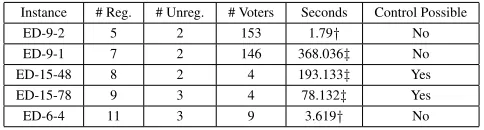
As with many declarative problem solving tools, there is a trade-off between expressibility and performance. In our tests using Clingo 4.5.4 and Preflib (Mattei and Walsh 2013) (the standard dataset of real-world preference data), we no-ticed the above encoding suffers from the so-called “ground-ing bottleneck.” That is, even on instances of Kemeny-CCAC with around 10 candidates, we are faced with pro-hibitively large programs after all variables are instantiated. This is in part due to the use of loops in saturation (which is the standard way to replace default negation, the use of which is limited in saturation), which were found in related work on encodingΣp2-complete problems in ASP to have a strong negative impact on performance (Gaggl et al. 2015). For a preliminary test of our encoding, we attempted to solve the Kemeny-CCAC problem for all elections from Preflib with 4 or more candidates having complete strict order votes, making the first candidate the preferred candidate and hold-ing out the last fifth of the candidates as unregistered with an add limit equal to one third of the number of unregistered candidates. There were 215 elections in total, and we were able to solve 114 of them using a timeout of 1 hour and a limit of 16GB of memory. Some noteworthy instances we could solve are summarized in Table 2. Of the 101 instances that we were not able to solve, 56 ran out of memory and the rest timed out. Despite its limitations, our encoding is an important starting point for future optimization and com-parison of techniques. In particular, we are interested in how techniques for overcoming the grounding bottleneck such as rewriting large rules (Bichler, Morak, and Woltran 2016) can improve the performance of our encoding.
Instance # Reg. # Unreg. # Voters Seconds Control Possible ED-9-2 5 2 153 1.79† No ED-9-1 7 2 146 368.036‡ No ED-15-48 8 2 4 193.133‡ Yes ED-15-78 9 3 4 78.132‡ Yes ED-6-4 11 3 9 3.619† No
Table 2: Details on some of the Preflib instances we were able to solve. The times reported were obtained on AMD Opteron(tm) 6180 SE (†) and AMD Opteron(tm) 6282 SE (‡) processors.
Related Encoding Approaches
We presented an encoding of Kemeny-CCAC using the satu-ration technique since it is the standard technique to encode
Σp2-complete problems in ASP and a starting point for ex-ploring how these problems can be encoded. There are alter-natives to our approach.
Eiter and Polleres (2006) address the issue of having to use advanced techniques, like saturation, when writing ASP encodings ofΣp2 problems by providing a template “meta-interpreter” and a transformation of ASP programs that can, together, be used to integrate a program that guesses a solution to the Σp2 problem with a program that checks whether the guessed solution is incorrect. Their combination amounts to a “guess and check” encoding of aΣp2problem.8 However, this approach does not support ASP programs with aggregates (e.g.,#count), which leads to more com-plex and somewhat less intuitive programs. To work around this issue, one could use thelp2normaltool (Bomanson, Gebser, and Janhunen 2014), which transforms ASP pro-grams with aggregates into equivalent ASP propro-grams with-out aggregates.
The work by Gebser et al. (2011) also addresses ASP en-codings for problems with complexity higher than NP with a different metaprogramming approach that does support ag-gregates by using optimization rules.
The framework ofstable-unstablesemantics by Bogaerts et al. (2016) provides a similar “guess and check” strategy for solving problems inΣp2. They point out that an advan-tage of the stable-unstable semantics is they can be easily extended to represent problems at any level of the poly-nomial hierarchy. In their implementation guess and check programs are each normalized, essentially discarding aggre-gates altogether.
It is an interesting direction for future work to determine how the performance of the above techniques and alterna-tive paradigms for constraint satisfaction compare with sat-uration encodings for very hard control problems in terms of implementation and adaptability.
Future Work
In addition to the future work on ASP described at the end of the previous section, it will be interesting to see if our newly-defined simpleΣp2-complete problems will be useful
8
in proving other problemsΣp2-hard, in particular the remain-ing control cases and other election-attack problems such as manipulation for systems with hard winner problems. Acknowledgments: We thank Andreas Pfandler for help-ful conversations and we thank the referees for their helphelp-ful comments and suggestions. This work was supported in part by an NSF-GRF under grant no. DGE-1102937.
References
Abseher, M.; Bliem, B.; Charwat, G.; Dusberger, F.; and Woltran, S. 2015. Computing secure sets in graphs using answer set pro-gramming.Journal of Logic and Computation.
Ali, A., and Meil˘a, M. 2012. Experiments with Kemeny ranking: What works when?Mathematical Social Sciences64(1):28–40. Bartholdi, III, J.; Tovey, C.; and Trick, M. 1989. Voting schemes for which it can be difficult to tell who won the election. Social Choice and Welfare6(2):157–165.
Bartholdi, III, J.; Tovey, C.; and Trick, M. 1992. How hard is it to control an election?Mathl. Comput. Modelling16(8/9):27–40. Betzler, N.; Fellows, M.; Guo, J.; Niedermeier, R.; and Rosamond, F. 2008. Fixed-parameter algorithms for Kemeny scores. In AAIM-08, 60–71.
Betzler, N.; Bredereck, R.; and Niedermeier, R. 2014. Theoretical and empirical evaluation of data reduction for exact Kemeny Rank Aggregation.JAAMAS28(5):721–748.
Bichler, M.; Morak, M.; and Woltran, S. 2016. The power of non-ground rules in answer set programming.TPLP16(5-6):552–569. Bogaerts, B.; Janhunen, T.; and Tasharrofi, S. 2016. Stable-unstable semantics: Beyond NP with normal logic programs.TPLP 16(5-6):570–586.
Bomanson, J.; Gebser, M.; and Janhunen, T. 2014. Improving the normalization of weight rules in answer set programs. InJELIA-14, 166–180.
Brandt, F.; Brill, M.; Hemaspaandra, E.; and Hemaspaandra, L. 2015. Bypassing combinatorial protections: Polynomitime al-gorithms for single-peaked electorates.JAIR53:439–496. Brandt, F.; Conitzer, V.; Endriss, U.; Lang, J.; and Procaccia, A. 2016.Handbook of Computational Social Choice. Cambridge Uni-versity Press.
Brewka, G.; Eiter, T.; and Truszczy´nski, M. 2011. Answer set programming at a glance.CACM54(12):92–103.
Charwat, G., and Pfandler, A. 2015. Democratix: A declarative approach to winner determination. InADT-15, 253–269.
Conitzer, V.; Davenport, A.; and Kalagnanam, J. 2006. Improved bounds for computing Kemeny rankings. InAAAI-06, 620–626. de Haan, R. 2017. Complexity results for manipulation, bribery and control of the Kemeny judgment aggregation procedure. In AAMAS-17, 1151–1159.
Dodgson, C. 1876. A method of taking votes on more than two issues. Pamphlet printed by the Clarendon Press, Oxford. Dwork, C.; Kumar, R.; Naor, M.; and Sivakumar, D. 2001. Rank aggregation methods for the web. InWWW-01, 613–622.
Eiter, T., and Polleres, A. 2006. Towards automated integration of guess and check programs in answer set programming: A meta-interpreter and applications.TPLP6(1-2):23–60.
Eiter, T.; Gottlob, G.; and Mannila, H. 1997. Disjunctive datalog. ACM Transactions on Database Systems22(3):364–418.
Eiter, T.; Ianni, G.; and Krennwallner, T. 2009. Answer set pro-gramming: A primer. InReasoning Web, 40–110.
Faliszewski, P., and Rothe, J. 2016. Control and bribery in voting. InHandbook of Computational Social Choice. Cambridge Univer-sity Press. 146–168.
Fitzsimmons, Z.; Hemaspaandra, E.; Hoover, A.; and Narv´aez, D. 2018. Very hard electoral control problems. Technical Report arXiv:1811.05438 [cs.GT], arXiv.org.
Gaggl, S.; Manthey, N.; Ronca, A.; Wallner, J.; and Woltran, S. 2015. Improved answer-set programming encodings for abstract argumentation.TPLP15(4-5):434–448.
Gebser, M.; Kaminski, R.; Kaufmann, B.; and Schaub, T. 2012. Answer Set Solving in Practice. Synthesis Lectures on Artificial Intelligence and Machine Learning. Morgan & Claypool.
Gebser, M.; Harrison, A.; Kaminski, R.; Lifschitz, V.; and Schaub, T. 2015. Abstract Gringo.TPLP15:449–463.
Gebser, M.; Kaminski, R.; and Schaub, T. 2011. Complex opti-mization in answer set programming.TPLP11(4-5):821–839. Harrison, A.; Lifschitz, V.; and Yang, F. 2014. The semantics of Gringo and infinitary propositional formulas. InKR-14, 32–41. Hemachandra, L. 1989. The strong exponential hierarchy col-lapses.JCSS39(3):299–322.
Hemaspaandra, E.; Hemaspaandra, L.; and Rothe, J. 1997. Exact analysis of Dodgson elections: Lewis Carroll’s 1876 voting system is complete for parallel access to NP.JACM44(6):806–825. Hemaspaandra, E.; Hemaspaandra, L.; and Rothe, J. 2007. Anyone but him: The complexity of precluding an alternative. AIJ171(5– 6):255–285.
Hemaspaandra, E.; Spakowski, H.; and Vogel, J. 2005. The com-plexity of Kemeny elections.TCS349(3):382–391.
Karp, R. 1972. Reducibilities among combinatorial problems. In Complexity of Computer Computations, 85–103.
Kemeny, J. 1959. Mathematics without numbers. Daedalus 88:577–591.
Konczak, K. 2006. Voting theory in answer set programming. In WLP-06, 45–53.
Mattei, N., and Walsh, T. 2013. PREFLIB: A library for prefer-ences. InADT-13, 259–270.
Meyer, A., and Stockmeyer, L. 1972. The equivalence problem for regular expressions with squaring requires exponential space. In SWAT-72, 125–129.
Papadimitriou, C., and Zachos, S. 1983. Two remarks on the power of counting. InTheoretical Computer Science, 269–276.
Rothe, J., and Schend, L. 2013. Challenges to complexity shields that are supposed to protect elections against manipulation and con-trol: A survey.AMAI68(1–3):161–193.
Rothe, J.; Spakowski, H.; and Vogel, J. 2003. Exact complexity of the winner problem for Young elections. TOCS36(4):375–386. Rutenburg, V. 1994. Propositional truth maintenance systems: Classification and complexity analysis.AMAI10(3):207–231. Schaefer, M., and Umans, C. 2002. Completeness in the polynomial-time hierarchy: A compendium. SIGACT News 33(3):32–49.
Stockmeyer, L. 1976. The polynomial-time hierarchy.TCS3(1):1– 22.
Wagner, K. 1990. Bounded query classes. SICOMP19(5):833– 846.
Wrathall, C. 1976. Complete sets and the polynomial-time hierar-chy.TCS3(1):23–33.