R E V I E W
Methods for Force Analysis of Overconstrained Parallel
Mechanisms: A Review
Wen-Lan Liu1•Yun-Dou Xu1,2•Jian-Tao Yao1,2•Yong-Sheng Zhao1,2
Received: 1 March 2017 / Revised: 5 June 2017 / Accepted: 12 October 2017 / Published online: 10 November 2017
The Author(s) 2017. This article is an open access publication
Abstract The force analysis of overconstrained PMs is relatively complex and difficult, for which the methods have always been a research hotspot. However, few liter-atures analyze the characteristics and application scopes of the various methods, which is not convenient for researchers and engineers to master and adopt them prop-erly. A review of the methods for force analysis of both passive and active overconstrained PMs is presented. The existing force analysis methods for these two kinds of overconstrained PMs are classified according to their main ideas. Each category is briefly demonstrated and evaluated from such aspects as the calculation amount, the compre-hensiveness of considering limbs’ deformation, and the existence of explicit expressions of the solutions, which provides an important reference for researchers and engi-neers to quickly find a suitable method. The similarities and differences between the statically indeterminate prob-lem of passive overconstrained PMs and that of active overconstrained PMs are discussed, and a universal method for these two kinds of overconstrained PMs is pointed out. The existing deficiencies and development directions of the force analysis methods for overconstrained systems are indicated based on the overview.
Keywords Redundantly actuated PMPassive
overconstrained PM Statically indeterminate problem Force analysis Weighted generalized inverse
1 Introduction
Compared with parallel mechanisms (PMs) with six degrees of freedom (DoFs), lower mobility PMs have increasingly drawn attention from researchers and engi-neers in the robotics community in recent years, since 100 percent flexibility (i.e., six DoFs) is not required in many instances [1]. In terms of the relationship between the number of constraints and that of DoFs possessed by the moving platform of a PM, the lower mobility PMs can be divided into two categories: PMs in which the moving platform suffers exactly 6–n (n represents the number of DoFs) constraints, for example, the 3-RPS PM [2], 3-UPU PM [3–5], 3-RCC PM [6], and so on [7], and those in which the moving platform suffers more than 6–n con-straints supplied by all supporting limbs, for example, the 3-RRC PM [8], 2UPR?SPR PM [9–11], and 3-PRC PM [12, 13]. The latter category of lower mobility PMs are called overconstrained PMs [14, 15], and they contain common or redundant constraints that can be removed without changing the kinematics of the mechanisms [16, 17]. The overconstrained PMs have the merits of higher stiffness and larger loading capacity with respect to general lower mobility PMs, which are also called passive overconstrained PMs, as the joint reactions are related to system stiffness [18].
It is well known that redundantly actuated PMs [19–21] have been investigated and utilized extensively, since redundant actuations can avoid kinematic singularities [22–27], enlarge load capability [28–30], improve dynamic
Supported by National Natural Science Foundation of China (Grant Nos. 51675458, 51275439), and Youth Top Talent Project of Hebei Province Higher Education of China (Grant No. BJ2017060).
& Yong-Sheng Zhao
[email protected]; [email protected]
1 Parallel Robot and Mechatronic System Laboratory of Hebei
Province, Yanshan University, Qinhuangdao 066004, China
2 Key Laboratory of Advanced Forging and Stamping
Technology and Science of Ministry of National Education, Yanshan University, Qinhuangdao 066004, China
characteristics [31,32], and eliminate backlash [33,34] of the mechanisms. The distribution of driving forces/torques of a redundantly actuated PM belongs to the statically indeterminate problem. From this view, the multi-robot cooperation system [35,36], walking machines with mul-tiple legs [37, 38], and mechanical hands grasping an object [39,40] can also be regarded as redundantly actu-ated PMs to some extent. As an actuator redundancy can transform a mechanism into an overconstrained mecha-nism, the redundantly actuated PMs are also overcon-strained PMs. These kinds of PMs are called active overconstrained PMs, since the driving forces/torques can be distributed arbitrarily according to different optimiza-tion goals [18].
Redundant constraints exist in both active overcon-strained and passive overconovercon-strained PMs. Although they have no effect on the kinematics [41], they increase the complexity and difficulty of the force analysis of these two kinds of overconstrained PMs. The objective of force analysis of passive overconstrained PMs is to determine the driving forces/torques and constraint forces/moments that balance the external loads. In the case that only driving forces/torques are required, the methods for force analysis of non-overconstrained PMs are applicable to this kind of mechanisms, such as, the Newton–Euler formulation [42,43], the virtual work principle [44,45], the Lagrangian formulation [9,46], and so on [47,48]. In many cases, for example, when we want to take the influence of friction in joints into consideration, the constraint forces/moments need to be calculated. Bi et al. [10], built a complete and solvable dynamic model of a passive overconstrained PM by extending the Newton–Euler formulation. This method is computationally intensive because of the high-rank coefficient matrix of the simultaneous equations. Wojtyra et al. [17, 49–52], proposed several mathematical and simulation methods to find the reactions for which joints can be uniquely determined. The corresponding physical interpretation is not considered in those methods. Vertechy et al. [53], Wang et al. [54], Yao et al. [55], and Hu et al. [56], studied the force analysis of passive overconstrained PMs under the condition that the deformations along dif-ferent axes generated at the end of each supporting limb by the corresponding driving forces/torques and constraint forces/moments are independent of each other. The cou-pled deformations of each limb generated by the driving forces/torques and constraint forces/moments within the same limb are ignored. Based on the screw theory, Huang et al. [57], presented an approach for the kinetostatics of passive overconstrained PMs with collinear constraint forces or coaxial constraint moments. However, this approach is not suitable for the passive overconstrained PMs with general constraints. Xu et al. [58], defined the stiffness matrix of the limb’s constraint or overconstraint
wrenches, based on which a general method was proposed for the force analysis of passive overconstrained PMs. This method requires an accurate judgment of the overconstraint wrenches and the non-overconstraint wrenches. On the basis of the work shown in Ref. [58] the weighted gener-alized inverse method was proposed for solving the stati-cally indeterminate problem of passive overconstrained PMs by the authors [59], in which the gravity of limbs was not considered. Besides, there are several other approaches presented in Refs. [60–64].
In theory, there are an infinite number of possible solutions to the statically indeterminate problem of active overconstrained PMs. At present, a variety of optimization goals have been proposed to distribute the driving for-ces/torques of active overconstrained PMs, such as mini-mizing the driving forces/torques [29, 65], energy consumption [36,66, 67], potential energy of the system [37,68,69], internal forces [18,40,70], and improving the traction/load sharing [71]. In essence, the driving for-ces/torques distribution of active overconstrained PMs under different optimization goals is just a constrained optimization problem, however, the existing methods have not formed a unified one. The pseudo-inverse method is widely applied when the minimum driving forces/torques are selected as the objective [30, 33, 72]. A weighted coefficient method was proposed by Huang et al. [73], to solve the load distribution of a redundantly actuated walking machine, in which the values of the weighted coefficients can be given arbitrarily according to different optimization goals. Afterwards, the weighted coefficient method [73] was further developed into a weighted gen-eralized inverse method in Ref. [59]. In addition to the abovementioned methods, there are other approaches for force analysis of active overconstrained PMs [74–76].
The force analysis of overconstrained PMs presents research difficulties. At present, the approaches proposed to solve this problem have different characteristics. It is dif-ficult to quickly find a suitable method for force analysis of the corresponding overconstrained system. In this paper, the methods for force analysis of both active overcon-strained and passive overconovercon-strained PMs are reviewed and discussed in detail, to provide an important reference for researchers and engineers who would like to solve the statically indeterminate problem of overconstrained systems.
2 Methods for Force Analysis of Passive
Overconstrained PMs
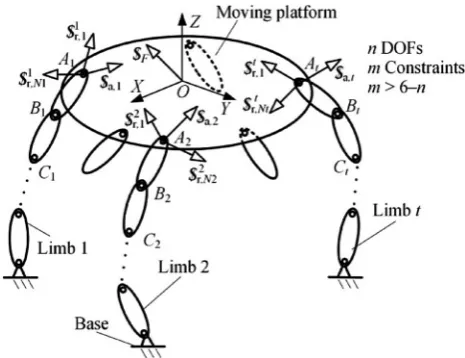
moving platform in total. For a passive overconstrained PM, there exists m[6–n. Let At,Bt, Ct, …, denote the joints of thetth (t=1, 2,…,t) supporting limb from the moving platform to the base in sequence. Assume that the friction in the kinematic joints is ignored, and the stiffness of the moving platform is much greater than that of the supporting limbs.
Owing to the existence of redundant constraints, the force and moment equilibrium equations of a passive overconstrained PM are insufficient to determine all the driving forces/torques and constraint forces/moments. Hence, a certain number of supplementary equations are required. The typical methods for force analysis of passive overconstrained PMs can be divided into six categories.
2.1 Traditional Method
Main ideas: The force and moment equilibrium equations of all movable bodies are established based on the New-ton–Euler formulation in sequence. Then, a certain number of compatibility equations of deformation are supple-mented to obtain a set of complete and solvable equations. Thus, the driving forces/torques and constraint forces/mo-ments can be solved by combining the force and moment equilibrium equations and the compatibility equations of deformation [10], which is explained briefly in the fol-lowing paragraphs.
Based on the Newton–Euler formulation the force and moment equilibrium equations of the moving platform of a passive overconstrained PM can be established as
FþP
t
t¼1 O
otRftþmOOgRg¼hO;
MþP
t
t¼1 O
otRttþrOtOotRft
¼nO;
8 > > < > > :
ð1Þ
whereFandMdenote the three-dimensional external force and moment vectors exerted on the moving platform expressed in the coordinate system {O} attached at the moving platform, respectively, ft (t=1, 2,…, t) and tt represent the three-dimensional reaction force and moment vectors of jointAtconnecting the moving platform and the
tth limb, respectively, which are expressed in the local coordinate system {ot} of the t-th limb, OotR is the
rota-tional transformation matrix of {ot} with respect to {O},g
is the gravity vector expressed in the global coordinate system, O
gR is the rotational transformation matrix of the
global system with respect to {O},mOis the mass of the moving platform,rOtis the position vector from originOto the center of joint At expressed in {O}, and hO and nO denote the inertia force and moment vectors of the moving platform expressed in {O}, respectively.
The force and moment equilibrium equations of the link
AtBtclose to the moving platform in thetth limb can be built as
fBtftþmt1ogtRg¼ht1;
tBtttþroBfBtroAft¼nt1;
ð2Þ
wherefBtandtBtrepresent the three-dimensional reaction force and moment vectors of joint Bt, respectively, ogtRis
the rotational transformation matrix of the global system with respect to {ot},mt1is the mass of the linkAtBt,roA and roB are the position vectors from the originot to the centers of the jointsAtandBt, respectively, andht1andnt1
denote the inertia force and moment vectors of the link
AtBt, respectively. fBt, tBt, roA, roB, ht1 and nt1 are
expressed in the local coordinate system {ot}.
Similarly, the force and moment equilibrium equations of other links of thetlimbs can be formulated. It should be noted that, for different types of joints, the number of unknown reactions is different, for example, one of the three reaction moments of a rotational joint (R) is zero, while for a translational joint (P), one of the three reaction forces is zero.
Assuming that the moving platform is rigid, the defor-mations of supporting limbs have to be compatible with each other to satisfy the geometric constraints. Hence, the compatibility equations of the deformations generated in the axes of redundant constraint forces and moments can be expressed as [10]
du;t¼du;tþ1;
wv;t¼wv;tþ1;
ð3Þ
wheredu,t anddu,t?1 denote the linear deformations
gen-erated at the ends of thetth and the (t?1)th limbs in the axis of theuth redundant constraint force, respectively, and
wv,t and wv,t?1 represent the angular deformations
generated at the ends of thetth and (t?1)th limbs in the axis of thevth redundant constraint moment, respectively. Then all driving forces/torques and constraint forces/moments can be solved by combining Eqs. (1), (2), and (3).
Discussion: This is a traditional method applicable to the statically indeterminate problem of general passive over-constrained PMs. However, it is computationally intensive because of the high-rank coefficient matrix of the simul-taneous equations. Furthermore, it is difficult to obtain the explicit expressions of the solutions by this method.
2.2 Method Based on the Judgment of Constraint Jacobian Matrix
Main ideas: The judgments of the independent and dependent rows of the constraint Jacobian matrix are used to find which joint reactions of a mechanism with redun-dant constraints can be uniquely determined [17,49–52].
Generally, a kinematic joint imposes a certain number of constraints on the relative motion between the two bodies it connects. If a mechanism is described byNcoordinates, the constraint conditions imposed by the bth kinematic joint can be expressed as
Ubð Þ ¼q Ubðq1;q2; ;qNÞ ¼0; ð4Þ
whereq1,q2,…,qNdenote the Ncoordinates.
Then the equations describing thelconstraints imposed by all the joints of the mechanism can be arranged as
Uð Þ ¼q
U1ð Þq
U2ð Þq .. .
Ulð Þq
0 B B B @ 1 C C C A¼
U1ðq1;q2; ;qNÞ
U2ðq1;q2; ;qNÞ
.. .
Ulðq1;q2; ;qNÞ 0 B B B @ 1 C C C
A¼0l1:
ð5Þ
The constraint Jacobian matrix of the constraint equa-tions can be obtained on the basis of Eq. (5):
Uqð Þ ¼q oU1 oq1
oU1 oq2
oU1 oqN
oU2 oq1
oU2 oq2
oU2 oqN .. . .. . .. .
oUl
oq1 oUl
oq2
oUl oqN
0 B B B B B B B B @ 1 C C C C C C C C A ¼ U1 ð Þq
U2 ð Þq
.. . Ul q 0 B B B @ 1 C C C A: ð6Þ
For a mechanism with redundant constraints, the rank of matrix Uqð Þq must be less than l. That is to say, one or more rows ofUqð Þq can be expressed as a linear combi-nation of other rows. The independent rows ofUqð Þq can
be identified by a variety of mathematical methods [17,49–52], such as the concept of direct sum, the singular value decomposition, the QR decomposition. For an
overconstrained rigid body mechanism, the reaction forces/moments corresponding to the independent con-straint equations are unique, despite that all joint reactions cannot be uniquely determined. In order to obtain the unique solutions to all joint reactions, it is necessary to consider the flexibility of passive overconstrained mecha-nisms. Wojtyra et al. [52], discussed which parts should be modeled as flexible bodies to guarantee unique joint reac-tions in overconstrained mechanisms.
Discussion: Based on the constraint Jacobian matrix of a passive overconstrained mechanism, several methods were proposed to isolate the joint reactions that can be uniquely determined. Those methods were proposed from a purely mathematical perspective, i.e., the corresponding physical interpretation was not considered. Besides, the analytical expressions of joint reactions cannot be obtained by this kind of method.
2.3 Method under the Condition of Decoupled Deformations
Main ideas: Assuming that the tth (t=1, 2, …,t) sup-porting limb of a passive overconstrained PM containsNt driving forces/torques and constraint forces/moments in total, as shown in Fig.1, the elastic deformations generated at the end of thetth limb by theNtdriving forces/torques and constraint forces/moments are considered to be decoupled to each other [53–56]. In this case, the stiffness of each supporting limb can be expressed as a scalar quantity or a diagonal matrix. The steps of this method can be summarized as follows:
The force and moment equilibrium equations of the moving platform of a passive overconstrained PM can be formulated as
6SF
ð Þ61¼G6ðnþmÞfðnþmÞ1; ð7Þ
where 6SF denotes the six-dimensional external load
imposed on the moving platform, G is the coefficient matrix mapping the driving forces/torques and constraint forces/moments to the external loads, and f is the vector composed of the magnitudes of thendriving forces/torques andmconstraint forces/moments.
Let kj be the stiffness between the jth driving for-ce/torque or constraint force/moment and the elastic deformation generated at the end of the corresponding limb under the action of thejth driving force/torque or constraint force/moment. There exists
fj¼kjdj;j¼1;2; ;nþm; ð8Þ
Rearranging Eq. (8) in the form of matrix yields
fðnþmÞ1¼KðnþmÞðnþmÞdðnþmÞ1; ð9Þ
where
fðnþmÞ1¼ðf1 f2 fnþmÞ
T
;
KðnþmÞðnþmÞ¼diagðk1 k2 knþmÞ;
dðnþmÞ1¼ðd1 d2 dnþmÞT:
The relationship between the elastic deformations gener-ated at the end of supporting limbs and the six-dimensional micro-displacementXof the moving platform as the result of external loads can be derived as
dj¼GT:;jX: ð10Þ
Rearranging Eq. (10) in the form of matrix leads to
d¼GTX: ð11Þ
From Eqs. (7) to (11) we can get
f¼KGTGKGT16SF; ð12Þ
from which the n driving forces/torques and mconstraint forces/moments can be obtained.
It should be noted that the driving force/torque or con-straint force/moment along an arbitrary direction can be decomposed along or perpendicular to the axis of the corresponding limb.
Discussion: This method gives the analytical expression of the solutions of the driving forces/torques and the con-straint forces/moments of passive overconstrained PMs. However, the coupled deformations generated at the ends of the supporting limbs by the driving forces/torques and constraint forces/moments are ignored.
2.4 Method Based on Resultant Constraint Wrenches
Main ideas: The resultant forces/moments of the collinear constraint forces or coaxial constraint moments are dealt with first. Then, the constraint forces/moments can be obtained by distributing the resultant forces/moments according to the stiffness proportion of the supporting limbs with collinear constraint forces or coaxial constraint moments [57].
Assume that a passive overconstrained PM hasp colli-near constraint forces and q coaxial constraint moments, and the remaining (m–p–q) constraints are independent. Based on the screw theory, the force and moment equi-librium equations between the actuation wrenches, the resultant constraint wrench of the p collinear constraint
forces and that of theqcoaxial constraint moments, and the remaining constraint wrenches can be built as
Xn
i¼1
wi6S^a;iþ X
mpq
k¼1
fk6S^r;kþfp6S^r;Fþfq6S^r;M
¼ðGbÞ66ð Þfb 61¼ 6ðSFÞ61; ð13Þ
where
fb¼ðw1 wn f1 fmpq fp fqÞT;
Gb¼ 6S^a;1 6S^a;n 6S^r;1 6S^r;ðmpqÞ 6S^r;F 6S^r;M
;
6S^a;iði¼1;2;. . .;nÞ;6S^r;kðk¼1;2;. . .;mpqÞ:
6S^r;F and6S^r;Mdenote the unit screws of theith actuation wrench, the kth independent constraint wrench, the resul-tant constraint wrench and the resulresul-tant constraint couple, respectively,wi,fk,fpandfqrepresent the magnitudes of the ith actuation wrench, the kth independent constraint wrench, the resultant constraint wrench and the resultant constraint couple, respectively. All screws are expressed in the global system.
If Gb is non-singular, the magnitudes of the actuation wrenches, the independent constraint wrenches, the resul-tant constraint wrench, and the resulresul-tant constraint couple can be solved from Eq. (13) as
fb¼Gb16SF: ð14Þ
According to the hypothesis given in Ref. [57], we assume that the stiffness proportion of the (c?1)th and thecth supporting limbs with collinear constraint forces is
gc, and that of the (k?1)th and thekth supporting limbs with coaxial constraint moments is gk. In view that the constraint forces and moments are in direct proportion to the stiffness of the corresponding limbs, the complemen-tary equations can be given as
fp;cþ1¼gcfp;cðc¼1;2; ;p1Þ; fq;kþ1¼gkfq;kðk¼1;2; ;q1Þ;
(
ð15Þ
wherefp,cand fq,kare the magnitudes of the cth collinear constraint force and the kth collinear constraint moment, respectively.
The magnitudes of the resultant constraint forces and moments have been solved from Eq. (14) as
fp¼ðGbÞ5;1:6SF ¼
Xp
c¼1
fp;c;
fq¼ðGbÞ6;1:6SF ¼
Xq
k¼1
fq;k:
8 > > > > < > > > > :
Combining Eqs. (15) and (16), the magnitudes of each collinear constraint force and coaxial constraint moment can be solved. Thus, the reactions of the joints connecting the moving platform and supporting limbs can be easily determined based on the relationship between them and the actuation and constraint wrenches. The reactions of other joints can be solved by establishing the force and moment equilibrium equations of the corresponding link one by one.
Discussion: In general, a kinematic joint possesses more than one constraint reaction, for example, there exist 5, 4, 4 and 3 constraint reactions for an R joint, universal joint (U), cylindrical joint (C), and spherical joint (S), respec-tively. If we adopt traditional methods to build the force and moment equilibrium equations of all movable bodies and complementary equations, the rank of the coefficient matrix of those equations will be very large. This method, which is based on resultant constraint wrenches, can avoid the high-rank matrix, reduce a certain number of unknowns, and ensure that the number of simultaneous equilibrium equations is not more than six each time. However, it is only suitable for solving the driving for-ces/torques and constraint forces/moments of passive overconstrained PMs with collinear constraint forces or coaxial constraint moments.
2.5 Method Based on the Stiffness Matrix of Limb’s Overconstraint or Constraint Wrenches
Main ideas: Based on the characteristics of the elastic deformations generated at the ends of supporting limbs, the passive overconstrained PMs are classified into two clas-ses: the limb stiffness decoupled and coupled overcon-strained PMs. Stiffness matrices of the limb’s overconstraint and constraint wrenches that correspond to the two types of mechanisms are defined, which help to establish the compatibility equations about the deforma-tions generated at the ends of supporting limbs and the micro-displacements of the moving platform [58]. Then, the driving forces/torques and constraint forces/moments of the two kinds of overconstrained PMs are solved by combining the force and moment equilibrium equations and the compatibility equations of deformation.
A brief review of the methods for force analysis of the limb stiffness decoupled and coupled overconstrained PMs follows.
For a limb stiffness decoupled overconstrained PM, the force and moment equilibrium equations of the moving platform can be expressed as
6SF¼wa;16S^a;1þ wa;n6S^a;nþfr;16S^r;1þ fr;l6S^r;lþf
e r;16S^
e r;1
þ þfre;d6S^er;d¼Gcfc;
ð17Þ
where
Gc¼ 6S^a;1 6S^a;n 6S^r;1 6S^r;l 6S^
e
r;1 6S^ e r;d
;
fc¼ wT a f
T r;non f
T e
T
;
wa¼ðwa;1 wa;nÞT;
fr;non¼ðfr;1 fr;lÞT;
fe¼fre;1 fre;dT;
6S^a;i(i=1, 2,…,n),6S^r;e(e=1, 2,…,l), and6S^er;r(r=1, 2,…,d) represent the unit screws of theith actuation wrench,
eth non-overconstraint wrench, andrth equivalent constraint wrench of the (m–l) overconstraint wrenches, respectively.
wa,i, fr,e, and fre;r are the magnitudes of the ith actuation
wrench, eth non-overconstraint wrench, and rth equivalent constraint wrench, respectively. Details about the non-over-constraint wrenches, overnon-over-constraint wrenches, and equivalent ones of overconstraint wrenches are given in Ref. [58].
Then the magnitudes of the actuation wrenches, the non-overconstraint wrenches, and the equivalent constraint wrenches can be solved from Eq. (17) as
fc¼ wTa f T r;non f
T e
T
¼Gc16SF: ð18Þ
Assume that the (m–l) overconstraint wrenches are dis-tributed in1supporting limbs. The relationship between the magnitudes of the equivalent constraint wrenches and those of the overconstraint wrenches can be expressed as
fe¼fre;1 fre;dT¼J1f1overþJ2f2overþ þJ1f1over:
ð19Þ
According to the definition of the stiffness matrix of the supporting limb’s overconstraint wrenches [58], we can know that
fsover¼Ksds;s¼1;2; ;1: ð20Þ
The elastic deformations generated at the end of thesth supporting limb in the axes of overconstraint wrenches can be formulated as
ds¼JTsXe; ð21Þ
where Xe is the vector composed of the elastic
deforma-tions in the axes of equivalent constraint wrenches. Then, the magnitudes of the overconstraint wrenches can be solved by combining Eqs. (19), (20) and (21) as
fsover¼KsJTs J1K1JT1þJ2K2JT2þ þJ1K1JT1
1
fe:
ð22Þ
For a limb stiffness coupled overconstrained PM, assuming that the tth supporting limb supplies Nt con-straint wrenches (including actuation wrenches) to the moving platform, the force and moment equilibrium equations of the moving platform can be expressed as 6SF¼f116S^11þf216S^12þ fN116S^1N1þf126S^21þf226S^22
þ fN226S^N22þ f1t6S^1t þf2t6S^2t þ fNtt6S^tNt
¼Gdfd; ð23Þ
where
Gd¼ðG1 G2 GtÞ;
Gt¼ 6S^t1 6S^t2 6S^tNt;t¼1;2;. . .;t; fd¼fT1 fT2 fTt T;
ft¼ðf1t f2t fNttÞT:
According to the definition of the stiffness matrix of the supporting limb’s constraint wrenches [58] there exists
ft¼Ktdt: ð24Þ
The compatibility equation about the elastic deforma-tions generated at the end of each limb in the axes of constraint wrenches and the six-dimensional micro-dis-placement of the moving platform is
dt¼GTtX: ð25Þ
Thus, the magnitudes of all the constraint wrenches (including the actuation wrenches) can be solved by com-bining Eqs. (23), (24) and (25) as
ft¼KtGTt G1K1GT1 þG2K2GT2þ þGtKtG T
t
1
6SF;
ð26Þ
which is just the general expression of the magnitudes of all actuation and constraint wrenches.
Then, the actual reactions of all kinematic joints can be easily obtained according to the relationship between them and the magnitudes of the actuation and constraint wren-ches shown in Ref. [58].
Discussion: It can be seen from Eqs. (18), (22), and (26) that, for the statically indeterminate problem of the limb stiffness decoupled overconstrained PMs, only the elastic deformations generated at the end of supporting limbs in the axes of overconstraint wrenches need to be considered, while for that of the limb stiffness coupled overconstrained PMs, the elastic deformations generated at the end of supporting limbs in the axes of all constraint wrenches, including actuation wrenches, should be taken into account. This method has clear steps, few computational requirements, and gives the explicit analytical expressions of the solutions to the statically indeterminate problem of general passive overconstrained PMs.
2.6 Weighted Generalized Inverse Method
Main ideas: A simple method is proposed in Ref. [59] by resorting to the definition of the weighted generalized inverse of a non-square matrix [77], which is suitable for solving the statically indeterminate problem of both the limb stiffness decoupled and coupled passive overcon-strained PMs.
Based on the weighted generalized inverse of the matrix mapping the driving forces/torques and constraint forces/moments to the external loads, the solutions of the statically indeterminate problem of a general passive overconstrained PM can be derived as [59]
f ¼GþB6SF ¼B1GTGB1GT16SF; ð27Þ
where the weighted matrix B is the inverse matrix of a block diagonal matrix composed of the stiffness matrices of each limb’s constraint wrenches.
In the case that each supporting limb only supplies one driving force/torque or constraint force/moment, the stiff-ness of each limb is just a scalar quantity, and the weighted matrix B becomes a diagonal matrix, which is consistent with the work done in Refs. [53,54].
Discussion: The method based on the weighted gener-alized inverse supplies a simpler and more effective way to solve the statically indeterminate problem of passive overconstrained PMs. Moreover, it can be seen from Eq. (27) that the elements of the weighted matrixBare the stiffness matrices of the limbs’ constraint wrenches, which shows that the solutions of the driving forces/torques and constraint forces/moments of passive overconstrained PMs are unique.
In addition to the above mentioned methods, there are other approaches of handling redundant constraints of a passive overconstrained PM, for example, the pseudo-in-verse method [60] and the augmented Lagrangian formu-lation [61,62]. Furthermore, Zahariev et al. [63], proposed a method for dynamic analysis of multibody systems in overconstrained and singular configurations, in which some closed chains are transformed into open branches and the missing links are substituted by stiff forces.
3 Methods for Force Analysis of Active
Overconstrained PMs
The schematic of a general active overconstrained PM with
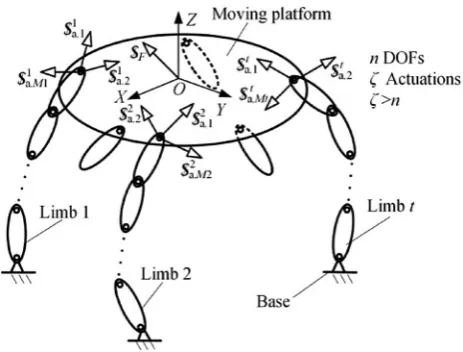
n DOFs and f actuated joints is shown in Fig.2, where
As there are theoretically infinite sets of solutions to the statically indeterminate problem of active overconstrained PMs, the key to the force analysis of this kind of over-constrained PMs is to find the optimal distribution of all driving forces/torques. The typical methods for solving this problem fall into four categories.
3.1 Pseudo-inverse Method
The force and moment equilibrium equations of an active overconstrained PM can be written in the form [40,42,72]
Gactfact¼Fextr; ð28Þ
wherefact consists offdriving forces/torques, Gact is the
coefficient matrix, and Fextr is the generalized external
force vector composed of inertia forces/moments, weight, and external loads encountered in the components of the mechanism.
As the matrixGactis singular, the pseudo-inverse ofGact
is used to find the minimum norm offactin some situations
[27,30,72]:
fact¼GþactFextr: ð29Þ
In this way, the minimum driving forces/torques of an active overconstrained PM can be obtained.
3.2 Weighted Coefficient Method
The distribution of the driving forces/torques of an active overconstrained PM under different optimization goals [65–69] can be viewed as a constrained optimization problem, i.e., the minimum set of solutions of the objective function under the constraints of force and moment balance need to be solved. The weighted coefficient method pro-posed by Huang et al. [73] and Zhao et al. [78], can achieve a variety of optimization goals. It is taken as representative
of this method and is briefly reviewed in the following paragraphs:
Selectnjoints among thefactuated joints as the gener-alized coordinates. The driving forces/torques of the (f–n) actuated joints, external loads, inertia forces/moments, and gravity applied on the moving platform and each supporting link can be expressed with respect to the generalized coor-dinates. Thus, the dynamic equilibrium equations of an active overconstrained PM can be rearranged as [73,78]
snon¼ X
t
t¼1 Xlt
h¼1
Gnonh
t
6StF;hþGnonF 6SFþGnonoversover !
;
ð30Þ
wheresnonis composed of the driving forces/torques of the
generalized joints, i.e., the n non-redundant driving for-ces/torques, andsoverconsists of the driving forces/torques
of the non-generalized joints, i.e., the remaining (f–n) redundant driving forces/torques. 6StF;h and6SF denote the resultant force vectors of the external loads, gravity, and inertia force/moment acted on the h-link of the tth limb and the moving platform, respectively. They are expressed in the corresponding local coordinates. Gnonh t,GnonF , and
Gnonover represent the transformation matrices of6StF;h, 6StF;h, and sover from the corresponding local coordinates to the
generalized coordinates, respectively.
In order to obtain the optimal distribution of all driving forces/torques, the objective function of optimization can be constructed as [73,78]
fobj¼
Xn
i¼1
Wi2s2iþ X f
n¼nþ1
Wn2s2n¼sTnonWnonsnonþsToverWoversover;
ð31Þ
where
Wnon¼diag W12;W 2 2; ;W
2
n
;
Wover¼diag Wn2þ1;W 2
nþ2; ;W 2
f
;
in whichWiandWn(n =n?1,n ?2,…,f) are weighted coefficients.
By solving the minimum values of the objective func-tion shown in Eq. (31) under the constraint condition of Eq. (30) we get
sover¼ Woverþ Gnonover
T
WnonGnonover
1
Gnonover
T
Wnon6SF;M;
ð32Þ
where6SF;M ¼
Pt t¼1
PMt
h¼1
Gnonh
t
6StF;hþGnonF 6SF
. Substituting Eq. (32) into Eq. (30) yields
snon¼ IGnonover Woverþ Gnonover T
WnonGnonover
1
Gnon over T
Wnon
6SF;M:
ð33Þ
Rearranging Eqs. (32) and (33) yields
snon
sover
¼
IGnonover Woverþ Gnonover
T
WnonGnonover
1
Gnonover
T
Wnon
Woverþ Gnonover
T
WnonGnonover
1
Gnonover
T
Wnon
0 B @
1 C A
6SF;M;
ð34Þ
which is the analytical expression of the optimal distribu-tion of driving forces/torques of a general active overcon-strained PM. Different optimization goals can be achieved by changing the values of the weighted matricesWnonand
Wover, for example:
(1) Let Wi and Wnbe the velocities of the ith andnth actuated joints, respectively. The driving forces/torques are distributed with the minimum input energy of the actuators [36,66,67].
(2) LetWi=Wn=1. Then, the minimum driving for-ces/torques of the mechanism can be obtained [40,65].
(3) Let Wi¼Ki 1 and Wn¼Kn1, where Ki and Kn represent the stiffness of the ith and nth actuated joints, respectively. The driving forces/torques are distributed with the minimum elastic potential energy of the mecha-nism [37,68,69].
3.3 Method Based on the Optimal Internal Forces
For an active overconstrained PM, the solution to its stat-ically indeterminate problem shown in Eq. (28) can be broken into a particular solution and a homogeneous solution [19,39], as follows:
fact¼fspclþfhomo; ð35Þ
where the special solutionfspclsatisfies
Gactfspcl¼Fextr;
and the homogeneous solutionfhomomeets
Gactfhomo¼0:
It can be seen from Eq. (35) that the solutions of driving forces/torques may involve the components corresponding to the null space of the coefficient matrixGact, which are
known as the internal forces. Hence, two kinds of methods are proposed for the statically indeterminate problem of active overconstrained PMs from the perspective of dealing with the internal forces. The first method is that the driving
forces/torques are distributed without internal forces [18, 35, 70]. A number of studies have shown that the internal forces can be utilized to change the stiffness [79], improve the motion accuracy [32], increase the load-car-rying capacity [19], and eliminate the backlash [34] of active overconstrained PMs, so the second method is that the driving forces/torques are distributed by utilizing the advantages of internal forces [19,32,34].
3.4 Weighted Generalized Inverse Method
If A2CxðyþzÞ andA=[U V], whereUandV are com-posed of the first ycolumns and the last zcolumns of A, respectively. The weighted generalized inverse of the matrix Acan be expressed as [80]
APþ;Q¼ UþP;QyðIVHÞ IUþP;QyU
Qy1LH H
!
;
ð36Þ
whereH¼CþP;K1þICþP;QyCK11DQyLUþP;Qy; K1¼QzþDQyDðDLþLDÞ L IUþP;QyU
Qy1L;
C¼IUUþP;QyV;D¼UþP;QyV;
AþP;Qrepresents the weighted generalized inverse matrix ofAwithPandQas the weighted factors,Iis an identity matrix, P is a x9x positive definite matrix, and Q is a (y?z)9(y?z) positive definite matrix that can be partitioned as
Q¼ Qy L L Qz
,
in which the sign ‘‘*’’ denotes the conjugate and transpose operations.
Using Eq. (36), we found that the solution of the driving forces/torques shown in Eq. (34) can be obtained directly using the weighted generalized inverse of the matrix mapping the driving forces/torques to the generalized external force [59]. Therefore, the weighted generalized inverse can be applied to distribute the driving for-ces/torques of active overconstrained PMs:
fact¼ðGactÞþS6SF;M¼S1GTact GactS1GTact
1
6SF;M; ð37Þ
where S is the weighted diagonal matrix whose elements are determined by the specific optimization goal.
among the actuators. A scaling factor method and an analytical method were presented in Ref. [74] to determine the wrench capabilities of active overconstrained PMs. Nahon et al. [75], summarized three methods for solving the optimal force distribution problem of this kind of PMs: the weighted pseudo-inverse, explicit Lagrange multipliers, and direct substitution.
4 Discussion
The force analyses of both active and passive overcon-strained PMs belong to the statically indeterminate prob-lem. A large number of methods have been proposed for the force analysis of these two kinds of overconstrained PMs, among which the weighted generalized inverse method is the simplest and most common. That is to say, the solutions of the statically indeterminate problems of both active and passive overconstrained PMs can be solved by
f¼GFf
þ
W6SF ¼W 1 GF
f
T
GFfW1GFfT
1
6SF:
ð38Þ
For the passive overconstrained PMs,f consists of the magnitudes of all constraint wrenches (including actuation wrenches),GFf is the coefficient matrix mapping the driving forces/torques and constraint forces/moments to the exter-nal loads, and the weighted matrixW is composed of the stiffness matrices of each limb’s constraint wrenches, which cannot be actively selected. As a result, the solutions of the driving forces/torques and constraint forces/moments of passive overconstrained PMs are unique. For the active overconstrained PMs,fis composed of the magnitudes of all driving forces/torques, GFf is the coefficient matrix mapping the driving forces/torques to the generalized external loads, and the elements of the weighted matrix
Wcan be actively given according to different optimization goals. Therefore, there are an infinite number of solutions of the driving forces/torques of active overconstrained PMs.
5 Conclusions and Outlook
The existence of redundant constraints or actuations makes the force analysis of both passive overconstrained PMs (i.e., the PMs with redundant or common constraints) and active ones (i.e., the redundantly actuated PMs) belong to a statically indeterminate problem, which is extremely dif-ficult and particularly complicated to solve. The various
approaches proposed for the force analysis of these two kinds of overconstrained PMs are divided into six cate-gories and four catecate-gories, respectively, in this paper, among which:
(1) The pseudo-inverse method was used to solve the force analysis of these two kinds of overconstrained PMs. However, for the passive overconstrained PMs, the solu-tions are obtained without physical meaning, and for the active overconstrained PMs, the driving forces/torques are solved with the minimum values.
(2) The common method used to solve the statically indeterminate problem of passive overconstrained PMs involves combining the force and moment equilibrium equations and the compatibility equations of deformation of the mechanisms, and that used to solve the driving forces/torques of active overconstrained PMs involves establishing a specific optimization goal and then solving the minimum values of the objective function under the constraint of force and moment equilibrium equations.
(3) The weighted generalized inverse method can be applied to solve the statically indeterminate problem of both passive and active overconstrained PMs. For the passive overconstrained PMs, the weighted matrix consists of the stiffness matrices of each limb’s constraint wren-ches, and for the active overconstrained PMs, it is deter-mined by the optimization goals.
In recent decades, sustained efforts have been made to find a simple and general method to solve the driving forces/torques and constraint forces/moments of passive overconstrained PMs, and to distribute the driving for-ces/torques of active overconstrained PMs. It can be seen from this paper that the weighted generalized inverse method is the simplest and most universal one at present.
However, the existing theoretical methods for force analysis of overconstrained PMs are basically proposed without considering the actual characteristics of the mechanisms, such as joint clearance and friction, the real stiffness models of supporting limbs. Therefore, the force analysis of typical overconstrained systems (for example, the parallel machine tool XT 700) under the condition of the actual characteristics will become a research hotspot. In addition, the establishment of systematic experimental platforms to verify the theoretical methods will be another important research direction.
Open Access This article is distributed under the terms of the
References
1. S A Joshi, L W Tsai. Jacobian analysis of limited-DOF parallel manipulators.Journal of Mechanical Design, Transactions of the ASME, 2002, 124(2): 254–258.
2. A Sokolov, P Xirouchakis. Dynamics analysis of a 3-DOF par-allel manipulator with R-P-S joint structure. Mechanism and Machine Theory, 2007, 42(5): 541–557.
3. L W Tsai, S Joshi. Kinematics and optimization of a spatial 3-UPU parallel manipulator. Journal of Mechanical Design, Transactions of the ASME, 2000, 122(4): 439–446.
4. R D Gregorio. Kinematics of the 3-UPU wrist.Mechanism and Machine Theory, 2003, 38(3): 253–263.
5. Y LU, Y Shi, B Hu. Kinematic analysis of two novel 3UPU I and 3UPU II PKMs.Robotics and Autonomous Systems, 2008, 56(4): 296–305.
6. M Callegari, M C Palpacelli, M Principi. Dynamics modelling and control of the 3-RCC translational platform.Mechatronics, 2006, 16(10): 589–605.
7. J F Li, J S Wang. Inverse kinematic and dynamic analysis of a 3-DOF parallel mechanism. Chinese Journal of Mechanical Engineering, 2003, 16(1): 54–58.
8. Y M Qian. Position equation establishment and kinematics analysis of 3-RRC parallel mechanism.Applied Mechanics and Materials, 2014, 664: 349–354.
9. T Bonnemains, H Chanal, B C Bouzgarrou, et al. Dynamic model of an overconstrained PKM with compliances: the Tripteor X7. Robotics and Computer-Integrated Manufacturing, 2013, 29(1): 180–191.
10. Z M Bi, B Kang. An inverse dynamic model of over-constrained parallel kinematic machine based on Newton–Euler formulation. Journal of Dynamic Systems, Measurement, and Control, Transactions of the ASME, 2014, 136(4): 041001-(1–9). 11. Z M Bi. Kinetostatic modeling of Exechon parallel kinematic
machine for stiffness analysis.International Journal of Advanced Manufacturing Technology, 2014, 71(1): 325–335.
12. Y M Li, Q S Xu. Dynamic modeling and robust control of a 3-PRC translational parallel kinematic machine. Robotics and Computer-Integrated Manufacturing, 2009, 25(3): 630–640. 13. Y M Li, S Staicu. Inverse dynamics of a 3-PRC parallel
kine-matic machine.Nonlinear Dynamic, 2012, 67(2): 1031–1041. 14. C Mavroidis, B Roth. Analysis of overconstrained mechanisms.
Journal of Mechanical Design, Transactions of the ASME, 1995, 117(1): 69–74.
15. Y F Fang, L W Tsai. Enumeration of a class of overconstrained mechanisms using the theory of reciprocal screws. Mechanism and Machine Theory, 2004, 39(11): 1175–1187.
16. E J Haug. Computer-aided kinematics and dynamics of mechanical systems. vol. 1: basic methods. Allyn and Bacon, 1989.
17. M Wojtyra. Joint reaction forces in multibody systems with redundant constraints.Multibody System Dynamics, 2005, 14(1): 23–46.
18. Y D Xu, J T Yao, Y S Zhao. Internal forces analysis of the active overconstrained parallel manipulators. International Journal of Robotics and Automation, 2015, 30(5): 511–518.
19. J Wu, X L Chen, L P Wang, et al. Dynamic load-carrying capacity of a novel redundantly actuated parallel conveyor. Nonlinear Dynamics, 2014, 78(1): 241–250.
20. C Z Wang, Y F Fang, S Guo. Multi-objective optimization of a parallel ankle rehabilitation robot using modified differential evolution algorithm. Chinese Journal of Mechanical Engineer-ing,2015, 28(4): 702–715.
21. Y D Xu, J T Yao, Y S Zhao. Inverse dynamics and internal forces of the redundantly actuated parallel manipulators. Mechanism and Machine Theory, 2012, 51: 172–184.
22. F Firmani, R P Podhorodeski. Force-unconstrained poses for a redundantly-actuated planar parallel manipulator. Mechanism and Machine Theory, 2004, 39(5): 459–476.
23. B Dasgupta, T S Mruthyunjaya. Force redundancy in parallel manipulators: theoretical and practical issues. Mechanism and Machine Theory, 1998, 33(6): 727–742.
24. J A Saglia, J S Dai, D G Caldwell. Geometry and kinematic analysis of a redundantly actuated parallel mechanism that eliminates singularities and improves dexterity. Journal of Mechanical Design, Transactions of the ASME, 2008, 130(12): 1786–1787.
25. S H Li, Y M Liu, H L Cui, et al. Synthesis of branched chains with actuation redundancy for eliminating interior singularities of 3T1R parallel mechanisms. Chinese Journal of Mechanical Engineering, 2016, 29(2): 250–259.
26. J Kim, F C Park, J R Sun, et al. Design and analysis of a redundantly actuated parallel mechanism for rapid machining. IEEE Transactions on Robotics and Automation, 2001, 17(4): 423–434.
27. H Cheng, Y K Yiu, Z X Li. Dynamics and control of redundantly actuated parallel manipulators. IEEE/ASME Transactions on Mechatronics, 2003, 8(4): 483–491.
28. Y J Zhao, F Gao, W M Li, et al. Development of a 6-DOF parallel seismic simulator with novel redundant actuation. Mechatronics, 2009, 19(3):422–427.
29. J M Tao, J Y S Luh. Coordination of two redundant robots. IEEE International Conference on Robotics and Automation, Scotts-dale, AZ, USA, May 14–19, 1989: 425–430.
30. S B Nokleby, R Fisher, R P Podhorodeski, et al. Force capabil-ities of redundantly-actuated parallel manipulators. Mechanism and Machine Theory, 2005, 40(5): 578–599.
31. Y J Zhao, F Gao. Dynamic performance comparison of the 8PSS redundant parallel manipulator and its non-redundant counter-part—the 6PSS parallel manipulator. Mechanism and Machine Theory, 2009, 44(5): 991–1008.
32. H Liang, W Y Chen, H F Li. Research on the method of improving accuracy of parallel machine tools. Key Engineering Materials, 2009, 407–408: 85–88.
33. J Wu, J S Wang, L P Wang, et al. Dynamics and control of a planar 3-DOF parallel manipulator with actuation redundancy. Mechanism and Machine Theory, 2009, 44(4): 835–849. 34. A Mu¨ller. Internal preload control of redundantly actuated
par-allel manipulators–its application to backlash avoiding control. IEEE Transactions on Robotics, 2005, 21(4): 668–677. 35. I D Walker, R A Freeman, S I Marcus. Internal object loading for
multiple cooperating robot manipulators. IEEE International Conference on Robotics and Automation, Scottsdale, AZ, USA, May 14–19, 1989: 606–611.
36. Y F Zheng, J Y S Luh. Optimal load distribution for two industrial robots handling a single object. Proceedings of the 1988 IEEE International Conference on Robotics and Automa-tion, Philadelphia, PA, USA, April 24–29, 1988: 344–349. 37. X C Gao, S M Song, C Q Zheng. Generalized stiffness matrix
method for force distribution of robotic systems with indetermi-nacy. Journal of Mechanical Design, Transactions of the ASME, 1993, 115(3): 585–591.
38. Y S Zhao, L Lu, T S Zhao, et al. Dynamic performance analysis of six-legged walking machines. Mechanism and Machine The-ory, 2000, 35(1): 155–163.
40. M A Nahon, J Angeles. Optimization of dynamic forces in mechanical hands. Journal of Mechanisms, Transmissions, and Automation in Design, 1991, 113(2): 167–173.
41. X W Kong. Standing on the shoulders of giants: a brief note from the perspective of kinematics. Chinese Journal of Mechanical Engineering, 2017, 30(1): 1–2.
42. J Wu, J S Wang, T M Li, et al. Dynamic analysis of the 2-DOF planar parallel manipulator of a heavy duty hybrid machine tool. International Journal of Advanced Manufacturing Technology, 2007, 34(3): 413–420.
43. Y W Li, J S Wang, L P Wang, et al. Inverse dynamics and simulation of a 3-DOF spatial parallel manipulator. 2003 IEEE International Conference on Robotics and Automation, Taipei, Taiwan, China, September 14–19, 2003: 4092–4097.
44. Y Lu, Y Shi, Z Huang, et al. Kinematics/statics of a 4-DOF over-constrained parallel manipulator with 3 legs. Mechanism and Machine Theory, 2009, 44(8): 1497–1506.
45. J Gallardo, J M Rico, A Frisoli, et al. Dynamics of parallel manipulators by means of screw theory. Mechanism and Machine Theory, 2003, 38(11): 1113–1131.
46. D G Raffaele, P C Vicenzo. Dynamics of a class of parallel wrists. Journal of Mechanical Design, Transactions of the ASME, 2004, 126(3): 436–441.
47. S Staicu, D Zhang. A novel dynamic modelling approach for parallel mechanisms analysis. Robotics and Computer-Integrated Manufacturing, 2008, 24(1): 167–172.
48. S Staicu, D Zhang, R Rugescu. Dynamic modelling of a 3-DOF parallel manipulator using recursive matrix relations. Robotica, 2006, 24(1): 125–130.
49. M Wojtyra. Joint reactions in rigid body mechanisms with dependent constraints. Mechanism and Machine Theory, 2009, 44(12): 2265–2278.
50. J Fraczek, M Wojtyra. On the unique solvability of a direct dynamics problem for mechanisms with redundant constraints and coulomb friction in joints. Mechanism and Machine Theory, 2011, 46(3): 312–334.
51. M Wojtyra, J Fraczek. Solvability of reactions in rigid multibody systems with redundant nonholonomic constraints. Multibody System Dynamics, 2013, 30(2): 153–171.
52. M Wojtyra, J Fraczek. Joint reactions in rigid or flexible body mechanisms with redundant constraints. Bulletin of the Polish Academy of Sciences: Technical Sciences, 2012, 60(3): 617–626. 53. R Vertechy, V Parenti-Castelli. Static and stiffness analyses of a class of over-constrained parallel manipulators with legs of type US and UPS. 2007 IEEE International Conference on Robotics and Automation, Roma, Italy, April 10–14, 2007: 561–567. 54. Z J Wang, J T Yao, Y D Xu, et al. Hyperstatic analysis of a fully
pre-stressed six-axis force/torque sensor. Mechanism and Machine Theory, 2012, 57: 84–94.
55. J T Yao, Y L Hou, J Chen, et al. Theoretical analysis and experiment research of a statically indeterminate pre-stressed six-axis force sensor. Sensors and Actuators A: Physical, 2009, 150(1): 1–11.
56. B Hu, Z Huang. Kinetostatic model of overconstrained lower mobility parallel manipulators. Nonlinear Dynamics, 2016, 86(1): 309–322.
57. Z Huang, Y Zhao, J F Liu. Kinetostatic analysis of 4-R(CRR) parallel manipulator with overconstraints via reciprocal-screw theory. Advances in Mechanical Engineering, 2010, 2010(2): 1652–1660.
58. Y D Xu, W L Liu, J T Yao, et al. A method for force analysis of the overconstrained lower mobility parallel mechanism. Mecha-nism and Machine Theory, 2015, 88: 31–48.
59. W L Liu, Y D Xu, J T Yao, et al. The weighted Moore-Penrose generalized inverse and the force analysis of overconstrained
parallel mechanisms. Multibody System Dynamics, 2017, 39(4): 363–383.
60. M Wojtyra, J Fraczek. Comparison of selected methods of han-dling redundant constraints in multibody systems simulations. Journal of Computational and Nonlinear Dynamics, 2013, 8(2): 021007-(1–9).
61. E Bayo, R Ledesma. Augmented lagrangian and mass-orthogonal projection methods for constrained multibody dynamics. Non-linear Dynamics, 1996, 9: 113–130.
62. W Blajer. Augmented Lagrangian formulation: geometrical interpretation and application to systems with singularities and redundancy. Multibody Systems Dynamics, 2002, 8(2): 141–159. 63. E Zahariev, J Cuadrado. Dynamics of mechanisms in overcon-strained and singular configurations. Journal of Theoretical and Applied Mechanics, 2011, 41(1): 3–18.
64. S M Song, X C Gao. Mobility equation and the solvability of joint forces/torques in dynamic analysis. American Society of Mechanical Engineers, Design Engineering Division (Publica-tion) DE, 1990, 24: 191–197.
65. J P Merlet. Redundant parallel manipulators. Laboratory Robotics and Automation, 1996, 8(1): 17–24.
66. D E Orin, S Y Oh. Control of force distribution in robotic mechanisms containing closed kinematic chains. Journal of Dynamic Systems, Measurement and Control, Transactions of the ASME, 1981, 103(2): 134–141.
67. M Nahon, J Angeles. Minimization of power losses in cooper-ating manipulators. Journal of Dynamic Systems, Measurement and Control, Transactions of the ASME, 1992, 114(2): 213–219. 68. D R Kerr, M Griffis, D J Sanger, et al. Redundant grasps, redundant manipulators, and their dual relationships. Journal of Robotic Systems, 1992, 9(7): 973–1000.
69. J Wu, T M Li, B Q Xu. Force optimization of planar 2-DOF parallel manipulators with actuation redundancy considering deformation. Proceedings of the Institution of Mechanical Engi-neers, Part C: Journal of Mechanical Engineering Science, 2013, 227(6): 1371–1377.
70. I D Walker, R A Freeman, S I Marcus. Analysis of motion and internal loading of objects grasped by multiple cooperating manipulators. International Journal of Robotics Research, 1991, 10(4): 396–409.
71. J F Gardner, K Srinivasan, K J Waldron. A solution for the force distribution problem in redundantly actuated closed kinematic chains. Journal of Dynamic Systems, Measurement and Control, Transactions of the ASME, 1990, 112(3): 523–526.
72. V R Kumar, K J Waldron. Force distribution in closed kinematic chains. IEEE Journal of Robotics and Automation, 1988, 4(6): 657–664.
73. Z Huang, Y S Zhao. Accordance and optimization-distribution equations of the over-determinate inputs of walking machines. Mechanism and Machine Theory, 1994, 29(2): 327–332. 74. V Garg, S B Nokleby, J A Carretero. Wrench capability analysis
of redundantly actuated spatial parallel manipulators. Mechanism and Machine Theory, 2009, 44(5): 1070–1081.
75. M A Nahon, J Angeles J. Force optimization in redundantly-actuated closed kinematic chains. IEEE International Conference on Robotics and Automation, Scottsdale, AZ, USA, May 14–19, 1989: 951–956.
76. M Nahon, J Angeles. Real-time force optimization in parallel kinematic chains under inequality constraints. Proceedings of the 1991 IEEE International Conference on Robotics and Automa-tion, Sacramento, CA, USA, April 9–11, 1991: 2198–2203. 77. Z P Xiong, Y Y Qin. Note on the weighted generalized inverse of
78. Y S Zhao, J Y Ren, Z Huang. Dynamic loads coordination for multiple cooperating robot manipulators. Mechanism and Machine Theory, 2000, 35(7): 985–995.
79. M A Adli, H Hanafusa. Contribution of internal forces to the dynamics of closed chain mechanisms. Robotica, 1995, 13(5): 507–514.
80. G R Wang, B Zheng. The weighted generalized inverses of a partitioned matrix. Applied Mathematics and Computation (New York), 2004, 155(1): 221–233.
Wen-Lan Liu,born in 1990, is currently a PhD candidate atCollege
of Mechanical Engineering, Yanshan University, China. She received her bachelor degree fromLanzhou University of Technology, China, in 2012. Her research interests include parallel manipulator and robotics. Tel:?86-18330387739; E-mail: [email protected]
Yun-Dou Xu,born in 1985, is currently an associate professor at
College of Mechanical Engineering, Yanshan University, China. He
received his PhD degree from Yanshan University, China, in 2012. His research interests include parallel manipulator and robotics. E-mail: [email protected]
Jian-Tao Yao,born in 1980, is currently a professor atCollege of
Mechanical Engineering, Yanshan University, China. He received his PhD degree fromYanshan University, China, in 2010. His research interests include six-axis force sensors, parallel manipulators, and mechatronics. E-mail: [email protected]
Yong-Sheng Zhao,born in 1962, is currently a professor atCollege