ISSN 0975-928X
Research Article
Studies on genetic control of quality traits in rice (
oryza sativa
L.) using six
parameter model of generation mean analysis
P. Jhansi Rani*, P.V. Satyanarayana1, N.Chamundeswari1, M. Lal Ahamed and M.Girija Rani1
*
Department of Genetics and Plant Breeding, Agricultural College Bapatla 522101, Andhra Pradesh 1APRRI & RARS, Maruteru, West Godavari (Dist), 534122, Andhra Pradesh
*Email: [email protected]
(Received:16 Jan 2015; Accepted:22 Feb 2015)
Abstract
Analysis of generation means in P1, P2, F1, F2, B1 and B2 generations of the two rice crosses MTU 1075/ MTU 3626 and
MTU 1121/ TN 1 was performed to determine the nature of gene action governing 11 quality traits viz., kernel length, kernel breadth, L/B ratio, hulling percentage, milling percentage, head rice recovery, kernel elongation ratio, volume expansion ratio, alkali spreading value, gel consistency and amylose content. All the traits studied showed non allelic gene interaction indicating presence of epistatic gene action. Nature of gene action varied with the character and both additive and non-additive gene action was involved in expression of the characters having the duplicate type of epistasis. The traits were predominantly governed by dominance and dominance x dominance interaction effects and favors heterosis breeding for improvement.
Key words
Quality traits, physical quality traits, alkali spreading value, gel consistency and amylose content
Introduction
Rice is the staple food for over half of the world population and it is ranked as the number one human food crop in world. More than 90% world rice is grown and consumed in Asia (Tyagi et al., 2004), where as 60% calories are consumed by 3 billion Asians. India is the second most populous nation, stands first in areas, second in production followed and preceded by China. Rice occupies a pivotal place in Indian food and livelihood security system. This study is focused on the improvement of quality traits and to elucidate the gene action associated with various quality attributes through generation mean analysis. Besides the yield and yield components quality parameters also gaining importance in development of new high yielding cultivars in rice. Quality characters can be classified as physical, cooking and chemical traits. Physical properties such as grain dimensions (kernel length, kernel breadth and L/B ratio) and milling traits (hulling %, milling % and head rice recovery) are major factors defining market value. Physical properties also include yield of edible and marketable polished grain, uniform shape, whiteness and translucence. These traits are immediately obvious to consumers and so are major factors defining market value. The traits that exert major effects on the eating and cooking qualities are related to the chemical properties of rice grains such as amylose content, alkali spreading value and gel consistency and cooking characteristics volume expansion ratio and kernel elongation ratio. Hence there is an imperative need for a shift in emphasis towards development of high quality rice besides yield. Information concerning the nature of gene action on complex traits would be a valuable tool for breeding high-yielding cultivars with good quality. In addition, an
attempt has been made to estimate various kinds of gene effects through standard biometrical and statistical procedures. Quantitative traits of economic importance are governed by complex interaction mechanisms. Genetics of such traits and knowledge on interactions would help to develop a suitable breeding strategy.
Materials and methods
The present research work was conducted during kharif and rabi 2012-2013 and kharif and rabi 2013-2014 at APRRI & RARS, Maruteru, West Godawari District, in Godawari Zone of Andhra Pradesh.
Crossing programme:The crossing programme included (i) effecting crosses between divergent parents for all quality traits, to generate F1 s and
(ii) raising F1 s to develop F2 and backcross
populations (B1 and B2) and (iii) evaluation of six
generation materials (parents, F1, F2, B1 and B2) for
physical, cooking and chemical quality attributes. During rabi 2014, six generations (P1, P2, F1, F2,
B1 and B2 of the two promising crosses MTU
ISSN 0975-928X
(1950), kernel elongation ratio was worked out following standard method of Verghese (1950) as modified by Murthy (1965), Alkali spreading value and gel consistency was estimated as per procedure of Jennings et al ( 1979 ) and amylose content was determined by using a simple procedure suggested by Juliano (1971).
The generation mean analysis was performed according to Hayman (1958) and Jinks and Jones (1958) for the estimation of genetic components of variation, epistasis model and gene effects in two steps (i) testing for epistasis to determine the presence or absence of interallelic interaction and (ii) estimation of gene effects and the type of epistasis involved.
Results and discussion
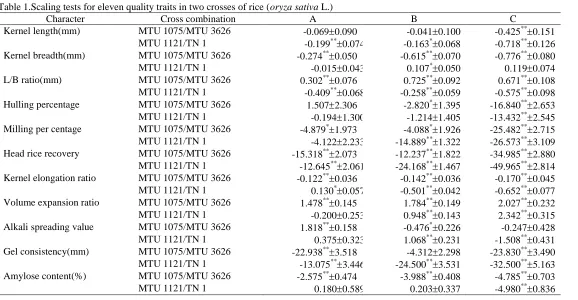
Results of individual scaling tests i.e., A, B and C scaling tests were presented in Table 1. The calculated values of all the three scaling tests were found significant for kernel breadth, L/B ratio, milling percentage, head rice recovery, kernel elongation ratio, volume expansion ratio and amylose content, while remaining characters hulling percentage, alkali spreading value and gel consistency had shown significance of two out of three scaling tests performed except kernel length which had shown significance for one scaling test in the cross MTU 1075/ MTU 3626. In the cross MTU 1121/ TN 1 all the three scaling tests were significant for kernel length, L/B ratio, head rice recovery and kernel elongation ratio, while remaining characters milling percentage, volume expansion ratio, alkali spreading value and gel consistency had shown significance of two out of three scaling tests performed except kernel breadth, hulling percentage and amylose content which had shown significance for one scaling test. Hence, epistasis contributed significantly towards the inheritance of these characters of the respective crosses.
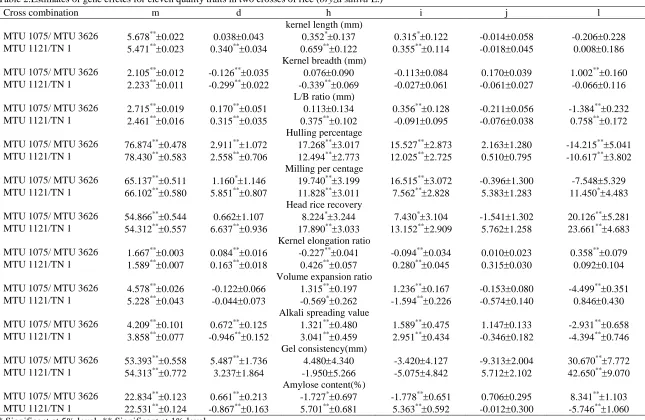
The results of main gene effects i.e., additive [d] and dominance [h] effects and interaction effects i.e., additive x additive [i], dominance x dominance [j] and additive x dominance [l] effects were presented in Table 2. Study of gene effects revealed that both additive [d] and dominance [h] genetic effects had significant contributions for the expression of majority of the characters.
Additive [d] gene effect was more important in L/B ratio, kernel elongation ratio, gel consistency and amylose content in the cross MTU 1075/ MTU 3626 because of the highest magnitude for the additive gene effect. Positive and significant additive x additive [i] interaction effects were found for the characters hulling percentage, milling percentage, head rice recovery and alkali spreading value in both the crosses and for the characters L/B ratio and volume expansion ratio in the cross MTU
1075/ MTU 3626 and for the character amylose content in the cross MTU 1121/ TN 1. These additive and additive x additive gene effects would be fixable in later generations. Hence, these traits in respective crosses offer scope for improvement through phenotypic selection based on pedigree method.
Dominance [h] gene effect was more important than the additive gene effect [d] in the inheritance of kernel length, hulling percentage, milling percentage, head rice recovery and alkali spreading value in both the crosses. Dominance [h] gene effect was significant for L/B ratio, kernel elongation ratio and amylose content in MTU 1121/ TN 1 and for the character volume expansion ratio in MTU 1075/ MTU 3626. Development of hybrids in the above mentioned cases would be a useful proposition provided hybrid seed production is relatively simple and economically viable.
The additive x dominance [j] type of interaction was found non significant for all the characters in both the crosses, indicating less importance of this type of interaction.
Dominane x dominance [l] gene effects were significant and greater in magnitude than both the main effects i.e additive [d] and dominance [h] gene effects for the traits, kernel elongation ratio and amylose content in the cross MTU 1075/ MTU 3626 and the type of epistasis was duplicate as the signs of dominanance [h] gene effects and dominance x dominance [l] interaction effects were opposite in sign. Duplicate epistasis was also found for the characters hulling percentage, alkali spreading value and amylose content in the cross MTU 1121/ TN 1. This type of epistasis tends to cancel or weaken the effect of each other in hybrid combination and hinder the progress made under selection and therefore, selection would have to be deferred till later generations of segregation where dominance effects are dissipated. Bi parental mating and recurrent selection especially reciprocal recurrent selection to break undesirable linkages followed by isolation of purelines in advanced generations would be more appropriate strategy as compared to pedigree method alone. Duplicate epistasis was reported by Mahalingamand Nadarajan (2010) for hulling percentage, Nayak (2007) for kernel elongation ratio and amylose content, Tomar and Nanda (1985) for alkali spreading value.
ISSN 0975-928X
besides duplicate epistasis revealing the scope of recovering plants showing transgressive effect. Complementary epistasis was found for the character head rice recovery in both the crosses.
Thus, both additive and nonadditive gene effects were important for inheritance of almost all the characters studied. The use of population improvement concept may become an amenable solution in highly autogamous crop like rice. Biparental mating, recurrent selection and diallel selective mating system might be profitable in exploiting both additive and nonadditive gene action to obtain desirable recombinants for different quality characters.
References
Gnanamalar, R. P and Vivekanandan, P. 2013. Genetic architecture of grain quality characters in rice (Oryza sativa L.).European Journal of Experimental Biology,3(2):275-279.
Hayman, B. I. 1958. The separation of epistasis from additive and dominance variation in generation means. Heredity, 12: 371-390.
Jennings, P. R., Coffman, W. R and Kaufman, M. H. E. 1979. Grain quality: Rice improvement. International Rice Research Institute Philippines, Chapter
6: 101-120.
Jinks, J. L and Jones, R. M. 1958.Estimates of components of heterosis.Genetics,43: 223-234.
Juliano, B. O. 1971. A simplified assay for milled rice amylose.Cereal Science, 16 (10): 334-339.
Mahalingam, L and Nadarajan, N. 2010.Genetic Analysis of Grain Yield and Milling Quality Characters of Two Line Rice Hybrids.Electronic Journal of Plant Breeding, 1(4): 977-982.
Murthy, B. R. 1965. Heterosis and combining ability in relation to genetic divergence in flue cured tobacco. Indian Journal of Genetics and Plant Breeding, 25: 46-56.
Nayak, A. R. 2007. Genetic architecture of quality characters in scented rice.Agriculture Science Digest,27(2):103-106.
Tomar, J. B and Nanda, J. S. 1985. Genetics of gelatinization temperature and its association with protein in rice.Zeitschrift fur Pflanzenzuchtung, 94(2): 89-100.
Tyagi, A. K., Khuran, J. P., Khurana, A. P., Raghubanshi, S., Gour, A., Kapur, A., Sharma, S. (2004). Structural and functional analysis of rice genome. J. Genet., 83: 79-99.
Verghese, E. J. 1950. A standard process for cooking rice for experimental purposes.
ISSN 0975-928X
Table 1.Scaling tests for eleven quality traits in two crosses of rice (oryza sativa L.)
Character Cross combination A B C
Kernel length(mm) MTU 1075/MTU 3626 -0.0690.090 -0.0410.100 -0.425**0.151
MTU 1121/TN 1 -0.199**0.074 -0.163*0.068 -0.718**0.126 Kernel breadth(mm) MTU 1075/MTU 3626 -0.274**0.050 -0.615**0.070 -0.776**0.080
MTU 1121/TN 1 -0.0150.043 0.107*0.050 0.1190.074
L/B ratio(mm) MTU 1075/MTU 3626 0.302**0.076 0.725**0.092 0.671**0.108
MTU 1121/TN 1 -0.409**0.068 -0.258**0.059 -0.575**0.098 Hulling percentage MTU 1075/MTU 3626 1.5072.306 -2.820*1.395 -16.840**2.653
MTU 1121/TN 1 -0.1941.300 -1.2141.405 -13.432**2.545
Milling per centage MTU 1075/MTU 3626 -4.879*1.973 -4.088*1.926 -25.482**2.715 MTU 1121/TN 1 -4.1222.233 -14.889**1.322 -26.573**3.109 Head rice recovery MTU 1075/MTU 3626 -15.318**2.073 -12.237**1.822 -34.985**2.880 MTU 1121/TN 1 -12.645**2.061 -24.168**1.467 -49.965**2.814 Kernel elongation ratio MTU 1075/MTU 3626 -0.122**0.036 -0.142**0.036 -0.170**0.045 MTU 1121/TN 1 0.130*0.057 -0.501**0.042 -0.652**0.077 Volume expansion ratio MTU 1075/MTU 3626 1.478**0.145 1.784**0.149 2.027**0.232
MTU 1121/TN 1 -0.2000.253 0.948**0.143 2.342**0.315
Alkali spreading value MTU 1075/MTU 3626 1.818**0.158 -0.476*0.226 -0.2470.428
MTU 1121/TN 1 0.3750.323 1.068**0.231 -1.508**0.431
Gel consistency(mm) MTU 1075/MTU 3626 -22.938**3.518 -4.3122.298 -23.830**3.490 MTU 1121/TN 1 -13.075**3.446 -24.500**3.531 -32.500**5.163 Amylose content(%) MTU 1075/MTU 3626 -2.575**0.474 -3.988**0.408 -4.785**0.703
ISSN 0975-928X
Table 2.Estimates of gene effetcs for eleven quality traits in two crosses of rice (oryza sativa L.)
Cross combination m d h i j l
kernel length (mm)
MTU 1075/ MTU 3626 5.678**0.022 0.0380.043 0.352*0.137 0.315*0.122 -0.0140.058 -0.2060.228 MTU 1121/TN 1 5.471**0.023 0.340**0.034 0.659**0.122 0.355**0.114 -0.0180.045 0.0080.186
Kernel breadth (mm)
MTU 1075/ MTU 3626 2.105**0.012 -0.126**0.035 0.0760.090 -0.1130.084 0.1700.039 1.002**0.160 MTU 1121/TN 1 2.233**0.011 -0.299**0.022 -0.339**0.069 -0.0270.061 -0.0610.027 -0.0660.116
L/B ratio (mm)
MTU 1075/ MTU 3626 2.715**0.019 0.170**0.051 0.1130.134 0.356**0.128 -0.2110.056 -1.384**0.232 MTU 1121/TN 1 2.461**0.016 0.315**0.035 0.375**0.102 -0.0910.095 -0.0760.038 0.758**0.172
Hulling percentage
MTU 1075/ MTU 3626 76.874**0.478 2.911**1.072 17.268**3.017 15.527**2.873 2.1631.280 -14.215**5.041 MTU 1121/TN 1 78.430**0.583 2.558**0.706 12.494**2.773 12.025**2.725 0.5100.795 -10.617**3.802
Milling per centage
MTU 1075/ MTU 3626 65.137**0.511 1.160*1.146 19.740**3.199 16.515**3.072 -0.3961.300 -7.5485.329 MTU 1121/TN 1 66.102**0.580 5.851**0.807 11.828**3.011 7.562**2.828 5.3831.283 11.450*4.483
Head rice recovery
MTU 1075/ MTU 3626 54.866**0.544 0.6621.107 8.224*3.244 7.430*3.104 -1.5411.302 20.126**5.281 MTU 1121/TN 1 54.312**0.557 6.637**0.936 17.890**3.033 13.152**2.909 5.7621.258 23.661**4.683
Kernel elongation ratio
MTU 1075/ MTU 3626 1.667**0.003 0.084**0.016 -0.227**0.041 -0.094**0.034 0.0100.023 0.358**0.079 MTU 1121/TN 1 1.589**0.007 0.163**0.018 0.426**0.057 0.280**0.045 0.3150.030 0.0920.104
Volume expansion ratio
MTU 1075/ MTU 3626 4.578**0.026 -0.1220.066 1.315**0.197 1.236**0.167 -0.1530.080 -4.499**0.351 MTU 1121/TN 1 5.228**0.043 -0.0440.073 -0.569*0.262 -1.594**0.226 -0.5740.140 0.8460.430
Alkali spreading value
MTU 1075/ MTU 3626 4.209**0.101 0.672**0.125 1.321**0.480 1.589**0.475 1.1470.133 -2.931**0.658 MTU 1121/TN 1 3.858**0.077 -0.946**0.152 3.041**0.459 2.951**0.434 -0.3460.182 -4.394**0.746
Gel consistency(mm)
MTU 1075/ MTU 3626 53.393**0.558 5.487**1.736 4.4804.340 -3.4204.127 -9.3132.004 30.670**7.772 MTU 1121/TN 1 54.313**0.772 3.2371.864 -1.9505.266 -5.0754.842 5.7122.102 42.650**9.070
Amylose content(%)