Vol.8 (2018) No. 4
ISSN: 2088-5334
Performance Evaluation of AODV and OLSR Routing Protocols in
MANET Environment
Mohammed Ahmed Jubair
#, Shihab Hamad Khaleefah
*, Avon Budiyono
$, Salama A. Mostafa
#,
Aida Mustapha
##
Faculty of Computer Science and Information Technology, Universiti Tun Hussein Onn Malaysia, 86400 Batu Pahat, Johor, Malaysia E-mail: [email protected], [email protected], [email protected]
*
Faculty of Computer Science, Al Maarif University College, 31001, Anbar, Iraq E-mail: [email protected]
$
School of Industrial Engineering, Telkom University, 40257 Bandung, West Java, Indonesia
Abstract— Mobile Ad-hoc Networks (MANETs) are self-sufficient networks that can work without the need for centralized controls,
pre-configuration to the routes or advance infrastructures. The nodes of a MANET are autonomously controlled, which allow them to act freely in a random manner within the MANET. The nodes can leave their MANET and join other MANETs at any time. These characteristics, however, might negatively affect the performance of the routing protocols and the overall topology of the networks. Subsequently, MANETs comprise specially designed routing protocols that reactively and proactively perform the routing. This paper evaluates and compares the performance of two routing protocols which are Ad-Hoc On-Demand Distance Vector (AODV) and Optimized Link State Routing (OLSR) in MANET environment. The study includes implementing a simulation to examine the performance of the routing protocols based on the variables of the nodes’ number and network size. The evaluation results show that the AODV outperforms the OLSR in most of the simulated cases. The results further show that the number of nodes and network size has a great impact on the Throughput (TH), Packet Delivery Ratio (PDR), and End-to-End delay (E2E) of the network.
Keywords— mobile ad-hoc network (MANET); ad-hoc on-demand distance vector (AODV); optimized link state routing (OLSR);
throughput (TH); packet delivery ratio (PDR); and end-to-end delay (E2E)
I. INTRODUCTION
A Mobile Ad-hoc Network (MANET) consists of a group of wireless nodes that can be set up dynamically and work independently from the infrastructure requirement [1], [2]. The network nodes have an autonomous architecture in which the nodes receive signals from mobile devices that are connected through wireless links. The nodes randomly move within the network without compliance constraints. These nodes act as router devices that work within the same topology as of the surrounding networks and establishing dynamic connections [3], [4]. However, if there is no pre-installed base station, the nodes would not be able to move within networks freely. Data packets are directed towards a multi-hop system because of the limited radio bandwidth in the broadcast of each node.
There are several associated problems with the MANET design. The MANET uses a multi-hop routing protocol due to the restriction of the network with a range of wireless radios to safeguard against intruders [5], [6]. The protocol
may hinder the selection of an appropriate routing that is more efficient than others. Several routing protocols with different orientation strategies are suggested such as movement restriction, increase in energy consumption, decrease the displayed bandwidth, and high precision rates despite the piece. The main differences between these strategies are the mechanism used to update information guidance.
The related work of the literature implements different parameter to assess the quality of the routing protocols in MANET. Jubair et al. [7] compare AODV and AOMDV using the assessment criteria of simulation time and some nodes. Bouhorma et al. [8] study the variation effect of the pause time and speed on the DSR and AODV performance. Manveen et al. [9] study the effect of the nodes number on the performance of AODV and DSR. Consequently, this paper presents another attempt to evaluate the performance of the AODV and OLSR routing protocols in MANET environment. The paper follows the same methodology as the [7], [8], [9]. It describes the behavior of the routing protocols in deferent scenarios. The main contribution of this paper is considering the factors of some nodes and network size for implementing and assessing the AODV and OLSR in MANET environment.
Recently, the trend in the wireless network research and applications seems to be decentralization, hence MANET evolution. The MANET is characterized by an infrastructure-less network in which each of its wireless devices is considered as an autonomous entity and can be called by multi-hop wireless systems [10]. There are two main functions of MANET nodes in the network which are hosting and routing [11]. Through these functions, MANET nodes directly or indirectly communicate with each other over a range of radio transmission [12]. The random mobility nature of the network and range of radio transmission between the nodes dramatically change the network topology, schedule, and locations of the wireless devices. An overview of the MANET topology is shown in Fig. 1.
Fig. 1 The MANET topology [10]
MANET technology is one of the most promising research fields due to the growth of mobile device that depends on wireless networks. Subsequently, the distinctive features of MANET technology bring great opportunity to improve wireless networks [13]. However, MANET becomes one of the most vibrant and active research fields of communication and networks due to their association with severe challenges. The following section presents some challenges that are associated with MANET research and application.
MANETs have emerged as a prevalent network type for good reasons. It is a network that is simple to implement.
Compared with traditional networks, it could also be set up at any location at any time. Regardless of the attractive applications, the features of MANET introduce several challenges that must be carefully studied [11].
There are some security problems in the network systems that result from vulnerability issues. An example vulnerability is, a network system allows unauthorized a user to manipulate its data before identifying and verifying the user identity and role. MANET is more exposed to vulnerability than typical and wired networks. Some of the challenges and vulnerability issues in MANET are as follows [10], [11], [13]:
1) Routing: The MANET has no precisely defined
physical boundaries. The dynamics of the MANET topology complicated the routing protocols that control the transmitted packets between the network nodes.
2) Security: The absence of a centralized administration and the scalability of the network that dynamically introduces new nodes create significant security concerns. These features make the detection of attacks more complicated and challenging, especially in large-scale and highly dynamic ad-hoc networks. As soon as an adversary (such as black hole attach) comes in the transmission range of a node, it will be able to communicate with that node. The routing protocols assume that nodes are cooperative and non-malicious for which reason a malicious attacker agent can disobey the protocols and disrupt the network operations. This issue might disturb the trust relationship among nodes. The network has a nasty neighbor relaying packets mechanism that creates additional security concerns.
3) The Quality of Service (QoS): The constantly
changing environment of the MANET affects the consistency of the QoS level.
4) Power Consumption: The interaction and data
transmission between nodes consume power. There is a need for improving the routing protocols to ensure lean power consumption (i.e., power-aware routing protocol). The limited power of the nodes is the mean reason for their selfish behavior.
5) Multicasting Routing: It is a desirable feature of the
MANET that provides multiparty wireless communications. However, the multicast tree of MANET is dynamic which mandate is routing protocols that can handle dynamic multicast memberships (e.g., leave and join mechanism).
6) Resource Availability: The secure communication
and protection mechanisms might affect the accessibility and availability of the resources.
7) Wireless Network Limitations: The range of the radio
band limits the wireless network. This issue consequence that the routing protocols must maintain an optimal usage of the bandwidth and low overhead. The network also vulnerable to external noise, interference, and signal attenuation problems.
Consequently, MANET technology is implemented in many applications and some of them are as follows [13], [14]:
1) Commercial Sector: MANET can be utilized in
emergency and rescue operations for efforts of disaster relief, such as (earthquake, flood, fire, etc.). These disasters will damage the communication infrastructures. Thus, MANET provides temporary and rapid communication services to the people and rescue teams.
2) Military Battlefield: Nowadays, military equipment
contains computerized equipment. MANET technology enables flexible connections between the equipment and facilitates communication between military headquarter, soldiers and vehicles.
3) Personal Area Network (PAN): Short range MANET
can simplify communication between several wireless mobile devices (e.g., cellular phone, personal digital assistant, and laptop). It replaces the wired cables connections with flexible wireless connections.
4) Local Level: MANET autonomously link a temporary
and instant multimedia network using palmtop or notebook computers to spread data among the devices and share information among individuals such as in a classroom or conference.
MANETs have three main types of routing protocols which are reactive, proactive and hybrid protocols as shown in Fig. 2.
Fig. 2 The types of routing protocols [7]
The reactive routing protocols are generated only when the source requests for a route to a destination (source-initiated routing). A route discovery procedure is employed to generate a route. The route discovery involves flooding the network with many route request packets in which the nodes flood their immediate neighbors with multiple request packets until they reach the source [5]. Once the route or multiple routes are established then the destinations are discovered, and the route discovery process halts. The route maintenance procedure aids in maintaining the route continuity of the timespan. This practice is required by the source, especially, for AODV and Distributed Sensor Web Routing Protocol (DSRP).
In the proactive routing protocols, maintaining of up-to-date information regarding routes for every node in the network is done by table-driven protocols. This routing table stockpiles the routing information of each node and updates with the latest information about the route throughout the network. Different protocols use and maintain different routing state information; and all of which have a common goal of minimizing route maintenance overhead to its maximum. However, highly dynamic networks do not support these types of protocols because of the extra control
overhead that is generated to maintain the routing tables [6]. Examples are Destination-Sequenced Distance-Vector (DSDV) and OLSR.
The hybrid protocol entails that the two components of on-demand (reactive) and table-driven (proactive) protocols are integrated into a single routing scheme [7], [8], [15]. The collective idea here is that the areas with slow connection changes are more suitable for table-driven routing and the areas with high-speed mobility are more suitable for on-demand routing. The hybrid type improves the performance by combining these two protocols. An example of this type is the Zone Routing Protocol (ZRP).
The paper is organized into four sections. The classification of different MANET routing protocols including the AODV and OLSR. Also, the performance metrics are presented in Section II. The simulation and evaluation results to the AODV and OLSR are presented in Section III. Finally, the research conclusions and future work are presented in Section IV.
II. MATERIALS AND METHODS
A. The Ad Hoc On-Demand Distance Vector
The AODV is a routing protocol for wireless networks including MANETs. In a MANET, its route discovery entails that the source node broadcasts the route request (RREQ) packet throughout the nodes. The process is combined with a set timer that is waiting for replies [16], [17]. The RREQ packet stores the routing information, including the broadcast ID, the originator IP address, and the sequence number of the destination. The RREQ packet is received by each intermediate node that also maintains the reverse path to the source node as shown in Fig. 3.
Fig. 3 The propagation of the RREQ Packet in an AODV [16]
These nodes perform two processes: (1) confirm the receipt of the RREQ packet with the same broadcast ID and originator IP address, and (2) decide on the RREQ packet needs to be accepted or discarded. The routing table stores the number of the destination sequence. The intermediate nodes check and verify the number. They unicast the route reply (RREP) packet to the source node if the number is greater than or equal to the one that is stored in the RREQ packet [17]. The RREQ packet keeps transmitting fresh destination sequence number until the transmitted data reaches the destination node. Fig. 4 shows the process of unicasting the RREP packet from the associated nodes to the source node.
Mobile Ad-Hoc Routing Protocols
Reactive protocols
Proactive protocols
Fig. 4 The path of the RREP Packet in an AODV [17]
B. The Optimized Link State Routing
An OLSR is a proactive link-state routing protocol that is designed for MANETs but is also used in other wireless ad hoc networks [18]. The OLSR uses IP address, hello and topology control messages to discover nodes then disseminate link state information to the nodes as shown in Fig. 5.
Fig. 5 The nodes discovery mechanism of the OLSR [21]
The OLSR is derived from Link State (LS) routing protocol. It overcomes the disadvantage of consuming a high amount of control message to establish the path between nodes that the LS has [19], [20]. The OLSR protocol is equipped with a Multi-Point Relays (MPRs) mechanism that chooses specific nodes to transmit control messages to whole nodes in the network. To configure the sets of MPR nodes, every node discovers/discovered the nodes within 1-hop neighbor, and share the information of the neighbor nodes between each other. The nodes that are not MPR can only read and process the packets that they receive without rebroadcasting them. This mechanism contributes to reducing the control message in the network [21]. However, it increases the size of the control packet in return.
C. The Performance Metrics
There are different evaluation metrics of networks’ performance [22]. The selected evaluation metrics of MANET routing protocols in this study are defined in this section as follows:
1) Throughput: The throughput (TH) is found from the
actual number of bytes that are handled by a host node in a specific period. The average throughput ATH of attempts is calculated by (1):
(1)
2) Packet Delivery Ratio: The PDR is the percentage of
the number of data packets that are received by the destination node, , to the number of the data packets that are sent by the source nodes, . The Average Packet Delivery Ratio (APDR) of attempts is calculated by (2):
(2)
3) End-to-End Delay The E2E delay is the time that is
spent to transmit the actual data from the source node, , to the time that is spent to reach the host nodes, . The E2E delay includes all the types of delays that occur in the network such as buffering delay during the route discovery latency, the interface queue time, retransmission at the MAC time, the propagation time, along with the transfer time. The average E2E, AE2E, delay of attempts is calculated by (3):
(3)
III.RESULTS AND DISCUSSION
There are different types of networks, and the research aspect for each of which encompasses improving the performance that is associated with the efficiency, flexibility, security and elasticity qualities [23], [24]. The routing optimization is a general problem in all network topologies. Different statistical and advance artificial intelligence techniques are implemented to optimally sole the routing problems [25], [26]. MANETs have three main types of routing protocols which are reactive, proactive and hybrid protocols [27].
In analyzing and verifying theoretical models of networks, simulation is frequently employed since, from a purely conceptual level, these models might be tough to build and study. Simulation is defined as a software and hardware collection which is combined towards minimizing the behavior of some phenomenon or entity [14]. The Network Simulator 2 (NS-2) tool is used in different networking studies to evaluate networks performance as in [28], and [29]. The effectiveness of NS-2 is evident in the way it separates the implementation of the control path from the data path. Fig. 6 shows a general overview of the NS-2 simulator.
Fig. 6 The view of the NS-2 [7]
many real-time protocols such as Transmission Control Protocol (TCP), User Datagram Protocol (UDP) and different routing protocols for wired and wireless networks [27].
NS-2 is an open source simulator as it is free to use plus many complex scenarios could be implemented with NS-2 and it is flexible as easy to install on different operating systems. The major two advantages of choosing NS-2 as a simulator is that it could rapidly obtain evaluation results and it has an event scheduler that handles all jobs [30].
The NS-2.33 version is used in this work for the implementation of the AODV and OLSR routing protocols in the MANET environment. The implementation of this work considers scrutinizing the network in order to evaluate the relative performance of the AODV and OLSR. The network’s performance evaluation focuses on observing and studying the routing protocols’ behavior with different settings to the network’s parameters. It utilizes the standard performance evaluation metrics of Throughput (TH), Packet Delivery Ratio (PDR), and End-to-End delay (E2E). The average of which is computed to determine the performance evaluation outcomes as is explained in III.
The evaluation consists of two scenarios in which the first scenario tests the network with varying number of nodes while the second scenario tests the network with varying network’s sizes. A Random Way Point (RWP) mobility model is used in both of the scenarios. The brief of the scenarios’ setting and the obtained results are presented in the following subsections.
A. The First Scenario
This scenario runs seven times by using different node numbers. Table 1 summarizes the simulation setting of the first scenario.
TABLE1
THE SIMULATION SETTING OF THE FIRST SCENARIO
Parameter value unit
Network size 5002 m2
Number of nodes 10, 20, 30, 40, 50, 60, 70
node
Simulation time 300 ms
Node speed 2 m/s
Traffic type CBR/UDP
Number of connections 2
Pause time 4 second
Packet size 512 byte
Parameter value unit
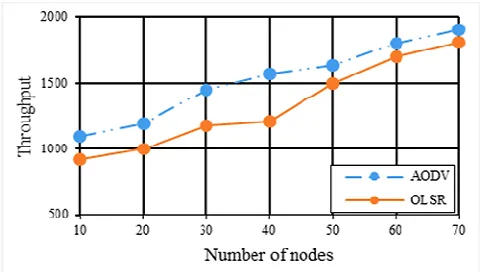
Fig. 7 plots the results that are obtained from the first scenario. It shows the effect of the number of nodes on the TH, PDR, and E2E delay when using AODV or OLSR protocols. The results show that the TH of the AODV is increased from 1100 to 1910 KBPS and the TH of the OLSR is increased from 920 to 1810 KBPS as a result of increasing the number of nodes. Subsequently, the AODV has a much higher TH than OLSR and is more affected by increasing the number of nodes. The reason is that the AODV protocol only sends packets data from node to node until the data are received by the destination.
Fig. 7 The throughput of the two protocols for various numbers of nodes
Fig. 8 shows the PDR variation of the AODV and OLSR protocols. The protocols show different PDRs when the number of nodes is increased. The AODV protocol delivers more data packets than the OLSR protocol. The routing from source to the destination becomes more stable when the density of node is increased. The results show that the PDR of the AODV is increased from 89.9% up to 99.1% and the PDR of the OLSR is increased from 85% to 94.5 as a result of increasing the number of nodes.
Fig. 8 The PDR of the two protocols for various numbers of nodes
Fig 9 The E2E delay of the two protocols for various numbers of nodes
In summary, the increase in the number of nodes positively affects the performances of the AODV and OLSR protocols in terms of the ATH, APDR and AE2E delay of the MANET. Consequently, the AODV excels the OLSR protocol for all the three TH, PDR, and E2E delay.
B. The Second Scenario
The second scenario runs six times by using different sizes of the network. Table 2 summarizes the simulation setting of the second scenario.
TABLEII
THE SIMULATION SETTING OF THE SECOND SCENARIO
Parameter value unit
Network size 500, 750, 1000,
1250, 1500, 1750
m2
Number of nodes 50 node
Simulation time 300 ms
Node speed 2 m/s
Traffic type CBR/UDP
Number of connections 2
Pause time 4 second
Packet size 512 byte
Fig. 10 shows the TH results of the two protocols in which, the AODV has a slightly higher TH than OLSR. In general, the overall TH is decreased when the network size is increased. This is because that the larger network size, the nodes can move more freely and easily change the network's topology. However, the freely moving characteristics of the nodes can likely increase the chances of link failure, which might lead to decrease the TH.
Fig 10 The throughput of the two protocols for various network sizes
Fig. 11 shows the AODV and OLSR protocols concerning PDR. In both routing protocols, the PDR is reduced when the network size is increased with a clear surpass to the AODV. The justification is that the process of establishing connections between source and destination nodes become more difficult.
Fig. 11 The PDR of the two protocols for various network sizes
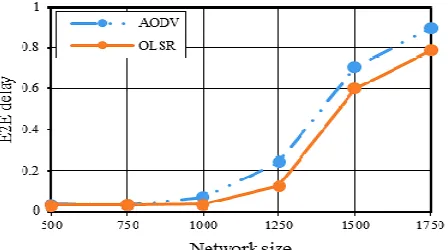
Fig. 12 shows the E2E delay in both OLSR and AODV routing protocols concerning the network size. The E2E delay is considered as one of the main sources of the route failure. The E2E delay is tremendously increased when the network size is increased. In such situations, an alternative route for transmitting data needs to be found by the source node with fewer queues in the interface.
Fig. 12 The E2E delay of the two protocols for various network sizes
In summary, the increase in the network size negatively affects the performances of the AODV and OLSR protocols regarding the ATH, APDR and AE2E delay of the MANET. Consequently, the AODV shows better TH, and PDR than the OLSR but the OLSR shows a slightly better E2E delay.
IV.CONCLUSION
This paper presents the evaluation of the performance of the AODV and OLSR protocols in MANET environment. The network is simulated and examined by NS-2.33 tool. The test consists of two test scenarios. The first test scenario concerns the effects of the change in the number of nodes and the second test scenario concerns the effects of the change in the network size on the protocols' performance. The performance is evaluated according to the metrics of Throughput (TH), Packet Delivery Ratio (PDR), and End-to-End delay (E2E). The simulation results show that the number of nodes and network size has significant impacts on the performance of the routing protocols. Additionally, the AODV outperforms the OLSR in both of the scenarios. The future work considers proposing a hybrid protocol to the MANET environments.
ACKNOWLEDGMENT
REFERENCES
[1] Alsaqour, R. A., Abdelhaq, M. S., & Alsukour, O. A. (2012). Effect of network parameters on neighbor wireless link breaks in GPSR protocol and enhancement using mobility prediction model. EURASIP Journal on Wireless Communications and Networking, 2012(1), 171.
[2] Parul Sharma, Arvind Kalia and Jawahar Thakur, “Performance analysis of AODV, DSR and DSDV Routing Protocols in Mobile Adhoc Networks (MANET),” Journal of Information Systems and Communication, Vol. 3, Issue 1, 2012.
[3] Narendra Singh Yaday, R.P.Yadav,” Performance Comparison and Analysis of Table-Driven and On-Demand Routing Protocols for Mobile Ad-hoc Networks,”International Journal of Information and Communication Engineering, 2008.
[4] Murizah Kassim Ruhani Ab Rahman, Mariamah Ismail Cik Ku Haroswati Che Ku Yahaya,” Performance Analysis of Routing Protocol in WiMAX Network,” IEEE International Conference on System Engineering and Technology (ICSET), 2011.
[5] Perkins, C. E., & Bhagwat, P. (1994, October). Highly dynamic destination-sequenced distance-vector routing (DSDV) for mobile computers. In ACM SIGCOMM computer communication review (Vol. 24, No. 4, pp. 234-244). ACM.
[6] Boukerche, A. (2004). Performance evaluation of routing protocols for ad-hoc wireless networks. Mobile Networks and Applications, 9(4), 333-342.
[7] Jubair, M., & Muniyandi, R. (2016). NS2 Simulator to Evaluate the Effective of Nodes Number and Simulation Time on the Reactive Routing Protocols in MANET. International Journal of Applied Engineering Research, 11(23), 11394-11399.
[8] Bouhorma, M., Bentaouit, H., & Boudhir, A. (2009, April). Performance comparison of ad-hoc routing protocols AODV and DSR. In Multimedia Computing and Systems, 2009. ICMCS'09. International Conference on (pp. 511-514). IEEE.
[9] Manveen Singh Chadha, Ranbir Joon and Sandeep, “Simulation and Comparison of AODV, DSR and AOMDV Routing Protocols in MANETs,” International Journal of Soft Computing and Engineering (IJSCE), Vol. 2, Issue 3, July 2012.
[10] Latiff, L. A., Fisal, N., Arifin, S. A., & Ahmed, A. A. (2010). Directional routing protocol in wireless mobile ad hoc network. In Trends in Telecommunications Technologies. InTech.
[11] Shenbagapriya, R. & N. Kumar 2014. A survey of proactive routing protocols in MANETs. Science Engineering and Management Research (ICSEMR), 2014 International Conference on. pp. 1-7. [12] Taha, A., Alsaqour, R., Uddin, M., Abdelhaq, M., & Saba, T. (2017).
Energy efficient multipath routing protocol for a mobile ad-hoc network using the fitness function. IEEE Access, 5, 10369-10381. [13] Goyal, P., Parmar, V., & Rishi, R. (2011). Manet: vulnerabilities,
challenges, attacks, application. IJCEM International Journal of Computational Engineering & Management, 11(2011), 32-37. [14] Lin, H., S. Sambamoorthy, S. Shukla, J. Thorp & L. Mili 2011.
Power system and communication network co-simulation for smart grid applications. Innovative Smart Grid Technologies (ISGT), 2011 IEEE PES. pp. 1-6.
[15] Hassan, M. H., & Muniyandi, R. C. (2017). An Improved Hybrid Technique for Energy and Delay Routing in Mobile Ad-Hoc Networks. International Journal of Applied Engineering Research, 12(1), 134-139.
[16] Yuan Xue, Member, IEEE, Baochun Li, Senior Member, IEEE, and Klara Nahrstedt, Member, IEEE,” Optimal Resource Allocation in Wireless Ad HocNetworks: A Price-Based Approach, 2006. [17] Ahlgren, B., Dannewitz, C., Imbrenda, C., Kutscher, D., & Ohlman,
B. 2012. A survey of information-centric networking. Communications Magazine, IEEE, 50(7), 26-36.
[18] Singla, S., & Panag, T. S. 2013. Evaluating The Performance of MANET Routing Protocols. International Journal of Electronics and Communication Engineering & Technology (IJECET), 4(1), 125-130. [19] Kuppusamy, P., Thirunavukkarasu, K., & Kalaavathi, B. (2011,
April). A study and comparison of OLSR, AODV and TORA routing protocols in ad hoc networks. In Electronics Computer Technology (ICECT), 2011 3rd International Conference on (Vol. 5, pp. 143-147). [20] Mbarushimana, C., & Shahrabi, A. (2007, May). Comparative study
of reactive and proactive routing protocols performance in mobile ad hoc networks. In Advanced Information Networking and Applications Workshops, 2007, AINAW'07. 21st International Conference on (Vol. 2, pp. 679-684). IEEE.
[21] Sharma, S., & Kumar, M. A. (2016). Performance Analysis of OLSR, AODV, DSR MANETs Routing Protocols. International Journal of Engineering Science, 7993.
[22] Abolhasan, M., T. Wysocki & E. Dutkiewicz 2004. A review of routing protocols for mobile ad hoc networks. Ad hoc networks 2(1): 1-22.
[23] Amini, A., Jamil, N., Ahmad, A. R., & Zaba, M. R. (2015). Threat Modeling Approaches for Securing Cloud Computing. Journal of Applied Sciences, 15, 953-967.
[24] Amini, A., Jamil, N., Ahmad, A. R., & Sulaiman, H. (2017, April). A Fuzzy Logic Based Risk Assessment Approach for Evaluating and Prioritizing Risks in Cloud Computing Environment. In International Conference of Reliable Information and Communication Technology (pp. 650-659). Springer, Cham.
[25] Mohammed, M. A., Ghani, M. K. A., Hamed, R. I., Mostafa, S. A., Ibrahim, D. A., Jameel, H. K., & Alallah, A. H. (2017). Solving vehicle routing problem by using improved K-nearest neighbor algorithm for the best solution. Journal of Computational Science, 21, 232-240.
[26] Mohammed, M. A., Ghani, M. K. A., Hamed, R. I., Mostafa, S. A., Ahmad, M. S., & Ibrahim, D. A. (2017). Solving vehicle routing problem by using an improved genetic algorithm for the optimal solution. Journal of Computational Science, 21, 255-262.
[27] Daranasi, S. K., M. Fatima & G. Sharma 2012. Performance Analysis of MANET Routing Protocols using Three Different Mobility Models. Wireless Communication 4(14): 813-818.
[28] Hameed, A. H., Mostafa, S. A., & Mohammed, M. A. (2013). Simulation and evaluation of WIMAX handover over homogeneous and heterogeneous networks. American Journal of Networks and Communications, 2(3), 73-80.
[29] Salih, A. I., Abdelouhahab, A., Mostafa, S. A., & Zaiter, M. J. (2015). Updating the NCTUns-6.0 tool to simulate parallel optical burst switching of all-optical ultra-dense WDM systems. Photonic Network Communications, 29(1), 106-117.
![Fig. 1 The MANET topology [10]](https://thumb-us.123doks.com/thumbv2/123dok_us/10011255.1988229/2.595.45.282.415.614/fig-the-manet-topology.webp)