I
. K
LAUTECH
JOURNAL
OF ENGINEERING
AND TECHNOLOGI'
I(l) 2003:
6-16
\
THE PHENOMENON OF WAKES FORMATION AND DEVELOP,}IENI'
BEHIND LIQUID DROPLETS
Waheed. M. A.
Mechanical Engineering Department. Ladoke Akintola University of Technology
P . M . 8 . 4 0 0 0 . O s b o m o s o . N i s e r i a
ABSTRACT
Numerical sinrululions of spherical &vplets sedinrcnling in a Nev,torticrn.fluid
in an wrhounlt'd rr'gr,,n
were investiguted
hy using finite elentent metlrcd for Reypslrlt nunrber up to 300. Thc c'otrtput.trt,,tt\
ure thereby c'arried out with the penaltl, nrctlrcd instead td the integral method. The e//acr tt rht
viscosity ratio ry in the range 0.02 < q* < 1000 antl the tlensits, rotio p* in the rent('
0.02 < p* < 1000 on lhe wakefornrution and developntenl
wus studied. It v'as ohsen'etl thut no v'uk.'
is fonned behind u droplet when tlrc viscositT'
ratio 1:.*
is below 2.3. The critical Reynoltl.s
ttuntbar.fir
a droplet with .fluid properties p* : I and ry* : 50 und anotlrcr droplet with fluid propcrtie,\
p*:
1000 and q*:50
is the sante,
and is 28.5.T'he viscositv
ratio llnrs ha.s
slrong efJ'et'l
otr truka
.fbrnrutrcn
u,hile dawit.\,ralio hos an insignificunt elfect. Further results shov'tlrut the wukc langth und
the angle oJ'separulion
dependvery)
etrottgltt
ott the t'i.r1p.r'ill'rutio.
The resulls
ure veD'use.liil
/in'tlte
design and optinisutirnr of engineering equipntent w,here
dntplets occur.
Ke1- rvords:
\ onrenclaturc
. ' l
( ' , ,
(1.,
E
t
(,
r l L
l l l rt
A 1 l l ) I'
r
R R ,
s
lt l t t l
7.
(ireek 51'mbols
')
' l
tl
t i '
f;
ri.r tl,
r l r
. : * - , ^ 1 1 t t n t r
u!
( )
Droplet. Two-phase Flow, Streanr Function, Streamlrne. Viscosity Ratro, Wake
Arca oIprojec.tion of a droplet. (nrr) Drag coefficient
Drameter of the droplet, (m) Total drag force, (N)
Matrix for the boundary conditions Acceleration due to gravity. (nl/s') Continuity matrrx
Pressure matrix
Matrix of the discretised convective term Pressure, (N/ml;
I{orizontal coordinate Radius of the drop, (m) Reynolds number Dissipation matrix
Vector of unknorvn velocities rr,. and rr,. (nr s) I{orizontal vclocity. ( nr,'s)
Vertical velocitv. ( nr,is)
Velocity at infinitely lar distance fionr droplet, (nr, s) Vertical coordinate
Residual or error Penalty pal'anreter
V lscoslty of thc continuous phase. ( l)as ) Vrscosrtv trf the dispersed phase, (Pas) \/ rscosrtv laticr
f ) c u s i r v o l ' t l r c c o t i t i r i ' t o u s p l t a s t ' . l k g r r r ' l D e n s i t y o l ' t h e d i s p e r s c d p h a s e , ( k g i n r ' ) D e n s r t l ' r a t r o
a
ll ahced, .II.A / L.-IIITECH Joarnal of Engineering and Technologt I(l) 200-l: GI6
|\
iltot)tr(-'t'lo\--lhoplet rs a basic object in industrral
pl()cc\se\. It occurs llr many ntodern technologies \uch as rn carburalion as a prelude to combustron. urk.ict printlng. spra)' drying, net shape forming, in orc treatnlent (llotatlm). in blotechnology (inverse tlurdrscd-bed brureactorl. and in micro-cncapsulation and manufacturing. lt has thus he'conre the oblect of research tbr many engineers arrtl screnlrsts rn tlte past {'erv decades. In the past. the llurd dynanucs oi solld sphere has been e'xtcnsivelv irrvestigated. Examples of published rvorks on florv over solid spheres are those by Lin and Lee (1973), Pruppacher et al. (1970), and 'l'aneda
(1956). Investigation of the viscous flow past liquid droplcts has gained increase attention. Published rvorks ori fluid dynamics of liquid droplets include those by Feng and Michaelides ( 2 0 0 1 ) . E l - S h a a r a u , i e t a l . ( 1 9 9 7 ) . W h a m e t a l . (1997), and Frohn and Roth (2000). The incre,rse research n'ork on droplet is due to the lict that a thorough knowledge of the fluid florv in and alound a hquid droplet is of central in'lportance to thc study of heat and mass transfer between the droplets and the sun-ounding plrase. The designs and the optimisation of engineering equipment involving fluid llow. heat and mass transfer have been done in the past by relying purely on both experimental and theoretical methods. But the theoretical analysis of the dynamics of droplets has been limited to creeping (Hadamard, l9t l. Rybczynski, l9l I ). potential and boundary-layer llorvs (Chao. 1962). rvhile the experimental work on single droplet seem almost impossible due to its small size (Sirignanoi. 1993). The most seemingly liurttirl solution approach to the intermediate flow reginrc of the system is that based on numerical cornputation. '[he past works on the two-phase llou between a single droplet and the continuous phase system have concerned thenrselves with the conlputation of the drag force and coefficient for gas bubble, solid sphere and also to very limited cascs for the liquid droplets with very high ratio of the viscosity between the droplet and the continuous phase 4', e. g. water droplet in air (Sirignanoi, 1993: Brander and Brauer, 1993; Oliver and Chung. 1985).
While wake lbrmation behind a solid sphere has been investigated extensively (Taneda, 1956t, the phenomenon of wake formation and development behind a droplet has not been thoroughly' studied. Wakes formation behind a droplet has been attributed to the effect of mass transfer process between it and the surrounding or as a result of fluid flow (Garner and Tayeban,
1 9 6 0 ) . -Ihe
present u'ork is concerned with the investigation of the effect of the fluid properties on
lre wake ibrnratron and development. The effects
of the densrty ratio l. rhe viscosrgr ratro ry an.l Reynolds number on the wake length and. on thc angle of separation are thoroughly' rnvestigated- -Ihe obtained results are important for the better understanding of processes in u'hich droplels are rising or falling in an unbounded
fluid-THE PHYSICAL SYSTEIII AND THE
MATHEI}IATICAL FORIIT ULATION
The period of droplet life during free rrse or fall with a velocity u. through a continuous phase is simulated in this u,ork. For the purpose of the numerical sinrulation of the motiorl a droplet fixed at a position in the stream of a florving unbounded fluid is assumed. The florv configuration is illustr-ated in Figure l. The flow at infinitely far arvay distance from the droplet is assumed uniform and its velocity is assumed equal to rr,.. The droplet is assumed sphcrical and has a constant diameter r/6. density p6 an I viscosity 4a. The continuous phase has different lluid properties. i. e. different density p, and viscosity 4.. The tu'o phases are assumed immiscible or partly miscible with each otlrer and both behave like Newtonian fluids. The flow in the contrnuous phase is communicated to the droplet through the interface as a result of rvhich there is mternal circulation inside the droplet. The following dimensionless relation holds for the system:
Re, = Reo
n'here Re, and Ret respectively represent the Reynolds number in the continuous phase and in the droplet, 4 the ratio of droplet to the continuous phase viscosity, and p the ratio of droplet to the continuous phase densiry. The flow ofthe two-phase system can be fully described by the conplete steady-state Navier-Stokes equations for the viscous. incompressible flow.
The two-phase flow problem being considered here rs solved using the axisymmetric coordinates. which inplies that the spherical &op reduces to a half circle in the (r,:) coordinates. This assunption is justified up to Re. = 3(X) as discussed by Pruppacher et al. ( 1970). The physical system is thus best described by Navier-Stokes equations and the continuity equation for an incompressible viscous fluid in the cylindrical coordinates in two dinrensiom- The Navicr-Stokes equations in this coordinate are:
4",*.".*)=-*.,&i.
ll ahccd, ,ll.,l / L..ll 'f l:( ll Journal of I:ngitccring uul Technologt' l(l) 201)-1: 6-16
( i u
i r )
i n
f d r , .
A u . J + l / r j = - : * l / i - +
' t . ( Y t . = .) ( i
\ ( r '
-and
l d r - t - r r -
I
; a , ' a j ) '
- '
and the continuity equation in the same coordinates is1 A ,
, 0 u ,
- | | r u , )+ *
= 0 .
1
-r or
dz
In the above equations, p and ry represent the pressure and the fluid viscosity, rr, and rr,, respectively the velocity in the r- und :-direction.
The numerical simulation of a florv problem required the prescription ofthe prevailing boundary condrtrons. These conditions for the case of a steady laminar flow of an incompressible Newtonian fluid past a liquid droplet are prescribed at an infinitely far distance from the droplet, at the droplet interface and at the symnrerry line as lbllows: (i) The flow is assumed to be syrrrmetric with respect to the z-axis. (ii) 1'he rnterface betrveen the droplet and the surroundine tluid is assumed smooth. The size of the drople t is constant and its shape is spherical. (iii) The vekrcity of fluid inside the droplet at r = 0 must renrain finite, i.e. rr, = 0, u. * 0. (iv) The tangential stresses at the rntcrface between the trvo fluids rnust be cqual. 1v) Jhe inflorv vclocity at sufficiently far distancc frorn the droplet is unifornr and is equal to rr,.
1'he steacly flou, of an isotherntal lluid is lirlly de;cribed if the velocities, the pressure and all the liuid properties are known at every point of the florv field. In practice. the t'lou, field is normally presented in a graphical form through streamlines, Irnes of constant value of streanr functions. which are drarvn such that they are tangential to the rclocity vector at each point in a flow field. A slreanr of constant volume flow rate flows between t , r o s t r e a m l i n e s ( B i r d e t a l . , I 9 6 0 ) .
S o l u t i o n T e c h n i q u e
In thrs rvork. the governing equations are solved, hy using the llnite element method. This method is a numerical analysis technique for obtaining approximate solutions to a wide variety of cnulneennc problenu. In this method, the florv trl-id ls dir idc.l into many small elements of r()llvcnient shrpcs and the unknown tield variables ;irr exprc'ssed iil terms of assumed approximatinu {interpolalron) tunctions within each elenrent. Thc
elenrents are connccted tosctlrcr *'rtlr onc another through the nodes.
T h c s o l u t i o n o f a p a r t i a l c l i t l c ' r e n t i a l c q u a t l ( ) n t h r o u g l r the linitc elemc'nt nre'thod is tlonc by lbrcnxrst castrng the equation lnto arr rnteilral firrnr. l'iris is done. 'ov u s i n g e r t h e r t h e v a n a t l o n a l n r c t h o d o l l h e r n e l h o d o l -u'eiglrtc-d residuals. l'hc- rrrethori ol' ucislrtcd rcsrtluals is the nrost convenient tool to translbrnr the \avrcr-Stokes equatiotrs into integral f olnt because thc variational principles cannot be fbund for the equations. To apply the method of rveighted resicltul lirr the solution ol' the Navier-Stokes equations. the velocities and pressure on eaclr node ofevery elcnrent is approxin.rated as follou's
n
\ - . ,
l l . . = t \ . U . = ) l \ . U .r | / _ / t r t ' i l
il
t u _ = N . u _ = f N , , r - , .
; - rP = N
The parameter N, in the above equations dcnotes the interpolation function. n {he rrumber of nodes per element, and p. l, and r- respectively represent the pressur€, the r- and the :- conrponent of the velocrtl'. Since the e.rpressions in equations (5 - 7) only grve an approxirnation ofthe actual values ofthe unknovln lor each node of every element, the substitution of tlresc expressions in the Navier-Stokes and the continuity equations result in rc'siduals or errors rl. These re'siduals are nrinrmized or forced tcl vanislr ovcr lhe s o l u t i o n d o m a i r r O b y c o n s t r u c t i n g a n i n r r c r p r o t l u c t ((tr. lr;) between the residuals r), and thc *erqhrirrs lirnctions lll and setting this product equal to zero:
(6,.H/,)
=
f,a
yr,r/f)
= o .
By the application of the Galcrkirr rncthod, rvhiclr is the nrost oltcn uscd method to dcrive finite elenrent c q u a t i o n s i n a n y p r o b l e m in v o l v i n g fl u i d t l o * . t h c rveighting lirnctions are choscrr to be the sante as lhe interpolation functron. The inlegratron of the resultrng expression over the elenrent ulvcs:
S " u + N " ( u ) u * l ! , p = f "
L " u = 0
'l'lt,-'
ll'aheed, Il.A / LALTTECH Journal of Engiueering and Technologv I(l) 2003: 6-l 6
borurdarl conditrons. J'o reduce the nunrber of equations that should be solved. the flow' system \\,as sol','ed numerically together rvith the prescnbed boundary condrtrons by uslng the p e n a l t v t e c h n i q u e ( C u v e l i e r e t a l . . 1 9 8 6 ) . W i t h t h i s tcchnrque. the nunrerical simulation is greatly enhanc'ed and thus. the conrputing tinre and the llle nlor)' space requlred for computation are considcrably reduced. l'he solution of the l'elocit;, fleld rs obtarned by the penalty techniqr.re through the expression:
S"u - N"(u)u * LCt M;'L"tt = F"
I I
t
The parameter I lr'. depict the penalty paramete r. The pressure p is obtained as a derivative ofthe velocity through the expression:
p - - r M f , l l ! u .
t 2
The simulated area is discretised into many isoparametric triangular elements with each c'lement having six nodal points. The matrices for all the elements were assembled and solved iteratively. A total of 5.693 isoparametric triangular elements were used in computation. This corresponds to a total of I 1,552 nodal points out of which 4881 nodes rvere positioned in the drop. Equation I i is a non linear equation. Its linearisation is done. by using Newton's iteration method. This method converges quadratically. but a good initial estirnate is required rvhich is obtained b."" solving the Stokes equations and next by iterating the equations through Picard's iteration r u c t h o d ( C u y e l i e r e t a l . , 1 9 8 6 ) .
RESULTS AND DISCUSSION
In order to validate and to demonsfrate the accuracy of the present simulations. the computed flow fields are compared with existing results. This accuracy test is done by computing the drag coefficients of both solid spheres and liquid droplets. and conrparing thcm with other results. The drag coeflicient Ce of a solid sphere or spherical droplct is defined as follows:
I^ FIA
U D = ; - ; - l i
P c u i l2
Tlre parametr:r I is the area of projection of the
solid or liquid sphere and is given as E(t: f 2. h,
.1 ,
product Pcu'* f 2 is the dynamic pressure and F is the total fbrce acting at the surface of a solid or l r q u r d s p h e r c .
'l'lrc
conrputetl dra-s coelficients for solid sphere are cor'irparcd u ith both the nunrerical ancl
expenmental data lionr Schlichtiqg and Gersten (2000). and the numencal results fiom Tabata and itakura (1995). The comparison is presented in l'able l. A close agre emcnt betrveen the present rcsults and the other data can be seen in the table. The drag coc'fficients of liquid droplets rvith viscosity ratios ,i * : I apd tl* - 't: are conrpared with both the data l i o m R i v k i n d c t a l . ( 1 9 7 6 ) a n d , F e n g a n d M i c h a e l i d e s (2001) in Table 2. 'I'he results agree fairly u'ell ,'vith both data, establrshrng that the results of the computations give a good presentation of the flo$' field. The varratlon oi drag coefficrent of hquid droplet with vrscosrty ratro tbr vanous value of Reprolds numbc'r. are presented in Table 3. The general trend of tlre results is that the drag coefficient rieureases rvith increase in Reynolds number for a fi:.c'd viscosity ratio. For a particular Reynolds ru,mber, the drag coefficient increases with viscosity ratio.
The flow field is presented here in the form of stream function for easy visualisation. Figures 2a and 2b depict the stream function field lbr a Reynolds number of 100 and, a viscosity of I and l0 respectively. The figures show that both for 4* : 1 and 4* -- 10. a rvell defined and simple recirculation florv occur in the droplets. -fhe external flow is, horvever, a bit complex, being characterised by wake formation behind the droplets for ?*: 10. A comparison of the trvo flow fields suggests that viscosity ratio plays a significant roll on the flow inside and outside a sedimenting droplet.
I
( b )
: l and (a) ry* : I and (b) t7* ==
Wohcd, M.A / ILIATECH Journal of Engineering and Tech nologlt I ( I ) 2003 : & I 6
and outside a drop by' Re = lAO, f
W
i l
t l l t
inside :
Figure
conti. phase
I P c l
4 c l
D" velocrty rz, at infinitely
drstance from the drop
Schernatic diagram of a liquid droplet
illI t
illt t l
l|il il
ilt\t t
i t \ I l l
F "
qt
b r'0
z 5 ,
7
)' ll I
' i ! L
ll'aheed, M.A / LA(|TECH Journal ol Engineering and Technologt I(I) 2003: 6-16
I Stmulatton
- ( b r r e l a t r o n
] { ) '
Viscosity Ratro r1
tigurc 3: Critical Reynolds number for u'ake formation as a function of viscosity ratio forp'=
!
llaheed, ilI-A / LAT|TECH Journal ofEngineering and rechnologl: lil) 2003: 6-16
\f
a,
J
()
, N d e
z
-1.6
1 . 4
1 . 2
1 . 0
0 . 8
0.6
0.4
0.2
0 . 0
W a t c r d r o p (n ' : 4 8 . 1 4 ; p - 8 5 2 . - 1 l ) : this work
r Brander und Brauer ( 199-3 )
S o l i d S p h e r e : this work
. e x p . d a t a - Tancda ( 1 9 5 6 )
W a t e r d r o p ( n = 4 8 . 1 4 ; p = 8 5 2 . 3 l ) : this work
. Brander und Brauer ( 1993)
Solid Sphere: this work
. e x p . d a t a - Taneda ( 1 9 5 6 )
80
120
160
Reynolds
Number Re"
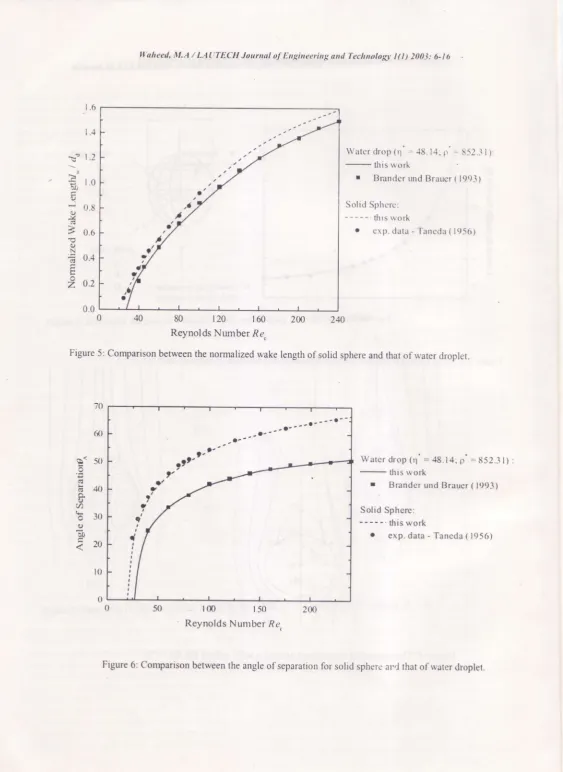
Figure 5: Comparison between the normalized wake length of solid sphere and that of water droplet,
q 2ffi
240
tr'
(l cl 0)
a
(l
C) 0l)
70
60
50
q
30
20
t 0
0
9)))'o"
,'
(
a
,'
t
i/
il
r c 0
1 5 0' Reynolds Number Re^
Figure
6: Comparison
between
the angle
of separation
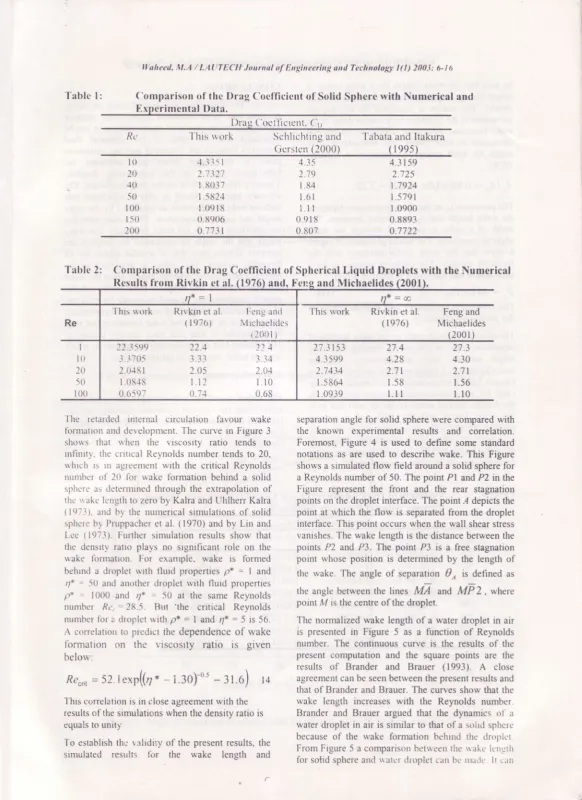
for solid sphere
arr.J
that of water
droplet.
2 N
50
,a
/
a
I
J
J
i/,
T a b l c l:
ll'ahccd, lll.A / L.4lITECH Journal of Engineering and Technologl, I(l) 2003: 6-16
C o m p a r i s o n
o f t h c D r a g C i o e l l i c i c n t
o f S o l i d S p h e r e
r v i t h N u m e r i c a l and
E x p e r i m e n t a l
D a t a .
Drag Coetliclent. C1y
'l'his
u ork
R c
S c h l i c h t i n g
a n d
G e r s t e n
( 2 0 0 0 )
Tabata
and Itakura
( l 9 e 5 )
l 0
2 0
4 0
5 0
1 0 0
l , s ( )
2 0 0
4 . - 1 - j 5 l
2 . 7 3 2 1 r . 8 0 - 1 7 1 . , 5 8 2 4 I . 0 9 1 8 0 . 8 9 0 6 0 . 7 7 1 I
4 . 1 5 2 . 1 9 1 . 8 4 l . 6 l l . l I 0 . 9 1 8 0 . 8 0 7
. 1 . 3 1 5 9
2 . 7 2 5
| 7924
i . 5 7 9 1
1 . 0 9 0 0
0 . 8 8 9 3
0 . 7 7 2 2
Table 2: Comparison of the Drag Coelficient of Spherical Liquid Droplets with the Numerical
Rcsults from Rivkin ct :rl. (1976) and. Feng and Michaelides (2001
This rvork R i v k i n e t a l ( 1 9 7 6 )
Feng and Michaelides
-l'he
rctalded intcrnal circulation favour wake firrnratron and development. The cuwe in Frgure 3 shous that uhen the viscosity ratio tends to infinrty'. tht' critrcal Reynolds number tends to 20. u h r c h r s l n a g l e c n l e n t r v i t h t h e c r i t i c a l R e y n o l d s nunrbcr ot' 20 lbr u,ake forn'ration behind a solid sphcre as deternrined through the extrapolation of thc \\ake le ugth to zero by Kalra and lJhlherl Kalra ( 1 9 1 3 ) . a n d b y t h e n u r n e r i c a l s i m u l a t i o n s o f s o l i d sphclc by Pmppacher et al. ( 1970) and by Lin and L e c ( 1 9 7 1 ) . F u r t h e r s i m u l a t i o n r e s u l t s s h o w t h a t the density ratio plays no srgnificant role on the u'ake lbrnration. For example. w'ake is formed belrrnd a droplet rvrth fluid properties p* = | and r/* -- 50 and anotlrer droplet with fluid propertles p* ,. 1000 and r7* = 50 at the sanre Reynolds number Rc, - 28.5. Rut 'the critical Reynolds number lbr a dloplet *,ith p* : I and ?* : 5 is 56. A correlatiorr to predict the dependence of wake tbrmation on thc viscosrty ratio is given lrelow:
t . , , . . \
R € " n
= 52.
! e x p ( ( r y ' r
- i.30)-"' - 31.6J t4
Thrs ct;rrelation is in close agreement with the results ol'lhe simulations when the densitv ratio is cquals to unity'
-lo
establish the vrlidity of the present results, the simulated resrrlts lbr the wake length and
2 0 0 1
27.3 l -s3
4 . 3
5 9 9
2 . 1 4 3 4
1 . 5 8 6 4
1 . 0 9 1 9
2 7 . 4
4 . 2 8
2 . 7
|
r . 5 8
l . l I
2 7 . 3
4 . 3 0
2 . 7
|
1 . 5 6
L l 0
separation angle for solid sphere were compared with the known experimental results and correlation. Foremost, Figure 4 is used to dehne some standard notations as are used to describe wake. This Figure shows a simulated flow field around a solid sphere for a Reynolds number of 50. The point Pl and P2 in the Figure represent the front and the rear stagnation points on the droplet interface. The point I depicts the point at which the flow is separated from the droplet interface. This point occurs when the wall shear stress vanishes. The wake length is the distance between the points P2 and P3. The point P3 is a free stagnation point whose position is determined by the length of the wake. The angle of separation d, is defined as
the angle between the lines MV and MF2, *hrrc point M is the centre of the droplet.
The normalized wake length of a water droplet in air is presented in Figure 5 as a function of Reynolds number. The continuous curve is the results of the present computation and the square points are the results of Brander and Brauer (1993). A close agreement can be seen betrveen the present results and that of Brander and Brauer. The curves show that the wake length increases with the Reynolds number Brander and Brauer argued that the dynamics ol' a water droplet in air is similar to that of a solrtl sphere because of the rvake formation behind the clronlct Fronr Figure 5 a comparison betu'een tlre trke le nstlr f o r s o l i d s p h e r e a n d s a t c r c l r o p l e t c a n b c n u d f l l r l n This rvork Rivkin et al. lrcng antl
( 1 9 1 6 1 M i c h a e l i d e s
"l
ll'aheel, trLA/ L.,II|TECII Journal of Engineering ond Technolo4l I(l) 200.1: 6-16
be seen that the rvake lcngth lbr a solid sphere ls lon-qer lbr any Reynolds nunrber than that of water droplet. The reason is attributed to the internal crrculatron rn the droplct. which causes delay in the nake formatron as agarnst a case of no internal crrculation in solid sphere. The nomralrzed rvake length for solid sphere rs correlated as (Brauer.
1 9 7 9 ) :
l , , f
d , ,
= 0 . 8 8 / r ( R e , + 2 2 ) - 3 . 2 9 . l 5
1-he parameter /* in the above expression represent thc u'ake length and r/a the droplet diameter. The width of a wake is measured through the wake angle of separation. The results presented in Ftgnre 6 show that the rvake width increases rvith the Reynolds number. The angle of separation for a solid sphere rvas correlated as (Brauer, 1979):
o , = 4 4 ( t n R e . -3 ) ' o t .
( 1 6 )
l'his conelation agrees very well with the results of this present simulation.
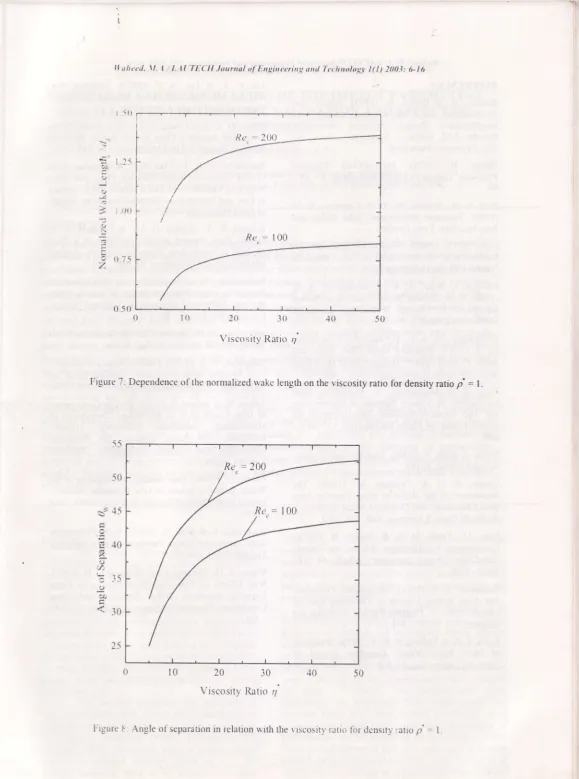
The effect of viscosity ratio on the wake length and separation angle rs gauged by plotting the u'ake length and the angle of separation over the vlscosrty riltlo as a tirnction of Re_""nolds number rn Iisurcs 7 and tt respectivcly. -l'hese results are only r a l i d l b r l d l o p l e t - c r l n t r n u o u s - p h a s e s y s t e n r u i t h the densitl.' ratio of'unit1'. lt can be seen that both llre w'ake len-ctlr and the angle of separation lncrease sharply u'ith an increasc in the viscosrty r a t i o u p t o 1 5 . T h e r c is n o a p p r e c i a b l e c h a n g e s i n thc r.r,ake length and thc angle of separatiou .,rhen {hc vrscosilv ratio is greatcr ol equ;rls to 20.
I ' g b l c - l :
( . O N ( ] L T I S I O N S
l'he florv charactcristics ol' risrn-s or lallrng droplets had been simulated using linitc' elenrent method. I;ronr the results of the srnrulation. r( cart be concluded that the ratlo of the identrcal flurd properties betueen the disperseci and the contlnuous plrase ls the ma1or lactor that delermrne the behavioural pattern of the sedimentrng droplets. Viscosity ratio has et-fect on the drag coetficient. -l'he viscosity ratio was lbund to play a signrlicant role both on rvake development as measured by the wake length and angle of separation. The density ratio has no significant role on the wake formation. The u,ake length and the angle of separation for droplets are however smaller than that of a solid sphere lbr all Reynolds number. This etlect is attributed to the internal circulation rn droplets, which delay the rvake formation behind the droplets. The results of the present simulation can be used as a guide for selectron of an operation velocity of' any droplet-conlinuous phase systenr so as to avord uake lbrrnatron that nray be detrimental to heat and nrass transl'er processcs. T h e r u n n i n g c o s t o l ' e n g l n c c n n g c q u r p n r e n t r r t r v h i c h droplets occur, can thus be grcatly reiluccd.
Acknorvledgement
- f h c
a u t l r o r g r a t e f i r l l l ' a c k n t l u l c t l e e s l h c s c l u r l r r s l r r l r auartl lionr thc (iernran rcadr'r'lric cxchartgc ser'\ rcc ( l ) , \ A I ) ) l i r l h r s d o c t o r a l r c s c u l c l r u o r k a t t h c , . \ l c l r c n [,'niversity ol' -l-cchuologv' ( It\\' Il I ). ..\achcn ( lc r n r l r t v .
\ ' : r r i a t i o r r
o f l ) r a g C o e f l i c i e n t
C p o f L i q u i d l ) r o p l c t r v i t h V i r c o s i n l t : r t i o r 7 x
I ' o r
r v ' a r i o u s
V a l u c o f l l e v n o l d s N u n r b c r R a ,
I ) r a g C o e l l r c i e n t .
C 1 ,
/L'
r / * ' =
0 l t l
t l " = 5
1 7 * : l0
Il"l ( )
l { )
2 ( )
-s0
1 0 0
l 5 ( )
200
2 5 0
300
l . 6 0 9 l i i 0 l - i l r l x O 0 i t l . 1 l 2 0 -t I l-r{x) 0 . l t i ( ) 6 1 I 0 . 2 2 4 - 1 5 2 0 . l 8 - 1 6 l . l 0 . l _ s 5 6 0 E
. 1 . 0 2 6 i
?
2 5 1 2 5 . s
1 A 2 6 2 4
0 . 9 5 7 8 . 1 - l
o.'762524
0 . 6 4 7 5 . 1 6
0 . 5 6 8 7 2 6
0 . s 0 9 9
r 5
. 1 . l l | i . + 4 0
2 6 r 3.160 1 . 5 0 1 2 7 0 1 . 9 2 - r , 1 9 0 0 . 8 2 6 3 1 ? tJ.7 | t22l 0 . 6 _ 1 2 6 9 E 0 . 5 1 4 2 3 2
\!
= | 1 5
t) J
J
> i { } r )
Et\
a
l.
o o 7 s
z
llahatd, ll..l / L..lI'TECH Journul of Engineering tnil Technology 1(l) 200"1: 6-16
V i s c o s i t y R a t i o
7-Figure 7: Dependence of the normalized wake length on the viscosity ratio for density ratio p'= 1.
Re = 200
cR e = 1 0 0
, c20
30
v lscoslty Katlo ry
5 5
a= 45
8 4 0
(n
G)
{ : O
2 5
5 0
40
l 0
ll ohced, .11..4 / LA(|TEC H Journol of Engineering nud Technologl' I ( I ) 2003: 6- I 6
Brauer. Processes. q9
I{T]F'T]RI'NCES
l J r a n d c r . B . & B r a u e r . I l . ( l 9 9 l ) . I n r p u l s - u n d Stol'ttransport durch dre Phasengrenzlliiche von kugeltiirmigen l'luiden Partikeln. Fortschrrtt-Berichte VDI. Reihe J: Verlahrens-technik. Nr. ,126. VDI press, Diisseldorf .
t - i n . C . l - . & I . e e . S ( ' ( 1 9 7 - l ) . I r a n s t c r t t S l a t c A n a l y s r s o l ' S c p a r a t e d l: l o u , { r o u n d a S p h c r c . Cqi1p111cl5ancl l'lu_tdl. 1. 2-15 - 250.
O l i v e r . D . L . R . & C ' h u n g . J . \ ( l 9 f i 5 ) . S t e a d y F k r n s Inside antl Around a Flurd Spherc at l-os Rey'nolds N u n r b e r . J o u r n a l o l ' F l u i d M e c h a n i c s . 1 5 . 1 , 2 1 5 - 2-10
P r u p p a c h e r , H . R . , t - e C ' l a i r . B . P . . & H a n r i e l e c . A . E . ( 1 9 7 0 ) . S o m e R e l a t i o n s B e t u ' c e n D r a g a n d F l o u ' P a t t e r n o f V i s c o u s F l o u ' P a s t a S p l r e r e a n d a ( - y l i n d e r at Low and Internredrate Reynolds Nurnbers. Journal o f F l u i d M e c h a n i c s . 4 4 ( 4 ) , 7 8 1 - 7 9 0 .
R i v k i n d , V . Y . , R y s k i n , G . \ ' 1 . , & F i s h b e i n . G . A . (1976). Flow Around a Sphcrical Drop in a Fluid Medium at lntermediate Reynolds Numbers. Applred Mathematics and Mechanics, 40, 687 - 691 .
R y b c z y n s k i , W . ( l 9 l I ) Liber die fortschreitende Beu,egung einer fliissigen Kugel in einem ztihen IVIedium. Bulletin ol' hrtelnational Academic Science C r a c o v i a , S e r . lA , 4 0 - 4 6 .
S c h l i c h t i n g , I I . & G e r s t e n . K ( 2 0 0 0 ) . B o u n d a r y ' - l - a y i r '[heory.
8th Ed. Sprrnger-Ver.la_{r. I]erlin.
S i r i g n a n o r , W . A . ( 1 9 9 3 ) . F l u r d D y n a m i c s o t - S p r a y s -1992 Freeman Scholar Lecture. 'lransactions of the ASME Joumal of Fluids Eneineerin_e. l 15, 345 - -178.
Tabata. M. & Itakura, K. ( 1995). Precise Computatron of Drag Coefficients of the Sphere; Department of Mathematics. Hiroshima University, Higashi-Hiroshima, 739 Japan, Institute for Numerical Simulations and Applied Mathematics (INSAM), R e p . N o . l 2 ( 9 5 - 0 7 ) .
Taneda, S. (1956). Experinrental lnvestigation of the Wakes Behind a Sphere at Low Reynolds Numbers. J.oumal of the Physical Society of Japan. l I ( l0), I l0.l - l t 0 8 .
W a s o w s k i , T . & B l a B , E . ( 1 9 8 7 ) . W a k e - P h d n o m e n e hinter festen und fluiden Partikeln. Chemie Ingenierrr
Telhnrk,
s9(7),
544
- 5s5.
W h a m , R . M . , B a s a r a n , O . A . & B y e r s , C . H . ( 1 9 9 7 ) . Wall Effects on Flou, Past Fluid Spheres at Finite Reynolds Nunrber: Wake Structure and Drag Correlations. Chentical Eneineering Science, 52. -1345
- 3367. H. 1lt)79). Partrcle/Fluid Transport
Fortschritt-Verfahrenstechnik. 17. 6l
-Bird. R. 8.. Steu,art. W. E. & Lightfoot. E. N. (1960) 'l'ransport Phenomena. John Wiley and Sons lnc.. Nerv York. London.
Chao. B. T. (1962). Motion of Spherical Gas Bubbles in a Viscous Liquid at Large Reynolds Nunrbers. Physrcs of Fluids , 5, 69 - 79 .
Cuvelier, C. Segal. A. & van Steenhoven. A. A. ( 1 9 8 6 ) . F i n i t e E l e m e n t M e t h o d s a n d N a v i e r - S t o k e s Equations. D. Reidel Publishing Company, Dordrecht. Holland.
El-Sluaraw'i. M. A. I., Al-Farayedhi, A. & Antar, M . A . ( 1 9 9 7 ) . B o u n d a r y L a y e r F l o w A b o u t a n d lnside a l-iquid Sphere.Transactions of the ASME J o t r n r a l t r f F l u i d s E n - q i n e e r i n g , 1 1 9 , 1 2 - 49.
Feng. Z. & Nlichaelides, E. E. (2001). Drag Coefficients of Viscous Spheres at Intermediates and High Reynolds Numbers. Transactions of the ASIUE Journal of Fluids Engineerine, 123. 841 -8.19.
Frohn, A. Roth, N. (2000). Dynamics of Droplets. Springer-Verlag, Berlin.
Garner. F. H & Tayeban, M. ( 1960). The Importance of the Wake in Mass Transfer from Both Continuous and Dispersed Phase Systems: I. A n a l e s d e F i s i c a Y Q u i n r i c a , 5 6 8 , 4 7 9 - 490.
Haas, U., Traub, H. S. & Brauer, H. (1972\. Umstrdmung kugelftirmiger Blasen mit innerer Zirkulation. Chemie Insenieur Technik, 44 (18),
r060
- t068.
H a d a m a r d . J . S . ( l 9 l l ) . M o u v e m e n t P e r m a n e n t lent d'une Sphere Liquide et Visqueuse dans un Liquide Visqueux, Comptes Rendus. Academie des S c i e n c e s . 1 5 2 . 1 7 3 5 - 1743.