ISSN 2185-3762
Human Resources as a Primary Consideration for Learning Space Creation
Luke Carson, Hiroshima City University, Japan
Corresponding author: [email protected]
Publication date: June, 2015.
To cite this article
Carson, L. (2015). Human resources as a primary consideration for learning space creation. Studies in Self-Access Learning Journal, 6(2), 245-253.
To link to this article
http://sisaljournal.org/archives/jun15/carson
This article may be used for research, teaching and private study purposes. Please contact the author for permission to re-print elsewhere.
Human Resources as a Primary Consideration for Learning Space
Creation
Luke Carson, Hiroshima City University, Japan
Abstract
This paper discusses language learning space creation within third level institutions in Japan – specifically self-access language centres (SALCs). Human resources are
particularly important considering that language learning is, both a difficult task that can be facilitated through expert support, and a necessarily communicative, interactive endeavour.
It suggests that the first issue designers of new learning spaces may wish to consider is educational staffing, and gaining institutional approval for the necessary funding from the outset if possible. As the history of SALCs clearly shows, adequate and appropriate staffing remains key in order for optimal and broad learning gains to occur.
One of the earliest evaluative studies of SALCs was conducted by Gardner and Miller (1997) in Hong Kong. The finding of most salience to this discussion is that “the SAC manager’s post should be full-time as should some of the tutor’s posts” (Gardner & Miller, 1997, p. 118). As a non-traditional learning environment where student and ‘teacher’ roles are repositioned, a SALC does not function within the same parameters as, for example, a language classroom. SALCs tend to employ learning advising rather than teaching. “While both the disciplines of advising in language learning and language teaching attempt to improve students’ language competence and learning ability, and would generally state both as desired learning outcomes, the weighting given to each goal is different” (Carson, 2012, p. 247). Those involved in setting up and running a SALC need to bear in mind different factors, and have a different knowledge base and skills set. Or, at least, they must have the time to develop this new knowledge and skills set, which can be problematic if this role is merely an addition to a wider job role.
Author background
I have worked in different capacities with seven different SALCs, in Japan and elsewhere. I was a full-time learning advisor for seven years, and a full-time SALC coordinator for five years. I have had coordination responsibilities for SALCs as a small part of wider academic roles, and worked in an external consultancy capacity. I have varied experience of what a SALC can be, and how staffing situations in universities arise and impact the services than can be offered.
Although not exhaustive, and definitely a personal list, reflecting on my working experience, staff working full-time in a SALC (coordinators, learning advisors and administrative staff) can do the following:
1. Become expert language learning advisors
2. Develop positive relationships with a large student population of individual learners and sustain these relationships to allow learning to prosper
3. Through understanding individual preference, bring enjoyment and creativity to learning
4. Create materials and learning pathways specifically for independent learning 5. Create materials and learning opportunities for the myriad of specific language
learning related issues students may have
6. Stay current with relevant educational developments
7. Complement wider university teaching and learning endeavours
8. Motivate and assist learners for whom traditional learners pathways are not so effective
9. Infuse learners with an interest in learning and a sense of their own agency 10.Develop the SALC as a hub of internationalisation within the university
While staff attached to SALCs on a part-time basis can indeed do some of the above, they cannot do all.
The Need for Academic Staffing: Case Studies
support and peer systems do help. Yet, in these cases, the technology has to be designed and maintained, and the administrative and peer support staff have to be trained
(preferably in an ongoing manner). Most importantly, none of these can provide the individualized expertise that a dedicated learning advisor can.
In order to understand how SALCs can be staffed (or indeed not staffed), three examples are given below of SALCs in Japan with different staffing situations, where I have had different levels of working involvement (the descriptions represent the
situations at the time of my involvement and may have since changed).
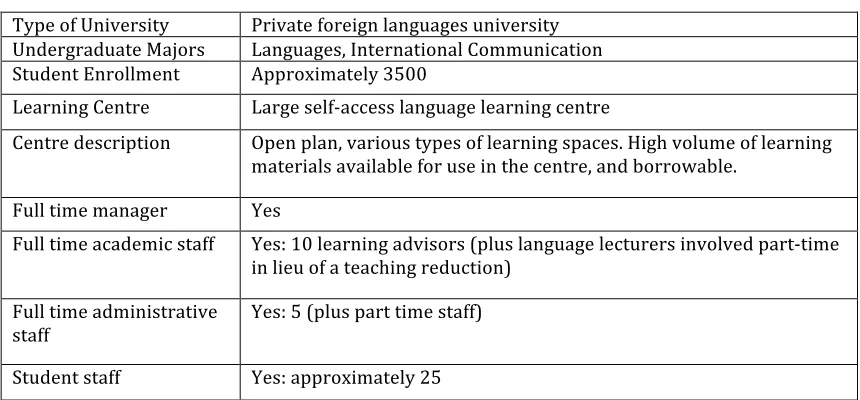
University 1
Table 1. SALC Situation in University 1
Type of University Private foreign languages university Undergraduate Majors Languages, International Communication Student Enrollment Approximately 3500
Learning Centre Large self-‐access language learning centre
Centre description Open plan, various types of learning spaces. High volume of learning materials available for use in the centre, and borrowable.
Full time manager Yes
Full time academic staff Yes: 10 learning advisors (plus language lecturers involved part-‐time in lieu of a teaching reduction)
Full time administrative staff
Yes: 5 (plus part time staff)
Student staff Yes: approximately 25
Why so well staffed? Although it is problematic to quantify the benefits of
self-access learning (Morrison, 2005), and therefore difficult to make a financial case for its provision, this particular university was able to obtain external funding at the outset, as at the time of its inception it was an innovative project. At the same time, although
quantifying its role as a revenue driver for the university was not possible, the university was also happy to fund the centre, as it understood it as a ‘loss leader’ (something that while not directly creating profit, drives wider profit to the provider). The centre became a major part of open campus tours for high school students, improving student enrollment. Being highly staffed, it developed excellent services. The centre became a central,
I was initially employed here as a full-time learning advisor, and later took on a managerial role. As a result of the large full-time staff, this centre provided a huge range of services – orientations to the SALC for all students in the university, semester-long independent learning modules all students could take with their own personal learning advisor (tailored to their stage of learning development or language need), drop-in advisory services all day, a reservation advising system, events, and a huge range of both purchased and in-house created language learning materials. The full-time staff were able to provide excellent services because the dedicated role allowed them time to do so, and time for ongoing training and development specific to this role.
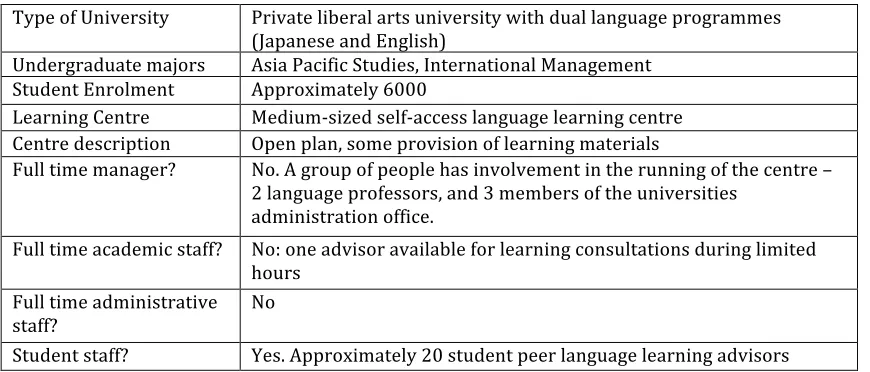
University 2
Table 2. SALC Situation In University 2
Type of University Private liberal arts university with dual language programmes (Japanese and English)
Undergraduate majors Asia Pacific Studies, International Management Student Enrolment Approximately 6000
Learning Centre Medium-‐sized self-‐access language learning centre Centre description Open plan, some provision of learning materials
Full time manager? No. A group of people has involvement in the running of the centre – 2 language professors, and 3 members of the universities
administration office.
Full time academic staff? No: one advisor available for learning consultations during limited hours
Full time administrative staff?
No
Student staff? Yes. Approximately 20 student peer language learning advisors
Why this staffing arrangement? When this SALC was created, the
management team did not include any members with specialist knowledge of independent learning or SALC management. The university administration office controlled funding for the SALC, and the employment of full-time staff was not considered. Student staff were employed as this was common across the university (through a teaching assistant system).
My involvement with this centre was short (providing cover for a professor who was on a leave of absence). After gaining consensus from colleagues involved, I
effectively addressed in other SALCs that have full-time employees. This report was then sent to the main financial decision-maker, but unfortunately, the request was not
approved. In fact, no reply was received.
Reflecting on this, my approach was somewhat naïve and shortsighted in its orientation. In this instance I did not have the social capital necessary to effect such a change, nor enough knowledge of the wider planning and activities of the university. At the time, the university was developing other aspects to promote active learning and the development of ‘global human resources’ (MEXT, 2012). Taking a longer, more
contextually situated view – placing the SALC within these activities – may have proven successful.
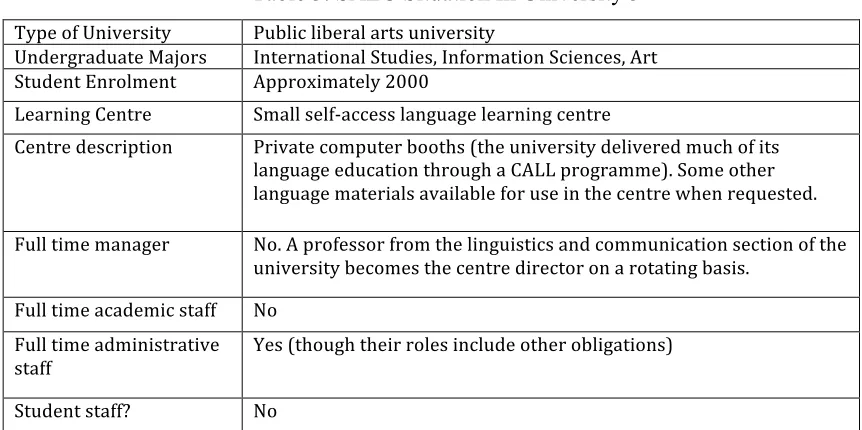
University 3
Table 3. SALC Situation In University 3
Type of University Public liberal arts university
Undergraduate Majors International Studies, Information Sciences, Art Student Enrolment Approximately 2000
Learning Centre Small self-‐access language learning centre
Centre description Private computer booths (the university delivered much of its language education through a CALL programme). Some other language materials available for use in the centre when requested.
Full time manager No. A professor from the linguistics and communication section of the university becomes the centre director on a rotating basis.
Full time academic staff No Full time administrative
staff Yes (though their roles include other obligations)
Student staff? No
Why no educational staff? In this university, the centre functioned with only an
Having a distant working association with this centre, when asked for some input – for example, suggestions for language materials to purchase – I found it difficult to answer with confidence. My main priorities were elsewhere and my knowledge of how students were using the centre was minimal. This made suggesting materials most appropriate to the specific context problematic – what language difficulties were these students having, what materials were they interested in using, what materials might encourage other students to use the centre? When I asked these questions, the information was not available. While I could use my past experience to inform my suggestions, doing so without context-specific knowledge or adequate time devoted to the process was not ideal.
Three different staffing arrangements are described above. Each centre provides valuable services to students, but the depth and breadth of services offered differ greatly – a direct result of the number of educational staff available, their understanding of self-access language learning, and whether or not this role is their main priority.
The Japanese university context: Academic Roles and Finance
Although it is globally common for faculty to be involved in various university activities, the degree and importance of this in the Japanese context is important to clarify. Tenured faculty members are expected to be teachers, researchers and ‘administrators’, unlike in many other international situations, where academics tend to move into one of these directions more singularly.
Faculty who become involved in SALCs on top of their base duties (or on a part-time basis with a reduction of other duties), can and do create excellent learning
programmes and systems. Many universities have vibrant conversation lounges and student driven initiatives. Many organize peer-to-peer learning and peer tutoring
programmes (as in the case of University 2) that have many benefits for students, though come with limitations (Boud, Cohen, & Sampson, 2014), and require coordination. If a centre is deemed ‘functioning’ under such a framework (as in the example of University 2 above), making the case for full-time staff is more complex. Making a strong case for this staffing at the outset, as part of a ‘SALC package’, may prove easier than asking for it later, when a SALC is already up and running under the ‘extra duty’ system.
Alongside the roles of academics, it is of value to know the financial workings of an institution. As learning centre creation requires funding, it is important to understand
• Budget categories (human resources, technology) and timeframes (e.g. an institution may function on a 6 year budget cycle)
• who the decision-makers are
• what the priorities of the decision-makers are
Take the case of University 3 given above. In this university, the number of faculty was being reduced. If my goal was to staff the centre with learning support, I would need to take a longer view – using the timeframe of the current budget cycle to garner university support, gain access to the most relevant decision-makers, and consider other options (i.e. if new tenured faculty appointments for the centre will not become possible, what about full-time term limited appointments?).
Conclusion
case of University 2 above shows) to begin such a centre without full-time staffing and seek the staffing at a later stage.
As exemplified in this paper, SALCs without full-time staffing arrangements provide fewer learning opportunities. This can leave the dedicated ‘part-timers’ facing an uphill battle in terms of their own learning curves, other work demands, and attempts to increase the staffing complement after a centre is up and running.
Following the four steps below from the outset may increase the likelihood of support for full time academic staff in a SALC:
1. Clarify what services a fully staffed centre could provide, and why these roles are necessary (perhaps through a comparison of a well-staffed centre and a non-staffed centre)
2. Find out who the academic members involved in the financial decision-making and educational planning of your university are, and which of these members are most likely to support your plan. Convince them of point one!
3. Understand the budget cycles and limitations of your institution, and find out about university wide initiatives.
4. Consider all the benefits a SALC can provide (beyond improved language
competency), and which of these will appeal to the decision-makers. For example, in Japan, universities have been tasked with but are struggling to develop
kokusaika (internationalization) (Breaden, 2013), kosei (individuality), ikiru chikara (‘zest for living’) and sozosei (creativity) (MEXT, 2013) – all of which a supported SALC may be positioned to facilitate.
Notes on the contributor
Luke Carson is an Associate Professor in the Faculty of International Studies at Hiroshima City University, where he teaches cross-cultural psychology, intercultural communication and education courses in English. His research interests are
interdisciplinary approaches to understanding and improving learning, curriculum and learning environment design, and cross-cultural studies.
Boud, D., Cohen, R., & Sampson, J. (2014). Peer learning in higher education: Learning from and with each other. Abingdon, UK: Routledge.
Breaden, J. (2013). The organisational dynamics of university reform in Japan: International inside out. Abingdon, UK, Routledge.
Carson, L. (2012). Why Classroom based advising? In J. Mynard & L. Carson (Eds.). Advising in language learning: Dialogue, tools and context (pp. 247-262). Harlow, UK: Pearson,
Gardner, D., & Miller, L. (1997). A study of tertiary level self-access facilities in Hong Kong. The Evaluation of the Student Experience Project. Hong Kong: Hong Kong City University. Retrieved from
http://www2.caes.hku.hk/dgardner/files/2013/12/Gardner-Miller_1997.pdf
Kidd, K., & Von Boehm, S. (2012). Kaleidoscope, an online tool for reflection on language learning. In Mynard & Carson, (Eds.). Advising in Language Learning: Dialogue, Tools and Context (pp. 129-150). Harlow, UK, Pearson,
MEXT [Ministry of Education Culture, Sports, Science and Technology, Japan] (2012). Project for Promotion of Global Human Resource Development. Retrieved from http://www.mext.go.jp/english/highered/1326675.htm
MEXT [Ministry of Education, Culture, Sports, Science and Technology, Japan] (2013). Kyoiku shinko kihon keikaku [Basic Plan for the advancement of education]. Retrieved from:
http://www.mext.go.jp/a_menu/keikaku/detail/__icsFiles/afieldfile/2013/05/16/13
35023_002.pdf
Morrison, B. (2005). Evaluating learning gain in a self-access language learning centre. Language Teaching Research, 9(3), 267-293.