Developing Prototype of E-Marketplace Using Extreme Programming Development
Method
Author Details: Lutfi Dwi Saifudin
University Gunadarma, Department of Business System Information, Indonesia E-mail: [email protected]
__________________________________________________________________________________________ Abstract
Business development in every country will always connected with the development of technologies, especially on the aspect of Information Technology (IT). Together with the high increase use of Smartphone and Internet, many digital marketplaces were developed to gain this new marketing target. They offer local product and local service to their consumer in Indonesia. Although currently there's still a gap between local store (physical store) and online store, especially on C2C marketplace. Findo is a C2C E-marketplace that tries to fuse both stores into one system that manage the management them as one. In this research, Author defined what is Findo and develop a prototype Findo using the extreme programming method to create the minimum viable product version of Findo. The minimum viable product was then tested to be usable.
Keywords: E-commerce, E-marketplace, Extreme Programming,React Natives, Mobile Application developments.
__________________________________________________________________________________________
1. INTRODUCTION
Business development in every country will always connected with the development of technologies. Especially on the aspect of Information Technology(IT). This connection could be seen with the increase of advertisement, online shop, and online marketplace on the internet. The result of the connection between business development and Information Technology could also be called as E-Commerce. E-Commerce is defined as process of transaction of product or service with the use of electronic systems such as internet or Computer[1]. The increase of Indonesia buyers on E-commerce from 2016-2017 is 3.2 million as could be seen in the chart in figure 1
.
Fig 1: E-commerce buyers in 2016 to 2017 and prediction until 2022 by Statista.com[2]
Fig 2: E-Commerce platform for B2B and C2C in Indonesia[3]
Fig 3: E-Commerce platform for B2C in Indonesia[2]
Other than the example above, there's also another booming transaction service used in Indonesia; it's named Go-Jek. Go-Jek offers not only service to drive you to your destination, but they're also offering many other services such as ordering food from nearby restaurant and buying groceries from the nearby supermarket. From all those E-commerce companies, most of them already reaching their hand to the next device of E-commerce like portable computer or Smartphone. From portable computer born the need for a responsive design for their site on the internet while Smartphone gives birth to a new term such as Commerce(Mobile-Commerce). M-Commerce is another e-commerce type that uses the portable platform such as smartphone as the media for their transaction.
In the recent years, those e-commerce companies start making smartphone application for their business. A few of them is like Blibli, Tokopedia, Lazada and Matahari Mall. By creating their own application on the smartphone platform, they could get more users to access their business. There's also go-jek application on smartphone that is used to sell service such as delivering package, drive you to your destination and also ordering food from nearby food stall for you and deliver it to your house. Other than Go-jek there's also much application that sells service for ordering food such as Food Panda or Grab Food. By using their service people could order food from anyplace and get it delivered to their location.
In C2C E-commerce there's already a platform called marketplace where retail business that sells goods could sell directly from the application or site without using their own systems such as Tokopedia or BukaLapak. While for retail business that in a shape of food stall or restaurants. There's only an indirect ordering using food panda or Go-Food in the lower and middle class business. The fast-food restaurant also prepares something like their own application so their customer could order delivery from there. Last is the type of application that let you book a seat from restaurant that works collaborate with them such as Qcraved.
Applications such as Go-jek or Grab Food that currently existing didn't fully access the cashier system of the restaurant itself. The effect of this would cause an extra time needed to process the customer order using application. But if they used each restaurant specific application such as Pizza-hut or KFC, it would end up filling their smart-phone. While this is a chance to develop a new online ordering system for a customer to customer marketplace, at the same time, there are also many rival developers that would be grasping this chance. To check the worthiness of the e-marketplace that will be presented in this research, the e-marketplace will be developed using development method Extreme programming. The use of extreme programming method is to present a prototype that would be able to be presented to the user to be tested and see how their response about this new marketplace. The prototype that will be presented to the public for testing will be satisfying the minimum viable product defined in the first phase of the development.
The concept of the E-marketplace prototype that will be developed is a customer to customer marketplace that will fuse the retail business with an online business, not only for the one selling goods but also the one selling in a food stall. The E-marketplace would serve as a cashier system for each store while at the same time provide a media for customer to search and buy from each store. By doing so, it would be able to shorten the time lag between the customer and the seller.
2. BACKGROUND
2.1 E-Commerce
Devendra defines Electronic commerce(E-commerce) is a process of buy and selling product or service using electronic system such as internet or computer network[1].
Niranjanamurthy defines that e-commerce is an economic activity that happened online. The activity consists of business activity such as buying, selling, banking, investation, and renting[5]. Yaser said that e-commerce is interaction between communication systems, data management systems and security, which because of them exchange commercial information in relation to the sale products or services, will be available[6]. So it could be said that E-commerce is a transaction that uses electronic media that connected to the network so they could exchange data needed for the transaction.
2.2 M-Commerce
devices[5].Based on research done by Khawaar, in M-commerce there are 4 perspectives of business such as[7]:
2.2.1. Wireless Business-to-Consumer(WB2C) Model
The Wireless Business-to-Consumer (WB2C) model adopts the perspective of activities, as opposed to transactions, to describe the interactions and relationships between organisations and mobile consumers. These activities are focused on service delivery to mobile consumers through wireless networks, specifically including mobile advertising, mobile shopping, mobile ticketing, mobile stock trading, and mobile banking[7].
The WB2C model has advantages when compared with traditional face-to-face transaction models and leverages the specific benefits afforded by mobility:
1. Sales and purchases can be conducted at any time and anyplace.
2. Personalized services are provided to consumers in a convenient and rapidly deployed manner.
3. Reduced delivery costs result in competitive commodity prices and improved efficiency of transactions.
2.2.2. Wireless Business to Business(WB2B) Model
The Wireless Business-to-Business (WB2B) model describes commercial transactions between organisations - such as between a manufacturer and a wholesaler, or between a wholesaler and a retailer. Its major characteristic is that the supply chain of constituent organisations required for the transactions, and the associated transaction process itself is predominately underpinned by wireless networks and communications. This aims to harmonise the collaborative basis of the transaction communication (again leveraging the benefits afforded by mobility) with a view to optimising the spectrum of costs associated with service delivery[7].
2.2.3. Wireless Consumer-to-Consumer(WC2C) Model
The Wireless Consumer-to-Consumer (WC2C) model views activities occurring between consumers through some third party. These activities are fairly common and typical such as E-mail, SMS, gaming, web access, and location-based activities[7].
2.2.4. Wireless Consumer-to-Self(WC2S) Model
Mobile devices are increasingly becoming part of end-to-end and sensor-based systems. For example, smartphones and personal networks can be used to communicate with or control other devices such as vehicles , smart refrigerators, and domestic media recorders[8]. This form of usage is encapsulated by Coursaris and Hassanein in a model called Consumer-to-Self. The Wireless Consumer-to-Self (WC2) model thus provides a perspective of the interaction of related activities that occur amongst mobile consumers themselves in the context of personalised or context-based scenarios[9].
Niranjanamurthy said that the advantage that m-commerce has against e-commerce is[5]
1. Ubiquity : The use of wireless device enables the user to receive information and conduct transactions anywhere, at any time.
3. Convenience: The portability of the wireless device and its functions from storing data to access to information or persons
4. Localization : The emergence of location-specific based applications will enable the user to receive relevant information on which to act.
5. Instant Connectivity: Instant connectivity or "always-on" is becoming more prevalent with the emergence of 4G… networks, GPRS or EDGE. Users of 4G services will benefit from easier and faster access to the Internet.
6. Personalization :The combination of localization and personalization will create a new channel/business opportunity for reaching and attracting customers. Personalization will take the form of customized information, meeting the user's preferences, followed by payment mechanisms that allow for personal information to be stored, eliminating the need to enter credit card information for each transaction
7. Time Sensitivity:Access to real-time information such as a stock quote that can be acted upon immediately or a sale at a local boutique.
8. Security:Depending on the specific end-user device, the device offers a certain level of inherent security.
2.3 Minimum viable product(MVP)
Minimum Viable Product or shorten as an MVP is a term coined by Frank Robinson and popularized by Eric Ries. This term is used for a methodology of a lean start-up company where they create a version of a new product, which allows a team to collect the maximum amount of validated learning about customers with the least effort[10]. This term is created because the creation start-up company is always followed by a grand idea of the owner. Without enough budget, time, and human resource the time needed to prove that the idea of the owner is truly profitable or not.
Moogk said that MVP is used to prove whether the idea that becomes the main weapon of the company truly has a great value in the eyes of the customer [11]. By using the feedback given by using MVP, the company could plan more function to increase the value or maybe throw the idea and move to the next one.
2.4 Extreme Programming
Extreme programming(XP) is an agile method for software developing used when the requirement is not firm or vague[12]. Extreme programming achieves success because this development method stresses on the customer satisfaction[13]. Extreme programming is used based on 4 values such as communication, simplicity, feedback, and courage[12].
This method is done by delivering the needed software with the needed function when it's needed by the customer. When the customer gives new feedback with new change feature to the software, the developer needed to respond to the change even if it's already so far ahead on the software development life cycle. In extreme programming method, there's something called iteration which depicts the cycle of the release of the software for the customer to check and give feedback. The iteration keeps increasing until the customer is satisfied. This is also why in extreme programming communication between developer member and customer is important.
React Native is a JavaScript framework to develop mobile application for IOS and android[9] React native is developed based on react and library javascript facebook to create an interface for the user. React native is not used to create application for web browser but for mobile media. In short, by using react-native developers that normally develop application based on web could develop an application for mobile using the javascript library that they already understand fully well. There's also an advantage of multi-platform code so it would make it easier to develop an application for both os at the same time[9]
React Native didn't differ very much from React that normally used in developing web. Application created by react-native is written using a joint language between Javascript and JSX. While to bridge the mobile application to server, React Native used API that runs on Objective C in IOS and Java on Android. By using these methods, the component is built by using react-native would be in the form of mobile user interface not a web component.React Native also used the Javascript interface on the device where it was developed so the application developed would be able to use those function. Currently, React Natively supported platform is Android and IOS . In the future, there's a chance that it'll be able to reach another platform. By using react native, we could create mobile application that could be ready to be released. A few examples of application using react native is Facebook, Palantir, and TaskRabbit.
Based on Bonnies Eisenman research[9], there's a few advantage and disadvantage of React Native:
Advantage :
1. Rendering based on the API renders standard of the targeted platform.
2. Short build time .
3. Developer tools and a useful error message is planted on the framework so developer could check it easier.
4. Web developer could easily adapt to create a mobile-based application from their current web.
5. Doesn't need a specific application for writing the application code.
6. Easy to maintenance and port the application that already exists to another platform.
7. Increase the number of the mobile application programmer. With the existence of React Native, programmer could develop both mobile application for Android or IOS while also having skill to develop web based.
Disadvantage :
1. Lack of documentation.
2. The most programmer also needs to start learning Objective C or Java because it'll be used in the development.
3. A few functions still didn't work in all platform.
4. I was debugging become hard because the code didn't directly interact with the targeted platform.
A web API is an interface for a third party software could access the function or data inside the system by utilizing HTTP protocol[14]. By using a web API on the web application or software developed, the application could then interact with the service provided by the web API used. This is also the reason why web API is also known as a web service. Currently there are two versions of API that could be developed which is RESTful API and SOAP API
3. PROPOSED WORK
The proposed work would be called Findo. The word Findo is based on the word find to find the store and do for doing the business. Below is the step needed until the design of Findo is fixed.
3.1 Define Findo Requirement
The proposed work for this research is defined by analysing the data collected from the initial data collection and initial analysis. The activity that needs to be finished on the initial data collection and initial analysis is as follow :
1. Observe feature in the market leader in e-marketplace in Indonesia (Tokopedia, Bukalapak, Blibli, Lazada)
2. Observe some map-based application Go-Jek and Grab
3. Observe end to end online ordering system, such as dominos pizza.
4. Observe commerce / popular apps from other countries such as Amazon, AirBnB, craigslist.
5. Get survey result about Indonesian internet usage behaviour.
6. Ask a developer that works in real e-marketplace project.
7. Ask some e-marketplace sellers about their experience selling things online. If there is any opinion or critique or things that they need and the marketplace provider do not have it yet.
From analysing the data we collected, we found that most of users in Indonesia access the internet using their mobile devices. There's also the internet penetration very high rate and still keep increasing every year.
Most of the basic feature was obtained by analysing and observing the sites and application of the same c2c marketplace such as Tokopedia, Bukalapak, Blibli, and Lazada. Their design is used as a based to design the layout of Findo site and application. While the ordering system is based on the data collected from Dominos Pizza system. The data was available because one of the developers is involved in the development of Dominos Pizza system.
For the design of mapping that would be used to show where the traditional store that sells the item/product customer search, we're using the data gathered from ab application that use maps as one of their features such as Go-Jek, Grab, and Google Maps.
using another site to sell things online. Their experience would be able to be built into an opinion how Findo should be developed.
From the collected data of the initial data collection phase, the proposed e-marketplace that would be developed is as follow :
1. Standard features for C2C e-marketplace such as checking item/product, order product, and tracking order.
2. Web application and mobile application
3. A web application that flexible to use in any kind of device size.
4. The use of Web API for the developing the mobile application and ajax request of the web application.
5. An integrated map to show the location of a nearby physical shop that sells the thing user search.
6. The feature that can help traditional commerce such as point of sales, inventory management system and many more.
3.2 Define Findo Minimum Viable Product
Based from the result of analysing the data collected in the initial data collection, it could be seen that to be able to develop it until it would be fully finished would need many times, human resource and budget. As explained in the introduction, the prototype of the system developed in this research will be based on the Minimum Viable Product defined here. This was done to minimize the time needed to verify the worthiness of the proposed work(Findo).
The point that would be developed for the web version could be seen as follow:
1. Design web app template.
2. Login and sign up as user or store owner
3. Online ordering system
4. Store product management
5. Payment gateway
6. Shopping cart & Checkout
7. Tracking order
8. Product Categorization
9. Search catalogue feature
10. About, FAQ, contact, term and condition, the term of use, etc
For the mobile application, fusing both store side and customer side would end up burdening the device. So for the MVP created this time, Findo mobile application version would be developed for the customer. The function that would be developed in the current MVP would enable the user to order and track their order. The function that would be developed in the MVP of Findo mobile application is as follow :
1. Login function
2. Register function
3. Profile function
4. Store profile function
5. Shopping cart function
6. Checkout function
7. Detail menu function
8. Categories function
9. Choosing order type function
10. Choosing payment type function
11. Confirm order function
12. Track order function
13. Search menu function
14. Upload proof order payment function
15. Faq,about, the term of use, term of condition, contact and many more
Other than the function that would be developed, the feature that would be needed to be developed in the future development is as follow:
1. Application for the store side that would provide help for a traditional store to manage their store while also selling their item online.
2. An integrated map function that would show the location of a physical store that sells the item customer search.
3.3 Define Findo Development Tools
4. DEVELOPMENT
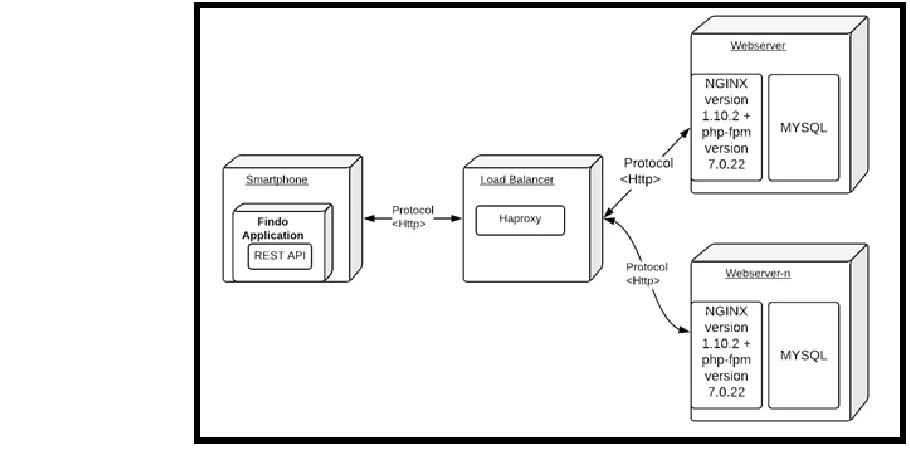
To start with the development, first we have to deploy a virtual private server to place the proposed work(Findo). The proposed work currently deployed in a virtual private server (VPS) using Linux CentOS 7. The first layer that would directly communicate with the client or in this case the application is a load balancer. Load balancer function is to split the request received from all the client that access the system to several servers used. Although currently the web server used on the system, by implementing this architecture from the beginning would allow the system to be easily upgraded when another web server would be added in the future. For load balancer we use haproxy version 1.5.18. For web server is NGINX version 1.10.2 and PHP-fpm version 7.0.22 as the PHP interpreter. The current proposed work(Findo) system architecture could be seen in figure 4
Fig 4: Findo Current System
As explained before load balancer is the one that directly interacted with the client so that the system would be scalable, interpreted SSL certificate in the first place, and flexibility. While the future findo system architecture would be done by adding a new web server. For each new web server added to the system all we need to do is configure the load balancer without modifying the application or web. The architecture for the future system server could be seen in figure 5.
The proposed work(Findo) interface that is used on the prototype is splitted into three-part. The mobile version, web version for customer and web version for the store. A few examples of the design could be seen below:
4.1. Findo Mobile Application Interface
The mobile application version has a few interfaces which the user/customer could use to interact with the system. Each of them is resizeable so that the size of the device/ smartphone won't affect the data shown. Each interface page is using web API to access the data from the database. Below is a few examples of the interface on the mobile version to understand the basic design and how the application normally work.
4.1.1. Login Interface
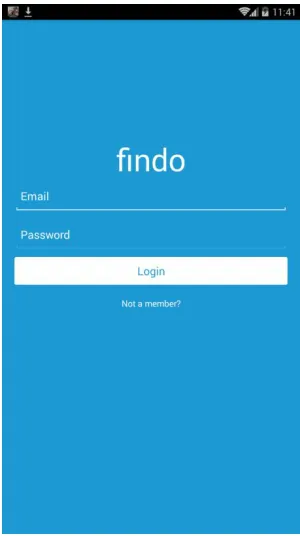
The login page is an interface page for user to login to the application. This is the first interface page that user would access if they just installed the application version. By inputting user email and password, user would be able to access the application using their account and start ordering thing as a customer. If user still doesn't have account, they could access register interface page by clicking one part in this interface page. The view of login page could be seen in figure 6 and 7 below.
Fig 7: Findo Mobile Application Version Login Horizontal View
4.1.2. Register Interface
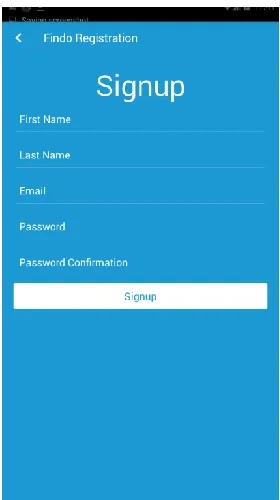
Register page is an interface page accessed from clicking not a member of the login interface page. In register page, user inputs their data such as name, email, password to register as a customer in the system. By clicking register button after filling all the required data, they could move to dashboard page. The view of register page could be seen in figure 8 and figure 9 below.
Fig 8 : Findo Mobile Version Register Page Vertical View
Fig 9: Findo Mobile Application Version Register Horizontal View
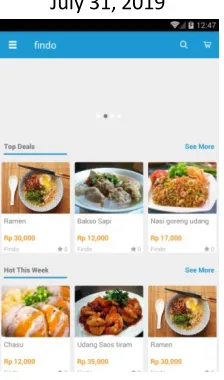
4.1.3. Dashboard Interface
Fig 10 : Findo Mobile Application Version Dashboard Vertical View
Fig 11 : Findo Mobile Application Version Dashboard Horizontal View
4.2. Findo Web Application Interface
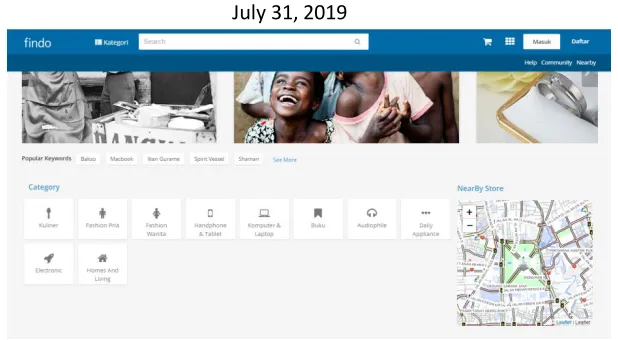
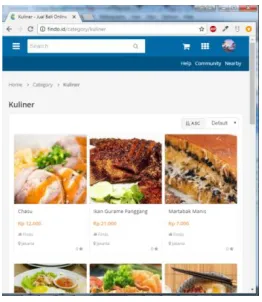
The web version interface didn't differ very much from the the mobile application version because the mobile application interface is based on the web version. Just like the mobile application version, all interface is resizeable and also use web API to access data from the database. The web version is splitted into two part the customer and store part. Each have their own design; a few examples could be seen below:
4.2.1. Customer Version Dashboard
Fig 12 : Findo Web Version Dashboard Page Full View
Fig 13 : Findo Web Version Dashboard Page Resized View
4.2.2. Customer Version Category
Fig 14: Findo Web Version Category Page Full View
.
Fig 15 : Findo Web Version Category Page Resized View
4.2.3. Store Version Store Panel
Store version store panel page is an interface page that would be accessible when a user chooses to open a store on this e-marketplace. They could access this page from any page on the web version. It would give the user an access to function that would help them to manage their store such as manage catalogue, seeing report about selling or directly using it as a cashier. The view of store version store panel page could be seen in figure 16
.
Fig 16 : Findo Web Version Store Panel Page View
Store version manages catalogue page is an interface page that would let the user or seller at this point manage the product they would like to sell. They could add, edit or delete product they want from the list on this page. The view of store version manage catalogue page could be seen in figure 17.
Fig 17: Findo Web Version Manage Catalogue Page View
4.2.5. Store Version Store Report
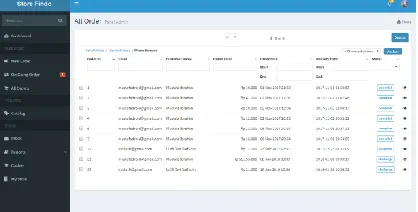
Store version store report page is an interface page that would let the seller see many kinds of reports such as the product that got sold today or profit and many other reports. The view of store version report page could be seen in figure 18.
Fig 18 : Findo Web Version Store Report Page View
5. TESTING
The testing that would be done to test the prototype is user acceptance test and SWOT test.
5.1. User Acceptance Test
This test is chosen because the premise of developing the prototype of the proposed work(Findo) is to check whether it's worth it to pour budget, human resource, and time with the current target of developed proposed work(Findo). The test is done by asking people to try most of the function in the system.To make it easier to compile the result from the tester, a questionnaire will be given for them to fill.
The questionnaire is based on the likert scale. It will ask whether the tester agree or disagree with the statement that describes the current Findo. The scale of this questionnaire also represents the satisfaction level of the tester. The satisfaction range on this questionnaire is as follow:
0-1 = Strongly disagree
2,01-3 = Neutral
3,01-4 = Agree
4,01-5 = Strongly agree
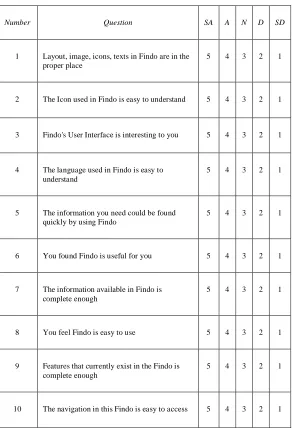
The questionnaire has ten-question which will be used to check the satisfaction level.The list of question could be seen in table 1.
Table 1: Findo User Acceptance Test Questionnaire
Number Question SA A N D SD
1 Layout, image, icons, texts in Findo are in the proper place
5 4 3 2 1
2 The Icon used in Findo is easy to understand 5 4 3 2 1
3 Findo's User Interface is interesting to you 5 4 3 2 1
4 The language used in Findo is easy to understand
5 4 3 2 1
5 The information you need could be found quickly by using Findo
5 4 3 2 1
6 You found Findo is useful for you 5 4 3 2 1
7 The information available in Findo is complete enough
5 4 3 2 1
8 You feel Findo is easy to use 5 4 3 2 1
9 Features that currently exist in the Findo is complete enough
5 4 3 2 1
10 The navigation in this Findo is easy to access 5 4 3 2 1
After checking the result of each category on the questionnaire, this test will also check the overall satisfaction level about Findo. The equation to check it is
The test result of each category and the overall is as follow:
5.1.1. Display
Category display represents whether the design of Findo is making the user could understand where they should go next, which icon represent each function. The result for the category display could be seen in table 2.
Table 2: Score Question Category Display
Number Question Score
1 Layout, image, icons, texts in Findo are in the proper place
3.7
2 The Icon used in Findo is easy to understand 3.9
3 Findo's User Interface is interesting to you 3.4
Total Score Mean 11
Average Score Mean 3.6
As could be seen in the table 2, The satisfaction level of Proposed work display category is
Fig 19: Likert Scale of Category Display
As it could be seen on the likert scale in figure 19, the average satisfaction level is 3,6. It's in the area of agree. From that it could be said that while the aspect display of Findo still needs to be refined, it already reach the level where people could understand its content just by looking at the design and layout.
5.1.2. Functionality
Category functionality represents the current feature implemented on Findo. The result of the test will show how satisfied user with the current function implemented on the application. The result for functionality category could be seen in table 3.
Table 3: Score Question Category Functionality
Number Question Score
1 The language used in Findo is easy to understand 3.8
2 The information you need could be found quickly by using Findo
3.3
3 You found Findo is useful for you 3.1
4 The information available in Findo is complete enough 3.1
Total Score Mean 13.3
Average Score Mean 3.3
As could be seen in the table 3, The satisfaction level of Findo functionality category is
Fig 20: Likert Scale of Category Functionality
As it could be seen on the likert scale in figure 20, the average satisfaction level is 3,3. It's in the area of agree. From that it could be said that while the category functionality of Findo still needs to be refined, the function existing could help the user on ordering item/product they want to buy.
5.1.3. Ease of Operation
Category ease of operation represents the satisfaction level on using the application. The result will show whether user could use the application easily without getting lost while trying to order an item/product. The result of the category ease of operation could be seen in table 4.
Table 4: Score Question Category Ease of Use
Number Question Score
1 You feel Findo is easy to use 3.9
2 Features that currently exist in the Findo is complete enough 3.2
3 The navigation in this Findo is easy to access 3.7
Total Score Mean 10.8
Average Score Mean 3.6
Figure 21: Likert Scale of Category Ease of Use
As it could be seen on the likert scale in figure 21, the average satisfaction level is 3,6. It's in the area of agree. From that it could be said that while the aspect display of Findo still needs to be refined, the user won't easily get lost on how they should move to finish their order.
5.1.4. Overall
Based on the result of each category, Findo still hasn't reached a very satisfying result in each category. The category with the lowest score is functionality. From this it could be understood that currently Findo still lacks the amount of function that it could offer to the user. While category display and ease of operation is a bit higher than functionality, the score still says on the level of agreeing. This mean there are a few parts that need to be revised within that category.
The overall score for the application itself is as follow:
The same as the result of categories, the likert scale for the overall result of the questionnaire is also on the range of agree which can be seen in figure 22. It already reaches a level which could be used, but as of now it wouldn't be able to stay long because it still lacking the power to beat another e-marketplace with the same target.
Other than the result of the questionnaire, a few testers also give opinion and critique about the current application. A few of that critique and opinion is as follow:
1. Promo Banner still didn't move into promo page.
2. Some categories doesn't have any dummy product.
3. The lack of feature on the mobile version.
4. A few bugs on display could be found sometimes.
5. The dummy image scaling sometimes messed up.
6. It would be better to lock the monitor to vertical on the mobile application version so that it won't destroy the scaling.
5.2. SWOT Analysis
A SWOT analysis was conducted to analyse the current system in Findo more comprehensively. Findo team gather the data for SWOT analysis by observing Findo's Google Analytic data, observing other e-commerce trend and features,analysing the current development of e-commerce and the market, analyse Findo current system and its future development.
Although the result from Findo's google analytic data still lacks cause there's only dummy product. Based on the other data, the result of the SWOT analysis for Findo is as follow:
5.2.1. Strength
1. Acceptable UX based on the result of User Acceptance Test.
2. I have good concept to combine traditional market and E-marketplace.
3. Function as Store management system for the seller
5.2.2. Weakness
1. Still in the middle of phase 1 development.
2. Many features that would be the main weapon of Findo is still not implemented.
3. Still doesn't have a clear segmentation of market target and business model.
4. I lack human resource.
6. Current layout still needs to be improved based on the data from the user experience .
5.2.3. Opportunity
1. The keep raising internet user in Indonesia.
2. Currently, there's only three big C2C e-marketplace in Indonesia (Bukalapak, Tokopedia, Jualo).
3. Much traditional market that still stands alone from e-marketplace.
4. The need for a store management system for the traditional store.
5.2.4. Threat
1. Another C2C e-marketplace that already released before Findo.
2. Development of E-commerce in general.
3. The change and development in Gadget style.
Based on the result of the SWOT analysis doned by the team. To be able to succeed, Findo still needs more development especially on the functional and usability aspect. The development done in the future can't not only trying to chase another C2C e-marketplace that already running before Findo, but also needs to create Findo special feature that would make it stand out from the other C2C marketplace. Other than that, the optimization and improving the current system and feature is also needed. For business aspect, Findo needs a clear market segmentation so it could build a business model that could support Findo to compete in that market segmentation.
6. CONCLUSION AND FUTURE WORK 6.1. Conclusion
From the result of research, developing and testing proposed work(Findo) System , there's a few conclusion that the development get:
6.1.1. Based on the initial analysis of the development of Findo, it was reached that the scope of development is to create an e-marketplace that would combine E-commerce and traditional market. The target is to create an e-marketplace that would help user not only order item/product online but also found a physical store close to them that sell it. For the store, Findo would be used for the customer to find them. The main target of Findo is not only for them to sell their product online, but also to help them manage their store and promote it. More people using Findo would be able to increase the chance for their physical store to be known by more people especially the closer one to them.
6.1.2. The MVP for the development this time is to create a minimum e-marketplace which customer and store could interact
6.1.3. Findo MVP is developed in both medium, Web version, and Mobile version. The mobile version is developed using react native while getting supported by Rest-API for accessing the database. Currently the mobile version of Findo MVP is currently released on Google play store. The released version is used to gather data for the next development.
1. From the result of black-box test, Findo MVP for the mobile version already has all the implemented version work properly. All that left is for these function is to developed to interact with future function. 2. From the result of the functionality test, it was found that Findo MVP for the mobile version still has
troubled by the redundancy of queries done to ease the burden for the internet quota of the user. Findo MVP server also could handle around 20 requests at once, so that it would be able to handle the stream of request of customer and seller. While at the same time, it was found that for the current server that this much would be the limit Findo MVP could offer.
3. Based on the User Acceptance test questionnaire that filled by the 30 respondent, Findo MVP for the mobile version was found to be acceptable as an e-marketplace. The respondent mostly agrees that the design and the ease of operation are already good enough, but for the functionality is still lacking. This is caused because Findo is currently only a Minimum Viable Product that released to gather data to check how it should go in the future development.
4. Based on the SWOT analysis, while the scope of Findo as an e-marketplace is good. It was still in the middle of developing to reach its full potential. The opportunity surely exists for Findo, but currently it was just another e-marketplace that people could find anywhere. Without any unique feature that exists in the scope developed, it would be hard for Findo to be able to reach the targeted market.
6.2. Future Work
Based on the result of the testing, there are a few suggestions that could be used in the future development of Findo as a marketplace:
6.2.1. The lack of human resource is making it hard for Findo to be able to penetrate in C2C market. So it would be much better for Findo to be able to find more human resource so that each person could focus on one thing. Currently both developer has to focus on two things at once. On the business aspect and developing aspect, with how big the scope, if the human resource is lacking it, would take more time to finish developing Findo.
6.2.2. The current C2C e-commerce is gaining more competitor, so if possible before fully released as a full product, Findo needs to develop the real unique feature that is described on its initial analysis.
6.2.3. For the testing and gathering data using the MVP, it would be much better if there's more data for the user to access. That's why the development team could found out which feature, product and many more thing that user/people would prefer. For recording the data, Google already provides a few tools. Especially for the mobile version, the play store already gives a few tools for the development team to use.
6.2.4. The lack of Business strategy in the initial analysis needs to be developed using the data recorded using the MVP of Findo.
REFERENCE:
i. Agrawal, D., Agrawal, R. P., Singh, J. B. & Tripathi, S.P. "E-commerce: True Indian Picture". Journal of Advances in IT, 2012, vol 3, number 4.
ii. https://www.statista.com/statistics/251635/number-of-digital-buyers-in-indonesia/, Accessed 23 december 2017,14/04/2018.
iii. https://ecommerceiq.asia/indonesia-ecommerce-landscape-2017/, Accessed 23 december 2017,14/04/2018.
iv. http://arenalte.com/berita/industri/data-gfk-terbaru-2016-pengguna-smartphone-indonesia/ /, Accessed 23 december 2017,14/04/2018.
v. M. Niranjanamurthy,Kavyashree, N., Mr. Jagannaths, S. & Dhamendra, D. C.
"Analysis of E-Commerce and M-commerce :Advantages, Limitations and Security issues",
vi. Nanehkaran.Yaser Ahangari
"An Introduction To Electronic Commerce",International Journal of Scientific & Technology Research, 2013, volume 2, number 6 .
vii. Hameed Khawaar,Kamran, A. & Weijung, Y,"Mobile Commerce and Applications: An Exploratory Study and Review"
Journal of Computing, 2010, volume 2, number 4 .
viii.Hassanein, C. C. &. K., "Understanding m-commerce: a consumer-centric model" Degroote School of Business, McMaster University, 2006 .
ix. Eisenman Bonnie,"Learning React Native. Building Native Mobile Apps with JavaScript",O’reilly media, 2016 .
x. Lenarduzzi, Valentina & Taibi, Davide. "MVP Explained: A Systematic Mapping Study on the Definitions of Minimal Viable Product.", 10.1109/SEAA.2016.56.
xi. Moogk,Dobrila Rancic,
"Minimum Viable Product and the Importance of Experimentation", Technology Innovation Management Review, 2012 .
xii. Widodo,"Extreme Programming : Pengembangan Perangkat Lunak Semi Formal", Konferensi dan Temu Nasional Teknologi Informasi dan Komunikasi untuk Indonesia, 2008.
xiii.Vijayan,Nidhin," Extreme Programming" Cochin University Of Science, 2010.
![Fig 1: E-commerce buyers in 2016 to 2017 and prediction until 2022 by Statista.com[2]](https://thumb-us.123doks.com/thumbv2/123dok_us/9961051.1984269/1.612.211.410.493.633/fig-e-commerce-buyers-prediction-statista-com.webp)
![Fig 2: E-Commerce platform for B2B and C2C in Indonesia[3]](https://thumb-us.123doks.com/thumbv2/123dok_us/9961051.1984269/2.612.127.506.299.482/fig-e-commerce-platform-for-b-and-indonesia.webp)