ISSN 0975-928X
Research Article
General and specific combining ability for quantitative characters in
castor (
Ricinus communis
L.)
K.P. Patel*, M.P. Patel, N.R. Joshi and J.A. Patel
Regional Research Station, Anand Agricultural University, Anand E-mail: [email protected]
(Received: 26 Nov 2015; Revised: 18 June 2017; Accepted: 23 June 2017)
Abstract
The experimental material consisted of ten monoecious lines, their 45 F1S developed through diallel mating excluding
reciprocals, which was evaluated in Randomized Complete Block Design with three replications. The analysis of variance for combining ability revealed that mean square values due to both GCA and SCA and were significant, accordingly the estimates of both σ2
GCA and σ 2
SCA were also significant for all the characters indicating an importance of both additive and
non-additive gene effects for the inheritance of studied characters. However, values of potence ratio and predictability ratio revealed preponderance of additive genetic variance for all the characters. Parents ANDCI 10-12, ANDCI 8, ANDCI 10-4 and ANDCI 10-3 were good general combiners for seed yield per plant and other yield contributing characters. The hybrids ANDCI 10-1 x ANDCI 9, ANDCI10-11 x ANDCI 10-12 and ANDCI 8 x ANDCI 10-11,had high per se performance, high heterotic effects and desired sca effects for seed yield per plant and its component characters.
Key words
Castor, Ricinus communis, gca, sca, additive and non-additive, combining ability, potence ratio
Introduction
Castor (Ricinus communis L.) is industrially an important non-edible oilseed crop widely cultivated in arid and semi-arid regions of the World (Govaerts et al., 2000). At present, India is a world leader in castor production and main exporter of castor oil and its derivatives. India contributes 65 per cent of the world production and meets about 90 per cent world castor oil demands. In India during 2015-16, Castor occupied an area about 10.61 lakh ha with a production of 17.82 lakh tonnes. Interestingly, an average seed yield has increased from 1334 kg/ha in 2009-10 to 1752 kg/ha in 2015-16, which is highly encouraging (Anonymous, 2017). Castor is usually cultivated as a hybrid in India, as hybrids give significantly higher yields than varieties (Moll et al., 1962; Birchler et al., 2003; Reif et al., 2007). Higher magnitude of heterotic effects and superior hybrids can be developed by combining diverse parents. In hybrids development programme availability of monoecious inbreds as pollen parents is mandatory.
In genetic improvement of different attributes of castor, selection of suitable parents is preliminary approach, which will lead to development of better hybrids, for that some indication can be obtained from per se performance of parents, but information based on per se performance of parents along with their general combining ability effect is more reliable. However, information on magnitude of heterotic effects, specific combining ability effect of hybrids, and type of gene action involved for inheritance of seed yield, and its component characters would be of immense value in selecting desired parents, and beneficial cross combinations for commercial exploitation of
hybrid vigour, and also in formulating appropriate future breeding programme of castor.
Material and Methods
The experimental material consisted of ten monoecious lines and their 45 F1s developed
through diallel mating excluding reciprocals. The experiment was conducted in a Randomized Complete Block Design with three replications at Regional Research Station, Anand Agricultural University, Anand during 2012-13. Each test genotype was grown in a single row of 10 plants with 120 cm inter row distance and 60 cm intra row distance. All the recommended agronomic practices and plant protection measures were followed to raise a good crop. The observations for all the characters under study except days to 50% flowering and days to 50% maturity of primary raceme were recorded on five randomly selected competitive plants and an average value per plant for each replication was worked out, whereas days to 50% flowering and days to 50% maturity of primary raceme were recorded on population basis. The mean values were subjected for statistical analysis as suggested by Snedecor and Cochran (1937). Combining ability analysis was performed as per Griffing (1956) Model-I andmethod-II. Estimation of relative heterosis and heterobeltosis analysis was carried out as per Turner (1953) and Fonseca and Patterson (1968).
Results and Discussion
Combining ability analysis is a powerful tool to select good combiners and for choosing desired parental material in crop breeding program. The
ISSN 0975-928X
information on nature of gene effects and their expression in terms of combining ability is necessary. Significate value of GCA and SCA variance for a character indicates existence of additive and non-additive genetic effects, respectively. However, both variance are non significant, epistatic gene effects suppose to play an important role in determining inheritance of a character (Fehr, 1993).
The analysis of variance for combining ability (Table 1) revealed that mean square values due to GCA and SCA were significant, accordingly the estimates of both σ2GCA and σ2SCA were significant
for all the characters, suggesting an importance of both additive and non-additive genetic variances for the inheritance of all the characters under investigation. Whereas, above one values of potence ratio and above one half value of predictability ratio indicated preponderance of additive genetic variance for all the characters except days to 50% maturity of primary raceme and shelling out turn. The results are in conformity with the findings of Patel (2010), Patel et al.
(2012), Ramesh et al. (2013), Chaudhari and Patel (2014) and Punewar et al. (2017) as they reported importance of additive genetic variance for seed yield per plant and other important seed yield component characters. Although there was pre-ponderance of additive gene action for all the characters, but presence of a considerable amount of non-additive gene effect could not be totally neglected. The estimates of average degree of dominance for all the characters except days to 50% maturity of primary raceme, shelling out turn were less than one revealing existence of partial dominance behavior of interacting alleles.
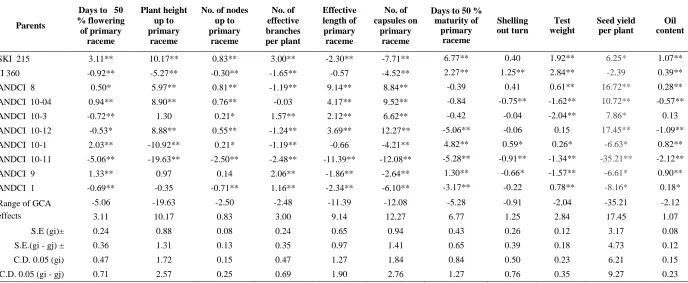
The perusal of the results (Table:2) in respect to
gca effect of parents revealed that for seed yield per plant, parents ANDCI 10-12, ANDCI 8, ANDCI 10-4, ANDCI 10-3 and SKI 215 were good general combiners and parent JI 360 was average general combiner. Among good general combiners for seed yield, ANDCI 8 was the good general combiner for effective length of primary raceme, while it was good general combiner for number of capsules on primary raceme, test weight and oil content; parent ANDCI 10-12 was also good general combiner for days to 50% flowering of primary raceme, length of primary raceme, effective length of primary raceme, number of capsules on primary raceme and days to 50% maturity of primary raceme, while it was average general combiner for shelling out turn and test weight.
Among the good general combiners for seed yield, ANDCI 10-4 was also good general combiner for effective length of primary raceme and number of capsule on primary raceme, ANDCI 10-3 was also good general combiner for days to 50% flowering
of primary raceme, number of effective branches per plant, length of primary spike, effective length of primary spike and number of capsules on primary raceme and SKI 215 was also good general combiner for number of effective branches per plant, test weight and oil content.
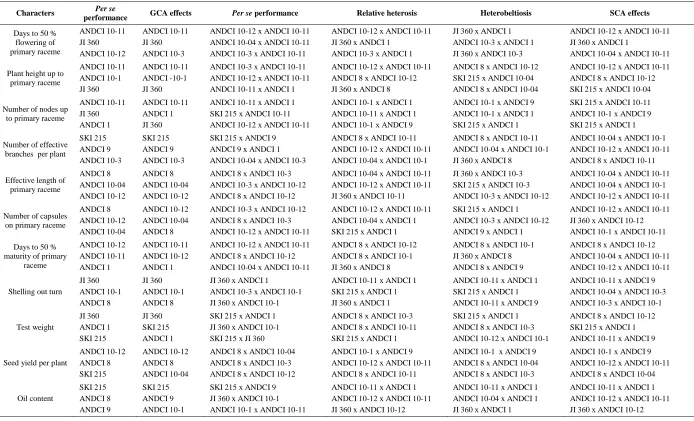
The top ranking three parental genotypes on the basis of their per se performance and general combing ability effects as well as crosses in respect to per se performance, specific combining ability, relative heterosis and heterobeltiosis for seed yield per plant and its component characters are presented in table 3. The per se performance of parents along with their gca effect could be a better criteria for selection of superior parent/s in future breeding programme. In present investigation, the results revealed that the most of the parents had relatively high degree of correspondence between
per se performance and their gca effects for almost all the characters, which could be ascribed to existence of genes, which showed additivity. Therefore, in selection of parents for varietal development programme due weightage should also be given to per se performance along with their gca effect.
The estimates of specific combining ability effect provide information on role of intra and inter-allelic interactions in the expression of heterotic effects and inheritance of a character. The results revealed that crosses, which had high per se
performance also depicted higher heterotic effects and high estimate of sca effect for all the growth and developmental attributes.
Among the evaluated crosses, none of the cross combinations had desirable significant sca effects simultaneously for all the characters under study; however, good specific combiners for seed yield also depicted desirable sca effects for most of the yield component characters.
ISSN 0975-928X
ANDCI 10-11 and ANDCI 9 were poor general combiners, therefore, cross combinations were of resultant of P x P, G x P and G x G gca effect of parents, and high sca or heterotic effects could be because of intra and inter allelic interactions.
Among the crosses, which depicted significant and positive sca effect for seed yield per plant, crosses ANDCI 10-1 x ANDCI 9 and ANDCI 10-12 x ANDCI 10-11 were good specific combiner for days to 50 % flowering of primary raceme, days to 50 % maturity of primary raceme, number of nodes up to primary raceme, , and plant height up to primary raceme .The cross ANDCI 10-12 x ANDCI 10-11 was also good specific combiner for number of effective branches per plant, effective length of primary raceme, number of capsules on primary spikes, and oil content, while it was average specific combiner for rest of the characters.
The cross ANDCI-8 x ANDCI 10-11 was good specific combiner for number of effective branches per plant, effective length of primary raceme, test weight and oil content. The crosses which exhibited high sca effect for seed yield per plant also registered desirable sca effect for at least two yield component characters, but those might not necessarily have higher sca effect for the said characters, which suggested cumulative effect of various yield contributing attributes towards high
sca effect for seed yield, and thereby high heterotic effects as well. This also appropriately suggest that yield is a complex character dependent on number of component characters, and suitable recombination of genes governing these characters would have produced promising crosses, therefore, none of the crosses had desirable sca effect for all the characters under study.
The monoecious parents ANDCI 10-12, ANDCI 8, ANDCI 10-4, ANDCI 10-3 and SKI 215 were good general combiners for seed yield per plant and other contributing characters suggesting these parental lines need to be used extensively as pollen parents in heterosis breeding and for making normal crosses and those crosses may be advanced for development of superior recombinants to strengthens monoecious gene pool and thereby for development of promising inbreds as improved varieties and/or male parents. Similarly, the cross combinations, ANDCI 10-1 x ANDCI 9, ANDCI10-11 x ANDCI 10-12 and ANDCI 8 x ANDCI 10-11, which showed high per se
performance, high heterotic effects and desired sca
effects for seed yield per plant and its component characters including developmental characters need to be advanced for development of inbreds having short plant stature, earliness, profused branches and resistant to major biotic stresses.
References
Anonymous. 2017. All India Coordinate Research Project on Castor. Annual Report of Castor. IIOR, Hyderabad.
Birchler, J.A., Auger, D.L. and Riddle, N.C. 2003. In search of the molecular basis of heterosis. Plant Cell, 15: 2236–2239.
Chaudhari, G. and Patel, B.N. 2014. Estimation of heterosis, combining ability and gene action in castor (Ricinus communis L.). A paper presentated at National Seminar on Challenges and Innovative Approaches in Crop Improvement, December 16 & 17, 2014, AC & RI, Madurai, TNAU, India.
Fehr, W.R. 1993. Principles of Cultivar Development. MacMillan Publ. Co. New York, USA. p 539 Fonseca, S. and Patterson, F. 1968. Hybrid vigour in a
seven parent diallel cross in common wheat.
Crop Sci., 8: 858-888.
Govaerts, R., Frodin, D.G. and Radcliffe-Smith, A. 2000. World check list and Bibliography of
Euphorbiaceae (with Pandaceae). Redwood Books Limited, Trowbridge, Wiltshire
Griffing, J.B. 1956. Concept of general and specific combining ability in relation to diallel crossing system. Austr. J. BioI. Sci., 9: 463-493.
Moll, R.H., Salhuanan, W.S. and Robinson, D.H.F. 1962. Heterosis and genetic diversity in variety crosses of maize. Crop. Sci., 2: 197–198. Panse, V.G. and Sukhatme, P.V. 1978. Statistical
Methods for Agricultural Workers. I.C.A.R., New Delhi.
Patel, A.R. 2010. Heterosis and combining ability study of yield and its components in castor (Ricinus communis L.) M.Sc. Thesis (Unpublished) submitted to Anand Agricultural University, Anand
Patel, J.A., Patel, K.V. and Patel, A.R. 2012.Genetic analysis of seed yield and component characters over environments in castor (Ricinus communis
L.).Indian J. Agric. Res., 46(2): 148-154. Punewar, A.A., Patil, A.S., Nandanwar, H.R., Patel, S.
M. and Patel, B.N. 2017. Genetic dissection of heterosis and combining ability in castor (Ricinus communis L.) with line × tester analysis. Journal of Experimental Biology and Agricultural Sciences, 5(1): 77-86
Ramesh, M., Lavanya, C., Sujatha, M., Sivasankar, A., Aruna Kumari, and Meena, H.P. 2013. Heterosis and combining ability for yield and yield component characters of newly developed castor (Ricinus communis L.) hybrid. The Bioscan,8(4): 1421-1424.
Reif, J.C., Gumpert, F.M., Fischer, S. and Melchinger, A.E. 2007. Impact of interpopulation divergence on additive and dominance variance in hybrid populations. Genetics, 176: 1931–1934
Snedecor, G.W. and Cochran, W.G. 1967. Statistical methods. 6th ed. Ames: Iowa State University Press.
Sprague, G.F. and Tatum, L.A. 1942. General vs. specific combining ability in single crosses of corn. J. Amer. Soc. Agron., 34: 927-932. Turner, J.H. 1953. A study of heterosis in upland cotton,
ISSN 0975-928X
Table 1. Analysis of variance for combining ability for various characters of castor
Source of
variation d.f.
Days to 50 % flowering of
primary raceme
Plant height up to primary
raceme
No. of nodes up to primary
raceme
No. of effective branches per plant
Effective length of primary raceme
No. of capsules on
primary raceme
Days to 50 % maturity of
primary raceme
Shelling out turn
Test weight
Seed yield per plant
Oil content
Mean squares
GCA 9 59.18** 1109.88** 12.21** 40.35** 346.22** 867.66** 160.77** 5.47** 31.80** 2933.43** 11.90**
SCA 44 7.25** 46.57** 0.35** 4.56** 32.51** 63.93** 28.95** 1.61** 2.31** 309.64** 1.15**
Error 106 0.81 10.32 0.10 0.77 5.66 12.02 2.544 0.91 0.200 134.77 0.09
Estimates of components of genetic variance and related parameters σ2
GCA (∑gi2) 4.86** 91.63** 1.01** 3.29** 28.38** 71.30** 15.42** 0.37** 2.63** 233.22** 0.98**
σ2
SCA (∑∑sij 2
) 6.44** 36.25** 0.25** 3.79** 26.84** 51.91** 26.45** 0.69** 2.11** 174.86** 1.05**
Potence ratio 3.69 12.35 19.75 4.24 5.17 6.72 2.85 2.62 6.09 6.52 4.56
Predectibility ratio 0.60 0.83 0.88 0.63 0.67 0.73 0.54 0.52 0.71 0.72 0.65
2
A 9.73 183.26 2.01 6.59 56.76 142.60 30.83 0.75 5.26 466.44 1.96
2D 6.44 36.25 0.25 3.79 26.84 51.91 26.45 0.69 2.11 174.86 1.05
(σ2D/σ2
A)0.5 0.81 0.44 0.35 0.75 0.69 0.60 0.93 0.95 0.63 0.61 0.73
ISSN 0975-928X
Table 2. Estimates of general combining ability (gca) effect of parents for various characters of castor
Parents
Days to 50 % flowering of primary
raceme
Plant height up to primary
raceme
No. of nodes up to primary
raceme
No. of effective branches per plant
Effective length of primary raceme
No. of capsules on
primary raceme
Days to 50 % maturity of
primary raceme
Shelling out turn
Test weight
Seed yield per plant
Oil content
SKI 215 3.11** 10.17** 0.83** 3.00** -2.30** -7.71** 6.77** 0.40 1.92** 6.25* 1.07**
JI 360 -0.92** -5.27** -0.30** -1.65** -0.57 -4.52** 2.27** 1.25** 2.84** -2.39 0.39**
ANDCI 8 0.50* 5.97** 0.81** -1.19** 9.14** 8.84** -0.39 0.41 0.61** 16.72** 0.28**
ANDCI 10-04 0.94** 8.90** 0.76** -0.03 4.17** 9.52** -0.84 -0.75** -1.62** 10.72** -0.57**
ANDCI 10-3 -0.72** 1.30 0.21* 1.57** 2.12** 6.62** -0.42 -0.04 -2.04** 7.86* 0.13
ANDCI 10-12 -0.53* 8.88** 0.55** -1.24** 3.69** 12.27** -5.06** -0.06 0.15 17.45** -1.09**
ANDCI 10-1 2.03** -10.92** 0.21* -1.19** -0.66 -4.21** 4.82** 0.59* 0.26* -6.63* 0.82**
ANDCI 10-11 -5.06** -19.63** -2.50** -2.48** -11.39** -12.08** -5.28** -0.91** -1.34** -35.21** -2.12**
ANDCI 9 1.33** 0.97 0.14 2.06** -1.86** -2.64** 1.30** -0.66* -1.57** -6.61* 0.90**
ANDCI 1 -0.69** -0.35 -0.71** 1.16** -2.34** -6.10** -3.17** -0.22 0.78** -8.16* 0.18*
Range of GCA effects
-5.06 -19.63 -2.50 -2.48 -11.39 -12.08 -5.28 -0.91 -2.04 -35.21 -2.12
3.11 10.17 0.83 3.00 9.14 12.27 6.77 1.25 2.84 17.45 1.07
S.E (gi)± 0.24 0.88 0.08 0.24 0.65 0.94 0.43 0.26 0.12 3.17 0.08
S.E.(gi - gj) ± 0.36 1.31 0.13 0.35 0.97 1.41 0.65 0.39 0.18 4.73 0.12
C.D. 0.05 (gi) 0.47 1.72 0.15 0.47 1.27 1.84 0.84 0.50 0.23 6.21 0.15
C.D. 0.05 (gi - gj) 0.71 2.57 0.25 0.69 1.90 2.76 1.27 0.76 0.35 9.27 0.23
ISSN 0975-928X
Table 3. Top three crosses with respect to their per se performance, RH, HB and sca effect and per se performance of parents for various characters in castor
Characters Per se
performance GCA effects Per se performance Relative heterosis Heterobeltiosis SCA effects
Days to 50 % flowering of primary raceme ANDCI 10-11 JI 360 ANDCI 10-12 ANDCI 10-11 JI 360 ANDCI 10-3
ANDCI 10-12 x ANDCI 10-11 ANDCI 10-04 x ANDCI 10-11 ANDCI 10-3 x ANDCI 10-11
ANDCI 10-12 x ANDCI 10-11 JI 360 x ANDCI 1
ANDCI 10-3 x ANDCI 1
JI 360 x ANDCI 1 ANDCI 10-3 x ANDCI 1 JI 360 x ANDCI 10-3
ANDCI 10-12 x ANDCI 10-11 JI 360 x ANDCI 1
ANDCI 10-04 x ANDCI 10-11
Plant height up to primary raceme ANDCI 10-11 ANDCI 10-1 JI 360 ANDCI 10-11 ANDCI -10-1 JI 360
ANDCI 10-3 x ANDCI 10-11 ANDCI 10-12 x ANDCI 10-11 ANDCI 10-11 x ANDCI 1
ANDCI 10-12 x ANDCI 10-11 ANDCI 8 x ANDCI 10-12 JI 360 x ANDCI 8
ANDCI 8 x ANDCI 10-12 SKI 215 x ANDCI 10-04 ANDCI 8 x ANDCI 10-04
ANDCI 10-12 x ANDCI 10-11 ANDCI 8 x ANDCI 10-12 SKI 215 x ANDCI 10-04
Number of nodes up to primary raceme
ANDCI 10-11 JI 360 ANDCI 1 ANDCI 10-11 ANDCI 1 JI 360
ANDCI 10-11 x ANDCI 1 SKI 215 x ANDCI 10-11 ANDCI 10-12 x ANDCI 10-11
ANDCI 10-1 x ANDCI 1 ANDCI 10-11 x ANDCI 1 ANDCI 10-1 x ANDCI 9
ANDCI 10-1 x ANDCI 9 ANDCI 10-1 x ANDCI 1 SKI 215 x ANDCI 1
SKI 215 x ANDCI 10-11 ANDCI 10-1 x ANDCI 9 SKI 215 x ANDCI 1
Number of effective branches per plant
SKI 215 ANDCI 9 ANDCI 10-3 SKI 215 ANDCI 9 ANDCI 10-3
SKI 215 x ANDCI 9 ANDCI 9 x ANDCI 1 ANDCI 10-04 x ANDCI 10-3
ANDCI 8 x ANDCI 10-11 ANDCI 10-12 x ANDCI 10-11 ANDCI 10-04 x ANDCI 10-1
ANDCI 8 x ANDCI 10-11 ANDCI 10-04 x ANDCI 10-1 JI 360 x ANDCI 8
ANDCI 10-04 x ANDCI 10-1 ANDCI 10-12 x ANDCI 10-11 ANDCI 8 x ANDCI 10-11
Effective length of primary raceme ANDCI 8 ANDCI 10-04 ANDCI 10-12 ANDCI 8 ANDCI 10-04 ANDCI 10-12
ANDCI 8 x ANDCI 10-3 ANDCI 10-3 x ANDCI 10-12 ANDCI 8 x ANDCI 10-12
ANDCI 10-04 x ANDCI 10-11 ANDCI 10-12 x ANDCI 10-11 JI 360 x ANDCI 10-11
JI 360 x ANDCI 10-3 SKI 215 x ANDCI 10-3 ANDCI 10-3 x ANDCI 10-12
ANDCI 10-04 x ANDCI 10-11 ANDCI 10-04 x ANDCI 10-1 ANDCI 10-12 x ANDCI 10-11
Number of capsules on primary raceme
ANDCI 8 ANDCI 10-12 ANDCI 10-04 ANDCI 10-12 ANDCI 10-04 ANDCI 8
ANDCI 10-3 x ANDCI 10-12 ANDCI 8 x ANDCI 10-3 ANDCI 10-12 x ANDCI 10-11
ANDCI 10-12 x ANDCI 10-11 ANDCI 10-04 x ANDCI 1 SKI 215 x ANDCI 1
SKI 215 x ANDCI 1 ANDCI 10-3 x ANDCI 10-12 ANDCI 9 x ANDCI 1
ANDCI 10-12 x ANDCI 10-11 JI 360 x ANDCI 10-12 ANDCI 10-1 x ANDCI 10-11 Days to 50 %
maturity of primary raceme ANDCI 10-12 ANDCI 10-11 ANDCI 1 ANDCI 10-11 ANDCI 10-12 ANDCI 1
ANDCI 10-12 x ANDCI 10-11 ANDCI 8 x ANDCI 10-12 ANDCI 10-04 x ANDCI 10-11
ANDCI 8 x ANDCI 10-12 ANDCI 8 x ANDCI 10-1 JI 360 x ANDCI 8
ANDCI 8 x ANDCI 10-1 JI 360 x ANDCI 8 ANDCI 8 x ANDCI 9
ANDCI 8 x ANDCI 10-12 ANDCI 10-04 x ANDCI 10-11 ANDCI 10-12 x ANDCI 10-11
Shelling out turn
JI 360 ANDCI 10-1 ANDCI 8 JI 360 ANDCI 10-1 ANDCI 8
JI 360 x ANDCI 1 ANDCI 10-3 x ANDCI 10-1 JI 360 x ANDCI 10-1
ANDCI 10-11 x ANDCI 1 SKI 215 x ANDCI 1 JI 360 x ANDCI 1
ANDCI 10-11 x ANDCI 1 SKI 215 x ANDCI 1 ANDCI 10-11 x ANDCI 9
ANDCI 10-11 x ANDCI 9 ANDCI 10-04 x ANDCI 10-3 ANDCI 10-3 x ANDCI 10-1
Test weight JI 360 ANDCI 1 SKI 215 JI 360 SKI 215 ANDCI 1
SKI 215 x ANDCI 1 JI 360 x ANDCI 10-1 SKI 215 x JI 360
ANDCI 8 x ANDCI 10-3 ANDCI 8 x ANDCI 10-11 SKI 215 x ANDCI 1
SKI 215 x ANDCI 1 ANDCI 8 x ANDCI 10-3 ANDCI 10-12 x ANDCI 10-1
ANDCI 8 x ANDCI 10-12 SKI 215 x ANDCI 1 ANDCI 10-11 x ANDCI 9
Seed yield per plant
ANDCI 10-12 ANDCI 8 SKI 215 ANDCI 10-12 ANDCI 8 ANDCI 10-04
ANDCI 8 x ANDCI 10-04 ANDCI 8 x ANDCI 10-3 ANDCI 8 x ANDCI 10-12
ANDCI 10-1 x ANDCI 9 ANDCI 10-12 x ANDCI 10-11 ANDCI 8 x ANDCI 10-11
ANDCI 10-1 x ANDCI 9 ANDCI 8 x ANDCI 10-04 ANDCI 8 x ANDCI 10-3
ANDCI 10-1 x ANDCI 9 ANDCI 10-12 x ANDCI 10-11 ANDCI 8 x ANDCI 10-04
Oil content SKI 215 ANDCI 8 ANDCI 9 SKI 215 ANDCI 9 ANDCI 10-1
SKI 215 x ANDCI 9 JI 360 x ANDCI 10-1 ANDCI 10-1 x ANDCI 10-11
ANDCI 10-11 x ANDCI 1 ANDCI 10-12 x ANDCI 10-11 JI 360 x ANDCI 10-12
ANDCI 10-11 x ANDCI 1 ANDCI 10-04 x ANDCI 1 JI 360 x ANDCI 1