V
OLUMEN
O.
7
(2017),
I
SSUEN
O.
07
(J
ULY)
ISSN
2231-5756
A Monthly Double-Blind Peer Reviewed (Refereed/Juried) Open Access International e-Journal - Included in the International Serial Directories Indexed & Listed at:
Ulrich's Periodicals Directory ©, ProQuest, U.S.A., EBSCO Publishing, U.S.A., Cabell’s Directories of Publishing Opportunities, U.S.A., Google Scholar, Open J-Gage, India [link of the same is duly available at Inflibnet of University Grants Commission (U.G.C.)],
Index Copernicus Publishers Panel, Poland with IC Value of 5.09 & number of libraries all around the world.
V
OLUMEN
O.
7
(2017),
I
SSUEN
O.
07
(J
ULY)
ISSN
2231-5756
INTERNATIONAL JOURNAL OF RESEARCH IN COMMERCE, IT & MANAGEMENT
CONTENTS
Sr.
No.
TITLE & NAME OF THE AUTHOR (S)
Page
No.
1
.
COMPREHENDING AND IMPLEMENTING BEST PRACTICES OF QUALITY MANAGEMENT ACROSS INDUSTRIESBALAJI GOPALAN & DR. REVATHI IYER
1
2
.
INVENTIVE USE OF INFORMATION AND COMMUNICATION TECHNOLOGY IN THE OPEN AND DISTANCE LEARNING SYSTEM: ANEMPIRICAL STUDY B. RUPINI
6
3
.
A STUDY ON PROBLEM FACED BY VEGETABLE PRODUCING FARMERS IN NILIGIRI - DISTRICTDR. S. NAMASIVAYAM & K. ARTHI
12
4
.
STUDY ON CONSUMER BEHAVIOUR TOWARDS FROZEN FOOD IN JAMMU CITY OF J & K STATETAVLEEN KAUR, JYOTI KACHROO & NAVEED HAMID
16
5
.
OPINION DIFFERENCE OF TEACHERS ON EXISTING PERFORMANCE APPRAISAL PRACTICES IN PRIVATE ENGINEERING INSTITUTIONSCHANDRA MOHAN SINGH, DR. ASHOK CHANDRA & DR. SANJAY SHARMA
22
6
.
COOPERATIVE INDUSTRIAL ESTATES: THE GOLDEN PLATFORM FOR SMALL SCALE INDUSTRIESDR. ARVIND CHAUDHARI
35
7
.
ECONOMIC GROWTH, EDUCATION EXPENDITURE AND INCOME INEQUALITY IN INDIAANIRUDDHA KAYET & DEBASISH MONDAL
38
8
.
LEADER MEMBER EXCHANGE QUALITY INFLUENCING COMMITMENT AND TRUST AMONG EMPLOYEESOWAIS AHMED & DR. MUSHTAQ AHMED SIDDIQI
44
9
.
EFFECTIVENESS OF TECHNOLOGY ENABLED LEARNING (TEL) IN LEARNING SCIENCE AT D.T.Ed. LEVELP. JAYANTHI NIRMALA & DR. K. S. PREMILA
47
10
.
ROLE OF FIXED ASSETS MANAGEMENTRAMESH VANKADOTH
50
11
.
A REVIEW OF LITERATURE ON THE INTER-LINKAGES OF STOCK MARKET DEVELOPMENT WITH ECONOMIC GROWTHTANUJ NANDAN & NIVEDITA SRIVASTAVA
52
12
.
A STUDY ON EMPLOYEE ATTRITION AND RETENTION IN BPO SECTORDR. SHAMSHER SINGH & RAVEENA RANA
60
13
.
A STUDY ON THE INFLUENCE OF ATTITUDINAL AND ENVIRONMENTAL FACTORS ON ENTREPRENEURIAL INTENTIONDR. JOHNEY JOHNSON & DR. SONIA KATHERIN MATHEW
64
14
.
E-GOVERNANCE: A BOON OR BLISS TO SOCIETY: A RESEARCHDR. SHALINI SRIVASTAV, DR. SUMIT AGARWAL & DR. GARIMA BHARDWAJ
68
15
.
BREXIT-AN END IN ITSELF OR THE BEGINNING OF A NEW ERADEEPA SHARMA
71
16
.
ROLE OF BUYER CHARACTERISTICS IN ONLINE SHOPPINGDR. ADIL RASOOL
79
17
.
FOREIGN INSTITUTIONAL INVESTORS (FIIs) FLOWS AND VOLATILITY IN STOCK MARKETS OF INDIA DURING SUB-PRIME CRISIS AND POST FPI ACTRAJNISH KLER
87
18
.
ASSESSMENT OF KNOWLEDGE LEVEL, NEED AND IMPACT OF ICTS AMONG FARMERS IN DIFFERENT ASPECTS OF AGRICULTURE ATTALERA BLOCK OF BUNDI DISTRICT IN RAJASTHAN DR. SUSMIT JAIN & NEERAJ KUMAR PRAJAPATI
92
19
.
ESSENTIAL FACTORS FOR TRAINING TRANSFER: A STUDY OF PHARMACEUTICAL REPRESENTATIVES IN LUCKNOW AREAANA RIZVI & DR. SURENDRA KUMAR
104
20
.
EXPLORING PSYCHOLOGICAL CAPITAL IN INDIAN CONTEXT AMONG MSME ENTREPRENEURSMARIA TRESITA PAUL V. & DR. N. UMA DEVI
108
21
.
FRUIT PROCESSING INDUSTRY IN MURSHIDABAD DISTRICT OF WEST BENGAL - PRESENT STATUS AND FUTURE PROSPECTSMADHAB KUMAR BISWAS & DR. SUDIPTA SARKAR
113
22
.
A COMPARATIVE STUDY ON REPORTING OF MERGERS AND ACQUISITIONS ACTIVITIES UNDER IGAAP AND IND ASNARAYAN KAFLE
117
23
.
CULTURAL INTELLIGENCE: AN INTEGRAL PART OF CROSS CULTURAL ORGANISATIONSJASLEEN KAUR ANEJA, VAISHALI JOSHI & PRIYANKA MARWA
120
24
.
BILATERAL RELATION BETWEEN INDIA AND THAILANDDR. SHEETAL ARUN KHANDRE
122
25
.
AN EVALUATION OF THE STATUS OF HIGHER EDUCATION IN INDIADR. YOGESH H S & DR. KIRAN S P
127
26
.
STOCK PERFORMANCE OF AMERICA’S LARGEST BANKS AFTER MERGERS & ACQUISITIONSSAL VILLEGAS
131
27
.
CORPORATE SOCIAL RESPONSIBILITY (CSR) AND CUSTOMER’S PERSPECTIVE OF INDIAN BANKSPUNEET KAUR
139
28
.
WIRELESS ROUTING PROTOCOLS AND ITS SECURITY ISSUES IN AD HOC NETWORKNEHA CHUGH
147
29
.
POLICY SUPPORT TO AUGMENT THE AGRIBUSINESS POTENTIAL OF KARNATAKANAGARAJA K.
150
30
.
WORK-LIFE BALANCE: ITS CORRELATION WITH JOB SATISFACTION, LIFE SATISFACTION AND STRESS LEVEL AMONGST EXECUTIVES OFPUBLIC SECTOR BANKS IN PUNJAB JASPREET KAUR
154
V
OLUMEN
O.
7
(2017),
I
SSUEN
O.
07
(J
ULY)
ISSN
2231-5756
INTERNATIONAL JOURNAL OF RESEARCH IN COMMERCE, IT & MANAGEMENT
CHIEF PATRON
Prof. (Dr.) K. K. AGGARWAL
Chairman, Malaviya National Institute of Technology, Jaipur
(An institute of National Importance & fully funded by Ministry of Human Resource Development, Government of India)
Chancellor, K. R. Mangalam University, Gurgaon
Chancellor, Lingaya’s University, Faridabad
Founder Vice-Chancellor (1998-2008), Guru Gobind Singh Indraprastha University, Delhi
Ex. Pro Vice-Chancellor, Guru Jambheshwar University, Hisar
FOUNDER PATRON
Late Sh. RAM BHAJAN AGGARWAL
Former State Minister for Home & Tourism, Government of Haryana
Former Vice-President, Dadri Education Society, Charkhi Dadri
Former President, Chinar Syntex Ltd. (Textile Mills), Bhiwani
FORMER CO-ORDINATOR
Dr. S. GARG
Faculty, Shree Ram Institute of Business & Management, Urjani
ADVISOR
Prof. S. L. MAHANDRU
Principal (Retd.), Maharaja Agrasen College, Jagadhri
EDITOR
Dr. R. K. SHARMA
Professor & Dean, Bharti Vidyapeeth University Institute of Management & Research, New Delhi
CO-EDITOR
Dr. BHAVET
Faculty, Shree Ram Institute of Engineering & Technology, Urjani
EDITORIAL ADVISORY BOARD
Dr. S. P. TIWARI
Head, Department of Economics & Rural Development, Dr. Ram Manohar Lohia Avadh University, Faizabad
Dr. CHRISTIAN EHIOBUCHE
Professor of Global Business/Management, Larry L Luing School of Business, Berkeley College, USA
Dr. SIKANDER KUMAR
Chairman, Department of Economics, Himachal Pradesh University, Shimla, Himachal Pradesh
Dr. JOSÉ G. VARGAS-HERNÁNDEZ
Research Professor, University Center for Economic & Managerial Sciences, University of Guadalajara,
Gua-dalajara, Mexico
Dr. M. N. SHARMA
Chairman, M.B.A., Haryana College of Technology & Management, Kaithal
Dr. TEGUH WIDODO
Dean, Faculty of Applied Science, Telkom University, Bandung Technoplex, Jl. Telekomunikasi, Indonesia
Dr. M. S. SENAM RAJU
Professor, School of Management Studies, I.G.N.O.U., New Delhi
Dr. CLIFFORD OBIYO OFURUM
Professor of Accounting & Finance, Faculty of Management Sciences, University of Port Harcourt, Nigeria
Dr. KAUP MOHAMED
V
OLUMEN
O.
7
(2017),
I
SSUEN
O.
07
(J
ULY)
ISSN
2231-5756
INTERNATIONAL JOURNAL OF RESEARCH IN COMMERCE, IT & MANAGEMENT
SUNIL KUMAR KARWASRA
Principal, Aakash College of Education, ChanderKalan, Tohana, Fatehabad
Dr. MIKE AMUHAYA IRAVO
Principal, Jomo Kenyatta University of Agriculture & Tech., Westlands Campus, Nairobi-Kenya
Dr. SYED TABASSUM SULTANA
Principal, Matrusri Institute of Post Graduate Studies, Hyderabad
Dr. NEPOMUCENO TIU
Chief Librarian & Professor, Lyceum of the Philippines University, Laguna, Philippines
Dr. SANJIV MITTAL
Professor & Dean, University School of Management Studies, GGS Indraprastha University, Delhi
Dr. ANA ŠTAMBUK
Head of Department of Statistics, Faculty of Economics, University of Rijeka, Rijeka, Croatia
Dr. RAJENDER GUPTA
Convener, Board of Studies in Economics, University of Jammu, Jammu
Dr. SHIB SHANKAR ROY
Professor, Department of Marketing, University of Rajshahi, Rajshahi, Bangladesh
Dr. ANIL K. SAINI
Professor, Guru Gobind Singh Indraprastha University, Delhi
Dr. SRINIVAS MADISHETTI
Professor, School of Business, Mzumbe University, Tanzania
Dr. NAWAB ALI KHAN
Professor & Dean, Faculty of Commerce, Aligarh Muslim University, Aligarh, U.P.
MUDENDA COLLINS
Head, Operations & Supply Chain, School of Business, The Copperbelt University, Zambia
Dr. EGWAKHE A. JOHNSON
Professor & Director, Babcock Centre for Executive Development, Babcock University, Nigeria
Dr. A. SURYANARAYANA
Professor, Department of Business Management, Osmania University, Hyderabad
Dr. MURAT DARÇIN
Associate Dean, Gendarmerie and Coast Guard Academy, Ankara, Turkey
Dr. ABHAY BANSAL
Head, Department of Information Technology, Amity School of Engg. & Tech., Amity University, Noida
Dr. YOUNOS VAKIL ALROAIA
Head of International Center, DOS in Management, Semnan Branch, Islamic Azad University, Semnan, Iran
WILLIAM NKOMO
Asst. Head of the Department, Faculty of Computing, Botho University, Francistown, Botswana
Dr. JAYASHREE SHANTARAM PATIL (DAKE)
Faculty in Economics, KPB Hinduja College of Commerce, Mumbai
SHASHI KHURANA
Associate Professor, S. M. S. Khalsa Lubana Girls College, Barara, Ambala
Dr. SEOW TA WEEA
Associate Professor, Universiti Tun Hussein Onn Malaysia, Parit Raja, Malaysia
Dr. OKAN VELI ŞAFAKLI
Associate Professor, European University of Lefke, Lefke, Cyprus
Dr. MOHENDER KUMAR GUPTA
Associate Professor, Government College, Hodal
Dr. BORIS MILOVIC
V
OLUMEN
O.
7
(2017),
I
SSUEN
O.
07
(J
ULY)
ISSN
2231-5756
INTERNATIONAL JOURNAL OF RESEARCH IN COMMERCE, IT & MANAGEMENT
Dr. MOHAMMAD TALHA
Associate Professor, Department of Accounting & MIS, College of Industrial Management, King Fahd
Uni-versity of Petroleum & Minerals, Dhahran, Saudi Arabia
Dr. V. SELVAM
Associate Professor, SSL, VIT University, Vellore
Dr. IQBAL THONSE HAWALDAR
Associate Professor, College of Business Administration, Kingdom University, Bahrain
Dr. PARDEEP AHLAWAT
Associate Professor, Institute of Management Studies & Research, Maharshi Dayanand University, Rohtak
Dr. ALEXANDER MOSESOV
Associate Professor, Kazakh-British Technical University (KBTU), Almaty, Kazakhstan
Dr. ASHOK KUMAR CHAUHAN
Reader, Department of Economics, Kurukshetra University, Kurukshetra
YU-BING WANG
Faculty, department of Marketing, Feng Chia University, Taichung, Taiwan
SURJEET SINGH
Faculty, Department of Computer Science, G. M. N. (P.G.) College, Ambala Cantt.
Dr. MELAKE TEWOLDE TECLEGHIORGIS
Faculty, College of Business & Economics, Department of Economics, Asmara, Eritrea
Dr. RAJESH MODI
Faculty, Yanbu Industrial College, Kingdom of Saudi Arabia
Dr. SAMBHAVNA
Faculty, I.I.T.M., Delhi
Dr. THAMPOE MANAGALESWARAN
Faculty, Vavuniya Campus, University of Jaffna, Sri Lanka
Dr. SHIVAKUMAR DEENE
Faculty, Dept. of Commerce, School of Business Studies, Central University of Karnataka, Gulbarga
SURAJ GAUDEL
BBA Program Coordinator, LA GRANDEE International College, Simalchaur - 8, Pokhara, Nepal
FORMER TECHNICAL ADVISOR
AMITA
FINANCIAL ADVISORS
DICKEN GOYAL
Advocate & Tax Adviser, Panchkula
NEENA
Investment Consultant, Chambaghat, Solan, Himachal Pradesh
LEGAL ADVISORS
JITENDER S. CHAHAL
Advocate, Punjab & Haryana High Court, Chandigarh U.T.
CHANDER BHUSHAN SHARMA
Advocate & Consultant, District Courts, Yamunanagar at Jagadhri
SUPERINTENDENT
V
OLUMEN
O.
7
(2017),
I
SSUEN
O.
07
(J
ULY)
ISSN
2231-5756
INTERNATIONAL JOURNAL OF RESEARCH IN COMMERCE, IT & MANAGEMENT
CALL FOR MANUSCRIPTS
We invite unpublished novel, original, empirical and high quality research work pertaining to the recent developments & practices in the areas of Com-puter Science & Applications; Commerce; Business; Finance; Marketing; Human Resource Management; General Management; Banking; Economics; Tourism Administration & Management; Education; Law; Library & Information Science; Defence & Strategic Studies; Electronic Science; Corporate Gov-ernance; Industrial Relations; and emerging paradigms in allied subjects like Accounting; Accounting Information Systems; Accounting Theory & Practice; Auditing; Behavioral Accounting; Behavioral Economics; Corporate Finance; Cost Accounting; Econometrics; Economic Development; Economic History; Financial Institutions & Markets; Financial Services; Fiscal Policy; Government & Non Profit Accounting; Industrial Organization; International Economics & Trade; International Finance; Macro Economics; Micro Economics; Rural Economics; Co-operation; Demography: Development Planning; Development Studies; Applied Economics; Development Economics; Business Economics; Monetary Policy; Public Policy Economics; Real Estate; Regional Economics; Political Science; Continuing Education; Labour Welfare; Philosophy; Psychology; Sociology; Tax Accounting; Advertising & Promotion Management; Management Information Systems (MIS); Business Law; Public Responsibility & Ethics; Communication; Direct Marketing; E-Commerce; Global Business; Health Care Administration; Labour Relations & Human Resource Management; Marketing Research; Marketing Theory & Applications; Non-Profit Or-ganizations; Office Administration/Management; Operations Research/Statistics; Organizational Behavior & Theory; Organizational Development; Pro-duction/Operations; International Relations; Human Rights & Duties; Public Administration; Population Studies; Purchasing/Materials Management; Re-tailing; Sales/Selling; Services; Small Business Entrepreneurship; Strategic Management Policy; Technology/Innovation; Tourism & Hospitality; Transpor-tation Distribution; Algorithms; Artificial Intelligence; Compilers & Translation; Computer Aided Design (CAD); Computer Aided Manufacturing; Computer Graphics; Computer Organization & Architecture; Database Structures & Systems; Discrete Structures; Internet; Management Information Systems; Mod-eling & Simulation; Neural Systems/Neural Networks; Numerical Analysis/Scientific Computing; Object Oriented Programming; Operating Systems; Pro-gramming Languages; Robotics; Symbolic & Formal Logic; Web Design and emerging paradigms in allied subjects.
Anybody can submit the soft copy of unpublished novel; original; empirical and high quality research work/manuscriptanytime in M.S. Word format
after preparing the same as per our GUIDELINES FOR SUBMISSION; at our email address i.e. [email protected] or online by clicking the link online submission as given on our website (FOR ONLINE SUBMISSION, CLICK HERE).
GUIDELINES FOR SUBMISSION OF MANUSCRIPT
1. COVERING LETTER FOR SUBMISSION:
DATED: _____________
THE EDITOR
IJRCM
Subject: SUBMISSION OF MANUSCRIPT IN THE AREA OF______________________________________________________________.
(e.g. Finance/Mkt./HRM/General Mgt./Engineering/Economics/Computer/IT/ Education/Psychology/Law/Math/other, please specify)
DEAR SIR/MADAM
Please find my submission of manuscript titled ‘___________________________________________’ for likely publication in one of your journals.
I hereby affirm that the contents of this manuscript are original. Furthermore, it has neither been published anywhere in any language fully or partly, nor it is under review for publication elsewhere.
I affirm that all the co-authors of this manuscript have seen the submitted version of the manuscript and have agreed to inclusion of their names as co-authors.
Also, if my/our manuscript is accepted, I agree to comply with the formalities as given on the website of the journal. The Journal has discretion to publish our contribution in any of its journals.
NAME OF CORRESPONDING AUTHOR :
Designation/Post* : Institution/College/University with full address & Pin Code : Residential address with Pin Code : Mobile Number (s) with country ISD code : Is WhatsApp or Viber active on your above noted Mobile Number (Yes/No) : Landline Number (s) with country ISD code :
E-mail Address :
Alternate E-mail Address :
Nationality :
V
OLUMEN
O.
7
(2017),
I
SSUEN
O.
07
(J
ULY)
ISSN
2231-5756
INTERNATIONAL JOURNAL OF RESEARCH IN COMMERCE, IT & MANAGEMENT
NOTES:
a) The whole manuscript has to be in ONE MS WORD FILE only, which will start from the covering letter, inside the manuscript. pdf. version is liable to be rejected without any consideration.
b) The sender is required to mention the following in the SUBJECT COLUMNof the mail:
New Manuscript for Review in the area of (e.g. Finance/Marketing/HRM/General Mgt./Engineering/Economics/Computer/IT/ Education/Psychology/Law/Math/other, please specify)
c) There is no need to give any text in the body of the mail, except the cases where the author wishes to give any specific message
w.r.t. to the manuscript.
d) The total size of the file containing the manuscript is expected to be below 1000 KB.
e) Only the Abstract will not be considered for review and the author is required to submit the complete manuscript in the first instance.
f) The journal gives acknowledgement w.r.t. the receipt of every email within twenty-four hours and in case of non-receipt of acknowledgment from the journal, w.r.t. the submission of the manuscript, within two days of its submission, the corresponding author is required to demand for the same by sending a separate mail to the journal.
g) The author (s) name or details should not appear anywhere on the body of the manuscript, except on the covering letter and the cover page of the manuscript, in the manner as mentioned in the guidelines.
2. MANUSCRIPT TITLE: The title of the paper should be typed in bold letters, centeredand fully capitalised.
3. AUTHOR NAME (S) & AFFILIATIONS: Author (s) name, designation, affiliation (s), address, mobile/landline number (s), and email/al-ternate email address should be given underneath the title.
4. ACKNOWLEDGMENTS: Acknowledgements can be given to reviewers, guides, funding institutions, etc., if any.
5. ABSTRACT: Abstract should be in fully Italic printing, ranging between 150 to 300 words. The abstract must be informative and eluci-dating the background, aims, methods, results & conclusion in a SINGLE PARA. Abbreviations must be mentioned in full.
6. KEYWORDS: Abstract must be followed by a list of keywords, subject to the maximum of five. These should be arranged in alphabetic order separated by commas and full stop at the end. All words of the keywords, including the first one should be in small letters, except special words e.g. name of the Countries, abbreviations etc.
7. JEL CODE: Provide the appropriate Journal of Economic Literature Classification System code (s). JEL codes are available at www.aea-web.org/econlit/jelCodes.php. However, mentioning of JEL Code is not mandatory.
8. MANUSCRIPT: Manuscript must be in BRITISH ENGLISH prepared on a standard A4 size PORTRAIT SETTING PAPER. It should be free
from any errors i.e. grammatical, spelling or punctuation. It must be thoroughly edited at your end.
9. HEADINGS: All the headings must be bold-faced, aligned left and fully capitalised. Leave a blank line before each heading. 10. SUB-HEADINGS: All the sub-headings must be bold-faced, aligned left and fully capitalised.
11. MAIN TEXT:
THE MAIN TEXT SHOULD FOLLOW THE FOLLOWING SEQUENCE:
INTRODUCTION REVIEW OF LITERATURE
NEED/IMPORTANCE OF THE STUDY STATEMENT OF THE PROBLEM OBJECTIVES
HYPOTHESIS (ES)
RESEARCH METHODOLOGY RESULTS & DISCUSSION
FINDINGS
RECOMMENDATIONS/SUGGESTIONS
CONCLUSIONS LIMITATIONS
SCOPE FOR FURTHER RESEARCH
REFERENCES
APPENDIX/ANNEXURE
V
OLUMEN
O.
7
(2017),
I
SSUEN
O.
07
(J
ULY)
ISSN
2231-5756
INTERNATIONAL JOURNAL OF RESEARCH IN COMMERCE, IT & MANAGEMENT
12. FIGURES & TABLES: These should be simple, crystal CLEAR, centered, separately numbered & self-explained, and the titles must be above the table/figure. Sources of data should be mentioned below the table/figure. It should be ensured that the tables/figures are
referred to from the main text.
13. EQUATIONS/FORMULAE: These should be consecutively numbered in parenthesis, left aligned with equation/formulae number placed at the right. The equation editor provided with standard versions of Microsoft Word may be utilised. If any other equation editor is utilised, author must confirm that these equations may be viewed and edited in versions of Microsoft Office that does not have the editor.
14. ACRONYMS: These should not be used in the abstract. The use of acronyms is elsewhere is acceptable. Acronyms should be defined on its first use in each section e.g. Reserve Bank of India (RBI). Acronyms should be redefined on first use in subsequent sections. 15. REFERENCES: The list of all references should be alphabetically arranged. The author (s) should mention only the actually utilised
references in the preparation of manuscript and they may follow Harvard Style of Referencing. Also check to ensure that everything that you are including in the reference section is duly cited in the paper. The author (s) are supposed to follow the references as per the following:
•
All works cited in the text (including sources for tables and figures) should be listed alphabetically.•
Use (ed.) for one editor, and (ed.s) for multiple editors.•
When listing two or more works by one author, use --- (20xx), such as after Kohl (1997), use --- (2001), etc., in chronologically ascending order.•
Indicate (opening and closing) page numbers for articles in journals and for chapters in books.•
The title of books and journals should be in italic printing. Double quotation marks are used for titles of journal articles, book chapters, dissertations, reports, working papers, unpublished material, etc.•
For titles in a language other than English, provide an English translation in parenthesis.•
Headers, footers, endnotes and footnotes should not be used in the document. However, you can mention short notes to elucidate some specific point, which may be placed in number orders before the references.PLEASE USE THE FOLLOWING FOR STYLE AND PUNCTUATION IN REFERENCES:
BOOKS
•
Bowersox, Donald J., Closs, David J., (1996), "Logistical Management." Tata McGraw, Hill, New Delhi.•
Hunker, H.L. and A.J. Wright (1963), "Factors of Industrial Location in Ohio" Ohio State University, Nigeria.CONTRIBUTIONS TO BOOKS
•
Sharma T., Kwatra, G. (2008) Effectiveness of Social Advertising: A Study of Selected Campaigns, Corporate Social Responsibility, Edited by David Crowther & Nicholas Capaldi, Ashgate Research Companion to Corporate Social Responsibility, Chapter 15, pp 287-303.JOURNAL AND OTHER ARTICLES
•
Schemenner, R.W., Huber, J.C. and Cook, R.L. (1987), "Geographic Differences and the Location of New Manufacturing Facilities," Jour-nal of Urban Economics, Vol. 21, No. 1, pp. 83-104.CONFERENCE PAPERS
•
Garg, Sambhav (2011): "Business Ethics" Paper presented at the Annual International Conference for the All India Management Asso-ciation, New Delhi, India, 19–23UNPUBLISHED DISSERTATIONS
•
Kumar S. (2011): "Customer Value: A Comparative Study of Rural and Urban Customers," Thesis, Kurukshetra University, Kurukshetra.ONLINE RESOURCES
•
Always indicate the date that the source was accessed, as online resources are frequently updated or removed.WEBSITES
V
OLUMEN
O.
7
(2017),
I
SSUEN
O.
07
(J
ULY)
ISSN
2231-5756
INTERNATIONAL JOURNAL OF RESEARCH IN COMMERCE, IT & MANAGEMENT
WIRELESS ROUTING PROTOCOLS AND ITS SECURITY ISSUES IN AD HOC NETWORK
NEHA CHUGH
RESEARCH SCHOLAR
BABA MASTNATH UNIVERSITY
ROHTAK
ABSTRACT
A network is normally a sequence of points or nodes interconnected by communication paths in the information technology. Networks means interconnect networks and also contain sub-networks. The most common topology or general configurations of networks include the Bus topology, Star topology, token ring and Mesh topologies. An Ad hoc network is the network that composed of individual devices that can be communicate with each other directly. Ad hoc network has also had two definitions:-“the first can be using what is on hand,” while on the other hand is “for one specific purpose.” i.e. members of an ad hoc committee they are studying a specific issue that might discover that they are attending the same event and decide to have an ad hoc meeting. A wireless ad hoc network is a collection of independent nodes or stations which communicate with each other by creating a multihop radio network. A network where nodes are all connected to each other can be called mesh network. A significant fact is that the connection is maintained in a decentralized way. Every node of a wireless ad hoc network is a user terminal and a router at the same time. The management of the network is distributed between all nodes.
KEYWORDS
wireless network, routing in ad hoc network, architecture of ad hoc networking, security issues, security attacks.
INTRODUCTION
ow a day’s wireless communication networks are used by millions of people in their daily routine. We use this technology for wireless Internet access with our personal computers, laptop, for data transfer between phones, and even to play multiplayer games with portable game console and so on. However, more of these wireless networks operate in ad hoc mode. These kinds of networks have many advantages over wired networks: ad hoc networks do not require infrastructure, they can be deployed instantly and they are highly flexible. MANET is a collection of two or more devices or nodes or terminals with wireless communications and networking capability that communicate with each other without the aid of any centralized administrator also the wireless nodes that can dynamically form a network to exchange information without using any existing fixed network infrastructure. And it’s an autonomous system in which mobile hosts connected by wireless links are free to be dynamically and sometime act as routers at the same time. All nodes in a wireless ad hoc network act as a router and host as well as the network topology is in dynamically, because the connectivity between the nodes may vary with time due to some of the node departures and new node arrivals. The special features of Mobile Ad Hoc Network (MANET) bring this technology great opportunity together with severe challenges.
FIG 1: MOBILE NETWORK
TYPES OF WIRELESS NETWORK
There are mainly three types of wireless network:
1. Wireless Personal Area Networking (WPAN):- WPAN describes an application of wireless technology that is intended to address usage scenarios that are inherently personal in nature. The emphasis is on instant connectivity between devices that manage personal data or which facilitate data sharing between small groups of individuals.
2. Wireless Local Area Networking (WLAN):- WLAN on the other is more focused on organizational connectivity not unlike wire based LAN connections. The intent of WLAN technologies is to provide members of workgroups access to corporate network resources be it shared data, shared applications or e-mail but do so in way that does not inhibit a user’s mobility.
3. Wireless Wide Area Networking (WWAN) :- WWAN addresses the need to stay connected while traveling outside this boundary. Today, cellular technologies enable wireless computer connectivity either via a cable to a cellular telephone or through PC Card cellular modems. The need being addressed by WWAN is the need to stay in touch with business critical communications while traveling.
ROUTING IN AD-HOC NETWORK
The basic routing problem is that of finding an ordered series of intermediate nodes that can transport a packet across a network from its source to its destination by forwarding the packet along this series of intermediate nodes. In traditional hop-by-hop solutions to the routing problem, each node in the network maintains a routing table: for each known destination, the routing table lists the next node to which a packet for that destination should be sent. Steering is a capacity in the system layer which decides the way from a source to a goal for the movement stream. A directing convention is required in light of the fact that it might be important to cross a few hubs (multi-bounces) before a parcel achieves the goal. The steering convention's principle capacities are the choice of courses for different source-goal sets and the conveyance of messages to their right goal. In remote systems, because of host portability, organize topology may change every now and then.
V
OLUMEN
O.
7
(2017),
I
SSUEN
O.
07
(J
ULY)
ISSN
2231-5756
INTERNATIONAL JOURNAL OF RESEARCH IN COMMERCE, IT & MANAGEMENT
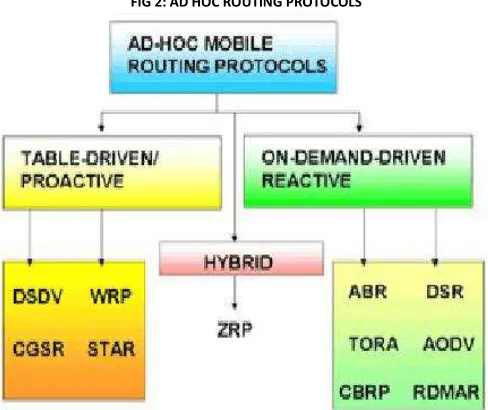
FIG 2: AD HOC ROUTING PROTOCOLS
1. TABLE DRIVEN ROUTING PROTOCOLS:- In the Table Driven Routing Protocol the information from each node to every node in the network which are main-tains up-to-date. When a node needs to forward a packet, the route will be readily available; thus there is no delay in searching for a route. However, for a highly dynamic topology, the proactive schemes will spend a significant amount of scarce wireless resource in maintaining the updated routing information correct. The areas where they differ from the other are the number of necessary routing-related tables and the methods by which changes in network structure are broadcast. The main disadvantage of table driven implementation algorithm is- They react slow on any restructuring and if there are failures. 2. ON DEMAND ROUTING PROTOCOLS:- A different approach from table-driven routing is source-initiated on-demand routing. This type of routing creates
routes only when desired by the source node. When a node requires a route to a destination, it initiates a route discovery process within the network. This process is completed once a route is found or all possible route permutations have been examined. Once a route has been established, it is maintained by some form of route maintenance procedure until either the destination becomes inaccessible along every path from the source or until the route is no longer desired.
3. HYBRID ROUTING PROTOCOLS:- In hybrid strategies, this protocol divide the network into zones (clusters) and run a proactive protocol within the zone and a reactive approach to perform routing between the different zones. This approach is better suited for large networks where clustering and partitioning of the network is very common.
ARCHITECTURE OF ROUTING
This refers the directing design must thoughtfully be on the level, that is, every address serves just as an identifier and does not pass on any data around one host to another that is topologically situated, concerning whatever other hub. The steering overhead increments quickly when the system gets to be bigger. The thought behind various leveled steering is to separate the hosts of a self-composed system into various covering or disjoint groups. One hub is chosen as bunch set out toward every group. This group head keeps up the enrollment data for the team. Hubs that are not group heads will, from this time forward, be alluded to as "customary hubs." When a standard hub needs to send a bundle, the hub can send the parcel to the bunch head that courses the bundle towards the goal.” Team head Gateway Switch Routing (CGSR) and Cluster-Based Routing Protocol (CBRP) have a place with this kind of directing plan. Various leveled directing includes bunch, address, and portability administration.”
SECURITY ISSUES
The security of any network is very important issue. In the security issues versatile remote systems are by large more inclined to security dangers than are altered link nets. The expanded probability of listening in, parodying, and dissent of administration assaults ought to be deliberately considered. Existing connection security strategies are frequently connected inside remote systems to lesson security dangers. Snooping is unapproved access to someone else's information. It is like listening in however is not really restricted to accessing information amid its transmission. Snooping can incorporate easygoing recognition of an email that shows up on another's PC screen or watching what another person is writing. More modern snooping utilizes programming projects to remotely screen action on a PC or system gadget. In system layer wormhole assault, a malevolent hub gets parcels at one area in the system and passages them to another area in the system, where these bundles are hate into the system. In Black gap assault, an assailant uses the directing convention to promote itself as having the most limited way to the hub whose parcels it needs to capture. An aggressor listens the solicitations for courses in a flooding based convention. At the point when the aggressor gets a demand for a course to the goal hub, it makes an answer comprising of a greatly short course.
SECURITY ATTACKS
Securing wireless ad hoc networks is a highly challenging issue. Understanding possible form of attacks is always the first step towards developing good security solutions. Ad hoc networks have to cope with the same kinds of vulnerabilities as their wired counterparts, as well as with new vulnerabilities specific to the adhoc contextSecuring and designing an efficient routing protocol for wireless ad-hoc network is one of the most challenging tasks. Due to dynamic nature and no infrastructure of MANET demands a new set of networking strategies to be processed in order to provide effective and protected overhead free end-to-end communication. Because of lack of predefined centralized administration for route discovery procedure, results in the decrease in the performance of network. There are several types of attack that affect the MANET and its security. These attacks can be divided into two types:
1) Passive attack 2) Active attack
Passive attack: In passive attack, an unauthorized node controls and goals to search out information about the network. Attackers do not damage data in the
network in place of it he examines traffic like recognizing communicating nodes, control data which is changed between them and steal important information. Passive attackers do not shatter the operation of routing protocols but try to discover the important information from routed traffic. Passive attack is used to achieve the information for future harmful effects. They do not examine to adjust or change the data packets. Some of the examples of passive attack include:
V
OLUMEN
O.
7
(2017),
I
SSUEN
O.
07
(J
ULY)
ISSN
2231-5756
INTERNATIONAL JOURNAL OF RESEARCH IN COMMERCE, IT & MANAGEMENT
Release of message contents
Active attack: Active attack can alter or change the state of the data in the network such as message modification, denial of services, message fabrications, congestion etc. it shatter the normal functionality of the network and launched by the nodes with authorization to process with in a network. Active attacks are divided into four groups i.e. dropping, modification, timing attacks and fabrication. Active can be of two types may be internal or external. An external active attack can be brought out by any outside source that do not belong to the network. An internal active attack is malicious nodes that are part of a network. They are hard to find out as compare to external attack. Some of the active attack includes:
Spoofing Modification Denial of service Masquerade Network Jamming Impersonating Message reply
There are numerous sort of shortcoming in any system. Powerlessness is a shortcoming that is inborn in a security framework or a system gadget, for example, switch, switch, desktop, server or security gadget itself. Any framework associated with the system might be helpless against unapproved information control as it doesn't confirm the client's character to get to the information. As MANET is a remote adhoc arrange it is substantially more inclined to assaults contrasted with a wired system. A portion of the vulnerabilities are talked about beneath.
CONCLUSION
Through this paper I got a conclusion that Ad hoc networking is at the center of the evolution towards the 4th generation wireless technology. Its intrinsic flexibility,
ease of maintain and also require lack of infrastructure, automated-configuration, self-administration and also its capabilities, and significant costs advantages make it a prime candidate for becoming the stalwart technology for personal pervasive communication. The opportunity and importance of ad hoc networks is being increasingly recognized by both the research and industry community.
REFERENCES
1. A Study on Issues and Challenges in Mobile Ad hoc Networks V. Jayalakshmi1, Dr. T. Abdul Razak2, DOI: 10.15680/IJIRCCE.2015. 0309003
2. Cross layer optimization for protocols in mobile adhoc networks dr. A. P. J. Abdul kalam technical university lucknow – 226021 (india)thesis jan 2016 3. Dr. Gurjeet Singh & Dr. Jatinder Singh “Security Issues in Broadband Wireless Networks” Global Journal of Researches in Engineering Electrical and Electronics
Engineering, Vol 12, Issue 5, 2012.
4. Mobile Ad Hoc Network Routing Protocols: a Detailed Performance Examination of AODV, DSR and DSDV Sanjeev Gangwar Department of Computer
Appli-cation, VBS Purvanchal University Jaunpur Krishan Kumar Department of Computer AppliAppli-cation, Gurukula Kangri Vishwavidyalaya, Haridwar, International
Journal of Computer Applications (0975 – 8887) Volume 49– No.9, July 2012
5. P. Sinha, R. Sivakumar, V. Bharghavan, CEDAR: a Core-Extraction Distributed Ad hoc Routing algorithm, IEEE INFOCOM’99
6. Survey on MANET: Routing Protocols, Advantages, Problems and Security Meenakshi Yadav1, Nisha Uparosiya2 1Department of Computer Science &