______________
GREGORY S.THIELEMANN is associate professor of political science and EUEL ELLIOTT is professor of political science at the University of Texas at Dallas.
The American Review of Politics, Vol. 26, Summer, 2005: 225-243 ©2005 The American Review of Politics
Texas: Same As It Ever Was?
Gregory S. Thielemann and Euel Elliott
The 2004 presidential election in Texas was among the least contested in the country. This is not surprising given the state’s recent electoral history and the fact that George W. Bush could probably be elected king for life in his home state. Initially, we will discuss the results from the 2004 elections in Texas, examining the 2004 primary elections, the fundraising, and the general election results. Because this single election year only tells part of the story of the changes in the Texas electorate, we will also offer an histor-ical analysis of the state’s partisan realignment as well as the reasons for this change and the extent to which this shift in the political landscape represents a long-term trend.
The 2004 Elections in Texas: General Context
In November of presidential election years, the state makes its choice for the presidency, U.S. House seats, and selected seats on the state’s multi-member Railroad Commission and higher judicial courts (the Texas Supreme Court and the Texas Court of Criminal Appeals).
The 2004 Primary Elections
In Texas, elections in presidential years take place on a number of dif-ferent fronts. Initially, voters take part in an open primary in March to select delegates to the national convention. Although the date of the Texas presi-dential primary has varied in the past, it has been held in March since 1988 as part of the “Super Tuesday” bloc of primaries.
In 2004, the Republican nomination was a foregone conclusion, with President George W. Bush running unopposed. Consequently, the Republi-can primary, held on Super Tuesday along with seven other states, passed almost without media notice, and, in general, the entire affair was quite low key. Bush won more than 92 percent of the Republican votes, with the un-committed slate claiming the remaining 7.5 percent. Bush won all 135 dele-gates selected in the primary, and three additional Bush votes were given to the party leaders.
The Democratic primary and the Republican primary in Texas were markedly different, though still lacking the high drama that the media and true political junkies might have desired. By March 9, John Kerry was very close to having the nomination wrapped up after victories in the Iowa pre-cinct caucuses, the New Hampshire primary, strong showings in South Caro-lina, and victories in Virginia, Tennessee and Wisconsin. Kerry’s enormous momentum resulted in a dramatic, rapid shift in the dynamics of the cam-paign as a certain sense of inevitability settled over the race.
We do not, by any stretch of the imagination, believe the results were in any way predestined. There is nothing to suggest that Kerry was the inevit-able victor in Texas. While there may be some lingering nostalgia for Presi-dent John F. Kennedy (like Kerry, from Massachusetts), it is surely fair to say that Kerry lacked the Kennedy magic. Still, however, Kerry was seen in Texas, and elsewhere, as electable by Democrats who were desperate to regain the White House after the controversial Bush win in 2000. He was seen as serious, solid, and well within the mainstream of the Democratic Party. He appeared to be moderate to slightly liberal within the context of the Democratic Party, and he had a record as a war hero (as this was long before the Swift Boat Veterans controversy erupted). Most importantly, he was not Howard Dean, viewed by many as unelectable, or Wesley Clark, viewed by many Democrats as a “Johnny-come-lately” to the party. John Edwards, while likeable, had not developed traction and was never taken very seriously in Texas.
of the 195 delegates available. Edwards finished second, garnering only 14 percent of the vote and winning the remaining nine delegates. In the pri-mary, Kerry received 563,237 votes, which was close to Bush’s 635,948 votes in the Republican primary. This is not necessarily a trivial observation: George Bush, running completely unopposed for his party’s nomination (there was not even a symbolic opponent in the race), nonetheless attracted more votes than the landslide victor in the Democratic primary and nearly as many votes as were cast for all Democrats.
Kerry’s victory was welcomed by many Democrats in Texas because he was seen as the candidate who had a legitimate chance of defeating an incumbent about whom substantial doubts were being raised. As the Iraq war grew increasingly chaotic and the economy struggled to regain momen-tum, Kerry almost seemed like a winner. Of course, one should not think that even the most hardened of the Democratic delegates thought that Kerry was going to beat Bush in Texas. But it surely was not beyond the realm of possibility, many partisan Democrats concluded, that a mainstream Demo-crat could at least run a respectable race in Texas and perhaps minimize any damage to Democrats running for other crucial offices in the state.
The Nomination and the Money
Even though the Texas outcome was not in doubt, Texas Democrats could join Texas Republicans in gaining influence the old-fashioned way, by contributing large sums of money to the campaigns. Even though the pri-maries lacked drama, quieter and more discreet political efforts were under-way in both parties and both campaigns. The state of Texas was campaign finance central for George W. Bush, and it played a role for John Kerry as well.
Texas was critical to the President since long before the 2004 political season his campaign had made the strategic decision to forego public finan-cing in the primaries. This left the Bush campaign free to raise unlimited amounts of money that could be used in the pre-convention period to boost the general election effort through media ads and the development of a massive organization that would ultimately pay off quite handsomely on November 2. The Bush campaign fundraising effort generated $293 million in the course of the campaign, an enormous amount by any standard and one that easily exceeded Bill Clinton’s 1996 effort. More important, however, $23 million was raised in Texas, his best state (followed by California and Florida respectively) (Center for Responsive Politics 2005).
The General Election
In the vernacular of the new century, Texas is really red. The fact that the outcome of the Texas vote was clear to everyone months before the ballots were even cast is an interesting fact in and of itself. The polls never showed the race to be competitive: in May of 2004, the Texas Poll showed Bush up 29 points, and, similarly, a Survey USA poll taken the final week of October put Bush up by 22 points. Exit polls showed that 76 percent of Texas voters had made their decisions by September. On election day, Bush won 61 percent of the vote, polling over 4.5 million votes. Kerry was only able to win 38.3 percent of the vote with a little over 2.8 million votes. The final margin of victory was a fraction less than 23 percentage points, not far off what polls had shown from as early as May. Kerry’s performance was only three-tenths of a percentage point better than Al Gore’s in 2000. The transformation of Texas politics was complete.
The National Election Pool exit poll for Texas revealed that Bush won virtually every demographic category. He won 60 percent of men and 63 percent of women. Indeed, to the extent there was a gender gap, it was re-versed from the expected direction! He won every age bracket and every income bracket over $30,000. He won 67 percent of the Protestant vote and 51 percent of the Catholic vote. Bush won 74 percent of the white vote and 49 percent of the Latino vote, which more than offset the fact that he won only 17 percent of the African-American vote. It is important to note that other studies find the Bush Hispanic percentage in the National Election Pool poll to be inflated and place the percentage for Bush in the high 30s or low 40s (Leal et al. 2005).
The Hispanic vote illustrates the efforts the Bush campaign and the GOP organization had devoted to a massive effort to attract Hispanics. Viewing Hispanics as sympathetic to the cultural conservatism of the Republican Party, the GOP has been making enormous efforts to chip away at the Hispanic “bloc,” with more than a little success. The Bush success in Texas vis-à-vis Hispanics also needs to be put in national context, as (according to the NEP polls) he carried 44 percent of the Hispanic vote nationwide, up from 39 percent in 2000.
The 2004 elections served to confirm the end of significant Democratic Party influence in the state. Having lost control of the legislature after the 2001 redistricting, Texas Democrats currently hold no statewide elected offices, and are a clear minority party in the state Senate and the state House of Representatives. Where the Democrats ran candidates for statewide seats in 2004, they were trounced by significant margins. Their candidate for the Texas Railroad Commission1 lost by 15 percentage points, and, in the six statewide judicial races, the Democrats only fielded two candidates, with the most successful losing by 15 percentage points. Taking advantage of a partisan redistricting accomplished rather famously during the 2003 legisla-tive sessions, the GOP took control of the state’s congressional delegation, winning a majority (21 of 32 seats) for the first time since Reconstruction. Republican persistence in their previously stymied efforts to redistrict political jurisdictions proved to be justified, as the new boundaries set the stage for GOP control for probably at least a decade.
Public opinion polls offered little hope for the Democrats. NEP exit polling found that 42 percent of the voters identified themselves as Repub-licans while only 33 percent identified themselves as Democrats. Although 25 percent of the respondents identified themselves as independents, 66 per-cent of them voted for Bush (2004 National Election Pool poll).
How Did We Get Here?2
Presidential Voting in Texas
All Southern states have undergone significant political change since the 1960s. Race is usually cited as the dominant factor, but the evidence finds that this is more prevalent in the Deep South rather than in Rim South states such as Texas (Black and Black 1987). In the Rim South states, the shift has been more gradual, and the issues have often varied from those in the Deep South. For example, Lyndon Baines Johnson, who shepherded the Civil Rights Act and the Voting Rights Act through Congress, was a Texas Democrat who enjoyed widespread public support among his fellow Texans. Texas Democrats, even when they were the one party in a one-party state, always had a fierce independent streak. The party had no problem opposing a Democratic presidential nominee when he was seen as out of step with Texas values. The Texas Regulars were famous for this in the 1920s, and Democratic Governor Alan Shivers followed suit with his endorsements of Eisenhower in the 1950s.
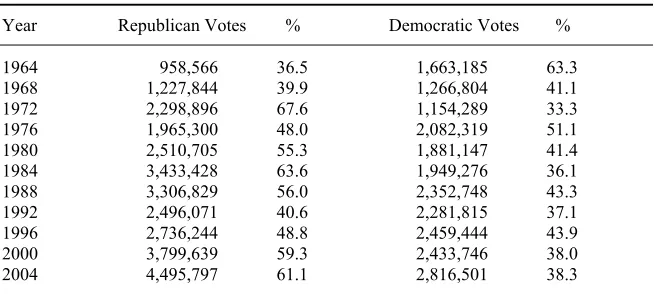
only twice, first in 1968 when Hubert Humphrey (LBJ’s Vice President) narrowly beat Richard Nixon (with George Wallace pulling in over 500,000 votes as a third party candidate), and then again in 1976 when Jimmy Carter fairly narrowly defeated President Gerald Ford (51 percent to 48 percent). President Clinton made the Presidential voting close in 1992 and 1996, but the Ross Perot factor should not be discounted as his third-party candidacy polled 22 percent of the Texas vote in 1992 and nearly 7 percent in 1996. A two-candidate race in 1992 with Perot not on the ballot would probably have resulted in a larger victory for George H.W. Bush (Table 1).
As the data in the table indicate, the GOP is fairly dominant in Texas presidential voting and has been for some time. Most striking is the fact that the GOP has shown a propensity to break the three million-voter mark with ease. Since 1984, only the Perot candidacy has kept the Republican vote total under three million, and, by 2004, George W. Bush polled over 4.5 million votes. In stark contrast, the Democrats have never broken the 3 million-vote barrier in spite of dramatic increases in the state’s population.
Non-Presidential Elections, 1960-1980
To focus solely on the presidential vote represents an incomplete analy-sis in searching for explanations for the Republican Party’s rise to virtual dominance in Texas. To be sure, it is clear that the Republican presidential voting trend reflected the perception of many voters that the Democratic
Table 1. Republican and Democratic Presidential Votes in Texas 1964-2004*
Year Republican Votes % Democratic Votes %
1964 958,566 36.5 1,663,185 63.3
1968 1,227,844 39.9 1,266,804 41.1
1972 2,298,896 67.6 1,154,289 33.3
1976 1,965,300 48.0 2,082,319 51.1
1980 2,510,705 55.3 1,881,147 41.4
1984 3,433,428 63.6 1,949,276 36.1
1988 3,306,829 56.0 2,352,748 43.3
1992 2,496,071 40.6 2,281,815 37.1
1996 2,736,244 48.8 2,459,444 43.9
2000 3,799,639 59.3 2,433,746 38.0
2004 4,495,797 61.1 2,816,501 38.3
*Percentages are rounded off to one decimal place.
candidates were too liberal and out of touch with Texas and its southern sisters, but that was only the beginning.
The recent electoral history of Texas in statewide races makes clear that Republican domination has been more recent than its success in presidential contests and thus even more dramatic. The Texas Democratic Party, like most political parties in one-party states, was typically fragmented during the one-party years. Liberals had achieved some success in electing populist Ralph W. Yarborough in the late 1950s, but the Democratic Party was still dominated by its conservative wing. Prior to 1961, Republicans offered only token opposition on the November ballot, which had the effect of making the primary contest between the liberal and conservative wings of the Demo-cratic Party the real election in statewide contests.
Liberal Democrats apparently failed to realize that incumbents have advantages, and Tower held this seat through three more elections. His mar-gins were never large as he polled 56.4 percent in 1966, 53.4 percent in 1972, and narrowly won reelection in 1978 by defeating U.S. Representative Robert Krueger with just under 50 percent of the vote. While he chose not to run for another term in 1984, Tower’s four victories established and pre-served an important beachhead for Texas Republicans (see Black and Black 2002, 88-91).
Tower was the lone success story for the GOP in Texas on the state-wide ballot until 1978. It was in 1978 that the Democratic Party again im-ploded in factionalism, resulting in the election of another Republican, William P. Clements, as governor. Clements’ election had little to do with his campaign or platform; instead, he was able to take advantage of a badly divided Democratic party in defeating Attorney General John Hill. Hill was a moderate-to-progressive Democrat who had succeeded in defeating the conservative incumbent Governor Dolph Briscoe in a hard fought, tight pri-mary. The defeat wounded Briscoe, and he later endorsed Clements in set-ting the stage for Hill’s defeat in November. Clements received 49.96 per-cent of the vote to Hill’s 49.24 perper-cent, defeating Hill by 16,909 votes in an election with nearly 2.4 million voters. Unlike in 1961, it was the conserva-tive wing of the Democratic Party that doomed the Democratic nominee in 1978 as Clements felt more ideologically akin to the conservative Briscoe than Hill. While Tower’s Senate victories had cracked the door slightly, the events surrounding the 1978 election opened the door widely for Republi-cans in Texas politics. For the first time conservative Democrats considered the GOP as something more than a mere protest vote. Reflecting this changed perception, in 1978 the Texas GOP not only fielded candidates for the U.S. Senate and Governor but also for Lieutenant Governor, Attorney General, and one of the two Railroad Commissioner seats.
The 1970s also saw the Republicans make some modest gains in elec-tions for the U.S. House of Representatives and the state legislature. Build-ing on extremely small foundations prior to the start of the decade (always less than ten percent and often zero), Republicans held 16.7 percent of con-gressional seats, 15.3 percent of state house seats, and 16.1 percent of state senate seats after the 1978 elections (see Feigert, Miller, Cunningham, and Burlage 2003, 185).
Non-Presidential Elections, 1980-1990
in the 1980s, but they also had more electoral success, including some of the statewide down-ballot races.
Although Attorney General Mark White would defeat Clements in 1982 (53.2 percent to 45.9 percent), Clements was able to regain the gover-norship in 1986 in defeating White in a rematch (53 percent to 46 percent). In 1984, Republican Phil Gramm, a recent convert to the GOP and former Democratic Congressmen, polled 58.6 percent of the vote in winning Tower’s open seat against State Senator Lloyd Doggett. He would win re-election in 1990 by an even larger margin, gaining 60.2 percent of the vote. As for the other U.S. Senate seat, Democrat Lloyd Bentsen, a moderate to moderately-conservative figure, retained Democratic control by winning 58.6 percent of the vote in 1982 and 59.2 percent in 1988. Republicans also made steady gains in congressional elections and state legislative elections. By the end of the decade Republicans held almost a third (29.6 percent) of the state’s congressional seats, just under two-fifths (38 percent) of the seats in the state house, and just over one-fourth (25.8 percent) of the seats in the state senate.
The GOP also made progress in down-ballot statewide elections, mainly by working to improve the party’s presence on those ballots. Unfor-tunately for Republican fortunes, the progress was uneven until 1988. The party did reasonably well in those elections in which it ran candidates and thereby made voting for the GOP in these other statewide races possible. For example, in 1980 the Republicans fielded a candidate for each of the four down-ballot statewide elections. Although they lost all four races, they lost three of these by less than ten percentage points. Similarly, in 1984 the GOP fielded candidates in three of seven down-ticket races; again they lost all three elections, but by margins of less than ten percent (and less than three percentage points decided two of these races).
The 1988 election signaled a significant shift in the fortunes of the Texas GOP. It was during this election that the party finally won additional statewide elections. In winning a seat on the Railroad Commission and three seats on the Texas Supreme Court, the Republicans had finally broken through in down-ballot statewide elections. The GOP even won two of these races by more than ten percentage points. Of course, they lost six races that same year (four by more than ten percent) and left one uncontested, but a corner had been turned. As elsewhere in the South, the Reagan presidency had legitimized the Republican Party for white southerners (Black and Black 2002).
Non-Presidential Elections, 1990-2004
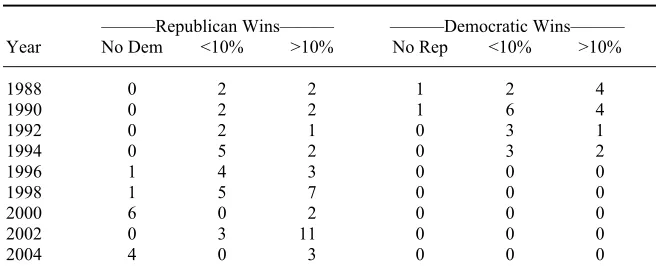
It was during the 1990s that the GOP established a stranglehold on the state. The early part of the decade was characterized by real two-party com-petition but by 1996, that comcom-petition was beginning to fade (Table 2).
In 1990, the coming decline of the Democrats as a competitive party was not yet visible. Ann Richards won back the governor’s mansion for the Democrats in a close election which she won by fewer than 100,000 votes (although it is important to keep in mind that Republican Clayton Williams was leading in polls prior to the election and, barring last minute campaign
Table 2. Republican Success in Down-Ballot Statewide Elections, 1988-2004*
———Republican Wins——— ———Democratic Wins———
Year No Dem <10% >10% No Rep <10% >10%
1988 0 2 2 1 2 4 1990 0 2 2 1 6 4 1992 0 2 1 0 3 1 1994 0 5 2 0 3 2 1996 1 4 3 0 0 0 1998 1 5 7 0 0 0 2000 6 0 2 0 0 0
2002 0 3 11 0 0 0
2004 4 0 3 0 0 0
*These elections are all statewide elections but excluding elections for the U.S. Senate and Texas Governor. These elections include those for Lieutenant Governor, Attorney General, Comptroller, State Treasurer, Land Commissioner, Agriculture Commissioner, Railroad Commissioner, Texas Supreme Court Justice, and Judge on the Court of Criminal Appeals.
gaffes, could have, and probably would have, won). At the same time Williams was shooting himself in the foot (and losing), Phil Gramm was winning reelection to the U.S. Senate with more than 60 percent of the vote. With the top two races split between the parties, the GOP was able to win additional down-ballot statewide elections as they won two Supreme Court seats by more than ten percentage points and the Agriculture Commissioner and State Treasurer elections by narrow margins. The Democrats remained in control of the down-ballot races by winning the remaining eleven con-tests, six by more than ten percentage points. One race was left uncontested by the GOP. In 1992 the GOP held its ground during a year the Democrats regained control of the White House by winning three of the seven down-ballot statewide elections held that year.
In 1993 President Clinton nominated Lloyd Bentsen to the post of Treasury Secretary, which forced a special election for his U.S. Senate seat. After much deliberation, Governor Richards appointed Robert Krueger to the seat until a special election could be called. In that election, Krueger placed second with 28.99 percent of the vote. He trailed State Treasurer Kay Bailey Hutchison by a miniscule 99 votes. When the run-off was held in June, the election was not even close, as Hutchison beat Krueger by more than 500,000 votes in winning over 67 percent to Krueger’s 32 percent. When she sought re-election to a full term less than a year later, she won nearly 61 percent of the vote in defeating her hapless opponent, Richard Fisher.
George W. Bush receives a great deal of credit for the success of the Texas GOP in the 1990s. Beginning with his defeat of Ann Richards in the 1994 gubernatorial contest, he put the Republican Party on track for elec-toral success. He defeated Richards by 53.5 to 45.9 percent, a much smaller margin than Senator Hutchison won her race by, but he still proved helpful in the down-ballot races. Of course, Bush was running against an incumbent governor who was reasonably well liked and respected which made his vic-tory all the more impressive. In 1994, the GOP won seven of the 13 addi-tional statewide races.
Not surprisingly, during the 1990s Republicans improved their position in the Texas congressional delegation and in the state legislature as well. Their percentage of U.S. House seats increased from 29.6 in 1990 to 43.3 after the 1998 elections. Similarly, they increased their percentage of seats in the state house from 37.3 to 48.0 percent over the same period. Most dramat-ically, the party’s proportion of state senate seats rose from 25.8 percent to a majority of 51.6 percent.
In a complete role reversal, it is now the Democrats who struggle in down-ticket statewide races. After conceding one race in both 1996 and 1998 without a challenger, the Democrats left six of the eight down-ballot races in 2000 uncontested. Perhaps fearing the Bush juggernaut from his 2000 presidential run, they simply abandoned the races to the GOP. In 2002, the Democrats fielded a full slate of candidates for the 14 statewide down-ballot elections but won not a single victory. In fact, the Republicans won 11 of these elections with margins greater than ten percent. In 2004 the Demo-crats left four of the seven statewide down-ballot contests without candidate. The Texas Republican Party has succeeded in transforming itself from perennial loser, to occasional spoiler, and now to dominant. Texas Republi-cans now control the congressional delegation (21 to 11) and each chamber of the state legislature, and they are completely dominant in all statewide elections. Texas has become one of the reddest of the red states and is a critical battleground in the ongoing Republican realignment in the South.
Republican dominance of the U.S. Senate elections continued as well. In 2000 Senator Hutchison easily won reelection, defeating her Democratic opponent with over 65 percent of the votes. Phil Gramm’s retirement from the Senate in 2002 simply allowed the seat to be transferred to another Republican when, in the November election, Attorney General John Cornyn defeated former Dallas Mayor Ron Kirk by about 12 percentage points. This was actually a fairly good showing by Democrats but it shows how far that party had fallen. The Kirk loss was an especially bitter pill to swallow, since Kirk had been viewed by the party establishment as being perhaps the most electable of Democrats and a real rising star in the Democratic Party.
Basically, Texas is a poster child for the Republican argument that a major political realignment in the South is underway, if not achieved. The transformation from hard-core “yellow dog” Democratic Party dominance to Republican supremacy has been thorough and complete.
Realignment Explanations
full slate of candidates, the changing demographics of the state, and the success of George W. Bush.
Transformation cannot take place without candidates and the state GOP finally figured this out in the decade of the 1990s. The Texas Republican Party moved past being a repository for protest votes by developing a party that contested elections at every level. Every spot on the ballot was filled. Once voters had a reason to vote Republican down ballot, they began to think of themselves as full-time Republicans. In addition, before the 1990s, the primaries in the Democratic Party were often competitive, while the Republicans rarely offered meaningful competition. This disadvantage was worse the further down the ballot a voter moved.
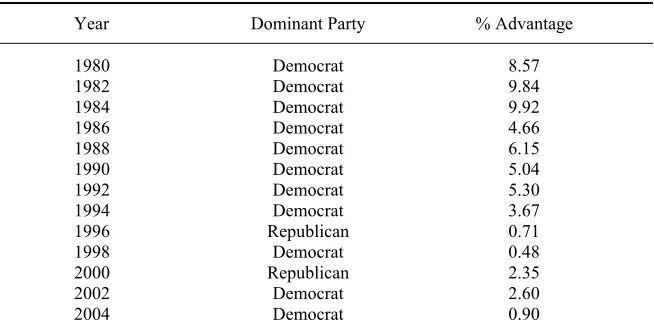
It was only after Clements was reelected governor in 1986 that the GOP began to make a serious commitment to fielding more candidates. The Republicans began to field a full slate of candidates for down-ballot races in 1988. After leaving one seat uncontested to the Democrats in 1988 and 1990, the Republicans have not left a general election slot in a statewide election empty since. In contrast, the Democrats are now likely to leave the general election ballot uncontested. This fact was one of the most dramatic findings in Table 2. Realignment cannot take place unless the voters shift their allegiances to a new party. Public opinion polls can demonstrate shifts in reported loyalty, but the real question is where they vote. The best mea-sure of partisanship is whether or not a voter is willing to vote in the party primary. Democrats in Texas had a huge advantage here and this served to keep them dominant for most of the last century. Table 3 examines varia-tions the percentage of the voting age population who voted in each primary, and it also explains the slow nature of Texas’ realignment. As long as a significantly greater number of Texans felt the Democratic Party was their home, the GOP was unable to make progress. Once the Republicans pulled ahead in 1996 and kept their primary turnout close to the Democrats after that year, the GOP went on to dominate the general elections. Between 1994 and 1996 the shift was more than four full percentages points. Not coinci-dentally, the Republicans have not lost a statewide election since 1994.
Table 3. Variations in Primary Turnout as a Percentage of Voting Age Population
Year Dominant Party % Advantage
1980 Democrat 8.57
1982 Democrat 9.84
1984 Democrat 9.92
1986 Democrat 4.66
1988 Democrat 6.15
1990 Democrat 5.04
1992 Democrat 5.30
1994 Democrat 3.67
1996 Republican 0.71
1998 Democrat 0.48
2000 Republican 2.35
2002 Democrat 2.60
2004 Democrat 0.90
Source: Texas Secretary of State, Election Returns, 1980-2004.
homes in Dallas-Ft. Worth, Austin, San Antonio, Houston and elsewhere. These suburban areas began to develop their own brand of politics as they increasingly identified with the conservative ideology of the Republican Party.
By 2000, 80 percent of Texans lived in metropolitan areas, with fast growing suburbs providing solid support for the Republican movement (Brown, et al. 2001, 15). As the Texas population has grown, so too has the Republican Party. This is particularly striking, even contradictory, since the fastest growing segment of the state’s population, Hispanics (mostly Mexi-can AmeriMexi-can), normally tend to favor the Democrats. Indeed, in 2004 census estimates, Hispanics make up 34.5 percent of the population with the Anglo population shrinking (U.S. Bureau of the Census 2004). However, George W. Bush’s success with Hispanics, noted above, helps to explain this seeming disparity.
emerged as more likeable than the affable Richards who entered the cam-paign with positive job evaluations. According to the Voter News Service Exit Poll, roughly twice as many voters blamed Richards for the unfair attacks during the campaign than blamed Bush, although the largest bloc of voters blamed both candidates. Bush won the election in spite of the fact that the exit poll showed that education was the issue cited most often as the reason for the vote (Voter News Survey 1994).
Bush’s tenure in the state House was successful by Texas standards. Because the governor has few powers, success depends on the ability to work well with legislative leaders and build an aura of good will. Bush did these things very well as he reached out to the Democratic Speaker and Lieutenant Governor to produce legislative results on shared agenda items. He did not push legislation that he could not win, and as a result he devel-oped the persona of a great compromiser and leader. His success was so great that most Democrats felt that running a candidate against him in 1998 was a lost cause. In the end, they ran a token candidate in Land Commis-sioner Gary Mauro who was beaten soundly. Bush demonstrated that he could win Democrats over to the Republican column and achieve legislative success by working across party lines. In 2000 he took this show on the road with the same results, but in Texas the home folks were already true believ-ers. Bush made it possible for Texans to vote Republican with pride, and every other Republican candidate in the state benefited from this.
We have identified three major components of the Republican realign-ment: the ability of the GOP to field a full state of candidates, changing demographics and the presence of George W. Bush and his “strategy.” All of this needs to be understood in the context of the evolving issues basis of the two-party system in Texas and the nation as a whole, where the cultural, economic and foreign policy/defense conservatism of the GOP has resonated with most of the Texas electorate, and where survey after survey has shown Texans to be more in step with the party’s agenda than the nation as a whole. This is not a brand new phenomenon of course. It is a process that began in the 1950s, accelerated under Reagan,3 and has come to fruition in the early Twenty-First Century.
Future Prospects
Americans and Hispanics. Currently, even with the state’s population being just under 50 percent Anglo,4 this domination is likely to continue. State reapportionment in 2002 was followed by congressional reapportionment in 2004, and the result of these decisions has been to make the Anglo Demo-cratic politician a vanishing breed. In the 1990s, most DemoDemo-cratic officials were Anglo, and this had the effect of splitting the white vote in the state. One of the consequences of this latest reapportionment has been to insure that the face of the Texas Democratic Party is non-white, and this is unlikely to change in the near future.
Democrats believe that their day will come when the fastest growing segment of the population, Hispanics, gain more prominence. In truth, this population will be a force in Texas in the relatively near future. Although it currently makes up more than a third of the population, it is very young with significant numbers of this population currently below voting age.
Of course, one should not assume that the Republicans are simply con-ceding this population to the Democrats. Although the vast majority of His-panic Texas legislators are Democrats, Bush during his gubernatorial terms made it a priority to appoint Hispanic Republicans to high profile vacancies (a practice continued by current Governor Perry). Both have even cam-paigned on behalf of Hispanic candidates during Republican primary elec-tions. Moreover, as noted earlier, George Bush was notably successful among Hispanics both in his gubernatorial campaigns and in 2004.
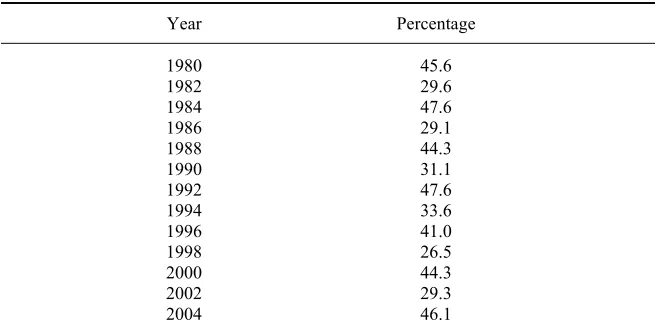
The most realistic chance for change in Texas is found in the fact that significant numbers of Texans do not vote. Similar to other southerners, Texans have not shown much interest in the electoral process. Table 4 exam-ines turnout in Texas as a percentage of the state’s voting age population. As the table indicates, although there are plenty of non-participants to swing elections, getting these voters to the polls is no small task. Like in other states, the assumption has always been that high turnout will favor the Democrats. This assumes that these non-voters are in fact likely Democratic voters.
Table 4. Turnout in Texas Elections as a Percentage of Voting Age Population
Year Percentage
1980 45.6
1982 29.6
1984 47.6
1986 29.1
1988 44.3
1990 31.1
1992 47.6
1994 33.6
1996 41.0
1998 26.5
2000 44.3
2002 29.3
2004 46.1
Source: Texas Secretary of State, Election Returns, 1980-2004.
Certainly Bush’s retirement from public life will help Texas Demo-crats, but the real test will be whether or not they can overcome his legacy. The Bush campaign has left a stable full of potentially viable Republican candidates to fill every need in Texas for decades to come. In stark contrast, from the vantage point of 2005 it is difficult to name even one Texas Demo-crat with the stature to win a statewide election, and this is the reason the Republican realignment is likely to guarantee the Lone State remains “Big Red,” the largest of the red states.
NOTES
1The Texas Railroad Commission has historically been one of the most important
regulatory bodies in the nation and is, thus, extremely important in Texas politics. Origi-nally established to oversee railroads, its authority was modified over the years to include regulation of the oil and natural gas industries in Texas. In this capacity, it has long strongly influenced the supply and price of these resources nationwide. Even though its involvement has declined over the past two decades, it remains an influential actor in
national energy policy. For further discussion, see The Handbook of Texas Online,
www.tsha.utexas.edu/handbook/online/articles/RR/mdr1.html.
2As with other southern states, the starting point for discussing Texas electoral and
partisan politics in the post-World War II period is V.O. Key’s classic work, Southern
(1986), Ippolito (1991), Feigert and Todd (1994), Feigert and McWilliams (1995), Feigert and Todd (1997), Feigert and Todd (2002), and Feigert, Miller, Cunningham, and Burlage (2003).
3Earl and Merle Black (2002) make a strong case that Reagan’s presidency
con-tributed significantly to the legitimation for white southerners of the Republican Party as the party most closely aligned with their basic conservative values. For Texans, Bush served to further this perception at the state level in the 1990s.
4According to July 1, 2004, population estimates by the U.S. Bureau of the Census,
Texas now has a minority population of 11.3 million, 50.2 percent of the total population of nearly 22.5 million. Texas thus joins three other states (Hawaii, New Mexico, and California) as majority-minority states (together with the District of Columbia). In Texas, 34.5 percent of the minority population is Hispanic and 12.1 percent black/African American with the remainder scattered among Native Americans, Asian-Americans, and others (U.S. Bureau of the Census 2004).
REFERENCES
Black, Earl, and Merle Black. 1987. Politics and Society in the South. Cambridge, MA:
Harvard University Press.
Black, Earl, and Merle Black. 2002. The Rise of Southern Republicans. Cambridge, MA:
Harvard University Press.
Brown, Lyle, Robert Trotter, Joyce Langenegger, and Sonia Garcia. 2001. Practicing
Texas Politics. Boston: Houghton Mifflin Company.
Feigert, Frank B., and Nancy L. McWilliams. 1995. Texas: Yeller Dogs and Yuppies. In
Southern State Party Organizations and Activists, eds. Charles D. Hadley and Lewis Bowman. Westport, CT: Praeger.
Feigert, Frank B., Dawn Miller, Kenda Cunningham, and Rachel Burlage. 2003. Texas:
Incipient Polarization? The American Review of Politics 24:183-196.
Feigert, Frank B., and John R. Todd. 1994. Texas: Friends, Neighbors, and Native Sons. In The 1992 Presidential Election in the South: Current Patterns of Southern Party and Electoral Politics, eds. Robert P. Steed, Laurence W. Moreland, and Tod A. Baker. Westport, CT: Praeger.
Feigert, Frank B., and John R. Todd. Texas: Suppose They Gave an Election and Nobody
Came. In The 1996 Presidential Election in the South: Southern Party Systems in
the 1990s, eds. Laurence W. Moreland and Robert P. Steed. Westport, CT: Praeger.
Feigert, Frank B., and John R. Todd. 2002. Texas: Ignored for Once. In The 2000
Presi-dential Election in the South: Partisanship and Southern Party Systems in the 21st Century, eds. Robert P. Steed and Laurence W. Moreland. Westport, CT: Praeger.
Ippolito, Dennis S. 1986. Texas. In The 1984 Presidential Election in the South: Patterns
of Southern Party Politics, eds. Robert P. Steed, Laurence W. Moreland, and Tod A. Baker. New York: Praeger.
Ippolito, Dennis S. 1991. Texas: Toward an Ideological Politics. In The 1988 Presidential
Election in the South: Continuity Amidst Change in Southern Party Politics, eds. Laurence W. Moreland, Robert P. Steed, and Tod A. Baker. New York: Praeger.
Key, V.O., Jr. 1949. Southern Politics in State and Nation. Alfred A. Knopf.
Leal, David L., Matt A. Barreto, Jongho Lee, and Rodolfo O. de la Garza. 2005. The
National Election Pool 2004 Texas Exit Polls. (Accessed at CNN at http://www.cnn.com/ ELECTION/2004/pages/results/states/TX/P/00/epolls.0.html).
Secretary of State of Texas, 1964-2004. Official Election Returns. Austin, TX.
The Handbook of Texas Online. (Accessed at www.tsha.utexas.edu/handbook/online/ articles/RR/mdr1.html).
U.S. Bureau of the Census. 2001. Texas Quick Facts. (Accessed at http://quickfacts. census.gov/qfd/states/48000.html).
U.S. Bureau of the Census. 2004. Texas Becomes Nation’s Newest “Majority-Minority” State, Census Bureau Announces. Press release (accessed at http://www.census. gov/Press-Release/www/releases/archives/population/005514.html).
The Texas Poll. May 15, 2004. (Accessed at http://www.realclearpolitics.com/Presiden-tial_04/tx_polls.html).
Survey USA Poll. October 28, 2004. (Accessed at http://www.realclearpolitics.com/ Presidential_04/tx_polls.html).