87
ISSN 1392-2785 ENGINEERING ECONOMICS. 2007. No 4 (54) COMMERCE OF ENGINEERING DECISIONS
Logistics Centre Concept through Evolution and Definition
Kristina Rimienė
1, Dainora Grundey
21 Kauno technologijos universitetas
K. Donelaičio g. 73, LT-44209, Kaunas
2 VU Kauno humanitarinis fakultetas
Muitinės g. 8, LT-44280, Kaunas
Along with worldwide production and trade global-ization, the importance of logistics centres is growing in the supply chain management efficiency aspect.
The paper reviews existing terminology of facilities for logistics operations. Most commonly logistics centre concept is consolidated with understanding of distribu-tion centre, central warehouse, freight/transport termi-nal, transport node, logistics platform, freight village, logistics depot, distripark etc.
An attempt to rectify the hierarchy of logistics facili-ties and formulate the definition of logistics centre was made in the article. The structure of logistics facilities hierarchy was proposed by the authors. Efforts were put to compare the concepts and understandings worked out by different world and Lithuanian authors and point out the development and evolution of logistics centres.
Logistics centre concept appeared 30 years ago. During this period either practical or nonfiction under-standing of Logistics centre functional and conceptual significance has changed. Logistics centres can be classi-fied into three different categories or generations on evo-lution basis. It is based on the scope and extension of logistics activities. Historically, typical logistics func-tions were shipping, receiving, storage, order picking, break-bulk, freight consolidation and containerization. Today, thanks to technology, many distribution opera-tions are computerized, automated, and equipped with state-of-the-art material handling equipment and infor-mation systems. Nowadays many distribution operations have added a number of value-added services, including total logistics management, inventory control and track-ing, packagtrack-ing, labeling and bar codtrack-ing, procurement and vendor management, and customer service functions, such as returns, repair, rework and assortment promo-tional assembly.
Due to the process of evolution as well as types and functionality of centres recently developed in the market there is no embracing concept and definition for logistics centre term determination. Lots of scientists (Pegrum, 1963; Bowersox, Smykay, LaLonde, 1968; Reynaud, Gouvernal, 1987; Cavinato, 1989; Holtgen, 1996; John-son, Wood, 1996; Wiegmans, Masurel, Nijkamp, 1998; Breitzmann, Wenske, 1999; Ballis, Golias, 2002; Židonis, 2002; Waters, 2003; Kondratowicz, 2003; Kia, Shayan, Ghotb, 2003; Ballou, 2004; Urbonas, 2004; Meidutė, Vasiliauskas, 2005; Rushton, Croucher, Baker, 2006; Lu, Yang, 2006; etc) examined the theory of logistics and
supply chain management, coping with logistics centre determination and functionality analysis, among all. Sur-vey findings showed that not only terms, but the concepts differ as well. Logistics researchers have made little ef-fort to build a unified logistics centre conception.
The definition of logistics centre was proposed by the paper author coming to the conclusion that evaluating presence and scope of the factors in Logistics centre definition, Logistics centre can be considered as Freight village, Transport node or Distribution centre as well. Keywords: logistics centre concept, definition, evolution,
freight village, logistics node, distribution centre.
Introduction
Worldwide globalization of industry and trade made a significant impact on practice and theory of logistics and supply chain management. Trade barriers have been decreased, but the logistics services requirements as well as cost constantly raises, so various businesses, especially international companies, change the attitude to material storage, production and product distribution. They are searching for industrial and logistics centres where re-packing, labeling, bar-coding, light assembly and other value-added services to merchandise in transit can be provided (United Nations, 2002).
The majority of European Countries have geographi-cal potential to establish and develop competitive logis-tics centres of European transport network. The construc-tion cost of logistics facilities such as warehouses or ter-minals are relatively low in East European regions. Lithuania tends to become and already is one of connect-ing parts between Eastern and Western Europe in context of international trade and logistics. The demand for com-petitive logistics centres is growing accordingly. The heritage of theory development and empirical research on unified concept of logistics centre is quite poor in com-parison to other disciplines. It might be influenced by a rather short history of supply chain management theory. So understanding what logistics centre definition encom-passes is essential in response to scientific, commercial and governmental attitude of any country.
88 definition of logistics centre, characterizing most com-mon understanding of a concept.
The object of the survey is logistics centre concept. Methodsof the survey include nonfiction and special literature comparative analysis and synthesis, the gener-alization of the research results.
Logistics centres evolution
Logistics Centre is not a new concept – it appeared 30 years ago. Logistics has changed over the past four-five decades. During this time there have been a number of significant changes in the way things are produced, stored and moved, which is what logistics is all about. Accordingly either practical or nonfiction understanding of Logistics centre functional and conceptual significance changed. Hence there was no commonly agreed definition of this concept established.
Lots of characteristics (names) are used to describe centre for logistics functions performance – logistics cen-tre, distribution centre, central warehouse, freight/transport terminal, transport node, logistics plat-form, freight village, logistics depot, distripark etc.
Variation in the definition of the term are partly an outcome of the evolution process and new types of cen-tres that have been developed in recent years (Kondra-towicz, 2003).Best way to understand what is what is to look back through years of evolution, while logistics cen-tres meaning and understanding have been shaped.
During the late 1950’s physical distribution manage-ment began to materialize as an important business activ-ity (Lynagh, 1971). ‘Marketing concept’ along with mar-ket segmentation, cost-profit squeeze, electronic data processing was the facts, which implemented the system approach and put the ground for physical distribution management. Twenty-five years have seen this concept of combining all the functions of distribution together into a system mature and into a major field of business study. The years since 1965 have been characterized by a re-finement in basic concepts (Bowersox, 1969). In 1960’s logistics was a synonym for physical distribution. In 1985 Jones and Riley introduced the term Supply Chain Man-agement as a tool to manage inventory for gaining com-petitive advantage. Eventually inventory management services became a subject for sale. Logistics centre con-cept emerged along with a concon-cept of logistics outsourc-ing (3rd Party Logistics). The consolidation of Distribu-tion Centre is a new trend in global logistics manage-ment, with a reduction in an inventory costs often being cited as one of the main benefits (Teo et al., 2001).
The following reasons have often been cited for adopting the consolidation system:
Reduced facility investment cost.
Increased service quality.
Lower total inventory cost (Teo et al., 2001). The process of globalization influenced multinational companies’ production concentration into fewer loca-tions. Market has demanded a new global logistics strat-egy. Since the end of 1980s global firms have been stead-ily reducing their number of national warehouses, con-solidating them into regional distribution centres that
serve a much wider geographical area (United Nations, 2002). European experience has showed that such con-solidation can result in enhanced competitiveness, though such centralized logistics services system may influence growth of transport costs, because products have travel longer distance and usually shorter time to succeed in customers’ requirements fulfilment. One more of lately offered logistics services package include final assembly and products customization that takes place at distribu-tion centres, close to the end users. In most cases, re-gional distribution centres are located near airport or sea-port, so that raising demand can be met with agility, reli-ability and flexibility.
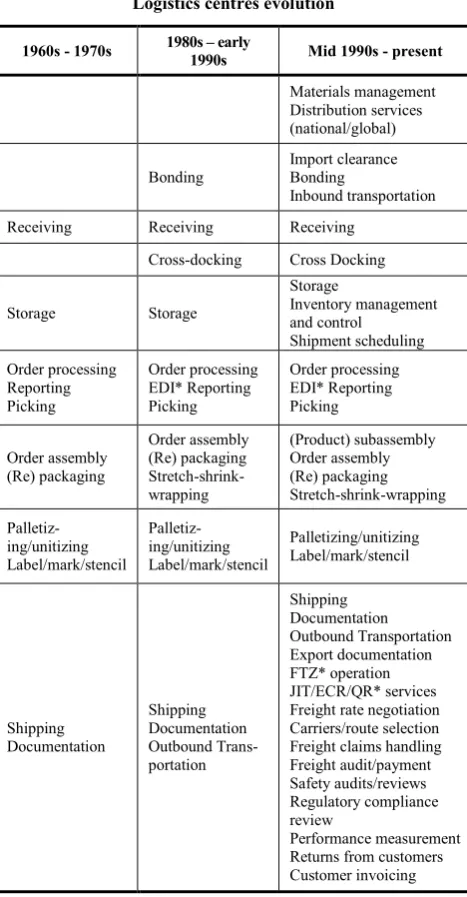
According to United Nations Economic and Social Commission for Asia and the Pacific (ESCAP) study re-port (2002) logistics centres can be classified on evolu-tion basis into three different categories or generaevolu-tions. It is based on the scope and extension of logistics activities as shown in Table 1. Logistics centres provide not only traditional activities such as storage, but also value-added logistics services such as labeling, assembly, semi manu-facturing and customizing.
Both logistics companies and shippers agree that value added services in logistics centres are important in supply chain management, and this tendency is expected to continue in the future. In many cases, these services overlap or include third-party logistics services, such as inventory management, inspection, labeling, packing, bar-coding, order picking and reverse logistics, etc. The main VAL activities are (United Nations, 2002):
Receiving goods, breaking shipments, preparing for shipment, returning empty packaging
Simple storage, distribution, order picking
Countrylizing and customizing, adding parts and manuals
Assembly, repair, reverse logistics
Quality control, testing of products
Installing and instruction
Product training on customer’s premises.
Logistics centers are challenged to offer market a competitive and high quality categories of functions, enlarge their profitability, and limit environmental inter-ference of their activities. Logistics centre evolution and development is leading to functionality and service qual-ity improvement as well as to unification of commonly used determinants for their establishment.
Logistics centre definition
Due to the process of evolution (see Table 1) and destination as well as types of centres recently developed in the market there is no embracing concept and defini-tion for logistics centre term determinadefini-tion.
89 can be used for number of other activities’ (Waters, 2003). Ballou (2004) the term ‘distribution warehouse’ uses synonymously with ‘field warehouse’ and ‘distribu-tion centre’ at the same time equating it to ‘terminal’.
Table 1 Logistics centres evolution
1960s - 1970s 1980s – early 1990s Mid 1990s - present
Materials management Distribution services (national/global)
Bonding
Import clearance Bonding
Inbound transportation
Receiving Receiving Receiving
Cross-docking Cross Docking
Storage Storage
Storage
Inventory management and control
Shipment scheduling Order processing
Reporting Picking
Order processing EDI* Reporting Picking
Order processing EDI* Reporting Picking
Order assembly (Re) packaging
Order assembly (Re) packaging Stretch-shrink-wrapping
(Product) subassembly Order assembly (Re) packaging Stretch-shrink-wrapping
Palletiz-ing/unitizing Label/mark/stencil
Palletiz-ing/unitizing Label/mark/stencil
Palletizing/unitizing Label/mark/stencil
Shipping Documentation
Shipping Documentation Outbound Trans-portation
Shipping Documentation Outbound Transportation Export documentation FTZ* operation JIT/ECR/QR* services Freight rate negotiation Carriers/route selection Freight claims handling Freight audit/payment Safety audits/reviews Regulatory compliance review
Performance measurement Returns from customers Customer invoicing
Source: Ernst F. Bolten, Managing time and space in the mod-ern warehousing, Amacom, 1997, p.19.x
Abbreviations*: EDI – electronic data interchange, FTZ – free trade zone, JIT – just-In-time ECR – efficient customer re-sponse, QR – quick-response.
They are a few of authors who put different names of facilities for transport, logistics, storage and distribution operations in one line. The main criteria to correspond are operations performed and services offered.
A number of previous studies have addressed the is-sue of the importance of service attributes of distribution centers or warehouses (Johnson, Wood, 1996; Bowersox, Closs, 1996; Lambert, Stock, 1993). Johnson and Wood (1996) provided a list of services attributes of public warehouses consisting of bonded storage, office and
dis-play space, integrated data-processing equipment, inven-tory level maintenance, local delivery or tendering outgo-ing movements to carriers, unpackoutgo-ing, testoutgo-ing, assem-bling, repacking, price marking, and securing collateral goods for loans (Lu, 2004).
Bringing out the level of performance in proposed definitions the structure of logistics facilities hierarchy is below to make some clearance in terms (see Figure be-low). 1st level indicates the smallest scope of activities
and the highest scope is defined by the 3rd level of the model. The intersection arrows between different levels show that either connected facilities names can be brought into higher or lower level, depending on how one or another author defines the facilities. The closest con-nection among the definitions is represented by linkage of unidirectional arrows.
Figure. Logistics facilities hierarchy
The model can be applied only if citing the authors, who make different terms for facilities presented in the model. For example, the literature survey showed that some logistics facility can include one or another type of facilities with different names in the model above. So in that case model can be applicable. The definitions of dif-ferent authors are presented further in such dimension.
Usually logistics centre conception in Lithuania is identified as storage facility. First of all a warehouse with only storage activity is taken into account while talking about logistics and distribution centre (Rimiene, 2006). But in fact even a small-scale terminal or warehouse has much more proceedings quite often.
Warehouse is understood as a place for inventory that has no direct impact on production (Minalga, 2001). An aim of warehouse logistics, as described by Minalga (2001), is to shape a system for all warehousing type sort-ing as well as freight shipment until the goods delivery, i.e. for goods storage during the production and delivery to customer period. He describes warehousing in narrow sense as a function – time cover between material in stock and the demand. Broader understandings are pro-posed by Urbonas (2004): ‘warehousing – goods inter-ception and storage in assigned area and facility‘, and Židonis (2002): ‘warehousing is a connecting link
be-3RD LEVEL
2ND LEVEL
1ST LEVEL
Transport terminal
Logistics centre
Freight village
Distribu-tion centre
Ware-house
90 tween producer and customer and is one of logistics sys-tem integrated parts’. The authors provide list of main differences among warehouses and distribution centres:
warehouses store all products and distribution cen-tres – only required inventory;
warehouses include more product maintenance op-erations;
distribution centres develop value-added services (VAL);
activity rate reduction is important in warehous-ing, distribution centres aim – to expand profit while meeting customers requirements (Židonis, 2002).
Warehouses can be either private or public (McGinnis, Kohn, 1988; Sheehan, 1989; De Koster, Warffemius, 2005) (Lu, Yang, 2006). Public warehouses almost satisfy the description of distribution centre. Some authors conclude that distribution center is virtually synonymous with the warehouse because it is also where most goods from different suppliers are collected for de-livery to customers' temporary holding areas and is in somebody's distribution system. In distribution channels, warehouses are intermediate storage points between sup-pliers and the manufacturer, and the manufacturer and industrial customers. A distribution center is a ware-house that emphasizes the rapid movement of goods (Johnson, Wood, 1996 (Lu, Yang, 2006)). Distribution center Cavinato (1989) defined as ‘a warehouse of fin-ished goods; also applied to the facility from which wholesale and retail orders may be filled; a materials warehouse would also be a distribution center for buyers of its stock’ (Lu, 2004).
Bowersox et al. (1968) stated that distribution cen-tre represents a ‘physical facility used to complete the process of product line adjustment in the exchange chan-nel. Primary emphasis is placed upon product flow in contrast to storage’. This differs from the old understand-ing of warehouse. Later perceptions of distribution cen-tres are close to logistics centre definitions (Reynaud, Gouvernal, 1987; Holtgen, 1996; Lu, Yang, 2006), be-cause they cover the main criteria that logistics centre compose of. For example, Reynaud and Gouvernal (1987) distribution centre defines as a place, where con-signments from different origins are grouped or split, it is above all a transport organization centre, located at nodal points in the system, i.e. at the meeting point of flows of goods in regional, inter-regional or international trade.
By consolidating a range of ancillary distribution ac-tivities at one site, logistics centres are intended to:
contribute to (additional) combined transport;
promote regional economic activity;
improve land use and local distribution (Holtgen, 1996).
In respect of regional aspect distribution centres are ranged into local,regional, national or international. The differences exist not only in names, but also in meanings, scope of activity, criteria for evaluation or importance in the context of logistics system.
An international distribution center is defined as a place that integrates the operations of manufacturing with
land, sea, air transportation, storage, port, and customs operations in order to achieve the efficient distribution of commodities (International Maritime Organization 1991 (Lu, 2004).
National Distribution centre – distribution centre whose purpose is to serve the whole country or supply a network of regional distribution centres to achieve na-tional coverage. Goods are usually received and often dispatched on a trunk haul journey (Britains Railway, 2004).
Regional Distribution centre – distribution centre serving a region as part of a wider network of similar facilities to achieve national coverage. Usually served by a trunk haul from a port, manufacturing site or national distribution centre (Britains Railway, 2004).
Local Distribution centre – distribution centre, mostly the ending point of a distribution network, distrib-uting consignments to their final users.
Being similar to logistics centre, a distribution centre does not function in the same way as a container depot or inland port currently does. Kia et al. (2003) presume a distribution centre as ‘an exchange point where an inland mode of transport, such as a train, meets another mode of transport, such as truck. It serves an invaluable purpose in the whole process of production, consumption and supply. It is a concept that can be placed in the chain of transport to speed up the process of freight distribu-tion’.
Wiegmans’ et al. (1998) point of view to transport or freight terminal is very similar to distribution or logistics centre: ‘terminal is a place where goods are transferred between any two or more freight transport modes. In this interface unit loads are collected, exchanged, stored and/or distributed. The handling operations at the freight terminal may include the same transport mode or two different transport modes’ (Wiegmans et al., 1998). Core activity of terminals is transshipment of goods between different transport modes (Holtgen, 1996). The transfer between transport modes is critical attribute of transport terminal since terminal appearance in distribution logis-tics evolution. Five decades ago Pegrum (1963) stated the same: ‘transport terminals are regarded as the points of concentration at which traffic on the intercity carrier ends its journey, or is interchanged for further movement when transferred for continuance to ultimate destination in an-other center’. Nowadays rail–roadterminals consist of a wide range of installations, ranging from simple terminals providing transfer between two or three modes of trans-port, to more extensive centres providing a number of value-added services such as storage, empties depot, maintenance, repair, etc (Ballis, Golias, 2002).
Seen from the specific perspective of geographical coverage, volume, and capacity Wiegmans et al. (1998) proposes the following five characteristic types of freight terminals:
play-91 ers involved. Usually a mainport will either be a major seaport or a large airport with world-wide connections.
2. XL or international terminal can be characterised by deep-sea, rail, truck, and barge connections on a more continental level. European-wide networks are served. This terminal is especially used as an international distribution centre.
3. L or national terminal: is operated on the country level in Europe and has rail, barge, and truck con-nections at a country level. This terminal is used as a national distribution centre.
4. S or regional terminal is characterised by low cost through low budget solutions, relatively low vol-umes, relatively low IT-components in the opera-tions, and smaller regional and national logistical players. This small terminal is used as a regional distribution centre. There are usually truck and rail or barge connections.
5. M or local terminal is only served by trucks that collect and distribute freight to and from their final destination. A simple connection with rail or barge is provided.
Alternative terminal types are based on the character-istics of freight flows (Bowersox, 1986; De Wit, 1989) that are handled by airport terminals combined with four types of bundling freight flows: point-to-point, trunk line with collection/distribution, line, hub-and-spoke (Wieg-mans et at., 1998). It should be absolutely clear that this sub-division of characteristics into such groups does not cover all current terminals unambiguously. Some termi-nals will have characteristics of two or more different terminal types.
Transport nodes are points which gather and con-nect different transport modes and give an opportunity to serve cargoes which flow from different directions (InLoc, 2006). Under this name EU financed ‘InLoc’ pro-ject coordinators (2006) see ports, intermodal terminals, logistics centres. Logistics centres form a special type of transport nodes. The Baltic seaports should be recognized as logistics nodes supplementing the logistics centres.
The literature survey above once more proved that there is no visible separation among terms identifying facilities for logistics services provision. Logistics centre definition can be used to cover either of them in response to:
geographical coverage;
services provided;
transport mode transfer.
Europlatforms – the association of the European freight villages (in Italy, France, Spain, Denmark, Ger-many, Portugal, Luxembourg, Greece, Poland), devel-oped the definition of logistics centre, which is agreed among its members:
‘A Logistics Centre is the hub of a specific area where all the activities relating to transport, logistics and goods distribution – both for national and international transit – are carried out, on a commercial basis, by vari-ous operators. The operators may be either owners or tenants of the buildings or facilities (warehouses, distri-bution centres, storage areas, offices, truck services, etc.)
built there. In order to comply with free market rules, a Logistics Centre must be accessible to all companies in-volved in the activities set out above. A Logistics Centre must also be equipped with all the public facilities neces-sary to carrying out the above-mentioned operations. If possible, it should also include public services for the staff as well as users’ equipment. In order to encourage intermodal transport for goods handling, a Logistics Cen-tre should preferably be served by a variety of transport methods (roads, rail, sea, inland waterways, air). It is vi-tal that a Logistics Centre be managed as a single and neutral legal body (preferably by a Public-Private-Partnership) if synergy and commercial cooperation are to be ensured. Finally, a Logistics Centre must comply with European standards and quality performance in or-der to provide the framework for commercial and sus-tainable transport solutions’ (Europlatforms, 2004).
‘InLoc’ (2006) appeal almost the same definition: ‘Logistics centre – a centre in a defined area within which all activities relating to transport, logistics and distribution of goods are carried out by various operators on a commercial basis. A Logistics Centre must be open to allow access to all companies involved in the activities set out above. It should also be equipped with facilities serving different modes of transport’.
But the same association previously used another name to cover the definition: ‘a freight village is a de-fined area within which all activities relating to transport, logistics and the distribution of goods, both for national and international transit, are carried out by various opera-tors’. This definition was established by Europlatforms in 1992 (Galloni, 1999).
In short, the Logistics Centre is simply a village planned and built to best manage all the activities in-volved in freight movement (Europlatforms, 2004). Usu-ally only large-scale intermodal logistic centre is called freight village.
Some authors make an emphasis on functionality of logistics centre:‘a logistics centre is a particular territory where such services as cargo transfer, storage, distribu-tion over the territory of one or more countries, customs mediators, insurance, maintenance and repair of transport facilities, etc. are provided’ (Lingaitis, Fadina, 2003). Other authors – exclude the scope of physical area and regard logistics centre or freight village a structure in-cluding premises, called by other terms above for specific activities to be performed. Breitzmann and Wenske (1999) describe logistics centre as a freight village being a specific group of transport and warehousing centres (Kondratowicz, 2003). Rushton et al. (2006) states that freight villages usually have warehouses and distribution companies based alongside the rail facilities. Break-bulk and freight consolidation services are usually also avail-able. Some of these facilities are classified as inland ports and so customs services are available. According Euro-platforms (2004) ‘the most important infrastructures in-side a Logistics Centre are the warehouses and the inter-modal terminal’.
92 Meidute, Vasiliauskas (2005) use these criteria to divide them into:
a) International Logistics Distribution Centres. b) Regional Logistics Distribution Centres, those
are intermediate link in the logistics channels, and fulfilling regional distribution service tasks. c) Local Logistics Distribution Centres, those in
most cases are end links of a distribution net-work.
Other researchers or institutions dealing with logis-tics concern come to an understanding that logislogis-tics cen-tre is only one section of a bigger structure. When logis-tics centres are grouped together in a common dedicated area, it is sometimes called a Distripark (distribution park). Therefore, a Distripark is a large-scale, advanced, value-added logistics complex with comprehensive facili-ties for distribution operations at a single location, which is connected directly to container terminals and multimo-dal transport facilities for transit shipment, employing the latest information and telecommunication technology (United Nations, 2002). Container ports are generally a preferred choice to set up Distripark, since they are al-ready closely located to various inland transport facilities and highly skilled workforce.
Such consolidation was influenced by worldwide de-velopment of information technologies and telecommuni-cation as well as financial investments in logistics infra-structure. These facts affect that logistics facilities have to put more emphasis on better utilizing existing facilities as well as adding capacity (United Nations, 2002).
Logistics centre services
Historically, typical logistics functions were shipping and receiving, storage, order picking, break-bulk, freight consolidation and containerization. Today, thanks to technology, many distribution operations are computer-ized, automated, and equipped with state-of-the-art mate-rial handling equipment and information systems. This enables them to deliver overnight to a widening geo-graphic market. As a result, many distribution operations have added a number of value-added services, including total logistics management, inventory control and track-ing, packagtrack-ing, labeling and bar codtrack-ing, procurement and vendor management, and customer service functions, such as returns, repair, rework and assortment promo-tional assembly.
An attempt to define logistics centre functionality was already made by the author of this survey (Rimienė, 2006). Different logistics centers at different locations and with different missions may offer different range of functional operations. Seeking competitiveness and cus-tomers’ satisfaction there must be found a way to create a consistent framework in which these logistics centers that operate within a wide variety of geographical, economic and political context can turn into an effective network for multimodal transport services to cater to international traffic and goods flow.
Warehouse/Distribution/Logistics center facilities vary greatly, depending on their type of operations, their functions, the geographic region served and their space
needs (New YorkEmpire state development, 2006). As the movement of freight within distribution cen-ters accelerates, cross-docking is growing in importance. With crossdocking, goods come in one door and go out another with minimal delay - a package that might have spent five days in yesterday’s distribution center is now processed through in 24 hours or less.
In general, the average distribution facility employs fewer than 100 workers. However, recent trends toward expanding operations to include value-added services are expected to increase the average employment in these types of operations (New York Empire state develop-ment, 2006). The location goal of most ware-house/distribution/logistics centers is to select a site that offers the lowest possible transportation costs with the easiest access to the greatest number of customers. The location process typically used in the selection of an ap-propriate site takes into consideration the products for which a distribution facility is desired; the market area or areas that are to be served and the degree of market pene-tration necessary. The location criteria that ware-house/distribution/logistics centers factor into their site selection decision include, but are not limited to, market trends, proximity to existing and new customers, access to suppliers and vendors, transportation services and cost, telecom infrastructure, labor availability and cost, build-ing and site acquisition and cost, quality educational in-stitutions and training facilities, and regulatory factors, such as inventory valuation.
Assuring fluidity between all the transport connec-tions and coordinating all the transport modes are some of the tasks of a Logistics Centre. This is why most Euro-pean Logistics Centres are located in hub points for transport and distribution activities. The widespread of logistics centres services indicates not only that their number is increasing substantially but also that their functionality is changing (De Koster, Warffemius, 2005).
Conclusions
A number of different terms, with the most common being ‘distribution centres’ and ‘logistics centres’ (Wa-ters, 2003) are used to describe warehouses or facilities for logistics operations to be held. At the same time a concept of ‘logistics centre’ in logistics theory and espe-cially in practice usually intersects with terms of ‘freight village’, ‘logistics node’, ‘terminal’, etc. Most likely such situation was influenced by the short existence of supply chain management approach and not long logistics centre evolution period.
Logistics researchers have made little effort to build a unified logistics centre conception. That is why the attempt to rectify the hierarchy of logistics facilities and formulate the definition of logistics centre is of a great importance to every researcher, interested in logistics theory.
93 financial and audit attendance.
The functionality depends on type, legal status, geo-graphical coverage, intermodality and other criteria of a logistics centre. Issue of different terms, naming the same logistics services rendering facilities, is important for function determination as well.
The literature review of concepts of different scien-tists and practicians was made by the authors to adjust the
hierarchy of logistics facility descriptions and under-standings. Logistics facilities hierarchy model was made to link different terms on one platform.
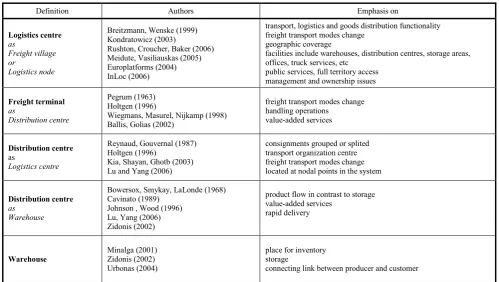
Summarizing works of different authors the table for comparison is proposed below to show the differences or similarity between different attitudes (see Table 2). List of main emphasis was excluded to see how researchers esti-mate the concept of logistics centre.
Table 2 Definitions of Logistics centre
Definition Authors Emphasis on
Logistics centre as
Freight village or
Logistics node
Breitzmann, Wenske (1999) Kondratowicz (2003)
Rushton, Croucher, Baker (2006) Meidute, Vasiliauskas (2005) Europlatforms (2004) InLoc (2006)
transport, logistics and goods distribution functionality freight transport modes change
geographic coverage
facilities include warehouses, distribution centres, storage areas, offices, truck services, etc
public services, full territory access management and ownership issues
Freight terminal as
Distribution centre
Pegrum (1963) Holtgen (1996)
Wiegmans, Masurel, Nijkamp (1998) Ballis, Golias (2002)
freight transport modes change handling operations
value-added services
Distribution centre
as
Logistics centre
Reynaud, Gouvernal (1987) Holtgen (1996)
Kia, Shayan, Ghotb (2003) Lu and Yang (2006)
consignments grouped or splited transport organization centre freight transport modes change located at nodal points in the system
Distribution centre as
Warehouse
Bowersox, Smykay, LaLonde (1968) Cavinato (1989)
Johnson , Wood (1996) Lu, Yang (2006) Zidonis (2002)
product flow in contrast to storage value-added services
rapid delivery
Warehouse
Minalga (2001) Zidonis (2002) Urbonas (2004)
place for inventory storage
connecting link between producer and customer
To conclude the research, common understanding of ‘Logistics centre’ concept was formulated on emphasized criteria (see Table 2) and is proposed by the author be-low:
‘Logistics centre (Freight village / Logistics node / Distribution centre) is a special intermodal hub (nodal point) in the transportation system, including different logistics facilities, where separate operators are providing number of services, connected to transportation, logistics and distribution in established geographical coverage.’
In this point, only public hubs are considered as Logis-tics centres. Geographical coverage is used in sense of de-scribing local, regional, international significance of a hub.
The resuming point can be made stating that evaluat-ing presence and scope of the factors from Logistics cen-tre definition, Logistics cencen-tre can be considered as Freight village, Logistics node or Distribution centre as well.
The rectified concept would be a platform for further research.
References
1. Ballis, A. Comparative Evaluation of Existing and Innovative Rail– Road Freight Transport Terminals / A. Ballis, J. Golias // Transpor-tation Research. Part A: Policy and Practice, 2002, Vol. 36, issue 7, p. 593-611.
2. Ballou, R.H. Business Logistics / Supply Chain Management (5th
ed.). New Jersey: Pearson Education, 2004. 789 p.
3. Bowersox, D.J. Physical Distribution Development, Current Status and Potential. Readings in Physical Distribution Management / D.J.Bowersox, B.J.LaLonde, E.W.Smykay. New York: The Mac-millan Company, 1969. 368 p.
4. Bowersox, D. Physical Distribution Management. Logistics Prob-lems of the Firm / D.Bowersox, E.W.Smykay, B.J.LaLonde. New York: The Macmillan Company, 1968.
5. Commercial Development of Regional Ports as Logistics Centres // United Nations; Economic and Social Commission for Asia and the Pacific. New York, 2002. 98 p.
6. Development profile for warehouse/distribution/logistics centre sites // Empire state development. State of New York. Current Pro-gram, Round 4, 2006. 12 p.
7. Galloni, G. FV-2000 - Quality of Freight Villages Structure and Operations // Final Report for Publication. Europlatforms E.E.I.G. 1999. 79 p. Prieiga per internetą: <
http://www.freight-village.com/fv2000/report/FReport.htm >
8. Generic Brochure on User-Oriented Measures for Linking Interna-tional Networks to NaInterna-tional and Regional Transport Systems // In-tegrating logistics centre networks in the Baltic Sea region. InLoc broshure, 2006, 21 p. Prieiga per internetą: <www.inloc.info/> 9. Holtgen, D. Intermodal Terminals in the Trans-European Network
// 24th European Transport Forum. Proceedings of Seminar A:
Pan-European Transport Issues. UK: PTRC, 1996.
94
11. Kondratowicz, L. Planing of Logistics centres // Final Report. Networking Logistics Centres in the Baltic Sea Region (NeLoc). Department of Scientific Publications of the Maritime Institute in Gdansk, 2003, Vol. 1, 133 p.
12. De Koster, M. B. M. American, Asian and Third-Party Internation-al Warehouse Operations in Europe. A performance comparison / M. B. M. De Koster, P. M. J. Warffemius // International Journal of Operations & Production Management, 2005, Vol. 25, No 8, p. 762-780.
13. Lingaitis, L. P. Investigation of the Possibility to Establish a Logis-tics Centre in Vilnius Region and its Potential Benefits / L. P. Lin-gaitis, O. Fadina // Proceedings of International Conference RelS-tat’03. Riga, 2004, Vol. 5, No 1, p. 53-59.
14. Logistics centre. Directions for use // Europlatforms E.E.I.G. 2004, 16p.
15. Lu, C. S. An Evaluation of Logistics Services' Requirements of International Distribution Centers in Taiwan // Transportation Journal, 2004, Vol. 43, No 4, p. 53-66.
16. Lu, C. S. Evaluating Key Logistics Capabilities for International Distribution Center Operators in Taiwan / C. S. Lu, C. C. Yang // Transportation Journal, 2006, Vol. 45, No4, p. 9-27.
17. Lynagh, P. M. Measuring Distribution Center Effectiveness // Transportation Journal, 1971, Vol. 11, Issue 2, p. 21-33.
18. Meidute, I. Significance of Logistics Centres for Development of Intermodal Transport Services in Lithuania / I. Meidute, V. A. Va-siliauskas // Proceedings of the 5th International Conference RelS-tat’05, Riga, 2005. p. 271-275.
19. Minalga, R. Logistika. Vilnius: Petro ofsetas, 2001. 383 p. 20. Pegrum, D.F., Transportation: Economics and Public Policy.
Ho-mewood: Richard D. Irwin, Inc., 1963. 625 p.
21. Reynaud, C. Monitoring Systems for Goods Transport / C. Rey-naud, E. Gouvernal // European Conference of Ministers of Trans-port: Round Table 74. Paris: ECMT, 1987, p. 5-50.
22. Rimiene K. An Importance of Functions for Logistics Center Choice // Proceedings of 10th International Conference Transport
Means 2006, Kaunas: Technologija, 2006, p. 263-265.
23. Rushton, A. The Handbook of Logistics and Distribution Manage-ment (3rd ed.) / A.Rushton, P.Croucher, P.Baker. Glasgow: Bell &
Bain, 2006. 612 p.
24. Strategic Rail Freight Interchange Policy // Britains Railway. 2004.
http://www.dft.gov.uk
25. Teo, Ch. P. Impact on Inventory Costs with Consolidation of Dis-tribution Centers / Ch. P. Teo, O. Jihong, M. Goh // IIE Transac-tions, 2001, Vol. 33, p. 99-110.
26. Urbonas, J.A. Tarptautinė logistika. Kaunas: Technologija, 2004. 267 p.
27. Waters, D. Logistics: an Introduction to Supply Chain Manage-ment. Basingstoke; New York: Palgrave Macmillan, 2003. 254 p. 28. Wiegmans, B. W. Intermodal Freight Terminals: an Analysis of the
Terminal Market / B. W. Wiegmans, E. Masurel, P. Nijkamp // Re-search Memorandum. Amsterdam, Free University, 1998. 14 p. 29. Židonis, Ž. Verslo logistika. Vilnius: Vilniaus vadybos kolegija,
2002. 146 p.
Kristina Rimienė, Dainora Grundey
Logistikos centrų raida ir sampratos jų sąvokai apibrėžti
Santrauka
Pasaulinė gamybos bei prekybos globalizacija daro didžiulę įta-ką logistikos ir tiekimo grandinės valdymo praktiniams bei teori-niams sprendimams. Tarptautinės kompanijos vis dažniau ieško logis-tikos centrų, kuriuose būtų teikiamos ne tik tradicinės logislogis-tikos pa-slaugos, bet ir pridėtinę vertę kuriančios (pvz.: žymėjimo, pakuotės keitimo, kodavimo, galutinio produkto surinkimo, kt.) paslaugos. Lietuva ketina tapti jungiančiąja tarptautinės prekybos bei logistikos grandimi tarp Rytų ir Vakarų Europos, vystyti logistikos centrų in f-rastruktūrą, kad galėtų įsilieti į Europos logistikos tinklą. Tuo tarpu mokslinių tyrinėjimų logistikos srityje rezultatai kol kas nepateikia visiems priimtinos ir vienodai suprantamos „logistikos centro“
sam-pratos. Taigi teisingai suvokti bei išgryninti „logistikos centro“ api-brėžimą ypač svarbu tiek moksliniu, tiek visuomeniniu bei komerci-niu aspektu.
Straipsnio tikslas – remiantis logistikos centrų vystymosi ir raidos apžvalga bei esamų logistikos centro sampratų ir apibrėžimų analize, išskirti arba suformuluoti logistikos centro sąvoką, kuri leistų apibendrinti logistikos centro sampratą.
Tyrimo objektas – logistikos centro sąvoka.
Tyrimo metodai apima mokslinės ir specialiosios literatūros ly-ginamosios analizės ir sintezės, tyrimo rezultatų apibendrinimo me-todus.
Logistikos centrų raida
Logistikos centro sąvoka nėra nauja – pirmą kartą ji pradėta var-toti prieš 30 metų. Tačiau bendro apibrėžimo kol kas nėra suformu-luota. Iki šiol vartojamas ne vienas pavadinimas centrui, kuriame teikiamos logistikos paslaugos, apibūdinti: „logistikos centras“, „pa-skirstymo centras“, „centriniai sandėliai“, „krovinių gabeni-mo/transporto terminalas“, „transporto mazgas“, „logistikos platfor-ma“, „krovinių kaimelis“, „logistikos bazė“ ir t.t. Tokią terminų įvai-rovę lėmė kaip tradicinių bei naujo tipo logistikos centrų evoliucijos rezultatas. Logistikos centrų sąvoka atsirado kartu su trečiosios šalies logistikos (3PL) samprata. Pagal literatūroje pateikiamus raidos eta-pus: I – 1960–1970 metai, II – 1980–1990 pradžia, III – 1990 vidurys – dabartis, logistikos centrai gali būti skirstomi į tris kategorijas (United Nations, 2002), kurios remiasi logistikos paslaugų įvairovės ir veiklos masto kriterijumi. Trečiosios kategorijos logistikos centrai teikia ne tik tradicines paslaugas (prekių priėmimas, saugojimas, krovinių konsolidavimas, kt.), bet ir pridėtinę vertę kuriančias logi s-tikos paslaugas. Daugeliu atvejų jos sutampa su trečiosios šalies logistikos paslaugomis – atsargų valdymu, priežiūra, žymėjimu, pa-kavimu, kodavimu, užsakymų surinkimu, reversine logistika, kt. Logistikos centrų evoliucija ir vystymasis daro įtaką jų paslaugų kiekio ir kokybės augimui bei bendrų jų kūrimosi veiksnių atsiradimui.
Logistikos centro apibrėžimas
Centrų, kuriuose teikiamos logistikos paslaugos, sampratas, pa-vadindami juos skirtingai, pateikia daugelis užsienio (Pegrum, 1963; Bowersox, Smykay, LaLonde, 1968; Reynaud, Gouvernal, 1987; Cavinato, 1989; Holtgen, 1996; Johnson, Wood, 1996; Wiegmans, Masurel, Nijkamp, 1998; Breitzmann, Wenske, 1999; Ballis, Golias, 2002; Waters, 2003; Kondratowicz, 2003; Kia, Shayan, Ghotb, 2003; Ballou, 2004; Rushton, Croucher, Baker, 2006; Lu, Yang, 2006; kt.) ir Lietuvos (Židonis, 2002; Urbonas, 2004; Meidutė, Vasiliauskas, 2005; kt.) autorių bei visuomeninės organizacijos (Europlatforms, 2004; InLoc, 2006; kt.).
Esamos logistikos centrų sampratos išsiskiria dviem kryptimis:
Autoriai, teigiantys, jog logistikos centro sąvoka atitinka sandėlio, paskirstymo centro, transporto terminalo ir kt. lo-gistikos patalpų pavadinimų sąvokas (Waters, 2003; Ballou, 2004);
Autoriai, apibrėžiantys logistikos centrą konkrečia sąvoka, tačiau atskirais atvejais prilyginantys jį atitinkamai kitoms logistikos patalpų pavadinimų sąvokoms (Pegrum, 1963; Bowersox, Smykay, LaLonde, 1968; Reynaud, Gouvernal, 1987; Cavinato, 1989; Holtgen, 1996; Johnson, Wood, 1996; Wiegmans, Masurel, Nijkamp, 1998; Breitzmann, Wenske, 1999; Minalga, 2001; Židonis, 2002; Ballis, Golias, 2002; Waters, 2003; Kondratowicz, 2003; Kia, Shayan, Ghotb, 2003; Europlatforms, 2004; Ballou, 2004; Urbonas, 2004; Meidutė, Vasiliauskas, 2005; Rushton, Croucher, Baker, 2006; Lu, Yang, 2006; InLoc, 2006).
95 sandėliai (logistikos centrai siaurąja prasme) yra atsargų saugojimas, atstojant jungiamąją grandį tarp gamintojų ir klientų (Minalga, 2001; Židonis, 2002; Urbonas, 2004). Paskirstymo centro, krovinių termi-nalo ir logistikos centro sąvokos siejasi tokiomis charakteristikomis: intermodalumo, pridėtinę vertę kuriančių paslaugų bei krovinių val-dymo funkcijų gausa (Wiegmans, Masurel, Nijkamp, 1998; Holtgen, 1996; Pegrum, 1963; Ballis, Golias, 2002; Reynaud, Gouvernal, 1987; Lu, Yang, 2006; Kia, Shayan, Ghotb, 2003; Židonis, 2002; Johnson, Wood, 1996; Cavinato, 1989; Bowersox, Smykay, LaLonde, 1968). Logistikos centro plačiąja prasme sąvoka tapatinama su kro-vinių kaimelio, logistikos bazės sąvokomis, ir apima transporto, logis-tikos ir paskirstymo funkcijų gausą, intermodalumą, geografinį išpli-timą, visuomeninių paslaugų bei viešumo kriterijus, centro valdymo bei nuosavybės klausimus, taip pat sandėliavimo, administracinių, techninių patalpų ir paslaugų gausą (Breitzmann, Wenske, 1999; Kondratowicz, 2003; Europlatforms, 2004; Meidutė, Vasiliauskas, 2005; Rushton, Croucher, Baker, 2006; InLoc, 2006).
Daugumos ankstesnių įvairių mokslininkų atliktų tyrimų rezulta-tai rodo, jog logistikos centro funkcijų gausa yra labai svarbus logis-tikos patalpų vertinimo kriterijus. Straipsnyje pateikiamas autorių sudarytas logistikos patalpų hierarchijos modelis, atskleidžiantis ryšį tarp išskirtų sąvokų bei nurodantis galimybę sisteminti mokslinėje literatūroje aptinkamų apibrėžimų bei sampratų įvairovę, išskiriant teikiamų paslaugų aspektą. Remiantis modeliu, įvairiai autorių api-brėžiamas logistikos patalpų sampratas galima išdėstyti trijų lygių atžvilgiu, kur 1-asis nurodo mažiausias veiklos apimtis vykdančių logistikos patalpų sąvokas, o 3-iasis – didžiausios apimties funkcijomis, patalpų gausa ir svarba transporto sistemoje apibūdina-mas sąvokas.
Įvairūs autoriai pateikia skirtingas jų apibrėžtų logistikos patal-pų (logistikos ar paskirstymo centrų, terminalų, kt.) grupavimo cha-rakteristikas. Savo dydžiu ar paskirtimi dažniausiai jos skirstomos į
vietinio, regioninio, ar tarptautinio lygio centrus.
Logistikos centrų paslaugos
Istoriškai susiklostė, kad tipinėmis logistikos funkcijomis yra laikomos prekių priėmimas, saugojimas, užsakymų surinkimas, iš-krovimas, krovinių konsolidavimas, konteinerių krova. Technologijų dėka šiandien daugelis operacijų yra kompiuterizuotos, automatizu o-tos, turi naujausią medžiagų priežiūros ir valdymo įrangą bei infor-macines sistemas. Todėl šiuo metu logistikos paslaugų įvairovė labai plati ir apima daug naujų papildomą vertę kuriančių paslaugų, tarp kurių galima paminėti visą logistikos valdymą, atsargų kontrolės ir apskaitos, pakavimo, žymėjimo, kodavimo, tiekimo bei tiekėjų val-dymo, klientų aptarnavimo paslaugas, pavyzdžiui, grąžinimo, remon-to, perdirbimo, asortimento reklamos paslaugas. Skirtingos paskirties bei skirtingose vietovėse įsikūrusios logistikos patalpos skiriasi savo funkcijų gausa bei veiklos mastu.
Apibendrinant tyrimo rezultatus, remiantis logistikos centrų rai-dos etapais, išanalizuotomis įvairių autorių sąvokomis ir akcentuoj a-momis savybėmis, buvo apibrėžta ir autorių pasiūlyta bendra logisti-kos centro sąvoka:
„Logistikos centras yra tam tikras transporto sistemos intermo-dalinis centras (mazgas) su įvairiomis logistikos patalpomis, kuriame veikiantys skirtingi operatoriai teikia daugelį su transportavimu, logistika ir paskirstymu susijusių paslaugų tam tikros geografinės rinkos atžvilgiu.“
Pagal šį apibrėžimą tik viešieji centrai laikomi Logistikos cent-rais. Geografinė rinka čia apibrėžiama vietinio, regioninio ar tarptau-tinio logistikos centro statusu.
Įvertinant patalpų, kuriose teikiamos logistikos paslaugos, atitik-tį pateiktame logistikos centro apibrėžime išskirtoms savybėms logis-tikos centru gali būti laikomas krovinių kaimelis, logislogis-tikos bazė ar paskirstymo centras.
Raktažodžiai:logistikos centro sąvoka, logistikos centrų evoliucija, krovinių kaimelis, logistikos mazgas, paskirstymo centras.
The article has been reviewed.