Endale Kassa, Abate Bane, Hailu Kefene. Ethiop Med J, 2016, Vol. 54, No.1
ORIGINAL ARTICLE
COMMON GENOTYPES AND TREATMENT OUTCOMES OF HCV INFECTION
AMONG ETHIOPIAN PATIENTS: A PROSPECTIVE STUDY
Endale Kassa, MD1, Abate Bane, MD2, Hailu Kefene, MD3
ABSTRACT
Background: The treatment response of HCV infection is dependent on genotype and stage of the disease. How-ever, genotype pattern and treatment outcomes of HCV infection among Ethiopian patients has not been studied so far.
Objectives: To evaluate the common HCV genotypes and treatment outcomes among Ethiopian adult patients. Method: Adult patients aged 18 and above with HCV infection referred from various regions of the country were included in the study after written informed consent. As there was no free or insurance coverage for treatment of HCV infection in the country, those who could afford to pay for treatment with PEG Interferon and Ribavirin were recruited during January 1, 2008 through December 31,2013 at United Vision, Adera, Old Airport, and Mexico referral higher clinics in Addis Ababa. Patients with decompensated cirrhosis and pregnant ladies were excluded from the study. The patients were counseled on treatment options, cost, treatment outcomes, adverse drug effects, and possible complications. Data were collected on demographic features, clinical characteristics, viral geno-types, and treatment outcomes during follow up visits until six months after completion of recommended standard treatment. Data were analyzed using SPSS software.
Results: A total of 200 adults with chronic HCV infection were treated with PEG -Interferon and Ribavirin (for 24 or 48 weeks according to the genotypes) during the study period. Of the 200 patients enrolled in the study, 120 (60%) were male, 90% were from Addis Ababa, and the median age was 48 years. Sixty per cent of the patients were infected with genotype 4,17% with genotype 1, 13.5% with genotype 2 and 9.5% with genotype 3.
Eighty percent of the patients had end of treatment response; of these, 74.4% had undetectable HCV RNA at6th month after end of treatment. The end of treatment response was noted to be close to 90% for patients with HCV genotypes 2 and 3 infections.
Conclusion: This study indicates that genotype 4 is the prevalent HCV genotype followed by 1,2, and 3 among Ethiopian patients. Treatment with interferon and ribavirin was well tolerated and provided a very good response. Key words: HCV, genotypes, treatment, Ethiopia.
1
Division of Gastroentrology, Department of Internal Medicine, Addis Ababa university Medical school and United Vision higher clinic 2Division of Gastroentrology, Department of Internal Medicine, Addis Ababa univer-sity Medical school and Adera higher clinic. 3Old Airport Higher clinic
INTRODUCTION
Hepatitis C virus (HCV), a single stranded ribonu-cleic acid virus belonging to the flaviviridae family, is one of the major global health issues affecting hu-mans.(1) It is most often transmitted parenterally but is also transmitted vertically and sexually. HCV is up to 4 times more infectious than Human Immunodefi-ciency Virus (HIV).(1) HCV is classified on the basis of the similarity of nucleotide sequence into major genetic groups designated genotypes. HCV geno-types are numbered (arabic numerals) in the order of their discovery. The more closely related HCV
strains within some types are designated subtypes, which are assigned lowercase letters (in alphabetic order) in the order of their discovery. The complex of genetic variants found within an individual isolate is termed the quasispecies. The quasispecies composi-tion of HCV results from the accumulacomposi-tion of muta-tions during viral replication in the host. (1-3)
HCV is also a common cause of death in HIV-positive patients on highly active antiretroviral ther-apy.(4,5) While the incidence rate of HCV infection is apparently decreasing in the developed world, deaths from HCV-induced liver diseases are esti-mated to rise over the next years from related com-plications like cirrhosis and hepatocellular carcinoma (HCC).(4,5-12)
HCV pandemic is a leading cause of chronic liver disease worldwide. The prevalence of HCV in the general population in Africa ranges between 0.1% and 17.5%, depending on the country reporting. The countries with the highest prevalence include Egypt (17.5%), Cameroon (13.8%) and Burundi (11.3%) while lowest prevalence was reported from Zambia, Kenya, Malawi, and South Africa (all with a preva-lence <1%).(6-13, 20, 21)
Since there is no effective vaccine yet, primary pre-vention against hepatitis C focuses on reducing risks of infection through educating people on safe sex, safe protocols while using needles and syringes, and blood safety. Very effective directly acting antiviral treatment is now available to treat HCV infections. HCV is curable with this effective therapy in 60-98% of cases. Although we have an effective therapy for hepatitis C, lack of knowledge and skill to deliver treatment among providers, and the high cost of HCV genotyping and drugs, make access to treat-ment a major global limiting problem yet.(6-13) Viral hepatitis is noted to be endemic in Ethiopia accounting for significant morbidity and mortality. (14) According to a United Nations report from 2000, HCV seroprevalence in Ethiopia, based on five cohort studies with a sample size of 2,080 tests, was estimated to be 1.9%.(15) In another study among HIV co-infected patients, sero-prevalence was 5.5%. (16-17) There were no treatment options available for HCV infection in Ethiopia until recently. No study has therefore been carried out to identify HCV genotypes and compare treatment response in Ethio-pia yet. Hence, we studied the prevalent genotypes and treatment response of HCV infection among Ethiopian patients.
METHOD AND MATERIALS
This is a prospective clinical treatment follow up study. The study protocol was reviewed and ap-proved by the Institutional Review Board of the School of Medicine at Addis Ababa University.
Adult patients (aged 18 years and above) with HCV infection who were referred from various regions of the country for specialty care, were evaluated for treatment. Confirmatory tests were done using the ARCHITECT i2000SR automated analyzer from Abbott Laboratories (USA) for those who had posi-tive anti HCV rapid tests. Then, sera of those with confirmed HCV infection were sent abroad for HCV viral load and genotype determination using TaqManreal time reverse transcriptase PCR at Bio-scientia GmBH in Germany, as these tests are not available in Ethiopia to date. Those patients with confirmed HCV infection and compensated liver disease, who could afford the treatment cost with PEG interferon and Ribavirin (the only treatment option available for HCV in the country during the study period), were recruited into the study after written informed consent.
Those with decompensated cirrhosis and pregnant ladies were excluded as interferon is contraindicated in these conditions. The recruited patients were treated and followed up prospectively every 2-4 weeks (for clinical response and adverse drug side effect) by senior Gastroenterologists at United Vi-sion, Adera, Old Airport, and Mexico referral higher clinics in Addis Ababa during January 1, 2008 through December 31, 2013. The patients were coun-seled on the available treatment options, cost of care, treatment outcomes, drug adverse effects, and possi-ble complications.
The patients were treated and dose adjustments were made for minor adverse effects (like pancytopenia, anemia, etc.) during follow up by the treating Gastro-enterologists. During each follow up, data were col-lected on demographic features, clinical characteris-tics, adverse drug reactions, and treatment response of the patients. Viral load was measured at base line, 12 weeks,24 weeks and48 weeks after initiation of treatment, as well as 24 weeks after completion of treatment Despite the treatable minor adverse effects, all the patients completed the treatment schedule (24 or 48 weeks for genotypes 2 and 3; 1 and4 respec-tively) and were included in the data analysis. The data were analyzed using SPSS software.
RESULTS
Table 1. Socio-demographic characteristics of patients with HCV infection, Addis Ababa 2014. male and 90% were from Addis Ababa, with median
age of 48 years. There were 91 patients treated at United Vision higher clinic, 63 at Adera higher clinic, 37 at Old Airport higher clinic, and 9 at Mex-ico higher clinic. The majority (90%) of the patients were married. (Table1) History of jaundice, liver disease in family, previous surgery was reported by 11.4%, 32.6%,and 7.8% of the patients, respectively. Fifty-nine(30.6%) patients admitted history of regu-lar alcohol consumption while only 1 patient admit-ted a history of IV drug use.
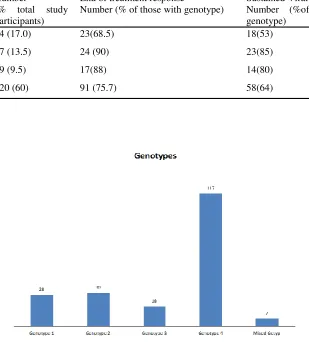
As shown in Table 2 one hundred twenty (60%) of the patients were infected with genotype 4 HCV fol-lowed by genotypes 1,2 and 3 in decreasing order while seven patients had mixed genotypes 1 and 4. ( Fig.1) In this study, types a, b, c, d, e were the com-mon HCV subtypes reported. Afew others could not be classified. As multiple HCV subtypes were re-ported for each patient, the percentage of HCV sub-types does not add up to 100 as shown in Fig 2.
Variables Number Percent
Health institutions UVC AHC MHC OAHC Total 91 63 9 37 200 45.5 31.5 4.5 18.5 Sex of the respondents
Male Female Total 118 82 200 59.0 41.0 Age group of the patients
<35 35-44 45-54 55-64 65 and above
Total Mean +SD 29 44 60 55 12 200 48.33 12.16 13.6 22.2 30.3 27.8 6.1 Marital status Single Married Divorced Widowed Total 15 180 2 3 200 7.5 90.0 1.0 1.5 Occupation Civil servant Merchant House wife Other Total 92 34 48 14 188 48.9 18.1 25.5 7.4 Address Addis Ababa Out of Addis
Table.2 HCV genotypes and treatment response, Addis Ababa, 2014
Fig 1. Number of patients infected with specific HCV genotype, Addis Ababa Genotype Number
(% total study participants)
End of treatment response
Number (% of those with genotype)
Sustained Viral response Number (%of those with genotype)
1 34 (17.0) 23(68.5) 18(53)
2 27 (13.5) 24 (90) 23(85)
3 19 (9.5) 17(88) 14(80)
4 120 (60) 91 (75.7) 58(64)
Fifty percent of the patients reported minor side ef-fects like fatigue, insomnia, hair loss, anemia, and flu like symptoms but all of them could complete the treatment course without interruption and responded to symptomatic treatment (and drug dose adjustment) for the adverse effects.
Overall, eighty percent of the patients had end of treatment response of whom 74.4% had undetectable HCV RNA at 6 months after end of treatment (sustained virological response, SVR). SVR was noted to be higher for genotypes 2 and 3 compared to others as depicted in table 2.
DISCUSSION
HCV exhibits high genetic diversity, characterized by regional variations in genotype prevalence. This has been the challenge to development of vaccines and pan-genotypic treatments18. There are six major HCV genotypes with many subtypes: a, b, c, and about 100 different strains: 1,2,3--- based on the se-quence of the HCV genome. Genotypes 1-3 are widely distributed globally (more in the west), with genotypes 1a and 1b accounting for 60% of infec-tions worldwide. Genotype 4 is characteristic for the Middle East, Egypt and Central Africa. Genotype 5 is almost exclusively found in South Africa while genotype 6 is mainly distributed in Asia(1,10,18-22) In this study, four different genotypes were identified among Ethiopian patients, 60% being genotype 4,17% genotype 1, 13.5% genotype 2 and 9.5% genotype 3(Table 2), which is similar to reports from the Middle East, North and Central Africa possibly suggesting the routes of its global spread following human migration and travels 20.Subtypes a, b, c, d, and e were the common subtypes reported. Mixed genotypes and unclassifiable HCV subtypes were noted inonly very few of our patients. As deduced from multi centre epidemiological studies, the routes of HCV transmission include blood, blood products, tissue and organs; unsafe medical procedures; health-care exposure like needle stick injury; intravenous drug use; sexual transmission; traditional body pierc-ings, and vertical transmission, which is higher with HIV coinfection(1,2,20,21). Although difficult to confirm from our own data due to study design limi-tations, similar risk factors as reported elsewhere could have contributed to HCV infection among our patients; but this needs a further case control study.
According to international guidelines, all patients with chronic hepatitis C infection should be consid-ered potential candidates for drug therapy. Treatment is recommended for patients who are at risk of devel-oping cirrhosis, generally defined by a measurable hepatitis C RNA level and liver biopsy or fibroscan showing portal or bridging fibrosis along with mod-erate inflammation and necrosis.20-21In our case, deci-sion to treat our patients was based on clinical evaluation, A separate aminotransferase (AST) to platelet ratio index (APRI,) scores, liver chemistry, and abdominal sonography results. Accordingly, all patients with chronic hepatitis C and compensated cirrhosis were given treatment and followed up for treatment response and drug adverse effect monitor-ing usmonitor-ing the same parameters. However, Fibroscan/ Elastography liver stiffness test was not available in Ethiopia during the study period and was thus not used. As it is invasive, liver biopsy is also optional and according to our own observation, most patients are against it.
The treatment goal in HCV is to achieve a sustained virological response (SVR), defined by the continued absence of hepatitis C RNA from the treated patient6 months after the completion of treatment. (20-24) Treatment for chronic HCV infection has evolved from interferon monotherapy, which results in an SVR of 10 to 20% to combination therapy with inter-feron plus ribavirin, and recently with new directly acting antiviral drugs (DAAs) which results in a higher SVR rate (but not yet available in Ethiopia) ( 20-21).
Genetic heterogeneity of HCV may account for some of the differences in disease outcome and treatment response observed in patients infected with HCV.
(25)Treatment duration and response of HCV is
also dependent on the viral genotype. Hence, identi-fying the common genotypes and subtypes prevailing in the country is essential for planning and selection of treatment. According to our finding, genotypes 4,1,2 and 3 are the predominant genotypes in Ethio-pia. Similar to international experiences, our patients with HCV genotypes 4 and 1were relatively difficult to treat and required a longer (48 weeks) treatment duration with PEG Interferon-Ribavirin combination. The response to treatment was lowest in patients with genotypes 1 and 4 among our series. Since these make up a large percentage of our cases (almost three -fourths in our study), there is a strong need for alter-native treatment for HCV in Ethiopia.
REFERENCES
1. Madhava, V., Burgess, C. & Drucker, E. Epidemiology of chronic hepatitis C virus infection in sub-Saharan Africa. Lancet Infect Dis 2012 (2): 293-302.
2. Perz, J. F., Armstrong, G. L., Farrington, L. A., et al. The contributions of hepatitis B virus and hepatitis C virus infections to cirrhosis and primary liver cancer worldwide. J Hepatol 2006 (45): 529-38.
3. Mohd Hanafiah, K., Groeger, J., Flaxman, A. D. et al. Global epidemiology of hepatitis C virus infection: new estimates of age-specific antibody to HCV seroprevalence. Hepatology 2013 (57): 1333-342.
4. Gower, E., Estes, C., Blach, S., et al Causes of death in HIV-1-infected patients treated with antiretroviral therapy: collaborative analysis of 13 HIV cohort studies. Clin Infect Dis 2010 (50) :1387-396.
5. Razavi, H., Elkhoury, A. C., Elbasha, E., et al Chronic hepatitis C virus (HCV) disease burden and cost in the United States. Hepatology 2013(57): 2164-170.
6. Timm, J. & Roggendorf, M. Sequence diversity of hepatitis C virus: implications for immune control and ther-apy. World J Gastroenterol 2007 (13): 4808-817.
7. Simmonds, P., Alberti, A., Alter, H. J., et al. A proposed system for the nomenclature of hepatitis C viral genotypes. Hepatology 1994 (19): 1321-324.
8. Simmonds, P. The origin and evolution of hepatitis viruses in humans. J Gen Virol 2001 (82): 693-712. 9. Magiorkinis, G., Magiorkinis, E., Paraskevis, D, et al The global spread of hepatitis C virus 1a and 1b: a
phy-lodynamic and phylogeographic analysis. PLoS Med 2009 (6): e1000198.
10. Pybus, O. G. & Barnes, E. Global distribution and prevalence of hepatitis C virus genotypes. Hepatology 2015 (61): 77-87.
11. Murphy, D. G., Willems, B., Deschenes, M., et al. Use of sequence analysis of the NS5B region for routine genotyping of hepatitis C virus with reference to C/E1 and 5' untranslated region sequences. J Clin Microbiol 2007 (45): 1102-112.
12. Markov, P. V., van de Laar, T. J., Thomas, X, et al. Colonial history and contemporary transmission shape the genetic diversity of hepatitis C virus genotype 2 in Amsterdam. J Virol 2012 (86): 7677-87
duration (24 weeks). The overall SVR and treatment tolerance in this study is very good and comparable to many other regional and international studies(4, 6,20-24) Most patients tolerated the medications, despite minor side effects, with very good response having SVR of 85%, 80%, 64%and 53% in geno-types 2,3,4, and 1 (with overall SVR of 74.4%). Hence, with availability of HCV genotype data and effective therapies, physicians, researchers, and health care decision makers need to improve efforts to promote the capacity of diagnosis, management, and prevention of HCV in Ethiopia.
Conclusion: From this study, HCV genotype 4 is the most prevalent among Ethiopian patients followed by genotypes 1,2 and 3 in decreasing order. The treat-ment with PEG Interferon and ribavirin was well tolerated by the patients with very good outcomes. Hence, a concerted national effort is needed to pro-mote awareness and build diagnostic and treatment capacity within the country as well as to establish screening and preventive programs to overcome the current challenges of endemic HCV infection in Ethiopia, a disease which is associated with signifi-cant morbidity and mortality and leads to huge health service costs.
Limitation of the study: Not all adult patients with HCV infection who deserve treatment were included in this study due to financial constraints. Patients with decompensated cirrhosis and pregnant ladies were also excluded from this study as interferon is contraindicated. These exclusions might have biased the outcomes of our study and limited extrapolations.
ACKNOWLEDGEMENT
13. Abera, B., Zenebe, Y., Mulu, W., et al. Seroprevalence of hepatitis B and C viruses and risk factors in HIV infected children at the felgehiwot referral hospital, Ethiopia. BMC Res Notes 2014 (7): 838.
14. Ayele, W., Nokes, D. J., Abebe, A., et al. Higher prevalence of anti-HCV antibodies among HIV-positive compared to HIV-negative inhabitants of Addis Ababa, Ethiopia. J Med Virol 2002 (68): 12-17.
15. Lauer, G. M. & Walker, B. D. Hepatitis C virus infection. N Engl J Med 2001(345): 41-52.
16. Abreha, T., Woldeamanuel, Y., Pietsch, C., et al. Genotypes and viral load of hepatitis C virus among persons attending a voluntary counseling and testing center in Ethiopia. J Med Virol 2011 (83): 776-82.
17. Taye, S., Abdulkerim, A. & Hussen, M. Prevalence of hepatitis B and C virus infections among patients with chronic hepatitis at Bereka Medical Center, Southeast Ethiopia: a retrospective study. BMC Res Notes 2014 (7): 272.
18. Messina JP1, Humphreys I, Flaxman A, et al. Global distribution and prevalence of hepatitis C virus geno-types. Hepatology. 2015;61(1):77-87.
19. Pybus, O. G., Cochrane, A., Holmes, E. C. & Simmonds.Genotype Distribution of Hepatitis C Virus in Sa-tildeo Paulo, BrazilHepatology, 1999 (29):994-95
20. Mercy Jelagat Karoney, Abraham Mosigisi Siika. Hepatitis C virus (HCV) infection in Africa: a review. The Pan African Medical Journal. http://www.panafrican-med- doi:10.11604/pamj.2013(14) 44.2199
21. Smith, D. B., Pathirana, S., Davidson, F., et al. The origin of hepatitis C virus genotypes. J Gen Virol 78 ,1997 (Pt 2), 321-28.
22. Taye, S. & Lakew, M. Impact of hepatitis C virus co-infection on HIV patients before and after highly active antiretroviral therapy: an immunological and clinical chemistry observation, Addis Ababa, Ethiopia. BMC Immunol 2013(14): 23-26.
23. Shepard, C. W., Finelli, L. & Alter, M. J. Global epidemiology of hepatitis C virus infection. Lancet Infect Dis2005(5): 558-67.
24. Gower, E., Estes, C., Blach, S., Razavi-Shearer, K. & Razavi, H. Global epidemiology and genotype distribu-tion of the hepatitis C virus infecdistribu-tion. (2014) J Hepatol 2014(61): S45-S57.