Participation and Goal Clarity Budget to Performance
Apparatus with Commitment and Cultural Organization as a Moderating Variable
Author’s Details:
Arifuddin1, Fariani Azis2, Andi Kusumawati3
1
Fakultas Ekonomi dan Bisnis, Universitas Hasanuddin, 2Fakultas Ekonomi, Universitas Negeri Makassar, 3 Fakultas Ekonomi dan Bisnis, Universitas Hasanuddin
Abstract:
The relationship between budgetary participation and clarity of budget objectives with performance still has not provided a uniform conclusion. This study aims to examine the effect of participation and clarity of budget targets on the performance of the apparatus and examine the effect of commitment and organizational culture in the interaction relationship between participation and clarity of budget targets on the performance of the apparatus. This research was conducted on the scope of Makassar City Government. Data collection method is questionnaire. The sample was chosen by purposive sampling as many as 84 respondents spread in 13 agencies and 18 agencies. Data were analyzed by moderation regression analysis. The results showed that the participation and clarity of budget targets significantly affected the performance of apparatus, commitment and organizational culture to moderate the influence of budgetary participation on apparatus performance, commitment and organizational culture to moderate the effect of budget target clarity on apparatus performance.
Keywords: participation, goal clarity budget, commitment, organizational culture, performance apparatus
1.
Introduction
Performance is important for an organization, especially public sector governance because the performance is the achievement level overview of the implementation of an activity. Goal Setting Theory by Locke (1968) emphasizes the importance of the relationship between the goals set by the resulting performance. Someone who is able to understand the purpose of the organization, then that understanding will affect its behavior. A measure of managerial performance is needed to assess the achievements of the organization he leads. Managerial performance is one factor that can increase the effectiveness of organizational performance. Mahoney et al (1963), suggests that the managerial performance is the performance of individual members of the organization in managerial activities, including planning, investigation, coordination, evaluation, supervision, staffing, negotiation and representation.
The budget has been set to be implemented by the working unit is in local government by itself will interact with individuals that exist in government. The performance of each of these forces will affect the overall performance of the government. The budgeting process is an important activity and involves many parties. In order for effective implementation, the participating officers to plan the budget, namely the extent to which participation or participation in budget preparation. Budgeting participation by Brownel & McInnes (1986), is the participation of individuals in the form of behavior, work, and activities by government officials during the budget process takes place.
The gap research on the relationship between budgeting participation with performance that is still under debate because the results of research on the relationship between these variables showed inconsistent results. Results of research Schuler & Kim (1976), Brownell (1982b), Brownell & McInnes (1986), Bangun (2009), Solina (2014) and Cahyadi (2015), found there is a positive and significant correlation between budget participation on the performance. While the research results Cherrington and Cherrington (1973), Kenis (1979), and Milani (1975), showed no significant relationship between budget participation on the performance.
Characteristics of the budget other than budgetary participation by Kenis (1979), is the clarity of the budget target. The relationship between the budget goal clarity to performance also showed inconsistent results. Kenis (1979), Syafrial (2009) and Solina (2014), found a significant link between budget goal clarity to performance. While Bangun (2009), Nurhalimah (2013), and Cahyadi (2015), found that the budget goal clarity no significant effect on performance.
The gap research on the relationship between these variables, so the researchers concluded that there was no direct relationship between budgetary participation and performance and alleged the existence of other factors that are contingencies. This is why doing the research back on the effect of budget participation and budget targets against performance kejelasasan apparatus using a variable organizational commitment and organizational culture as a moderating variable.
Allen & Meyer (1991), defines the organization's commitment as a psychological condition which describes the relationship of members of the organization with the organization and has implications for the individual's decision to continue or not membership in the organization. Subordinates who have a high level of organizational commitment that will have a positive outlook and try my best for the sake of the organization (Porter et al., 1974). By having strong organizational commitment, then it will affect the government officials to work hard in achieving the goals that were set.
In addition to organizational commitment, organizational culture has also become one of the situational factors that can affect the performance of the apparatus. Organizational culture is the values of the belief held members of the organization as outlined in the form of norms of behavior between individuals or groups of individuals in the organization of the work (Hofstede et al., 1990).
Cultural differences are owned by individuals in the organization of government concern in this study because there may be a perceived difference between the leadership or the people who work in the government of Makassar in connection with the budget setting process of participation, budget goal clarity, and performance. Existing culture in governmental organizations can realize good governance, both at the central and local governments. Based on this phenomenon, the purpose of research directed to examine and analyze the effect of budget participation and budget goal clarity on the performance of the apparatus and test the influence of organizational commitment and organizational culture as a moderating variable strengthen or weaken the effect of budget participation and budget goal clarity on the performance of government officials.
Although some other researchers have conducted this study, the difference of this study with previous research is that previous research uses Goal Setting Theory as a grand theory while this study also uses the Theory of Planned Behavior (TPB) to see the behavior of officials related to budget participation, clarity of budget target, And organizational culture. This research is to see how the performance of Makassar City government officials related to budget participation, clarity of budget targets, organizational commitment and organizational culture.
2.
Literature Review
2.1 Goal Setting Theory
Goal setting theory originally proposed by Locke (1968). Goal Setting Theory emphasizes the importance of the relationship between the goals set and the resulting performance. The basic concept that a person who is able to understand the purpose of which is expected by the organization, such understanding will affect its behavior.
Goal Setting Theory suggests that an individual committed to the goal (Robbins, 2008). If an individual has a commitment to achieve the goal, then the commitment would influence his actions and the consequences affect its performance. The achievement of targets (objectives) set can be viewed as an end/performance levels to be achieved by the individual. Overall, the intention in relation to the objectives set, a strong motivation in realizing its performance. Individuals should have the skills, has a goal and receive feedback to assess its performance. The achievement of targets (objectives) have an influence on employee behavior and performance in the organization (Locke & Latham, 1979).
Theory of Planned Behavior is a theory developed by Ajzen (1988) which is an extension of Theory Reason Action (TRA) proposed by Fishbein and Ajzen (1967). The main focus of the theory of planned behavior is the same as the theory of action action is the intention (intention) of individuals to perform certain behaviors. Intentions are an indication of how hard people try to try and how much effort the individual will spend to perform a behavior.
Theory of Planned Behavior relating to budgetary participation is that the participation of the apparatus is a manifestation of behavior. In TPB theory there are 3 factors that underlie behavior are attitude, subjective norm, and behavior control.
First, attitudes related to positive or negative evaluations of individuals on certain behaviors. If the apparatus considers participation to be useful then he will participate, vice versa. Through the participation of subordinates involved in the process of budgeting by contributing ideas and information related to the budget, in addition to the active communication with superiors in terms of determining tasks, goals, and targets to be achieved, subordinates can benefit to complete the tasks.
Second, subjective norms relate to the belief that others encourage or discourage individuals from behaving. In this case how perceptions of superiors on participation or contribution made subordinates in the process of budget preparation.
Third, behavior control is linked to beliefs about the availability of support and resources or barriers to behavior, so in this case the support of superiors to allow subordinates to participate in budgeting. This it can be said that the participation of officials in the preparation of the budget can hone their knowledge of the budget.
2.3 Performance Apparatus
Mahoney et al (1963) stated that the performance is the result of work that can be achieved by a person or group of people in an organization, in accordance with the authority and responsibilities of each in order to achieve organizational goals. Managerial performance is one factor that can increase the effectiveness of organizational performance. Further Mahoney et al (1963) suggested manejerial performance is the performance of individual members of the organization in managerial activities that include planning, investigation, coordination, evaluation, supervision, staff appraisal, negotiation, and representation.
2.4 Participation Budget
Brownell (1982b) explains that participation is a process that involves individuals directly in it and have an influence on the preparation of budget performance objectives will be assessed and will likely be rewarded on the basis of their budget goal achievement.
The definition of participation in budgeting in more detail proposed by Milani (1975), ie how far the budget is influenced by the involvement of managers, the reasons for the higher-ups at the time of the budget in the revision process, the frequency stated initiatives, give proposals or opinions about the budget to the boss without being asked , how far the manager feels have an influence in the final budget, interests of managers in its contribution to the budget, and the frequency of the budget discussed by the employer at the time the budget is prepared.
Milani (1975) says there are some indicators that should be considered in the participation of the budget, involvement, influence on the budget, and commitment. The conclusion to be conveyed Milani is that the main factor that distinguishes between budgetary participation and non-participation is subordinate level of involvement and influence on decision making in the budget process. So the point of participation budget is the cooperation among all levels of the organization in budgeting.
2.5 Goal Clarity Budget
budgetary targets.
Locke (1968) said that the budget goal clarity deliberate to regulate employee behavior. Obscurity budget targets will cause the budget execution to be confused, restless, dissatisfied at work. This causes the budget execution was not motivated to achieve the expected performance. Kenis (1979) found that implementing the budget gives a positive realization and relatively very strong to improve the clarity of the budget target.
2.6 Organizational Commitment
Allen & Meyer (1991) defined organizational commitment as a psychological construct which is a characteristic member organization relationship with the organization and has implications for an individual's decision to continue its membership in the organization. Based on these definitions officials who are committed to the organization would be able to survive as part of the organization rather than officials who did not have a
commitment to the organization.
Organizational commitment proposed by Allen & Meyer (1990) consists of three components, namely organizational affective commitment, continuance commitment, and normative commitment.
2.7 Organizational Culture
Hofstede (1990) defines organizational culture as the values of the belief held members of the organization as outlined in the form of norms of behavior between individuals or groups of individuals working place organization.
Variable dimensions of organizational culture as the basis of measurement derived from six (6) dimensions of organizational culture are presented based on the results of research Hofstede et al (1993) which covers professionalism, distance from management, trust in co-workers, regularity, competition, and integration.
3.
Research Methodology
The population in this study was 31 SKPD spread over 13 agencies working units and 18 government agencies in the scope of Makassar. The sampling method is purposive sampling with criteria SKPD the sample in this study were 13 agencies and 18 departments in the government of Makassar representing the shopping center, revenue center, public services and administrative center, the focus of the respondents in this study is the structural officials SKPD ie as the head SKPD budget and echelon III and IV (one level below the head SKPD), which acts as the proxy of the government budget in Makassar.
Data collected through survey by distributing questionnaires. Questionnaires were administered contains a number of questions distributed to the respondents accompanied by a written request for filling out the questionnaire. This questionnaire contains a structured list of questions addressed to the respondent for the purpose of obtaining the written information pertaining to budget participation, budget goal clarity, organizational commitment, and organizational culture on the performance of government officials.
Data analysis techniques in this study using regression analysis to determine whether the moderation of budgetary participation and budget goal clarity as independent variables affect the performance of the government apparatus as the dependent variable. Then if the organizational commitment and organizational culture can moderate the effect of budget participation and budget goal clarity on the performance of the apparatus.
Figure 1: Research Test Instrument
Figure 1 Research Model
4.
Results and Discussion
4.1 Characteristics of Sample
Characteristics of respondents by gender, male respondents amounted to 61.91% more than the respondents gender Female of 38.09%. The difference is quite significant. This indicates that the government of Makassar related to budget management is dominated by forces that male sex.
Characteristics based on age, grouped into four age groups is that most of the officers aged 41-50 years as many as 39 people (46.43%), aged> 50 years as many as 13 people (15.48%), aged 31- 40 years as many as 23 people (27.38%) and aged 21-30 years were 9 people (10.71%). This shows the officers involved in budget management dominated the age of 41 years up to the age of 50 years.
Characteristics by level of education, the apparatus has a Tier One (S1) as many as 46 people (54.76%), Tier Two (S2) as many as 33 people (39.29%), and a Diploma as many as 5 people (5.95%). This indicates that the officers involved in the management of the budget with the education level of Tier One (S1) dominates compared to other educational levels.
Characteristics based on years of service, the apparatus is dominated by his term of 1120 years as many as 36 people (42.85%), followed by the apparatus of his term of 1-10 years as many as 35 people (41.67%), officials with the times office 21-30 years as many as 13 people (15.48%) and the lowest term of office apparatus with> 30 years of no or 0 persons (0.00%).
4.2 Test Instrument Results
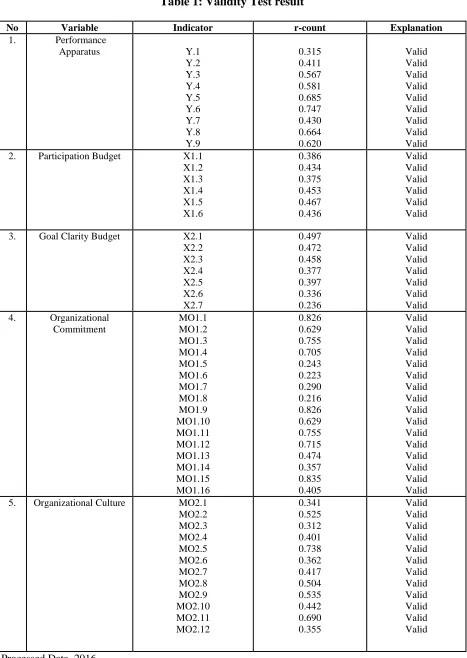
Test the validity shows r-count is greater than r-table then with df = 82 (84-2) means the r-table is 0.2146 so it can be concluded that all items of questions to measure each study variable declared invalid.
Table 1: Validity Test result
No Variable Indicator r-count Explanation
1. Performance
Apparatus Y.1
Y.2 Y.3 Y.4 Y.5 Y.6 Y.7 Y.8 Y.9 0.315 0.411 0.567 0.581 0.685 0.747 0.430 0.664 0.620 Valid Valid Valid Valid Valid Valid Valid Valid Valid 2. Participation Budget X1.1
X1.2 X1.3 X1.4 X1.5 X1.6 0.386 0.434 0.375 0.453 0.467 0.436 Valid Valid Valid Valid Valid Valid
3. Goal Clarity Budget X2.1 X2.2 X2.3 X2.4 X2.5 X2.6 X2.7 0.497 0.472 0.458 0.377 0.397 0.336 0.236 Valid Valid Valid Valid Valid Valid Valid 4. Organizational Commitment MO1.1 MO1.2 MO1.3 MO1.4 MO1.5 MO1.6 MO1.7 MO1.8 MO1.9 MO1.10 MO1.11 MO1.12 MO1.13 MO1.14 MO1.15 MO1.16 0.826 0.629 0.755 0.705 0.243 0.223 0.290 0.216 0.826 0.629 0.755 0.715 0.474 0.357 0.835 0.405 Valid Valid Valid Valid Valid Valid Valid Valid Valid Valid Valid Valid Valid Valid Valid Valid 5. Organizational Culture MO2.1
MO2.2 MO2.3 MO2.4 MO2.5 MO2.6 MO2.7 MO2.8 MO2.9 MO2.10 MO2.11 MO2.12 0.341 0.525 0.312 0.401 0.738 0.362 0.417 0.504 0.535 0.442 0.690 0.355 Valid Valid Valid Valid Valid Valid Valid Valid Valid Valid Valid Valid
Based on the results of testing the reliability of the data shows that cronbach`s alpha value of each variable studied is greater than 0.70. This indicates that the instrument is reliable.
Table 2: Reliability Test result
Variable Cronbach’s
Alpha Limit Reability Explanation
Performance Apparatus 0,700 0,70 Reliable
Participation Budget 0,765 0,70 Reliable
Goal Clarity Budget 0,856 0,70 Reliable
Organizational Commitment 0,736 0,70 Reliable
Organizational Culture 0,729 0,70 Reliable
Source: Processed Data, 2016
4.3 Regression Analysis
Before testing moderation regression analysis, test results of the classical assumption of normality test, heteroscedasticity and multicollinearity produces that normality test results show the value of the Kolmogorov-Smirnov with Asymp.Sig. (2-tailed) were above α = 0.05 so it can concluded that the data were normally distributed. Heteroskedasitisitas test results shows the dots spread randomly, does not form a specific pattern is clear, and spread both above and below zero on the Y axis, the test does not occur heteroskedastisitas. The test results showed VIF multikoleniaritas not more than 10 and the value of tolerance of not less than 0.1, so it does not happen multicolinearity.
Table 3: Moderation Regression Test Results
Dependent Variable: Performance Apparatus
Source : Processed Data, 2016
The test results directly influence the participation coefficient obtained a budget of 0.502 with a significance of 0.000 (<0.05), so it can be concluded that the budget participation on the performance of the apparatus. The results of this study supported research conducted by Schuler & Kim (1976), Brownell (1982b), Brownell & McInnes (1986), Cahyadi (2015), Sari et al (2014), and Nurhalimah (2013) Budget participation significant effect on performance.
Based on Theory of Planned Behavior (TPB), the connection with budgetary participation is that the participation of the apparatus is a manifestation of behavior. Budgetary participation is the participation of individuals in the form of behavior, work, and activities by the government apparatus during the budget preparation process takes place. With direct involvement in the budgeting process, officials are given the opportunity to actualize themselves which in turn explores their ability to set goals and objectives reflected in the budget. This process will lead to a greater sense of responsibility for achieving the things that are targeted in the budget which means performance improvement.The higher the forces participating in the preparation of the budget, it will further enhance the performance of the apparatus.
4.3.2 Clarity Influence on Performance Targets Budget Officers
The test results obtained directly influence budget goal clarity coefficient of 0.987 with a significance of 0.002 (<0.05), so it can be concluded that the budget goal clarity on the performance of the apparatus. The results of this study are supported by research conducted by Kenis (1979), Shelly et al (2014) stating that clarity of budget targets has a significant effect on performance. Local government budget targets should be clearly stated, specific and understandable to those responsible for carrying them out. With clarity of budget objectives, it will encourage the officers to be responsible for each task that diembannya so that will improve its performance. According to Goal Setting Theory, someone who is able to understand the goals expected by the organization, then the understanding will affect the behavior of his work. The clarity of the budget objective is the extent to which the budget objectives are clearly defined and specific with the aim that the budget can be understood by the person responsible for achieving that goal.
4.3.3 Participation Influence on Performance Budget Officers with Organizational Commitment as Variable Moderation
The variable interaction between budgetary participation and organizational commitment to providing value coefficient of 0.010 with 0.039 significance (sig <0.05) so that it can be concluded that moderate organizational commitment variable budget participation on the performance of the apparatus. The results of this study are in line with the results of research conducted by Sardjito & Muthaher (2007) stating that organizational commitment strengthens the influence between budget participation on apparatus performance.
Based on goal setting theory, budget participation can increase subordinate commitment to budget objectives. The opportunity to be involved and influential in the budgeting process will increase the trust of the authorities and have ego involvement with the organization, so that the apparatus will be more receptive and committed to budget decisions. Commitment that an officer will provide emotional bond and feel an obligation in its organization, so that officials are motivated to do the right thing for the organization, including participating in the preparation of the budget.
4.3.4 Clarity Influence on the Performance Targets Budget Officers with Organizational Commitment as Variable Moderation
The variable interaction between budget goal clarity and organizational commitment gives the coefficient of 0.079 with 0.003 significance (sig <0.05) so that it can be concluded that variable of organizational commitment moderates the budget goal clarity on the performance of the apparatus. The results of this study are in line with the results of research conducted by Sari et al (2014) and Arifin (2012) which states that there is an influence between organizational commitment which is the belief and strong support to the value and target to be achieved.
will affect its actions and affect its performance consequences. If the budget objectives are clear, then the achievement of the objectives (goals) set can be viewed as the goal/level of performance to be achieved by individuals. Officers felt the budget target will obviously be more responsible if it is supported by the commitment of high officials about government organizations, so that will encourage officials to work with the best.
4.3.5 Participation Influence on Performance Budget Officers with Cultural Organization as Variable Moderation
The variable interaction between budgetary participation and organizational culture provides coefficient value of 0.027 with 0.000 significance (sig <0.05) so that it can be concluded that the organizational culture variables moderate budget participation on the performance of the apparatus. A strong culture will have a great influence on individual behavior and participation in budgeting more effective if decisions are important in organizations more often made by groups.
4.3.6 Clarity Influence on the Performance Targets Budget Officers with Cultural Organization as Variable Moderation
The variable interaction between budget goal clarity to the organizational culture gives the coefficient of 0.604 with a significance of 0.000 (sig <0.05) so that it can be concluded that moderate the organizational culture variable budget goal clarity on the performance of the apparatus. Behavior is part of the culture associated with the performance because by behaving someone will be able to obtain what is desired and budget goal clarity will help the authorities to achieve the expected performance.
5. Conclusion
Based on these results it can be stated that budget participation and budget goal clarity significantly affect the performance of personnel, organizational commitment moderates the effect of budget participation and budget goal clarity to performance and organizational culture apparatus moderating influence of budget participation and budget goal clarity on the performance of the apparatus.
Implications this study can at least motivate further research, especially related to the performance of government officials. Organizational culture factors and organizational commitment are likely to be conditional factors that must be considered in order to improve organizational effectiveness. This factor is important in the condition of globalization era that is full of environmental uncertainty.
Limitations this research is proposed some of the limitations of research that is expected to be a guide of development by future researchers. It is realized that this study has limitations that the authors include only two moderating variables that moderate the relationship of budget participation and clarity of budget targets on apparatus performance that is organizational commitment and organizational culture. Allegedly, there are other factors that moderate the relationship of budget participation and clarity of budget targets on the performance of the apparatus.
References
i. Allen, NJ & Meyer JP 1990, ‘The Measurement of Antecedents of Affective, Continuance,and Normative Commitment to the Organization’, Journal of Occupational psychology, 91,pp. 1-18.
ii. Allen, NJ & Meyer JP, 1991, ‘A Three-Component Conceptualization of Organizational Commitment’, Human Resource Management Review, 61-89.
iii. Bangun Andarias, 2009, ‘Pengaruh Partisipasi Penyusunan Anggaran, Kejelasan Sasaran Anggaran Dan Struktur Desentralisasi Terhadap Kinerja SKPD Dengan Pengawasan Internal Sebagai Variabel Pemoderasi (Studi Kasus Pada Pemerintahan Kabupaten Deli Serdang, Tesis. Sekolah Pascasarjana Universitas Sumatera Utara.
iv. Brownell, P, 1982b, ‘A Field Study Examination of Budgetary Participation and Locus of Control’, The Accounting Review, Vol. LVII (4), October: 766-777.
The Acccounting Review, Vol. LXI(4). October: 587-600.
vi. Cahyadi Mangunjung, 2015, ‘Pengaruh Partisipasi dan Kejelasan Sasaran Anggaran terhadap Kinerja
Apartur Daerah dengan Budaya Siri’ Na Pacce sebagai Variabel Moderasi. Tesis. Universitas Hasanuddin Makassar.
vii. Cherrington, DJ & JO, Cherrington, 1973, ‘Approriate Reinforeement Contingencies in The Budgeting Process, Journal of Accounting Research (Supplemen), pp. 225- 253.
viii. Hofstede G. Neuijen, B. Ohavy, DD, & Sanders G, 1990, ‘Measuring Organization Culture: A Qualitative and Quantitative Study Across Twenty Cases’, Administrative Science Quarterly, Vol 35. pp. 286-316
ix. Hofstede, Geert, Michael Harris B, & Chung Leung L,1993, ‘Individual Perceptions of Organizational Cultures : A Methodological Treatise on Level of Analysis’, Organizational Studies. 14/4, 483-503. x. Holmes, Scott & Mersden, Stephen, 1996, ‘An Exploration of The Espoused Organizational Cultures of
Public Accounting Firms’, Accounting Horizons. Vol 10, Nomor 3 September, pp 26-53.
xi. James, Fransiskus, & Suwandi. 2009, ‘Pengaruh Partisipasi penyusunan anggaran Terhadap Kinerja Manajerial: Pengetahuan Tentang Manajemen Biaya sebagai Variabel Moderasi’, Kajian Akuntansi ISSN: 1979-4886, Hal 84-89.
xii. Kenis, 1979, ‘Effects on Budgetary Goal Characteristic on Managerial Attitude and Performance’, The
Accounting Review LIV (4). 707-721 (diunduh 6 Januari 2016, dari http://www.jstor.org.
xiii. Latham, G. P., & Locke, E. A, 1979, ‘Goal Setting-A Motivational Technique That Works’, Organizational Dinamics. Autumn. 68-80.
xiv. Locke, E.A, 1968, ‘Toward a Theory of Task Motivation and Incentives’, Organizational Behavior and
Human Performance, pp. 157-189.
xv. Mahoney, T. A., T. H. Jerdee & S. J. Carroll, 1963, ‘Development of Managerial Performance: A Research Approach’, Cincinnati: South Western Publ. Co.
xvi. Milani, K, 1975, ‘The Relationship of Participation in Budget-Setting to Industrial Supervisor Performance and Attitudes : A Field Study’. The Accounting Review 50,
xvii. April.
xviii. Nurhalimah, 2013, ‘Pengaruh Partisipasi Penyusunan Anggaran dan Kejelasan Sasaran Anggaran terhadap Kinerja Aparatur Perangkat Daerah di Pemerintah Aceh’, Jurnal Teknik Sipil. ISSN 2302-0164 pp. 27-36.
xix. Porter, L.W.,R. M, Strees, R.T. Mowday, & P.V. Boulian, 1974, ‘Organizational Commitment in Satisfaction, and Turnover Among Psychiatric Technicians’, Journal of Applied Psychology 59: 603-609.
xx. Robbins, Stephen P & Timothy A. Judge, 2008, ‘Perilaku Organisasi’. Salemba Empat, Jakarta.
xxi. Sardjito, & Muthaher, 2007, ‘Pengaruh Partisipasi Penyusunan Anggaran Terhadap Kinerja Aparat Pemerintah Daerah: Budaya Organisasi dan Komitmen Organisasi Sebagai Variabel Moderating’, Simposium Nasional Akuntansi X. IAI.
xxii. Sari, Adiputra, & Yuniarta, 2014, ‘Pengaruh Pengaruh Partisipasi Penyusunan Anggaran terhadap Kinerja Aparat Pemerintah Daerah dengan Kepuasan Kerja dan Komitmen Organisasi Sebagai Variabel Moderating’, E-journal S1 Akuntansi Universitas Pendidikan Ganesha, Vol 2, Nomor 1 Tahun 2014.
xxiii. Schuler, R.S., & J.S. Kim, 1976, ‘Interactive Effect of Participation in Decision Making, the Goal Setting Process and Feedback on Employee Satisfaction and Performance’, Academy of Management Procedings, pp. 144-117.
xxiv. Shelly, Emrinaldi, & Julita, 2014, ‘Pengaruh Partisipasi Anggaran, Kejelasan Tujuan Anggaran Terhadap Kinerja Aparat Pemerintah Daerah : Komitmen Organisasi, Budaya Organisasi Dan Locus Of Control Sebagai Variabel Moderating’, JOM FEKON Vol 1 No. 2 Oktober 2014.
Tanjungpinang’
xxvi. Syafrial, 2009, ‘Pengaruh Ketepatan Skedul Penyusunan Anggaran, Kejelasan Sasaran Anggaran dan