Fall 2018
Implementation of an Information Security Program for a City
Implementation of an Information Security Program for a City
Government
Government
Minh Tran
Iowa State University, [email protected]
Follow this and additional works at: https://lib.dr.iastate.edu/creativecomponents
Part of the Information Security Commons, and the Risk Analysis Commons
Recommended Citation Recommended Citation
Tran, Minh, "Implementation of an Information Security Program for a City Government" (2018). Creative Components. 110.
https://lib.dr.iastate.edu/creativecomponents/110
by
Minh Duy Tran
A creative component submitted to the graduate faculty
in partial fulfillment of the requirements for the degree of
MASTER OF SCIENCE
Major: Information Assurance
Program of Study Committee: Doug Jacobson, Major Professor
The student author, whose presentation of the scholarship herein was approved by the program of study committee, is solely responsible for the content of this creative component. The Graduate College will ensure this creative component is globally
accessible and will not permit alterations after a degree is conferred.
Iowa State University
Ames, Iowa
2018
TABLE OF CONTENTS
Page
LIST OF TABLES ... iv
NOMENCLATURE ... v
ABSTRACT ... vi
CHAPTER 1. INTRODUCTION ... 1
Problem Statement ... 2
CHAPTER 2. PROJECT GOALS AND EXPECTED OUTCOMES ... 4
Objective 1: Understand the Current State of Security ... 5
Objective 2: Strengthen the Existing Information Security Operations ... 6
Objective 3: Improve the Information Risk Management Process ... 7
CHAPTER 3. DESIGN AND IMPLEMENTATION ... 9
Task 1.1: Conduct Information Security Awareness and Knowledge Survey ... 9
Results of the Information Security Awareness and Knowledge Survey ... 10
Task 1.2: Determine Potential Areas of Risk ... 13
Task 1.2.1: Evaluation of Information Security Policies and Procedures ... 13
Task 1.2.2: Assessment of Information Security Awareness Training ... 15
Task 1.2.3: Analyze the Current Information Technology Infrastructure and Examine Existing Information Security Controls ... 20
Task 2.1: Establish Formal Information Security Goals and Strategy and Gain Sponsorship and Commitment from Senior Management ... 21
Task 2.2: Build a Resilient Information Security Culture ... 24
Task 3.1: Evaluate and Select Risk Management Framework ... 25
COSO Enterprise Risk Management ... 26
COBIT Risk IT Framework ... 26
ISO 27005 Information Security Risk Management ... 27
NIST Risk Management Framework ... 27
CHAPTER 4. CONCLUSION AND FUTURE WORK ... 30
Future Work ... 31
REFERENCES ... 33
APPENDIX A. INFORMATION SECURITY SURVEY ... 34
APPENDIX B. INFORMATION SECURITY SURVEY RESULTS ... 37
APPENDIX C. ACCEPTABLE USE OF TECHNOLOGY POLICY ... 40
APPENDIX E. INFORMATION SECURITY TRAINING ... 48
LIST OF TABLES
Page
Table 1 Survey Results by Category ... 10
Table 2 Survey Results by Departments ... 11
Table 3 Survey Results by Tenure Length ... 13
Table 4 Survey answers to: “Have you attended an information security
training in the past year?” ... 17
NOMENCLATURE
City refers to the subject city and/or the decision-makers who represent the City, which
can include management and/or the Information Security Team.
Enterprise Security Operations Department or Information Security Team or Team
refers to the team of current City employees who work in information security operations.
information security program (lowercase) refers to any information security operation in general, not specific to the subject City’s Information Security Program.
Information Security Program (capitalized) or Program refers to the business initiative at the subject City under which the Information Security Team operates.
ABSTRACT
The City is a fast-growing city located on the northern edge of a metropolitan
area. Its rapid growth is accompanied by increased demands from residents, local
businesses, and other private and public institutions. To provide sufficient services and
meet the high demands of its constituents, the City has responded by increasing its output
through the expansion of its administration, such as the creation of new departments,
projects, and initiatives. As a result, the Enterprise Security Operations Department has
been developed to ensure information used, stored, and processed by the City is protected
against adversaries. However, as the Enterprise Security Operations Department is still
in its infancy, there are currently no goals or strategies to guide its operations. This
resulted in a lack of an information risk management process, poor security practices and
culture, and failure to understand the organization’s true security posture. The purpose of
this project is to establish a formal Information Security Program with well-defined
goals, strategies, and future roadmap through the following objectives: 1) understand the
current state of security for the City; 2) strengthen the information security operations;
and 3) improve the risk management process. Accomplishing these objectives will
contribute to creating a solid information security foundation that the City can apply and
build upon as the program matures.
CHAPTER 1. INTRODUCTION
Located on the northern edge of a metropolitan area, the City stretches across 89
square miles and is the seat of its respected county. The City has an estimated population
of 140,000 residents in 2017, with projections to grow over 210,000 residents by 2030. It
is a full-service city that is operated by a council-manager governmental structure with a
mission to create an environment where quality services and products are provided
through leadership and innovation; stakeholder, peer group, and citizen collaboration; and
sustainable and efficient use of resources. The City provides its residents with
municipally-owned electric and water utilities, along with many other common city
services, such as public transportation, parks and recreation, airport, animal control,
building and community development, consumer health, police, libraries, and waste
management. Its main sources of revenue come from property taxes, enterprise fees from
municipally-owned utilities, and general service fees. The City is also home to two state
universities.
To accommodate for the services it provides for residents, local businesses, and
other private and public institutions, the City currently employs over 1,600 staff members
from a multitude of operational areas and departments. These resources work together in
an action-oriented strategic plan to accomplish initiatives and goals that fall under five
key focus areas: 1) organizational excellence; 2) public infrastructure; 3) economic
development; 4) safe, livable, and family friendly; and 5) sustainable and environmental
stewardship. These five key focus areas define what the City is about, where they aim to
In order to successfully implement its strategic plans and carry out its mission, the
City must have a mechanism in place to manage any risks that may be presented, and
minimize the window of opportunity for failures in achieving its goals. The City, like
any modern organization, stores, uses, and exchanges information among its employees,
internal departments, and external third-party vendors and contractors in its day-to-day
operations. This information consists of different levels of sensitivity, up to and
including private personal information and confidential business information, such as
Personally Identifiable Information, financial information, Protected Health Information,
and information used to operate industrial control systems for the municipal utility
services that the City provides.
Information can be created, used, stored, destroyed, processed, transmitted,
corrupted, lost, or stolen. Like all important business assets, information is an asset that
has value to an organization; and therefore, should be suitably secured and protected.
Because the use of information is such a critical piece to the success of any modern
organization, the inability to properly secure and protect such critical information
presents a substantial risk to the business. As such, many organizations develop an
information security program with a strategy that supports and aligns to its business goals
and objectives through the protection of its information assets. The purpose of the
information security program is to provide the ability to preserve the confidentiality,
integrity, and availability of key information systems, applications, and data.
Problem Statement
Currently, the City’s Enterprise Security Operations Department, also known as
Electric Utility Department, one who supports the Water Utility Department, and two
who are responsible for information security within all other departments across the City.
The Information Security Team currently operates in an impromptu manner with no
strategic plan in place, no long-term goals, and no clear directions or guidance.
Consequently, the lack of such plan and roadmap resulted in a nonexistent information
risk management process, the inability to prioritize and adequately allocate resources, the
inconsistency of security-related tasks and actions taken across the enterprise, poor
security practices and culture; and ultimately, the failure to understand the organization’s
true information risk and security posture. This problem does not only affect the
Information Security Team, but the entire city government, its residents, business
partners, stakeholders, and all other constituents. Without a means to securely support
the increasing use of information technology and properly protecting critical information,
the organization’s overall information risk profile may extend past its risk tolerance level,
which could result in lost revenue and reputation, unavailability of critical public services
CHAPTER 2. PROJECT GOALS AND EXPECTED OUTCOMES
The overall goal of any information security program is to harden the computer
network infrastructure, reduce information-related risks, and improve the overall security
posture for the organization. As such, the goal of this project is to revamp the current
impromptu operations of the Enterprise Security Operations Department and implement a
formal Information Security Program with a strategy that supports the mission and
objectives of the City. Information security does not revolve around a single technology;
rather, it is a multi-layered approach comprised of the people, processes, and technology
necessary to prevent, detect, document, and counter threats to information (both in paper
form and electronic form) and the systems and media in which the information is being
stored, used, and transmitted. Information security is a continuous, ever-evolving process
that needs to respond to the constant changes of the business and the implemented
technologies.
Because information security is a continuous process, the ability to successfully
achieve the overall information security goal in its entirety is unlikely, if not ever
unattainable. Due to this and to the time constraints of a one-semester course, the scope
of this project will cover the following objectives:
1. Understand the present state of information security for the City, which includes
the City’s security culture, and employees’ level of awareness and knowledge on
protecting sensitive information.
2. Strengthen the existing information security operations and solidify its roadmap
for the future in order to better allocate resources in preparation for unexpected or
3. Improve the information risk management process to meet industry standards in
order to accurately identify the City’s current information risk profile and to allow
for on-going analyses throughout the entire risk lifecycle.
Each of these objectives plays an important role in the initialization of a robust, effective
information security program. The successful completion of these objectives will
contribute to creating a solid information security foundation that the Information
Security Team can apply and build upon as the program matures.
Objective 1: Understand the Current State of Security
To become cognizant of the current state of security for the City, an assessment of
the current information security operations will be conducted. The following tasks will
be performed as part of the assessment:
1. Conduct an information security awareness and knowledge survey on a random
sample set of employees. The survey will include questions to determine the
employees’ level of knowledge in common information security practices.
According to an information technology service provider, IT Governance,
employees are commonly perceived as a company’s biggest threat to security.
2. Determine potential areas of risk or deficiency through:
a. evaluating current information security policies and procedures, and their
level of enforcement;
b. assessing the content and effectiveness of required information security
trainings for employees; and
c. analyzing the current information technology infrastructure and examining the
These tasks will allow the organization to obtain a general perspective on the deficiencies
and shortcomings of the current information security operations, if any. Additionally, the
results will allow the organization to create an information security strategy that will be
better aligned with its business goals and objectives in order to meet the needs of the
business.
Objective 2: Strengthen the Existing Information Security Operations
Setting achievable goals and gaining executive management support are two
critical success factors for any business initiative. Since the Information Security Team
currently works in an improvised manner with no goals or strategies in place, it is
unlikely that the team will be able to obtain the support it needs from management.
Therefore, the tasks needed to satisfy this objective includes establishing a formal
information security strategy that will support the business needs and objectives of the
City. The strategy will outline the mission and goals of the Information Security
Program and how it plans to accomplish them. The strategy can be stated in the
Information Security Program charter, which will presented to City officials in order to
gain sponsorship and commitment from senior management to proceed with the program,
acquire necessary funding, and/or obtain authorization to utilize City assets and resources
as necessary.
Because this objective partly builds upon the first objective, the results of the
assessments conducted in Objective 1 will be one of the driving forces behind what the
Information Security Team determines as the best course of action to strengthen its
current operations. Depending on the level of deficiency shown from the survey results,
is oriented towards information security best practices, and help guide and educate
employees in their day-to-day operations through:
a. making appropriate changes to the information security policies and
procedures to better support the information security strategy, and obtain
support from senior management to enforce strict compliance; and
b. making appropriate changes to the information security awareness and
training program focusing on the areas of deficiency in order to increase its
effectiveness, in addition to establishing the required frequency that
employees must repeat the training.
Successfully achieving this objective will help the Information Security Team set a solid
path forward and build a robust and resilient information security program that is
prepared to withstand and defend against upcoming security challenges.
Objective 3: Improve the Information Risk Management Process
Information risk management is a critical process in every information security
program. Information risks can stem from systems, processes, and internal and external
constituents. Without understanding what risks the organization is facing, appropriate
controls cannot be implemented and management cannot effectively allocate security
resources in the right areas. Risk management can be formalized through evaluating and
adopting one of many risk management frameworks available from industry
standard-setting organizations, such as COSO (Committee of Sponsoring Organizations of the
Treadway Commission), COBIT (Control Objectives for Information and Related
Technologies), ISO (International Organization for Standardization) and NIST (National
or adopt an information security risk framework that is accepted by the industry, contains
steps and procedures that are repeatable, and can be used to accurately determine the
City’s current information security risk profile, as well as defining the City’s information
security risk appetite and tolerance levels. Leveraging an industry-accepted framework
for the information risk management process can also allow the City to perform on-going
risk analyses and provide the ability to effectively manage risks throughout its entire
CHAPTER 3. DESIGN AND IMPLEMENTATION
Task 1.1: Conduct Information Security Awareness and Knowledge Survey
The information security awareness and knowledge survey consists of 15
questions. Fourteen of the questions are categorized into five different information
security topics: 1) General Security; 2) E-mail/Phishing/Spam; 3) Sensitive Information;
4) Physical Security; and 5) Password/Access Control. One question is to determine
whether or not the respondent has attended an information security training session
provided by a member of the Information Security Team within the past year, which will
not be factored into determining the overall level of employees’ information security
knowledge. The survey questions are comprised of different formats, including multiple
choice, option, and true/false; and are designed to help the Information Security Team
determine how knowledgeable employees are in common information security practices
(see Appendix A). Separating the questions into different topical categories will allow
the team to get a general perception of the areas where the employees’ deficiencies
reside. Accordingly, this will help the team design more effective training materials by
placing higher emphasis on those areas.
The survey was distributed to a sample population consisted of 450 employees.
The sample population is randomly drawn from using a computer-generated list, which
produces a form of probability sampling where all City employees have equal chances of
being selected to take the survey. According to researchers at the National Institute of
Mental Health, survey results deriving from a random, probabilistic sampling
methodology produces a more accurate representation of the entire populations. The
provides management with a 95% confidence level that within a 10% margin of error, the
results of the survey is an accurate representation of the entire population of 1,679
employees. The City believes that this sample size is statistically significant and
adequate for the purpose of this study.
Results of the Information Security Awareness and Knowledge Survey
Since the survey questions were designed to test the most fundamental
information security knowledge, the City expects a 92% passing score for each
respondent and by each category in order to be considered acceptable. Based on this
criterion, the results of the survey were unsatisfactory as the average score for all
respondents is 82.34% and two of the five categories received an average score of less
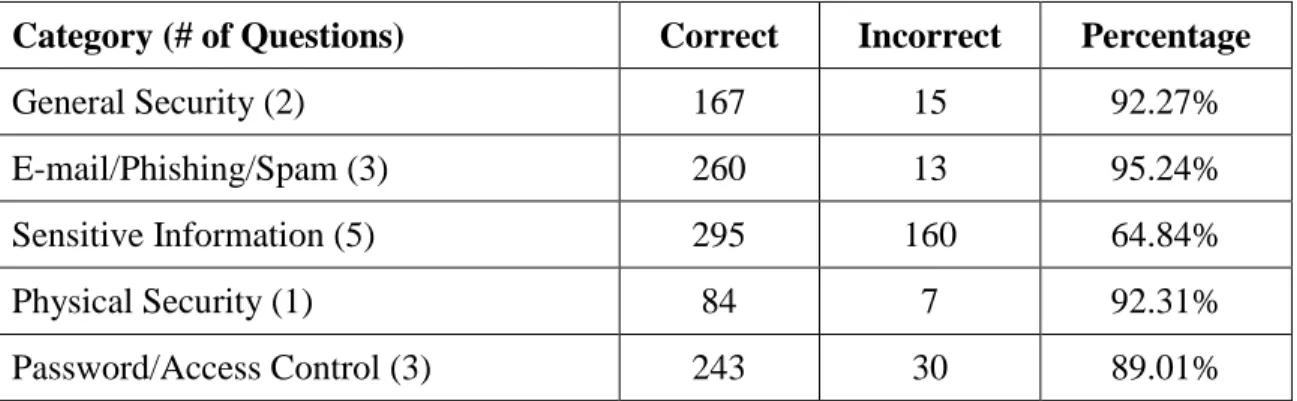
than 92%. When viewing the results from a categorical perspective, Sensitive
Information received the lowest score at 64.84% (see Table 1). What’s more alarming is
the fact that only 10 total respondents (11% of the sample population) being able to
correctly identify Personally Identifiable Information (see Question 2 in Appendix A).
This question may be the main reason for the low score received by the category. On the
other hand, the category with the highest score is E-mail/Phishing/Spam at 95.24%.
Table 1 Survey Results by Category
Category (# of Questions) Correct Incorrect Percentage
General Security (2) 167 15 92.27%
E-mail/Phishing/Spam (3) 260 13 95.24%
Sensitive Information (5) 295 160 64.84%
Physical Security (1) 84 7 92.31%
From a departmental perspective, departments that have less than three
respondents were excluded from these statistics to avoid any misrepresentation. The
survey results showed that employees who work in Electric Utility scored the highest on
average at 90.82%. Contrarily, employees from Capital Projects scored the lowest on
average at 69.64%, followed by Water Utility, Parks and Recreation, and Community
Development at 76.79%, 79.22%, and 80.95%, respectively (see Table 2). It is
recommended that the Information Security Team conduct interviews with managers
from these low-scoring departments to get a better understanding of how these
departments operate. The discussion topics should include:
1. Types of information processed and its level of sensitivity;
2. Other parties (internal or external) that this information is shared with;
3. Systems and applications that are used in the department, and whether its
homegrown or provided and supported by a third-party vendor;
4. Information flow and common data transmission or processing activities; and
5. Potential information security risks, if any.
The interviews will provide the Information Security Team with intuitive insight into
what types of information are being used, stored, and processed in each respective
department, what security measures are in place to protect such information from
malicious activities, what factors might have contributed to the low scores, and any
potential risks that need to be immediately addressed or further examined.
Table 2 Survey Results by Departments
Department Correct Incorrect Percentage
Water Utility (8 respondents) 86 26 76.79%
Parks and Recreation (11 respondents) 122 32 79.22%
Community Development (3 respondents) 34 8 80.95%
… … … …
Finance (3 respondents) 36 6 85.71%
Fire (3 respondents) 36 6 85.71%
Library (5 respondents) 60 10 85.71%
Information Technology (6 respondents) 72 12 85.71%
Electric Utility (7 respondents) 89 9 90.82%
Looking at the results from the perspective of tenure length, it is interesting to see
that those who have been employed at the City for less than one year have an average
score of 83.93% versus 82.19% for those who have been employed at the City for one
year or more (see Table 3). This slightly higher percentage achieved from newer
employees may be an indicator that the existing security culture is weak, which can be
caused by various factors. For instance, the City may not consider information security
as part of its core values or may not have adequately communicated security awareness
messages. In some cases, security has been communicated, but has not been widely
accepted, where longer-tenured employees have the mindset of resisting change and
staying with how the City has operated historically before the information age.
Conversely, the higher percentage achieved by newer employees may also indicate that
these employees have more extensive information security training from previous
employers or elsewhere. In any event, this suggests that it may be worth devoting time
and resources to update existing information security training and policies to foster a
Table 3 Survey Results by Tenure Length
Tenure Length Correct Incorrect Percentage
Less than one year 94 18 83.93%
One or more years 955 207 82.19%
Task 1.2: Determine Potential Areas of Risk
Task 1.2.1: Evaluation of Information Security Policies and Procedures
The City currently operates under two policies in the information technology
realm: Acceptable Use of Technology and E-mail Use (see Appendices C and D for
policy documents). The Acceptable Use of Technology policy outlines what is allowed
and prohibited with respect to the use of computer equipment and technology systems at
the City, in addition to who the policy applies to. This policy seems to be comprehensive
and covers many of the common areas, such as protecting sensitive information, data
encryption requirements, Internet and e-mail usage, and limited personal use of City
resources. The policy also has an Unacceptable Use section that discusses topics such as
prohibiting the use of personally-owned equipment for conducting official City business,
restricting the installation of unapproved computing software, and forbidding Internet
usage for conducting outside business or illegal activities. There is also a reference link
to information on social media usage within this policy, but the link was found to be
broken.
The E-mail Use policy discusses the proper use, access, disclosure, retention, and
disposal of e-mail messages created, sent, or received by City employees. This policy
explains that all information created or stored on the electronic mail system remain the
or disclose any messages on the system, and employees should not expect the right to
personal privacy from using the system. Similar to the Acceptable Use of Technology
policy, it outlines the unacceptable uses of the City-provided e-mail service. This
includes prohibiting the use of e-mail for non-business related matters, or to send graphic,
vulgar, or offensive content. Copyrighted materials, trade secrets, and other legally
privileged information are also prohibited to be included in e-mail messages without
proper authorization. This policy also outlines the State laws and requirements with
respect to protecting the integrity of confidential information in e-mails.
The two available policies seem to be thorough with respect to its subject matter.
Despite being comprehensive, the level of enforcement of these policies is deficient. The
Acceptable Use of Technology policy prohibits the use of personally-owned devices for
conducting official City businesses, yet the City allows employees to use their own
mobile phones and computers to read and send work emails, which means they also have
the ability to download and store City-owned information onto personal devices. Also,
the policy prohibits the installation of unapproved software on City-owned computer
equipment; however, a list of approved software is not provided to employees and any
employee with administrative privileges to their computers may install any software,
even those downloaded from the Internet. More stringent enforcement of policies will
make them more effective in meeting their intentions and reducing the chances of
undesirable outcomes.
With the global rise in social media usage, it is prudent that the City create a
policy for social media, or fix the broken link to its existing social media policy, if
and personal time, and help employees understand their responsibilities and commitments
towards the City even after business hours. Additionally, it is recommended that the City
establish a policy for external media usage to cover what is permitted and prohibited with
regards to using external storage devices on or within the City’s computer networks, as
the use of such devices has become considerably common. These devices include flash
drives (also known as USB or thumb drives), mobile phones, digital music players, and
any other external devices that can store or transmit data. Furthermore, since employees
are responsible for creating and setting their own computer and network passwords,
creating policies for proper password usage and protection, in addition to providing
guidelines for constructing strong passwords, would help employees understand how to
protect their passwords, what makes a good password, and the important role strong
passwords play in keeping computers and networks secured.
Documented procedures for common information technology and information
security processes were not found. Without such documents, inconsistent practices may
occur across each city department. This may lead to difficulty in managing
enterprise-wide information technology and security processes, wasteful resource expenditures,
and/or inefficiencies in the operation and security of information technology.
Task 1.2.2: Assessment of Information Security Awareness Training
Information security training is currently being instructed by one member of the
Information Security Team through means of visiting each of the city departments and
presenting a set of PowerPoint slides. The information security training covered the
following four topics (see Appendix E for training presentation slides):
a. Password complexity requirements,
b. Vulnerabilities of weak passwords and how they are exploited, and
c. Proper ways to manage passwords;
2. Phishing, which discusses:
a. Statistics on global phishing threats,
b. Trends and new targets of phishing,
c. A real phishing incident that occurred at the City, and
d. Ways to detect phishing e-mails (what to look for and other items to note);
3. Social Media, which discusses:
a. How attackers use the information posted online; and
4. Applicable laws and regulations, which discusses:
a. Federal, state, and local laws that apply to the City, and
b. Consequences of noncompliance.
Based on reviewing the presentation slides, it can be concluded that the depth of the
materials presented in each of the four topical areas is very shallow.
When training is scheduled, attendance is said to be mandatory. However, there
is no enforcement as seen from the survey results (see Table 4), where only 22 applicable
respondents (26.51%)—those who have been with employed at the City for one year or
more—have attended an information security training session within the past year. A
whopping 61 applicable respondents (73.49%) stated that they have not attended a
training session within the past year; of those, 14 (16.87%) did not know such training
even existed. This data indicates that enterprise-wide security communications are
Eight (8.79%) total respondents have been employed at the City for less than one year;
thus, were excluded from this specific statistic. The results of the survey also indicate
that the training slightly improve the overall score as the average score of respondents
who attended the training is only about 3.5% higher than those who did not attend the
training. Nevertheless, the training is ineffective in achieving the desirable level of
security awareness and knowledge—which is 92%—as the overall average score for
respondents who have taken the training is only 84.74% (see Table 5).
Table 4 Survey answers to: “Have you attended an information security training in the
past year?”
Yes No Didn’t Know
Training Existed N/A Attendance Rate
22 47 14 8 26.51%
Table 5 Survey Results by Security Awareness Training Attendance
Correct Incorrect Percentage
Attended Training 261 47 84.74%
Did not Attend Training 694 160 81.26%
Because everyone has a different learning method, the City may wish to modify
the format of the training to increase its overall effectiveness, such as moving to a
computer-based training or requiring employees to pass a short quiz after each topic
presented. It is also recommended that the City expand the depth of information
presented in each of the topical area, especially in social media usage. As previously
stated, with the increase in social media usage globally, employees need to be cautious of
sites. For example, to protect the City’s reputation, information posted on Facebook
should be made clear that it is one’s own opinion, and not representative of the City.
Also, only general information on work experience, not specific system brands and
models (Palo Alto, Cisco, Norton, Windows, etc.), should be posted on LinkedIn as
attackers can target the vulnerabilities of such systems on the employer’s computer
networks. These are only two examples of the countless ways that improper social media
usage can hurt employees and/or the companies they work for.
To offer a more comprehensive information security awareness training, it is
advisable that the City also include the following topics in the training to increase the
breadth of the overall training:
1. Information Protection
Introduce employees to the different types of information processed by and within
each of the departments, such as Confidential Information, Internal Use Only,
Personally Identifiable Information, Protected Health Information, etc., and the
laws and regulations for properly protecting each type, including using, storing,
processing, disposing, and retaining.
2. Social Engineering
Government employees are social engineering targets for many reasons, including
financial, political, terrorism, and nation-state spying, etc. Employees need to
understand that social engineering attacks target the human factor, not any
specific technology. Due care must be taken to avoid sharing too much
information with outsiders, especially at external events, conferences, and even
3. Mobile Devices
Many City employees use mobile phones, tablets, and laptops (personally- and
City-owned) to read, compose, and send work e-mails. Because of this, sensitive
information is likely to exist on such devices. It is important to understand that
these mobile devices are also targets of attacks, and employees must protect these
devices in the same manner as they would for their work computers. It is also
important for employees to recognize attacks specifically targeting mobile
devices, such as phishing attacks through SMS text messaging (also called
smishing).
4. Physical Security
Spending a lot of resources to implement electronic safeguards can be pointless if
the public has physical access to the City’s server rooms, data centers, and offices
where sensitive information is processed. It is essential that employees
understand the importance of physical security to prevent incidents such as
tailgating (following an authorized individuals into a secure area) and shoulder
surfing (viewing sensitive, need-to-know information on monitor screens or
keyboards). Employees should also be educated on the importance of locking
computer workstations, adhering to visitor policies, and keeping printed
information safe and secure at all time.
Every city department works in different environments and processes different types of
information with different levels of sensitivity. Educating employees on the security
measures of different operational areas will help heighten employees’ levels of security
Task 1.2.3: Analyze the Current Information Technology Infrastructure and Examine Existing Information Security Controls
The purpose of this analysis is to preliminarily determine potential areas of risks
or deficiencies within the City’s computing networks, information systems, applications,
and related assets, as well as examining the information security controls that are
currently implemented. Controls may be administrative, operational, technical, or a
combination thereof. Administrative controls can include enforcing corporate policies,
but the control may be made more rigorous by tying it with the implementation of an
operational or technical control. Operational controls include security training and
building a strong culture around the protection of sensitive information. Technical
controls can include the implementation of an application that can prevent controlled
information from leaving the City’s computer networks or from leaving an electronic
storage area of different sensitivity level. For example, the City may enforce a policy
that prohibits the use of cloud storage. Training may further reinforce the requirements,
and the implementation of a data loss prevention tool may detect and block sensitive data
from egressing out of the City’s internal network. Effective controls implementation will
reduce risks to a tolerable level.
Similar to an information systems audit, this task can be very valuable in
determining the risks from a technical/systems standpoint. However, the City has
requested that this task be withdrawn from the project due to a possible violation of City
policies. The City stated that it will be doing its own internal assessment of the system at
Task 2.1: Establish Formal Information Security Goals and Strategy and Gain Sponsorship and Commitment from Senior Management
To be a valuable asset to the organization, a business initiative must support the
goals, objectives, and strategies of the organization. As such, the Information Security
Program has developed the mission to support the strategic goals and objectives of the
City by safeguarding key information systems, networks, applications, and data to
minimize adverse impact from unauthorized disclosure, use, modification, loss, or
damage caused intentionally or unintentionally. The Information Security Program has
devoted to operate on the following basis:
1. Ensure the confidentiality of information such that the information is only
accessible by authorized persons and protected from unauthorized use and
disclosure;
2. Ensure the integrity of information such that the information maintains its
accuracy, reliability, and completeness during its use, storage, and transmission;
and
3. Ensure the availability of information such that information is accessible to
authorized persons when required.
The goals of the Information Security Program are to reduce information-related risks,
improve the overall security posture, and promote growth and productivity for the City.
As the use of information technology is substantial in all operating areas of the City,
accomplishing these goals will provide a safe and secure computing environment
necessary for the City to carry out its strategic plans and fulfill its mission. The
Information Security Program has committed to support the goals and objectives of the
1. Build relationships with all City departments and business units.
The Information Security Team must not only work amongst its team members,
but it is imperative that the team work closely and build rapport with each and
every business unit throughout the City. Partnership and relationship building is
key to understanding and gaining visibility into every operational area of the City
in order to meet customer needs and expectations, accommodate emerging
technologies, and maintain regulatory compliance. Security must not be barrier,
but must support each internal initiative by enabling them to work in a safe and
secure method.
2. Strengthen security-related communications.
Strong communication is vital in disseminating important information regarding
security trends, requirements, and awareness. Communication can be
strengthened through designing and implementing a Security Champion Program,
which identifies employees from various departments who demonstrate security
competency to act as stewards of the security awareness message. The champion
will be the link between the Information Security Team and their respective
department. Because effective communication is reciprocal, champions will not
only communicate security information to their departments, but will also raise
issues and concerns from their departments to the attention of the Information
Security Team.
3. Cultivate and promote a strong security culture.
Culture is the mindset of the organization, one that is integrated into its
to incorporate information security best practices into all areas of the City’s
operations. Fostering a strong security culture can be successful through clear
communications; delivering periodic, consistent, and relevant information
security awareness and training topics; and executing strict enforcement of
policies. A strong security culture will also reduce human error, which makes up
95% of all security-related incidents, according to a 2014 study conducted by
IBM Corporation.
4. Identify and reduce information-related risks.
Determining the risk posture, risk appetite, and risk tolerance level is critical to
any information security operation. Through a continuous risk management
process, the Information Security Team can identify what information security
risks the City faces, and allows for preparation, prioritization, and adequate
allocation of resources to implement the appropriate security controls necessary to
respond to incidents and defend against attacks.
5. Establish key performance indicators.
Creating relevant metrics and key performance indicators that directly tie to the
City’s key initiatives and focus areas will ensure that the Information Security
Program becomes one of the City’s core values and part of the overall strategy. It
will also provide useful information for all stakeholders to demonstrate the
effectiveness of the Information Security Program in achieving its objectives and
The Information Security Program’s strategic objectives have been included in the
program charter (see Appendix F), which is currently under review and pending approval
by the City Manager’s office.
Task 2.2: Build a Resilient Information Security Culture
Work culture can be described as a set of values, beliefs, thought process, or
attitudes of employees. It can also be considered the ideology or principles of employees,
which make up the “point of view” of an organization. Similar to changing a person’s
point of view, changing work culture can be very challenging, and can require persistent
and strenuous efforts. As such, successfully fostering a security-oriented work culture for
the City will take more time than the scope and time constraints of this one-semester
project will allow. Alternatively, recommendations will be provided to the City for
future implementation, as this task is also part the Information Security Program’s
long-term strategic objectives.
The following list provides recommended actions required to reshape the City’s
work culture based on the assessment results from previous tasks. Details of these
recommendations have been provided in the previous sections above (see Tasks 1.1 and
1.2).
Recommendation 1: Gain more insight of the operations of departments that
scored low on the Information Security Awareness and Knowledge survey.
Recommendation 2: Implement more stringent enforcement of information
Recommendation 3: Create policies applicable to social media usage; external
media and storage device usage; and proper password usage and protection.
Recommendation 4: Provide guidelines for constructing strong passwords.
Recommendation 5: Document procedures for common information technology
and information security processes that occur frequently.
Recommendation 6: Improve security-related communication and implement
more stringent enforcement on mandatory security awareness training attendance.
Recommendation 7: Expand the breadth and depth of training materials by adding
more relevant content to each topic, as well as adding topics on Information
Protection, Social Engineering, Mobile Devices, and Physical Security.
Recommendation 8: Increase training effectiveness through the possibility of
changing the method of training, such as requiring employees to pass a short quiz
or increase the frequency of training.
Recommendation 9: Establish valuable key performance indicators to position
information security as a core value for the City.
Task 3.1: Evaluate and Select Risk Management Framework
Four globally-recognized standards were considered in the City’s evaluation of
available risk management frameworks: COSO Enterprise Risk Management (managed
by the American Institute of Certified Public Accountants), COBIT Risk IT Framework
(managed by ISACA), ISO 27005 Information Security Risk Management, and NIST
Risk Management Framework. The strengths and weaknesses of each framework in
COSO Enterprise Risk Management
Strengths:
1. Identifies and manages cross-enterprise risks
2. Aligns risk appetite and business strategy
3. Scalable and adaptable to organizations of any size
4. Complements the COSO’s Internal Control Framework
5. Identifies and evaluates responses to risks
Weaknesses:
1. Developed for enterprise-level risks, but more concentrated on financial risks.
2. Only a small subset is focused on information security risks.
COBIT Risk IT Framework
Strengths:
1. Manages risks associated with the use of information technology
2. More practical and robust as it focuses on processes, rather than functions or
applications
3. Globally-accepted in auditing standards and can be used as an authoritative source
reference document
Weaknesses:
1. Focuses more on enterprise information technology governance, rather than
providing a risk framework
2. Widely scoped to include all IT management processes, many modules do not
apply to the objectives of the Information Security Program
3. Difficulty in implementation due to its large coverage area, which can lead to
ISO 27005 Information Security Risk Management
Strengths:
1. Respected and adopted by organizations of all sizes globally
2. Designed to assist in the implementation of an information security program
based on a risk management approach
3. While limited in scope (only pertains to information risks), it could be seen as a
strength specifically for what the Information Security Program is trying to
achieve
4. Models a continuous, on-going process, consisting of a structured sequence of
activities, to identify, prioritize, and respond appropriately to risks, also known as
“security-by-design”
5. Creates other risk standards to help organizations define risk appetite and
tolerance level
Weaknesses:
No significant weaknesses
NIST Risk Management Framework
Strengths:
1. Similar to ISO in many aspects:
a. designed to assist in the implementation of an information security program
using a risk-based approach
b. pertains specifically to information risks
c. consists of a structured process that integrates information security and risk
d. provides other publications and guidance to help organizations define risk
appetite and tolerance levels
2. Nationally-recognized and accepted by the U.S. Federal Government to meet the
requirements of the Federal Information Systems Management Act of 2002
(FISMA) in protecting systems that process federal information
3. Integrates the formal systems certification and accreditation process that is used
extensively on a global scale
Weaknesses:
No significant weaknesses
While each framework satisfies the City’s requirements of being accepted by the
industry and containing a structured, repeatable process to manage risks, COSO’s
strengths are focused on financial risks and COBIT aims to provide a foundation for
information technology governance. Because the applicability of COSO and COBIT are
not specific to information security risk, the City determined that these two frameworks
may not meet the needs of the City; and thus, were eliminated from consideration.
On the other hand, both NIST and ISO provide a comprehensive risk management
framework specifically for managing information security risks. Additionally, both
organizations develop supplemental technical guidance to help organizations calculate
and determine their risk appetite and tolerance levels. Accordingly, both frameworks
remain highly comparable to one another in the selection process and offered the same
level of competencies with regards to the City’s requirements. In spite of this, the City
information security risk management process. Because all other qualifiers are equal
between the two frameworks, this decision was made mainly due to the fact that the NIST
standards are adopted by the U.S. Federal Government in protecting information and
CHAPTER 4. CONCLUSION AND FUTURE WORK
As the business environment evolves, the organization must make the appropriate
adjustments in response to the changes. With information technology shaping the way
business is conducted and making business operations more data-driven and
information-centric, it is crucial that the proper security measures are implemented to protect the
confidentiality, integrity, and availability of valuable information assets. The rapid
growth that the City is currently experiencing is forcing them to go through the same
growing pains. For that reason, the goal of this project is to help the City properly protect
its valuable information assets by establishing a formal Information Security Program,
with clearly-defined goals and objectives that align to the City’s overall strategies.
The success of this project is measured by the ability to accomplish the objectives
set out to establish a solid information security foundation, which consists of
understanding the present state of information security for the City, strengthening the
existing information security operations, and improving the information security risk
management process. The outcome of this project has proved its success by delivering the
following results:
1. Acquired a snapshot of the City’s present state of security. Through the tasks
completed, the City discovered that employees’ knowledge of common
information security practices were less than satisfactory, trainings and policies
are narrowly-scoped and insufficient, and enforcement of policy is loose. This
leads to a culture where information security is not highly regarded.
2. Formulated strategies for the Information Security Program to help the program
security awareness message across the enterprise. Support from senior
management is very important to the success of this initiative, and also provides
the opportunity to reshape the culture. Guidance and recommendations on
corrective actions were constructed to correct deficiencies and strengthen the
current processes, creating a fresh slate for the Information Security Program to
operate and build upon.
3. Adopted a process to continuously manage current and upcoming information
security risks. Rather than building its own risk management process, the City
was able to make an informed decision on the selection of an information security
risk management framework through a comparative evaluation of four different
globally-recognized risk management standards.
In conjunction with using the provided recommendations for correcting deficiencies,
these activities are necessary and play an important role in the initialization of a formal
Information Security Program for the City. The success of this project serves as the
initial stepping stone for developing a robust and effective program that the City can
continue to build upon in subsequent activities.
Future Work
A few tasks have been left for future work due to the scope and time constraints
of this project. One task that was not performed was the assessment of the information
technology infrastructure. This task was requested to be withdrawn from the project by
management due to a possible violation of City policies. Since this project has been
concentrated on the assessment of administrative and operational controls, an assessment
provide valuable insights on deficiencies and risks from a technical standpoint, and
would be a good starting point for future work.
Another important work that wasn’t included in this project is the implementation
of a formal risk management process. A formal risk management process is vital to the
success of any information security program. From the comparative evaluation, the City
has selected the NIST Risk Management Framework over three other globally-recognized
risk management standards. The next step is to bring this into fruition through proper
implementation.
This NIST Risk Management Framework provides continuous risk management
through six distinct steps: 1) Identify and Categorize Systems; 2) Select Security
Controls; 3) Implement Selected Controls; 4) Assess Selected Controls; 5) Authorize
System for Use; and 6) Monitor Security Controls. These steps ensure that the risk
management process is integrated into every information system across the enterprise.
Based on the categorization of the system (low-, medium-, or high-impact), NIST
provides appropriate security controls from its Special Publication 800-53 for the
organization to implement. The framework also helps the organization determine how
much risk is acceptable and provides guidance on assessing the effectiveness of the
controls, based on the impact and risk tolerance levels, and helps the organization
sufficiently allocate the right amount of resources to protect each system. The framework
also promotes near real-time risk management through its continuous monitoring
approach. Proper implementation and use of this framework will provide the City with a
REFERENCES
Elfil, M., & Negida, A. (2017). Sampling methods in Clinical Research; an Educational Review. Emergency, 5(1), e52. Retrieved from
https://www.ncbi.nlm.nih.gov/pmc/articles/PMC5325924/
Everson, M., Martens, F., Nottingham, L., & Steinberg, R. (2004, September). Enterprise risk management – Integrated framework [Executive summary]. Retrieved from
https://www.coso.org/Documents/COSO-ERM-Executive-Summary.pdf
IBM Corporation. (2014, June). IBM Security Services 2014 cyber security intelligence
index. Somers, NY: Author. Retrieved from
https://media.scmagazine.com/documents/82/ibm_cyber_security_intelligenc_20450.pdf
ISACA. (2012). COBIT 5: A business framework for the governance and management of
enterprise IT. Retrieved from
http://www.isaca.org/cobit/Documents/COBIT-5-Introduction.pdf
ISACA (n.d.). COBIT FAQs. Retrieved from
http://www.isaca.org/Knowledge-Center/cobit/Pages/FAQ.aspx
IsecT (2018). The ISO27k FAQ. Retrieved from
http://www.iso27001security.com/html/faq.html
National Institute of Standards and Technology. (2010, February). Guide for applying the Risk Management Framework to federal information systems, NIST Special Publication
800-37. Retrieved from http:/dx.doi.org/10.6028/NIST.SP.800-37r1
Samarati, M. (2016, November 15). Accidental or malicious insider threat: staff awareness makes the difference [Blog post]. Retrieved from
APPENDIX A. INFORMATION SECURITY SURVEY
1. [General] Who is responsible for information security?
a. Information Technology
b. My manager
c. Everyone including myself
d. The Information Security Team
2. [Sensitive Information] Personally Identifiable Information (PII) include (check all that applies):
a. Social Security Number
b. Birthdate with no other information
c. A combination of name, address, and birthdate
d. Address
3. [Sensitive Information] It is OK to store, save, and send PII and other sensitive information through (check all that applies):
a. DropBox (as long as it’s password-protected)
b. On my personal USB drive
c. E-mail
d. On the City’s “O” drive
e. Only on City’s approved data repository and applications
4. [Access Control] Passwords should be shared with (check all that applies):
a. Nobody
b. My manager
c. Contractors, such as Microsoft, who support the systems
d. Other members of my team
e. Only family members
5. [Access Control] It is OK to write down my password as long as it’s stored under my keyboard out of plain sight.
a. True
b. False
6. [Physical Security] When entering or exiting sensitive physical areas, each employee is required to scan his/her own badge.
a. True
7. [Access Control] It is OK to use my credentials to log into a City computer for someone else to use.
a. True
b. False
8. [E-mail] E-mail links and attachments received from people you know are always safe to open.
a. True
b. False
9. [Sensitive Information] Which of the following statements are true with respect to protecting PII and other types of sensitive data (check all that applies):
a. You only need to worry about outsider threats such as hackers, phishing scams,
and ransomware
b. Physical security is not an important aspect of protecting sensitive data
c. Using secure text messaging to send sensitive information to others
d. None of the above
10.[General] Do you know who to contact if you believe your computer is hacked or infected?
a. Yes
b. No
If you answered yes, please indicate who:
11.[Sensitive Information] To protect sensitive information written on paper or from printouts, it is OK to (check all that applies):
a. Leave printouts on printer until you’re ready to retrieve it because it is located
inside the work office
b. Write sensitive information on a sticky note
c. Label the document properly according to the level of sensitivity
d. Leave document inside your car as long as it’s locked
12.[Sensitive Information] With respect to retention and disposal of sensitive information, employees must (check all that applies):
a. Tear up the document and throw it in the trash bin immediately
b. Dispose of the document properly (i.e. approved shredder)
c. Retain the document based requirements set by laws and regulation
13.[E-mail] Like medical and financial institutions, your workplace normally sends e-mails with link(s) to click on when information such as passwords, account numbers, social security numbers need to be changed:
a. True
b. False
14.[E-mail] When receiving an e-mail that notifies you of an urgent matter, and requires you to respond via a provided link, the best response is:
a. Click on the link to see what the urgent matter is
b. Forward that e-mail to everyone you know in case it applies to them
c. Forward that e-mail to the appropriate security personnel then immediately delete
the e-mail, as no urgent matter will require response through e-mail
d. Reply to the sender to let them know you’ve received their e-mail
15.[No Category] Have you attended an information security training in the past year? (Mark N/A if employed for less than one year)
a. Yes
b. No
c. I didn’t know such training existed
APPENDIX B. INFORMATION SECURITY SURVEY RESULTS W h o is r es p o n si b le f o r in fo rma ti o n s ec u ri ty ? P er so n al ly Id en ti fi ab le In fo rma ti o n ( P II ) ca n in cl u d e (c h o o se a ll th at ap p ly ): It is O K to s to re , s av e, a n d s en d P er so n al ly Id en ti fi ab le In fo rma ti o n ) P II ) an d o th er Ci ty c o n fi d en ti al in fo rma ti o n th ro u gh (c h ec k al l th at ap p ly ): P as sw o rd s ca n b e sh ar ed w ith ( ch ec k al l th at ap p ly ): It is O K to w ri te d o w n my p as sw o rd a s lo n g as it' s sto re d o u t o f p la in s ig h t. W h en e n te ri n g o r ex iti n g se n si ti ve p h ys ic al a re as , e ac h e mp lo ye e is r eq u ir ed to s ca n h is /h er b ad ge . It is O K to u se my c re d en ti al s to lo g in to a Ci ty c o mp u te r fo r so me o n e el se to u se . Ema il lin ks a n d a tt ac h me n ts r ec ei ve d f ro m p eo p le y o u k n o w a re al w ay s sa fe to o p en . W h ic h o f th e fo llo w in g sta te me n ts a re tr u e w ith r es p ec t to p ro te cti n g P er so n al ly Id en ti fi ab le In fo rma ti o n ( P II ) an d o th er ty p es o f co n fi d en ti al d ata ( ch ec k al l th at ap p ly ): D o y o u k n o w w h o to c o n ta ct if y o u b el ie ve y o u r co mp u te r is h ac ke d , i n fe cte d , o r fu n cti o n in g imp ro p er ly ? To p ro te ct co n fi d en ti al in fo rma ti o n w ri tt en o n p ap er o r fr o m p ri n to u ts , i t is O K to ( ch ec k al l th at ap p ly ): W ith r es p ec t to r ete n ti o n a n d d is p o sa l o f se n si ti ve in fo rma ti o n , emp lo ye es mu st (c h ec k al l th at ap p ly ): Yo u r w o rk p la ce n o rma lly s en d s ema ils w ith li n k( s) th at w ill re q u es t co n fi d en ti al o r P er so n al ly Id en ti fi ab le In fo rma ti o n ( P II ) to b e en te re d : If y o u r ec ei ve a n e ma il th at n o ti fi es y o u o f an u rg en t ma tt er , a n d re q u ir es y o u to r es p o n d v ia a p ro vi d ed li n k, th e b es t re sp o n se is : Legend: 1 = Correct 0 = Incorrect Hav
e yo u a tt en d ed a n in fo rma ti o n s ec u ri ty tr ai n in g in th e p as t ye ar ( Ch o o se N /A if y o u 'v e b ee n e mp lo ye d a t th e Ci ty fo r le ss th an o n e ye ar )?
#1 #2 #3 #4 #5 #6 #7 #8 #9 #10 #11 #12 #13 #14 #15 Q17
Department Tenure General Sensitive Sensitive Password Password Physical Password Email Sensitive General Sensitive Sensitive Email Email Correct Answers by Employee No Cat
1 Skipped Skipped 1 0 1 1 1 1 1 1 1 1 0 1 1 1 12 No 2 Skipped Skipped 1 1 0 1 1 1 1 1 1 0 0 1 0 1 10 No 3 Skipped Skipped 1 0 1 1 1 1 1 1 1 1 1 1 1 1 13 No 4 Skipped Skipped 1 0 1 1 1 1 1 1 1 0 1 1 0 1 11 No 5 Skipped Skipped 1 1 1 1 1 1 1 1 1 1 1 1 0 1 13 No 6 Skipped Skipped 1 0 0 1 1 1 1 1 1 1 1 1 1 1 12 No 7 Skipped Skipped 1 0 0 0 1 1 1 1 0 1 1 0 0 1 8 No 8 Skipped Skipped 1 0 0 0 1 1 1 1 1 1 1 0 1 1 10 No 9 Skipped Skipped 1 0 1 1 1 1 1 1 1 1 1 1 1 1 13 No 10 Skipped Skipped 1 0 1 1 1 1 1 1 1 1 1 1 1 1 13 No 11 Skipped Skipped 1 0 0 1 1 1 1 1 1 1 1 1 1 1 12 No 12 Water < 1 1 0 1 1 1 1 1 1 1 1 1 0 1 1 12 N/A
13 Water > 1 1 0 1 1 0 1 1 1 1 0 1 1 1 1 11 No
14 Police 5 1 0 1 1 1 1 1 1 1 1 0 0 1 1 11 No
15 Electric 3 1 1 1 1 1 1 1 1 1 0 1 1 1 1 13 Yes
16 Water 5 1 0 0 1 1 1 1 1 1 1 1 1 0 1 11 No
17 Finance < 1 1 0 1 1 1 1 1 1 1 1 1 1 1 1 13 N/A
18 TS < 1 1 0 0 1 1 1 1 1 1 1 1 1 1 1 12 N/A
19 Electric > 1 1 1 1 1 1 1 1 1 1 1 1 1 1 1 14 No
20 TS 4 1 0 1 1 1 1 1 1 1 1 1 1 1 1 13 Yes
21 Water 20 1 0 0 1 1 1 1 1 1 1 0 0 0 1 9 No
22 Fire 18 1 1 1 1 1 1 1 1 0 1 0 0 1 1 11 No
23 PARD 9 1 0 1 0 0 1 1 1 1 1 1 1 1 1 11 No
24 Skipped Skipped 1 0 1 1 1 1 1 1 1 1 1 0 1 1 12 Yes 25 Development Services 4 1 0 1 1 1 1 1 1 1 1 1 0 1 1 12 Yes
26 Finance 12 1 0 0 1 1 1 1 1 0 1 1 0 1 1 10 Yes
27 Community Development 24 1 0 1 1 1 1 1 1 0 1 1 1 0 1 11 No 28 Facilities 5 1 0 0 1 0 1 1 1 1 1 1 1 1 1 11 Didn't know 29 Engineering 3 1 1 1 1 0 0 1 1 1 1 1 0 1 1 11 No
30 Water 10 1 0 1 1 1 1 1 1 1 1 0 1 1 1 12 No
31 Solid Waste 10 1 1 1 1 1 1 1 1 1 1 1 0 1 1 13 No 32 Municipal Court 21 1 0 1 1 0 1 1 1 1 1 1 0 1 1 11 No 33 PARD 11 1 0 1 1 1 1 1 1 1 1 1 0 1 1 12 Didn't know 34 Engineering 4 1 0 1 1 0 1 1 1 1 1 1 0 1 1 11 No
35 Library 5 1 0 1 1 1 1 1 1 1 1 1 1 1 1 13 No
36 Customer Service 23 0 0 1 1 1 0 1 1 1 1 1 1 1 1 11 No
37 Electric 4 1 0 1 1 1 1 1 1 1 1 1 1 1 1 13 No
38 Finance 5 1 1 1 1 1 0 1 1 1 1 1 1 1 1 13 Didn't know
39 TS 3 1 0 1 0 0 1 1 1 0 1 1 1 1 1 10 Yes
40 Skipped Skipped 1 0 1 1 1 1 1 1 1 0 1 0 1 1 11 Didn't know
41 PARD 3 1 1 1 1 0 1 1 1 0 1 1 0 1 1 11 No
42 Library 12 1 0 0 1 1 1 1 1 1 1 1 1 1 1 12 No
43 Economic Dev 13 1 1 1 1 1 1 1 1 1 0 1 1 1 1 13 Yes 44 Environmental 5 1 0 1 1 1 0 1 1 1 1 1 1 1 1 12 No 45 Managers Office > 1 1 0 1 1 1 1 1 1 0 1 1 0 1 1 11 Yes
46 TS 1 1 0 0 1 1 1 1 1 1 1 1 1 1 1 12 Yes
47 Environmental 18 1 0 1 1 1 1 1 1 1 1 1 0 1 1 12 Yes 48 Library 7 1 0 1 1 0 1 1 1 1 1 1 1 1 1 12 Didn't know 49 Capital Projects 31 1 0 1 1 1 1 1 1 1 1 0 1 1 1 12 No 50 Electric 7 1 0 1 1 1 1 1 1 1 1 1 1 1 1 13 Yes
51 Risk Mgt 11 1 0 1 1 1 1 1 1 1 1 1 1 1 1 13 No
52 Economic Dev 4 1 0 1 1 1 1 0 1 1 1 1 0 1 1 11 No 53 Community Development 5 1 0 0 1 0 1 1 1 1 1 1 1 1 1 11 No
54 Water 18 1 0 1 1 1 1 1 1 1 0 1 1 1 1 12 No
55 PARD 17 0 0 0 1 1 1 1 1 0 1 1 0 0 1 8 No
56 Electric 18 1 0 1 1 1 1 1 1 1 1 1 0 1 1 12 No
57 Fire 5 1 0 1 1 0 1 1 1 1 1 1 1 1 1 12 No
58 PARD 2 1 0 0 1 1 0 1 0 1 1 1 1 1 1 10 No
59 Customer Service 14 1 0 1 1 0 1 1 1 1 1 1 1 1 1 12 Yes 60 Purchasing 24 1 0 1 1 1 1 1 1 1 1 1 1 1 1 13 Didn't know
61 PARD 4 1 0 1 0 0 1 1 1 1 1 1 0 1 1 10 Yes
62 Capital Projects 18 0 0 0 1 0 1 1 0 0 1 0 0 1 1 6 Didn't know 63 Fire 19 1 0 1 1 1 1 1 1 1 1 1 1 1 1 13 Didn't know
64 PARD < 1 1 0 1 1 1 1 1 1 1 1 1 1 1 1 13 N/A
65 Legal 30 1 0 0 1 1 0 1 1 1 1 0 1 1 1 10 Didn't know
66 PARD < 1 1 0 1 1 1 1 1 1 1 1 1 1 1 1 13 N/A