IJBCP International Journal of Basic & Clinical Pharmacology
Research Article
Knowledge, attitude and practice of adverse drug reaction reporting
among teaching and nonteaching hospital physicians
Vitthal B. Karande
1, Ramchandra B. Burute
2, Nitin N. Puram
1*, Mangala B. Murthy
3,
Shreyas B. Burute
3, Sunita J. Ramanand
3INTRODUCTION
Adverse drug reactions have been considered as major cause of morbidity and mortality.1 WHO defines an adverse drug reaction as any noxious, unintended and undesired effect of a drug which occurs at doses normally used for treatment, diagnosis or prophylaxis in human being.2 Serious adverse drug reactions(ADRs) require hospital admission and in a study about 0.7% of hospital admissions were due to ADRs and a total of 3.7% of the
hospitalized patients experienced an ADR of which 1.3% were fatal.3 A Study carried out in south India showed that ADRs to prescription drugs were responsible for 3.4% of the hospital admission and 3.7% developed ADRs during their hospital stay.4 The incidence of serious ADRs in India is 6.7% and reporting rate of ADR is 1% which is below the world wide reporting rate of 5%.5,6 Study carried out by Eland A et al showed that 72% of the surgical specialist and 81% of medical specialist had diagnosed an ADR but did not report due to multiple reasons.7
ABSTRACT
Background: Knowledge, attitude and practice (KAP) analysis may provide insight into the reasons associated with reporting of adverse drug reaction. Therefore study was carried out to investigate knowledge, attitude and practice of adverse drug reaction reporting and identify factors affecting reporting of adverse drug reactions among physicians in a teaching (THPs) and non-teaching hospital/s (NTHPs).
Methods: This was a questionnaire based cross sectional study. 6 items on knowledge, 3 on attitude and 1 on practice were scored and mean KAP score calculated. The score was graded as: 0-5 low, 6-8 moderate, 9-10 high. Factors influencing reporting of ADRs were studied. Chi square and student’s unpaired t test were used to study statistical significanceintergroup.
Results:Out of 102, 61 were THPs and 41 NTHPs. KAP scores were similar in both groups. Both groups believed in reporting all ADRs to new and old drugs. Most did not know where to obtain a form/ if an ADR monitoring centre existed in town. Most were ready to report an ADR to ADR monitoring centre while very few had actually reported. Most were unaware how and where to report. THPs seemed more concerned about being considered negligent in duty and had difficulties identifying ADRs correctly.
Conclusions: Groups had moderate knowledge, attitude and practice (KAP) score but there is scope for improvement. Attitude to reporting is positive. Concerns regarding blame for negligence in duty, difficulty in identifying ADRs, how and where to report exist. There is a need to create awareness among physicians and address these factors.
Keywords: Adverse drug monitoring centre, Knowledge, Attitude, Practice, Physicians
DOI: http://dx.doi.org/10.18203/2319-2003.ijbcp20162432
1
Department of Pharmacology, Government Medical College, Kolhapur, Maharashtra, India 2Department of Anesthesiology,
Institute of Medical Sciences and Research, Mayani, Maharashtra, India
3Department of Pharmacology,
Government Medical College, Miraj, Maharashtra, India
Received: 18 April 2016
Accepted: 03 June 2016
*Correspondence to:
Dr. Nitin N. Puram, Email: drnitinpuram@ gmail.com
World Health Organization (WHO) adverse drug reaction monitoring was started in Uppsala, Sweden. India joined this centre in 1997 but the major limitation of monitoring of ADR was underreporting. To overcome the underreporting national pharmacovigilance programme was started in January 2005. Indian pharmacovigilance commission Ghaziabad is functioning as a national coordination centre for pharmacovigilance of India. There are also 150 adverse drug reaction monitoring centres present in government medical colleges, hospitals and nongovernment hospitals to monitor and collect ADR reports in India. A reporter can send ADR reporting form directly to national coordination centre or their nearest adverse drug reaction monitoring centre. According to Rishi et al despite improvement of ADR reporting system in India by launching pharmacovigilance programme for India we still have to work to improve ADR reporting rate.8
Knowledge, attitude and practice (KAP) analysis may provide insight into the reasons associated with underreporting of adverse drug reactions. In this context knowledge means theoretical or practical understanding of the subject matter , attitude means a predisposition or a tendency to respond positively or negatively towards a certain idea, object, person or situation and practice means application of knowledge or practical approach to the subject matter.9 Voluntary reporting of ADR is required for unsuspected, serious and unusual adverse drug reaction. Previous studies from India have found inadequate knowledge, poor attitude and practice of physicians in a teaching hospital about ADR reporting.10,11 However, these studies excluded physicians from nonteaching hospitals. Therefore the present study was conducted for investigating knowledge, attitude and practice of adverse drug reaction reporting, factors affecting reporting of adverse drug reactions among physicians in teaching and non-teaching hospitals.
METHODS
This was a questionnaire based cross sectional study. A questionnaire was designed to observe the knowledge, attitude and practice of teaching hospital physicians (THPs) and non-teaching hospital physicians (NTHPs) regarding reporting of ADRs and the factors responsible for underreporting. Questionnaire contained 6 items on knowledge, 3 items on attitude, 1 item on practice and 1 item on factors influencing reporting of ADRs. Each right answer for a knowledge based item was given 1 mark and each positive answer to attitude and practice based item was allotted 1 mark. Item related to factors affecting ADRs reporting was not scored. The total score was 10.The score was graded as follows; 0 to 5 low score, 6 to 8 moderate score and 9-10 high score. Physicians were approached personally and requested to participate and complete the questionnaire to enhance the response rate. Physicians willing to give an informed consent and participate in the study were included. The study was approved by institutional ethics committee. Study was
carried out in between the period February 2014 to September 2014. The mean KAP score was then calculated. Demographic data and frequency of responses were calculated as proportions. Chi square with Yate’s correction and student’s unpaired t test were used to study statistical significance between the results of the two groups. P <0.05 was considered significant.
RESULTS
One hundred and ten questionnaires were distributed among physicians and all responded giving a response rate of 100%. Data of 8 physicians were excluded because they did not fill the consent form properly. Out of 102 respondents whose data was analysed, 61 (59.60%) were THPs and 41 (40.19%) were NTHPs. Demographic data and characteristics are shown in Table 1.
Table 1: Demography of responders.
Characteristic Total
Gender Male 75 (73.52%)
Female 27 (26.47%)
Age
>20 40 (39.21%)
>30 31 (30.39%)
>40 12 (11.76%)
>50 19 (18.62%)
Physician
Teaching hospital
physicians 61 (59.80%)
Nonteaching hospital
physicians 41 (40.19%)
[image:2.595.312.546.518.660.2]Table 2 shows mean KAP scores of respondents. Mean KAP score of THPs was better than NTHPs but statistically not significant.
Table 2: Mean KAP scores of responders.
Physicians
Mean±SD
Knowledge (6)
Attitude (3)
Practice (1)
Teaching hospital physicians (n=61)
3.21±1.002 2.83±0.3733 0.42±0.4986
Nonteachin g hospital physicians (n=41)
3±0.7416 2.78±0.4191 0.41±0.4988
P value 0.2473 0.4845 0.8995
Knowledge of physicians
could obtain an ADR reporting form, while 68.85% were not aware about the existence of ADR reporting centre in the town.
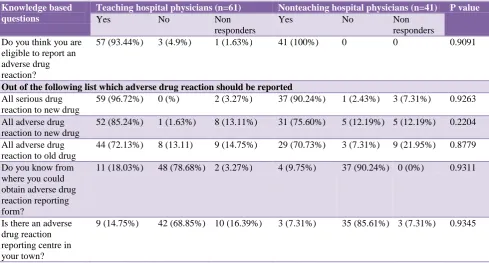
Knowledge in NTHPs did not differ significantly from THPs. All 41 NTHPs (100%) knew that they were eligible to report an ADRs. 90.24% and 75.60% knew that all
[image:3.595.55.545.204.467.2]serious ADRs to new drugs and all adverse drug reactions to new drugs respectively should be reported but only 12.19% knew that ADRs to old drugs need not be reported. 90.24% did not know from where they could obtain an ADR reporting form, while 85.61% were not aware about the existence of ADR reporting centre in the town.
Table 3: Responses of THPs and NTHPs to knowledge based items.
Knowledge based questions
Teaching hospital physicians (n=61) Nonteaching hospital physicians (n=41) P value
Yes No Non
responders
Yes No Non
responders Do you think you are
eligible to report an adverse drug reaction?
57 (93.44%) 3 (4.9%) 1 (1.63%) 41 (100%) 0 0 0.9091
Out of the following list which adverse drug reaction should be reported
All serious drug reaction to new drug
59 (96.72%) 0 (%) 2 (3.27%) 37 (90.24%) 1 (2.43%) 3 (7.31%) 0.9263
All adverse drug reaction to new drug
52 (85.24%) 1 (1.63%) 8 (13.11%) 31 (75.60%) 5 (12.19%) 5 (12.19%) 0.2204
All adverse drug reaction to old drug
44 (72.13%) 8 (13.11) 9 (14.75%) 29 (70.73%) 3 (7.31%) 9 (21.95%) 0.8779
Do you know from where you could obtain adverse drug reaction reporting form?
11 (18.03%) 48 (78.68%) 2 (3.27%) 4 (9.75%) 37 (90.24%) 0 (0%) 0.9311
Is there an adverse drug reaction reporting centre in your town?
9 (14.75%) 42 (68.85%) 10 (16.39%) 3 (7.31%) 35 (85.61%) 3 (7.31%) 0.9345
Table 4: Responses of THPs and NTHPs to attitude based items.
Attitude based question
Teaching hospital physicians (n=61) Non-teaching hospital physicians (n=41)
Yes No Non
responders Yes No
Non responders Is it important to report an
adverse drug reaction? 61 (100%) 0 (0%) 0 (0%) 41 (100%) 0 (0%) 0 (0%)
Do you feel that reporting an adverse drug reaction is useful for your practice?
61 (100%) 0 (0%) 0 (0%) 41 (100%) 0 (0%) 0 (0%)
Would you report an adverse drug reaction if there was an adverse drug reaction reporting centre in your town?
51 (83.60%) 5 (8.19%) 5 (8.19%) 32 (78.08%) 7 (17.07%) 2 (4.87%)
Attitude of physicians
As shown in Table 4 there was no significant difference amongst the two groups of physicians with respect to their attitude towards ADR reporting. All THPs and NTHPs considered it important to report an ADR and felt that
[image:3.595.51.548.499.658.2]ADR reporting practice of physicians
Out of 61 THP, 57.37% had never reported an ADR (Table 5). Of the 42.62% who had reported an ADR most
[image:4.595.48.553.275.376.2](39.34%) reported to seniors in hospitals (Table 6). ADR monitoring centre, area manager of drug companies and medical representatives were less preferred for reporting. None of the physician reported in journals or conference.
Table 5: Responses of THPs and NTHPs to practice based item.
Practice based question
Teaching hospital physicians (n=61) Non-teaching hospital physicians (n=41) P value
Yes No Non
responders Yes No
Non responders
0.7173 Have you ever
reported an adverse drug reaction?
26 (42.62%) 35 (57.37%) 0 (0%) 16 (39.02%) 25 (60.97%) 0 (0%)
Table 6: Number of physicians who had reported an adverse drug reaction.
ADR reported to Teaching hospital physicians (n=61) Nonteaching hospital physicians (n=41)
ADR reporting centre 3 (4.91%) 1 (2.43%))
Journals 0 (0%) 1 (2.43%)
Conference 0 (0%) 0 (0%)
Local body meetings 2 (3.27%) 4 (9.75%)
Seniors in hospitals 24 (39.34%) 10 (24.39%)
Area manager of drug companies 2 (3.27%) 3 (7.31%)
Medical representatives 3 (4.91%) 5 (12.19%)
Participants were allowed to tick multiple options; hence the number of responses is more than number of participants who had reported an ADR.
Table 7: Factors influencing the reporting of adverse drug reaction.
Factors Teaching hospital
physician (n=61)
Nonteaching hospital
physician (n=41) P value
Do not know how to report? 37 (60.65%) 25 (60.97%) 0.9741
Do not where to report? 35 (57.37%) 21 (51.21%) 0.5400
Reporting could be considered as negligence of duty 12 (19.67%) 3 (7.31%) 0.8864
Difficulty in identifying an adverse drug reaction 14 (22.95%) 3 (7.31%) 0.8580
Participants were allowed to tick multiple options; hence the number of responses is more than number of participants
Out of 41 NTHP, 60.97% had never reported an ADR (Table 5). Similar to THPs; of the 39.02% NTHPs who had reported an ADR most (24.39%) reported to seniors in hospitals. On the other hand reporting to medical representatives, in local body meetings and to area manager of drug companies was more preferred as compared to an ADR monitoring centre by NTHPs though differences were not statistically significant. None of the physicians reported in conference.
Factors influencing the reporting of adverse drug reaction
Amongst the factors which could influence reporting of ADRs, not knowing how to report and whom to report (Table 7) seem to be most important. 60.65% THPs and 60.97% NTHPs did not know how to report an ADR while 57.37% THPs and 51.21% NTHPs did not know where to report an ADR. 19.67% THPs feared that
reporting of ADR could be considered as negligence of duty as compared to 7.31% NTHPs. Similarly 22.95% THPs found it difficult to identify an ADR as compared to 7.31%NTHPs, but these differences were not statistically significant.
DISCUSSION
[image:4.595.50.548.430.507.2]In the present study majority of physicians in both groups believed that all ADRs to new and old drugs and all serious ADRs to new drugs may be reported (Table 3). A study has identified that severity of the reaction, a reaction to a new drug, and an unusual reaction may influence the reporting of an ADR positively whereas the reaction being well known may prevent physicians from reporting.12 Further most physicians were unaware of where they could obtain an ADR reporting form and about the existence of ADR reporting centre in the town, indicating the need for corrective measures in this regard.
All physicians in both groups had a positive attitude towards ADR reporting, its importance and usefulness in practice (Table 4). Most were favourable to reporting an ADR to an ADR reporting centre in their town. Studies carried out by Ramesh M et al, Desai CK et al, Pavlin MS and Sanghavi DR showed that physicians had good attitude towards ADR reporting.3,5,13,14
Teaching hospital physicians had reported more adverse drug reactions than NTHPs (Table 5) mainly to seniors (Table 6). This could possibly be due to the protocol requirement in teaching hospitals where it is mandatory to regularly report to seniors whereas a non-teaching physician may, in first place not have a senior to report to or may do so out of choice in order to discuss the case. A study identified that senior colleagues may aid supportive reporting.15 Only a few physicians from both the groups had reported to an ADR reporting centre (Table 6). The reasons could possibly be explained by studying observations from Table 7 in this study. As compared to THPs, NTHPs seemed to prefer medical representatives, local body meetings and area manager of a drug company for reporting to in that order (Table 6). Interestingly none had reported at conferences. Overall it appears that physicians might have preferred a path which as per their belief appeared to have less adverse repercussions. This is in contrast to a study conducted by Desai et al in teaching hospital physicians who showed that out of 39 physicians who had reported an adverse drug reaction, 41.02% had reported to an adverse drug reaction reporting centre, 33.33% had reported to the concerned pharmaceuticals while 15.38% had reported them at conference or in journals.4
There are several factors which discourage physicians to report an adverse drug reaction as shown in Table 7. In this study more than half the physicians did not know “how to report” and “where to report” an adverse drug reaction. Some were having difficulties in identifying the ADR and some assumed that reporting could be considered as negligence of duty on their part. These factors could have possibly influenced to whom the physicians reported ADRs as seen in Table 6. A study by Heard GC et al which studied the barriers to reporting of adverse events in anaesthesia identified that the concern about being blamed by colleagues for the event/error may influence reporting.15 These concerns seemed to be more in THPs as compared to NTHPs possibly because more
THPs reported to seniors, but these concerns need to be addressed. These findings corroborate well with our observation that few physicians had reported to an ADR monitoring centre. Similarly, a study conducted by Manoj Goyal et al showed that 85% of physicians did not know how to report ADR and study conducted in Nigeria revealed that only 1.96% physicians reported an ADR to adverse drug reaction reporting centre.16,17 Thus in theory addressing these concerns could possibly improve ADR reporting to an ADR monitoring centre.
Various measures to improve ADR reporting have been suggested such as forming adverse drug reaction reporting network with hospitals.18 A study on anesthesiologists indicates that generalized de-identified feedback about reports, encouraging senior colleagues and protection from legislation are preferred assistive strategies for reporting.15 Continued medical education programmes for physicians should be conducted regarding methodologies and technical aspect of the adverse drug reaction monitoring system so that concerns regarding how, where and whom to report can be effectively addressed.19 Previous studies have shown that educational programmes that enhance the knowledge can improve the number of ADR reports.20-23
CONCLUSION
In this study both the groups had moderate knowledge, attitude and practice score but there seems to be scope for improvement. Attitude to reporting is positive. Most physicians had not reported to ADR monitoring centre but preferred to report to seniors. The present study also identifies factors which could influence ADR reporting. Concerns regarding how to report, whom to report, blame for negligence in duty and difficulties in identifying an adverse drug reaction exist. There is a need to create awareness among physicians of both groups and address these factors.
Funding: No funding sources Conflict of interest: None declared
Ethical approval: The study was approved by the Institutional Ethics Committee
REFERENCES
1. Beard K. Adverse reactions as a cause of hospital admission in the aged. Drugs Aging. 1992;2:356-67. 2. Tripathi KD. Adverse drug effects. In Tripathi KD
(Ed). Essentials of medical pharmacology, 7th edition. New Delhi, Jaypee Brothers Medical Publishers, 2013;82-91.
3. Ramesh M, Pandit J, Parthasarathi G. Adverse drug reactions in a south Indian hospital-their severity and cost involved. Pharmacoepidemiol Drug Saf. 2003;12:687-92.
5. Desai CK, Iyer G, Panchal J, Shah S, Dikshit RK. An evaluation of knowledge, attitude, and practice of adverse drug reaction reporting among prescribers at a tertiary care hospital. Perspect Clin Res. 2011;2:129-36.
6. Ahmad A, Parimalkrishnan S, Mohanta GP, Manna PK, Manavalan R. Incidence of adverse drug reactions with commonly prescribed drugs in tertiary care teaching hospital in India. Int J Phar Sci. 2011;3:79-83.
7. Eland IA, Belton KJ, van Groothest AC, Meiners AP, Rawlins MD, Stricker BH. Attitudinal survey of voluntary reporting of adverse drug reactions. Br J Clin Pharmacol.1999;48(4):623-7.
8. Rishi RK, Patel RK, Bhandari A. Under reporting of ADR by medical practitioners in India-results of pilot study. Adv Pharmacopidem Drug Safety. 2012;1:112. 9. Abubakar AR, Simback BN, Mainul H. A systemic review of knowledge, attitude and practice on adverse drug reactions and pharmacovigilance among doctors. Journal of Applied Pharmaceutical Science. 2014;4(11):117-27.
10. Chopra D, Wardhan N, Rehan HS. Knowledge, attitude and practices associated with adverse drug reaction reporting among doctors in teaching hospital International journal of risk and safety in medicine. 2011;23(4):227-32.
11. Khan SA, Goyal C, Chandel N, Rafi M. Knowledge, attitudes and practice of doctors to adverse drug reaction reporting in a teaching hospital in India. Journal of natural science, biology and medicine. 2013;4(1):191-6.
12. Ekman E, Backstorm M. Attitudes among hospital physicians to the reporting of adverse drug reactions in Sweden. Eur J clin Pharmacol. 2009;65(1):43-6. 13. Pavelin MS, Bengea-Luculescu S, Toma M, Paveliu
SF. Perception on adverse drug reaction reporting by physicians working in Southern Romania. Journal of Clinical Medicine. 2013;8(1):17-25.
14. Sanghavi DR, Dhande PP, Pandit VA. Perception of pharmaqcovigilance among doctors in tertiary care
hospital: influence of an intreventional lecture. Int J Risk Saf Med. 2013;25(4):197-204.
15. Heard GC, Sanderson PM, Thomas RD. Barrier to adverse events and error reporting in anaesthesia. Anesth Analg. 2012;114(3):604-14.
16. Goyal M, Bansal M, Yadav S, Grover V, Preetkanwal. To assess the attitude, knowledge and practice of medical professional about adverse drug reaction and their reporting in teaching hospital. Indian journal of clinical practice. 2013;24(3):281-4. 17. Oshikoya KA, Awobusuyi JO. Perception of doctors
to adverse drug reaction reporting in a teaching hospital in Lagos, Nigeria. BMC Clin Pharmacol. 2009;9:14.
18. Goldstein LH, Berlin M, Saliba W, Elias M, Berkovitch M. Founding an adverse drug reaction (ADR) network: a method for improving doctors spontaneous ADR reporting in a general hospital. J Clin Pharmacol. 2013;53:1220-5.
19. Dhikav V, Singh S, Anand KS. Adverse drug reaction monitoring in India. JIACM. 2004;5(1):27-33.
20. Selvan N, Saravanan R, Sakthibalan M. Effect of educationl interventions on pharmacovigilance awareness among M.B.B.S. internee’s in a tertiary care hospital. International journal of basic and clinical pharmacology. 2016;35(1):149-54.
21. Bhist M, Singh S, Dhasmana DC. Effect of educational interventions on adverse drug reporting by physicians: across sectional study. ISRN Pharmacology. 2014;2014:1-5.
22. Figueiras A, Herdeiro MT, Polónia J, Gestal-Otero JJ. An educational intervention to improve physician reporting of adverse drug reactions: a cluster-randomized controlled trial. JAMA. 2006;296:1086-93.
23. Tabali M, Jeschke E, Bockelbrink A, Witt CM, Willich SN, Ostermann T, et al. Educational intervention to improve physician reporting of adverse drug reactions (ADRs) in a primary care setting in complementary and alternative medicine. BMC Public Health. 2009;9:274.