Keywords: Anopheles, vector control, mass rearing, irradia-tion, genetic sexing
In 2004 the International Atomic Energy Agency (IAEA) initia-ted an integrainitia-ted five year feasibility study to develop tech-nologies for controlling malaria mosquitoes with the Sterile Insect Technique (SIT). The goal of the project is to develop and evaluate all relevant components needed for such an area-wide integrated approach to vector control. Some of the experimental work is perf o rmed at the Agency’s laboratories in Seibersdorf, Austria, and a pilot project area is un- der de-velopment in the Northern State of Sudan, in collaboration with the Tropical Medicine Research Institute (TMRI) in Khar-toum, Sudan. Moreover, collaborations with other research g roups in developed and developing countries have been ini-tiated to develop methods and share opinions. This paper p rovides an introduction to SIT and the project as a whole.
SIT: ‘The principle’
The SIT is based on the mass production, sterilisation and subsequent release of sterile insects into a target population
(Knipling 1955, Dyck et al. 2005). The released sterile males mate with wild females, which produce no viable offspring. Repeated releases lead to population suppression and can, under certain circumstances, lead to local elimination of a population. Sterility can be induced through chemosteril-ants, irradiation, or modern biotechnological approaches. Other methods of inducing sterility in a population are the release of hybrids or insects with translocations or other chromosomal rearrangements (Knipling et al. 1968), but the-se fall outside the scope of this paper.
For the SIT to be a successful component of a control programme, certain prerequisites are needed (Vreysen 1995): 1) colonization (i.e. establishment of the species in the labo-ratory) should be feasible and mass production possible at a reasonable cost to provide the required number of sterile in-sects, 2) the competitiveness of the sterile male needs to be adequate and there should be no major behavioural diffe-rences between the sterile and wild population, 3) populat-ion density of the target species needs to be low or reduced prior to release to make it economically feasible to obtain the desired sterile-to-wild male ratio, 4) detailed informa-tion on the target populainforma-tion is required, such as spatial and temporal dynamics, mating behaviour, breeding sites, flight range, et cetera, 5) the method needs to be applied against the total population in the target area or part of the popula-tion that can be isolated by natural or artificial barriers to exclude immigration from neighbouring sites, 6) the target area should preferably contain only one species, and 7) the release of sterile females is not acceptable for those species where the females are vectors of disease and/or cause biting nuisance (Robinson & Franz 2000). Females therefore need to be removed from the release population. The removal of females is also advantageous for agricultural pests to reduce cost, avoid assortative mating (i.e. mating between released
The Sterile Insect Technique: can
es-tablished technology beat malaria?
Michelle E.H. Helinski1, Badria El-Sayed2&
Bart G.J. Knols1
1International Atomic Energy Agency (IAEA) Agency’s Laboratories Seibersdorf
A-2444 Seibersdorf, Austria [email protected]
2Tropical Medicine Research Institute P.O. Box 1304
Khartoum, Sudan
The Sterile Insect Technique (SIT) is the mass
production, sterilisation and subsequent release
of sterile insects into a target population in an
area-wide integrated approach. The released
sterile males mate with wild females; they thus
no longer produce offspring and therefore the
size of the target population is reduced. Over
the years, SIT has proven to be a safe, effective
and environmentally sound method to suppress,
eliminate or contain pest populations. The
In-ternational Atomic Energy Agency (IAEA) has a
long history of supporting SIT programmes
against key insect pests, including fruit flies,
ts-etse flies and moths. Recently, an integrated
five year study to assess the feasibility of SIT to
control African malaria mosquitoes has been
initiated. In this article, we discuss the
compo-nents and research requirements for such a
feasibility study including sexing, mass
produc-tion, sterilisation and release methodologies.
Entomologische Berichten 66(1): 13-20Introduction
males and females), avoid (limited) economic losses and in-crease the overall efficiency of the programme (Robinson 2002a).
Although it is generally believed that the released males need to be fully sterile, it has been suggested (Robinson 2002b) that complete sterility does not have to be induced and that more sterility can be introduced into the field popu-lation using lower radiation doses but with more
competitive insects. Moreover, reduced competitiveness of the sterile males can be partly overcome by increasing the ratio of sterile-to-wild insects (Knipling 1955).
SIT: ‘A brief overview’
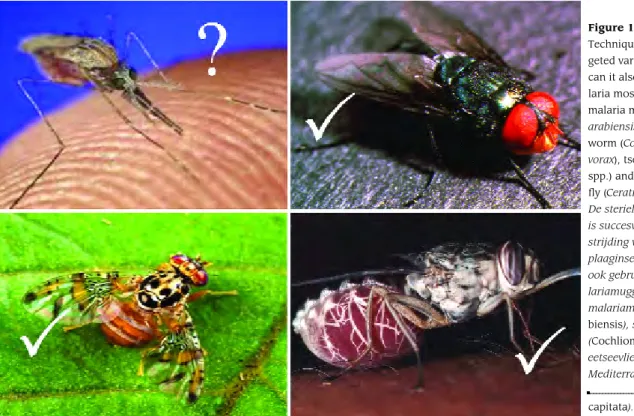
The SIT approach has been developed and successfully ap-plied against several insect species (figure 1). The most successful and well-known project is the eradication of the New World screwworm Cochliomyia hominivorax(Coquerel) from the USA, Central America (Dame 1985, Snow 1988) and (during an outbreak in 1989) Libya (Lindquist et al. 1992). Another example is the eradication of the tsetse fly Glossina austeniNewstead from the island of Zanzibar (Vreysen et al. 2000). Ongoing SIT projects are taking place against the Me-diterranean fruit fly (medfly) Ceratitis capitataWiedemann in Central and South America, parts of southern Europe, South Africa and Australia (Robinson 2002a). The largest medfly production facility is in El Pino, Guatemala, and produces around two billion sterile male flies per week (IDIDAS 2005), primarily for use in California, Guatemala and Mexico. Other pests targeted with SIT include the Mexican fruit fly Anast-repha ludens (Loew) in southern USA and Mexico (Toledo et al. 2004), the melon fly Dacus cucurbitaeCoquillett in Japan (Ito et al. 2003), the onion fly Delia antiqua(Meigen) in The Netherlands (Ticheler et al. 1974, Everaarts 2006), the cod-ling moth Cydia pomonella(Linnaeus) in British Colombia (Bloem et al. 1997) and the pink bollworm Pectinophora gossypiella (Saunders) in California (Lindquist et al. 1990).
Substantial research was dedicated to genetic control of mosquitoes from 1950-1980, especially against Anopheles albimanusWiedemann in the Americas and A. pharoensis
Theobald and A. stephensiListon in Asia. Benedict & Ro-binson (2003) provide a review of these earlier programmes. The largest SIT field programmes against an Anopheles -vec-tor (A. albimanus) were performed in El Salvador and were initiated in 1972 (Lofgren et al. 1974). Over a five month pe-riod, 4.3 million sterile pupae were released around Lake
Apastepeque. Results were promising and a substantial re-duction in population size was observed (Lofgren et al. 1974, Dame et al. 1981). A second more extensive trial loca-ted on the Pacific coast of El Salvador took place between 1977-79 (Lowe et al. 1980, Dame et al. 1981), when up to 0.5 million sterile males or 1.25 million sterile male pupae were released daily. Complete control was not achieved due to the immigration of females from outside the target area, despite the introduction of a barrier zone (which consisted of a zone covered with indoor residual spraying) (Dame et al. 1981). Nevertheless, re-analysis of the data (Benedict & Robinson 2003) on A. albimanusdensities in the release and a nearby control area emphasises how successful the sterile males were in preventing a normal seasonal rise in vector density (Curtis 2005). In both these trials, sterilisation was induced with chemosterilants.
In 2005 the World Malaria Report by UNICEF, the World He-alth Organisation, and Roll Back Malaria (UNICEF & WHO/-RBM 2005) gives a clear picture of the current malaria situ-ation. 350-500 million cases of clinical malaria occur annual- ly, of which 60% in sub-Saharan Africa. Moreover, 80% of all deaths attributed to malaria occur in this region.
Figure 1. The Sterile Insect Technique has successfully tar-geted various pest insects, but can it also be used against ma-laria mosquitoes? Clockwise: malaria mosquito (Anopheles arabiensis), New World screw-worm (Cochliomyia homini-vorax), tsetse fly (Glossina spp.) and Mediterranean fruit fly (Ceratitis capitata). De steriele-mannetjestechniek is succesvol ingezet bij de be-strijding van verschillende plaaginsecten, maar kan het ook gebruikt worden tegen ma-lariamuggen? Kloksgewijs: malariamug (Anopheles ara-biensis), schroefwormvlieg (Cochliomyia hominivorax), ts-eetseevlieg (Glossina spp.) en Mediterrane fruitvlieg (Ceratitis capitata).
History of SIT for malaria
In numbers, this means that each year one million Africans die of the disease, with the vast majority of deaths occurring in child-ren below five years of age. Pregnant women are another major risk group: malaria can cause low birth weight and premature delivery. The impact of malaria on the economic situation of endemic countries is high: an estima-ted annual reduction of 1.3% in economic growth is reporestima-ted (UNICEF & WHO/RBM 2005).
Efforts to control malaria are currently focused on two main strategies: anti-malarial treatment and vector control. Due to widespread resistance of the main malaria parasite Plas-modium falciparum Welch to the affordable drugs chloro-quine and sulfadoxine-pyrimethamine (FansidarÆ), other anti-malarial therapies are urgently needed. Currently, WHO recom- mends combination therapies in those countries where resistance is reported. The preferred combination contains artemisinin, derived from the plant Artemisia annua. Although artemisinin-based combination therapies (ACT’s) are currently the best treatments available, they are ten times more expensive than the conventional monothera-pies (Mutabingwa 2005). A number of malaria-endemic countries have now adopted ACT’s as their first or second line drug treatment. However, actual implementation is still ongoing in most of these countries (UNICEF & WHO/RBM 2005).
Contemporary vector control methods include the use of Insecticide Treated bedNets (ITNs) and Indoor Residual Sp-raying (IRS). Other efforts focus on larval control mainly by
Bacillus sphaericusMeyer & Neide and B. thuringiensis Ber-liner derivatives, which are bacterial compounds that are toxic to mosquito larvae (Fillinger et al. 2003). Coverage of ITN’s is increasing in Africa, although major differences be-tween countries are observed. A new generation of ITN’s, the long-lasting insecticidal bednets (LLN’s) are now recom-mended due to their highly extended life span. These nets stay effective for 4-5 years, while the conventional nets re-quire re-impregnation every 6-12 months. However, the cost of an ITN remains a major constraint to ownership for a lar-ge proportion of Africans and voucher schemes are being introduced to improve uptake (Magesa et al. 2005). Distur-bingly, in many countries resistance of mosquitoes against insecticides commonly used for IRS and bednets is incre-asing (Vulule et al. 1994, Hargreaves et al. 2000, Etang et al. 2003, Etang et al. 2004).
Insecticide and drug resistance in recent years has led to an increased interest in other methods of malaria control. Pro-mising results were obtained in the trials in El Salvador, and since the 1970’s a variety of other insects have successfully been targeted with SIT. Increased knowledge of SIT, combi-ned with great advances in the tools required to conduct such campaigns (e.g. remote sensing, geographic informa-tion systems and computer models) have resulted in a renewed interest in SIT for malaria vectors, particularly for potential application in urban ‘island’ settings and vector populations in geographically or ecologically isolated areas (Curtis 2002).
The project will initially focus on A. arabiensisPatton, which belongs to the A. gambiaespecies complex (White 1974), comprising seven sibling species of which A. gambiaeGiles
sensu strictoand A. arabiensisare the major malaria vectors. For SIT to be manageable, preferably one vector species should be present in the release area. Anopheles arabiensis is present in some areas where A. gambiae s.s. is not pre-sent, while A. gambiae s.s. occurs sympatrically with A. ara-biensisthroughout most of its distribution range. Moreover, the genetic make-up of the target population must be such that it can be regarded as a uniform, panmictic (i.e. freely mating) species. This appears to hold true for A. arabiensis, which is believed to be a rather uniform species. Anopheles gambiae s.s. on the other hand shows extreme genetic hete-rogeneity and substantial gene flow barriers between different chromosomal and molecular forms exist (Tripet et al. 2001, della Torre et al. 2002). Anopheles funestusGiles, the other major vector on the African continent, was not considered a suitable target, as crucial knowledge of the population genetic structure of this species and of its coloni-zation procedures is lacking (Cohuet et al. 2004), although some observations have been made of substantial popula-tion heterogeneity in A. funestus, and so far two chromoso-mal forms have been described (Cohuet et al. 2004).
Development of appropriate methods of mass production is critical for the success of SIT programmes. Experience in medfly rearing has shown that colonization and mass pro-duction itself accounts for considerable fitness loss and behavioural change due to the large selective pressure du-ring colonization and the unnatural conditions of the readu-ring process (Cayol 2000) and these effects should be minimized as much as possible. In mosquitoes, it is well-known that larval rearing conditions, such as density and food availabi-lity, have an important effect on the size and energy reserves of the adults (Clements 1992). Recent experiments with A. gambiae s.s. have shown that males reared at lower densi-ties as larvae were much more likely to succeed in acquiring the first female during mating, compared to males reared at higher densities (Ng’habi et al. 2005). The trade-off between a short development time and space restriction desired in a mass rearing facility, and the overall fitness and behaviour of the insects produced, needs to be understood to implement effective production management. Research is under- way on all aspects of rearing, including egg handling, larval re-aring, pupal collection, adult holding, membrane blood feeding, as well as the development of quality control proce-dures.
Insects can be sterilised by use of chemosterilants, irradia-tion (figure 2), or modern biotechnological approaches. Chemosterilants were used experimentally and in field trials in the 1960-70’s (Dame et al. 1981). However, chemosterili-sing agents are mutagenic and present a potential hazard to humans during the treatment process. Their use was aban-doned (Hayes 1968) after concerns were raised about the effects of the chemicals on the environment and non-target
Malaria: ‘control efforts’
The target species
Mosquito SIT at the IAEA
Mass production
organisms, particularly when large numbers of treated in-sects were released. These concerns were mainly based on the findings of one, so far unreplicated study (Bracken & Dondale 1972) that found that spiders fed on a diet of not-hing but chemosterilised mosquitoes consequently became sterile. Although the amount of residue released in the envi-ronment was very low due to the careful rinsing of the pupae (LaBrecque et al. 1972), it is unlikely that current pu-blic opinion would be in favour of chemosterilisation. Ionising radiation has therefore become the principal tech-nique for sterilisation, even though it has been reported to reduce competitiveness of the males more than chemosteri-lisation (El-Gazzar & Dame 1983, Dame 1985).
The irradiation process is generally carried out using gamma rays, due to their high energy and penetrating capa-bility. When biological matter is irradiated, molecular bonds are broken, ions created and free oxygen radicals are form-ed. Presence of free radicals results in DNA damage, leading to the formation of dominant lethality in the germ cells (LaChance 1967, Curtis 1971). Moreover, somatic damage can occur in cells undergoing mitosis. In general, damage induced by irradiation is greater with increasing dose and small- er as insect development progresses. The efficiency of SIT programmes is directly related to the ability of sterile males to successfully locate, mate and inseminate wild fe-males. In general, the competitiveness of irradiated insects will be lower than the competitiveness of wild insects, ho-wever the goal is to reduce the negative effects of irradiation as much as possible but still maintain an adequate level of sterility.
In mosquitoes, both the pupal and the adult stages can be irradiated. Pupae are more robust than adults, which ma-ke them easier to handle for irradiation. Competitiveness loss due to irradiation is considered greater in the pupal sta-ge than in the adult stasta-ge (Curtis 1976, Andreasen 2003), however there is little research into the use of lower doses. The effects of lower doses will be addressed in the current mosquito SIT programme.
As only limited data is available on the radio sensitivity of A. arabiensis, the first phase of the programme has focu-sed on the development of dose-sterility curves for the pupae and adult stages. Once completed, a range of doses will be tested in competition experiments. Initial experi-ments in the laboratory will be performed to gain insight into the level of competitiveness present in the sterile males. A large cage will be used in which sterile males compete with non-irradiated reared males for laboratory-reared females. However, in later stages of the programme, competition experiments will need to take place in a
semi-field setting, such as a greenhouse, where irradiated males will be competing with (wild) males for (wild) females.
Moreover, there are ways to reduce irradiation damage. Irradiation in a low-oxygen environment can produce more competitive insects (Fisher 1996). For anophelines, the few studies with irradiation under low oxygen that have been performed (Curtis 1976, El-Gazzar & Smittle 1984) indicated no major benefits, but as the method proved worthwhile for other insect species, this might still be worth pursuing. Mo-dern biotechnology has suggested that transgenic methods may be able to induce sterility (Thomas et al. 2000) although such methods are not yet available for anopheline mosquit-oes. Moreover, the release of transgenic insects in the wild may be problematic.
The release of only males is a prerequisite for any mosquito SIT programme (Robinson & Franz 2000), thus an efficient sex separation system is required. Male mosquitoes are ge-nerally smaller than females, resulting in smaller pupae and a shorter development time (Clements 1992). However, in anophelines, mechanical sex separation of pupae based on size will not yield satisfactory separation, because the size distributions are overlapping. The effectiveness that was achieved with mechanical pupae separation of A. albimanus
in the first El Salvador trial was only 85% (Lowe et al. 1980), which is too low for any operational SIT programme.
Male and female mosquitoes have a distinctly different spectrum of wing beat frequency and they can easily be dif-ferentiated and separated on the basis of this. However, up-scaling a system in a way that it can automatically recognize and sort males and females with little stress remains a chal-lenge. In such a system, females would be removed only at the very last stage of development, reducing the capacity of the facility and increasing the costs of mass rearing.
The main focus currently is on sexing methods based on genetic transformation. The classical genetic sexing strains (GSS’s) have been developed for various insects including anophelines and they rely on the linkage of a dominant se-lectable marker to the male determining chromosome. Linkage is accomplished by radiation-induced translocations followed by crossing and screening of the offspring. Resi-stance genes, e.g. temperature-sensitive lethal genes and insecticide-resistance genes, have been used as selectable markers. The process of creating a GSS is very time consu-ming and the system must be accurate and stable under mass rearing conditions. Moreover, the method is species-specific. However, once established, these strains can be very valuable. For example a GSS of medfly is currently used in all SIT operational programmes (Robinson et al. 1999). A successful anopheline GSS was the MACHO strain of A. albi-manus used in the second trial at the Pacific coast in El Salvador (Dame et al. 1981). This strain was created by lin-king an insecticide (propoxur) resistance gene to the male chromosome and an inversion was induced to suppress furt-her recombination and thus stabilize the strain. Females were removed from the population by treatment of the eggs with a discriminating dose of insecticide. The effectiveness of this sexing strain was 99.9% and large numbers of male mosquitoes (one million per day) could be released (Lowe et al. 1980, Dame et al. 1981).
Another method to create a GSS is by genetic transfor-mation whereby a specific segment of DNA is inserted into Figure 2. Cobalt-60 gamma source
used for the irradiation of insects. Cobalt-60 gammabron die gebruikt wordt voor de bestraling van insec-ten.
the genome (transgenesis) creating a genetically modified organism (GMO). This will require the insertion of a condi-tionally lethal gene that would be expressed only in the fe-males. Genetic transformation can also be used to engineer strains of mosquitoes that render the mosquito refractory to Plasmodium parasites (Ito et al. 2002), or generate a sterili-sing system that is based on dominant lethal genes express-ed in females only, referrexpress-ed to as RIDL (release of insects carrying dominant lethals) (Alphey et al. 2002). In RIDL, no irradiation is required. So far, successful germline transfor-mation has been accomplished in a number of insects (Ro-binson et al. 2004) using fluorescent markers to identify transformed individuals. However, for a sexing strain, the marker needs to be accompanied by a gene that is condi-tionally lethal to females and this has not yet been accom-plished for Anopheles, though several of such strains have been developed in Aedes aegypti (Linnaeus) (Alphey pers. comm.). Another useful application of transgenesis is the ability to mark insects so that they can be recognized after release. Marking can also result in a sexing method. Recent-ly, a transgenic sexing strain has been developed in A. stephensithat has male mosquitoes expressing a fluorescent protein in their gonads. Females do not express the protein and can be removed from the population by automated screening of third instar larvae (Catteruccia et al. 2005).
Our project will focus on the development of a genetic sexing strain based on a classical genetic approach. In the case of A. arabiensisthis can be done using an insecticide (dieldrin) resistant strain that is currently under study. Paral-lel to this, the transgenic approach will also be developed. Both types of sexing strains would require irradiation to ste-rilise the males.
Depending on the time of irradiation, mosquitoes can be re-leased at either the pupal (pupal irradiation) or the adult stage (pupae/adult irradiation). Releases of pupae were per-f o rmed in the El Salvador trials. The pupae were released in cups or pans and left to emerge in the field (Dame et al. 1974, Bailey et al. 1979, Lowe et al. 1980); a cup could hold aro u n d 1500 pupae. Cups were either put in floating containers that were released on water surfaces of breeding sites or on land when placed in release shelters. The latter method proved to be more effective (Lowe et al. 1980). How- ever, some preda-tion (mostly by ants) was observed, but this was easily managed by placing baits around the release site (Bailey et al. 1979, Lowe et al. 1980). The release of pupae is feasible, but requires good access to the release sites by land and a large number of personnel to perf o rm the daily releases. Irradia-tion of pupae has to be perf o rmed preferably on older pupae, thus irradiation and release will need to be done on the same d a y, which requires that the field sites should be in the vicini-ty of rearing and irradiation facilities. However, cooling of pupae delays their development and this may be a useful way to increase the time between irradiation and release.
Adults can be released by ground or by aerial release. In El Salvador, some experiments with adult ground releases were performed; a special ‘flat cage’ was developed that could hold up to 2000 adults and cages could easily be stac-ked for transport (Bailey et al. 1979). Mortality was accept-able, however handling was intensive and caused considera-ble stress to the mosquitoes. Releases were difficult and, due to weather conditions, adults had to be released after sunset. Aerial releases, although never tried with
mosquit-Figure 3. Satellite image of the project area along the Nile, situated between Dongola and Merowe, in Northern State, Sudan. Photo: unknown Satellietbeeld van het onderzoeksgebied langs de Nijl, gelegen tussen Dongola and Merowe, in de Noordelijke Staat van Soedan.
Release methodology
Sudan
Dongola
Merowe
oes, have a number of potential benefits over ground relea-ses. The release sites can be further away from the facilities, extending the geographical scope of the operation greatly. The need for good ground access to the field sites is no lon-ger valid for daily releases, although for monitoring pur-poses it would still be desired. In addition, the number of staff required for aerial releases is lower and aerial releases can benefit from existing on-board navigation equipment to accurately release the mosquitoes in the designated areas. However, costs associated with aerial releases are higher and landing strips/platforms et cetera need to be in place. Aerial releases are performed in the large medfly program-mes where flies are kept immobile during packing and trans-port by chilling and are released through the bottom of the aircraft. However, unlike the robust medfly, mosquitoes are rather fragile creatures. Handling, packing and release me-thods for mosquitoes need to be developed and tested to assess the impact of aerial release on male behaviour and longevity (Dame & Curtis 1996). Moreover, age of release is important, in El Salvador it was found that the release of ol-der adults (2-3 days) caused less population reduction than the release of pupae or young adults (Dame et al. 1981).
Historically, the majority of research on mosquito behaviour and ecology has focused on females, as these are the vectors of disease. Male biology and behaviour has largely been ig-nored (Ferguson et al. 2005), but it is a crucial component for any SIT programme. Therefore, the project focuses on improving field evaluation of released males: this will entail developing methods for assessing male behaviour and com-petitiveness, dispersal and monitoring of released male mosquitoes.
The field site of the pilot project is situated in Northern State, Sudan, where pockets of breeding sites occur on the banks of the Nile in an area otherwise surrounded by irriga-ted land and desert (figure 3). Anopheles arabiensisis the
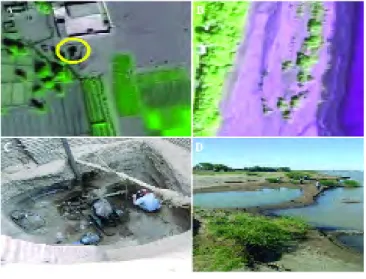
only malaria vector present. Two localities, each at the edge of the anticipated release area, have been selected and state-o f-the-art larval surveillance has been set in place. Arstate-o u n d the project areas, on a monthly basis, larval surveys are per-f o rmed in random and static sites. All breeding sites per-found are characterized according to fixed criteria (for instance lar-val density, water depth et cetera) and the data are fed into a hand-held computer linked to a Global Positioning System (GPS). Moreover, with aid of high-resolution satellite images of the project areas, potential breeding sites are easily identi-fied (figure 4). Collection of meteorological data occur with automated weather stations on site. Population genetic stu-dies on the various A. arabiensis populations present acro s s the project area are perf o rmed. So far no chromosomal or molecular differences have been found between populations.
The objective of the programme is to see whether it is feasi-ble, from a technical, economical and a biological perspec-tive, to use sterile male mosquitoes to control mosquito populations in designated areas in the African context. It is a challenging project. However, considering the successes of SIT with other insect pests and the fact that current techno-logy can facilitate many aspects of a SIT programme, the effort is justified. Substantial progress has been made in de-veloping field sites and establishing research collaborations. Current research focuses on mass production, sexing and sterilisation. The success of a SIT campaign, besides proper management, largely depends on the quality and behaviour of the released insects. Where as in the past SIT might have been perceived as a stand-alone technology, the current thinking is to consider it as part of an integrated anopheline control programme, where SIT has the potential to suppress and at a later stage eliminate a local pest population.
The authors would like to thank Alan Robinson and Rebecca Hood for valuable comments on an earlier version of the manuscript.
Alphey L, Beard CB, Billingsley P, Coetzee M, Crisanti A, Curtis C, Eg-gleston P, Godfray C, Hemingway J, Jacobs-Lorena M, James AA, Kafatos FC, Mukwaya LG, Paton M, Powell JR, Schneider W, Scott TW, Sina B, Sinden R, Sinkins S, Spielman A, Toure Y & Collins FH 2002. Malaria control with genetically manipulated insect vectors. Science 298: 119-121.
Andreasen MH 2003. Genetic studies related to the sterile insect technique for Anophelesmosquitoes. PhD thesis, London School of Hygiene and Tropical Medicine.
Bailey DL, Lowe RE, Fowler JEF & Dame DA 1979. Sterilizing and packaging males of Anopheles albimanus Wiedemann for field release. American Journal of Tropical Medicine and Hygiene 28: 902-908.
Benedict MQ & Robinson AS 2003. The first releases of transgenic mosquitoes: an argument for the sterile insect technique. Trends in Parasitology 19: 349-355.
Bloem S, Bloem KA & Fielding LS 1997. Mass-rearing and storing codling moth larvae in diapause: a novel approach to increase production for sterile insect release. Journal of the Entomologi-cal Society of British Columbia 94: 75-81.
Bracken GK & Dondale CD 1972. Fertility and survival of Achaeara-nea tepidariorum (Araneida:Theridiidae) on a diet of
chemosterilized mosquitoes. Canadian Entomologist 104: 1709-1712.
Figure 4. High-resolution satellite images (a, b) from the project area in Northern State, Sudan. aLeaking underground pump, briverside. Pic-tures below (c, d) show what was observed during ground inspection. Hoge-resolutiesatellietbeelden (a, b) van de onderzoeksgebieden in Noor-delijke Staat, Soedan. aLekkende ondergrondse pomp, brivieroever. Foto’s onder (c, d) laten de situatie zien vanaf de grond.
Field evaluation
Conclusions
Acknowledgements
Catteruccia F, Benton JP & Crisanti A 2005. An Anophelestransgenic sexing strain for vector control. Nature Biotechnology 23: 1414-1417.
Cayol JP 2000. Changes in sexual behavior and life history traits of tephritid species caused by mass-rearing processes. In: Fruit Flies (Tephritidae): Phylogeny and Evolution of Behavior (Aluja M & Norrbom AL eds): 843-860. CRC Press LLC.
Clements AN 1992. Growth and Development. In: The biology of mosquitoes, Volume 1. Development, nutrition and reproduc-tion. 150-170. Chapmann & Hall.
Cohuet A, Dia I, Simard F, Raymond M & Fontenille D 2004. Popula-tion structure of the malaria vector Anopheles funestusin Sene-gal based on microsatellite and cytogenetic data. Insect Molecu-lar Biology 13: 251-258.
Curtis CF 1971. Induced sterility in insects. Advances in Reproduc-tive Physiology 5: 120-165.
Curtis CF 1976. Radiation sterilization. Report on mosquito re-search. Ross Institute of Tropical Hygiene. 01.01.76-31.12.77. Curtis CF 2002. Possible ways of using transgenic mosquitoes for malaria and dengue control and risk assessment. In: 7th Inter-national Symposium on Biosafety of Genetically Modified Organisms: 165-175. Beijing, China, 10-16 October.
Curtis CF 2005. Review of previous applications of genetics to vector control. In: Bridging laboratory and field research for genetic control of disease vectors (Louis C & Knols BGJ eds): 33-43. Frontis, Springer.
Dame DA, Lowe RE, and Williamson DL 1981. Assessment of Rele-ased Sterile Anopheles albimanus and Glossina morsitans morsi- tans. In: Cytogenetics and genetics of vectors (Kitzmiller JB & Kanda T eds): 231-248. Elsevier Biomedical.
Dame DA 1985. Genetic control by sterilized mosquitoes. In: Biolo-gical Control of Mosquitoes (Chapman R, Barr R, Weidhaas DE & Laird M ed): 159-172. American Mosquito Control Associa-tion, Bulletin 6.
Dame DA and Curtis CF 1996. The potential use of the sterile insect technique and other genetic control methods for control of ma-laria-transmitting mosquitoes. IAEA.
Dame DA, Lofgren CS, Ford HR, Boston MD, Baldwin KF & Jeffery GM 1974. Release of chemosterilized males for the control of
Anopheles albimanusin El Salvador. II. Methods of rearing, ste-rilization, and distribution. American Journal of Tropical Medi-cine and Hygiene 23: 282-287.
della Torre A, Costantini C, Besansky NJ, Caccone A, Petrarca V, Po-well JR & Coluzzi M 2002. Speciation within Anopheles gambiae
- the glass is half full. Science 298: 115-117.
Dyck A, Hendrichs J & Robinson AS 2005. The Sterile Insect Techni-que: Principles and Practice in Area-Wide Integrated Pest Ma-nagement. Springer.
El-Gazzar LM & Dame DA 1983. Effects of combinations of irradia-tion and chemosterilizairradia-tion on mating competitiveness of Culex quinquefasciatusSay. Journal of Economic Entomology 76: 1331-1334.
El-Gazzar LM & Smittle BJ 1984. Effect of gamma irradiation on Cu-lex quinquefasciatus(Diptera: Culicidae) following exposure to radioprotectors. Journal of Medical Entomology 21: 91-94. Etang J, Chandre F, Guillet P & Manga L 2004. Reduced bio-efficacy
of permethrin EC impregnated bednets against an Anopheles gambiaestrain with oxidase-based pyrethroid tolerance. Malaria Journal 3: 46.
Etang J, Manga L, Chandre F, Guillet P, Fondjo E, Mimpfoundi R, To-to JC & Fontenille D 2003. Insecticide susceptibility status of
Anopheles gambiae s.l. (Diptera: Culicidae) in the Republic of Cameroon. Journal of Medical Entomology 40: 491-497. Everaarts TC 2006. De Steriele-Insecten-Techniek tegen de uienvlieg.
Entomologische Berichten 66 (in press).
Ferguson HM, John B, Ng’habi KR & Knols BGJ 2005. Redressing the sex imbalance in knowledge of vector biology. Trends in Ecology and Evolution 20: 202-209.
Fillinger U, Knols BG & Becker N 2003. Efficacy and efficiency of new Bacillus thuringiensisvar. israelensisand Bacillus sphaeri-cusformulations against Afrotropical anophelines in Western Kenya. Tropical Medicine and International Health 8: 37-47. Fisher K 1996. Queensland fruit fly (Bactrocera tryoni): eradication
from Western Australia (McPheron BA & Steck GJ eds): 535-541. St. Lucie Press.
Hargreaves K, Koekemoer LL, Brooke BD, Hunt RH, Mthembu J & Coetzee M 2000. Anopheles funestusresistant to pyrethroid in-secticides in South Africa. Medical and Veterinary Entomology 14: 181-189.
Hayes WJ 1968. Toxicological aspects of chemosterilants. In: Prin-ciples of insect chemosterilisation. (LaBrecque GC & Smith CN eds): 315-347. Appleton Century Crofts.
IDIDAS 2005. International Database on Insect Desinfestation and Sterilization. http://www-ididas.iaea.org/IDIDAS/start.htm Ito J, Ghosh A, Moreira LA, Wimmer EA & Jacobs-Lorena M 2002.
Transgenic anopheline mosquitoes impaired in transmission of a malaria parasite. Nature 417: 452-455.
Ito Y, Kakinohana H, Yamagishi M & Kohama T 2003. Eradication of the melon fly, Bactrocera cucurbitae, from Okinawa, Japan, by means of the sterile insect technique, with special emphasis on the role of basic studies. Journal of Asia-Pacific Entomology 6: 119-129.
Knipling EF 1955. Possibilities of insect population control through the use of sexually sterile males. Journal of Economic Entomo-logy 48: 459-462.
Knipling EF, Laven H, Craig GB, Pal R, Kitzmiller JB, Smith CN & Brown AW 1968. Genetic control of insects of public health im-portance. Bulletin of the World Health Organisation 38: 421-438. LaBrecque GC, Bowman WC, Patterson RS & Seawright JA 1972. Per-sistence of thiotepa and tepa in pupae and adults of Culex fati-gans. Bulletin of the World Health Organisation 74: 676. LaChance LE 1967. The induction of dominant lethal mutations in
insects by ionizing radiation and chemicals - as related to the sterile-male technique of insect control. In: Genetics of insect vectors of disease (Wright JW & Pal R eds): 617-650. Elsevier. Lindquist DA, Abusowa M & Hall MJ 1992. The New World
screw-worm fly in Libya: a review of its introduction and eradication. Medical and Veterinary Entomology 6: 2-8.
Lindquist DA, Butt B, Feldmann HU, Gingrich RE & Economopoulos A 1990. Current status and future prospects for genetic methods of insect control or eradication. In: Pesticides and Alternatives (Casida JE ed): 69-88. Elsevier.
Lofgren CS, Dame DA, Breeland SG, Weidhaas DE, Jeffery G, Kaiser R, Ford HR, Boston MD & Baldwin KF 1974. Release of chemo-sterilized males for the control of Anopheles albimanusin El Salvador. 3. Field methods and population control. American Journal of Tropical Medicine and Hygiene 23: 288-297. Lowe RE, Bailey DL, Dame DA, Savage K & Kaiser PE 1980.
Efficien-cy of techniques for the mass release of sterile male Anopheles albimanusWiedemann in El Salvador. American Journal of Tro-pical Medicine and Hygiene 29: 695-703.
Magesa SM, Lengeler C, Desavigny D, Miller JE, Njau RJ, Kramer K, Kitua A & Mwita A 2005. Creating an ‘Enabling Environment’ for taking insecticide-treated nets to national scale: the Tanzanian experience. Malaria Journal 4: 34.
Mutabingwa TK 2005. Artemisinin-based combination therapies (ACTs): Best hope for malaria treatment but inaccessible to the needy! Acta Tropica 95: 305-315.
Ng’habi KR, John B, Nkwengulila G, Knols BGJ, Killeen GF & Fergus-on HM 2005. The effect of larval crowding Fergus-on the mating com-petitiveness of Anopheles gambiaemosquitoes. Malaria Journal 4: 49.
Robinson AS 2002a. Genetic sexing strains in medfly, Ceratitis capi-tata, sterile insect technique programmes. Genetica 116: 5-13. Robinson AS 2002b. Mutations and their use in insect control.
Mu-tation Research 511: 113-132.
Robinson AS & Franz G 2000. The application of transgenic insect technology in the sterile insect technique. In: Insect transgene-sis: Methods and application. (Handler AM & James AA eds): 307-318. CRC Press.
Robinson AS, Franz G & Atkinson PW 2004. Insect transgenesis and its potential role in agriculture and human health. Insect Bio-chemistry and Molecular Biology 34: 113-120.
Robinson AS, Franz G & Fisher K 1999. Genetic sexing strains in the medfly,Ceratitis capitata: Development, mass rearing and field application. Trends in Entomology 2: 81-104.
Snow JW (ed) 1988. Radiation, insects and eradication in North America. An overview from screwworm to bollworm. Modern In-sect control: Nuclear techniques and Biotechnology. Proceed-ings of a symposium jointly organized by IAEA/FAO, Vienna, No-vember 1987, IAEA- SM-301/29.
Thomas DD, Donnelly CA, Wood RJ & Alphey LS 2000. Insect popu-lation control using a dominant, repressible, lethal genetic sys-tem. Science 287: 2474-2476.
Ticheler J,Loosjes M, Noordink JPW, Noorlander J,Theunissen J 1974. Field experiments with the release of sterilized onion flies. Hyle-mya antiqua(Meig.). In: The sterile-insect technique and its field applications: 103-107. Proceedings of a panel on the practical use of the sterile-male technique for insect control organized by the Joint FAO-IAEA Division of Atomic Energy in Food and Agri-culture and held in Vienna, 13-17 November 1972.
Toledo J, Rull J, Oropeza A, Hern ndez E & Liedo P 2004. Irradiation of Anastrepha obliqua(Diptera: Tephritidae) revisited: Optimi-zing sterility induction. Journal of Economic Entomology 97: 383-389.
Tripet F, Toure YT, Taylor CE, Norris DE, Dolo G & Lanzaro GC 2001. DNA analysis of transferred sperm reveals significant levels of gene flow between molecular forms of Anopheles gambiae. Mo-lecular Ecology 10: 1725-1732.
UNICEF & WHO/RBM 2005. World Malaria Report. WHO/HTM/MAL/ 2005.1102.
Vreysen MJ 1995. Radiation induced sterility to control Tsetse flies. PhD thesis, Wageningen Agricultural University.
Vreysen MJ, Saleh KM, Ali MY, Abdulla AM, Zhu ZR, Juma KG, Dyck VA, Msangi AR, Mkonyi PA & Feldmann HU 2000. Glossina auste-ni(Diptera: Glossinidae) eradicated on the island of Unguja, Zanzibar, using the sterile insect technique. Journal of Economic Entomology 93: 123-135.
Vulule JM, Beach RF, Atieli FK, Roberts JM, Mount DL & Mwangi RW 1994. Reduced susceptibility of Anopheles gambiaeto permethr-in associated with the use of permethrpermethr-in-impregnated bednets and curtains in Kenya. Medical and Veterinary Entomology 8: 71-75.
White GB 1974. Anopheles gambiaecomplex and disease transmis-sion in Africa. Transactions of the Royal Society of Tropical Medicine and Hygiene 68: 278-301.
Ingekomen 1 september 2005, geaccepteerd 29 november 2005.
Samenvatting
De Steriele-Insecten-Techniek: kan een bestaande methode malaria verslaan?
In 2004 is het Internationaal Atoomagentschap (IAEA) begonnen aan een vijfjarige haalbaarheidsstudie naar het gebruik van de steriele-mannetjestechniek ter bestrijding van Afrikaanse malaria-muggen. De steriele-mannetjestechniek behelst het in grote aan-tallen produceren, steriliseren en vervolgens loslaten van steriele mannetjes. De vrijgelaten mannetjes paren met wilde vrouwtjes in het veld; omdat ze steriel zijn komen er geen nakomelingen. Op deze manier kan een plaagpopulatie gereduceerd en uiteindelijk geëlimineerd worden. De steriele-mannetjestechniek is succesvol toegepast voor de eliminatie van diverse plaaginsecten, bijvoor-beeld de schroefwormvlieg in Noord- en Midden-Amerika en Libië en de tseetseevlieg in Zanzibar.
Het project zal zich in eerste instantie richten op de muggen-soort Anopheles arabiensis, een belangrijke vector van malaria in Afrika.Er wordt onderzoek uitgevoerd naar de voorwaarden waaraan bij massaproductie moet worden voldaan om op grote schaal kwalitatief goede steriele mannetjes te produceren. Verder wordt er gewerkt aan een systeem om mannetjes en vrouwtjes te scheiden door middel van genetische methoden. Dit is nodig om-dat vrouwtjes de ziekte overdragen en dus niet losgelaten mogen worden. Mannetjes worden steriel gemaakt door middel van gam-mastraling. Er zal onderzoek worden verricht naar de optimale dosis en ontwikkelingsstadium voor het bestralingsproces. Er wordt gezocht naar een dosis waarbij de muggen een hoog niveau van steriliteit hebben (gestreefd wordt naar minstens 80% steri-liteit per mannetje), maar niet te veel inleveren aan competitiever-mogen. Er zal ook onderzocht worden hoe de muggen losgelaten kunnen worden en in welk ontwikkelingsstadium dit dient te gebeuren. Het veldonderzoek zal plaatsvinden in een gebied in het noorden van Soedan. Anopheles arabiensisis in dit gebied de enige malariavector. Met behulp van geavanceeerde technieken zoals global positioning systemen (GPS) en satellietbeelden wor-den de larvale broedplaatsen gelokaliseerd.