Users Guide to the Database
Extension of the Forest
Vegetation Simulator Version
2.0
United States Department of Agriculture Forest Service Forest Management Service Center Fort Collins, CO 2003 Revised: March 2015
Authors:
Nicholas L. Crookston, USDA-FS, Moscow, ID
Dennis L. Gammel, USDA-FS, Moscow, ID
Stephanie Rebain, USDA-FS, Fort Collins, CO
Donald C.E. Robinson, ESSA Technologies Ltd., Vancouver, Canada
Chad Keyser, USDA-FS, Fort Collins, CO
Christopher Dahl, USDA-FS, Fort Collins, CO
Crookston, Nicholas L.; Gammel, Dennis L.; Rebain, Stephanie; Robinson, Donald; Keyser, Chad
E.; Dahl, Christopher A. 2003 (revised March 2015). Users Guide to the Database Extension
of the Forest Vegetation Simulator Version 2.0. Internal Rep. Fort Collins, CO: U. S.
TABLE OF CONTENTS
TABLE OF CONTENTS ... 3
1.0 INTRODUCTION ... 4
2.0 OUTPUT DATA TABLE STRUCTURE ... 5
2.1BASE FVSSYSTEM TABLES ... 6
2.2FIRE AND FUELS EXTENSION TABLES ... 12
2.3DWARF MISTLETOE IMPACT MODEL TABLES ... 23
2.4ECONOMICS ANALYSIS EXTENSION TABLES ... 25
2.5WESTERN ROOT DISEASE MODEL TABLES ... 27
3.0 INPUT DATA TABLE STRUCTURE ... 30
3.1AUTOMATIC COLUMN MATCHING AND EXTRA VARIABLES ... 34
3.2KEYWORD ORDER IS IMPORTANT ... 35
3.3AUTOMATIC DATA TYPE CONVERSION ... 35
3.4LINKING TO AN INPUT DATABASE WITH SUPPOSE ... 36
4.0 KEYWORDS ... 38
4.1CONNECTIONS... 38
4.2OUTPUT TABLE CONTROL... 38
4.3STAND AND TREE INTIALIZATION ... 43
5.0 EVENT MONITOR – DATABASE INTERACTION ... 45
6.0 EXAMPLES ... 47
6.1–EXAMPLE 1:CREATE A DATABASE CONTAINING SUMMARY AND COMPUTE TABLES ... 47
6.2–EXAMPLE 2:DELETE EXISTING TABLES. ... 48
6.3–EXAMPLE 3:STAND INFORMATION INITIALIZATION ... 48
6.4–EXAMPLE 4:INPUT STAND/PLOT AND TREE DATA FROM AN FSVEG-DERIVED DATABASE. ... 49
6.5–EXAMPLE 5:EVENT MONITOR –DATABASE INTERACTION ... 51
6.6–EXAMPLE 6:WESTWIDE PINE BEETLE MODEL –DATABASE INTERACTION ... ERROR!BOOKMARK NOT DEFINED. 7.0 ACKNOWLEDGMENTS ... 54
8.0 REFERENCES ... 55
1.0 INTRODUCTION
You can directly load FVS (Wykoff and others 1982, Dixon 2002) predictions into databases,
initialize FVS and Suppose from databases, or both, using the Database Extension to the Forest
Vegetation Simulator (DB-FVS). This document says how to use the system capabilities and outlines
how the extension works. Examples are also provided.
DB-FVS runs on Microsoft Windows platforms using Object Database Connectivity (ODBC). You
provide a file name of a data base object or a Data Source Name (DSN) and other connection
information, and the DB-FVS software can then interact with your databases. Excel spreadsheet
files, Access database files, and SQL-based databases like Oracle can then directly interact with
DB-FVS. Support for transferring information to and from other SQL-based relational databases has
been tested but is not universally guaranteed.
DB-FVS version 1.0 output limited information generated from FVS. This version outputs most
information generated from FVS. This document describes our thinking and provides a pattern that
can be followed when adding more features.
This document assumes that you know how to use FVS in general and concepts related to ODBC,
SQL, Excel, and Access. For help on FVS, see the Web site
http://www.fs.fed.us/fmsc
, and for help
on ODBC see the Microsoft Windows Help system on your computer. See Appendix 1 for
instructions on creating a data source name (DSN).
Here is a general description of DB-FVS functionality. For output, the program produces a set of
tables that form a relational database. These data are sent to a database connection you specify. For
input, the program sets initial stand variables, tree variables, or both by inputting information found
in a database. The input is taken from the result of an SQL query run on a separate database
connection from the one used for output. The details of these two kinds of operations are presented
in sections 2-4 that outline the output and input table structures and the keywords used to control the
system. Examples are presented to illustrate the concepts.
DB-FVS also supports interaction between databases and FVS’s Event Monitor (Crookston 1990).
This interaction occurs at any time step during the simulation and is covered in section 5, titled
Event Monitor – Database Interaction. Using this facility, you can add rows to a database table,
setting the values in the table equal to any variable known to the Event Monitor at any time step
during the simulation. You can also set the value of user-defined Event Monitor variables to values
found in a database, again at any time step during the simulation.
While not inherently part of the DB-FVS, the Suppose Interface may now populate its list of stands
based on its capability to read DB-FVS input tables; the process is explained in section 3.4.
2.0 OUTPUT DATA TABLE STRUCTURE
A typical use of DB-FVS is to optionally output the tables outlined in sections 2.1 – 2.4 to form a
simple relational database. When any of these tables are output, the
FVS_Cases
table is
automatically generated. The details of this table are outlined below.
FVS_Cases
contains a list of FVS projections, called
cases.
Each case is the projection of one stand
run with a specific set of options. A single run of FVS can include several stands, a few stands each
run using different options, or both. Therefore, one run of FVS may generate several cases. The
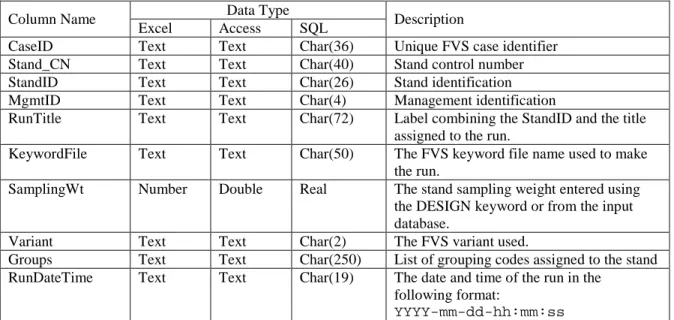
FVS_Cases table identifies a case by defining the data columns listed in table 2.0.1. This table is
automatically generated if any of the other tables in this section are generated.
Data in the FVS_Cases table can be joined to data in the following tables using the universal
variable
CaseID
as a key. Information in the other tables can be joined using
CaseID
and
Year
as
keys.
FVS keywords are used to specify which output tables you want, as is done for other parts of the
FVS system. Joining information between tables depends on you not destroying the relationship
between the
CaseID
values in the related tables. This version of DB-FVS does not insure the
integrity of these relationships.
Table 2.0.1
– The content of the FVS_Cases table.
Column Name Data Type Description
Excel Access SQL
CaseID Text Text Char(36) Unique FVS case identifier
Stand_CN Text Text Char(40) Stand control number
StandID Text Text Char(26) Stand identification
MgmtID Text Text Char(4) Management identification
RunTitle Text Text Char(72) Label combining the StandID and the title
assigned to the run.
KeywordFile Text Text Char(50) The FVS keyword file name used to make
the run.
SamplingWt Number Double Real The stand sampling weight entered using
the DESIGN keyword or from the input database.
Variant Text Text Char(2) The FVS variant used.
Groups Text Text Char(250) List of grouping codes assigned to the stand
RunDateTime Text Text Char(19) The date and time of the run in the
following format:
2.1 Base FVS System Tables
2.1.1 FVS_Summary and FVS_Summary_East
FVS_Summary
and
FVS_Summary_East
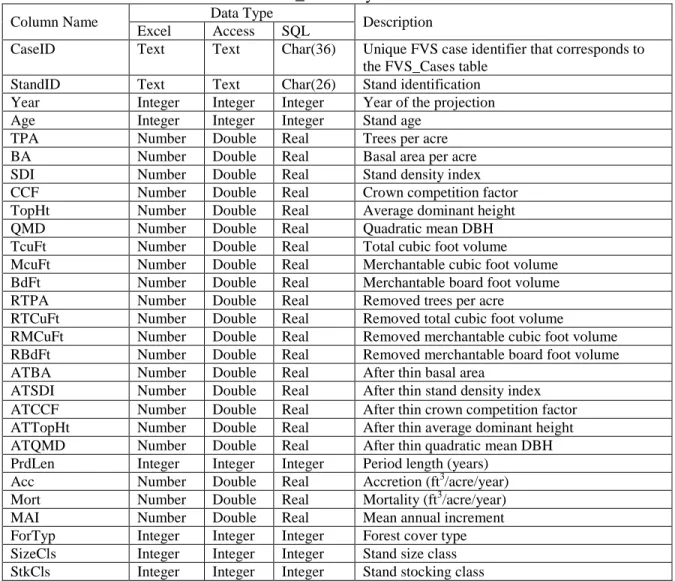
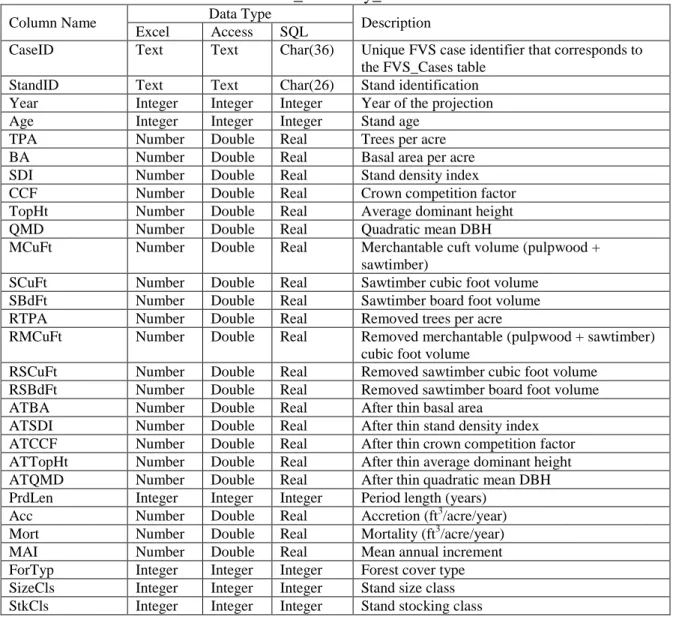
contain the information from the FVS summary
statistics output table plus the case number and an automatic row identification value (tables 2.1.1.1
and 2.1.1.2). Note that there are slightly different formats for Western U.S. variants of FVS versus
those used in the Eastern part of the country. Note that this table is output at the end of the
simulation of a case, not during the simulation. Refer to section 4.3.1.4 of the
Essential FVS Guide
for more information on the summary statistics table.
Table 2.1.1.1
– The content of the FVS_Summary table.
Column Name Data Type Description
Excel Access SQL
CaseID Text Text Char(36) Unique FVS case identifier that corresponds to
the FVS_Cases table
StandID Text Text Char(26) Stand identification
Year Integer Integer Integer Year of the projection
Age Integer Integer Integer Stand age
TPA Number Double Real Trees per acre
BA Number Double Real Basal area per acre
SDI Number Double Real Stand density index
CCF Number Double Real Crown competition factor
TopHt Number Double Real Average dominant height
QMD Number Double Real Quadratic mean DBH
TcuFt Number Double Real Total cubic foot volume
McuFt Number Double Real Merchantable cubic foot volume
BdFt Number Double Real Merchantable board foot volume
RTPA Number Double Real Removed trees per acre
RTCuFt Number Double Real Removed total cubic foot volume
RMCuFt Number Double Real Removed merchantable cubic foot volume
RBdFt Number Double Real Removed merchantable board foot volume
ATBA Number Double Real After thin basal area
ATSDI Number Double Real After thin stand density index
ATCCF Number Double Real After thin crown competition factor
ATTopHt Number Double Real After thin average dominant height
ATQMD Number Double Real After thin quadratic mean DBH
PrdLen Integer Integer Integer Period length (years)
Acc Number Double Real Accretion (ft3/acre/year)
Mort Number Double Real Mortality (ft3/acre/year)
MAI Number Double Real Mean annual increment
ForTyp Integer Integer Integer Forest cover type
SizeCls Integer Integer Integer Stand size class
Table 2.1.1.2
– The content of the FVS_Summary_East table.
Column Name Data Type Description
Excel Access SQL
CaseID Text Text Char(36) Unique FVS case identifier that corresponds to
the FVS_Cases table
StandID Text Text Char(26) Stand identification
Year Integer Integer Integer Year of the projection
Age Integer Integer Integer Stand age
TPA Number Double Real Trees per acre
BA Number Double Real Basal area per acre
SDI Number Double Real Stand density index
CCF Number Double Real Crown competition factor
TopHt Number Double Real Average dominant height
QMD Number Double Real Quadratic mean DBH
MCuFt Number Double Real Merchantable cuft volume (pulpwood +
sawtimber)
SCuFt Number Double Real Sawtimber cubic foot volume
SBdFt Number Double Real Sawtimber board foot volume
RTPA Number Double Real Removed trees per acre
RMCuFt Number Double Real Removed merchantable (pulpwood + sawtimber)
cubic foot volume
RSCuFt Number Double Real Removed sawtimber cubic foot volume
RSBdFt Number Double Real Removed sawtimber board foot volume
ATBA Number Double Real After thin basal area
ATSDI Number Double Real After thin stand density index
ATCCF Number Double Real After thin crown competition factor
ATTopHt Number Double Real After thin average dominant height
ATQMD Number Double Real After thin quadratic mean DBH
PrdLen Integer Integer Integer Period length (years)
Acc Number Double Real Accretion (ft3/acre/year)
Mort Number Double Real Mortality (ft3/acre/year)
MAI Number Double Real Mean annual increment
ForTyp Integer Integer Integer Forest cover type
SizeCls Integer Integer Integer Stand size class
2.1.2 FVS_Compute
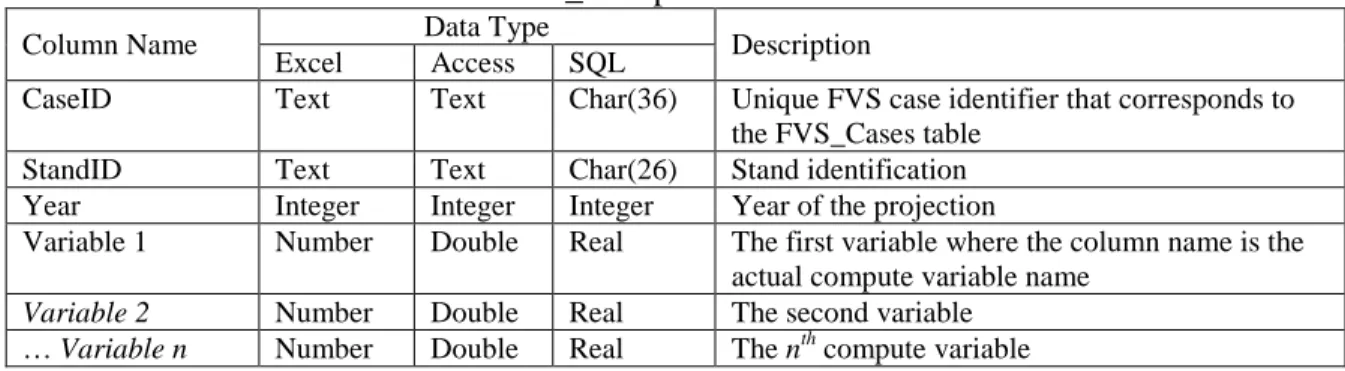
FVS_Compute
contains the FVS compute variables. Like the Summary table, this table contains the
corresponding case number and a row identification value (table 2.1.2.1). When the database type is
Excel, the columns in this table are defined to be the compute variables in the
first
case added to the
database. This is due to a limitation in Excel as other databases allow for adding columns to a table
that contains data. Therefore, for other database types, if an FVS compute variable is used in a case
subsequent to the first case, a new column is generally added to the table for that variable. An option
is available to control the process of automatically adding columns (see section 4.2). Like
FVS_Summary, this table is output at the end of the simulation of a case, not during the simulation.
Refer to the
Essential FVS Guide
for more information on compute variables.
Table 2.1.2
– The content of the FVS_Compute table.
Column Name Data Type Description
Excel Access SQL
CaseID Text Text Char(36) Unique FVS case identifier that corresponds to
the FVS_Cases table
StandID Text Text Char(26) Stand identification
Year Integer Integer Integer Year of the projection
Variable 1 Number Double Real The first variable where the column name is the
actual compute variable name Variable 2 Number Double Real The second variable
… Variable n Number Double Real The nth compute variable
2.1.3 FVS_Treelist, FVS_Cutlist, and FVS_ATRTList
FVS_Treelist
contains information for individual trees similar to the output generated using the
FVS TreeList keyword (table 2.1.3). The data for each time step is output during the simulation of a
case.
FVS_Cutlist
contains information for individual cuts similar to the output generated using the FVS
CutList keyword (table 2.1.3). The data for each time step is output during the simulation of a case.
FVS_ATRTList
contains information for individual trees following thinning treatments similar to
the output generated using the FVS ATRTList keyword (table 2.1.3). The data for each time step is
output during the simulation of a case. Both the “Base FVS System: ATRTList” and “Database
Extension: ATRTList” keywords are needed to send this list to the output database.
More information regarding the Treelist, Cutlist, and After Treatment Treelist can be found in
section 4.3.3.1 of the
Essential FVS Guide
.
Table 2.1.3
– The content of the FVS_Treelist, FVS_Cutlist and FVS_ATRTList tables.
Column Name Data Type DescriptionExcel Access SQL
CaseID Text Text Char(36) Unique FVS case identifier that corresponds to
the FVS_Cases table
StandID Text Text Char(26) Stand identification
Year Integer Integer Integer Year of the projection
PrdLen Integer Integer Integer Length of the projection cycle
TreeId Text Text Char(8) Tree identification
TreeIndex Integer Integer Integer Tree index
Species Text Text Char(3) Species code
TreeValue Integer Integer Integer Tree value class
SSCD Integer Integer Integer Special tree code
PtIndex Integer Integer Integer Point (or plot) index
TPA Number Double Real Trees per acre
MortPA Number Double Real Mortality trees per acre
DBH Number Double Real Diameter at breast height
DG Number Double Real Diameter growth (DBH increment)
Ht Number Double Real Height
HtG Number Double Real Height growth
PctCr Integer Integer Integer Percent live crown
CrWidth Number Double Real Crown width
MistCD Integer Integer Integer Mistletoe rating code
BAPctile Number Double Real Basal area percentile
PtBAL Number Double Real Point-level basal area in larger trees
TcuFt Number Double Real Total cubic feet (Merchantable cuft volume
(pulpwood + sawtimber) in eastern variants)
McuFt Number Double Real Merchantable cubic feet (Merchantable
sawtimber cuft volume in eastern variants)
BdFt Number Double Real Merchantable board feet
Mdefect Integer Integer Integer Defect percent on MCuFt
Bdefect Integer Integer Integer Defect percent on BdFt
TruncHt Integer Integer Integer Truncated height
EstHt Number Double Real Estimated height
ActPt Integer Integer Integer Actual point (or plot) number from input
Ht2TDCF Real Real Real Height to the merchantable cubic foot top
diameter in western variants and height to the pulpwood top diameter in eastern variants *only available when using profile equations
Ht2TDBF Real Real Real Height to the merchantable board foot top
diameter in western variants and height to the sawlog top diameter in eastern variants *only available when using profile equations
2.1.4 FVS_StrClass
FVS_StrClass
contains information that is identical to the data output of the Structural Statistics
Table in FVS (table 2.1.4). The Structural Statistics Table is described in detail in section 4.3.2.2 of
the
Essential FVS Guide
.
Table 2.1.4
– The content of the FVS_StrClass table.
Column Name Data Type Description
Excel Access SQL
CaseID Text Text Char(36) Unique FVS case identifier that
corresponds to the FVS_Cases table
StandID Text Text Char(26) Stand identification
Year Integer Integer Integer Year of the projection
Removal_Code Number Double Real 0 = Before tree removal, 1 = After
tree removal
Stratum_1_DBH Number Double Real Stratum 1 nominal dbh
Stratum_1_Nom_Ht Number Double Real Stratum 1 nominal height
Stratum_1_Lg_Ht Number Double Real Height of the tallest tree in stratum
1
Stratum_1_Sm_Ht Number Double Real Height of the shortest tree in
stratum 1
Stratum_1_Crown_Base Number Double Real Weighted average height to crown
base for trees in stratum 1
Stratum_1_Crown_Cover Number Double Real Percent canopy cover, accounting
for overlap, of trees in stratum 1
Stratum_1_Species_1 Text Text Char(3) Tree species that accounts for the
most crown cover of the trees in stratum 1
Stratum_1_Species_2 Text Text Char(3) Tree species that accounts for the
second most crown cover of the trees in stratum 1
Stratum_1_Status_Code Number Double Real Stratum 1 status code where 0 =
invalid stratum, 1 = valid stratum, and 2 = the uppermost valid stratum
Stratum_2_DBH Number Double Real Stratum 2 nominal dbh
Stratum_2_Nom_Ht Number Double Real Stratum 2 nominal height
Stratum_2_Lg_Ht Number Double Real Height of the tallest tree in stratum
2
Stratum_2_Sm_Ht Number Double Real Height of the shortest tree in
stratum 2
Stratum_2_Crown_Base Number Double Real Weighted average height to crown
base for trees in stratum 2
Stratum_2_Crown_Cover Number Double Real Percent canopy cover, accounting
for overlap, of trees in stratum 2
Stratum_2_Species_1 Text Text Char(3) Tree species that accounts for the
most crown cover of the trees in stratum 2
Stratum_2_Species_2 Text Text Char(3) Tree species that accounts for the
second most crown cover of the trees in stratum 2
Stratum_2_Status_Code Number Double Real Stratum 2 status code where 0 =
Column Name Data Type Description
Excel Access SQL
and 2 = the uppermost valid stratum
Stratum_3_DBH Number Double Real Stratum 3 nominal dbh
Stratum_3_Nom_Ht Number Double Real Stratum 3 nominal height
Stratum_3_Lg_Ht Number Double Real Height of the tallest tree in stratum
3
Stratum_3_Sm_Ht Number Double Real Height of the shortest tree in
stratum 3
Stratum_3_Crown_Base Number Double Real Weighted average height to crown
base for trees in stratum 3
Stratum_3_Crown_Cover Number Double Real Percent canopy cover, accounting
for overlap, of trees in stratum 3
Stratum_3_Species_1 Text Text Char(3) Tree species that accounts for the
most crown cover of the trees in stratum 3
Stratum_3_Species_2 Text Text Char(3) Tree species that accounts for the
second most crown cover of the trees in stratum 3
Stratum_3_Status_Code Number Double Real Stratum 3 status code where 0 =
invalid stratum, 1 = valid stratum, and 2 = the uppermost valid stratum
Number_of_Strata Number Double Real Number of valid strata
Total_Cover Number Double Real Total percent canopy cover,
accounting for overlap, of trees in the stand
Structure_Class Text Text Char(4) Stand structural class: 0 = bare
ground, 1 = stand initiation, 2 = stem exclusion, 3 = understory reinitiation, 4 = young forest multistrata, 5 = old forest single stratum, 6 = old forest multistrata
2.2 Fire and Fuels Extension Tables
2.2.1 FVS_Potfire
FVS_Potfire
contains the information similar to the FFE Potential Fire Report that is generated
using the FVS Fire Model keyword POTFIRE (table 2.2.1). The data for each time step is output
during the simulation of a case. More information on this report can be found in Section 2.5.7 Output
within the
FFE Guide
.
Table 2.2.1
– The Potential Fire FVS_PotFire table.
Column Name Data Type Description
Excel Access SQL
CaseID Text Text Char(36) Unique FVS case identifier that corresponds
to the FVS_Cases table
StandID Text Text Char(26) Stand identification
Year Integer Integer Integer Year of the projection
Surf_Flame_Sev Number Double Real Surface Flame Length (ft), severe fire
Surf_Flame_Mod Number Double Real Surface Flame Length (ft), moderate fire
Tot_Flame_Sev Number Double Real Total Flame Length (ft), severe fire
Tot_Flame_Mod Number Double Real Total Flame Length (ft), moderate fire
Fire_Type_Sev Text Text Char(8) The Severe Fire Type
Fire_Type_Mod Text Text Char(8) The Moderate Fire Type
PTorch_Sev Number Double Real Probability of torching, severe fire
PTorch_Mod Number Double Real Probability of torching, moderate fire
Torch_Index Number Double Real The 20-ft wind speed (miles/hour) required
to cause a torching of trees
Crown_Index Number Double Real The 20-ft wind speed (miles/hour) required
to cause an active crown fire
Canopy_Ht Number Double Real Height of the base of canopy (ft)
Canopy_Density Number Double Real Bulk density of canopy (kg/m3)
Mortality_BA_Sev Number Double Real Percent of the basal area that would be killed
in severe fire conditions
Mortality_BA_Mod Number Double Real Percent of the basal area that would be killed
in moderate fire conditions
Mortality_VOL_Sev Number Double Real Total volume that would be killed under
severe fire conditions (ft3)
Mortality_VOL_Mod Number Double Real Total volume that would be killed under
moderate fire conditions (ft3)
Pot_Smoke_Sev Number Double Real Potential amount of smoke (tons/acre) in
severe fire conditions
Pot_Smoke_Mod Number Double Real Potential amount of smoke (tons/acre) in
moderate fire conditions
Fuel_Mod1 Number Double Real Current fuel model 1
Fuel_Mod2 Number Double Real Current fuel model 2
Fuel_Mod3 Number Double Real Current fuel model 3
Fuel_Mod4 Number Double Real Current fuel model 4
Fuel_Wt1 Number Double Real Percent weighting for corresponding model.
Fuel_Wt2 Number Double Real Percent weighting for corresponding model.
Fuel_Wt3 Number Double Real Percent weighting for corresponding model.
2.2.2 FVS_Potfire_East
FVS_Potfire_East
contains the information similar to the FFE Potential Fire Report that is
generated using the FVS Fire Model keyword POTFIRE with the SN or CS variant (table 2.2.2).
Since the SN variant has a different potential fire report output, there was a need for a separate table.
More information on this report can be found in Section 2.5.7 Output within the
FFE Guide
.
Table 2.2.2
– The Potential Fire FVS_PotFire_East table.
Column Name Data Type Description
Excel Access SQL
CaseID Text Text Char(36) Unique FVS case identifier that corresponds
to the FVS_Cases table
StandID Text Text Char(26) Stand identification
Year Integer Integer Integer Year of the projection
Flame_Len_Sev Number Double Real The Severe Flame Length (ft)
Flame_Len_Mod Number Double Real The Moderate Flame Length (ft)
Canopy_Ht Number Double Real Height of the base of canopy (ft)
Canopy_Density Number Double Real Bulk density of canopy (kg/m3)
Mortality_BA_Sev Number Double Real Percent of the basal area that would be killed
in severe fire conditions
Mortality_BA_Mod Number Double Real Percent of the basal area that would be killed
in moderate fire conditions
Mortality_VOL_Sev Number Double Real Total volume that would be killed under
severe fire conditions (ft3)
Mortality_VOL_Mod Number Double Real Total volume that would be killed under
moderate fire conditions (ft3)
Pot_Smoke_Sev Number Double Real Potential amount of smoke (tons/acre) in
severe fire conditions
Pot_Smoke_Mod Number Double Real Potential amount of smoke (tons/acre) in
moderate fire conditions
Fuel_Mod1_Sev Number Double Real Current fuel model 1: Severe fire conditions
Fuel_Mod2_Sev Number Double Real Current fuel model 2: Severe fire conditions
Fuel_Mod3_Sev Number Double Real Current fuel model 3: Severe fire conditions
Fuel_Mod4_Sev Number Double Real Current fuel model 4: Severe fire conditions
Fuel_Wt1_Sev Number Double Real Percent weighting for corresponding model.
Fuel_Wt2_Sev Number Double Real Percent weighting for corresponding model.
Fuel_Wt3_Sev Number Double Real Percent weighting for corresponding model.
Fuel_Wt4_Sev Number Double Real Percent weighting for corresponding model.
Fuel_Mod1_Mod Number Double Real Current fuel model 1: Moderate conditions
Fuel_Mod2_Mod Number Double Real Current fuel model 2: Moderate conditions
Fuel_Mod3_Mod Number Double Real Current fuel model 3: Moderate conditions
Fuel_Mod4_Mod Number Double Real Current fuel model 4: Moderate conditions
Fuel_Wt1_Mod Number Double Real Percent weighting for corresponding model.
Fuel_Wt2_Mod Number Double Real Percent weighting for corresponding model.
Fuel_Wt3_Mod Number Double Real Percent weighting for corresponding model.
2.2.3 FVS_CanProfile
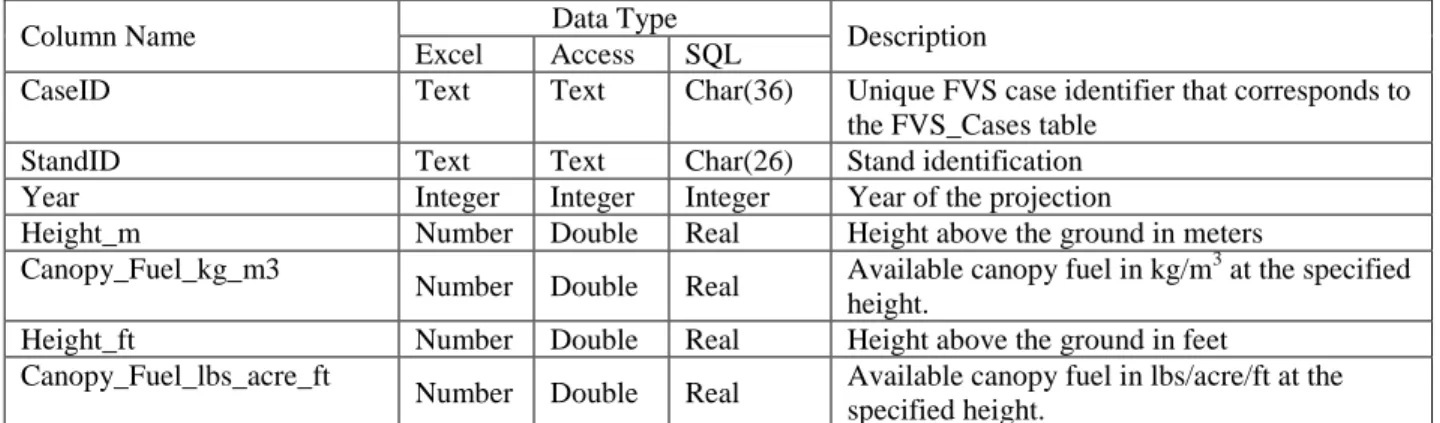
FVS_CanProfile
contains canopy fuels profile information that is used to determine the canopy
base height and canopy bulk density (table 2.2.3). Specifically, output is the available canopy fuel
(kg/m
3or lbs/acre/ft) at various heights above the ground (feet or meters). As described in the
FFE
Guide
, available canopy fuel is foliage and small branchwood (half of the 0-0.25 inch branchwood).
Generally, it only includes conifer trees above 6 ft tall, but this assumption can be changed with the
FFE keyword CanCalc.
**The FVS_CanProfile table is created thru the use of the FFE keyword
CanFProf (rather than a DBS keyword). See the
FFE Guide
for additional information about this
keyword.
Table 2.2.3
– The content of the FVS_CanProfile table.
Column Name Data Type Description
Excel Access SQL
CaseID Text Text Char(36) Unique FVS case identifier that corresponds to
the FVS_Cases table
StandID Text Text Char(26) Stand identification
Year Integer Integer Integer Year of the projection
Height_m Number Double Real Height above the ground in meters
Canopy_Fuel_kg_m3
Number Double Real Available canopy fuel in kg/m
3 at the specified height.
Height_ft Number Double Real Height above the ground in feet
Canopy_Fuel_lbs_acre_ft
Number Double Real Available canopy fuel in lbs/acre/ft at the specified height.
2.2.4 FVS_Fuels
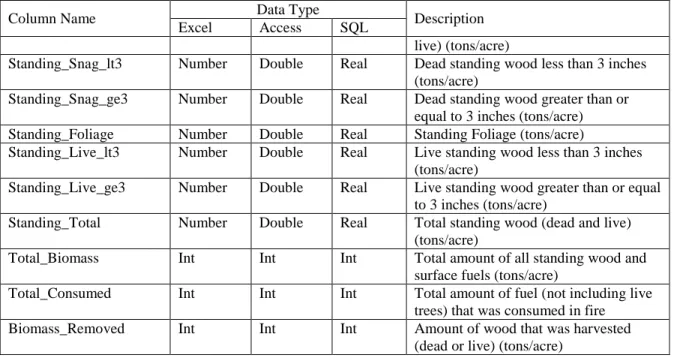
FVS_Fuels
contains the output information that is identical to the data output of the FFE All Fuels
Report (table 2.2.4). The data for each time step is output during the simulation of a case. More
information on this report can be found in Section 2.4.10 Output within the
FFE Guide
.
Table 2.2.4
– The All Fuels FVS_Fuels table.
Column Name Data Type Description
Excel Access SQL
CaseID Text Text Char(36) Unique FVS case identifier that
corresponds to the FVS_Cases table
StandID Text Text Char(26) Stand identification
Year Integer Integer Integer Year of the projection
Surface_Litter Number Double Real Ground litter (tons/acre)
Surface_Duff Number Double Real Surface duff (tons/acre)
Surface_lt3 Number Double Real Dead fuel less than 3 inches (tons/acre)
Surface_ge3 Number Double Real Dead fuel greater than or equal to 3
inches (tons/acre)
Surface_3to6 Number Double Real Dead fuel between 3 and 6 inches
(tons/acre)
Surface_6to12 Number Double Real Dead fuel between 6 and 12 inches
(tons/acre)
Surface_ge12 Number Double Real Dead fuel greater than or equal to 12
inches (tons/acre)
Surface_Herb Number Double Real Live Herbs (tons/acre)
Surface_Shrub Number Double Real Live Shrubs (tons/acre)
Column Name Data Type Description
Excel Access SQL
live) (tons/acre)
Standing_Snag_lt3 Number Double Real Dead standing wood less than 3 inches
(tons/acre)
Standing_Snag_ge3 Number Double Real Dead standing wood greater than or
equal to 3 inches (tons/acre)
Standing_Foliage Number Double Real Standing Foliage (tons/acre)
Standing_Live_lt3 Number Double Real Live standing wood less than 3 inches
(tons/acre)
Standing_Live_ge3 Number Double Real Live standing wood greater than or equal
to 3 inches (tons/acre)
Standing_Total Number Double Real Total standing wood (dead and live)
(tons/acre)
Total_Biomass Int Int Int Total amount of all standing wood and
surface fuels (tons/acre)
Total_Consumed Int Int Int Total amount of fuel (not including live
trees) that was consumed in fire
Biomass_Removed Int Int Int Amount of wood that was harvested
(dead or live) (tons/acre)
2.2.5 FVS_BurnReport
FVS_BurnReport
contains information similar to the FFE Burn Conditions Report (table 2.2.5).
More information on this report can be found in Section 2.5.7 Output within the
FFE Guide
.
Table 2.2.5
– The FVS_BurnReport table.
Column Name Data Type Description
Excel Access SQL
CaseID Text Text Char(36) Unique FVS case identifier that
corresponds to the FVS_Cases table
StandID Text Text Char(26) Stand identification
Year Integer Integer Integer Year of the burn
One_Hr_Moisture Number Double Real Moisture of 0 – 0.25” fuels (%)
Ten_Hr_Moisture Number Double Real Moisture of 0.25 – 1” fuels (%)
Hundred_Hr_Moisture Number Double Real Moisture of 1 – 3” fuels (%)
Thousand_Hr_Moisture Number Double Real Moisture of 3”+ fuels (%)
Duff_Moisture Number Double Real Duff moisture (%)
Live_Woody_Moisture Number Double Real Live woody fuel moisture (%)
Live_Herb_Moisture Number Double Real Live herbaceous fuel moisture (%)
Midflame_Wind Number Double Real Midflame wind speed (mi/hr)
Slope Number Double Real Stand slope (%)
Flame_length Number Double Real Total flame length (ft)
Scorch_height Number Double Real Scorch height (ft)
Fire_Type Text Text Char(8) The type of fire
FuelModl1 Number Double Real Fuel model 1
Weight1 Number Double Real Weight given to fuel model 1 (%)
FuelModl2 Number Double Real Fuel model 2
Weight2 Number Double Real Weight given to fuel model 2 (%)
FuelModl3 Number Double Real Fuel model 3
Weight3 Number Double Real Weight given to fuel model 3 (%)
FuelModl4 Number Double Real Fuel model 4
2.2.6 FVS_Consumption
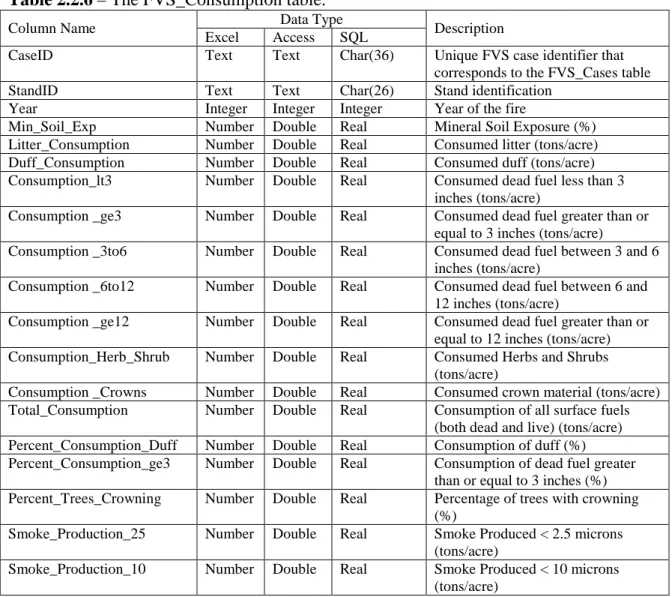
FVS_Consumption
contains information similar to the FFE Fuel Consumption Report (table 2.2.6).
More information on this report can be found in Section 2.5.7 Output within the
FFE Guide
.
Table 2.2.6
– The FVS_Consumption table.
Column Name Data Type Description
Excel Access SQL
CaseID Text Text Char(36) Unique FVS case identifier that
corresponds to the FVS_Cases table
StandID Text Text Char(26) Stand identification
Year Integer Integer Integer Year of the fire
Min_Soil_Exp Number Double Real Mineral Soil Exposure (%)
Litter_Consumption Number Double Real Consumed litter (tons/acre)
Duff_Consumption Number Double Real Consumed duff (tons/acre)
Consumption_lt3 Number Double Real Consumed dead fuel less than 3
inches (tons/acre)
Consumption _ge3 Number Double Real Consumed dead fuel greater than or
equal to 3 inches (tons/acre)
Consumption _3to6 Number Double Real Consumed dead fuel between 3 and 6
inches (tons/acre)
Consumption _6to12 Number Double Real Consumed dead fuel between 6 and
12 inches (tons/acre)
Consumption _ge12 Number Double Real Consumed dead fuel greater than or
equal to 12 inches (tons/acre)
Consumption_Herb_Shrub Number Double Real Consumed Herbs and Shrubs
(tons/acre)
Consumption _Crowns Number Double Real Consumed crown material (tons/acre)
Total_Consumption Number Double Real Consumption of all surface fuels
(both dead and live) (tons/acre)
Percent_Consumption_Duff Number Double Real Consumption of duff (%)
Percent_Consumption_ge3 Number Double Real Consumption of dead fuel greater
than or equal to 3 inches (%)
Percent_Trees_Crowning Number Double Real Percentage of trees with crowning
(%)
Smoke_Production_25 Number Double Real Smoke Produced < 2.5 microns
(tons/acre)
Smoke_Production_10 Number Double Real Smoke Produced < 10 microns
2.2.7 FVS_Mortality
FVS_Mortality
contains information similar to the FFE Mortality Report (table 2.2.7). More
information on this report can be found in Section 2.5.7 Output within the
FFE Guide
.
Table 2.2.7
– The FVS_Mortality table.
Column Name Data Type Description
Excel Access SQL
CaseID Text Text Char(36) Unique FVS case identifier that
corresponds to the FVS_Cases table
StandID Text Text Char(26) Stand identification
Year Integer Integer Integer Year of the fire
Species Text Text Char(3) Species
Killed_class1 Number Double Real Trees per acre killed in diameter class
1*
Total_class1 Number Double Real Trees per acre in diameter class 1
before fire
Killed_class2 Number Double Real Trees per acre killed in diameter class 2
Total_class2 Number Double Real Trees per acre in diameter class 2
before fire
Killed_class3 Number Double Real Trees per acre killed in diameter class 3
Total_class3 Number Double Real Trees per acre in diameter class 3
before fire
Killed_class4 Number Double Real Trees per acre killed in diameter class 4
Total_class4 Number Double Real Trees per acre in diameter class 4
before fire
Killed_class5 Number Double Real Trees per acre killed in diameter class 5
Total_class5 Number Double Real Trees per acre in diameter class 5
before fire
Killed_class6 Number Double Real Trees per acre killed in diameter class 6
Total_class6 Number Double Real Trees per acre in diameter class 6
before fire
Killed_class7 Number Double Real Trees per acre killed in diameter class 7
Total_class7 Number Double Real Trees per acre in diameter class 7
before fire
Bakill Number Double Real Basal area of killed trees (ft2/acre)
Volkill Number Double Real Volume of killed trees (cuft/acre)
(This is total cuft volume in western variants and merchantable cuft volume in eastern variants.)
*The diameter classes can be changed with the FFE MORTCLAS keyword and are the following by default:
Diameter class 1: 0 – 5” Diameter class 2: 5 – 10” Diameter class 3: 10 – 20” Diameter class 4: 20 – 30” Diameter class 5: 30 – 40” Diameter class 6: 40 – 50” Diameter class 7: > 50”
2.2.8 FVS_SnagSum
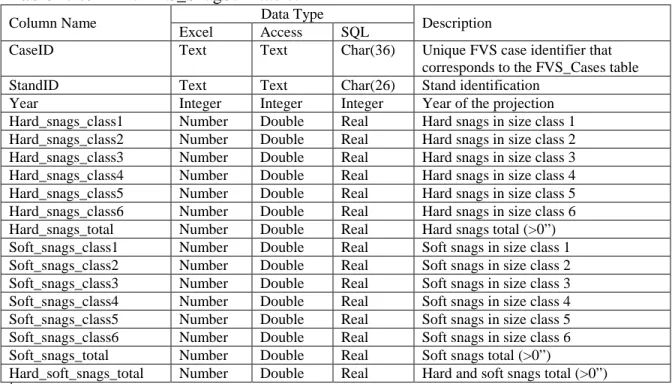
FVS_SnagSum
contains information similar to the FFE Snag Summary Report (table 2.2.8). More
information on this report can be found in Section 2.3.8 Output within the
FFE Guide
.
Table 2.2.8
– The FVS_SnagSum table.
Column Name Data Type Description
Excel Access SQL
CaseID Text Text Char(36) Unique FVS case identifier that
corresponds to the FVS_Cases table
StandID Text Text Char(26) Stand identification
Year Integer Integer Integer Year of the projection
Hard_snags_class1 Number Double Real Hard snags in size class 1
Hard_snags_class2 Number Double Real Hard snags in size class 2
Hard_snags_class3 Number Double Real Hard snags in size class 3
Hard_snags_class4 Number Double Real Hard snags in size class 4
Hard_snags_class5 Number Double Real Hard snags in size class 5
Hard_snags_class6 Number Double Real Hard snags in size class 6
Hard_snags_total Number Double Real Hard snags total (>0”)
Soft_snags_class1 Number Double Real Soft snags in size class 1
Soft_snags_class2 Number Double Real Soft snags in size class 2
Soft_snags_class3 Number Double Real Soft snags in size class 3
Soft_snags_class4 Number Double Real Soft snags in size class 4
Soft_snags_class5 Number Double Real Soft snags in size class 5
Soft_snags_class6 Number Double Real Soft snags in size class 6
Soft_snags_total Number Double Real Soft snags total (>0”)
Hard_soft_snags_total Number Double Real Hard and soft snags total (>0”) 1 The size classes can be changed with the FFE SNAGCLAS keyword and are the following by default:
Size class 1: >= 0” Size class 2: >= 12” Size class 3: >=18” Size class 4: >=24” Size class 5: >=30” Size class 6: >=36”
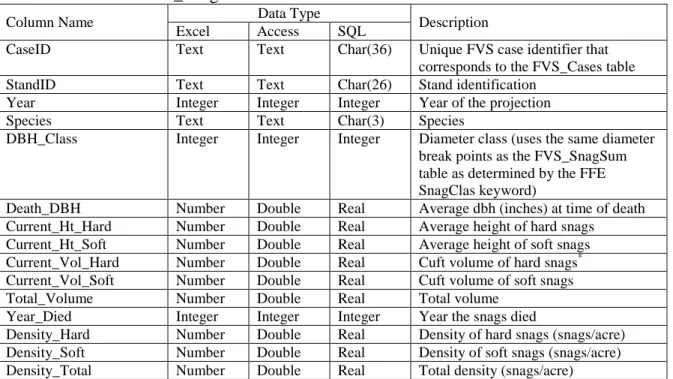
2.2.9 FVS_SnagDet
FVS_SnagDet
contains information similar to the FFE Detailed Snag Report (table 2.2.9). More
information on this report can be found in Section 2.3.8 Output within the
FFE Guide
.
Table 2.2.9
– The FVS_SnagDet table.
Column Name Data Type Description
Excel Access SQL
CaseID Text Text Char(36) Unique FVS case identifier that
corresponds to the FVS_Cases table
StandID Text Text Char(26) Stand identification
Year Integer Integer Integer Year of the projection
Species Text Text Char(3) Species
DBH_Class Integer Integer Integer Diameter class (uses the same diameter
break points as the FVS_SnagSum table as determined by the FFE SnagClas keyword)
Death_DBH Number Double Real Average dbh (inches) at time of death
Current_Ht_Hard Number Double Real Average height of hard snags
Current_Ht_Soft Number Double Real Average height of soft snags
Current_Vol_Hard Number Double Real Cuft volume of hard snags*
Current_Vol_Soft Number Double Real Cuft volume of soft snags
Total_Volume Number Double Real Total volume
Year_Died Integer Integer Integer Year the snags died
Density_Hard Number Double Real Density of hard snags (snags/acre)
Density_Soft Number Double Real Density of soft snags (snags/acre)
Density_Total Number Double Real Total density (snags/acre)
*The volume estimates in this table are for the entire snag record, not per snag. Also, the volume estimates are total cuft/acre in western variants but merchantable cuft/acre in eastern variants.
2.2.10 FVS_Carbon
FVS_Carbon
contains output information identical to the main Carbon report produced by the FFE
extension: reporting above- and below-ground live and dead stand carbon pools. Output may be
expressed using imperial (tons/acre, the default), metric (metric tons/hectare) or combined (metric
tons/acre) units, depending on the FFE CarbCalc keyword. (table 2.2.10). More information on this
report can be found in Section 2.6.2 Output within the
FFE Guide
.
Table 2.2.10
– The content of the FVS_Carbon table.
1Column Name Data Type Description
Excel Access SQL
CaseID Text Text Char(36) Unique FVS case identifier that corresponds to
the FVS_Cases table
StandID Text Text Char(26) Stand identification
Year Integer Integer Integer Year of the projection
Aboveground_Total_Live Number Double Real Aboveground live C (tons/ac)
Aboveground_Merch_Live Number Double Real Aboveground merchantable C (tons/ac)
Belowground_Live Number Double Real Belowground live C(tons/ac)
BelowGround_Dead Number Double Real Belowground dead C (tons/ac)
Standing_Dead Number Double Real Standing dead C (snags) (tons/ac)
Forest_Down_Dead_Wood Number Double Real Woody debris C (tons/ac)
Forest_Floor Number Double Real Forest floor C (tons/ac)
Forest_Shrub_Herb Number Double Real Shrub & herb C (tons/ac)
Total_Stand_Carbon Number Double Real Total stand C (tons/ac)
Total_Removed_Carbon Number Double Real Total removed C (tons/ac)
Carbon_Released_From_Fire Number Double Real C in fuel consumed by fire (tons/ac) 1 Measurement units may be imperial (tons/acre, default), metric (metric tons/hectare), or combined (metric tons/acre), depending on FFE CarbCalc keyword.
2.2.11 FVS_Hrv_Carbon
FVS_Hrv_Carbon
contains output information identical to the Harvested Carbon report produced
by the FFE extension: reporting the fate of carbon that is harvested. Output may be expressed using
imperial (tons/acre, the default), metric (metric tons/hectare) or combined (metric tons/acre) units,
depending on the FFE CarbCalc keyword (table 2.2.11). More information on this report can be
found in Section 2.6.2 Output within the
FFE Guide
.
Table 2.2.11
– The content of the FVS_Hrv_Carbon table.
1Column Name Data Type Description
Excel Access SQL
CaseID Text Text Char(36) Unique FVS case identifier that corresponds to
the FVS_Cases table
StandID Text Text Char(26) Stand identification
Year Integer Integer Integer Year of the projection
Products Number Double Real Wood Products C (tons/ac)
Landfill Number Double Real Landfill C (tons/ac)
Energy Number Double Real Energy C (tons/ac)
Emissions Number Double Real Emitted C (tons/ac)
Merch_Carbon_Stored Number Double Real Stored C (tons/ac)
Merch_Carbon_Removed Number Double Real Removed C (tons/ac)
1
Measurement units may be imperial (tons/acre, default), metric (metric tons/hectare), or combined (metric tons/acre), depending on FFE CarbCalc keyword.
2.2.12 FVS_Down_Wood_Cov
FVS_Down_Wood_Cov
contains information similar to the FFE Down Woody Debris Cover
Report (table 2.2.12). More information on this report can be found in Section 2.4.10 Output within
the
FFE Guide
.
Table 2.2.12
– The FVS_Down_Wood_Cov table.
Column Name Data Type Description
Excel Access SQL
CaseID Text Text Char(36) Unique FVS case identifier that
corresponds to the FVS_Cases table
StandID Text Text Char(26) Stand identification
Year Integer Integer Integer Year of the projection
DWD_Cover_3to6_Hard Number Double Real Cover of 3 – 6” hard down wood (%)
DWD_Cover_6to12_Hard Number Double Real Cover of 6 – 12” hard down wood (%)
DWD_Cover_12to20_Hard Number Double Real Cover of 12 – 20” hard down wood (%)
DWD_Cover_20to35_Hard Number Double Real Cover of 20 – 35” hard down wood (%)
DWD_Cover_35to50_Hard Number Double Real Cover of 35 – 50” hard down wood (%)
DWD_Cover_ge_50_Hard Number Double Real Cover of 50”+ hard down wood (%)
DWD_Cover_Total_Hard Number Double Real Total cover of hard down wood (%)
DWD_Cover_3to6_Soft Number Double Real Cover of 3 – 6” soft down wood (%)
DWD_Cover_6to12_Soft Number Double Real Cover of 6 – 12” soft down wood (%)
DWD_Cover_12to20_Soft Number Double Real Cover of 12 – 20” soft down wood (%)
DWD_Cover_20to35_Soft Number Double Real Cover of 20 – 35” soft down wood (%)
DWD_Cover_35to50_Soft Number Double Real Cover of 35 – 50” soft down wood (%)
DWD_Cover_ge_50_Soft Number Double Real Cover of 50”+ soft down wood (%)
2.2.13 FVS_Down_Wood_Vol
FVS_Down_Wood_Vol
contains information similar to the FFE Down Wood Debris Volume
Report (table 2.2.13). More information on this report can be found in Section 2.4.10 Output within
the
FFE Guide
.
Table 2.2.13
– The FVS_Down_Wood_Vol table.
Column Name Data Type Description
Excel Access SQL
CaseID Text Text Char(36) Unique FVS case identifier that corresponds to
the FVS_Cases table
StandID Text Text Char(26) Stand identification
Year Integer Integer Integer Year of the projection
DWD_Volume_0to3_Hard Number Double Real Volume of 0 – 3” hard down wood (cuft/acre)
DWD_Volume_3to6_Hard Number Double Real Volume of 3 – 6” hard down wood (cuft/acre)
DWD_Volume_6to12_Hard Number Double Real Volume of 6 – 12” hard down wood (cuft/acre)
DWD_Volume_12to20_Hard Number Double Real Volume of 12 – 20” hard down wood (cuft/acre) DWD_Volume_20to35_Hard Number Double Real Volume of 20 – 35” hard down wood (cuft/acre) DWD_Volume_35to50_Hard Number Double Real Volume of 35 – 50” hard down wood (cuft/acre)
DWD_Volume_ge_50_Hard Number Double Real Volume of 50”+ hard down wood (cuft/acre)
DWD_Volume_Total_Hard Number Double Real Total volume of hard down wood (cuft/acre)
DWD_Volume_0to3_Soft Number Double Real Volume of 0 – 3” soft down wood (cuft/acre)
DWD_Volume_3to6_Soft Number Double Real Volume of 3 – 6” soft down wood (cuft/acre)
DWD_Volume_6to12_Soft Number Double Real Volume of 6 – 12” soft down wood (cuft/acre)
DWD_Volume_12to20_Soft Number Double Real Volume of 12 – 20” soft down wood (cuft/acre) DWD_Volume_20to35_Soft Number Double Real Volume of 20 – 35” soft down wood (cuft/acre) DWD_Volume_35to50_Soft Number Double Real Volume of 35 – 50” soft down wood (cuft/acre)
DWD_Volume_ge_50_Soft Number Double Real Volume of 50”+ soft down wood (cuft/acre)
2.3 Dwarf Mistletoe Impact Model Tables
2.3.1 FVS_DM_Spp_Sum
FVS_DM_Spp_Sum
contains the output information that is identical to the data output of the
Species-Specific report in the FVS Interim Dwarf Mistletoe Model (table 2.3.1). The data for each
time step is output during the simulation of a case. Dwarf mistletoe tables are created at the
beginning
of each time step. In contrast, most other tables are created at the end of each time step.
This difference is maintained here for consistency with the existing structure of the mistletoe
extension. More information on this report can be found in Section 3.3.2 within the
Dwarf Mistletoe
Model User’s Guide
.
Table 2.3.1
– The content of the FVS_DM_Spp_Sum table.
Column Name Data Type Description
Excel Access SQL
CaseID Text Text Char(36) Unique FVS case identifier that corresponds to
the FVS_Cases table
StandID Text Text Char(26) Stand identification
Year Integer Integer Integer Year of the projection
Spp Text Text Char(2) 2-character species code
Mean_DMR Number Double Real Average dwarf mistletoe rating for species
Mean_DMI Number Double Real Average dwarf mistletoe rating for infected trees
for species
Inf_TPA Integer Integer Integer Trees acre infected for species
Mort_TPA Integer Integer Integer Trees per acre killed by mistletoe for species Inf_TPA_Pct Integer Integer Integer Trees per acre (% of stand) infected for species Mort_TPA_Pct Integer Integer Integer Trees per acre (% of stand) killed by mistletoe for
species
Stnd_TPA_Pct Integer Integer Integer Trees per acre (% of stand) for species
2.3.2 FVS_DM_Stnd_Sum
FVS_DM_Stnd_Sum
contains the output information that is identical to the data output of the Stand
Average report in the FVS Interim Dwarf Mistletoe Model (table 2.3.2). The data for each time step
is output during the simulation of a case
1. More information on this report can be found in Section
3.3.1 within the
Dwarf Mistletoe Model User’s Guide
.
Table 2.3.2
– The content of the FVS_DM_Stnd_Sum table.
Column Name Data Type Description
Excel Access SQL
CaseID Text Text Char(36) Unique FVS case identifier that corresponds to
the FVS_Cases table
StandID Text Text Char(26) Stand identification
Year Integer Integer Integer Year of the projection
Age Integer Integer Integer Stand Age
Stnd_TPA Integer Integer Integer Stand trees per acre at the start of cycle
Stnd_BA Integer Integer Integer Stand basal area per acre at the start of cycle
Stnd_Vol Integer Integer Integer Stand volume per acre at the start of cycle
Inf_TPA Integer Integer Integer Trees per acre of the total infected by mistletoe
Inf_BA Integer Integer Integer Basal area infected by mistletoe of the total
Inf_Vol Integer Integer Integer Volume per acre infected by mistletoe of the total
Column Name Data Type Description
Excel Access SQL
Mort_BA Integer Integer Integer Basal area killed by mistletoe of the total
Mort_Vol Integer Integer Integer Volume killed by mistletoe of the total
Inf_TPA_Pct Integer Integer Integer Trees per acre (% of stand) infected by mistletoe
Inf_Vol_Pct Integer Integer Integer Volume (% of stand) infected by mistletoe
Mort_TPA_Pct Integer Integer Integer Trees per acre (% of stand) killed by mistletoe Mort_Vol_Pct Integer Integer Integer Volume (% of stand) killed by mistletoe
Mean_DMR Number Double Real Average dwarf mistletoe rating for the stand
Mean_DMI Number Double Real Average dwarf mistletoe rating of infected trees
2.3.3 FVS_DM_Sz_Sum
FVS_DM_Sz_Sum
contains the output information that is identical to the data output of the
Diameter Class report in the FVS Interim Dwarf Mistletoe Model (table 2.3.3). The data for each
time step is output during the simulation of a case
1. More information on this report can be found in
Section 3.3.3 within the
Dwarf Mistletoe Model User’s Guide
.
Table 2.3.3
– The content of the FVS_DM_Sz_Sum table.
Column Name Data Type Description
Excel Access SQL
CaseID Text Text Char(36) Unique FVS case identifier that corresponds to
the FVS_Cases table
StandID Text Text Char(26) Stand identification
Year Integer Integer Integer Year of the projection
Type Text Text Char(3) “TPA” (trees/acre); “INF” (trees/acre infected);
“MRT” (trees/acre killed by mistleteo); “DMR” (average dwarf mistletoe rating); “DMI” (average dwarf mistletoe rating of infected trees)
0-3in Number Double Real Units vary by type for each diameter class
3-5in Number Double Real
5-7in Number Double Real
… … … … 2 inch diameter classes
17-19in Number Double Real
gt19in Number Double Real
2.4 Economics Analysis Extension Tables
2.4.1 FVS_EconSummary
FVS_EconSummary
contains output identical to the Economics Analysis Extension (ECON)
summary measures table (table 2.4.1). More information on this report can be found in Section III
within the
User Guide to the FVS Economic Extension
.
Table 2.4.1
– The content of the FVS_EconSummary table.
Column Name Data Type Description
Excel Access SQL
CaseID Text Text Char(36) Unique FVS case identifier that corresponds to
the FVS_Cases table
Year Integer Integer Integer Year of the projection
Period Integer Integer Integer Cycle length
Pretend_Harvest Text Text Char(3) Pretend or actual harvests, “yes” for pretend.
Undiscounted_cost Number Double Real Undiscounted cost (accumulation of all costs)
Undiscounted_revenue Number Double Real Undiscounted revenue (accumulation of all
revenues)
Discounted_cost Number Double Real Discounted cost
Discounted_revenue Number Double Real Discounted revenue
PNV Number Double Real Present Net Value
IRR Number Double Real Internal Rate of Return
BC_Ratio Number Double Real Benefit-Cost Ratio
RRR Number Double Real Realizable Rate of Return
SEV Number Double Real Soil Expectation Value
Value_of_forest Number Double Real Value of forest
Value_of_trees Number Double Real Value of trees
Mrch_Cubic_Volume Integer Integer Integer Harvested Merchantable cubic foot volume
(west) and Sawlog cubic foot volume (east)
Mrch_BoardFoot_Volume Integer Integer Integer Harvested Merchantable board foot volume
(west) and Sawlog board foot volume (east)
Discount_Rate Number Double Real Discount rate
2.4.2 FVS_EconHarvestValue
FVS_EconHarvestValue
contains output identical to the Economics Analysis Extension (ECON)
harvest volumes and gross values table (table 2.4.2). More information on this report can be found in
Section III within the
User Guide to the FVS Economic Extension
.
Table 2.4.2
– The content of the FVS_EconHarvestValue table.
Column Name Data Type Description
Excel Access SQL
CaseID Text Text Char(36) Unique FVS case identifier that corresponds to
the FVS_Cases table
Year Integer Integer Integer Year of the projection
Species Text Text Char(8) Species
Min_DIB Number Double Real Minimum top diameter inside bark
Max_DIB Number Double Real Maximum top diameter inside bark
Min_DBH Number Double Real Minimum diameter at breast height
Max_DBH Number Double Real Maximum diameter at breast height
TPA_Removed Integer Integer Integer Trees per acre removed
TPA_Value Integer Integer Integer Trees per acre value
Tons_Per_Acre Integer Integer Integer Tons of material
Ft3_Removed Integer Integer Integer Cubic foot volume removed
Ft3_Value Integer Integer Integer Cubic foot volume value
Board_Ft_Removed Integer Integer Integer Board foot volume removed
Board_Ft_Value Integer Integer Integer Board foot volume value
2.5 Western Root Disease Model Tables
2.5.1 FVS_RD_SUM
FVS_RD_SUM
contains the output information that is identical to the data output of the Summary
Statistics for Root Disease Areas (table 2.5.1). The data for each time step is output during the
simulation of a case. More information on this report can be found in Section 7.2 within the
Western
Root Disease Model User’s Guide
.
Table 2.5.1
– The content of the FVS_RD_Sum table.
Column Name Data Type Description
Excel Access SQL
CaseID Text Text Char(36) Unique FVS case identifier that corresponds to
the FVS_Cases table
StandID Text Text Char(26) Stand identification
Year Integer Integer Integer Year of the projection
Age Integer Integer Integer Stand Age
RD_Type Text Text Char(1) Root disease type
Num_Centers Integer Integer Integer Number of disease centers
RD_Area Number Double Real Diseased area of stand (acres)
Spread_Ft_per_Year Number Double Real Disease spread rate (ft/year)
Stumps_per_Acre Number Double Real Number of stumps per acre
Stumps_BA_SqFt Number Double Real Basal area of stumps (square feet)
Mort_TPA Number Double Real Mortality trees per acre
Mort_CuFt Number Double Real Mortality cubic feet per acre
Unin_TPA Number Double Real Uninfected trees per acre
Inf_TPA Number Double Real Infected trees per acre
Ave_Pct_Root_Inf Number Double Real Average percent root system infected
2.5.2 FVS_RD_DET
FVS_RD_DET
contains the output information that is identical to the data output of the Detailed
Output of Stand Attributes Inside Root Disease Patches (table 2.5.2). More information on this
report can be found in Section 7.3 within the
Western Root Disease Model User’s Guide
.
Table 2.5.2
– The content of the FVS_RD_DET table.
Column Name Data Type Description
Excel Access SQL
CaseID Text Text Char(36) Unique FVS case identifier that corresponds
to the FVS_Cases table
StandID Text Text Char(26) Stand identification
Year Integer Integer Integer Year of the projection
RD_Type Text Text Char(1) Root disease type
RD_Area Number Double Real Disease area in acres
Species Text Text Char(2) Tree species
Mort_10Pctile_DBH Number Double Real Mortality trees 10 percentile DBH inches
Mort_30Pctile_DBH Number Double Real Mortality trees 30 percentile DBH inches
Mort_50Pctile_DBH Number Double Real Mortality trees 50 percentile DBH inches
Mort_70Pctile_DBH Number Double Real Mortality trees 70 percentile DBH inches
Mort_90Pctile_DBH Number Double Real Mortality trees 90 percentile DBH inches
Mort_100Pctile_DBH Number Double Real Mortality trees 100 percentile DBH inches
Column Name Data Type Description
Excel Access SQL
Live_10Pctile_DBH Number Double Real Live trees 10 percentile DBH inches
Live_30Pctile_DBH Number Double Real Live trees 30 percentile DBH inches
Live_50Pctile_DBH Number Double Real Live trees 50 percentile DBH inches
Live_70Pctile_DBH Number Double Real Live trees 70 percentile DBH inches
Live_90Pctile_DBH Number Double Real Live trees 90 percentile DBH inches
Live_100Pctile_DBH Number Double Real Live trees 100 percentile DBH inches
UnInf_TPA_Total Number Double Real Live uninfected total trees per acre
Inf_TPA_Total Number Double Real Live infected total trees per acre
Pct_Roots_Inf Number Double Real Average percent of root system infected
2.5.3 FVS_RD_BBMortTPA
FVS_RD_BBMortTPA
contains the output information that is identical to the data output of the
Trees Per Acre Killed by Bark Beetles in Each Time Period (table 2.5.3). More information on this
report can be found in Section 7.4 within the
Western Root Disease Model User’s Guide
.
Table 2.5.3
– The content of the FVS_DM_Sz_Sum table.
Column Name Data Type Description
Excel Access SQL
CaseID Text Text Char(36)
Unique FVS case identifier that corresponds to the FVS_Cases table
StandID Text Text Char(26) Stand identification Year Integer Integer Integer Year of the projection Species Text Text Char(2) Tree species
In_Inf_0_5_DBH Number Double Real
Disease area infected TPA mortality in 0-5 inch DBH class
In_Inf_5_10_DBH Number Double Real
Disease area infected TPA mortality in 5-10 inch DBH class
In_Inf_10_15_DBH Number Double Real
Disease area infected TPA mortality in 10-15 inch DBH class
In_Inf_15_20_DBH Number Double Real
Disease area infected TPA mortality in 15-20 inch DBH class
In_Inf_20_25_DBH Number Double Real
Disease area infected TPA mortality in 20-25 inch DBH class
In_Inf_25_30_DBH Number Double Real
Disease area infected TPA mortality in 25-30 inch DBH class
In_Inf_30_DBH Number Double Real
Disease area infected TPA mortality in 30+ inch DBH class
In_Inf_Mort Number Double Real Disease area infected TPA mortality total In_Inf_Live_before Number Double Real Disease area infected TPA live before beetle kill
In_UnInf_0_5_DBH Number Double Real
Disease area uninfected TPA mortality in 0-5 inch DBH class
In_UnInf_5_10_DBH Number Double Real
Disease area uninfected TPA mortality in 5-10 inch DBH class
In_UnInf_10_15_DBH Number Double Real
Disease area uninfected TPA mortality in 10-15 inch DBH class
In_UnInf_15_20_DBH Number Double Real
Disease area uninfected TPA mortality in 15-20 inch DBH class
In_UnInf_20_25_DBH Number Double Real
Disease area uninfected TPA mortality in 20-25 inch DBH class
In_UnInf_25_30_DBH Number Double Real
Disease area uninfected TPA mortality in 25-30 inch DBH class
In_UnInf_30_DBH Number Double Real
Disease area uninfected TPA mortality in 30+ inch DBH class
In_UnInf_Mort Number Double Real Disease area uninfected TPA mortality total
In_UnInf_Live_Before Number Double Real
Disease area uninfected TPA live before beetle kill
Outside_0_5_DBH Number Double Real
Nondiseased area TPA mortality in 0-5 inch DBH class
Outside_5_10_DBH Number Double Real
Nondiseased area TPA mortality in 5-10 inch DBH class
Outside_10_15_DBH Number Double Real
Nondiseased area TPA mortality in 10-15 inch DBH class
Outside_15_20_DBH Number Double Real
Nondiseased area TPA mortality in 15-20 inch DBH class
Outside_20_25_DBH Number Double Real
Nondiseased area TPA mortality in 20-25 inch DBH class
Outside_25_30_DBH Number Double Real
Nondiseased area TPA mortality in 25-30 inch DBH class
Outside_30_DBH Number Double Real
Nondiseased area TPA mortality in 30+ inch DBH class
Outside_Mort Number Double Real Nondiseased area TPA mortality total Outside_Live_Before Number Double Real Nondiseased area TPA live before beetle kill Stand_Mort_Total Number Double Real Mortality TPA for total stand area
3.0 INPUT DATA TABLE STRUCTURE
DB-FVS supports the initializations of stand and tree information in FVS. The STANDSQL or
TREESQL keywords are used along with an SQL query on pre-existing databases. The keywords are
detailed in section 4.3.
When building a keyword file with Suppose and linking to an Access input
database, these keywords should be included within the FVSKeywords column of the
FVS_GroupAddFilesAndKeywords table and automatically inserted when a stand or plot is added to
the simulation.
DB-FVS input tables must generally conform to the definitions listed in tables 3.0.1 and 3.0.2. The
formats presented in tables 3.0.1 and 3.0.2 have some flexibility and all fields are not required (as
specified below). More detailed descriptions input data requirements can be found in Sections 3.3
and 4.2 of the
Essential FVS Guide
. The following Table 3.0.1 shows a standard input database
format option for the FVS input FVS_StandInit and FVS_PlotInit tables.
Table 3.0.1
– The predefined table structure (FVS_StandInit and FVS_PlotInit tables) used for
initializing stand/plot information when using the STANDSQL keyword.
Column Name Data type Description
Stand_CN Char(40) Stand control number. Not read by FVS when previously set, but may be used for querying purposes. (Not included in the Blank_Database).
Stand_ID
Required
Integer or Char(26)
Stand identification code. Required by Suppose 2.0+ when processing stand lists from the stand initiation table. Not read by FVS when previously set, but may be used for querying purposes.
StandPlot_CN Char(40) Plot control number. Not read by FVS, but may be used for querying purposes. This variable is usually included when processing plots as stands in Suppose. (Not included in the FVS_StandInit table or the
Blank_Database).
Plot_ID Double Plot ID: Used to compute the StandPlot_ID in the FVS_PlotInit table. Not read by FVS, but may be used for querying purposes.
StandPlot_ID
Required when plots run as stands
Integer or Char(26)
Plot identification code. Required by Suppose 2.0+ when populating stand lists from the plot initiation table. (Not included in the FVS_StandInit table).
Variant
Required
Char* The two character variant identification code. Required by Suppose 2.0+ when populating stand lists. May contain more than one variant separated by a space, by default the first variant listed is selected by Suppose.
Inv_Year
Required
Integer The stand’s inventory year corresponding to IY(1) in FVS. Required by Suppose 2.0+ when populating stand lists.
Groups Char* A list of Grouping codes separated by spaces, tabs, carriage returns, or newlines. Used by Suppose 2.0+ when populating stand lists. NOTE- The “All_Stands” or “All_Plots” grouping codes are used for linking the FVS_StandInit and FVS_PlotInit tables with the
FVS_GroupAddFilesAndKeywords table and should not be deleted. AddFiles Char* A list of Addfile names (.kcp) separated by tabs, carriage returns, or newlines that will be inserted into the simulation file as one or more components by Suppose 2.0+.
FVSKeywords Char* A list of FVS keywords separated by carriage returns or newlines. Keywords must be formatted using FVS formatting rules. Added to simulations by Suppose 2.0+.
Latitude Double Latitude in degrees of the stand’s location Longitude Double Longitude in degrees of the stand’s location