POUR L'OBTENTION DU GRADE DE DOCTEUR ÈS SCIENCES
PAR
acceptée sur proposition du jury:
Lausanne, EPFL 2009
Prof. A. Wegmann, président du jury Prof. M. Odersky , directeur de thèse
Prof. M. Merro, rapporteur Prof. C. Petitpierre, rapporteur
Dr J. H. Spring, rapporteur
PROGRAMMING LANGUAGE ABSTRACTIONS
FOR MOBILE CODE
Stéphane MICHELOUD
THÈSE N
O4515 (2009)
ÉCOLE POLYTECHNIQUE FÉDÉRALE DE LAUSANNE
PRÉSENTÉE LE 23 OCTOBRE 2009À LA FACULTÉ INFORMATIQUE ET COMMUNICATIONS LABORATOIRE DE MÉTHODES DE PROGRAMMATION 1
Contents
Abstract xx Acknowledgments xxiv 1 Introduction 1 1.1 Motivation . . . 2 1.2 Scope . . . 8 1.3 Background . . . 81.3.1 The Scala Language . . . 8
1.3.2 The Java Platform . . . 10
1.4 Contributions . . . 11 1.5 Outline . . . 12 2 Multi-paradigm Programming 13 2.1 Functional Programming . . . 14 2.1.1 Higher-Order Functions . . . 14 2.1.2 Lexical Closures . . . 26 2.2 Distributed Programming . . . 30 2.2.1 Historical Survey . . . 30
2.2.2 Remote Procedure Calls . . . 31
2.2.3 Remote Evaluation . . . 33
2.2.4 OMG CORBA . . . 36
2.2.5 Java RMI . . . 37
2.2.6 .NET Remoting . . . 38
2.3 Distributed Programming in Java . . . 40
2.3.1 Distributed Objects . . . 40
2.3.2 Distributed Exception Handling . . . 41
2.3.3 Distributed Garbage Collection . . . 41
3 Code Mobility 45
3.1 Forms of Code Mobility . . . 47
3.1.1 Weak Mobility . . . 47
3.1.2 Strong Mobility . . . 47
3.2 Security . . . 48
3.3 Code Mobility in Java . . . 50
3.3.1 Java Applet . . . 50
3.3.2 Dynamic Class Loading . . . 54
3.3.3 Object Serialization . . . 58
3.3.4 Security . . . 59
3.4 Discussion . . . 60
4 State of the Art 61 4.1 Calculi . . . 62
4.1.1 λmarsh Calculus . . . 62
4.1.2 Calculus of Module Systems . . . 64
4.2 Languages . . . 66 4.2.1 Obliq . . . 66 4.2.2 ML3000 . . . 69 4.2.3 MobileML . . . 70 4.2.4 PLAN . . . 71 4.3 Discussion . . . 72 5 Programming Examples 73 5.1 Marshalling Example . . . 74
5.2 Basic Example using Typed Channels . . . 77
5.3 Basic Example using Remote Actors . . . 85
5.4 Compute Server Example . . . 87
5.5 Bank Account Example . . . 89
5.6 Calendar Example . . . 92
5.7 Discussion . . . 94
6 Programming Abstractions 95 6.1 Closures as Control Abstraction . . . 96
6.1.1 Lexical Closures . . . 97
6.1.2 Detached Closures . . . 98
6.2 Generalized Data Binding Mechanism . . . 99
6.2.1 Module Objects . . . 99
6.2.2 Import Clauses . . . 100
6.3 Programming Model . . . 102
CONTENTS vii 6.3.2 Formalization . . . 104 6.4 Discussion . . . 110 7 Implementation 111 7.1 Closure Conversion . . . 112 7.1.1 Lexical Closures . . . 112 7.1.2 Detached Closures . . . 114 7.2 Extending Scala . . . 144 7.2.1 Scala Compiler . . . 144 7.2.2 Detach Phase . . . 150 7.2.3 Scala Run-time . . . 152 7.2.4 Scala API . . . 152 7.3 Java Platform . . . 154 7.4 Discussion . . . 155 8 Conclusion 159 8.1 Achievements . . . 160 8.2 Open Issues . . . 161 8.3 Future Work . . . 161 Abbreviations 163 Glossary 167 Index 177 Bibliography 195
About the Author 199
List of Figures
2.1 RPC architecture. . . 32
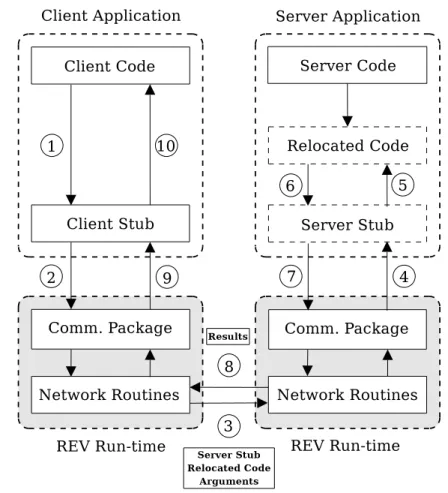
2.2 REV architecture. . . 34
2.3 CORBA architecture. . . 36
2.4 RMI architecture. . . 38
2.5 .NET Remoting architecture. . . 39
3.1 Java applet using RMI. . . 54
3.2 Class loader architecture. . . 57
4.1 λmarsh extended language syntax. . . 63
4.2 λmarsh typing rules. . . 63
4.3 Value transmission in Obliq. . . 67
4.4 Closure transmission in Obliq. . . 68
5.1 Marshalling application (consoles). . . 76
5.2 Basic C/S application (consoles). . . 82
5.3 Basic C/S application (consoles, option info). . . 82
5.4 Basic C/S application (server console, option info,lib). . . 83
5.5 Basic C/S application (client console, option info,lib). . . 84
6.1 Core language syntax. . . 105
6.2 Extended language syntax. . . 105
6.3 Well-formedness. . . 106
6.4 Typing rules. . . 107
6.5 Extended typing rules. . . 107
6.6 Transformation rule (close). . . 108
6.7 Transformation rule (detach). . . 108
6.8 Transformation rule (proxy). . . 108
7.1 Detached closure and outer class. . . 118
7.2 Detached closure and free variables. . . 143
List of Tables
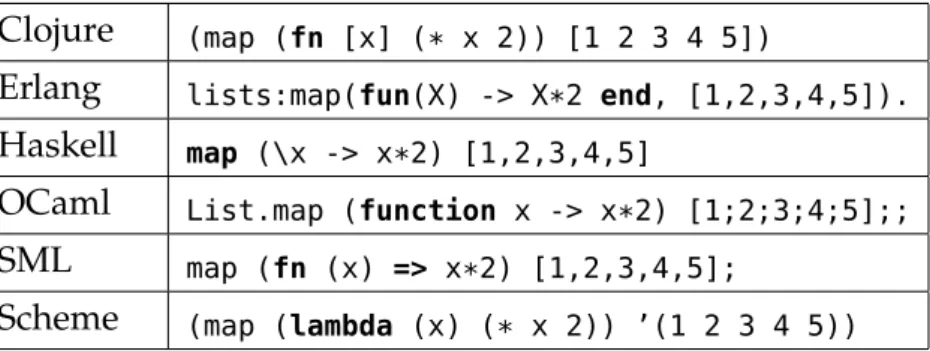
2.1 map function in functional languages. . . 15
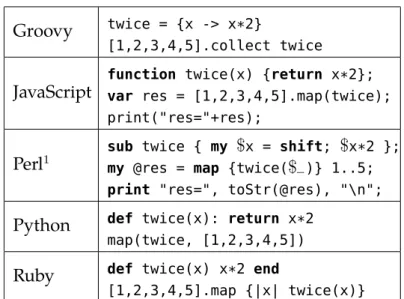
2.2 map function in dynamic languages. . . 16
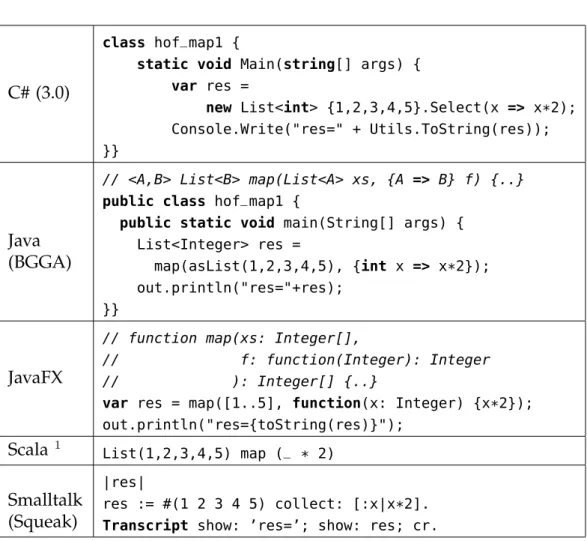
2.3 map function in object-oriented languages. . . 16
2.4 map function in functional languages. . . 17
2.5 map function in dynamic languages. . . 18
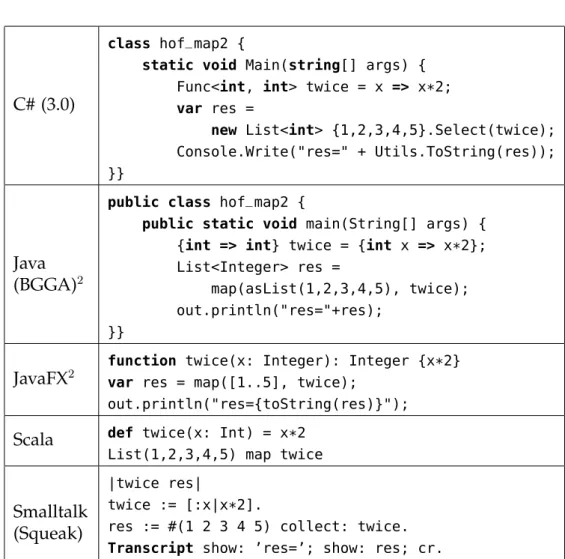
2.6 map function in object-oriented languages. . . 19
2.7 Closures in functional languages. . . 27
2.8 Closures in dynamic languages. . . 28
List of Listings
1.1 Source location "A". . . 4
1.2 Target location "B". . . 4
1.3 Agenda pseudo-code (library). . . 5
1.4 Agenda pseudo-code (client). . . 6
1.5 Agenda pseudo-code (server). . . 6
1.6 Agenda pseudo-code (client converted). . . 6
2.1 Composition of HOFs in C#. . . 20
2.2 Composition of HOFs in Python. . . 21
2.3 Composition of HOFs in Ruby. . . 21
2.4 Composition of HOFs in Scala. . . 22
2.5 Composition of HOFs in Scheme. . . 22
2.6 Abstracting over functional behavior in C#. . . 23
2.7 Abstracting over functional behavior in Python. . . 24
2.8 Abstracting over functional behavior in Ruby. . . 24
2.9 Abstracting over functional behavior in Scala. . . 25
2.10 Abstracting over functional behavior in Scheme. . . 25
3.1 Java applet using RMI (service). . . 51
3.2 Java applet using RMI (server). . . 51
3.3 Java applet using RMI (client). . . 52
3.4 Java applet using RMI (HTML page). . . 53
3.5 Service class reloading (interface). . . 55
3.6 Service class reloading (server). . . 55
3.7 Service class reloading (client). . . 56
5.1 Type-safe marshalling in Scala. . . 74
5.2 Marshalling application (server). . . 74
5.3 Marshalling application (client). . . 75
5.4 The Channel class (Scala API). . . 77
5.5 The ServerChannel class (Scala API). . . 77
5.6 Basic C/S application (server). . . 78
5.7 Basic C/S application (client). . . 79
5.9 Basic C/S application (client script). . . 80
5.10 Basic C/S application (policy file). . . 81
5.11 C/S application with Scala actors (server). . . 85
5.12 C/S application with Scala actors (client). . . 85
5.13 A compute server in Obliq. . . 87
5.14 Compute application (service). . . 87
5.15 Compute application (server). . . 88
5.16 Compute application (client). . . 88
5.17 Bank account application (Account). . . 89
5.18 Bank account application (server). . . 89
5.19 Bank account application (client). . . 90
5.20 Calendar application (agendas). . . 92
5.21 Calendar application (server). . . 92
5.22 Calendar application (client). . . 93
6.1 Scala closure and free variables. . . 97
6.2 Import clauses at any scope level. . . 100
6.3 Import clauses opening any object. . . 101
6.4 Core language example. . . 109
6.5 Core language example (transformed). . . 109
7.1 Scala closure inside a class. . . 112
7.2 Scala closure inside a class (converted). . . 113
7.3 Detached Scala closure inside a class. . . 116
7.4 Detached Scala closure inside a class (1/4). . . 116
7.5 Detached Scala closure inside a class (2/4). . . 117
7.6 Detached Scala closure inside a class (3/4). . . 117
7.7 Detached Scala closure inside a class (4/4). . . 117
7.8 Scala closure inside an object. . . 119
7.9 Scala closure inside an object (converted). . . 119
7.10 Detached closure inside an object. . . 120
7.11 Detached closure inside an object (1/4). . . 120
7.12 Detached closure inside an object (2/4). . . 120
7.13 Detached closure inside an object (3/4). . . 121
7.14 Detached closure inside an object (4/4). . . 121
7.15 Scala closure inside an inner class. . . 122
7.16 Scala closure inside an inner class (converted). . . 122
7.17 Detached closure inside an inner class. . . 124
7.18 Detached closure inside an inner class (1/4). . . 124
7.19 Detached closure inside an inner class (2/4). . . 125
7.20 Detached closure inside an inner class (3/4). . . 125
7.21 Detached closure inside an inner class (4/4). . . 126
LIST OF LISTINGS xv
7.23 Scala closure inside a member function (converted). . . 127
7.24 Detached closure inside a member function. . . 128
7.25 Detached closure inside a member function (1/4). . . 128
7.26 Detached closure inside a member function (2/4). . . 129
7.27 Detached closure inside a member function (3/4). . . 129
7.28 Detached closure inside a member function (4/4). . . 130
7.29 Scala closure inside a local function. . . 131
7.30 Scala closure inside a local function (converted). . . 131
7.31 Detached closure inside a local function. . . 132
7.32 Detached closure inside a local function (1/4). . . 133
7.33 Detached closure inside a local function (2/4). . . 133
7.34 Detached closure inside a local function (3/4). . . 134
7.35 Detached closure inside a local function (4/4). . . 134
7.36 Scala closure inside a closure. . . 135
7.37 Scala closure inside a closure (converted). . . 135
7.38 Detached closure inside a closure. . . 136
7.39 Detached closure inside a closure (1/4). . . 136
7.40 Detached closure inside a closure (2/4). . . 137
7.41 Detached closure inside a closure (3/4). . . 137
7.42 Detached closure inside a closure (4/4). . . 137
7.43 Scala closure referring out of scope objects. . . 139
7.44 Scala closure referring out of scope objects (converted). . . 139
7.45 Detached closure referring out of scope objects. . . 140
7.46 Detached closure referring out of scope objects (1/6). . . . 140
7.47 Detached closure referring out of scope objects (2/6). . . . 141
7.48 Detached closure referring out of scope objects (3/6). . . . 141
7.49 Detached closure referring out of scope objects (4/6). . . . 142
7.50 Detached closure referring out of scope objects (5/6). . . . 142
7.51 Detached closure referring out of scope objects (6/6). . . . 142
7.52 Extending Scala with detached closures. . . 144
7.53 Scala closure inside a class (Typer). . . 148
7.54 Scala closure inside a class (Uncurry). . . 149
7.55 Scala closure inside a class (ExplicitOuter). . . 149
7.56 Scala closure inside a class (LambdaLift). . . 150
Résumé
Scala est un langage de programmation généraliste développé à l’EPFL. Il combine les principaux concepts mis en oeuvre dans les langages orientés-objets et fonctionnels. Scala est un langage statiquement typé; en particulier il possède un système de types évolué et supporte l’inférence de type locale. D’autre part, il s’intègre facilement avec les plateformes Java et .net: leur bibliothèques sont directement accessibles et le compi-lateur Scala génère du code pour les deux environnements d’exécution.
Le langage Scala offre plusieurs fonctionnalités qui font de lui un candidat idéal pour la programmation d’applications distribuées. En particulier, il supporte les fonctions de première classe qui sont utiles en relation avec les notions de portée distribuée et de mobilité du code. Dans ce contexte, l’absence de support des types à l’exécution représente un inconvénient important de l’environnement d’exécution Java comme plateforme cible.
Cette thèse se focalise sur la réalisation d’un concept nouveau com-binant des notions essentielles de la programmation fonctionnelle et de la programmation distribuée et impliquant l’extension de la notion de portée lexicale au contexte distribué. En quelques mots, nous défendons l’idée selon laquelle la notion d’abstraction lambda permet de traiter de manière élégante la liaison dynamique des références locales dans un environnement d’exécution distribué.
Les principales idées exposées dans ce travail de recherche ont été mises en œuvre dans notre compilateur Scala. Cela nous a permis d’évaluer la qualité des techniques utilisées, en particulier leur impact sur la fiabil-ité et les performances des programmes distribués.
A ce jour, la plupart des travaux de recherche en relation avec le présent sujet se sont concentrés sur les langages de programmation fonc-tionnels, en particulier sur la famille des langages ML.
Mots-clés: langage de programmation, programmation distribuée, code mobile, évaluation distante, appel de méthode distante, liaison dynamique, portée distribuée, compilation, Scala.
Abstract
Scala is a general-purpose programming language developed at EPFL. It combines the most important concepts found in object-oriented and functional languages. Scala is a statically typed language; in particular it features an advanced type system and supports local type inference. Futhermore it integrates well with the Java and .net platforms: their li-braries are accessible without glue code and the Scala compiler generates code for both execution environments.
The Scala programming language has several features that make it desirable as a language for distributed application programming. In par-ticular, it supports first-class functions which are useful in relation with the notions of distributed scope and code mobility. In that context, the missing support for run-time types is one important drawback of the Java run-time environment as a target platform.
This thesis focuses on the realisation of a new concept combining essential notions from the functional and distributed programming and implying the extension of the notion of lexical scoping to the distributed context. In short, we claim that the notion of lambda abstraction provides an elegant way for dealing with the dynamic rebinding of local references in a distributed execution environment.
The key ideas exposed in this research work have been implemented in our Scala compiler. This helped us to evaluate the used techniques, in particular their impact on the reliability and the performance of dis-tributed programs.
So far, most research works related to the present subject have focused on functional programming languages, in particular on the ML language family.
Keywords: programming language, distributed programming, mobile code, remote evaluation, remote method invocation, dynamic binding, distributed scope, compilation, Scala.
Remerciements
Je remercie tout d’abord mon directeur de thèse, le Prof. Martin Odersky, pour m’avoir accueilli dans son groupe et m’avoir donné la possibilité de travailler sur ce captivant projet de recherche.
J’exprime en second lieu ma gratitute à mes anciens collègues Philippe Altherr, Michel Schinz et Matthias Zenger qui m’ont aidé à comprendre les méchanismes internes du compilateur Scala, et qui, de manière plus générale, m’ont fait profiter de leur grande expertise du langage de pro-grammation Java. Je remercie également Vincent Cremet, Iulian Dragos et Philipp Haller pour leur aide précieuse durant la réalisation de ce projet.
De nombreuses autres personnes ont activement contribué au projet Scala, — qui a évolué au cours des ans de Scala 1 à Scala 2 —; travailler à leur côté m’a apporté beaucoup de satisfaction. Outre les personnes déjà citées je souhaite remercier ici Gilles Dubochet, Burak Emir, Nikolay Mihaylov, Sean McDirmid, Adriaan Moors, Tiark Rompf, Lukas Rytz, Lex Spoon et Geoffrey Washburn.
J’adresse ensuite mes pensées amicales à trois collègues avec qui j’ai successivement partagé mon bureau pendant ces six dernières années, à savoir Massimo Merro, Erik Stenman et Fabien Salvi; ensemble nous avons passé de bons moments à débattre de sujets liés au travail ou ayant trait avec la vie en générale.
Finalement, je remercie Phil Bagwell, Johannes Borgström, Sébastien Briais, Daniel Bünzli, Danielle Chamberlain, Rachele Fuzzati, Simon Kramer, Maxime Monod, Uwe Nestmann, Christine Röckl et Yvette Dubuis, notre secrétaire à la retraite, pour leurs encouragements sincères dans les bons comme dans les moins bons moments de mon travail de recherche.
Lausanne, avril 2008
Acknowledgments
I first thank my supervisor Prof. Martin Odersky for accepting me in his group and for giving me the opportunity to work on this interesting research project.
Secondly, I express my gratitude to my past colleagues Philippe Al-therr, Michel Schinz and Matthias Zenger who helped me to understand the internals of the Scala compiler, and more generally shared with me their great expertise of the Java programming language. I also thank Vincent Cremet, Iulian Dragos and Philipp Haller for their helpful in-puts during the realization of this project.
Many people actually contributed to the Scala project — which evolved over the years from Scala 1 to Scala 2 — and working with all of them proved very enjoyable. Besides the persons already mentioned, I would therefore like to thank Gilles Dubochet, Burak Emir, Nikolay Mihaylov, Sean McDirmid, Adriaan Moors, Tiark Rompf, Lukas Rytz, Lex Spoon and Geoffrey Washburn.
I also address my friendly thoughts to three colleagues I successively shared my office with over the last six years, namely Massimo Merro, Erik Stenman and Fabien Salvi; together we spent pleasant moments debating both on work-related and general interest topics.
Finally, I thank Phil Bagwell, Johannes Borgström, Sébastien Briais, Daniel Bünzli, Danielle Chamberlain, Rachele Fuzzati, Simon Kramer, Maxime Monod, Uwe Nestmann, Christine Röckl and Yvette Dubuis, our retired secretary, for their friendly encouragements in the good and less good moments of my research work.
Lausanne, April 2008
Chapter 1
Introduction
The best way to predict the future is to invent it.
Alan Kay1
Languages supporting mobile code differ from other languages or middleware for distributed systems (like CORBA) because they explicitly model the concept of separate computational environments and how code and computations move among these environments.
Some concepts shared with traditional languages acquire new dimen-sions in the case of languages supporting mobile code (e.g. scope rules and name resolution) and others are typical of those languages (e.g. dy-namic binding and security).
Mobility has a strong impact on programming language features:
1. Programs are location aware [100]. Knowing where computation happens is necessary in order to write mobile programs effectively. The structure of the underlying computer network is made explicit to the programmer.
2. Mobility is under program’s control. Code units may be shipped or fetched to/from remote nodes.
Code mobility places new demands on programming languages and run-time systems. We mention here two of them:
1
Alan Kay was honored with theACM Turing Award 2003 for pioneering many of the ideas found in OO languages; he also contributed to the development of Smalltalk.
1. Code manipulation. The language must provide means to identify and transmit code units and the run-time environment must be able to execute received code units within the existing address space of the recipient.
2. Type safety. Type safety2 is the property that every operation the program performs is executed on values of the appropriate type. It is the responsibility of the compiler to enforce type safety. In order to ensure type safety a high-level language must provide a correct mapping of typing rules between the type checker of the compiler and the verifier tool (e.g. the bytecode verifier in the Java VM) of the run-time environment.
Mobile code languages (MCL)3 [35, 43] facilitate the transmission of code between remote locations in a distributed system. A piece of code which is generated at one location can be transmitted for execution at another location which may exhibit characteristics different from its place of origin.
1.1
Motivation
In this work we focus our attention to language-enforced disciplines that guarantee abstraction safety — presupposing the existence of reliable communication. However, this work is fully compatible with the usage of cryptographic techniques to enforce the reliability and authenticity of the transmitted code.
The objectives of this work are two-fold: propose a new approach to dynamic binding in the context of mobile code and take advantage of the expressiveness of the Scala language [89] to extend it with programming abstractions for mobile code.
First we perform an analysis to identify the language abstractions important to our model. Concretely, we study and compare the different existing approaches found in the literature [28, 33, 56, 59, 96]. Second we design the new language abstraction and propose a formalization of our programming model. We focus in particular on typical concepts of languages supporting mobile code such as dynamic binding and type safety.
2
More terms are defined in appendix "Glossary".
3
1.1. MOTIVATION 3
Finally we integrate the programming model into the language Scala and implement a few sample applications to validate our conceptual choices. The target platform is the Java VM [72].
Although our approach is targeted at Java, it is not heavily based on its features. Indeed we propose a more general translation that abstracts from the language features; we only assume that the target language provides support for weak mobility — code mobility without migration of execution state — and distributed objects.
We consider first two different approaches found in existing program-ming languages to address the problem of dynamic reference binding inherent to the concept of mobile code. The main technical issue is to find a meaning for higher-order distributed computations.
On one side, the language Obliq [27, 28] uses network references to remotely access objects at the source location. Obliq objects have state; they are local to a site and are never automatically copied over the net-work. Regarding the free variables of network-transmitted functions, Obliq takes the view that such variables are bound to their original loca-tions and network sites, as prescribed by lexical scoping.
On the other side, Java adopts the opposite approach where the applet code is moved and bound to the target location.
In this work we propose a more general approach which retains the two approaches just described and extends the abstraction model with a solution based on the lambda calculus for the dynamic (re-)binding of local references.
A fundamental question about dynamic binding in the context of mo-bile code lies in the way object references are handled at run-time.
In this work we handle references in three different ways:
- Either they are routed back to the source location. In this case we need some proxy mechanism based on remote objects.
- Or they are copied together with the transmitted code. We use here
marshalling based on serializable objects.
- Or they are (re-)established at the target location. We think that this case can be handled by a simpler solution as described in existing works [10, 56]. This observation constitutes the main motivation of this research work.
While the first two cases can be solved using well-known techniques, such as Java RMI [120] for remote objects and Java object serialization [119] for serializable objects, we propose for the last case a solution based on the lambda calculus.
When values or computations are marshalled from a running system and moved elsewhere, either by network communication or via a persis-tent store, some of their identifiers may need to be dynamically rebound. These may be both identifiers of language run-time library functions or identifiers from application libraries which exist in the new context.
There are several reasons motivating this approach. In particular, Scala supports closures, meaning that the facilities for remote invoca-tion and distributed scope pioneered by Obliq [28] can be easily added without any change to the underlying language semantics.
Example
Consider the following scenario which is quite common in distributed environments: Several network locations are hosting some agenda infor-mation, e.g. agenda entries about people working in the same company. In order to arrange a project meeting we want to check the availability of all concerned persons.
Principle From a functional perspective it looks quite natural to con-sider that mobile code is just a function that we parameterize with the variables to be locally bound at the target location.
We illustrate that principle with two small pieces of pseudo-code:
"send_to_B"(
a: Agenda => { ... a.doSomething() ...} )
val e = "receive_from_B"
Listing 1.1: Source location "A".
val a = new Agenda(...)
val f = "receive_from_A" "send_to_A"(f(a))
Listing 1.2: Target location "B".
The client process at location "A" (Listing 1.1) sends a closure contain-ing the parameterized code — in this example with parameter a — to some location "B" and waits for some result. The server process at loca-tion "B" (Listing 1.2) executes the transmitted code using the locally bound variable a and sends the result value back to the client. In the above
1.1. MOTIVATION 5
pseudo-code we rely on the two operations send_to and receive_fromto deal with the type-safe transmission of higher-order functions.
Why has this not been done before? Note that the closure could also access other names from its environment that need to be rebound. For instance, it could use a Math.max function, in that case the reference to the Math module needs to be rebound. Such rebindings are possible in Scala, unlike in other programming languages, because:
- Modules are objects in Scala [88] and can thus appear as free vari-ables in the transmitted code.
- The import clause in Scala [89] may also appear in a block, which is for example not possible in Java.
Code sample Let us illustrate the basic idea of our solution with a small example4 based on the above scenario. We limit our example to processes running on a single machine and we assume the availability of typed channels to establish a type-safe communication between them. The source code excerpts presented below are coded in Scala.
In Listing 1.3 we define a minimal framework with a classAgenda man-aging a list of agenda entries and some library functions like freeSlots to operate on Agenda objects.
object agendas {
type Day = ...
type Entry = ...
class Agenda(e: Entry*) {
def get(day: Day): List[Entry] = ...
... (more methods) }
def freeSlots(a1: Agenda, a2: Agenda, d: Day): List[Entry] = ...
... (more methods) }
Listing 1.3: Agenda pseudo-code (library).
In Listing 1.4 the client process sends a closure marked with detach to the target location specified by the communication channel chan. The
detach primitive is used to "detach" the closure from its lexical
environ-ment. In the closure body we consider the agendas of two people and look for free time slots available on the week day day. The code itself
4
accesses three non-local variables: the application-specific objectagendas, the non-local object agendaBob and the local variable day.
...
val agendaBob = new Agenda(..)
def client {
val server = new Channel(host, port)
var day = "Mon" server ! detach(
(a: Agenda) => agendas.freeSlots(a, agendaBob, day)
)
val e = server.receive[List[Entry]]
println("e = "+e) }
Listing 1.4: Agenda pseudo-code (client).
The server process in Listing 1.5 simply waits for incoming requests, executes the received closure code with its actual parameter agendaTom and, finally, sends the evaluation result back to the client.
...
val agendaTom = new Agenda(..)
def server {
val server = new ServerChannel(port)
loop {
val client = server.accept
val f = client.receive[Agenda => List[Entry]]
client ! f(agendaTom) }
server.close() }
Listing 1.5: Agenda pseudo-code (server).
Code Transformations For supporting the new programming abstrac-tion we intend to perform code transformaabstrac-tions only on source code containing occurences of the primitive detach. In Listing 1.6 we sketch how the transformed program code for the client may look like:
1.1. MOTIVATION 7
class Env(x1: Proxy1, x2: Proxy2, x3: RemoteObjectRef)
extends ... with Function[Agenda, List[Entry]] {
def apply(a: Agenda): List[Entry] =
x2.freeSlots(a, x1.agendaBob, (Day) x3.elem) }
val agendaBob = new Agenda(...)
def client {
val server = new Channel(host, port)
val day = new ObjectRef("Mon")
server.!({
val x1 = bind(name1, new Proxy1Impl(this))
val x2 = bind(name2, new Proxy2Impl(agendas))
val x3 = bind(name3, new RemoteObjectRefImpl(day))
new Env(x1, x2, x3)
});
val e = server.receive[List[Entry]]
println("e = " + e) }
Listing 1.6: Agenda pseudo-code (client converted).
Several transformations are actually applied to the original code:
- The synthetic classEnvallows us to capture the free variables (in this case variablesagendas, agendaBob and day) and to turn the function into an object;
- The type of the captured variables agendas, agendaBob and day is changed to remote reference types (declarations of traits Proxy1,
Proxy2and RemoteObjectRefare omitted here for brevity);
- A methodapplywith parameterais added to the classEnvto allow the deferred evaluation of the closure body.
Implementing the above example in a distributed environment requires additional handling of object references. In particular we need to:
- Use remote instead of local references to access free variables. - Provide some remote interface to classes containing functions which
are called in the mobile code executed remotely at the target loca-tion.
- Rely on some global service to permit type-safe communication be-tween separate computational environments (i.e. address spaces [30]).
1.2
Scope
The aim of this work is neither to propose a new process calculus nor to design a fully-fledged mobile code language (MCL).
We further recognize that considering all aspects of a distributed sys-tem is not realistic; we thus limit our study to some dynamic aspects of relocated code — such as dynamic binding and type safety — and delib-erately keep aside considerations related to inter-process communication — such as concurrency and security —. The Scala Actors library and the Java security library already provide good support in those domains.
A practical goal of this work is to extend the Scala programming language with programming facilities for mobile code without compro-mising type safety. By programming facilities we mean either language or library extensions.
1.3
Background
1.3.1
The Scala Language
Scala [89,90] is a general-purpose programming language developed by Prof. Martin Odersky and his team at EPFL since 2002. Scala incorpo-rates several advanced concepts from recent research and has been used successfully in the development of large-scale programs.
Scala is amulti-paradigm languagewhich combines functional and object-oriented elements [22,101] and thus supports both programming styles. From the functional world, it takes the concepts of higher-order func-tions, algebraic data types and pattern matching; from the object-oriented world, it takes the concepts of classes, objects and virtual types.
Scala is a statically typed language featuring an advanced type system and supporting local type inference [95]. In particular, Scala is equipped with a rich set of language constructs providing powerful type abstrac-tions:
Type parametrization Classes and methods support type parametriza-tion (or parametric polymorphism) and the specified type parame-ters can have both lower and upper bounds, which can refer to the parameter itself (so-called F-bounded polymorphism).
Higher-kinded types Type constructor polymorphism[82,83] — also known as higher-kinded types — allows to abstract over generic types; a type constructor is like a function on the level of types that takes
1.3. BACKGROUND 9
type arguments to yield a type. The Scala collection library rely heavily on type constructor polymorphism5.
Type members A class can include type members as well as value mem-bers; like value members, type members can be either abstract or concrete. Abstract type members [34] — also known asvirtual types — are bounded by a type, and this bound can be refined by sub-classes.
Compound types A value can be declared to have a compound type con-sisting of a set of class types and an optional type refinement. When present the refinement constrains the type of the class members by specifying more precise types. A compound type thus expresses the fact that a value has simultaneously all the component types.
Structural types A value can be declared to have a structural type con-sisting of a (usually implicit) base type and a mandatory type re-finement. The refinement constrains the type of the class members by specifying more precise types.
Existential types Existential types are similar to the Java wildcard types which provide type-safe casts for erased types at run-time. In prac-tice, they are mainly useful for accessing Java wildcard types and raw types from Scala.
Self types A self type specifies the requirements on any concrete class when one or more traits are mixed into. Then it may be necessary to specify which of those other traits should be assumed. Technically, a self type is an assumed type for variable this whenever this appears within the class.
Singleton types Singleton types represent a basic form of dependent types and always refer to a particular value. A singleton type thus expresses the fact that a value is the only instance of its type.
Scala further supports powerful programming techniques such as im-plicit conversions [90, §21.1], implicit parameters [90, §21.5], default pa-rameter values and named arguments for adapting existing code or writ-ing new code in a more flexible and concise way.
5
The refactoring of the collection library has been achieved in version 2.8 but Scala supports type constructor polymorphism since version 2.5.
NOTE
Since the project’s beginning the Scala language has undergone one major evolution in March 2006; while software versions released before that date implement the Scala 1 specification actual versions of the language implementation follow the Scala 2 specification [89]. The Scala compiler and libraries (e.g. the collection library and the Actors library) are actively maintained — a new software distribution is released every 2-3 months — and are still evolving through smooth steps.
The Scala compiler is targeted both to the Java and the .NET platforms and can read respectively generate either Java class files or MSIL assembly files (separate compilation). The Scala compiler is itself written in the Scala programming language and is bootstrapped.
The design of Scala is mainly — but not only — influenced by the language Java (Java-like syntax, class libraries) and the Java infrastruc-ture (run-time environment and libraries). Scala also integrates concepts pioniered by other languages like the uniform object model of Smalltalk, the systematic nesting of Beta and functional aspects of ML and Haskell.
In particular, Scala benefits from its interoperability with Java and its greater expressiveness to get adopted by many programmers from the Java community. Nevertheless, this pragmatic approach has both advan-tages and disadvanadvan-tages: while the functionality of the numerous Java libraries is directly accessible to the Scala programmers the interaction with some Java features does complicate the tasks of the Scala imple-mentors.
1.3.2
The Java Platform
In this project we adopt the Java platform as our global target architecture and thus avoid the implementation challenges related to the heterogene-ity of the network locations.
Indeed, while Java as an object-oriented language doesn’t offer lan-guage support for distributed programming, Java as a development plat-form provides library and run-time support for developing distributed applications. Its cross-platform capability together with mechanisms like dynamic class loading, object serialization and distributed objects facili-tate the development of distributed systems.
Furthermore, the Java security framework was designed with the se-curity aspects of network programming in mind and features run-time mechanisms at both the platform level and the application level.
1.4. CONTRIBUTIONS 11
1.4
Contributions
The main contributions of this work can be summarized as follows:
• We present a novel approach based on the notion of lambda ab-straction for dealing with the dynamic rebinding of local references in a distributed execution environment.
The lambda-calculus has had a tremendous influence on the design and analysis of programming languages; realistic languages are in-deed too large and complex to study from scratch as a whole. That applies in particular to distributed programming languages which promote the cooperation between concurrent processes.
In this work we defend the idea that the naked notion of lambda abstraction — with no domain-specific extensions — offers an effec-tive way to build a new programming abstraction for mobile code.
• We introduce a new programming abstraction for mobile code which relies on two fundamental binding mechanisms: the dynamic re-binding mechanism provided by the lambda abstraction applies to variables captured in the lexical context and the generalized data binding mechanism provided by the concept of module objects al-lows the selective import of object members to any lexical context. Concretely, we define detached closures as lexical closures with re-mote references which can move in a distributed execution envi-ronment. This follows the functional way of dealing with higher-order functions and allows us to stay close to the concept of lambda abstraction with our new programming abstraction.
• We add programming support for detached closures to the language Scala. The new facility preserves language semantics and relies on three existing features: Scala higher-order functions, Java code mobility and Java distributed objects.
We address the different challenges associated with the conversion of detached closures in a distributed settings: first, the function body is a parametrized piece of code that can move between differ-ent environmdiffer-ents; second, the code preserves bindings to variables in their originating scope; and finally, the code performs operations on type-safe remote references.
Concretely, we extend the compiler front-end with a new transfor-mation phase and provide the needed run-time infrastructure as an
extension of the Scala standard library. After analyzing the code of the detached closure, the new phase generates remote interfaces and substitutes occurences of free objects with remote references to proxy objects. The run-time library extension provides a global naming service for remote references and remote interfaces for pre-defined types.
1.5
Outline
The structure of the thesis is as follows:
Chapter 1 introduces the key idea and the design goals of this work; it also defines its scope, presents some backgrounds and resumes its main contributions.
Chapter 2 gives an overview of multi-paradigm programming. In particular, it focuses on two concepts of the functional and distributed programming which are essential in this project for the realization of our new programming abstraction: lexical closures and distributed objects.
Chapter 3 handles important aspects of code mobililty. In particular, it introduces two forms of code mobility, discusses security issues related to mobile code and finally focus on the mechanisms featured by the Java platform to support code mobility.
Chapter 4 focus on previous research efforts to study the concept of dynamic rebinding in higher-order distributed computations. In partic-ular, we observe that most research on mobile code has been carried out in the context of functional programming languages.
Chapter 5 gives several code examples to demonstrate the practical usage of our programming abstraction. In particular, the new abstraction relies only on existing language features and combines smoothly with other functionalities provided by the existing Scala libraries.
Chapter 6 presents the abstraction model for extending the Scala lan-guage with support for mobile code. In particular, it builds upon the idea that the notion of lambda abstraction provides an elegant way for dealing with the dynamic rebinding of local references in a distributed execution environment.
Chapter 7 presents the implementation of the compiler and library extensions for supporting mobile code. In particular, the addition of the new facility does not require any language change.
Chapter 2
Multi-paradigm Programming
The idea of a multi-paradigm language is to provide a framework in which programmers can work in a variety of styles, freely inter-mixing constructs from different paradigms.
Timothy Budd1
Timothy Budd [22] describes a programming paradigm as ".. a way
of conceptualizing what it means to perform computation, of structuring and organizing how tasks are to be carried out on a computer" in his seminal book on multi-paradigm programming.
Examples of programming paradigms include the imperative paradigm (Turing machine), functional paradigm (lambda calculus), logic paradigm (predicate calculus) or object-oriented programming (object calculus).
Some languages tend to subscribe to a single programming paradigm like Smalltalk and Java, two representatives of the object-oriented paradigm. Other languages like OCaml, Leda, Oz and Scala integrate concepts bor-rowed from several programming paradigms. Since every paradigm comes with its own strengths and weaknesses, no single paradigm offers the simplest, most elegant and efficient solution to every problem. This quite naturally motivates the need to use a combination of paradigms in a manner that best fits the problem(s) at hand.
Multi-paradigm extensions to Java have been experimented by several researchers [23, 91]. Furthermore languages such as Groovy and Scala go one step further in adopting the multi-paradigm concept without sac-rifying their interoperability with Java.
1
2.1
Functional Programming
Functional programming (FP) [62] is a programming paradigm that treats computation as the evaluation of mathematical functions and avoids state and mutable data. FP emphasizes the application of functions, in contrast with the imperative programming style that emphasizes changes in state. In particular, referential transparency — the program behaves the same when an expression is replaced by its value — is an important principle of FP, allowing referentially transparent functions to be memoized or to be included in interprocedural dependence analysis.
FP supports functions as first-class objects, also called function values. Essentially, function values are objects that act as functions and can be operated upon as objects — allowing them to be stored in data structures, passed as arguments and returned as results.
A function value that captures free (non-local) variables is also called a closure(discussed later in Section 2.1.2). Many research works have fo-cused on supporting closures in non-functional languages such as Ada [61], C++ [20, 127] and Java [45].
FP also supports higher-order functions (HOFs). A HOF can take func-tional arguments or can return function values.
These two constructs together allow for elegant ways to modularize programs, which is one of the biggest advantages of adopting the FP style. Curried functions [90, §9.3] is another powerful FP construct we’ll keep aside as it is not directly relevant for this work.
2.1.1
Higher-Order Functions
Besides functional languages like Erlang, Haskell, ML or Scheme, which are well-known to make use of higher-order programming techniques, dynamic languages like Groovy, JavaScript, Python or Ruby also provide good support for higher-order programming.
As a citizen of both the functional and object-oriented worlds, Scala also features many FP concepts for supporting higher-order program-ming. HOFs are for instance used in simulation programs to execute actions at specified points in simulated time or to install triggers that associate actions with state changes.
Several proposals have been submitted by the Java community to pro-vide support for closures in Java; the Java source code listed in Table 2.3 and Table 2.6 follows BGGA’s proposal2 [45].
2
2.1. FUNCTIONAL PROGRAMMING 15
Also, the possibility to compose HOFs is a powerful language abstrac-tion of the FP paradigm. In particular, the funcabstrac-tion value returned by the function composition is a closure whose formal parameters are bound to actual arguments visible from the calling environment.
In the following we illustrate the usage of HOFs with themapfunction and give source code examples in several programming languages. Basi-cally, the mapfunction takes a function f and a sequence s as arguments and returns a list containing the results of applying f to the elements of
s. Iterating over a sequence using the map function obliviates the need
for an explicit counter — typical with the imperative programming style. Table 2.1, Table 2.2 and Table 2.3 illustrate the usage ofanonymous
func-tion values (or function literals) in several functional languages, dynamic languages and object-oriented languages, respectively.
In particular, we can make the following observations:
• In functional languagesmapis a first-class function taking a sequence as argument while in object-oriented languages map is a member function of some sequence type. The difference in the syntactical order becomes explicit then function composition comes into the play (an example is presented later in this section).
• The language Java — in opposite to C# and JavaFX — has not
yet adopted closures as control abstraction; Java code samples pre-sented later in this chapter are thus based on BGGA’s proposal.
• Most languages featuring function values associate local type
infer-ence with a lightweight syntax to enforce their conciseness.
Clojure (map (fn [x] (* x 2)) [1 2 3 4 5])
Erlang lists:map(fun(X) -> X*2 end, [1,2,3,4,5]).
Haskell map (\x -> x*2) [1,2,3,4,5]
OCaml List.map (function x -> x*2) [1;2;3;4;5];;
SML map (fn (x) => x*2) [1,2,3,4,5];
Scheme (map (lambda (x) (* x 2)) ’(1 2 3 4 5))
Groovy [1,2,3,4,5].collect {x -> x*2}
JavaScript var res =[1,2,3,4,5].map(function(x) {return x*2});
print("res="+res);
Perl my @res = map {$_*2} 1..5;
print "res=", toStr(@res), "\n";
Python map(lambda x: x*2, [1,2,3,4,5])
Ruby [1,2,3,4,5].map {|x| x*2}
Table 2.2: map function in dynamic languages.
C# (3.0)
class hof_map1 {
static void Main(string[] args) {
var res =
new List<int> {1,2,3,4,5}.Select(x => x*2);
Console.Write("res=" + Utils.ToString(res)); }}
Java (BGGA)
// <A,B> List<B> map(List<A> xs, {A => B} f) {..}
public class hof_map1 {
public static void main(String[] args) { List<Integer> res =
map(asList(1,2,3,4,5), {int x => x*2});
out.println("res="+res); }}
JavaFX
// function map(xs: Integer[],
// f: function(Integer): Integer // ): Integer[] {..}
var res = map([1..5], function(x: Integer) {x*2});
out.println("res={toString(res)}");
Scala1 List(1,2,3,4,5) map (_ * 2) Smalltalk
(Squeak)
|res|
res := #(1 2 3 4 5) collect: [:x|x*2].
Transcript show: ’res=’; show: res; cr.
Table 2.3: map function in object-oriented languages.
1
Scala intentionally appears here, near to Java, although it is both a functional and an object-oriented language.
2.1. FUNCTIONAL PROGRAMMING 17
Similarly, Table 2.4, Table 2.5 and Table 2.6 illustrate the usage of
named function valuesin several functional languages, dynamic languages and object-oriented languages, respectively.
In particular, we can make the following observations:
• Most languages adopt a similar (if not identical) syntax for
spec-ifying anonymous and named function values while in languages such as Haskell, OCaml, Python and Ruby the function body is introduced by a different token (e.g. "->" versus "=" in Haskell).
• Languages such as Perl and Ruby require an unusual syntax for specifying function values as function arguments. For instance, the Ruby programmer must write |x| twice(x) instead of providing the partially applied functiontwice as argument (see Table 2.5).
• Again, most languages featuring function values associate local type inference with a lightweight syntax to enforce their conciseness.
Clojure (defn twice [x] (* x 2))
(map twice [1 2 3 4 5])
Erlang1 Twice = fun(X) -> X*2 end.
lists:map(Twice, [1,2,3,4,5]).
Haskell let twice x = x*2
map twice [1,2,3,4,5]
OCaml let twice x = x*2;;
List.map twice [1;2;3;4;5];;
SML fun twice x = x*2;
map twice [1,2,3,4,5];
Scheme (define (twice x) (* x 2))
(map twice ’(1 2 3 4 5))
Table 2.4: map function in functional languages.
1
Groovy twice = {x -> x*2}
[1,2,3,4,5].collect twice
JavaScript
function twice(x) {return x*2};
var res = [1,2,3,4,5].map(twice);
print("res="+res);
Perl1
sub twice { my $x = shift; $x*2 };
my @res = map {twice($_)} 1..5;
print "res=", toStr(@res), "\n";
Python def twice(x): return x*2
map(twice, [1,2,3,4,5])
Ruby def twice(x) x*2 end
[1,2,3,4,5].map {|x| twice(x)}
Table 2.5: map function in dynamic languages.
1toStr
2.1. FUNCTIONAL PROGRAMMING 19
C# (3.0)
class hof_map2 {
static void Main(string[] args) { Func<int, int> twice = x => x*2;
var res =
new List<int> {1,2,3,4,5}.Select(twice);
Console.Write("res=" + Utils.ToString(res)); }}
Java (BGGA)2
public class hof_map2 {
public static void main(String[] args) { {int => int} twice = {int x => x*2};
List<Integer> res =
map(asList(1,2,3,4,5), twice); out.println("res="+res);
}}
JavaFX2
function twice(x: Integer): Integer {x*2}
var res = map([1..5], twice);
out.println("res={toString(res)}");
Scala def twice(x: Int) = x*2
List(1,2,3,4,5) map twice
Smalltalk (Squeak)
|twice res|
twice := [:x|x*2].
res := #(1 2 3 4 5) collect: twice.
Transcript show: ’res=’; show: res; cr.
Table 2.6: map function in object-oriented languages.
2
HOFs can further be composed to build more complex programming abstractions; for example they provide an elegant way to express queries over some data collection.
In Listing 2.1 (C#), Listing 2.2 (Python), Listing 2.3 (Ruby), Listing 2.4 (Scala) and Listing 2.5 (Scheme) we look for the salary of the highest paid programmer in some software company. Each employee is described by his name, role and salary, and is stored in a list of employees.
The query itself is composed of three successive operations: a filter function retains employees who are programmers, a map function returns the salary of those programmers and, finally, a fold (or reduce) function picks up the highest salary.
class Employee {
private string _name; private string _role; private int _salary;
public Employee(string name, string role, int salary) { _name = name; _role = role; _salary = salary;
}
public string role() { return _role; } public int salary() { return _salary; }
}
class hof_comp1 {
static void Main(string[] args) {
var employees = new List<Employee> {
new Employee("John", "programmer", 4500),
new Employee("Tom", "programmer analyst", 6000),
new Employee("Jessica", "programmer", 5000),
new Employee("Alvin", "software architect", 7000),
new Employee("Peter", "programmer", 5200) };
int maxSalary = employees.
Where(emp => "programmer" == emp.role()).
Select(emp => emp.salary()).
Aggregate(0, (m, v) => (m > v) ? m : v);
Console.WriteLine("Max. salary=" + maxSalary); }
}
2.1. FUNCTIONAL PROGRAMMING 21
class Employee:
def __init__(self, name, role, salary):
self.name = name self.role = role self.salary = salary
def __str__(self):
return ’%s(%s,%d)’ % (self.name, self.role, self.salary) employees = (\
Employee(’John’, ’programmer’, 4500),
Employee(’Tom’, ’programmer analyst’, 6000), Employee(’Jessica’, ’programmer’, 5000),
Employee(’Alvin’, ’software architect’, 7000), Employee(’Peter’, ’programmer’, 5200)
)
maxSalary =\
reduce(lambda m, v: max(m, v),\
map(lambda emp: emp.salary,\
filter(lambda emp: ’programmer’ == emp.role,\
employees)), 0)
print ’Max. salary=%d\n’ % maxSalary
Listing 2.2: Composition of HOFs in Python.
class Employee
def initialize(name, role, salary)
@name = name; @role = role; @salary = salary
end
attr_reader :name, :role, :salary
def to_s @name+"("+@role+","[email protected]_s+")" end end employees = [ Employee.new("John", "programmer", 4500),
Employee.new("Tom", "programmer analyst", 6000), Employee.new("Jessica", "programmer", 5000),
Employee.new("Alvin", "software architect", 7000), Employee.new("Peter", "programmer", 5200)
]
maxSalary = employees.
select {|emp| "programmer" == emp.role}. map {|emp| emp.salary}.
inject {|m, v| m > v ? m : v} print "Max. salary=", maxSalary, "\n"
Listing 2.3: Composition of HOFs in Ruby.
case class Employee(name: String, role: String, salary: Int)
val employes = List(
Employee("John", "programmer", 4500),
Employee("Tom", "programmer analyst", 6000), Employee("Jessica", "programmer", 5000),
Employee("Alvin", "software architect", 7000), Employee("Peter", "programmer", 5200)
)
val maxSalary = employes.
filter {emp => "programmer" == emp.role}.
map {emp => emp.salary}.
foldLeft(0) {(m, v) => if (m > v) m else v}
println("Max. salary="+maxSalary)
Listing 2.4: Composition of HOFs in Scala.
(define (get-salary emp) (cadr (cdr emp))) (define (get-role emp) (cadr emp))
(define employees
’(("John" "programmer" 4500)
("Tom" "programmer analyst" 6000) ("Jessica" "programmer" 5000)
("Alvin" "software architect" 7000) ("Peter" "programmer" 5200)
2.1. FUNCTIONAL PROGRAMMING 23
(define maxSalary (foldl
0
(lambda (x y) (max x y)) (map
(lambda (emp) (get-salary emp)) (filter
(lambda (emp) (equal? (get-role emp) "programmer")) employees
) ) ) )
(println "Max. salary=" maxSalary)
Listing 2.5: Composition of HOFs in Scheme.
Furthermore the expressiveness of HOFs also comes from the ability to abstract over functional behavior. Examples of such an abstraction are the concurrent primitives in the pi-calculus or the foldoperation.
In Listing 2.6 (C#), Listing 2.7 (Python), Listing 2.8 (Ruby), Listing 2.9 (Scala) and Listing 2.10 (Scheme) we first define recursively the addition and multiplication on number sequences using the two binary operators
+ and * together with the corresponding neutral elements. In a second
step we abstract over the functional behavior of those two operations to obtain the same functionality using HOFs.
class hof1 {
static int Sum1(List<int> xs) {
if (xs.Count == 0) return 0;
else return xs.ElementAt(0) + Sum1(xs.Skip(1).ToList()); }
static int Mul1(List<int> xs) {
if (xs.Count == 0) return 1;
else return xs.ElementAt(0) * Mul1(xs.Skip(1).ToList());
}
static int Sum2(List<int> xs) {
return xs.Aggregate(0, (x, y) => x + y); }
static int Mul2(List<int> xs) {
return xs.Aggregate(1, (x, y) => x * y);
static void Main(string[] args) {
var xs = new List<int> {1,2,3,4,5};
Console.WriteLine(Sum1(xs)); // 15 Console.WriteLine(Mul1(xs)); // 120 Console.WriteLine(Sum2(xs)); // 15 Console.WriteLine(Mul2(xs)); // 120 } }
Listing 2.6: Abstracting over functional behavior in C#.
def sum1(xs):
if xs == []: return 0
else: return xs[0] + sum1(xs[1:])
def mul1(xs):
if xs == []: return 1
else: return xs[0] * sum1(xs[1:])
def sum2(xs): return reduce(lambda x, y: x+y, xs, 0)
def mul2(xs): return reduce(lambda x, y: x*y, xs, 1)
xs = [1,2,3,4,5]
sum1(xs) # prints 15
mul1(xs) # prints 120
sum2(xs) # prints 15
mul2(xs) # prints 120
Listing 2.7: Abstracting over functional behavior in Python.
def sum1(xs)
if xs == [] then 0 else xs[0] + sum1(xs[1..-1]) end
end
def mul1(xs)
if xs == [] then 1 else xs[0] * mul1(xs[1..-1]) end
end
def sum2(xs) xs.inject(0) {|x, y| x + y} end
def mul2(xs) xs.inject(1) {|x, y| x * y} end
2.1. FUNCTIONAL PROGRAMMING 25
sum1(xs) # prints 15 mul1(xs) # prints 120 sum2(xs) # prints 15 mul2(xs) # prints 120
Listing 2.8: Abstracting over functional behavior in Ruby.
def sum1(xs: List[Int]): Int =
if (xs.isEmpty) 0 else xs.head + sum1(xs.tail)
def mul1(xs: List[Int]): Int =
if (xs.isEmpty) 1 else xs.head * mul1(xs.tail)
def sum2(xs: List[Int]): Int = xs.foldLeft(0)((x, y) => x+y)
def mul2(xs: List[Int]): Int = xs.foldLeft(1)((x, y) => x*y)
val xs = List(1,2,3,4,5)
println(sum1(xs)) // prints 15
println(mul1(xs)) // prints 120
println(sum2(xs)) // prints 15
println(mul2(xs)) // prints 120
Listing 2.9: Abstracting over functional behavior in Scala.
(define (sum1 xs) (if (null? xs) 0 (+ (car xs) (sum1 (cdr xs))))) (define (mul1 xs) (if (null? xs) 1 (* (car xs) (mul1 (cdr xs))))) (define (foldl z f xs)
(if (null? xs) z (foldl (f z (car xs)) f (cdr xs))))
(define (sum2 xs) (foldl 0 + xs)) (define (mul2 xs) (foldl 1 * xs)) (define xs ’(1 2 3 4 5))
(sum1 xs) ; prints 15 (mul1 xs) ; prints 120 (sum2 xs) ; prints 15 (mul2 xs) ; prints 120
2.1.2
Lexical Closures
The term lexical closure refers to a function value that captures free (non-local) variables while preserving lexical scoping, i.e. bindings to the surrounding scope are retained until the function is actually applied to its arguments (see also Section 6.1).
Every programming language must have some rules to determine the declaration to which each variable reference refers. These rules are typi-cally called scoping rules. The portion of the program in which a decla-ration is valid is called the scope of the decladecla-ration.
Lexical scopes are nested: to find which declaration corresponds to a given use of a variable, we search outward from the use until we find a declaration of the variable. With lexical scoping (or static scope) a local declaration thus takes precedence over a previous declaration using the same name.
The concept has been around in programming languages since at least Algol-60 and in the following we use the termsclosuresandlexical closures interchangeably3.
NOTE
Scheme has introduced lexical scoping and lexical closures to the Lisp world; early Lisp implementations were indeed purely dynamically scoped. Concretely, the name of a dynamically scoped variable is looked up in the call stack and resolved in the most recent stack frame. Languages such as Common Lisp [105, §6] and Scala support both ways to declare variables; Scala adopts the lexical scoping rule and the Scala standard library provides support for dynamically scoped variables:
object Scope extends Application {
val xs = List(1,2,3,4)
val ys = xs.map((x: Int) => x :: xs)
println("ys="+ys.mkString("List(\n ", ",\n ", ")"))
def map[A, B](f: A => B,
v: DynamicVariable[List[A]]): List[B] = {
val xs = v.value
if (xs.isEmpty) Nil
else f(xs.head) :: v.withValue(xs.tail) { map(f, v) } }
val xs2 = new DynamicVariable(List(1,2,3,4))
val ys2 = map((x: Int) => x :: xs2.value, xs2)
println("ys2="+ys2.mkString("List(\n ", ",\n ", ")")) }
3
2.1. FUNCTIONAL PROGRAMMING 27
(continued)
The printed values for the resulting lists ys (static scope) and ys2 (dynamic scope) differ according to the adopted scoping rule:
ys=List( ys2=List(
List(1, 1, 2, 3, 4), List(1, 1, 2, 3, 4), List(2, 1, 2, 3, 4), List(2, 2, 3, 4), List(3, 1, 2, 3, 4), List(3, 3, 4), List(4, 1, 2, 3, 4)) List(4, 4))
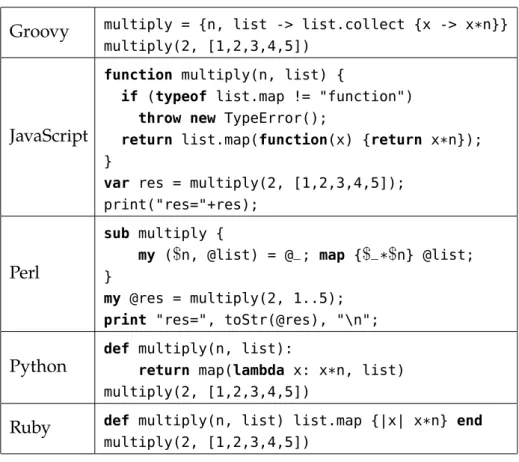
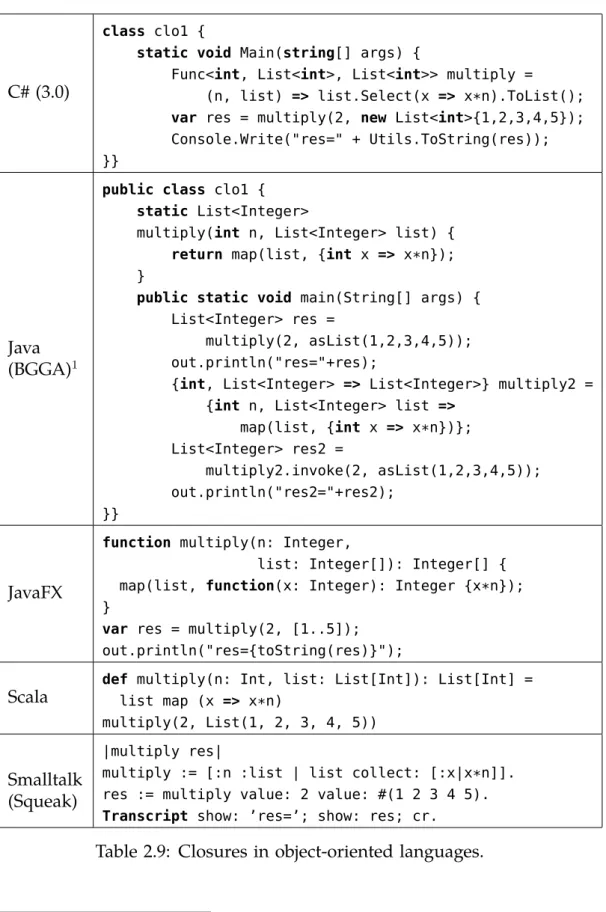
Table 2.7 illustrates the usage of closures with a source code sample written in several functional languages; Table 2.8 and Table 2.9 present the same example for well-known dynamic and object-oriented languages.
In the presented code, the function multiply takes two parameters, a list list of integers and some integer value n, and returns a list of integers containing the results of the multiplication of each element of
listwithn. Variable xis bound to the lexical scope of the closure passed
as argument to the map function while nis a free variable.
Clojure (defn multiply [n list] (map (fn [x] (* x n)) list))
(multiply 2 [1 2 3 4 5])
Erlang
Multiply = fun(N, List) ->
lists:map(fun(X) -> X*N end, List) end.
Multiply(2, [1,2,3,4,5]).
Haskell let multiply n list = map (\x -> x*n) list
multiply 2 [1,2,3,4,5]
OCaml
let multiply n list =
List.map (function (x) -> x*n) list;;
multiply 2 [1; 2; 3; 4; 5];;
SML fun multiply n list = map (fn x => x*n) list;
multiply 2 [1,2,3,4,5];
Scheme
(define (multiply n list)
(map (lambda (x) (* x n)) list))
(multiply 2 ’(1 2 3 4 5))
Table 2.7: Closures in functional languages.
In each example, the evaluation of function multiply with the argu-ments 2 and [1,2,3,4,5] simply returns the list [2,4,6,8,10].
Groovy multiply = {n, list -> list.collect {x -> x*n}}
multiply(2, [1,2,3,4,5])
JavaScript
function multiply(n, list) {
if (typeof list.map != "function")
throw new TypeError();
return list.map(function(x) {return x*n}); }
var res = multiply(2, [1,2,3,4,5]);
print("res="+res);
Perl
sub multiply {
my ($n, @list) = @_; map {$_*$n} @list;
}
my @res = multiply(2, 1..5);
print "res=", toStr(@res), "\n";
Python
def multiply(n, list):
return map(lambda x: x*n, list) multiply(2, [1,2,3,4,5])
Ruby def multiply(n, list) list.map {|x| x*n} end
multiply(2, [1,2,3,4,5])
Table 2.8: Closures in dynamic languages.
NOTE
One can approximate the functionality of closures in Java using anony-mous inner classes. There are two problems with this, though. First, anonymous inner classes are unnecessarily verbose. Second, Java doesn’t really close over the surrounding scope, it copies it. To hide this implementation detail, any variable referenced inside the inner class must be declared final outside it.
The combination of anonymous functions and higher-order functions together is where the programmer gets the power from, the anonymous functions essentially specialize the higher-order functions. Any language that supports passing functions as parameters can support higher-order functions, but without anonymous functions, they won’t get used too often.
2.1. FUNCTIONAL PROGRAMMING 29
C# (3.0)
class clo1 {
static void Main(string[] args) {
Func<int, List<int>, List<int>> multiply =
(n, list) => list.Select(x => x*n).ToList();
var res = multiply(2, new List<int>{1,2,3,4,5});
Console.Write("res=" + Utils.ToString(res)); }}
Java (BGGA)1
public class clo1 {
static List<Integer>
multiply(int n, List<Integer> list) {
return map(list, {int x => x*n}); }
public static void main(String[] args) { List<Integer> res =
multiply(2, asList(1,2,3,4,5)); out.println("res="+res);
{int, List<Integer> => List<Integer>} multiply2 = {int n, List<Integer> list =>
map(list, {int x => x*n})}; List<Integer> res2 = multiply2.invoke(2, asList(1,2,3,4,5)); out.println("res2="+res2); }} JavaFX
function multiply(n: Integer,
list: Integer[]): Integer[] {
map(list, function(x: Integer): Integer {x*n});
}
var res = multiply(2, [1..5]);
out.println("res={toString(res)}");
Scala
def multiply(n: Int, list: List[Int]): List[Int] =
list map (x => x*n)
multiply(2, List(1, 2, 3, 4, 5))
Smalltalk (Squeak)
|multiply res|
multiply := [:n :list | list collect: [:x|x*n]]. res := multiply value: 2 value: #(1 2 3 4 5).
Transcript show: ’res=’; show: res; cr.
Table 2.9: Closures in object-oriented languages.
1