Procedia - Social and Behavioral Sciences 149 ( 2014 ) 685 – 690
ScienceDirect
1877-0428 © 2014 The Authors. Published by Elsevier Ltd. This is an open access article under the CC BY-NC-ND license (http://creativecommons.org/licenses/by-nc-nd/3.0/).
Selection and peer-review under responsibility of the Organizing Committee of LUMEN 2014. doi: 10.1016/j.sbspro.2014.08.254
LUMEN 2014
Getting your Migration Analysis Together by Integrating Internal
and International Migration
Adrian Otoiu
a*
aBucharest Academy of Economic Studies, Piata Romana 1, Bucharest, Romania
Abstract
The joint analysis of internal and international migration is increasingly popular. This paper advocates this approach through a review of the theories and drivers of both types of migration. It shows that most of the models and variables used in the analysis of one type of migration are valid for the other. A fixed-effects panel econometric model using internal and international migration departures data from EUROSTAT between 2000 and 2007 proves substitution between the two migration streams. Finally, the benefits to be achieved by using integrated models of human migration are pointed out, along with future potential research directions.
© 2014 Adrian Otoiu. Published by Elsevier Ltd.
Selection and peer-review under responsibility of the Organizing Committee of LUMEN 2014.
Keywords: internal migration; international migration; migration drivers; integrating approach
1.Introduction
One of the most important demographic events is migration. At some point in time, a significant percentage of a country’s population will move to another city, or even to another country. Sometimes one person will move several times during his life in pursuit of education opportunities, work and/or business opportunities, family creation or reunification, improved residential location and amenities, or retirement.
While both internal and international migration are significant, the research and public policy does not match their relative magnitude and importance. Ellis (2012), notes that US international migration has received much more attention than its relative importance vis-à-vis the US internal migration since the late 80s, a trend noticed in the rest
* Corresponding author. E-mail address: [email protected]
© 2014 The Authors. Published by Elsevier Ltd. This is an open access article under the CC BY-NC-ND license (http://creativecommons.org/licenses/by-nc-nd/3.0/).
of the world. International migration is receiving most attention, with a dedicated inter-governmental organization (IOM), a Directorate General of the European Commission (Home Affairs) dealing mostly with it, and national ministries having a significant international migration portfolio, while internal migration is mostly a branch of demographics with respect to the research done and assigned policy responsibilities.
However, the different magnitudes and attention received by both migration phenomena overlook the similarities and the close relationship between them. In most cases, both are triggered by better economic and living opportunities at destination (pull factors) or by the relatively low available opportunities existing in the originating locations (push factors), and are influenced by similar variables: earnings differentials, probability of finding a job, size of the regions, levels of education, marital status, etc. Moreover, it seems that migrations are not unique; many migrants engage one type of migration after the other (King and Skeldon, 2010).
While several studies who analyzed both types of migration have their merit in increasing our knowledge of the migratory phenomena, none of them has attempted to use aggregated flows data for several countries from well-known sources. This study attempts to examine the theories and the variables that can be used in the analysis of both types of migration, and does a preliminary analysis to determine the relationship between the two types of migration in the EU.
2.The common drivers of migration
Research that focuses on one type of migration is the standard, and constitutes the starting point for the integrating approach of migration. A review study of the quantitative-based migration research done by Hatton (2010), shows that international migration has been initially analyzed as flows whose magnitude was influenced by business cycle indicators such as GDP, output gap, unemployment, wages and income. Later research has shown that the relative measures matter: relative income, differentials between future/expected income, and the probability of finding a job, in the home country and abroad. Migrant population stocks in the destination country, the existence of social networks and the flows of remittances of migrants to their home destinations are used in the latest research approaches. Distance, cost and age of migrants are also employed as important migration factors.
Bijak (2006) shows the theoretical streams defining international migration theory: a sociological stream, a macroeconomic stream, a microeconomic stream and a geographic stream.
Among the macroeconomic theories, the Harris-Todaro model (Harris and Todaro, 1970) models migration based on future potential wage gains in the manufacturing sector that “agricultural” workers will benefit from by moving to the manufacturing area. The dual labour markets theory by Piore, cited by Bijak (2006), shows how the local population moves to more attractive jobs while immigrants take their place. The world systems theory by Wallerstein shows that international migration is driven by advances of the capitalist system, where manufacturing and low-level service jobs become less attractive for local workforce in developed countries, while increased productivity in agriculture in developing countries lowers demand for labour and provides an immigrant pool willing to take up these positions.
The microeconomic theories explain migration as an individual cost-benefit, and a human capital accumulation (Sjaastad, 1962), decision. The net expected value of future income and the costs entailed by migration are considered. In this stream, migration is modeled at household level, by considering their relative deprivation, and remittances to families that were left behind.
The geographic stream comprises gravity models, where the size of populations at origin and destination increase migration, and distance decreases it. In some studies, population is replaced by other indicators of “mass”, incomes, GDP, unemployment rates, size of the labour force, while distance is replaced by structure of transportation networks, time, or cost of transportation between origin and destination.
In a review paper of internal migration, Etzo (2008), citing Greenwood (1997), establishes that research in internal migration attempts to answer why people migrate, and who migrates and why, with the first question being microeconomic, and the second focusing on the aggregate migratory flows and their macroeconomic determinants. An important conclusion of Etzo (2008) is that often the macro approaches are influenced by the micro approaches, as models based on aggregate data are built using microeconomic theory.
The importance of personal characteristics in the microeconomic migration literature was emphasized by several authors. Todaro (1980) observes that migrants “tend to be disproportionately young, better educated, less
risk-averse, and more achievement-oriented and to have better personal contacts in destination areas than the general population in the region of out-migration”. Other authors emphasize the role of household in the decision-making processes, similar to Oda (2007).
The macroeconomic approaches, which are significantly more empirical in nature, tend to use macroeconomic variables in explaining migration, such as employment and per capita incomes. Gravity models, analysed by Etzo (2008) within the macroeconomic approaches, take more variables into account such as distance, and population size at origin and destination.
Reviews of the theories and indicators show striking similarities between the approaches used in modelling both types of migration, and the role they play in shaping up research. Moreover, we can also observe that the theoretical streams tend to borrow a lot from each other. In addition to the fact that macroeconomic models use elements of microeconomic theories as they consider the fact that aggregate decisions to migrate draw upon individual decisions to migrate, in the development of gravity models, explanatory factors from microeconomic and macroeconomic theory such as incomes, GDP, unemployment rates, size of the labour force are used as “population”, while distance is replaced by transportation networks, time, or cost of transportation between origin and destination.
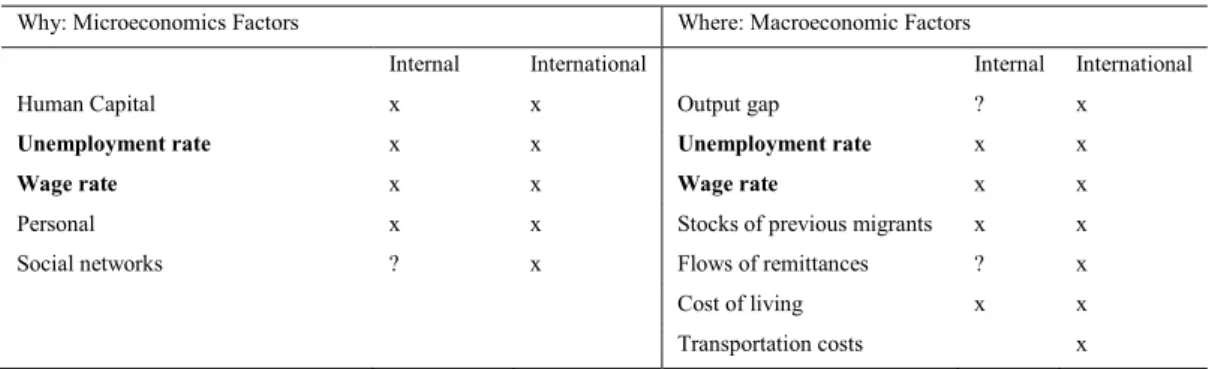
Table 1. Similarities and differences in migration analysis drivers
Why: Microeconomics Factors Where: Macroeconomic Factors
Internal International Internal International
Human Capital x x Output gap ? x
Unemployment rate x x Unemployment rate x x
Wage rate x x Wage rate x x
Personal x x Stocks of previous migrants x x
Social networks ? x Flows of remittances ? x
Cost of living x x
Transportation costs x Notes: 1) variables in bold acts as both microeconomic and macroeconomic factors
Figure 1 shows a synthesis of the variables used in analysing both types of migration. The classical theories of migration have pointed out the importance of wage differentials and the probability of finding employment, as major drivers of migration in a quest for a better life. Likewise, GDP per capita may also be an indicator of the strength and development of the economic activity of a country, and of its well-being. Positive effects of the GDP per capita on internal migration were observed by Van der Gaag and Van Wissen (2008).
Empirical observations have determined that migration is stronger at younger ages. This has been shown by Etzo (2008), and is consistent with Eurobarometer and Gallup studies (Esipova et al, 2013, Fouarge and Ester, 2007).
The highly educated are more likely to move as indicated by Esipova et al. (2013), Fouarge and Ester (2007) for Europe, Aguayo-Téllez and Martínez-Navarro (2013) for Mexico, and Oda (2007) for external migration originating in rural Pakistan. A higher level of education usually entails more chances to get a job in a destination with a higher level of development. However, migration opportunities exist for the low-skilled, too. The dual labour markets theory by Piore, cited by Bijak (2006) and the world systems theory by Wallerstein point out to a demand for low-skilled migrant labour.
The beneficial effects of FDI flows for the economies in increasing their GDP per capita and their level of development were perceived to diminish migration. In a study of the least-developed countries, Sanderson and Kentor (2009) showed that the effect has been mixed, with FDI in primary sector increasing emigration through making it more productive and leading to displacement of workers, and FDI in the secondary sector decreasing emigration by boosting internal rural to urban migration. In Europe, the cohesion policy, which entails substantial transfers of resources from rich to poor Member States, was shown to lower migration (Schmidt, 2013).
Relative magnitude of variables also plays an important role in the dynamics of migratory phenomena. The relative deprivation concept (Stark and Taylor, 1989, cited by Bijak, 2006) shows that migration is driven by relative
income differentials. Sanderson and Kentor (2009) show that the migration transition hypothesis holds, in that emigration levels rise and then decrease as GDP per capita levels increase in less-developed countries. Hatton (2010) points out that in several studies the differences between wages and employment conditions in the receiving and destination countries mattered. This is also the basis of the Harris-Todaro Model (Harris and Todaro, 1970), which models migration on the urban-rural expected wage differential.
There are a few variables that are used in the analysis of one type of migration only. Thus, housing is found significant by many authors in explaining internal migration decisions (Etzo, 2008). Housing market was also found an important factor that explained higher unemployment during the Great Depression in the US (Estevao and Tsounta, 2011). Remittances may lead to a decreased propensity to migrate if they provide a decent standard of living for recipients situated in origin countries. The Aguayo-Téllez and Martínez-Navarro (2013) study shows that domestic remittances increase internal migration, but decrease the likelihood of migration to the USA. The existence of social networks as a factor influencing international migration was analyzed in several studies. Kritz et al.(2011) shows that immigrants to the US tend to move to places where they can find higher social support. Other authors show that loss of social networks is a factor that hampers migration intentions in Europe (Fouarge and Ester, 2007, Schmidt, 2013).
A closer examination of these factors leads us to believe that their use in the analysis of one type of migration only is mainly due to data availability and comparability issues rather than their explanatory power.
3.The link between internal and international migration
The similarities between both types of migration led to their integrated analysis. King and Skeldon (2010) draw attention on the complex paths of migration, where international migration may precede internal migration, and the other way around. There could be a fair amount of substitutability and complementarity between them given these (complex) migration paths, as both are influenced by a common set of factors. Authors also conclude that it is very likely that any migration theory applies to both types of migration.
Among the more recent studies that provide an extensive empirical analysis of both migratory phenomena are the ones done by Aguayo-Téllez and Martínez-Navarro (2013) for Mexico, Oda (2007) for Pakistan, and Fouarge and Ester (2007) and Zaiceva and Zimmerman (2008) for the EU. The first one makes use of an extensive micro data set to examine migration to Mexico and the US, and shows the linkages between international and internal migration. In addition, the authors point out that the factors that influence migration, wage differentials, education, agriculture and manufacturing share of employment, household characteristics, and remittances, do so at different magnitudes across the regions of origin of migrants. In rural Pakistan, it seems that the migration decisions are taken at household level, and the choice between internal and international migration is determined by income levels. Based on the 2005 Eurobarometer survey, Fouarge and Ester (2007) analyse the drivers behind the intentions to migrate of the European Union citizens at regional and cross-border level. Most of the coefficients obtained for the explanatory variables used, namely gender, education, age, employment status, household situation, view on mobility and past mobility, are significant. However, coefficients differed markedly across migration types.
Using the internal and international departure flows data provided by Eurostat for the 2000-2007 period, the links between internal and international migration in Europe were tested. This analysis has benefitted a lot for the fact that internal migration data is comparable, as it is reported at NUTS2 region level. A fixed-effects (country and time) two-way model, (Croissant & Millo, 2008), was used in order to use a relatively small sample with limited time-series and longitudinal dimensions. The model used is shown in formula 1, with coefficient estimates shown right below the variables and results of the t-tests on the coefficients shown in brackets. The .. symbol is used to show the
demeaned variables used in the fixed-effects estimation, which are calculated as ÿ=y-ȳ.
ሷ ൌ ߚͳܫ݊ݐ݁ݎ݈݊ܽܯ݅݃ݎܽݐ݅݊ሷ ݅ݐെͳ ߚʹܴ݈݁ܽݐ݅ݒ݁ܫ݊ܿ݉݁ܲܲܲሷ ݅ݐߚ͵ܧ݉݅݃ݎܽݐ݅݊ሷ ݅ݐെͳ ߝ݅ݐሷ (1)
-0.25 -0.04 0.63 (1.78) (1.69) (6.54)
Results show that there is a significant degree of substitutability between the two types of migration, with emigration decreasing by 0.25% at an 1% increase in internal migration in the previous period, controlling for past
emigration and relative income per capita in purchase-parity terms, expressed as a percentage of the average per capita income in the EU. The regression has a medium fit, with an R2 of 46%, showing that, apart from the strong
explanatory power of past internal and international migration, and relative income, there are other factors that influence emigration.
4.Conclusion
The case for an integrated approach to migration is valid if we look at the theories, and drivers that influence both types of migration. The fact that most factors that explain one type of migration can explain the other, and the fact that migration theories designed for one type of migration are used in the analysis of the other, are proofs that both types of migration should be analysed together rather than separately.
However, this does not mean that the same drivers have the same influence on both migration phenomena. As King and Skeldon (2010) and Ellis (2012) have pointed out, overarching models and results explaining migrations are not appropriate. Rather, an integrated analysis can benefit both types of migration. This analysis should take into account the fact that both migration phenomena are affected to a different extent, by the same factors, and will draw upon, to a good extent, the same pool of potential migrants.
Our analysis shows that there is a certain degree of complementarity between the two types of migration, similar to the findings of Aguayo-Téllez and Martínez-Navarro (2013) and Plane (1993). The existence of it should be the key to understanding and forecasting both internal and international migration, by taking onto account the different degrees of influence of the common drivers, the substitutability of both migration streams, and the existence of a common, finite and demographically-determined pool of potential migrants.
Acknowledgement: This work was cofinanced from the European Social Fund through Sectoral Operational Programme Human Resources Development 2007-2013, project number POSDRU/159/1.5/S/134197 „Performance and excellence in doctoral and postdoctoral research in Romanian economics science domain”.
References
Aguayo, Téllez, E., Martínez, Navarro, J. (2013). Internal and international migration in Mexico: 1995–2000, Applied Economics, 45:13, 1647-61. Bijak, J., (2006). Forecasting International Migration: Selected Theories, Models, And Methods, CEFMR Working Paper, 4/2006.
Croissant, Y., Millo, G. (2008). Panel Data Econometrics in R: The plm Package, in Journal of Statistical Software, 27(2).
Esipova, N., Pugliese, A., Ray, J. (2013). The demographics of global internal migration, in Migration Policy practice, Vol 3, No II, pp 3-6. Ellis, M. (2012). Reinventing US Internal Migration Studies in the Age of International Migration, Population, Space and Place, in Special Issue:
Re-Making Migration Theory: Transitions, Intersections and Cross-Fertilisations, Volume 18, Issue 2, pp. 196–208.
Estevão, Marcello, Tsounta, Evridiki (2011). Has the Great Recession Raised U.S. Structural Unemployment?, IMF Working Paper, WP/11/105. Etzo, Ivan (2008). Internal migration: a review of the literature, MPRA Paper No. 8783, online at http://mpra.ub.uni-muenchen.de/8783/ Fouarge, D., Ester, P. (2007). Factors Determining International and Regional Migration in Europe. Dublin: European Foundation for the
Improvement of Living and Working Conditions.
Greenwood, M. J. (1997). Internal Migration in Developed Countries, in Mark R. Rosenzweig and Oded Stark, editors, Handbook of Population and Family Economics, Volume 1B. Amsterdam: Elsevier, pp. 647-720.
Harris, J., R., Todaro, M., P. (1970). Migration, unemployment and development: a two-sector analysis, in American Economic Review, 60. Hatton, T (2010). The Cliometrics Of International Migration: A Survey, in Journal of Economic Surveys, Vol. 24, No. 5, pp. 941–969
King, Russell, Skeldon, Ronald (2010). ‘Mind the Gap!’ Integrating Approaches to Internal and International Migration, in Journal of Ethnic and Migration Studies, 36:10, pp. 1619-1646
Kritz, M., Gurak, D., Lee, M. (2011). Will They Stay? Foreign-Born Out-Migration from New U.S. Destinations, Population Research and Policy Review, in Population Research and Policy Review, Volume 30, Issue 4, pp. 537-567.
Van der Gaag, N., Van Wissen, l. (2008). Economic Determinants of Internal Migration Rates: A Comparison Across Five European Countries,
Tijdschrift voor economische en sociale geografie, Vol 99, Issue 2, pp. 209-222
Oda, H. (2007). Dynamics of Internal And International Migration In Rural Pakistan, Asian Population Studies, 3:2, pp. 169-179 Plane, D., A. (1993). Demographic influences on migration, Reg. Studies, 27, pp. 375–383.
Schmidt, Peter (2013). The EU structural funds as a means to hamper migration, Jahrbuch fur Regionalwissenschaft, 33, pp.73–99.
Sanderson M., R., Kentor, J., D. (2009). Globalization, Development and International Migration: A Cross-National Analysis of Less-Developed Countries, 1970–2000, Social Forces 88 (1), pp. 301-336.
Todaro, M., P., (1980). Internal Migration in Developing Countries: A Survey, in Population and Economic Change in Developing Countries. Ed. Richard A. Easterlin (University of Chicago Press, London and Chicago), pp. 361-402.