CONTRIBUTION FACTOR OF WOOD PROPERTIES OF THREE POPLAR
CLONES TO STRENGTH OF LAMINATED VENEER LUMBER
Fucheng Bao
ProfessorResearch Institute of Wood Industry Chinese Academy of Forestry
Beijing 100091, PRC
Feng Fu
Professor
Research Institute of Wood Industry Chinese Academy of Forestry
Beojing 100091, PRC
Elvin
T.
Choong?
Professor
School of Forestry, Wildlife, and Fisheries Louisiana State University Agricultural Center
Baton Rouge, LA 70803 and
Chung-yun Hse
Principal Wood Scientist Southern Research StationUSDA, Forest Service Pineville, LA 71360 (Received October 1998)
ABSTRACT
The term "Contribution Factor" (C,) was introduced in this paper to indicate the contribution ratio of solid wood properties to laminated veneer lumber (LVL) strength. Three poplar (Populus sp.) clones were studied, and the results showed that poplar with good solid wood properties has high Contribution Factor. The average Contribution Factor of Poplar 69 (Populus deltoides cv. I- 69/55), Poplar 72 (P. euramericana cv. 1-72/58), and Poplar 63 (P. deltoides cv.1-63-51) was 76.2%, 68.6%, and 66.1%, respectively. The average Contribution Factor of the three clones for shear strength, modulus of elasticity (MOE), and impact toughness was approximately 80%, which is higher than that for modulus of rupture (MOR), compressive strength, and hardness. The average Contribution Factor of the six properties tested was highest in Poplar 69 (76.2%) and the lowest in Poplar 63 (66.1%), indicating that the Contribution Factor is positively affected by solid wood properties. Densification also significantly affects LVL MOE in Poplar 72, as compared to that of Poplar 69. Poplar 63, however, showed highest improvement in MOR strength from solid wood to LVL and also highest specific LVL MOR, even though it has the lowest solid wood MOR among the three clones.
Keywords: Contribution factor, Populus sp., solid wood, laminated veneer lumber, wood properties, strength, plantation.
? Member of SWST
Wood and Fiber Science, 33(3), 2001, pp. 345-352
346 WOOD AND FIBER SCIENCE, JULY 2001, V. 33(3)
INTRODUCTION
Plantation forests are important for the sus- tainable development of forestry. China has more than 33 million hectares of planted for- ests to increase its fiber resource and improve its ecosystem, and is now a world leader in afforestation programs (Wang 1995). Efficient use of this resource, however, requires com- prehensive understanding of the relationship between wood properties and processing of plantation-grown wood for end-use products. There is voluminous information in the liter- ature on the growth-quality relations of Poplar (Populus sp.) wood, which Hu (1988) has compiled, but only a few studies have been conducted addressing the effects of silvicul- tural treatments andlor juvenile wood on prop- erties of wood composites (Pugel et al. 1989a,b; Wasniewski 1989; Kretschmann et al. 1993). Recent research has focused on the silvicultural effects of specific products, i.e., laminated veneer lumber (Shupe et al. 1997a), plywood (Shupe et al. 1997b; Bao and Jiang 1998), and fiberboard (Shupe et al. 1998). These investigations, however, were per- formed mainly on the southern pines (Pinus spp.), and did not address the effects of plan- tation-grown genetically engineered species on the performance of specific end-use prod- ucts. With regard to poplar plantation wood, preliminary studies have been done to deter- mine the relationships between wood proper- ties and end-uses (Fu and Bao 1999; Bao et al. 2000); however, these studies did not iden- tify the "Contribution Factor" of properties other then the inherent solid wood strength.
This study was undertaken to investigate the contribution ratio of solid wood (SWD) prop- erties to laminated veneer lumber (LVL) strength. The objective was to determine the relationship between SWD and LVL proper- ties as observed in poplar clones and to pro- vide a scientific basis for better utilization of poplar plantation resources. Among the vari- ous types of wood composites, LVL has more structural similarities to natural
wood
because it is a wood-matrix laminated assembly withall veneers glued parallel to the longitudinal axis of the billet; therefore, LVL was chosen as the end-use product, whose properties are usually superior to those of solid wood.
MATERIALS AND METHODS
Three clones of a poplar plantation, i.e., Po- pulus deltoides cv. 1-6315 l (Poplar 63), p. del- toides cv. 1-69/55 (Poplar 69), and P. eura- mericana cv. 1-72/58 (Poplar 72), were select- ed. Two 1 1-year-old trees were obtained for each of the three clones from a plantation for- est having a stand density of 270 trees per ha growing in a sandy soil site and located at 117" E longitude and 38" N latitude near the Yangtze River at Ann Qing, Anhui Province. Logs 3.5 m in length with base diameter from 24 to 26 cm were cut from each tree. To min- imize variability, test samples for determina- tions of wood and LVL properties were ob- tained from the same log. Each log was cross- cut into two parts-the lower part (1.3 m) was used to manufacture into LVL, and the upper part (2. I m) was used to determine solid wood properties. The LVL in this study were made from 2.61-mm-thick veneers.
LVL manufacture
The veneers used in the manufacture of LVL were peeled with a laboratory peeler. Af- ter peeling, the veneers were clipped to 50-
60-cm size and dried to a moisture content be- low 6% in a "roller" dryer. LVL was prepared at the Research Institute of Wood Industry Laboratory in Beijing, China, using a 600- X
600-mm plywood press. The plies consisted of thirteen layers of 2.61-mm-thick veneer. The resin spread was 300 g/m2 (liquid basis) of unextended phenol-formaldehyde adhesive (52.7% solid content, 700 MPa viscosity, 10-12 pH). The press temperature, pressure, time, and spacer were 160°C, 1.5 MPa, 20 min, and 25 mm thick, respectively.
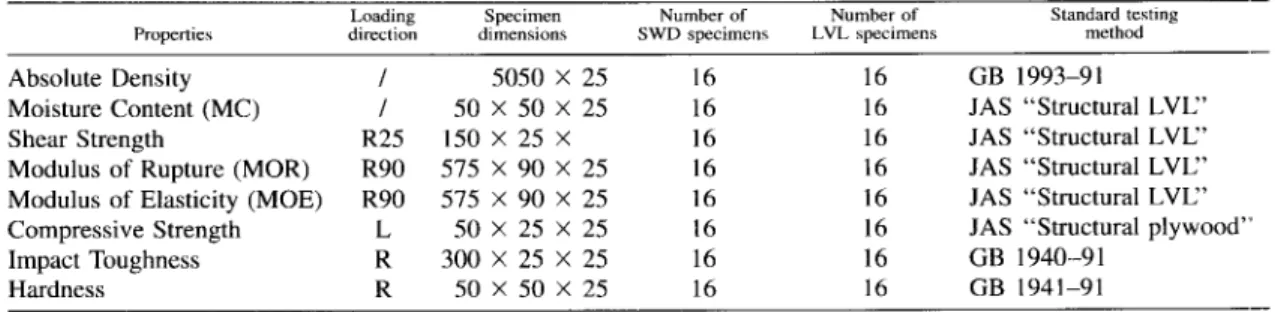
Specimen preparation and testing The various
SWD
and LVL properties test- ed are shown in Table 1. In loading direction,Bao et a1.--CONTRIBUTION FACTOR OF WOOD PROPERTIES TO STRENGTH OF LVL 347
TABLE 1. Testing methods for poplar solid wood (SWD) and laminated veneer lumber (LVL) properties.
Absolute Density Moisture Content (MC) Shear Strength
Modulus of Rupture (MOR) Modulus of Elasticity (MOE) Compressive Strength Impact Toughness Hardness Loading direction I I R25 R90 R90 L R R
Specimen Number of Number of
d~mensions SWD specimens LVL specimens
- Standard testmg method GB 1993-91 JAS "Structural LVL" JAS "Structural LVL" JAS "Structural LVL" JAS "Structural LVL" JAS "Structural plywood" GB 1940-91
GB 1941-91
R, T, and L refer to radial, tangential, and lon- is mainly due to the contribution of adhesive gitudinal, respectively, and the number after and processing technique.
them (e.g., 90, 25) refers to specimen width in
mm. With respect to specimen dimensions: for RESULTS AND DISCUSSION
SWD-L refers to longitudinal length, T to tan- gential width, and R to radial thickness; for LVL-L refers to length parallel to grain, T to width perpendicular to grain, and R to thick- ness. The letters GB refer to Chinese national standards (National Technique Monitoring Bu- reau of PRC 1991) and JAS to Japanese ag- ricultural standards (Japanese Agric-For- Aquatic Ministry 1989; 1991).
To measure the effect of wood properties on LVL strength, the term "Contribution Factor" (C,) was applied. Since the mechanical prop- erties of wood structural composites are usu- ally better than those of solid wood, we as- sumed that the strength of LVL would be bet- ter than that of solid wood. Accordingly, the Contribution Factor C,, as an indication of the proportion (%) of LVL strength that originated from solid wood properties, can be expressed as:
where P, is SWD strength and PL is LVL strength. A high C, indicates a large effect of solid wood properties on LVL strength, i.e., a large portion of the LVL strength originated from solid wood properties, and only a small portion from processing variables (e.g., adhe- sive and hot panel assembly, etc). Conversely, a low C, has a small effect of solid wood prop- erties, and any improvement in LVL strength
The various properties of solid wood artd LVL for different clones are shown in Table 2. In solid wood, the highest density was found in Poplar 69 (0.39 g/cm3) and the lowest in Poplar 63 (0.33 g/cm3). By analysis of var- iance, all the five strength properties [i.e., shear, modulus of rupture (MOR), modulus of elasticity (MOE), compressive strength, artd hardness] of Poplar 69 were significantly greater than those of Poplar 63, with the cor- responding values for Poplar 79 between the two other clones. Impact toughness, however, showed higher value in Poplar 72 than in Pop- lar 69, with Poplar 63 still exhibiting the low- est value. It is noted that the variability of the data, as expressed by coefficient of variation, indicated that most of the coefficients in the solid wood properties were higher than those of LVL. The variability of LVL is reduced through the additive effect of LVL strength and the defect dispersion from the assembled veneers (Ambrose 1994).
As shown in Table 2, LVL density w,as higher than SWD density due to densification effect during hot-pressing, but the order (of LVL density with respect to the clone fact'or was the same as that of solid wood, i.e., den- sities of LVL 69, LVL 72, and LVL 63 were 0.52, 0.49, and 0.43 g/cm3, respectively. On the average, all LVL strength properties, with the exception of impact toughness, exhibited
WOOD AND FIBER SCIENCE, JULY 2001, V. 33(3) m h b - 0 - 0 - 0 h r - h 9"?"9?*19?99 m - N - m w m b m - m b W N E N c m Om NV" EN e m
z
PI - m h C C - \ O - b h W-
w ? i ? ? = ? m " Y - " " z F 2 Z Z 2 v ' 3 2 2 9 2 a w w Vg a r n u u < <
0 h m h ' c h m h c c h m h 9"??1?1?""99 t-m00mZm~~rl2~ c-NV ,-
higher values than those of SWD of the same poplar clone. In impact toughness, the LVL was better than that of SWD wood in the ra- dial direction, but not in the tangential direc- tion. It is further noticed that the impact tough- ness is greater in the tangential than the radial direction in SWD, but it is the reverse in LVL. Radial toughness was higher than tangential toughness due mainly to the LVL structure of multiple gluelines. When LVL was impacted radially, the gluelines were in series with one another; thus only the wood veneer in the con- tacted LVL surface absorbed or buffered the impact energy. On the other hand, when LVL was impacted tangentially, the alternate ve- neers and adhesive films were in parallel with one another, therefore, the adhesive restricted the absorbing action of contiguous veneers to reduce the impact toughness.
A comparison of the Contribution Factors of SWD strength to those of LVL strength in different clones is shown in Table 3. Among individual properties, the average C, of the three clones for shear strength, MOE, and im- pact toughness were near SO%, whereas those of the other strength properties were much lower (i.e., 72.9% for MOR, 54.9% for com- pressive strength, and 61.2% for hardness). The differences in C, in individual clones are summarized as follows:
1. In shear strength and MOR, the C, in both tangential and radial directions were high-
-
est in Poplar 69, and lowest in Poplar 63.C
2. In compressive strength, the C, showed the C-
same trends as in shear strength, and the.$
L
average C, in the longituclinal direction was
-
c almost 30% higher than in the tangential
e direction.
3. In MOE, the C, of Poplar 69 were highest,
0
-
but those of Poplar 72 &ere the lowest.$
4. In impact toughness, the C,s were calculat- G ed only in the radial direction but not in thef
B
tangential direction because the tangential toughness of solid wood was greater than8 that of LVL. When LVL, was impacted in
E
i
the radial direction, the C, was highest in I - Poplar 63 and least in Poplar 72.ROO rr 01.-CONTRIBUTION FACTOR OF WOOD PROPERTIES TO STRENGTH OF LVL 349
FIG. 1. Effects of Poplar clones and Cf on modulu:~ of rupture of laminate veneer lumber.
5 . In hardness, Poplar 72 had the highest C,, and Poplar 63 the least.
The Contribution Factors in individual properties varied greatly among the clones. Even though a large portion of the L'VL strength originated from solid wood proper- ties, the differences in C, that existed among the various mechanical properties cannot be explained entirely by the effect of wood prop- erties alone. An improvement in LVL strength is also due to the contributory effect of several variables, such as adhesive and manufacture technique. Consequently, the C, were furtlher evaluated to identify the most probable cause of the LVL performance. Since the bend-ing strength is considered most critical to LVL's structural performance, MOE and MOR were chosen for the analysis. The relationships lbe- tween C, and average MOE for the three clones are shown in Fig. 1, and the relation- ships between C, and average MOR are shown in Fig. 2.
A comparison of the strength properties among the poplar clones shows three types of relationship:
Case 1 Lower SWD strength and smaller C, value with lower LVL strength (e.g.,
350 WOOD AND FIBER SCIENCE, JULY 2001, V. 3 3 ( 3 )
1
TABLE 5. Mean specific bending strength of SWD andI LVL ,fir different clones.
WoodIClone MOE (GPa*crn'/g) MOR (MPa*cm3/g)
U SWD63 22.41 (13.3)a C 132.13 (24.3) C SWD69 27 83 (13 5) A 177 17 (13.5) A SWD72 28 86 (8.7) A 17 1.66 (8 7) AB LVL63 22.14 (3 7) C 169 27 ( 1 l 5) AB 24 81 (10.9) BC 153 07 (14.6) BC LVL72 26.92 (9.1) AB 165.28 (10.4) AB
Nurnher tn parenthe\~i refer, to ~ o e f l l ~ l e n t of vandtlon ('h) Means wlth the same cap~tal letter dre not \ ~ g n ~ h c a n t l y d~tterent by l u k e y s test at 0 05
75 level
, 4 1 1 7 0 ent solid wood strength also affect LVL MOE;
F a P68 Pi2
I
1
therefore, a further examination was neces-
Poplar clones
sary. The improvement in MOE of LVL (E,,,) over MOE of SWD (E,,,) [i.e., (E,,, - E,,,)/ FIG. 2. Effects of poplar clones and CI on the modulus ES,,] and compaction ratio [i.e., ratio of LVL of rupture of lammate veneer lumbber. density to SWD density] were calculated from the average data of Poplar 63, Poplar 72, and Poplar 69. The results, summarized in Table
Case
Case
Poplar 63 vs. Poplar 69 or Poplar 63 vs. Poplar 72).
2 Higher SWD strength and larger C, value with higher LVL strength (e.g., Poplar 69 vs. Poplar 63, or Poplar 72 vs. Poplar 63).
3 Lower SWD strength and smaller C, value associated with higher LVL strength (e.g., MOE and MOR of Pop- lar 72 vs. Poplar 69).
An interesting result is found in Case 3. The MOE of solid wood in Poplar 72 was 8.2% lower than that in Poplar 69. However, the MOE of LVI, in Poplar 72 was 5.3% greater than that in Poplar 69 even though the Con- tribution Factor of Poplar 72 was more than 12% smaller than that of Poplar 69. These re- sults indicate that factors other than the inher-
4, indicate that Poplar 72 had a higher com- paction ratio (i.e., 1.43) and higher improve- ment of LVL MOE (37.73%). Since veneer thickness was not significantly different, and resin application rate and LVL thickness were controlled in the same manner during hot- pressing, the high compaction ratio of Poplar 72 was most likely due to veneer densification on the LVL surface, resulting in a high MOE value. A significant improvement in MOE by surface densification of panel products has been documented by Hse
(1
975) on flakeboard and Suchsland and Woodson (1986) on fiber- board. It should be noted, however, that the effect of density in composite materials is of- ten evaluated also based on specific strength properties (i.e., ratio of strength to density). Such calculation for the average specific MOE and MOR together with Tukey's range test isTABLE 4. The improve~nent in bending strength from SWD to LVL for difSerent clones.
Strength Improvement (70)
MOE MOR
Cornpactlon
Clonch ratio K 9 0 1'25 Mean R90 '1'25 Mean
Poplar 63 1.30 30.7 1 29.40 30.06 5 1.54 88.89 70.22
Poplar 69 1.33 18.02 20.75 19.39 16.67 14.56 15.62
Boo et a/.--CONTRIBUTION FACTOR OF WOOD PROPERTIES TO STRENGTH OF LVL 351 1 summarized in Table 5. An analysis of vari-
ance indicated that the differences in specific MOE of solid wood between Poplar 69 and Poplar 72 were not significant. However, the LVL's specific MOE (24.8 1) of Poplar 69 was significantly lower than that of SWD wood specific MOE (27.83), indicating that the den- sity of LVL from Poplar 69 had the least effect on LVL MOE. This phenomenon supports Case 3, i.e., the higher compaction ratio of Poplar 72 resulted in higher improvement of LVL strength. The analysis of variance also showed that the specific LVL MOR (153.07) of Poplar 69 was significantly lower than the specific SWD MOR (177.17), but the differ- ences in specific MOR between LVL and solid wood of Poplar 72 were not significant, indi- cating again that the density effects on LVL MOR were less in Poplar 69 than Poplar 72. The most surprising results on MOR, however, were in Poplar 63. Even though the SWD spe- cific MOR had the lowest value (132.13 in Table S), Poplar 63 yielded the largest im- provement in LVL MOR (70.22% in Table 4), and resulted in the highest specific LVL MOR
( 169.27). The reason for the high specific LVL MOR of Poplar 63 is not clear in this study; nevertheless, the potential of improving LVL property with poplar clone needs further in- vestigation.
CONCLUSIONS
The term "Contribution Factor" can be used as an index to evaluate the contribution of solid wood strength to LVL strength. It is directly related to the inherent properties of wood. A genetically good poplar tree had high contribution factors, and vice versa. The Con- tribution Factors in shear strength, modulus of elasticity, and impact toughness were near 8096, and higher than those in modulus of rup- ture, compressive strength, and hardness. The average Contribution Factors of the six prop- erties tested were highest in Poplar 69, and lowest on Poplar 63, indicating that the Con- tribution Factor is positively affected by solid wood properties.
Densification effect on LVL MOE was sig- nificant in Poplar 72, as compared to Poplilr 69. The most surprising results on MOR, how- ever, were in Poplar 63. With the lowest SWD specific MOR, Poplar 63 yielded the largest improvement in LVL MOR and resulted in the highest specific LVL MOR.
REFERENCES
AMBROS~, J. 1994. Simplified design of wood structure. 5th ed. John Wiley & Sons, Inc., New York, pp. 21 Z-
218.
BAO, E C., AND Z. H. JIANG. 1998. Wood properties of
main species from plantation in China. China Forestry Publ. Ilouse, Beijing, PRC pp. 525-575.
--
, AND S. LIU. 2000. A modeling approach to the relationship between plantation poplar properties and qualities of veneer and plywood. Scientia Silvae Sinicae 36(1):91-96.Fu, E, AND E C. BAO. 1999. End-use selection of planta-
tion poplar: Solid wood or laminated veneer lumber. Scientia Silvae Sinicae 35(4):64-72.
HSE, C. Y. 1975. Properties of flakeboards from hard- woods growing on southern pine sites. Forest Prod. J. 25(3):48-53.
Hu, S. C. 1988. Cottonwood (Populus deltoides Bart.)--A bibliography 1987-1986. Bulletin 794, La. Agric. Exp. Sta., Louisiana State Univ. Agric. Center, Baton Rouge, LA.
JAPANESE AGRIC-FOR-AQUATIC MINISTRY. 1989. Structural plywood. JAS (Japanese Agricultural Standard), Tokyo, Japan.
, 1991 Structural laminated lumber. JAS (Japanese Agricultural Standard), Tokyo, Japan.
KRETSCHMAN, D. E., R. C. MOODY, R. E PELLEKIN, B. A.
BENDWEN, J. M. CAHII,I.I, R. H. MCALISTER, AND D. W. SHARP. 1993. Effect of various proportions of juvenile wood on laminated veneer lumber. Res. Pap. FPL-RP- 521. USDA Forest Service, Forest Prod. Lab., Madison, WI. 31 pp.
NATIONAL TECHNIQUE MONITORING BUREAU OF PRC. 19'91. Test methods for wood physical and mechanical prop- erties. GB 1927-1943-91 (Chinese National Standard), Beijing PRC.
PUGEL, A. D., E. W. PRICE AND C. Y. HSE. 1989a. Corn- posites from southern pine juvenile wood. Part 1. Panel fabrication and initial properties. Forest Prod. J. 40( 1): 29-33.
--- , 1989b. Composites from south-
ern pine juvenile wood. Part 2. Durability and dimen- sional stability. Forest Prod. J. 40(3):57-61.
SHUPE, T. E, C. Y. HSE, L. H. GROOM, AND E. CHOONG. 1997a. Effect of silvicultural practice and veneer layup on some mechanical properties of loblolly pine L'JL. Forest Prod. J. 47(9):63-69.
352 WOOD AND FIBER SCIENCE, JULY 2001, V. 33(3)
--- , AND
-
. 1997b. Effect of silvicultural practice and veneer layup on some me- chanical properties of loblolly pine plywood. Forest Prod. J. 47(10):101-106.-- , E. T. CHOONG, AND L. H. GROOM. 1998. Effect of silviculture practice and wood type on loblolly pine particleboard and medium density fiberboard prop- erties. Holzforschung 53:215-222.
SUCHSLAND, O., AND G. E. WOODSON. 1986. Fiberboard man-
ufacturing practices in the United States. USDA Forest Service Agric. Handbook 640, Washington, DC, p. 30. WASNIEWSKI, J. L. 1989. Evaluation of juvenile wood and
its effects on Douglas-fir structural composite panels. pages 159-173 in T. M. Maloney, ed. Proc. 23rd Wash- ington State Univ. Intern. ParticleboardComposite Ma- terials Symposium, Pullman, WA.
WANG, S. J. 1995. Recent research on Poplar. Chinese Forestry Publ. House, Beijing PRC. pp. 1-2.