The Role of University in its
Environment - Specific
Features and Identity
Maja Lamza Maronić,Jerko Glavaš
Article Info:
Management Information Systems, Vol. 8 (2013), No. 1, pp. 003-007 Received 04 October 2012 Accepted 18 February 2013 UDC 378.4:332.1 Summary
Contributing to regional economies and regional development, universities play a very important role in regional development. It is a generally accepted fact around the world that human capital is a major tool for achieving competitive advantage in the global market. An efficient society, which builds its competitive advantages on knowledge, must have a flexible labour market, adequate levels of employee security and protec-tion, but also a system that continuously fosters and rewards investment into know-ledge. People, their needs, motivation and satisfaction have therefore come into the focus of human resource management. An autonomous university, willing to adapt to changes and fulfill the requirements of the community, is a driving force behind overall development.
Keywords
university, regional development, human capital
1. Introduction
Exponential and continued growth of overall hu-man knowledge offers new possibilities for its crea-tive application and continuously generates new needs. The process of European Union (EU) ac-cession has accelerated the changes in the eco-nomic development of the Republic of Croatia. The Bologna process marks the start of harmoniza-tion in the area of science and educaharmoniza-tion. The aim of the paper is to formulate a subsystem of control model for education process. The model should allow a dynamic and transparent monitoring of the Bologna process application, harmonization with the EU countries, and be a constituent part of the economic development strategy in Eastern Sla-vonia, Croatia and other areas which naturally gravitate to this region.
2. Josip Juraj Strossmayer University as a Regional Leader
There are universities throughout the Union's re-gions. Their activities often permeate the local eco-nomic, social and cultural environments. This helps to make them an instrument of regional develop-ment and strengthening European cohesion. The development of technology centres and science parks, the proliferation of regional cooperation structures between the business sector and the uni-versities, the expansion of university regional de-velopment strategies, the regional networking of universities, are all illustrations of this dimension of university activity.
The regional dimension of the university activity is thus set to get stronger, given its essential role in achiev-ing the Europe of knowledge, particularly lookachiev-ing ahead to enlargement.
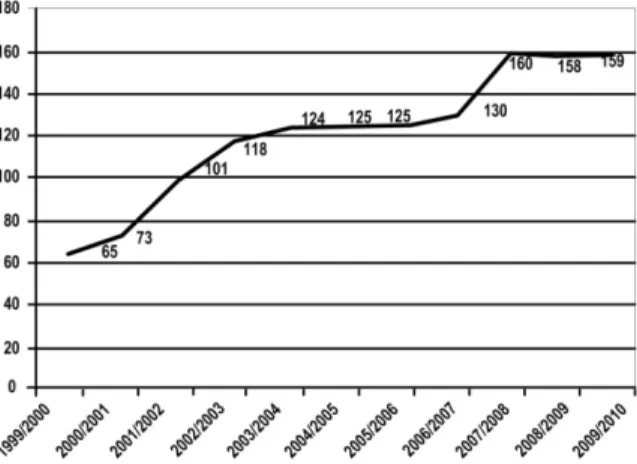
Figure 1 University course books published at the University in Osijek between academic years 1999/2000 and 2009/10
Source: Barišić, 2010
The EU supports these developments, particu-larly through the Structural Funds. In addition, the role played by the universities as a source of exper-tise and a catalyst for multiple partnerships be-tween economic and social players within a range of networks is very relevant at the regional and local levels. The increased involvement of the uni-versities locally and regionally should not, however, overshadow a more outward-looking international perspective and a constant endeavour to improve their excellence in research and education. These remain essential and will indeed enable the univer-sities to make a more effective contribution to the development of their local and regional environ-ment.
Universities play a very important role in re-gional development as they contribute to rere-gional economies and regional development. They are frequently major employers and buyers of services. This direct connection is extensively presented in a well documented study. Universities take care of the cultural, sports and physical infrastructure in a region. They provide leadership in a community. In regional development, universities work together with national and local authorities, as well as with local industry.
The Josip Juraj Strossmayer University (Univer-sity of Osijek) is a major factor in the development of eastern Croatia. It creates and transfers knowl-edge that is important for economic and social wel-fare at regional, national, but also at the global level. Universities should be founded on well or-ganised research capacities and research-based teaching. The principal goal of the transition of Croatian universities is to be transformed into inte-grated, competent, research-oriented and efficient universities, striving for institution and programme accreditation and quality enhancement.
Quality assurance is one of the fundamental principles of the Bologna process. It is therefore essential for Europe to have a coherent policy based on the tenets that institutional autonomy creates and requires accountability, and that univer-sities are the nodes of accountability in the process of developing an internal culture of quality. The expected results refer to consistent implementation of the Bologna process and university driven ac-tions for regional development.
The paper should demonstrate how universities can play an important role in local and regional economy. The paper will naturally be under the scrutiny of the university itself, its constituents, as well as other social factors in the region. The sig-nificance of the proposed research is in line with the Bologna declaration, which emphasizes that knowledge-based Europe is recognized as an irre-placeable factor of social and human development. This increases the role and responsibilities of uni-versities. The expected results of the paper are in the function of economic development of the Re-public of Croatia. A growing demand for sophisti-cated services in education and science has recog-nized the University as a polycentric nexus of the expected changes.
3. Performance Indicators of the Bologna Process Implementation at the University of Osijek
An overview of the number of the enrolled stu-dents at the University of Osijek from the aca-demic year 1999/2000 to 2005/2006 shows that there has been a slight increase in the number of enrolled students in 2002/2003 when compared to previous years, as well as a significant increase in the number of enrolled students since the academic year 2003/2004.
This is the result of the fact that new university studies and higher vocational studies were intro-duced that year, as well as classes at the satellite college in the area of Vukovar-Srijem County. Therefore, the aforementioned increase in the number of enrolled students could be directly linked to the keen interest of students in these new studies. A development of new studies, which are harmonised with the Bologna process and devel-oped according to the Act on Scientific Activity and Higher Education, begins in the 2005/2006 academic year, resulting in 16,818 enrolled stu-dents, which is 7,782 students more when com-pared to 1999/2000.
In percentage terms, this is a significant increase in the number of enrolled students in 2005/2006, 87.2% when compared to 1999/2000. The last four years show a steady increase in the number of en-rolled students in comparison to previous years. When comparing certain years within this ten-year period, it can be concluded that the last four years show a steady increase of enrolled students. Fur-thermore, there are 10,681 students more in the last observed year, by comparison with the initial academic year, which represents an increase of 118%. In the academic year 2009/2010 there were 1,464 students at postgraduate doctoral studies and specialist studies at the University.
3.1. Results and Activities
Some of the results of the Bologna process imple-mentation at the University of Osijek achieved in the period from 2005/2006 academic year to 2008/2009 academic year can be summarised within the following conclusions:
A mentoring programme of student counselling has been organised at all faculties and depart-ments of the University;
A continuing monitoring, evaluation and as-sessment of student activities has been intro-duces at most faculties and departments;
Implementation of the 2007 -2010 strategic plan for quality improvement at the University;
Student and staff mobility process has success-fully started (Erasmus);
According to most indicators, student perform-ance has been increased at almost all faculties and departments of the University, which is es-pecially noticeable at the faculties and depart-ments with previously extremely poor student performance;
According to one of the most important indica-tors, the overall exam pass rate at the level of the University increased by more than 20% (compared to the reference year 2004/2005). According to the strategy and the principles of the Bologna Declaration, it is of utmost impor-tance to continue achieving the following activities:
working with smaller groups of students and reducing staff and adjunct faculty workload more efficient activities with smaller groups of students,
ensuring further development of the system for higher education quality monitoring at the Uni-versity,
increasing the activities of the University as a whole and its members for continuation and strengthening of student and staff mobility processes (Erasmus).
The efficiency of higher education system at the University of Osijek as well as the success of inte-grating higher education system of the Republic of Croatia in the common European educational sys-tem will directly depend upon the efficiency of im-plementing these measures.
3.2. Scientific Research Activity and Scientific Projects
According to the Act on Scientific Activity and Higher Education, fundamental principles of sci-ence and higher education have been determined. Scientific activity and higher education represent activities of special interest for the Republic of Croatia and are a constituent part of the interna-tional, especially European, scientific, art and edu-cational area. Scientific activity is based on the freedom and autonomy of creativity, research eth-ics, transparency of work, relationship with the system of higher education, international quality criteria as well as the encouragement of and respect for specificities of national contents and the pro-tection of intellectual property. Higher education is based on the inseparability of university
educa-tional activities and scientific research, i.e. artistic creation. The University of Osijek encourages the unity between educational and scientific and re-search activities, which is the main precondition for the development of the University as it contributes to the development of knowledge-based society. Scientific and research activity is based on scien-tific, fundamental, applied and developmental re-search.
Figure 2 Overview of scientific projects granted by the Min-istry of Science, Education and Sports at the University of
Osijek in the period 1999-2010.
Source: Barišić, 2010
It is carried out through scientific and research activities of university teaching staff within the framework of scientific projects, as well as through training and promotion of scientific novices, i.e. junior researchers. Research and development aims to create a higher education area of high quality, in support of economic, social and humane develop-ment of a knowledge-based society. Scientific and research activity encompasses the research work of scientists within scientific projects as a basic means of research and development at the faculties and departments of the University of Osijek within various scientific areas and accompanying scientific fields. Scientific and research activity at the Univer-sity of Osijek as the scientific centre of Eastern Croatia has been developed for decades, along with the maintenance and development of scientific and research infrastructure that includes scientific labo-ratories and equipment, the use of modern infor-mation technologies. Furthermore, it provides ave-nues for presenting the results of scientific research and publishing of scientific papers. The University of Osijek has been in charge of systematic scientific training of postgraduates (master’s and doctoral degree candidates), as well as training junior re-searchers for research activities. The analysis of scientific and research activities of the University
of Osijek shows that in the last ten-year period, the majority of scientific projects granted by the Minis-try of Science, Education and Sports was carried out in the period from 2007 to 2011.
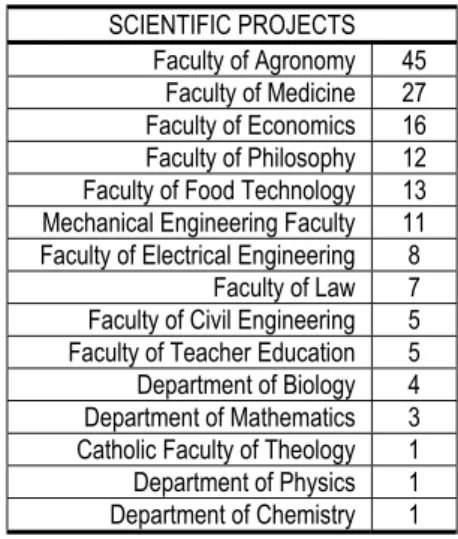
In the academic year 2009/2010, 159 scientific projects approved by the Ministry of Science, Edu-cation and Sports were carried out at scientific-teaching components of the University (Table 1).
Table 1 Overview of scientific projects at scientific-teaching organizational units of the University
SCIENTIFIC PROJECTS Faculty of Agronomy 45
Faculty of Medicine 27 Faculty of Economics 16 Faculty of Philosophy 12 Faculty of Food Technology 13 Mechanical Engineering Faculty 11 Faculty of Electrical Engineering 8
Faculty of Law 7 Faculty of Civil Engineering 5 Faculty of Teacher Education 5 Department of Biology 4 Department of Mathematics 3 Catholic Faculty of Theology 1 Department of Physics 1 Department of Chemistry 1
3.3. International Cooperation an Inter - University Cooperation
International cooperation and inter-university co-operation at the University of Osijek has been achieved within the framework of bilateral coop-eration with European universities, according to the signed Treaty of International Cooperation. At present, 31 Treaties of International Cooperation have been signed at the University level. Member-ship in international associations, such as the European University Association (EUA), Rectors’ Conference in the Alps-Adria region and the Da-nube Rectors’ Conference (DRC), obliges the rep-resentatives from the University of Osijek to ac-tively participate in international meetings that are thematically related to dynamically including higher education institutions into European research ac-tivities. Furthermore, with the aim to efficiently respond to the challenges of general internationali-zation in science and education, the international activities of the University of Osijek have been re-alised within the mobility programme (Erasmus), by participating in international scientific and re-search projects, as well as in activities of post-graduate European Studies of the University of Osijek.
The intensification of bilateral international co-operation in the next period is one of the priorities in the development of the University of Osijek. Its goal is to increase the level of international recog-nisability that will be achieved by participating in the programmes of the European Commission with scientific and research projects, programmes of cross-border cooperation and mobility pro-grammes.
4. Conclusion
When speaking of improvements, i.e. the necessary changes in Croatian higher education, we have to start from the quality level of the former education system. The higher education system in the Repub-lic of Croatia has experienced a profound change and now it will take a certain amount of time to complete the harmonization of the entire system with the European system of higher education. The quality assurance system at the University of Osijek is undoubtedly an important segment of the overall reform of Croatian higher education (the Bologna process), and the reform at the University od Osi-jek itself. Quality assurance system is a kind of benchmarking for universities, based on compari-sons of performance at our University with per-formance at leading or our partner universities.
The findings show clearly where the major problems and deficiencies are, and which changes and improvements are necessary. These changes and improvements, carried out through the quality assurance system as a benchmarking tool, have to be based on self-evaluation, resulting in the Uni-versity's advancement and enhanced competitive-ness. Benchmarking is not a one-time assessment of the situation at the university; rather, it is a con-tinuous process that can be implemented in differ-ent ways.
The use of knowledge in order to revolutionize both traditional and advanced sectors of the econ-omy requires a radical change in the development policies. The economy continues to depend on foreign loans and knowledge imports since struc-tural reforms are not undertaken which should cre-ate knowledge-based manufacturing and service sectors. In this way the vicious circle of indebted-ness, unproductive spending, techno-logical lagging behind, reduced investment into research and de-velopment is perpetuated and spread, covering in concentric circles an ever larger number of social actors.
Future analyses need to focus on the socio-cultural and value-driven aspects that determine the behaviour of social actors and thus impact the
creation of social and economic environment in which the knowledge society concept can and must be the driving force behind necessary reforms.
References
Barišić, Z. (2010). Monography - Josip Juraj Strossmayer University ofin Osijek. Osijek: Josip Juraj Strossmayer University in Osijek.
European Commission. (2002, February 2). The Role of the Universities in the Europe of Knowledge. Retrieved September 11, 2012 from European Commission:
http://eur-lex.europa.eu/LexUriServ/LexUriServ.do?uri=COM:2003:0058:FIN:en:pdf Josip Juraj Strossmayer University in Osijek. (2006). Strategy for the
Establishment and Improvement of Quality on J.J. Strossmayer University in Osijek. Retrieved December 9, 2006 from Josip Juraj Strossmayer University in Osijek: http://www.unios.hr/kvaliteta
Lamza-Maronić, M., & Glavaš, J. (2008). Poslovno komuniciranje. Osijek: Studio HS internet, Faculty of Economics in Osijek.
Lamza-Maronić, M., Glavaš, J., & Kolar, J. (2010). Application Possibilities of Knowledge Management in Learning System Development. Paper presented at the 2nd Scientific Conference – Management, education in tourism (pp. 1237-1244). Portorož: Fakulteta za turistične študije. Švarc, J. (2011). Hrvatska u gospodarstvu znanja – o čemu govorimo? Društvena istraživanja, 20 (4), 919-942 .
Maja Lamza Maronić
University of Osijek Faculty of Economics in Osijek Gajev trg 7 31000 Osijek Croatia Email: [email protected] Jerko Glavaš University of Osijek Faculty of Economics in Osijek Gajev trg 7
31000 Osijek Croatia