Policy Reoearch I
WORKING PAPERS
W-S
a
3Internatlonal Trade
International Economics Department The World Bank
October 1992 WPS 994
Textiles and Apparel
in NAFTA
A Case of Constrained
Liberalization
Geoffrey Bannister
and
Patrick Low
The paper examines the changes Mexico's textile and clothing industry is likely to face under NAFTA.
PolicyRcaechWoing peadiseminatefindingsofwotkinpmgrssandaccowngctheoe chngeofidcaamgnBkstaffand aIo hinthWcdindevelpgncatissuslesccpapcra distibutedbythcReearchAdvisoyStaff.curytienamesofthcuuor.reflcct only tirviews.and shouldbusid and acitdac cTdiney.hefindings.in crotaions,andconclwuions aeheauthoieown.Theyshould
not bc ibuted to the Wodd Bank, its Board of Diectors, its management, or any of its membcrcontrics.
Public Disclosure Authorized
Public Disclosure Authorized
Public Disclosure Authorized
Polley Research
International Trade WPS 994
This paper-a product of the Intemational Trade Division, Intemational Economics Department-is part of a larger effort in the department to analyze the effects of trends toward growing regionalism in interrational trade. Copies of the paper are available free from the World Bank, 1818 H Street NW, Washington, DC 20433. Please contact Aban Daruwala, room S7-042, extension 33713 (October 1992,43 pages).
Bannister and Low examine the changes that and apparel exports to the United States fall Mexico's textile and clothing industry is likely to under production-sharing programs, with an face under the North American Free Trade average 69 percent of value added of U.S. origin. Agreement (NAFTA). They compare pre- Only 15 percent of inpilt ri.quirements for the NAFTA and probable post-NAFrA scenarios for other 47 percent of trade is imported into Mexico Mexican exports. The U.S. clothing and textile -only 8 percent from non-NAFTA countries.
industry is likely to remain among the most
protected of U.S. industries, so this is essentially What about future trade? Bannister and Low a comparison of two protectionist situations, not estimate that these Mexican exports to the of protection and free trade. United States will increase only
modestly-partly because of the low level of protection Bannister and Low trace how current quota already associated with production-sharing and tariff restrictions on U.S. imports from arrangements. Rules of origin will not restrict Mexico will be replaced by rules of origin trade expansion.
designed to protect U.S. industry. Mexican
textile and clothing exports will enjoy greater The additional costs to the Mexican con-access to the U.S. market if most inputs originate sumer of adopting rules of origin under the
in North America. NAFTA are small.
Under the triple transformiation requirement, How much investment from outside North for example, a cotton shirt would have to be America will be attracted to Mexico under made in the NAFTA region from yam and fabric stringent input-sourcing requirements is open to of NAFTA origin. Mexican compliance with this question. The competitiveness of Mexico's rule would not prove onerous. Proximity and apparel industry in non-NAFTA markets will long-standing production-sharing arrangements depend to some extent on the intemational have made Mexico heavily dependent on U.S. competitiveness of the U.S. textile industry. inputs. Roughly 53 percent of Mexican textile
ThePolicy Research WoTking PaperSeries disseeinates the workunder indinpof wayCin theRank Anobjecdveof the series is to get these findings out quickly, even if presentations are less than fully polished. 'Me fmdings, interpretations, and conclusions in these papers do not necessarily represent of ficial Bank policy.
Textiles and Apparel in NAFTA
A Case of Constrained Liberalization
by
Geoffrey Bannister and Patrick Low*
* International Trade Division, World Bank. The authors wish to thank Naomi Freeman for useful
discussions, Santiago Levy and Sweder van Wijnbergen for data and helpful discussions on an earlier draft, and Christopher Holmes for valuable research assistance.
List of Tables
1. Barriers Against U.S. Imports of Textiles and Apparel from Mexico, 1990.
2. U.S. Imports of Textiles and Apparel from Mexico, 9802 and Non-9802 Flows, 1990.
3. Intermediate Input Requirements for Non-9802 Exports.
4. Imported Input Requirements for Non-9802 Exports, And Their Region of Origin.
5. Trade Creation and Trade Diversion Effects.
6. Trade-Weighted Tariff Averages for Textiles and Apparel, Mexico and U.S., 1990.
7. Comparison of Consumer Dead-Weight Loss from Mexico and U.S. Tariff Structures, 1990.
Al. U.S.-Canada Rules of Origin for Textiles and Apparel. A2. Trade Creation and Trade Diversion Effects: Sensitivity
Analyses.
A3. NAFTA Imports of Textiles and Apparel from Leading Suppliers, 1990.
List of Figures
1. Value of U.S. Imports of Apparel from Mexico Under the MFA, 1987-1990.
2. Value of U.S. Imports of Textiles and Apparel from Mexico, 1990.
I. INTRODUCTION
The North American Free Trade Agreement (NAFTA) will not lead to free trade in all goods between Mexico, Canada and the United States. Trade barriers that already exist in a number of
"sensitive" sectors will most probably be maintained through restrictive arrangements under the NAFTA. A particular case is the textiles and clothing sector, which has long enjoyed special protection in the United States and Canada, at levels significantly above the average. Mexico is one of approximately 40 countries whose exports of textiles and apparel face quota barriers in the United States market.' Maintaining quotas on textiles and clothing exports from Mexico will be inconsistent with NAFTA principles; some alternative arrangement will be required. This will involve a careful definition of the trade that qualifies for barrier-free treatment. Rules of origin, designed to ensure a high proportion of domestic (within NAFTA) content for products traded freely across NAFTA borders, will be the principal instrument for identifying eligible exports. If NAFTA content is insufficient, exports will be treated as
if they originate outside the region, and be subject to tariffs and/or quotas.
This paper analyzes the implications of a NAFTA for U.S.-Mexico trade in textiles and apparel by comparing the pre- and possible post-NAFTA policy regimes. The analysis focuses exclusively on trade between Mexico and the United States. It asks whether there are additional benefits to Mexico's textiles and apparel sector from arrangements based on rules of origin, as compared to current arrangements that rely on tariffs and quotas. We examine three aspects of anticipated policy changes. First, we review the salient characteristics of the rules of origin regime likely to replace tariffs and
I The principle instrument for restricting trade in textiles and clothing is the Multi-Fiber Arrangement (MFA), a multilaterally negotiated departure from normal GATT disciplines that permits developed countries to apply quotas on imports of a wide range of textiles and apparel items
2
-quotas. The obvious advantage for Mexican industry of moving from the present quota and tariff regime to rules of origin is that production using within-NAFTA inputs will enjoy free access to the American market. A potential cost, however, is that rules of origin maintain some protection for the U.S. textile
industry and restrict possible gains in Mexico from access to non-NAFTA imports. In addition there is the possibility that duty drawbacks, (exemptions from duty for extra-regional inputs for use in Mexico's maquiladora industry), will no longer be available for Mexican exports qualifying for NAFTA treatment. We examine the restrictiveness of rules of origin, given present trade flows and sourcing patterns for Mexican exports, and find that they will not prove onerous for the majority of Mexican exports as they stand today.
What about future trade flows? We calculate the trade creation and trade diversion effects for Mexican trade of moving from the existing quota and tariff regime to free trade. These calculations are linear projections,ond they do not account for any complications introduced by rules of origin. Nevertheless they illustrate that effective trade barriers to Mexican exports in the U.S. are already very low, due to the high level of U.S. content already embodied in these exports. As a result, the trade increase from the removal of these barriers is moderate, and over 50 percent of this increase will take place in exports that currently enter the U.S. market under production sharing arrangements.2 These exports already enjoy a high leve! of U.S. content. Our conclusion is that rules of origin will not significantly restrict these increases in trade either.
Finally, we examine the implications of the NAFTA rules of origin regime for Mexican consumers. We compare the rules of origin to a customs union with a common external tariff, set at U.S. levels of protection. The NAFTA negotiations have never contemplated establishing such a customs union, but it is a useful point of reference from which to examine the benefits of rules of origin. Under
2
Production sharing arrangements refer to imports entering the U.S. under heading 9802.00.80 of the Harmonized Tariff Schedule of the United States (HTS) under which imported that were assembled abroad using fabricated, U.S.-manufactured components are subject to duty only on that part of value added in the foreign country.
3
-a free tr-ade -agreement rules of origin -are superior to -a customs union if they -allow consumers to benefit from lower tariffs. In this case, any benefit accruing to Mexico will depend on Mexican tariffs being lower than U.S. tariffs (assuming that the common external tariff was set at U.S. levels of protection). We compare the dead-weight loss resulting from U.S. tariffs to that of Mexican tariffs, and find the difference to be negligible. This means that the additional benefits, beyond NAFTA liberalization, from rules of' origin over a common external tariff are correspondingly small. Additional benefits to Mexican consumers from access to non-NAFTA inputs will depend on lowering Mexican tariffs.
4
-II. THE U.S. TRADE REGIME AND TRADE FLOWS 3. trade policy
Four policy instruments control textile an1 clothing imports from Mexico into the United States: most-favored-nation (MFN) tariffs, the Multi-Fiber Arrangement (MFA), and two additional provisions, one controlling tariffs and the other quotas. MFN tariffs on textiles and clothing are higher than the average on all products. The trade-weighted average most-favored-nation (MFN) tariff is 18 percent for apparel, 9 percent for made-ups, 9 percent for fabrics, and 11 percent for yarns (Table 1). For the textiles and clothing sector as a whole, this amounts to an average tariff of 14 percent. The comparable tariff for U.S. industry is less than 5 percen:.
Textiles and clothing have also been subject to quantitative restrictions at least since the 1950s, but the Multifiber Arrangement (MFA), the principle instrument for restricting textile trade, first came into being in 1974 (Cline, 1987). The MFA allows industrialized countries to negotiate quantitative restrictions on specific textile and clothing items with individual developing exporting countries. Authority also exists under the MFA to apply unilateral restrictions in the absence of agreement. The MFA has been used exclusively by industrial countries to restrict the exports of developing countries, although it is the exporters who adrninister agreed restrictions and supposedly enjoy the associated quota rents.3 The MFA has been justified as a temporary exception to normal GATT trade disciplines. Nevertheless, it has been renewed three times, and the current arrangement, MFA IV, is due to expire on December 31, 1992.
'Note that Japan is the only industrial country which has MFA quotas impos d on its exports of textiles and apparel, and that the U.S. is the only country which imposes MFA quotas against Japan.
.5
-Table 1. Barriers Against Mexican Exports of Textiles and Apparel to the U.S., 1990
MFA MFA
Effective Normal Regime Special Regime MFN Tariff Rates* QucGa Utilization Quota Utilization Tariff Rates 9802 Imports Rates Rates
Apparel 18.3 6.5 60.0 63.1
Made-Ups 9.0 n.a. 68.3 n.a.
Fabric 8.9 n.a. 97.8 n.a.
Yarn 10.6 n.a. 40.2 n.a.
Total 14.0 6.5 43.6 63.1
Source: World Bank computer files on the MFA and U.S. Department of Commerce data. *Effective Tariff Rates on 9802 imports are equal to the MFN tariff times the share
6
-Members of the MFA have committed on paper to make the agreement less restrictive. There is an obligation under MFA IV to expand the quotas by at least 6 percent per annum, with certain exceptions, including woollen items, where a I percent expansion is envisaged. In addition, certain mechanisms are available for carrying quotas over from one period to anothet and for borrowing from the quota of a subsequent period. In practice, the MFA has become increasingly restrictive, covering
a greater proportion of world textile and apparel trade at each renewal (Erzan et al., 1990).4
The additional special textiles and clothing provisions developed by the United States build on the MFA and MFN regimes, but offer more favorable access to the U.S. market in exchange for the use of U.S. inputs in production. These are part of production sharing provisions in the United States, covered by Harmonized Tariff Schedule (HTS) subheadings 9802.00.60 (certain metal products. and 9802.00.80 (miscellaneous products, including textiles and clothing).5 These provisions levy duties only
on value added outside the United States. They accounted for 16 percent of total U.S. imports in 1989, compared to 10 percent in 1986 (USITC 2365, 1991). The average duty actually paid on clothing items from Mexico under HTS 9802.00.80 was 6.5 percent in 1990 (Table 1), little higher than the average for all products imported into the United States (U.S. Department of Commerce, 1990).
Textile and apparel imports with high U.S. content also enjoy liberal quota provisions under a program known as the Special Regime.6 The Special Regime effectively eliminates quotas under the
MFA for apparel assembled in Mexico from fabric cut and formed in the U.S. Although Special Regime trade flows are a subset of those entering under HTS 9802.00 provisions, the test for eligibility for the Special Regime quota exemption is more stringent than that for 9802.00, since the latter only requires
4 There are proposals in the Uruguay Round that would eliminate the MPA in three phases over ten years.
I The arrangements under HTS 9802.00.80 used to be known as the 807 regime under the TSUS system of tariff nomenclature. The 807 regime was introduced in 1963.
7
-the cutting to take place in -the U.S. Although Special Regime quotas are often filled, -they are effectively non-binding, as evidenced by utilization rates of over 100 percent in some MFA categories in recent years.
Mexico's MFA quotas are distributed between the Special Regime and all othei textiles and clothing exports, including the HTS 9802.00.80 regime. Increasingly, quotas have been concentrated in the Special Regime category. Many quotas on non-Special Regime items remain unfilled, particularly in apparel, made-ups and yarn , while restrictions on fabric exports appear to be more binding (Table 1).7 Within each of these aggregates there can be significant variation in quota utilization rates. In the apparel sector, for example, quotas were binding throughout the 1980s on only three export items --trousers, men's underwear and woven shirts. In addition to special status under production sharing arrangements with U.S. producers, apparel assembly operations in Mexico receive duty drawbacks under the Maquiladora program. Duty drawbacks give preferential tariff treatment to inputs imported into Mexico from non-NAFTA sources solely for the production of exports. In the NAFTA negotiations, the U.S. is concerned that duty drawbacks will give maquiladoras an unfair advantage over U.S. owned firms exporting to the U.S. market outside the Maquiladora program. To safeguard against this, the NAFTA contemplates the phase-out of all duty drawbacks, and other exceptions to tariff provisions between the U.S. and Mexico, at the same time that regular tariff barriers are lowered.
7 A quota is considered binding when the utilization rate (shipments as a percentage of what the quota will allow) is above
Figure 1: Value of U.S. Imports of Apparel
from Mexico Under the MFA, 1987-1990
Imports (Current US$ Mn)
/ Special Regime Imports
Imports Under HTS 9802.00.80
Source: World Bank compurTotal Imports Under
Lithe
MFA 600 **.*~*~ . 500 400 300 200 100~~~~~~~~~~~~~~~~~~~~~~~~~~~~~~~~~~~~~~~~~~~~~~~~~~~~~~~~~~~~~~~~~~~~~~~~~~~~~~~~~~~~~~~~~~~~~~~~~~~~~~~~~~~~~~~~~~~~~~~~~~~~~~~~~~~~~~~~~~~~~~~~~~~~~~~~~~~~~~~~~~~~~~~~~~~0 0~~~~~~~~~~~~~~~~~~~~~~~~~~~~~~~~~~~~~~~~~~~~~~~~~~~~~~~~~~~~~~~~~~~~~~~~~~~~~~~~~~~ 1987 Vas8 1989 1990-9
-Mexico has enjoyed increased access to the U.S. market over the last few years, through quota growth and reduced effective tariff rates under HTS 9802.00.80 and the Special Regime, but in exchange for importing inputs from the U.S. Within the textile and apparel sector, apparel exports have grown the most, more than doub!ing from US$ 300 million in 1985 to over US$700 million in 1990. Figure 1 shows the distribution of U.S. apparel imports under the MFA from Mexico between 1987 and 1990. The vast bulk of apparel imports come in under the HTS 9802.00.80 regime, and under the Special Re,>4me.
Figure 2 shows trends for all textiles and appare! imports from Mexico in 1990, not just MFA trade. Again, the predominance of apparel in Mexican exports to the United States is clear. Almost 70 percent of all Mexican textile and clothing exports were apparel items in 1990, and a further 10 percent were made-ups and miscellaneous items. The figure also shows that some US$265 million (or 28 percent) of Mexico's exports to the United States are not covered by the MFA. This non-MFA trade consists of some yarns, but is mainly apparel, made-ups and miscellaneous items.
There is some complementarity between the Mexican and U.S. industries, which has been encouraged by the design of the U.S. quota and tariff regime. The U.S. apparel industry has been squeezed by imports over the years (Lande, 1990), whereas the textile (mill) sector has done much better. In Mexico, by contrast, much of the mill sector has suffered from high costs, outdated technology, poor quality, prolonged machine down time, and excess capacity. It has been estimated that textile mill production costs are between 25 percent and 150 percent higher in Mexico than the United States (Botella et al., 1990). The apparel sector, however, has enjoyed vigorous growth, particularly through exports
Figure
2:Value of U.S. Imports of
Textiles and Apparel from Mexico, 1990
1,200
_ g3 0 Apparel $943.6
1,000
M_de- ups & Misc. Fabric ZT800 MaRn$678.5 adCommreDprmn aa 0) 4 00 $496.6
20
0Total Imports MFA HTS 9802.00.80 Special Regime
Source: World Bank computer files on the MFA and Commerce Department data.
I1
-to the United States (Figure 1). Labor intensive operations in apparel manufacture have increasingly located in Mexico in order to take advantage of low wages relative to industrial country levels (Bailey and Eicher, 1991). Mexico is estimated to have a 30 to 50 percent production cost advantage over the United States in apparel finishing operations (Botella et al., 1990).
While the distinction between the mill and apparel sectors does not perfectly capture the competitive positions of Mexico and the United States, it does demonstrate a clear pattern. Only 18 percent of U.S. textiles and clothing exports in 1990 were apparel. By contrast, the comparable figure for Mexico was 67 percent. Some in favor of NAFTA argue that this complementarity will facilitate effective North American competition against Asian suppliers (USITC 2326, 1990). Whether or not there are competitive gains to be reaped from closer integration of the Mexican and U.S. textiles and apparel sector, the firm intention of U.S industry is to maintain arrangements that ensure a large share of U.S. yarn and fabric inputs (involving spinning, weaving, knitting and fabric finishing) into Mexican export production. New trading arrangements under NAFTA are likely to have negative consequences for the U.S. apparel industry, which have to be weighed against gains in the textiles sector.
For its part, Mexico seems willing to accept certain sourcing obligations with respect to the inputs into its intra- NAFTA exports, in return for unrestricted access for its apparel exports, as well as for sales of any non-apparel items such as acrylic yarn, polypropylene yarn, denim and cotton sheeting in which the country appears to have a competitive advantage (USITC 2353, 1991). Reluctance on Mexico's part to allow the uncompetitive part of its textiles industry to face North American competition may have been addressed to some extent through Mexico's autonomous program of trade liberalization over the last four or five years. It is likely, however, that significant new investments will be required in Mexico's textile sector to make it internationally competitive. Moreover, it should be noted that a weak link in Mexico's production chain is fabric finishing and dyeing, which makes it difficult for Mexican fabrics to be used
- 12
-Overall, the Mexican industry has concentrated increasingly on labor-intensive finishing operations for apparel and other made-up textile articles, carried out on U.S. inputs. This characteristic of the Mexican textiles and apparel industry makes it possible to establish the kind of rules of origin regime discussed in the next section without provoking significant structural changes in trade patterns.
- 13
-III. A NAFIA REGIME FOR TEXTILES AND CLOTHING Rules of Origin
Bringing Mexico within a more or less unified textiles and apparel market under NAFTA will require replacing existing tariffs and quotas with rules of origin. In the absence of rules to determine the definition of domestic content, Mexico could become a transit point, or export platform, for textile and clothing sales by non-NAFTA members into the United States. NAFTA rules of origin will be modelled on the existing rules between Canada and the United States, but possibly with some key differences. The basic criteria for the Canada/U.S. rules of origin are not complex. It is their detailed application at the tariff line level that renders their effects obscure. Broadly speaking, there are two approaches to origin rules. One relies on a value added criterion: origin is conferred on a product if more than a specified percentage of its value added is of domestic origin. The other defines changes in tariff nomenclature headings through which a product must pass to attain domestic status.
The United States has traditionally favored the value added criterion, but moved towards international conformity by adopting nomenclature heading in the Canada/U.S. Free Trade Agreement. Under this agreement, there are 146 separate rules, expressed at varying levels of disaggregation, from single chapter headings down to six-digit classifications. These rules are supplemented by value-added criteria when they do not guarantee sufficient transformation. The supplementary rules require that at least 50 percent of the value added of the product is of within region origin.
The value-added criteria can be readily understood in terms of an accounting exercise that determines which inputs are local and which are foreign, but its interpretation leaves room for discretion on the part of customs authorities and creates uncertainty for traders. This discretionary element partly explains why nomenclature change is preferred. In addition, detailed information on production processes is essential to an analysis of a rule of origin based on value added criteria. Arn understanding of rules based on the nomenclature change only requires good knowledge of tariff headings along production
-14-chains.
The concept of substantial transformation is crucial to rules of origin. Under the nomenclature change criterion, there can be simple or multiple transformation. Simple transformation is generally associated with a single tariff heading jump, reflecting the fact that manufacture has taken place within the preferential trading area. Double transformation requires that inputs into final production also have to pass the origin test. Triple transformation extends the origin test back to the previous stage in production. Double and triple transformation rules are generallv ^ssociated with two and three changes in tariff classifications respectively.
In textiles and clothing, under simple transformation, origin will be conferred if apparel to be exported was cut and stitched within the region. Double transformation will require apparel to be cut and stitched in the region from fabric also formed within the region. Triple transformation will require that all production from yarn forward take place within the region.8 A simple or multiple transformation criterion could apply to fabrics in the same way that it applies to apparel. It is possible to specify quadruple transformation for apparel by going back to the fiber stage, depending on whether spinning or preparing yarn is senarable in the production process from fiber production.
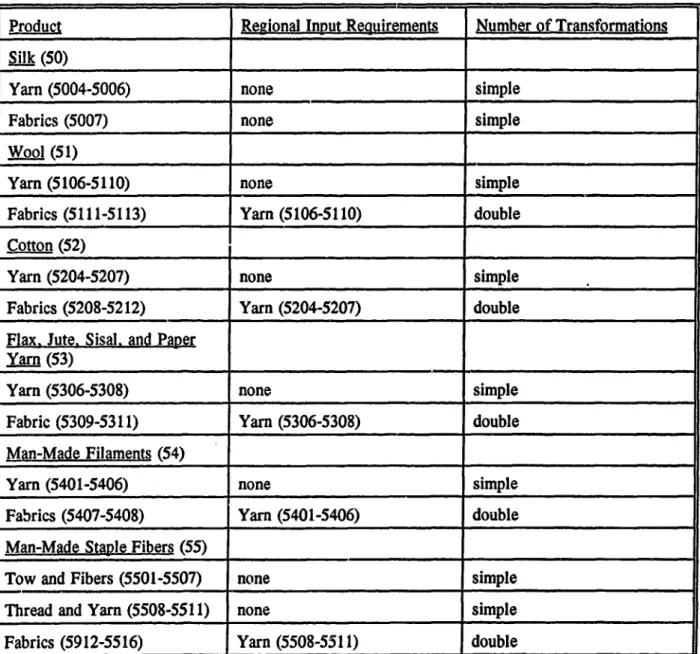
Appendix Table Al sets out the existing U.S./Canada origin rules in textiles, indicating the number of transformations required at various stages of production. The system relies primarily on simple and double transformation. Triple transformation might be required where end products do not involve a high degree of processing, so that both fabric and yarns must be of regional origin.
Two special tariff quotas are also included in the Canada/U.S. arrangements, allowing limited exemptions from the standard transformation requirements for inputs that are in scarce supply in the North American market. Since tariff quotas will almost certainly be a feature of the NAFTA origin rules on textiles and clothing, it is worth examining them briefly. One of these applies to wool and non-wool
- 15
-apparel cut and sewn within the region, but from fabrics not formed in the region. The other is a special tariff quota for Canada, involving non-wool fabric production from yarn produced or obtained outside the region up to an annual amount of 30 million square yards. This tariff quota permitting Canada to make fabrics for export from imported yarns is due to expire on December 31, 1992. The tariff quotas on apparel and fabrics are supposed to be revisited if circumstances change. According to early drafts of the NAFTA text, certain cut or "non-finished" fabrics will be subject to tariff quotas at varying levels depending on their fiber makeup.
The Restrictiveness of Rules of Origin
We first examine how restrictive rules of origin are likely to be for U.S.-Mexico textile and apparel trade based on the imported input content of present trade flows. As mentioned above, the high level of integration that already exists between U.S. and Mexico in the production of textiles leads us to suspect that imposing rules of origin will have little effect. We begin by examining the less stringent requirement of double transformation. The rules of origin established under the Canada/U.S. FTA generally require double transformation within the NAFTA region ("fabric forward" for apparel and "yarn forward" for fabrics), although the rule for non-apparel final goods may extend as far back as yarn in some cases. Special regime imports will certainly qualify for within-region status under such a double transformation requirement, since the fabric and apparel stages in the production chain occur within the NAFTA. These imports account for 31 percent of total U.S. imports of textiles and apparel from Mexico in 1990 (Figure 2).
Of the remaining 69 percent of Mexican exports, 22 fall under the HTS 9802 provisions. These trade flows need only satisfy a simple transformation criterion to qualify for preferential tariff provisions, since the fabric used to produce them need only be cut in the U.S., but may be of imported origin. There are at least two reasons, however, for arguing that they satisfy double transformation. First, a significant amount of trade entering under preferential arrangements (HTS 9802.00), but not under the Special
- 16
-Regime, could qualify for Special Regime treatment (Lande, 1990). This trade is not declared under the Special Regime because of a perception that it is advantageous to keep the less restrictive Normal Regime quotas open by continuing to use them. The difference between the Special and Normal Regime HTS 9802.00 flows cannot, therefore, be taken as a strict indicator of less within-region input sourcing.
Second, very little U.S. textile consumption is imported. In 1990, for example, only 10 percent of all U.S. textile consumption consisted of imports, and some of these were from Canada and Mexico (American Textile Manufacturers Institute, 1991). It is thus not likely that the fabrics from which HTS 9802.00 apparel is manufactured originate outside the region to any significant degree. As far as HTS 9802.00 trade is concerned, then, there are good reasons to suppose that existing trade flows will not encounter many problems in meeting a double transformation rule of origin requirement.
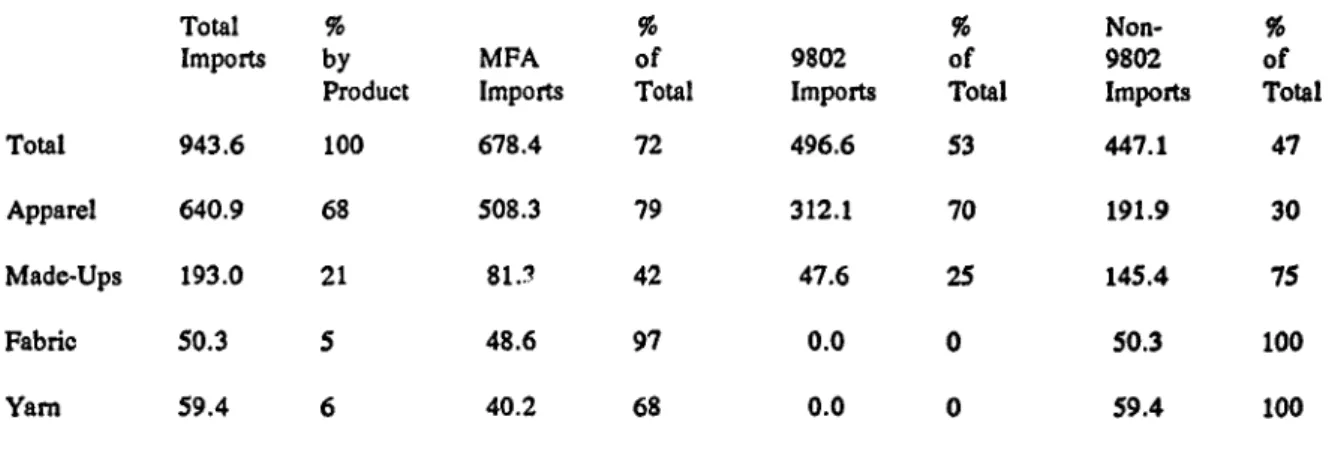
What about non-HTS 9802.00 trade, which account for the remaining 47 percent of Mexico's exports of textiles and clothing to the United States? There is no guarantee that this trade will even satisfy a simple transformation requirement. In 1990, these flows were mainly apparel (43 percent) and made ups and miscellaneous items (32.5 percent), with the remaining 25 percent split evenly between fabric and yarn (Table 2). To assess the effects of rules of origin on these flows, an estimate must be made of their imported input requirements. For this purpose, we used the Mexican 1985 input-output table updated to 1989, together with the results of the 1989 Mexican Annual Survey of Manufactures, which has detailed information on the proportion of inputs imported and their source countries.9
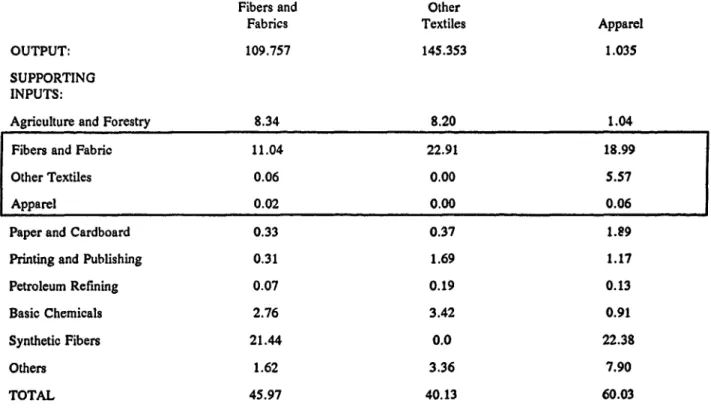
The results of this exercise are reported in Table 3. Exported output in the first row includes US$ 109.7 million of fibers and fabrics, US$192 million of apparel and US$145.3 million of other textiles (made ups and miscellaneous). These figures are taken from the last column of table 2. In order to produce this flow of exports, intermediate inputs from all industries worth US$146.1 million were
I Because of the definitions in the Mexican production classification, we aggregated fiber and fabrics into one sector, leaving apparel and other final textile goods as additional sectors.
- 17
-required: US$45.9 for Fiber and Fabric, US$40.1 for Other Textiles, and US$60.0 for Apparel (bottom row of Table 3). Fiber and Fabrics and Synthetic Fibers made up the majority of inputs into the three industries.
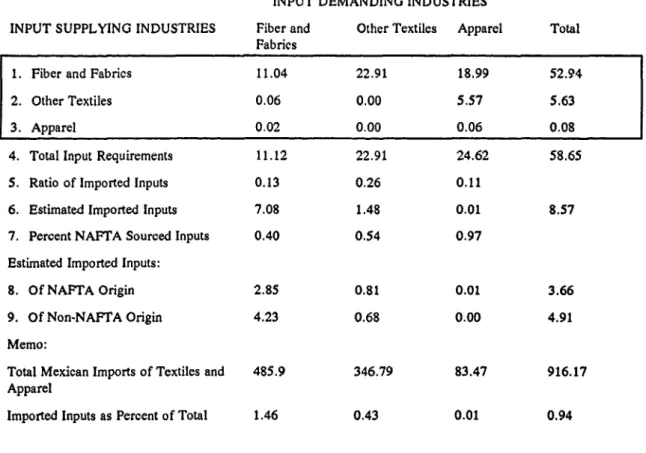
Table 4 shows our estimates of the proportion of imported inputs of textiles and apparel required to produce the above flows of exports, and their origin. The first four rows of Table 4 are a matrix of textile and clothing input requirements for Mexican textile and clothing output, taken from the corresponding rows of Table 3. The fifth row indicates the ratio of importedinputs to total inputs taken from the Mexican annual survey data. Subsequent rows show calculations of what these numbers mean in terms of 1990 imports into Mexico.
Two significant points stand out from the results. First, a relatively small proportion of inputs in these industries is imported: 13.3 percent for fiber and fabric, 26.3 percent for apparel, and 10.5 percent for other final textile goods. Together, these represent less than 1 percent of Mexico's actual 1990 imports of textiles and clothing. Second, a large proportion of imported inputs came from NAFTA countries, and will therefore qualify under origin requirements. The relevant shares were 40.2 percent for fiber and fabrics, 54.3 percent for apparel, and 97.2 percent made ups and other textile products. The remaining non-NAFTA imported inputs make up less than one percent of total Mexican imports of textiles and apparel. These are the very imports that will be affected by the imposition of double transformation rules of origin. Based on the above, the imposition of a double transformation rule of origin on Mexico's exports to the United States will have a limited effect on Mexico's pattern of intermediate input use. Any resulting shift in this pattern towards regional input sources brought about by the NAFTA could probably be achieved with relative ease. These results also have implications for duty drawback negotiations, suggesting that they are not as important an issue in the textiles and apparel sector as they might be in other industries.
- 18
-Table 2. U.S. Imports of Textiles and Apparel from Mexico 9802 and Non-9802 Flows, 1990
(Millions Current U.S. dollars)
Total % 9 % Non- %
Imports by MFA of 9802 of 9802 of
Product Imports Total Imports Total Imports Total
Total 943.6 100 678.4 72 496.6 53 447.1 47
Apparel 640.9 68 508.3 79 312.1 70 191.9 30
Made-Ups 193.0 21 81.1 42 47.6 25 145.4 75
Fabric 50.3 5 48.6 97 0.0 0 50.3 100
Yarn 59.4 6 40.2 68 0.0 0 59.4 100
- 19
-Table 3. Intermediate Input Requiremetns for Non-9802 Exports (Millions of Dollars)
Fibers and Other
Fabrics Textiles Apparel
OUTPUT: 109.757 145.353 1.035
SUPPORTING INPUTS:
Agriculture and Forestry 8.34 8.20 1.04
Fibers and Fabric 11.04 22.91 18.99
Other Textiles 0.06 0.00 5.57
Apparel 0.02 0.00 0.06
Paper and Cardboard 0.33 0.37 1.89
Printing and Publishing 0.31 1.69 1.17
Petroleum Refining 0.07 0.19 0.13
Basic Chemicals 2.76 3.42 0.91
Synthetic Fibers 21.44 0.0 22.38
Others 1.62 3.36 7.90
TOTAL 45.97 40.13 60.03
20
-Table 4. Imported Input Requirements for Non-9802 Exports And Their Region of Origin, 1990
(Millions 9f Dollars)
INPUT DEMANDING INDUSTRIES
INPUT SUPPLYING INDUSTRIES Fiber and Other Textiles Apparel Total Fabrics
1. Fiber and Fabrics 11.04 22.91 18.99 52.94
2. Other Textiles 0.06 0.00 5.57 5.63
3. Apparel 0.02 0.00 0.06 0.08
4. Total Input Requirements 11.12 22.91 24.62 58.65
S. Ratio of Imported Inputs 0.13 0.26 0.11
6. Estimated Imported Inputs 7.08 1.48 0.01 8.57
7. Percent NAFTA Sourced Inputs 0.40 0.54 0.97
Estimated Imported Inputs:
8. Of NAFTA Origin 2.85 0.81 0.01 3.66
9. Of Non-NAFTA Origin 4.23 0.68 0.00 4.91
Memo:
Total Mexican Imports of Textiles and 485.9 346.79 83.47 916.17 Apparel
Imported Inputs as Percent of Total 1.46 0.43 0.01 0.94
Source: Input Requirements from Table 3. Ratio of Imported to Total Inputs is from the Mexican Annual Survey of Manufactures data.
21
-What about a triple transformation rule?'" Under such a rule, trade in textiles and. apparel between NAFT,' countries will have to be made from yarn produced within the region. The question, then, is how far Mexican (or U.S.) apparel production relies on imported yarn. Precise data are not readily available. However, Mexican import data for 1990 indicate that only about one- third (35.2 percent) of Mexico's imports of fibers and yarns come from non-NAFTA sources. In addition, Botella et al. (1990) report that only 7 percent of all fiber and yarn consumption in Mexico was imported in 1988 (the latest figure available). This suggests, therefore, that about 2.35 percent of Mexican fiber and yarn consumption comes from non-NAFTA sources (one third of 7 percent) and the triple transformation rule will not prove onerous in terms of current consumption and trade patterns. Moreover, to the extent that problems do arise, such that certain existing trade flows do find themselves on the wrong side of the origin rules, there will be scope for exemptions based on negotiated tariff quotas. The specification of the size and coverage of tariff quotas that exempt Mexican exports from restrictive rules of origin will be an important element in the NAFTA negotiations.
Finally, what of textile and clothing exports from Mexico to its NAFTA partners that qualify neither under the rules of origin nor for favorable treatment under tariff quotas? Investments in the production of non-qualifying textile and clothing items for export are unlikely to be forthcoming unless these exports receive treatment more favorable than that generally available to third parties. The question is whether the existing MFN-cum-MFA regime is retained for these trade flows. A proposal by the American Textile Manufacturers Institute (ATMI) and the American Association of Manufacturers of Apparel (AAMA) seems to envisage a suspension of quotas, provided "acceptable" rules of origin are adopted, although it is unclear whether this refers to all Mexican exports or only those qualifying for duty free treatment. At the same time, there is mention of a safeguard with a snapback mechanism that would
tO Two prominent textile and clothing industry associations have put this position forward in the NAFTA negotiations. The
American Textile Manufacturers Institute (ATMI) and the American Apparel Manufacturers Association (AAMA) have proposed yam forward as the origin rule for the entire sector (ATMI Press Release, October, 1991).
22
-impose further tariffs or quantitative restrictions under certain conditions. Fear of the "export platform" effect is likely to induce the U.S. textile industry to lobby hard against any preferences at all for non-qualifying exports from Mexico.
- 23
-IV. TRADE CREATION, TRADE DIVERSION, AND PREFERENTIAL FREE TRADE While present trade flows will not be significantly affected by the imposition of rules of origin, there is still a possibility that they may hamper future trade increases. We calculated the trade creation and trade diversion effects of going to free access for Mexico's exports to the United States for all of the 138 MFA categories on which Mexico faces restrictions and for non-MFA trade. These calculations were made using the standard partial equilibrium reduced form equations for trade creation and diversion, as modified in Laird and Yeats (1991) to take account of the price effects of nontariff barriers (in this case quotas). In addition, trade flows entering under HTS 9802.00 were treated separately from those entering under the normal regime since these two flows face different effective tariff rates (see Table 1). Details of the calculations appear in Appendix II.
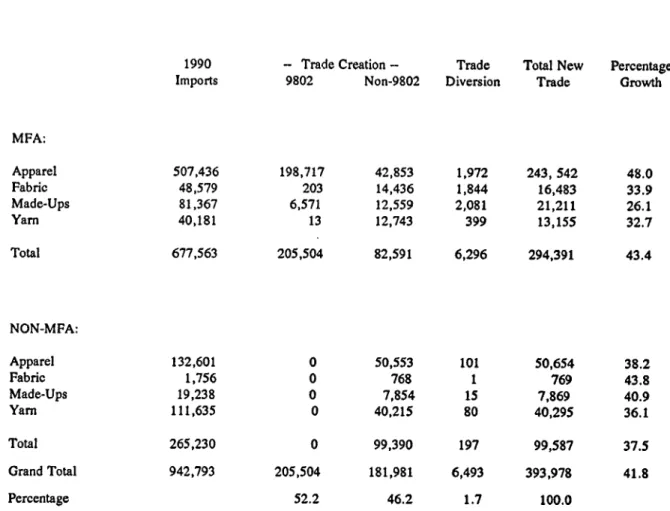
Our least conservative estimates used a compensated import demand elasticity of -3, and an infinite elasticity of supply (set at 99). This resulted in a total growth of Mexico's exports of textiles and clothing to the United States of 42 percent over the 1990 base (Table 5). As relevant, perhaps, as the magnitude of the expansion is the very small part of this total increase that is accounted for by trade diversion. Of the total estimated trade expansion, 52.2 percent came as trade creation previously under HTS 9802.00, 46.2 percent as trade creation under non-preferential trade, and only 1.6 percent was trade diversion. This low figure is explained by Mexico's small share in total U.S. textile and apparel imports (3 percent). It is also significant that over one half of the projected increase came from trade previously under HTS 9802.00 provisions, even though these face significantly lower trade barriers. This leads us to conclude that trade growth under the NAFTA will not be significantly hampered by rules of origin restraints.
24
-Table S. Trade Creation and Trade Diversion Effects Thousands of U.S. dollars
Elasticity of Import -3.00
Demand:
Elasticity of Supply: 99.00
1990 - Trade Creation - Trade Total New Percentage
Imports 9802 Non-9802 Diversion Trade Growth
MFA: Apparel 507,436 198,717 42,853 1,972 243, 542 48.0 Fabric 48,579 203 14,436 1,844 16,483 33.9 Made-Ups 81,367 6,571 12,559 2,081 21,211 26.1 Yam 40,181 13 12,743 399 13,155 32.7 Total 677,563 205,504 82,591 6,296 294,391 43.4 NON-MFA: Apparel 132,601 0 50,553 101 50,654 38.2 Fabric 1,756 0 768 1 769 43.8 Made-Ups 19,238 0 7,854 15 7,869 40.9 Yarn 111,635 0 40,215 80 40,295 36.1 Total 265,230 0 99,390 197 99,587 37.5 Grand Total 942,793 205,504 181,981 6,493 393,978 41.8 Percentage 52.2 46.2 1.7 100.0
25
-As to the size of the projected increase in trade, 42 percent is small, considering that Mexican exports of apparel to the United States more than doubled between 1986 and 1990, notwithstanding the continued existence of tariffs and some binding quotas. As already noted, this is an upper bound estimate. Sensitivity analysis on the elasticities is reported in Appendix Table 2, with demand elasticities of -2 and -1.5, and supply elasticities of 5 and 2. With more conservative elasticity estimates, the trade creation goes as low as 13 percent of 1990 exports.
The relative modesty of the effects of trade liberalization in this sector suggests that barriers to Mexico's textile and clothing exports are not significant. Indeed, effective tariffs have been lowered through the HTS 9802 arrangements, and many quotas are not binding (Table 2). The results also sug7est that if Mexico is to benefit significantly from NAFTA in this sector, it will be through the dynamic effects of trade liberalization. To the extent that those dynamic benefits require new investment, and the rules of origin inhibit new investments from third countries (unless they are tied into North American input sources), there is at least a doubt about the long term benefits of NAFTA in this sector. The extent of these benefits will depend vitally on the supply of North American investment.
-26
-V. EXTRA-NAFTA TRADE PROTECTION IN MEXICO AND THE UNITED STATES In this section we estimate the cost to Mexican consumers of imposing a common external tariff at the U.S. level of protection. Such a tariff might be set in place if Mexico and the United States were to enter into a customs union. Both the Mexican and U.S. textile and clothing industries have suggested that Mexico might consider such an arrangement, restricting its textile and clothing imports from non-NAFTA sources in a similar fashion to the United States." Rules of origin will be preferable to such an arrangement if they allowed Mexican consumers of final goods to enjoy imports from non-NAFTA sources at lower prices. The extent to which this potential gain will accrue under an FTA depends on the difference between the level of the common external tariff and Mexico's independent tariff structure.
Table 6 presents the tariff levels in both countries aggregated using Mexican import weights.12 Mexico's nominal tariffs in the textile and clothing sector in 1990 were slightly higher than U.S. tariffs would have been if applied to Mexican imports. The trade-weighted tariff was 13.7 percent for the United States, and almost 15 percent for Mexico. For apparel, fabric, and yarn, the difference between the two average rates was less than 2 percent. But for made ups the Mexican average tariff is almost double the U.S. level. The final column in Table 6 shows the U.S. effective tariff, adjusted for the price effect of restrictive MFA quotas. The tariff equivalents of quotas reported here are taken from 1987 calculations (USITC 2222, 1989) and should be treated as approximations. The addition of these nontariff barrier equivalents increases the weighted average tariff from 14 percent to 20 percent for the United States. This increase is largely due to restrictions on apparel, and most of the average effective tariffs for fabrics, made ups and miscellaneous goods, and yam are not significantly different from the
" It is important to stress that such an arrangement is not being considered in the NAFTA negotiations. We establish the
possibility he.-e only for the sake of comparison, to highlight the possible benefit of rules of origin to Mexican consumers.
12 This procedure abstracts from the fact that the application of the U.S. tariff structure of Mexico's imports will change
27 -unadjusted rates.
The cost to consumers of imposing either tariff structure can be measured as a percentage of GNP using a common approximation:"3
(1) DWL = 22a^
Y 2
where r = t/(1 +t) and t is the ad valorem tariff rate, af is the fraction of GNP spent on imports of textiles and apparel, and em is the compensated own price elasticity of demand for imports. Our calculations, comparing Mexican tariffs with U.S. effective tariffs including the mark-up effects of MFA quota restrictions, are presented in Table 7 for three values of the elasticity of demand for imports, ranging from -1 to -5. In the extreme case, for an elasticity of -5, the consumer loss from both tariff structures is similar, amounting to close to one percent of GNP. The loss from imposing the U.S. effective tariff is slightly higher because of the higher protection on apparel. However, the difference between the cost of the two structures is minimal. Imposing the U.S. level of protection on Mexican imports in 1990 would have resulted in an additional loss to consumers (beyond that resulting from the already existing Mexican level of protection) of .019 of one percent of 1990 GDP. In the more likely case of an elasticity of demand for imports of -2 the figure is .007 of one percent of GDP.
Although there are some differences between the Mexican and the U.S. tariff structures (including the mark-up effects of quotas) our calculations indicate that the consumer loss from imposing either country's level of protection on Mexican imports is extremely similar. Thus, rules of origin imposed after the NAFTA has taken place will not be significantly superior to the imposition of a
28
-common external tariff at the present U.S. level of protection.'4
Further benefits to the Mexican consumer will depend on lowering Mexican tariffs to non-NAFTA imports.
14 This conclusion should be tempered by the fact that it is not only the level of tariffs, but their variation across products that matters. If we were able to examine effective protection rates, i.e., protection to value added), it is likely that the U.S. tariff structure will be more restrictive than Mexico's, since the variation in U.S. tariffs is much higher (Table 6).
29
-Table 6. Trade-Weighted Tariff Averages for Textiles and Apparel Mexico and U.S., 1990
U.S.
MEXICAN U.S. EFFECTIVE
TARIFF TARIFF TARIFF*
All Trade 14.9 13.7 20.4
Non MFA 3.9 6.0 n.a.
MFA CATEGORIES:
Apparel 20.0 17.8 26.9
Fabric 15.2 15.5 16.9
Made-Ups 19.3 7.7 7.9
Yarn 12.2 10.2 11.1
Note: U.S. averages are calculated using Mexican import weights.
*U.S. effective tariff includes MFA quota premia for 1987 claculated by USTIC 2222( 1989).
Source: Mexican import and tariff data from SECOFI. U.S. Import data form U.S. Department of Commerce, Bureau of the Census.
Source: Mexican import and tariff data from SECOFI. U.S. Import data from U.S. Department of Commnerce, Bureau of the Census.
30
-Table 7. Comparision of Consumer Dead-Weight Loss from Mexico and U.S. Tariff Structures, 1990
(Percent of Mexican 1990 GDP)
Loss from Loss from
Mexican U.S.
Tariff Tariff Difference
Elasticity -1 All Trade 0.187 0.191 -0.004 Apparel 0.077 0.079 4.002 Fabric 0.061 0.061 0.000 Made-Ups 0.014 0.012 0.002 Yarn 0.010 0.010 0.000 Other 0.025 0.029 4.004 Elasticity = -2 All Trade 0.374 0.382 4.008 Apparel 0.155 0.159 4.004 Fabric 0.122 0.122 0.000 Made-Ups 0.029 0.025 0.004 Yarn 0.019 0.019 0.000 Other 0.050 0.057 4.008 Elasticity = -5 AU Trade 0.935 0.954 4.019 Apparel 0.387 0.496 -0.010 Fabric 0.304 0.304 0.000 Made-Ups 0.072 0.062 0.010 Yarn 0.049 0.048 0.000 Other 0.124 0.143 4.020
31 -VI. CONCLUSIONS
Because of reluctance on the part of the United States to reduce the high level of protection of its domestic textiles and clothing industry, trade liberalization benefits accruing under NAFTA to Mexico in this sector will be constrained. Improved access to the U.S. market will be exchanged for commitments on input sourcing that will largely tie Mexico's industry to North American (including Mexican) inputs. Since Mexico only accounts for 3 percent of U.S. imports of textiles and clothing, it is not fear of the inroads Mexico could make into the U.S. market from its existing production base that explains U.S. insistence on input sourcing restrictions. Rather, it is the scope for unrestricted third country investment in Mexico to serve the U.S. market that prompts protection against foreign sourcing.
Rules of origin will replace existing tariff and quota restrictions faced by Mexican textiles and clothing exports to the U.S. market. Unlike the simple transformation requirements facing most products, textiles and clothing exports will have to go through two or three substantial transformation tests. Mexican exports to the United States do not rely to a significant extent on inputs imported from third countries, however, so such requirements will be easily met. Dependence on U.S. input sources has been encouraged for many years under production sharing arrangements, where tariffs are charged only on value that is added outside the United States, and quotas are expanded in favor of products made form U.S. inputs. Any difficulties faced by specific products under multiple transformation origin rules can be dealt with through limited tariff quota exemptions.
The size of the benefit accruing to Mexico under NAFTA as a result of free access to the U.S. market depends in part on existing restrictions, as well as the base from which exports are expanding, and the price elasticities of supply and demand. Under the most optimistic elasticity assumptions, the trade expansion benefits of liberalization are not as great as might be expected, particularly in the light of recent export growth. This is partly because, under the kinds of preferential arrangements mentioned above, Mexico does not face very high barriers on average to its textiles and apparel exports. This
- 32
-suggests that the post-NAFTA restrictive policy regime including rules of origin will not be a significant obstacle to expanding trade. Further, it suggests that if significant benefits do result from NAFTA in this sector, they will be longer term and dynamic in nature, relying particularly on new investments.
The establishment of a NAFTA should thus provide benefits to both Mexican producers and consumers of apparel and textiles. Mexican producers of apparel will have improved access to the U.S. market, which at present absorbs more than half of Mexican exports. Consumers will have unrestricted access to U.S. products, at present the source of 55 percent of imports in the sector. Short-term gains will come from immediate liberalization but these will be relatively modest because trade barriers in this sector are already low. Medium terms gains will come from income growth in the Mexican market, and these will be received by both Mexican and U.S. producers. Long-term gains in international
competitiveness may also be seen from the "rationalization" of the industry as it moves to benefit from the respective advantages of labor cost and technology of each market.
However, these benefits will come at a cost. First, is the disappearance of the long protected indigenous textile industry in Mexico. With the rapid decline in tariff barriers since 1987 the industry is already hard hit. Preliminary estimates put Mexican manufacturing GDP growth at 1.1 percent for 1991, while the textile industry's contribution to output fell by 8.9 percent. It is unlikely that the industry will be able to compete with duty free U.S. textiles after the NAFTA comes into effect. Its salvation will lie with foreign investment and joint ventures with producers possessing competitive technology. In the case of U.S. investment, however, proximity and low trade barriers may imply that there is little incentive for capital flows to replace trade.
Another hidden cost of the NAFTA is the limited access to third party non-NAFTA inputs for consumers and producers in Mexico. While this cost may seem small now, compared to the gains from access to the U.S. market, it may grow higher if NAFTA production becomes relatively less efficient compared to world markets. In the long term, rules of origin and protected markets may discourage
33
-investment in Mexico from non-NAFTA countries and leave Mexican industry tied to U.S. production and technology.
34 -REFERENCES
American Textile Manufacturers Institute, Inc., (1991), Textile Hi-lights, December 1991.
Bailey, Thomas and Theo Eicher, (1991), "The Effect of a North American Free Trade Agreement on Apparel Employment in the U.S." Prepared for the Bureau of International Labor Affairs, U.S. Department of Labor.
Botella, Ovidio, Enrique Garcia C., and Jose Giral B., (1991), "Textiles: Mexican Perspective" inU.S. Mexican Industrial Integration. The Road to Free Trade. Sidney Weintraub, Luis Rubio F. and Alan D. Jones, eds. Westview Press 1991.
Canada, Department of External Affairs, (1988), The Canada-U.S. Free Trade Agreement, Second Edition, Minister of Supply and Services, Ottawa, 1988.
Cline, W. (1987), The Future of World Trade in Textiles and Apparel, Institute for International Economics, Washington, D.C.
Erzan, Refik, Junichi Goto and Paula Holmes (1990), "Effects of the Multi-Fibre Arrangement on Developing Countries' Trade: An Empirical Investigation" in Textiles Trade and the Developing Countries: Eliminating the Multi-Fibre Arrangement in the 1990s, Carl B. Hamilton, ed. The World Bank, Washington, D.C.
Laird, Samuel and Alexander J. Yeats, (1990), "Two Sources of Bias in Standard Partial Equilibrium Trade Models," World Bank, Policy Research and External Affairs Working Paper No. 374. Washington D.C. 1990
Lande, Stephen L. (1991), "Textiles: U.S. Perspective" in U.S. Mexican Industrial Integration. The Road to Free Trade. Sidney Weintraub, Luis Rubio F. and Alan D. Jones, eds. Westview Press 1991.
Sawyer, W. Charles and Richard L. Sprinkle (1988), "Alternative Empirical Estimates of Trade Creation and Trade Diversion: A Comparison of the Baldwin-Murray and Verdoom Models" Weltwirtschaftliches Archiv, Vol 125, 1988 61-73.
United States Department of Commerce, (1990), Office of International Agreements. Expired Performance Reports. Washington, DC, 1991.
United States International Trade Commission, 2222 (1989), The Economic Effects of Significant U.S. Import Restraints, Phase 1: Manufacturing, Report to the Committee on Finance of the United States Senate, Washington, D.C. 1989.
United States International Trade Commission, 2353 (1991), The Likely Impact on the United States of a Free Trade Agreement With Mexico, Report to the Committee on Ways and Means of the United States House of Representatives and the Committee on Finance of the United States Senate, Washington, D.C. 1991. U.S. International Trade Commission, 2326
35
-Harmonized Tariff Schedule Subheadings 9802.00.60 and 9802.00.80, 1987-1990, Washington, D.C. 1991.
36 -APPENDIX I.
Table Al. U.S.-Canada Rules of Origin for Textiles and Apparel (Harmonized Tariff System Classifications in Parentheses)
Product Regional Input Requirements Number of Transformations l
Silk (50) _l ...
Yarn (5004-5006) none simple
Fabrics (5007) none simple
Wool
(51) , __. _. _lYarn (5106-5110) none simple
Fabrics (5111-5113) Yarn (5106-5110) double
Cotton
(52)Yarn (5204-5207) none simple
Fabrics (5208-5212) Yarn (5204-5207) double Flax. Jute. Sisal, and Paper
Yarn
(53)Yarn (5306-5308) none simple
Fabric (5309-5311) Yarn (5306-5308) double Man-Made
Filaments
(54)Yarn (5401-5406) none simple
Fabrics (5407-5408) Yarn (5401-5406) double Man-Made Staple Fibers (55)
Tow and Fibers (5501-5507) none simple Thread and Yarn (5508-5511) none simple Fabrics (5912-5516) Yarn (5508-5511) double
37
-Table Al. (cont.) Regional Input Requirements Number of Transformations Product
Wadding, Felt and Non-Woven Textiles. Twine and Cordaeg (56)
All Products (5601-5609) Yarn and Fabric of Wool, Double or Triple Cotton, or Hard Fibers, or any
Man-Made Filaments or Staple Fibers (5106-5113, 5204-5212,5306-5311, 54 55) Carpets and Other Textile
Floor Coverings (57) l
All Products Except of Jute Yarn and Fabric of Wool, Double or Triple (5701-5705) Cotton, or Hard Fibers, or any
Man-Made Filament or Staple Fibers (except Filament Tow and Fibers) (5106-5113, 5204-
5212,5306-5309,5311,54,5508-5516)
Jute Products (Various) Yarn (but not Fabric) (5310) Simple or Double Special Woven Fabrics (58)
All Products (5801-5811) Yarn and Fabric of Wool, Double or Triple Cotton or Hard Fibers, or any
Man-Made Filaments or Staple Fibers (5106-5113,5204-5212,5306-5311,54,55)
38
-Table Al. (cont.) Regional Input Reguirements Number of Transformations Product
Impregnated. Coated, Covered or Laminated Fabrics (59)
All Products (5901-5911) Fabrics of Wool, Cotton, Hard Double Fibers, Man-Made Filaments,
or Staple Fibers (5111- 5113,5208-5212,5309-.________________________ 53611,5407-5408,5512-5516) Knitted and Crocheted Fabrics
(60) _
All Products (6001-6002) Yarn and Fabric of Wool, Double or Triple Cotton, or Fabric of Hard
Fiber, or any Man-Made Filaments or Staple Fibers
(5106-5113,5204-5212,5309-5111,54,55)
Apparel. Knitted or Crocheted (61)
All Products (6101-6117) Fabrics of Wool, Cotton, Hard Double Fioers, Man-Made Filaments
or Man-Made Staple Fibers (Provided goods are cut or knitted and sewn or otherwise assembled within the region) (5111-5113, 5208-5212, 5309-5311, 5407-5408, 5512-5516,6001-6002)
39
-Table Al. (cont.) Regional Input Requirements Number of Transformations Product
Apparel. not Knitted orl
Crocheltd (62) l
All Products (6201-6217) Fabrics of Wool, Cotton, Hard Double Fibers, Man-Made filaments,
or Man-Made Staple Fibers (Provided goods are cut and sewn within region) (5111-5113, 5208-5212, 5309-5311, 5407-5408,5512-5516, 6001-6002)
Other Made-up Articles (63) l
All Products (6301-6309) Yarn and Fabric of Wool, Double or Triple Cotton, Hard Fibers, or any
Man-Made Filaments or Staple Fibers (Provided goods are cut and sewn within region) (5106-5113, 5204-5212, 5306-5111,
54,
55)40
-APPENDIX H. Trade Creation and Diversion Calculations
For trade flows entering under HTS 9802, trade creation was calculated for each apparel and textile category i as follows:
(2) TC9802i = M9802,-ed- (d a )
(2) ~~~~~~~~~~~~ed
es
where M9082 is the value of the original trade flows entering under HTS 9802, ed is the compensated own price elasticity of import demand and es is the eiasticity of supply, t is the pre- liberalization tariff and N is any price effect of other trade barriers (in this case MFA quotas, when they are binding). w is one minus the U.S. customs ratio presented in the aggregate in Table 4 -i.e. the proportion of value added in Mexico on which the tariff is levied. For flows not under HTS 9802, the same formula was used excluding the w term and based on non-HTS 9802 flows. Trade diversion is calculated weighting the trade creation results by the ratio of imports from the preferred partner (Mexico) to total imports
(Sawyer and Sprinkle, 1988).
It is important to note some of the limitations of these kinds of calculations. First, they do not measure welfare in any sense, only changes in trade flows. Second, they are partial estimnates, capturing nothing of the ripple effects throughout the economy provoked by relative price changes. Third, they are static, building only on existing trade flows and ignoring the dynamic effects of expanded trade. Finally, the trade effect estimates rely crucially on supply, demand and substitution elasticities, most of which are made up. Many more sophisticated models suffer from some of these drawbacks, especially the failure to capture the dynamic effects of trade liberalization and resort to inventiveness for the elasticity estimates. Despite these drawbacks, these estimates provide some indication of likely consequences from trade liberalization.
41
-Appendix Table 2: Trade Creation and Trade Diversion Effects Sensitivity Analysis
(Percentage Increase in Trade Flows)
Elasticity of Supply 99 5 2 Mean Elasticity -3.00 41.79 28.28 18.68 of Demand -2.00 29.35 21.78 15.48 -1.50 22.21 17.58 13.23
Table A3: NAFTA Imports of Textiles and Apparel from Leading Suppliers, 1990
EXPORTER
NAFrA BIG THREE
Importer Total | Canada Mexico United Total China South
T
Taiwan | WorldStates _ _ Korea
j
(ROC)-Value of Trade (Current Mn US$)
-NAFTA
________
Fibers 404 110 35 259 78 14 33 32 988
Fabric & Yarn 2,216 411 323 1482 2060 823 699 538 9620
Apparel 1,381 250 727 404 10756 4036 3889 2831 29973
Total 4,002 771 1084 2146 12894 4873 4621 3400 40581
Canada T_ 7_ _ __ ____T_T-IT
Fibers 141 n.a. 0 141 4 0 1 2 177
Fabric& Yarn 1206 n.a. 26 1180 305 96 138 71 2338
Apparel 222 n.a. 9 212 864 300 373 192 2407
Total 1569 n.a. 35 1534 1173 396 512 265 4922
Mexico
Fibers 124 5 n.a. 118 2 1 1 0 183
Fabric & Yarn 307 5 n.a. 302 72 24 48 0 531
Apparel 192 0 n.a. 192 37 29 7 0 395
Total 623 11 n.a. 612 111 54 56 0 1108
United States
Fibers 139 104 35 n.a. 73 13 31 30 628
Apparel 967 250 717
[
n.a. 9855 3707 3509 | 2639 27172Total 1810 761 1049 n.a. 11610 4422 4053 3135 34551
- Share of Total Textile & Apparel Imports
(Percent)-NAFTA 10 2 3 5 32 12 11 8 100
Canada 32 n.a. 1 31 24 8 10 5 100
Mexico 56 1 n.a. 55 10 5 5 0 100
United States 5 2 3 n.a. 34 13 12 9 100
Source: UNSO COMTRADE Data Base
Policy Research Working Paper Series
Contact
Title Author Date for paper
WPS977 Income Security for Old Age: Estelle James September 1992 D. Evans
Conceptual Background and Major 37489
WPS978 How Restricting Carbon Dioxide Charles R. Blitzer September 1992 WDR Office and Methane Emissions Would Affect R. S. Eckaus 31393 the Indian Economy Supriya Lahiri
Alexander Meeraus
WPS979 Economic Growth and the Dennis Anderson September 1992 WDR Office
Environment 31393
WPS980 The Environment: A New Challenge Piritta Sorsa September 1992 WDR Office
for GATT 31393
WPS981 After Socialism and Dirigisme: Andres Solimano September 1992 S. Fallon
Which Way? 37947
WPS982 Microeconomics of Transformation Brian Pinto September 1992 S. Husain
in Poland: A Survey of State Marek Belka 37139
Enterprise Responses Stefan Krajewski
WPS983 Legal Reform for Hungary's Private Cheryl W. Gray October 1992 R. Martin
Sector Rebecca J. Hanson 39065
Michael Heller
WPS984 Barriers to Portfolio Investments Asli DemirgOG-Kunt October 1992 W. Patrawimolpon
in Emerging Stock Markets Harry Huizinga 37664
WPS985 Regional Integration, Old and Jaime de Melo October 1992 D. Ballantyne
New Claudio Montenegro 37947
Arvind Panagariya
WPS986 The Administration of Road User Roy Bahl October 1992 J. Francis-O'Connor
Taxes in Developing Countries 35205
WPS987 How the Epidemiological Transition Jose Luis Bobadilla October 1992 0. Nadora Affects Health Policy Issues in Cristina de A. Possas 31091 Three Latin American Countries
WPS988 Economic Valuation and the David Pearce October 1992 WDR Office
Natural World 31393
WPS989 The Indian Trade Regime M. Ataman Aksoy October 1992 R. Matenda 35055 WPS990 Protection and Industrial Structure M. Ataman Aksoy October 1992 R. Matenda
in India Francois M. Ettori 35055
WPS991 Environmental Costs of Natural Margaret E. Slade October 1992 WDR Office
Resource Commodities: Magnitude 31393
Policy Research Working Paper Series
Contact
Title Author Date for paper
WPS992 Regional Integration in Sub-Saharan Faezeh Foroutan October 1992 S. Fallon
Africa: Experience and Prospects 37947
WPS993 An Economic Analysis of Capital S. Ibi Ajayi October 1992 0. Miranda
Flight from Nigeria 34877
WPS994 Textiles and Apparel in NAFTA: Geoffrey Bannister October 1992 A. Daruwala A Case of Constrained Liberalization Patrick Low 33713