Effect Analysis of e
-
Catalog Implementation on Income Increase
Through Accounting Information System (SIA) Sales SMEs Batik Tulis
Mardiana Andarwati(1), Edi Subiyantoro(2), Tutut Subadyo(3)
University of Merdeka Malang
E-mail: (1)[email protected], (2)[email protected], (3)[email protected]
Abstrack
Increased profit of batik SMEs is influenced by the use of e-catalogs and profits is increasing if e
-catalogs also apply sales SIA. This study aims to (1) analyze the effect of application of batik e
-catalog on sales SIA, (2) to analyze the effect of the application of batik e-catalog on increasing the profit of batik SMEs; and (3) to analyze the effect of the application of e-catalog of batik to increase the profit of SMEs batik tulis through SIA sales. The results of research is increasing profit if e
-catalog is applied because the consumer network is increasingly widespread and profit is increasing if supported by the SIA integrated sales means consumers choose batik tulis in e-catalog and then make sales transactions through SIA online sales so much easier for consumers buy batik products so that the impact on increasing the profit of SMEs batik tulis.
Key words: e-catalog, profit income, sales SIA, SMEs, batik tulis
Received: 3 July 2018; Revised: 23 September 2018; Accepted: 25 September 2018
Introduction
Batik is an Indonesian cultural heritage that is shown through a sheet of pictorial fabric and has a variety of motifs with different mean-ings or meanmean-ings. Batik sales currently decline by 30% since last four years (Tempo, Tuesday, October 3, 2017) because the price of batik in the market level of interest is batik cap rather than batik, with consideration of the function of each batik cloth is the same that is for clothing needs. Given the process of making batik takes longer time then the price of batik is more ex-pensive, while batik brand by Sovia, Iif et al. (2016) requires a relatively short time so that the selling price is relatively cheaper. Suryanto, et al. (2015) explains that batik cap more widely circulated in the community because the price is cheaper than batik tulis the process of making longer to three months or more and is classy. So innovation is done to increase the sales of batik
cloth by paying attention to the promotion
method to increase sales volume (Swastha and Irawan, 2005).
Catalogs are generally available in man-ual form, so the media campaign is only used by the owner of the catalog only. One attempt to increase sales volume is by the availability of e
-catalogs. The use of e-catalog can be accessed by anyone to know the availability of batik, quick and easy to update data from the contents of e-catalog in accordance with the latest prod-uct developments produced by SMEs.
Intended to introduce batik globally. E
-catalog is an online media as a media campaign that is more easily obtained for batik enthusiasts who are in any location. The use of web-based e
-catalogs can be freely accessed in various re-gions of the world using the internet and with e
-cataloging, data updating can be done at any time. Among them are renewal of product iden-tity, product price, product description, product availability number, and product image. E
-38 Copyright © 2018, JDR, E ISSN 2579-9347 P ISSN 2579-9290
Journal Of Development Research, 2 (2), November 2018, Page 38-42 DOI: https://doi.org/10.28926/jdr.v2i2.56
catalogs feature transactional orders and pay-ment method mechanisms. The batik enthusiasts can make direct transactions to SMEs batik without having to come to where the SMEs of batik is available. According Manik (2015) that the promotion of the greatest contribution to the level of sales and promotional activities such as by using the catalog. While transactions that occur in e-catalogs recorded through the Ac-counting Information System (SIA) sales so that simplify the verification of orders that occur in sales reports. According Rahayu, Mahsina, and Cholifah (2017) effective sales impact on earn-ings increase. Meanwhile, according to Cahyadi and Wijaya PSM (2011) that to improve the products advertised in the catalog will cause consumers to buy.
This refers to research conducted by An-darwati, M. and Jatmika, D. (2017); under the heading of the quality of the accounting infor-mation system on technology acceptance in the SME sector with the TAM model approach; and by Andarwati, M., Nirwanto, N., and Darsono, JT. (2018) entitled analysis of factors that influ-ence the success of information technology based accounting information systems on SME management as end users of accounting infor-mation recommends the need for further re-search on information technology-based ac-counting information systems in SMEs. This research is an application of the accounting in-formation system section, namely the system of procurement of goods electronically by using e
-catalogs which will be used to increase the prof-its of batik SMEs through the accounting infor-mation system (SIA).
Prospects in SMEs batik tulis Treng-galek as a superior product of the area is very potential, especially the manufacture of materi-als using natural dyes that are able to export, but the promotion is very minimal that is through the exhibition and not using promotions through online media so that the level of sales has not been effective and profit increase has not reached optimal. So, UKM Batik Tulis Treng-galek use e-catalog through market place to in-troduce batik motif Trenggalek and through making of batik web of Trenggalek to increase market reach for domestic and foreign consum-er.
Based on the above description, the problem is (1) how is the effect of the applica-tion of e-catalog of batik to sales SIA?, (2) how is the effect of the application of batik e-catalog to increase the profit of batik SME?, and (3)
how the influence of e-catalog of batik to in-crease the profit of SMEs batiktulis through SIA sales?
The purpose of this study is to (1) analyze the effect of the application of batik e-catalog on sales SIA; (2) to analyze the effect of the applica-tion of batik e-catalog on the increase of batik
SME’s profit; and (3) to analyze the effect of the application of e-catalog of batik to increase the profit of SMEs batik tulis through SIA sales.
Material and Methods
Profit is the excess of income derived from the cost during the period of one accounting period (Harahap, 2009) and based on the account-ing structure that profit is the difference of gross profit to operating expenses, profits derived from the activities of the company (Soemarso SR, 2002). The increase in profits of firms according to Warsidi and Scout (2000) is profit growth with the value formula of profit growth is
Indicators of an increase in profit by Moribe and Ernawati (2000) are increasing sales volume, raising sales prices, and reducing costs.
Sales activity is an important function be-cause as the main source of income, the source of payment of corporate costs, and can cause the receivables and quantity of goods is reduced (Azhar Susanto, 2008). Sales include sales of goods and services sold by credit and by cash (Mulyadi, 2010). The accounting information system (SIA) indicator is the sales order, the warehouse, the shipping part, the sales order part, the billing part, the general ledger, the accounts receivable and the inventory (Baridwan, Zaki: 2009).
E-catalog is part of the implementation of online promotion and electronic publishing is now popular since 2003 and is one of the elec-tronic market for the purpose of doing business via the internet. Consumers surveyed that 98% found e-catalogs are easy to use by anyone and are effective for consumers encouraging exten-sive browsing of product information (McCarthy, 2006). E-catalogs are static and dynamic. Static in question is to present information with text and static images, while dynamically presenting in-formation and moving images and sound (Lestari, Sri, et al., 2013). E-catalog is able to provide in-formation through the internet media so that it is easy to access and better known in national and
Journal Of Development Research , 2 (2), November 2018, Page 38-42
international scope. The indicators of the cata-log are frequency, attention, and intensity (Moriarty M. and Klassen B., 2001). Frequen-cies include the level of frequency and frequen-cy. Attention is attention and ask. Intensity is a state of intense level or size.
The design of this research uses a cau-sality design that is to prove the relationship be-tween the causation of some research variables, the tool used is SPSS analysis version 16. The sample of the population using the questionnaire as a means of data collection. Primary data of this research comes from batik in Trenggalek through questionnaire.
Operational definition of increased profit is the development of profit earned by batik en-trepreneurs, whose indicators include increasing sales volume, increasing sales prices, and reduc-ing costs. Accountreduc-ing information system (SIA) sales is a system used as sales information of a product, which has indicators such as sales or-ders, warehouse, delivery, sales order, billing, general ledger, accounts receivable and invento-ry. E-catalog is the implementation of promo-tions made online, which has indicators such as frequency, attention, and intensity.
Population and sample of population this study is the owner of SMEs batik business as well as batik in Trenggalek regency amounted to 44 people, and from the entire population is used as sample, so this research is called census research.
Results and Discussion
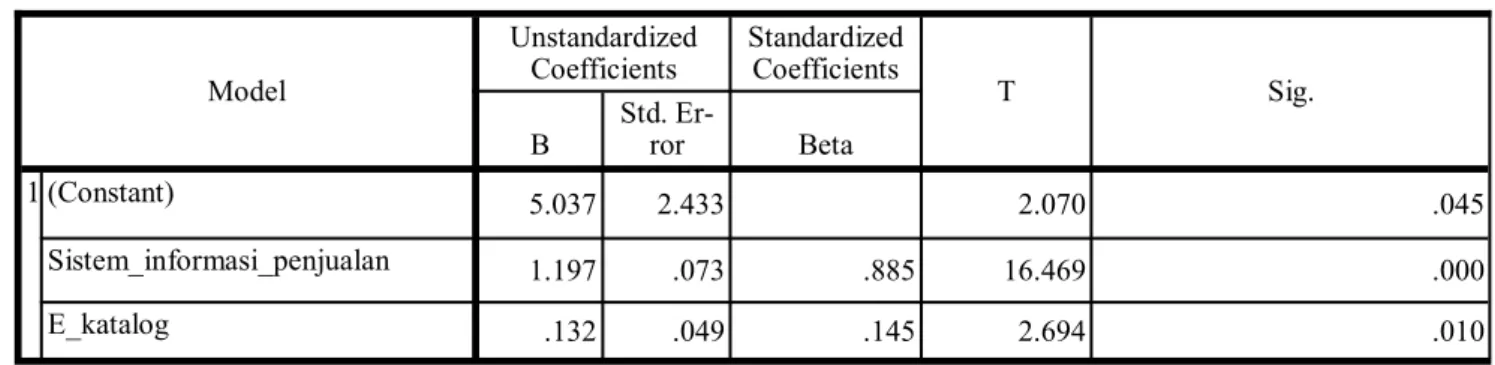
Multiple Linear Regression Analysis The result of the analysis can be modeled by multiple linear regression equation as follows:
Y= 5,037+1,197X1+0,132X2+e
The result of the equation can be interpreted as follows:
Constant (a) : 5.037, the value of con-stant is positive value means if the score of ac-counting information sys-tem (SIA) variable of sales and e-catalog equal to zero (0), then score in-crease of profit equal to 5,037 meaning that with-out accounting infor-mation system (SIA) sales and e-catalog then batik
SMEs will get a profit increase of 5.037.
Coefficient b1 : 1.197, the coefficient of variable accounting infor-mation system (SIA) sales are positive, meaning that the accounting infor-mation system (SIA) sales performed significant ef-fect on the increase of positive and strong batik profit. If the score of ac-counting information sys-tem (SIA) sales of batik
increases, then the in-crease in profit of batik
SMEs will also increase higher.
Coefficient b2 : 0,132, coefficient of e
-catalog variable is posi-tive, meaning e-catalog have significant effect to increase of batik profit. If the score of e-catalog val-ue increases, then the profit of batik SME will also increase.
40 Copyright © 2018, JDR, E ISSN 2579-9347 P ISSN 2579-9290
Model
Unstandardized
Coefficients Standardized Coefficients
T Sig.
B Std. Er-ror Beta
1(Constant) 5.037 2.433 2.070 .045
Sistem_informasi_penjualan 1.197 .073 .885 16.469 .000
E_katalog .132 .049 .145 2.694 .010
Table 1. Correlation Coefficient
Multiple Linear Regression Analysis 2
The result of the analysis can be modeled by regression equation as follows:
Y2= 25,622+0,244Y1
The result of the equation can be interpreted as follows:
Constant (a) : 5,622, the value of constant is positive value means if the score of accounting infor-mation system variable (SIA) sales equal to zero (0), then score increase of profit equal to 25,622, which means that without existence of account-ing information system (SIA)
batik sales will get increase earnings of SME batik of 25,622.
Coefficient b3 : 0,244, coefficient of variable of accounting information sys-tem (SIA) of sale of positive value, meaning that account-ing information system (SIA) of sale which have significant effect to increase of positive and strong batik profit. If the score of accounting infor-mation system (SIA) sales of
batik increases, then the in-crease in profit of batik SMEs will also increase higher. Calculating Direct Influence
1. Effect of e-catalog implementation on ac-counting information system (SIA) batik
sales. X to Y1 with a significance level of 0.016 with a coefficient of 0.244, which means that the application of e-catalog effect on accounting information system (SIA) sales of batik.
2. The effect of e-catalog implementation on the increase of profit of batik entrepre-neurs, X to Y2 with a significance level of
0.010 with coefficient value of 0.132 which means that e-catalog implementation has an effect on increasing earnings of batik
SMEs.
3. The influence of accounting information system (SIA) of batik sales to the increase of profit of batik entrepreneurs, Y1 to Y2 with a significance level of 0,000 with co-efficient of 1,197, which means that ac-counting information system (SIA) sales of
batik influence to increase profit of SMEs
batik tulis. Indirect Influence
The effect of e-catalog implementation on the increase of profit of batik entrepreneurs through sales accounting information system (SIA) of batik, (X to Y2 through Y1), with value of 0,244x1,268 = 0,309, meaning that implemen-tation of e-catalog effect to increase profit SMEs
batik tulis through accounting information system (SIA) sales of batik, with total value of indirect influence of e-catalog application to increase profit of SMEs batik tulis of 0.309.
Conclusion
Based on the results of research, it can be con-cluded that: (1) SMEs batik tulis by applying the system with integrated sales to in-crease profits because the sales process from sales orders to recording the expenditure of goods on inventory is done more quickly and accurately because it already uses an integrated system. In addition, by applying online promotions and al-ways update the e-catalog content is also able to increase profits because consumers are always interested to make sales orders after seeing the type of batik products sold are always growing. (2) SIA batik sales have an effect on increasing the profit of batik SMEs. This means that batik
SMEs that apply e-catalog as a media campaign to further increase the number of sales, especially sales using integrated sales so that all systems can be interrelated. So with the application of e
-catalog, increased profits to be increased because
Journal Of Development Research , 2 (2), November 2018, Page 38-42
Copyright © 2018, JDR, E ISSN 2579-9347 P ISSN 2579-9290 41
Model
Unstandardized
Coeffi-cients Standardized Coefficients T Sig. B Std. Error Beta
1 (Constant) 25.622 3.325 7.705 .000
E_katalog .244 .097 .361 2.510 .016
it makes it easier for consumers in choosing products to be purchased online. (3) SMEs of
batik have increased profits when e-catalog is applied because it increasingly exploits the net-work of consumers who see batik products ready for sale. More increased if supported by the sales system that is done by integrated with the process after consumers see the type of batik in the e-catalog and then make sales orders through online sales SIA, making it easier for consumers in the sale of sales must visit the shop SME batik shop so that to further increase the number of consumers who will buy batik products that automatically can further increase the profit of batik SMEs.
Suggestion
After the researcher conducted re-search, the suggestion as follows: (1) Batik is advised to always maintain e-catalog by up-date to the content of e-catalog for increased sales increase and certainly affect the increase in profit. (2) Further researcher if you want to re-view the similar research is suggested to add variable increase in profit, including quality of raw material inventory information system.
References
Andarwati, M., and Jatmika, D. (2017). Analisis Pengaruh Kualitas Sistem Informasi Akuntansi Terhadap Penerimaan Teknologi di Sektor UKM dengan Pen-dekatan Model TAM. Seminar Nasional Sistem Informasi (Senasif) (hal. 946
-956). Malang: Fakultas Teknologi Infor-masi Universitas Merdeka Malang. Andarwati, M., Nirwanto, N., and Darsono JT.
(2018). Analysis of Factors Affecting the Successof Accounting Information Systems Based on Information Technol-ogy on SME Managements as Account-ing InformationEnd User. European Journal of Economics, Finance, and Ad-ministrative Science, Issue 98, April
-Juli, p. 97-102.
Baridwan, Zaki. (2009). Sistem Akuntansi, Penyusunan, Prosedur dan Metode. Yogyakarta: BPFE
Harahap, Sofyan Syafri. (2009). Teori Kritis Laporan Keuangan. Jakarta: Bumi Aksara
Lestari, Sri; Triansyah, Apri; and Yulmaini. (2013). E-Catalogue Inkubator Bisnis IBI Darmajaya. Jurnal Informatika, Vol. 13 (2) Desember 2013
Manik, Cornelia Durmaya. (2015). Pengaruh Kualitas Produk, Harga, dan Promosi Terhadap Tingkat Penjualan. Jurnal Kreatif, Vol. 3 No.1 Oktober 2015
McCarthy, Thomas. (2006). Teori Kritis Jurgen Habermas. Yogyakarta: Kreasi Wacana. Moriarty, Mike and Klassen, Bruce. (2001).
Pow-er Play The Beginnig of The Endgame in Net Markets. Published by John Wiley and Sons, Inc.
Rahayu, M.; Mahsina; and Cholifah. (2017). An-alisis Sistem Informasi Akuntansi atas Prosedur Penjualan Kredit dalam Upaya Meningkatkan Efektifitas Pengendalian Intern pada CV. Sayap Media. Jurnal Akuntansi Equity, Vol. 3 Issue 2 (2017) Soemarso S.R. (2002). Akuntansi Suatu
Pengan-tar. Buku Dua, Edisi Kelima, Penerbit Salemba Empat, Jakarta.
Sovia, Iif; Achdiani, Yani; dan Widiaty, Isma. (2016). Penguasaan Pengetahuan Pem-buatan Batik Cap pada Peserta Didik SMKN 14 Bandung. Jurnal Family Edu. Vol. II No. 1 April 2016
Suryanto; Suharto; Priyo, VS Tri; Hermawan, Iwan; Sarana; dan Suwondo, Agus. (2015). Pembuatan Canting Batik Cap (CBC) Menggunakan Mesin CNC Rout-er Milling BRout-erbasis Software Mas-tercam. Science and Engineering Na-tional Seminar. Semarang, 8 Agustus 2015
Swastha, Basu and Irawan. (2005). Manajemen Pemasaran Modern. Liberty, Yogyakar-ta.
Warsidi dan Bambang Agus Pramuka. (2000). Evaluasi Kegunaan Rasio Keuangan Da-lam Memprediksi Perubahan Laba di Masa Yang Akan Datang. Jurnal akuntansi dan Ekonomi Vol.2 (1)