Alberto Ambrosetti1, Anthony M. Reilly1, Robert A. DiStasio Jr.2, and Alexandre Tkatchenko1∗ 1Fritz-Haber-Institut der Max-Planck-Gesellschaft, Faradayweg 4-6, 14195, Berlin, Germany
2
Department of Chemistry, Princeton University, Princeton, NJ 08544, USA
(Dated: December 16, 2013)
An accurate determination of the electron correlation energy is an essential prerequisite for de-scribing the structure, stability, and function in a wide variety of systems, ranging from gas-phase molecular assemblies to condensed matter and organic/inorganic interfaces. Even small errors in the correlation energy can have a large impact on the theoretical description of chemical and phys-ical properties in molecular systems of interest. The development of efficient approaches for the accurate calculation of the long-range correlation energy (and hence the dispersion energy as well) is essential and such methods can be coupled with many density-functional approximations (DFA), local methods for the electron correlation energy, and even interatomic force fields. While a num-ber of methods have been developed to augment DFA via corrections for the dispersion energy, most of these approaches ignore the intrinsic many-body nature of correlation effects, leading to inconsistent and sometimes even qualitatively incorrect predictions. In this work, we build upon the previously developed many-body dispersion (MBD) framework, which is intimately linked to the random-phase approximation (RPA) for the correlation energy. We separate the correlation energy into short-range contributions that are modeled by semi-local functionals and long-range contributions that are calculated by mapping the complex all-electron problem onto a set of atomic response functions coupled in the dipole approximation. We propose an effective range-separation of the coupling between the atomic response functions that extends the already broad applicability of the MBD method to non-metallic materials with highly anisotropic responses, such as layered nanostructures. Application to a variety of high-quality benchmark datasets illustrates the accuracy and applicability of the improved MBD approach, which offers the prospect of first-principles model-ing of large structurally complex systems with an accurate description of the long-range correlation energy.
I. INTRODUCTION
Density-functional theory (DFT) has emerged as a powerful electronic-structure technique that is increas-ingly being applied to many areas of chemistry, physics, and materials science. This success can be attributed to the very favorable ratio of computational cost to accuracy in DFT; by offering “correlation at a mean-field price” DFT allows for systematic first-principles in-vestigations for relatively large-scale systems. [1] DFT has a much higher computational efficiency compared to wavefunction-based methods, following directly from the mapping between the wavefunction and the electron den-sity as provided by the first Hohenberg-Kohn (HK) the-orem. [2] In fact, HK proved that the ground-state (gs) energy of a many-electron system can be expressed as a functional of the ground-state electronic density n(r), i.e.,Egs=E[ngs(r)].
Despite the exactness of the HK approach, Kohn-Sham DFT [3] relies in practice on an approximate treatment of the exchange and correlation (xc) energy, which en-codes all of the non-trivial quantum-mechanical interac-tions between electrons. As the xc contribution is essen-tial in order to describe bonding and electronic structure, the success or limitation of a given density-functional ap-proximation (DFA) strongly depends on the underlying xc functional.
One of the most widely used classes of approximate xc functionals are the semi-local functionals, which use the density and its gradients to determine the exchange and correlation energy. Due to the potentially quasi-linear scaling of the computational cost (wherein thousands of atoms can now be treated in the most efficient implemen-tations), semi-local DFT represents a work-horse method for molecular and solid-state applications. However, cur-rent semi-local functionals have a number of well-known deficiencies, such as self-interaction or delocalization er-rors [4] and a lack of long-range electron correlation. [5] The self-interaction error stems from the approximate treatment of electron exchange. On the other hand, the lack of long-range correlation is a consequence of the semi-local nature of the correlation, which implies an exponential decay of the interaction among separated (charge-neutral) density fragments. This approximation completely neglects long-range correlation due to collec-tive electronic fluctuations, which are known to occur in all molecules and solids. Hence, standard semi-local func-tionals neglect the long-range dispersion interactions that are essential for cohesion and function in many systems of interest.
In recent years, a number of different approaches and methods have been proposed in order to include disper-sion in semi-local DFAs [6–10] (see Ref. 5 for a com-prehensive review). Among these, the pairwise-additive van der Waals (vdW) methods, which rely on a sum-mation over inter-fragmentC6/R6terms, provide a sim-ple and computationally efficient approximation for the
long-range correlation energy [5] that is often capable of reliably describing certain classes of molecular systems. However, in many instances both quantitative and quali-tative failures can occur, as was found in supramolecular systems, [11] molecular crystals, [12–14] and layered ma-terials. [15] For example, pairwise methods are unable to correctly account for the experimentally well-known relative stabilities of the α, β and γ polymorphs of the glycine molecular crystal, [13] a shortcoming that is pri-marily due to the inherently many-body nature of long-range correlation and dispersion. While the pairwise con-tributions are sizeable, there are substantial higher-order energy and screening contributions, all of which must be considered in a collective many-body framework. In fact, the importance of many-body effects in the interatomic dispersion energy has been recently demonstrated in a number of studies. [11, 13, 14, 16–18]
The importance of many-body contributions to the correlation energy can be understood by making use of the random-phase approximation (RPA). When the cor-rect “bare” susceptibilities are provided as input, RPA yields an accurate treatment of the long-range corre-lation energy, by virtue of the fact that RPA natu-rally accounts for higher order (beyond two-body) ef-fects and electrodynamic response screening. Indeed, re-cent RPA implementations based on the adiabatic con-nection fluctuation-dissipation theorem (ACFDT) and Kohn-Sham orbitals yield an improved description of dispersion-bound systems with respect to semi-local DFAs. [19–21] However, the steep computational cost as-sociated with RPA@DFA calculations makes them im-practical for most systems of interest.
RPA can also yield useful insight into the develop-ment of simpler and more efficient approaches for model-ing many-body interactions. The infinite series resultmodel-ing from a perturbative expansion of the RPA correlation en-ergy is slowly converging, and the poor performance of low-order truncations [11, 22] is clearly indicative of the limitations of low-order perturbative approaches with re-spect to the infinite-order many-body treatment. In this regard, it was observed that the simple inclusion of the Axilrod-Teller-Muto [23] three-body term, also consid-ered by others in the field, [9, 24] does not necessarily imply an improved accuracy with respect to a pairwise vdW expression. [11]
Very recently, an alternative approach has been de-veloped in order to compute the long-range many-body dispersion (MBD) energy in an efficient manner. [18, 25] Furthermore, an analytic proof has been presented demonstrating the equivalence between the MBD energy expression and the RPA correlation energy for a system of localized quantum harmonic oscillators coupled in the dipole approximation. [26] The MBD approach avoids the explicit use of single-electron orbitals, allowing for a fa-vorable N3 scaling (where N is the number of atoms) and a negligible computational cost with respect to a self-consistent DFT calculation. This is made possible in the dipole approximation and for finite-gap systems,
by mapping the “bare” susceptibility of the system onto that of a set of localized response functions. The MBD method [18] has proven to be very accurate for a wide va-riety of molecular and solid-state systems. [13, 14, 17, 27] In the present article we analyze in detail the basic concepts underlying the MBD method, and carefully con-sider the problem of polarizability screening and separat-ing correlation into short-range and long-range contribu-tions. Here we introduce a revised MBD method (termed MBD@rsSCS), which employs range-separation (rs) of the self-consistent screening (SCS) of polarizabilities and the calculation of the long-range correlation energy. This enables us to separate the inherently short-range contri-bution to the correlation calculated with semi-local DFT from the long-range contribution calculated with MBD. The MBD@rsSCS method should be universally appli-cable to finite-gap systems, regardless of their size and geometry.
In the following sections (Sections II–IV) we will con-sider the derivation of the long-range correlation en-ergy within the MBD framework before applying the MBD@rsSCS and related methods to a wide range of benchmark datasets in Section V, demonstrating the broad applicability and improved performance of the MBD@rsSCS method for a wide variety of systems.
II. THE CORRELATION ENERGY IN
DENSITY-FUNCTIONAL APPROXIMATIONS Common semi-local and hybrid xc functionals only provide a short-range description of the correlation en-ergy. This follows from their integral definition, com-monly given in terms of the densityn(r) and the corre-lation energy per particlec:
Ec= Z
drn(r)c(n(r),∇n(r)). (1)
In absence of a truly non-local c, [28] the decay of the correlation energy contribution is directly controlled by that of n(r). Hence, correlation effects in semi-local functionals will typically vanish exponentially with the distance between fragments with non-homogeneous elec-tron densities. Therefore, the interaction energy between rare-gas atoms, for example, has an exponential decay, whereas a more long-ranged∼1/R6decay is expected. [5] An alternative and more powerful approach for calcu-lating the correlation energy is to use the ACFDT for-mulation, wherein the correlation energy is expressed in terms of the density-density response function of the sys-temχ(r,r0, iω), which describes the density response at
r0 induced by a perturbation at r. The ACFDT for-mula employs the bare (χ0) response function of the non-interacting DFT system and the “dressed” (χλ) response function of the interacting system, in which the Coulomb interactionvis scaled by the adiabatic connection
param-eterλ: [29] Ec =− 1 2π Z ∞ 0 dω Z 1 0 dλTr[χλv−χ0v]. (2) Whileχ0is known analytically (as we shall discuss be-low in Section III), the computation of the correlation energy from Eq. (2) in practice requires the introduc-tion of a model for χλ. In this regard, one of the most popular approaches is the random-phase approximation (RPA), which corresponds to a summation of ring dia-grams up to infinite order, neglecting effects in the inter-acting response function which derive from the xc kernel. Hence, the RPA correlation energy can be computed from Eq. (2) by approximating χλ with the RPA interacting response function:
χRPAλ = χ0 1−χ0λv
. (3)
The ACFDT-RPA expression is commonly evaluated by computing χ0 using Kohn-Sham (KS) or Hartree-Fock (HF) electronic orbitals. While capable of describing dif-ferent types of bonding, including ionic, covalent, and metallic bonds, RPA performs best at long range, as sys-tematic underbinding is found for both molecules and solids, [30] which is attributed to the difficulty in accu-rately describing short-range correlation effects. Inclu-sion of renormalized exchange diagrams as in the SOSEX method, [31] may yield improvements for ACFDT-RPA, but clearly this will further increase the already large computational cost of RPA based on KS or HF orbitals. A promising solution to this problem is offered by the so-called range-separation technique. [32] In this frame-work, the electron-electron Coulomb interactionvis split into short-range and long-range contributions:
v=vSR+vLR. (4) The correlation arising from the short-range part of the interaction vSR is efficiently treated using local or semi-local functionals, while the long-range part can be evalu-ated through traditional wavefunction methods, such as configuration interaction [32] or RPA. [33] The range-separation approach is therefore particularly convenient, as it allows for the application of different techniques that can be adapted for correctly describing both the short-and long-range correlation energy.
While the RPA correlation energy is normally com-puted using response functions calculated from KS or HF orbitals, the use of a model response function is equally possible. In this work we will exploit the frameworks of both RPA and range separation to compute the long-range electron correlation energy using a model system based on atom-centered response functions. As will be shown below, a judicious choice of model system and cor-responding response functions can lead to a substantial reduction of the computational cost, while still yielding an accurate and physically motivated description of long-range correlation effects in non-metallic systems. An ap-propriate model system and corresponding response func-tions will be introduced in the next section. While we will
employ a model system herein to compute the long-range correlation energy, we will only make use of quantities derived from the external potential Vext and the elec-tron density n(r). Thus, the long-range correlation en-ergy will be consistent with HK picture of DFT,i.e., the long-range correlation energy will be afunctional of the density and external potential: EcLR=EcLR[n(r), Vext].
III. MODEL RESPONSE FUNCTIONS FOR
FREE ATOMS AND ATOMS IN MATTER As discussed above, a key quantity to be considered in the study of the electron correlation energy and response properties of a given molecular system is the (density-density) response function,χ(r,r0, iω). From the knowl-edge ofχ(r,r0, iω), it is possible to obtain optical excita-tion spectra, polarizability, and higher multipolar suscep-tibilities of the system. Moreover, the ACFD theorem in Eq. (2) provides an integral formulation of the correlation energy, given in terms of the bare and dressed response functions, and the Coulomb interaction. The ability to reliably compute the response function or susceptibilities of a system is thus a fundamental step towards an accu-rate and physically sound description of the correlation energy.
The response function χλ of the interacting system is typically written in terms of the bare susceptibility [Eq. (3)]. Therefore, we will first concentrate on χ0. Mathematically, χ0 can be determined from the com-plete set of eigenfunctions obtained from a mean-field electronic-structure calculation via the Adler-Wiser for-malism: [34, 35] χ0(r,r0, iω) =X ij (fi−fj)φ ∗ i(r)φi(r0)φ∗j(r0)φj(r) i−j+iω , (5)
where φi is the ith eigenorbital with corresponding eigenenergy i, and fi is the Fermi occupation num-ber. However, the evaluation and the subsequent integra-tion of the bare response funcintegra-tion from electronic single-particle orbitals is computationally very expensive.
For a more efficient treatment of the response, we as-sume now that our system, consisting of molecules or condensed matter, has a finite electronic gap (between the highest-occupied and lowest-unoccupied molecular orbitals) and hence can be divided into effective atomic fragments. Under this assumption, we initially map the full nucleo–electronic system onto a set of localized atomic response functions. Since we are only interested in long-range effects, the atomic response is conveniently expressed in terms of multipole-multipole susceptibili-ties. The low-lying valence electron excitations, respon-sible for the long-range correlation effects, are then ef-fectively described through a set of quasi-particles that are tailored in such a way as to reproduce the relevant multipole-multipole susceptibilities.
Given their simplicity and convenient analytical prop-erties, we will represent the atomic response functions by
a set of quantum harmonic oscillators (QHOs). Notably, only a single QHO per atom is needed to exactly repro-duce the static dipole polarizabilities and homoatomicC6 coefficients of isolated atoms. [10] This is readily shown from Eq. (5): by making use of the dipole-selection rules, the dipole polarizability tensor of an isotropic QHO hav-ing massm, chargeZ, and characteristic frequency ˜ωcan be written as:
α(iω)ln =δln Z2
m(˜ω2+ω2), (6) where the indicesl andnindicate the Cartesian compo-nents of the tensor. Two conditions on the QHO param-eters are then applied to obtain the exact value ofα(0)ii (the isotropic static dipole polarizability) and ˜ω. In the more general case of an anisotropic non-diagonal atomic dipole polarizability, a single SO(3)-rotated anisotropic QHO is still sufficient to reproduce the full static dipole polarizability tensor, in the absence of time-reversal sym-metry breaking (non-imaginary eigenstates).
Analogous considerations hold for the higher multipo-lar response functions, which can again be expressed in terms of QHOs. Naturally, a larger number of QHOs will be necessary in order to exactly capture all the desired susceptibilities. Nonetheless, it was recently observed that a single isotropic QHO is sufficient for accurately re-produce dipole, quadrupole, and octupole response func-tions at the same time in noble gases, alkali atoms, and small molecules. [36]
In the present work we will make use of the dipole ap-proximation to the Coulomb interaction v. Hence, from Eq. (2), only the dipolar component of the full response function is required. We remark that the full Coulomb potential can also be utilized to describe the coupling be-tween atomic response functions, albeit at the expense of a much increased computational cost. [36]
Among the different possible strategies for model-ing the atomic dipole polarizability, [7, 28, 37, 38] the Tkatchenko-Scheffler (TS) [10] method will be our method of choice in this work. This is particularly suit-able as the TS approach is compatible with a single isotropic QHO per atom, and provides very accurate first-principles polarizabilities for both free atoms and small molecules. In particular, the free-atom polarizabilities and the corresponding homoatomicC6coefficients in the TS framework are derived from time-dependent density-functional theory (TDDFT) reference data, [39] with an accuracy of ∼3%. Similar accuracy has also been found for the corresponding heteronuclear C6 coefficients. To account for the short-range exchange and correlation ef-fects arising from the molecular environment, these free-atom polarizabilities are proportionally rescaled accord-ing to the atomic Hirshfeld volumes, computed from a given DFA electronic density. The resulting molecu-lar C6 coefficients show a mean absolute relative error (MARE) of 5.5% for a database of 1225 small molecular dimers. [10]
As visible from the aforementioned performance for
small molecular dimers, hybridization and short-range overlap effects are accurately treated through the TS pro-cedure. In fact, the TS polarizabilities account for semi-local xc effects deriving from the DFT electron density. However, while the Hirshfeld volume of a given atom is sensitive to the density modifications induced by neigh-boring atoms, the effects arising from more distant atoms decays exponentially with the distance, instead of the well-known electrostatic power law decay.
To explicitly account for the dipole interaction occur-ring between atomic response functions, we consider two charged atom-centered QHOsiandj, which are located atri andrj, and separated by a distancerij=|ri−rj|. The Coulomb potential due to to these spherical Gaus-sian charge distributions (corresponding to the QHOs) is: [18, 26] vGG(rij) = erf (rij/σij) rij . (7) Here σij = q σ2 i +σj2, with σi = ( p 2/παi/3)1/3 rep-resenting the Gaussian width of the ith QHO, which depends on its corresponding bare frequency-dependent polarizability. As we are operating within the dipole approximation, the coupling among QHOs is described solely by the dipole-dipole tensor derived fromvGG:
TlmGG,ij=∂rl i∂r
m
j vGG(rij), (8)
whererl
i indicates the lth Cartesian component ofri. The long-range screened dipole polarizability is then computed through the discrete self-consistent screening (SCS) equation, [18]
αSCS(iω) =α0(iω)−α0TGGαSCS(iω), (9) whereα0
lm =δlmαTSl is the diagonal bare polarizability matrix and αSCS is the corresponding self-consistently screened polarizability matrix.
The intermolecularC6coefficients derived from the re-sulting SCS polarizabilities show a MARE of 6.3% for the 1225 molecular dimer database discussed above. In addi-tion, the anisotropy in the molecular polarizability is sig-nificantly improved by SCS compared to TS calculations that yield essentially isotropic molecular polarizabilities. For more complex extended systems, calculations on Si clusters of increasing size and bulk Si yielded agreement within∼8% ofC6coefficients derived from TDDFT and experiment, whereas for TS alone deviations up to∼70% were observed for the larger clusters. [18]
IV. THE LONG-RANGE CORRELATION
ENERGY IN THE MBD METHOD
In the preceding section, we introduced model response functions for computing the long-range correlation en-ergy of finite-gap molecular systems. Here we outline
the steps necessary to calculate an accurate long-range correlation energy utilizing these response functions, in a method we term MBD@rsSCS.
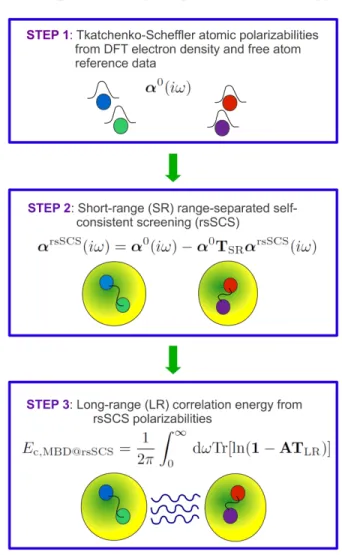
In particular, there are three key steps, as shown in Figure 1:
1. Evaluation of the “bare” TS atomic polarizabili-ties from free-atom reference data and the DFT electron density, which accounts for short-range hy-bridization effects in the atomic polarizabilities. 2. Calculation of the self-consistently screened
po-larizabilities using range-separated self-consistent screening (rsSCS) of the TS atomic polarizabilities. 3. Computation of the many-body long-range correla-tion energy starting from the rsSCS input polariz-abilities.
To understand the benefit of the range separation be-tween steps two and three, we begin by discussing the long-range correlation energy that arises from this model. Thereafter, we will discuss the concept of short-range po-larizability screening, which follows naturally from the range separation of the coupling between QHOs.
A. The Long-Range Correlation Energy from Coupled Atomic Response Functions
Starting from the ACFDT formula [Eq. (2)], the key ingredients contributing to the correlation energy are the response function χ and the interaction v. The sin-gle QHO approximation to the atomic response function has already been introduced and discussed above in Sec-tion III. Here, we will focus on the Coulomb interacSec-tion. In line with discussion of Section II we begin by range-separating v into vSR and vLR. As the short- and long-wavelength excitations of the system will be typically as-sociated with different energy scales, we neglect their ex-plicit coupling as a first approximation, and express the total correlation energy as
Ec'ESRc +E LR
c , (10)
with the two terms stemming fromvSR andvLR, respec-tively.
Semi-local DFT represents an efficient and balanced choice for computing short-range correlation energy con-tributions. Therefore, we takeESR
c to be the semi-local DFT correlation energy. We point out that at this point no explicit range separation of the electron-electron in-teraction is introduced in DFT. The desired separation is rather recovered from the implicit short-range character of the semi-local DFT correlation. A rigorous range sep-aration of the correlation functional is also possible, [32] and is currently under investigation.
In the present approach, the long-range correlation en-ergy EcLR can be formally defined through Eq. (2) by substitutingv with vLR. This separate treatment of the
FIG. 1. Schematic diagram illustrating the computation of the MBD@rsSCS long-range correlation energy.
long-range correlation energy contribution permits a mul-tipole expansion of vLR that can be restricted to lower orders. Clearly, at the large distances of interest here, the dipole component will be dominant compared to higher multipoles, which we will therefore neglect. As previously mentioned in Section III, only the dipole component of the full response function will contribute toELR
c within the dipole approximation to vLR. Hence, we will again make use of the aforementioned single-QHO parametriza-tion of the atomic response, as such a response funcparametriza-tion can reproduce static polarizabilities and homoatomicC6 coefficients exactly [cf., Eq. (6)].
With respect to standard ACFDT-RPA implementa-tions, in which χ0 is computed from electronic single-particle orbitals, the introduction of the MBD approach based on atomic response functions permits a consider-able reduction in the degrees of freedom (i.e., to a single QHO per atom). As a result, in the specific case of dipole-coupled QHOs, Eq. (2) can be recast into a very efficient
discrete matrix formulation. This is accomplished after analytical integration over spatial variables by substitut-ing χ0v with AT. [26] Here A is a diagonal 3N ×3N matrix, which is defined as Alm = −δlmαl(iω) in the case of isotropic QHOs, and T is now the dipole-dipole interaction tensor. The scalar αl corresponds to the lth (isotropic) atomic polarizability computed using a cho-sen response function approximation (RFA). Extension to anisotropic polarizabilities is equally possible through the use of a block-diagonalAmatrix.
Making use of this matrix formulation and considering the fact that Tr[AT] = 0 due to the absence of intra-oscillator interactions, the ACFDT-RPA correlation en-ergy for the MBD model becomes:
Ec,MBD= 1 2π Z ∞ 0 dωTr[ln(1−AT)]. (11)
In order for this energy expression to provide an accurate approximation to ELR
c , a range-separation of the inter-action should be introduced inT. Notably, if the tensor
Tis frequency independent, the same correlation energy as in Eq. (11) can be exactly computed by diagonalizing the MBD Hamiltonian (see Appendix A). [26] This prop-erty makes the evaluation of the MBD correlation energy highly efficient, as the overall computational cost scales as N3 (with N being the number of atoms), and hence remains negligible with respect to the underlying DFT calculation.
We also emphasize that depending on the definition of theTtensor and the RFA used, different procedures for the computation of Ec,MBD can be defined. This is in direct analogy with standard ACFDT-RPA implementa-tions, wherein different choices of the underlying orbitals might lead to different bare response functions and thus different correlation energies. Accordingly, our notation for the method employed will be MBD@RFA, similar to that used for RPA calculations,e.g., RPA@PBE. [30]
In the original MBD implementation, [18] which we now refer to as MBD@SCS, the correlation energy was computed from the full (not range-separated) self-consistently screened TS polarizabilities. In this re-gard, we note that the full SCS equation Eq. (9) pro-vides RPA screening of the localized atomic polarizabili-ties. As such, long-range screening is also present in the RPA expressions discussed above. As a consequence, the MBD@SCS method effectively introduces a double RPA polarizability screening in the long range. The newly de-veloped MBD@rsSCS method, which we will introduce in the following subsection, amends this aspect by providing single RPA screening at long distances.
B. Range-Separation of the Interaction As shown in Section III, the dipole-dipole interaction
TGG that occurs between charged QHOs is derived from the Coulomb potential resulting from the corresponding
Gaussian charge distributions [Eq. (8)]. [18, 26] This in-teraction intrinsically contains a short-range attenuation due to the QHO charge overlap and is therefore well-suited for the treatment of the polarizability screening. The short-range behavior of TGG, however, is not ade-quate for the computation ofEcLR, as in practice we have observed that a steeper attenuation of the interaction is required for coupling the DFT short-range correlation energy with the respective long-range component.
A potential solution to this problem is obtained by range-separating TGG into short- and long-range com-ponents, indicated by TSR and TLR, respectively. We define the short-rangedTSR as:
TlmSR,ij= (1−f(rij))TlmGG,ij, (12) whererijis the distance between atomiand atomj, and f(rij) is the well-known Fermi-type damping function, widely employed in previous work: [10, 37, 40, 41]
f(rij) = 1
1 + exp[−a(rij/SvdW−1)]
. (13)
Here theaparameter is fixed to a value ofa= 6, which leads to smooth damping behavior and substantially dif-fers from the value typically used in pairwise vdW ap-proaches in whicha≈20. This is by no means surprising, as f(rij) directly acts on the dipole–dipole interaction here, which seamlessly controls the correlation energy at all orders. SvdW is defined as β(RivdW+R
j
vdW), where Ri
vdWis the vdW radius of thei
thatom, and the parame-terβis fitted once per xc functional by minimizing energy deviations with respect to highly accurate reference data on a database of choice.
According to the range-separation technique, TLR is defined asTGG−TSR. TheTGG tensor depends on the frequency of the electric field, while it is more computa-tionally efficient to have a frequency independent inter-action tensorTLR. Therefore, we conveniently approxi-mateTLR as: TabLR,ij=f(rij) −3raijrbij+rij2δab r5 ij , (14) where ra
ij and rbij specify the a and b Cartesian com-ponents of rij and the vdW radii employed in f(rij) are consistent with the RFA used. The tensor is now frequency independent, and can be directly used in the MBD Hamiltonian (Appendix A).
Within this range-separation approach, TSR is em-ployed for the short-range self-consistent screening (SCS) of the TS polarizabilities:
αrsSCS(iω) =α0(iω)−α0TSRαrsSCS(iω). (15) All quantities are denoted here according to the notation introduced in Section III above.
The resulting renormalized polarizabilities αrsSCS are subsequently utilized as input parameters for the effective
ACFDT-RPA computation of the long-range correlation energy Ec,MBD@rsSCS. We remark that Ec,MBD@rsSCS is computed by making use of TLR, i.e., the long-range component of the dipole-dipole interaction tensor, in or-der to avoid double counting of the DFT correlation en-ergy and the polarizability screening.
Following from its definition, the MBD@rsSCS ap-proach permits a “soft” short-range screening of the po-larizability, providing at the same time a correct separa-tion of the short- and long-range correlasepara-tion energy. As will be shown later, this aspect is particularly relevant in condensed matter such as bulk semiconductors, where short-range screening is typically dominant over long-range effects. Significant contributions, however, are also found in the energetics of large supramolecular systems. We emphasize here that no double counting of ring dia-grams will be present in the MBD@rsSCS energy expres-sion at long distances, preserving an effective RPA-like treatment of the many-body effects. This represents a major advantage with respect to the MBD@SCS method, especially in highly anisotropic systems, such as one-and two-dimensional nano-structures where long-range many-body effects become increasingly relevant. [42] The MBD@rsSCS method is also consistent with the over-all DFT framework: the long-range correlation energy is computed by making use of the electron density and the atomic coordinates, and therefore can be expressed asEc,MBD@rsSCS =Ec,MBD@rsSCS[n(r), Vext].
C. Interatomic Forces
As well as providing a very efficient computation of the long-range correlation energy, the MBD model allows for the straightforward computation of interatomic forces for use in structural optimizations and molecular dynamics simulations.
To derive the interatomic forces, we will make use of the formulation given in Eq. (11) for Ec,MBD. The in-teroscillator forces can now be obtained from the energy gradient asF=−∇Ec,MBD: F= 1 2π Z ∞ 0 dωTr (1−AT)−1(∇AT) . (16)
The differentiation of theATmatrix can be readily car-ried out if the dependence of the A matrix (and hence the polarizabilities) on the atomic positions is neglected. The subsequent numerical integration over imaginary fre-quency can be efficiently performed via Gauss-Legendre quadrature. Considering the dependence of the polar-izability upon the atomic positions is also possible, and has recently been been studied in the context of self-consistent screening of the TS method. [43]
The present interatomic forces naturally account for the many-body effects present in the MBD energy. How-ever, we stress that these only represent the long-range correlation contribution to the total interatomic forces. Due to the linearity of the gradient operator, the MBD
forces can therefore be directly added to the forces orig-inating from the underlying DFT calculation.
V. BENCHMARKING AND APPLICATIONS
The MBD@rsSCS method is designed to accurately describe long-range correlation (and thus dispersion) in finite-gap systems, including at the same time a descrip-tion of the short-range interacdescrip-tions from the underlying DFT computation of the electronic structure. To evalu-ate the performance of the DFT+MBD@rsSCS method, we will employ a wide variety of systems, represent-ing different bondrepresent-ing types, symmetry, and physical ex-tent, ranging from small-molecule dimers to supramolec-ular and solid-state systems. The DFT+MBD@rsSCS method will be assessed against the most accurate the-oretical and experimental benchmark data available, al-lowing us to categorically ascertain the performance of the method as well as provide a broad overview of the importance of different dispersion contributions. In each application, the MBD@rsSCS method will be combined with the widely used PBE [44] semi-local functional and its corresponding hybrid functional PBE0, [45] which in-cludes 25% exact exchange. The comparison between the semi-local and hybrid functionals will also provide further insight into the role of exact exchange in these different systems.
The benchmarks utilized herein for small molecules are the S22 and S66×8 databases of gas-phase dimers developed by Hobza and co-workers, [46, 47] for which “gold standard” coupled-cluster CCSD(T) binding ener-gies are available. The performance for supramolecular and larger molecules will be assessed using the extrapo-lated experimental binding energies of the S12L database of Grimme. [48] Finally, the performance in the solid state will be assessed by comparison to the binding en-ergy of bulk graphite and the X23 database of exper-imental molecular-crystals lattice energies. [14, 49] All calculations were carried out using the all-electron FHI-aims code [50], employing the “tier 2” basis set, that essentially yields DFT binding energies at the basis set limit.
In addition to the MBD@rsSCS method, a second sim-plified many-body method will also be considered in this work, which follows from the ideas presented in Ref. [26]. This method consists of the direct use of unscreened TS polarizabilities as input parameters for MBD. The coupling among localized QHOs is again determined by the range-separatedTLR interaction tensor, while theβ parameter, which controls the separation range, will be fixed independently of MBD@rsSCS. Although this ap-proach lacks short-range polarizability screening, it is of particular interest as it allows for a straightforward im-plementation of interatomic forces (Section IV C), and will be referred to as MBD@TS.
TABLE I. Optimized values of the dimensionlessβparameter that controls the range-separation of the long-range correla-tion interaccorrela-tion.
PBE PBE0
MBD@rsSCS 0.83 0.85
MBD@TS 0.81 0.83
A. Parametrization of the MBD Method The range-separation parameter β is determined by minimizing the mean absolute relative error (MARE) on the S66×8 database. [47] As the S66×8 database includes non-equilibrium geometries, this fitting proce-dure removes any potential bias towards equilibrium ge-ometries. Performing the parametrization on small and medium-size molecules will further avoid the introduc-tion of artifacts in large-scale systems. For such systems, changes in the cohesive energies will occur naturally due to many-body effects, and not due to ad hoc modifica-tions of the interaction.
The optimal values ofβare reported in Table I for both the MBD@rsSCS and MBD@TS methods with the PBE and PBE0 functionals. Interestingly, only slight varia-tions are found between PBE and PBE0 for the value of β. This is certainly consistent with the fact that both PBE and PBE0 have the same correlation functional. The minor differences are therefore due to the fraction of exact exchange present in PBE0 and the correspond-ing improvement in its short-range treatment of xc ef-fects. [51]
B. Polarizability
We begin by assessing the MBD method for its abil-ity to determine C6 dispersion coefficients. For small molecules there is only a marginal difference between the polarizabilities of MBD@rsSCS and MBD@TS. Consid-ering a test set of 1225 molecular dimers, [10, 18] the MARE in the C6 coefficients is 6.2% for MBD@TS and 7.1% for MBD@rsSCS, while the pairwise TS method has a MARE of 5.5%. However, we note here that the small size of systems in this database limits the importance of many-body contributions. In comparison, a recent as-sessment of the XDM method yielded a MARE of 10% for a small-molecule database, [24] while a number of vdW density functionals also yield larger deviations for small-moleculeC6 coefficients. [52]
The effect of many-body contributions on the polariz-ability is far more pronounced in extended systems, in line with its importance for energetics. A clear example of this can be seen in the polarizabilities of bulk diamond and silicon. For diamond, the static isotropic TS polariz-ability is 10.9 a.u. per atom. In the absence of short-range screening MBD@TS gives a value within 1% of this, as
long-range screening effects cancel due to the high sym-metry of the lattice. In contrast, including short-range ef-fects as in MBD@rsSCS yields a polarizability of 7.2 a.u. per atom, in better agreement with the value of 5.6 a.u. extrapolated from the experimental dielectric constant via the Clausius-Mossotti relation. [53] The same is true for silicon, where the TS value of 33.6 a.u. is essentially unvaried with MBD@TS, but is reduced to 24.5 a.u. by MBD@rsSCS, in good agreement with a TDLDA bench-mark value of 26.6 a.u. [54] The original MBD@SCS ap-proach has also been shown to give good predictions for the dielectric properties of the molecular crystals of the acene molecules. [55]
C. Small- and Medium-Sized Molecules We now turn to the assessment of the energet-ics of MBD, starting with a benchmark of the DFA+MBD@rsSCS and DFA+MBD@TS methods us-ing the the S22 [46] and S66×8 [47] databases of Hobza and co-workers. These databases contain a variety of gas-phase dimers (22 and 66 in the S22 and S66, re-spectively), covering different geometrical structures and bonding types, with binding energies computed by means of coupled-cluster theory with single, double, and per-turbative triple excitations [CCSD(T)]. In the case of the S66×8, eight different inter-fragment distances are considered, with the equilibrium configurations being re-ferred to as the S66 database. This permits accurate benchmarking using more challenging non-equilibrium geometries. In addition, a subset consisting of the seven largest distances is also considered in the present work and denoted as S66×7. With this database the many-body dispersion contribution in the long-range limit can be better assessed.
The mean absolute relative errors (MARE) and mean absolute errors (MAE) with respect to the CCSD(T) reference data are presented in Table II. In addition to the many-body schemes the values for the pairwise TS method are also given. Generally, all of the meth-ods yield good performance with MAEs well below the 1 kcal/mol chemical accuracy threshold. It is also clear that for the larger S66 datasets PBE0 yields a notice-able improvement over PBE. The inclusion of many-body contributions also substantially improves over the pairwise TS method, which has a comparable MAE to Grimme’s PBE-D3(BJ) for the S66×8. [14, 56] The inclu-sion of short-range screening in MBD@rsSCS also yields expected improvements in binding energies.
For the S22 the picture is less clear. First, TS per-forms very well for this dataset. One reason for this is the fact that the TS damping function was fitted to the S22, [10] making it optimal for this database. The ma-jority of the error arises in complexes 11 to 15, which are stacked aromatic dimers. MBD@rsSCS yields systematic underbinding for these complexes and as MBD@TS sys-tematically overbinds other systems it appears to
per-TABLE II. MARE (in %) of different vdW-inclusive DFT methods with MAE (in kcal/mol) given in parenthesis.
PBE+MBD@rsSCS PBE0+MBD@rsSCS PBE+MBD@TS PBE0+MBD@TS PBE+TS PBE0+TS
S22 8.9 (0.49) 8.5 (0.55) 8.6 (0.45) 8.7 (0.53) 9.1 (0.29) 7.3 (0.30)
S66 9.0 (0.42) 8.1 (0.40) 10.0 (0.45) 8.9 (0.43) 12.0 (0.44) 9.7 (0.40)
S66×8 10.6 (0.32) 9.2 (0.30) 12.3 (0.36) 10.5 (0.33) 13.6 (0.37) 11.1 (0.33) S66×7 7.9 (0.27) 6.4 (0.25) 10.3 (0.32) 8.3 (0.29) 13.0 (0.34) 10.2 (0.30)
FIG. 2. The mean absolute relative error of PBE0+MBD@rsSCS and PBE0+TS (in %) at each of the S66×7 inter-fragment separations.
form better here. Accurate treatment of anisotropy in the molecular polarizabilities may play an important role in such small systems, for which an accurate treatment of anisotropy in the short-range interaction is crucial. In the stacked dimers much of the polarization will be in the plane of the molecules. When this is isotropized for in-put into the MBD Hamiltonian, the polarizability in the perpendicular direction will be overestimated, possibly leading to an over-screening of the stacking interaction. However, it is clear that for larger systems, and a broad benchmark like the S66, MBD@rsSCS represents a sub-stantial improvement over the other methods. This will be further confirmed by application to more extended systems in the following subsections.
We now focus our attention on how the accuracy of the various methods changes as a function of the inter-fragment separation. The description of short-range con-tributions is expected to be intrinsically difficult for both MBD@rsSCS and MBD@TS as these theories consider only dipole-dipole contributions and were derived on the assumption that the interacting fragments were well sep-arated. This is indeed the case, as a clear improvement in the accuracy is observed when omitting the shortest distance, as in the S66 and S66×7 datasets. Higher mul-tipole components of the Coulomb interaction become in-creasingly important at the short range, while a detailed
TABLE III. MARE (in %) and MAE (in kcal/mol) of PBE0+MBD@rsSCS for each of the separations in the S66×8 database. Separations are given as multiples of the equilib-rium distance.
Separation MARE (%) MAE (kcal/mol)
0.90 29.0 0.64 0.95 11.0 0.50 1.00 8.1 0.40 1.05 6.7 0.32 1.10 5.8 0.26 1.25 5.0 0.16 1.50 4.3 0.08 2.00 4.2 0.02
description of the effects of overlap between electronic orbitals is not possible with a single isotropic dipole os-cillator per atom.
We further investigate this aspect through a more detailed analysis of the error as a function of the inter-fragment distance, as shown in Table III for PBE0+MBD@rsSCS. A monotonic decrease of both the MARE and MAE is found with increasing distances, while the deviation found at the shortest separations (0.9 times the equilibrium distance) reaches 29% of the total energy. However, even here the MAE remains well be-low 1 kcal/mol, still maintaining chemical accuracy. The consistent improvement in the accuracy found with larger distances (See Figure 2) provides a clear confirmation of the quality and robustness of the MBD model as a method for modeling long-range correlation effects.
There are a number of pairwise dispersion methods that have been applied to the S66 database or parts thereof. These include the TS method (already discussed above), DFT-D3, [9, 56] and the non-local vdW-DF2 [57] and VV10 [38] functionals. Typically their MAEs are within 0.2 kcal/mol of MBD@rsSCS, close to the limit of the accuracy and convergence of the reference data. Indeed, despite the inherent differences between the dif-ferent methods, their performance for small molecules is generally good, implying that a pairwise description ac-counts for the majority (but not all) of the long-range correlation effects in these systems, in agreement with the work of Grimme. [9] While the role of many-body vdW interactions is limited in these systems, this will not be the case in general for larger molecules and
con-densed phases, as we shall demonstrate in the following subsections.
D. Supramolecular Systems
As a benchmark for larger and more complex inter-molecular interactions, we employed the S12L dataset of Grimme. [48] This database is comprised of 12 supramolecular complexes, formed by six hosts combined with two guest monomers each. [16, 48] Due to the mixed nature of the non-covalent host-guest interactions, which includes hydrogen bonding, dispersion,π-πstacking, and electrostatic (cation-dipolar) bonding, the S12L dataset can be regarded as representative of large host-guest sys-tems. The reference binding energies were determined by extrapolation from experimental association free ergies through the use of approximate solvation and en-tropic corrections. [48] These energies have an estimated average error of 2 kcal/mol. [16, 48]
Due to the larger size of these complexes, which con-tain between 86 and 177 atoms, and their relatively anisotropic geometries, we expect that many-body dis-persion effects will play a much more significant role than for the smaller molecules in the preceding section. In-deed, recently it has been shown that the many-body contributions of MBD@rsSCS yield a substantial reduc-tion of the host-guest binding interacreduc-tions in all of the systems, typically on the order of 10% of the energy. [11] This amounts to PBE+MBD@rsSCS having a MAE of 1.6 kcal/mol (MARE 5.4%), [11] which is within the es-timated uncertainty in the reference data. [16, 48] In contrast, PBE+TS has a MAE of 8.0 kcal/mol (MARE 25%), corresponding to a systematic overestimation of the host-guest binding. From Table IV we can see that PBE+MBD@TS also performs substantially better than PBE+TS. PBE+MBD@TS still overbinds due to the lack of proper short-range polarizability screening. As already observed and discussed elsewhere, [11] the combination of a vdW term (either pairwise or many-body) with PBE always performs better than with the hybrid PBE0 func-tional, which is in contrast to the behavior seen for the smaller molecules of the S22 and S66 databases. This is possibly related to the largercontact area between host and guest monomers, which implies substantial overlap effects, and might require a more sophisticated treat-ment of exchange, including for instance screening ef-fects. [31, 58]
A detailed analysis of the many-body contributions has shown that high-order contributions (typically up to sixth-order) are required to achieve reasonable con-vergence (better than 1 kcal/mol) with the full infinite-order MBD@rsSCS results. [11] Considering a number of (effective) pairwise approaches to dispersion interac-tions, [11, 16] the D3 method performs the best for these supramolecular systems, with PBE+D3 having a MAE of 2.1 kcal/mol, within 0.5 kcal/mol of the PBE+MBD@rsSCS value. It is important to note though
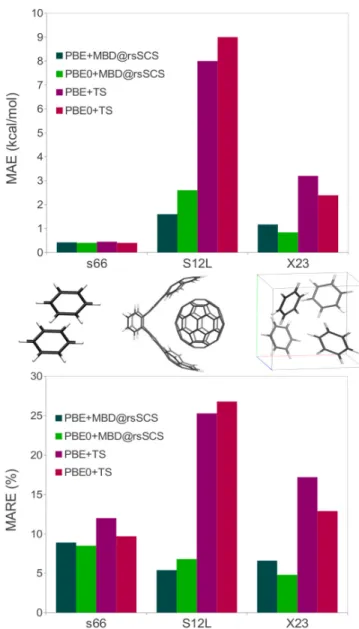
FIG. 3. MAE (upper panel in kcal/mol) and MARE (lower panel in %) for the S66, S12L and X23 databases computed with MBD@rsSCS and TS combined with both the PBE and PBE0 functionals.
TABLE IV. MARE (in %) and MAE (in kcal/mol) in the binding energies of various vdW-inclusive DFT methods when compared to the experimental binding energies of the S12L database. [48] The MBD@rsSCS values are taken from Ref. [11], while the PBE-D3 values are from Ref. [16].
MARE (%) MAE (kcal/mol)
PBE+MBD@rsSCS 5.4 1.6 PBE0+MBD@rsSCS 6.8 2.6 PBE+MBD@TS 10.0 3.3 PBE0+MBD@TS 12.1 4.5 PBE+TS 25.3 8.0 PBE0+TS 26.8 9.0 PBE-D3 5.9 2.1
that many-body contributions can be very system de-pendent. [11] As the many-body contributions are very sensitive to the size, geometry, and electronic properties of a given system, it is difficult to a priori assess the performance of more-empirical pairwise methods, which often have fixed or only locally dependent dispersion co-efficients. In contrast, MBD@rsSCS is able to naturally “adapt” to the different systems through its seamless con-sideration of many-body effects, yielding higher accuracy and good transferability for very different types of sys-tems (See also Figure 3).
E. Molecular Crystals
Moving to even more extended systems we consider the lattice energy of molecular crystals. The X23 database consists of 23 molecular crystals, [14, 49] and was de-rived in part from the database of Otero de la Roza and Johnson. [12] The X23 database is comprised of 11 systems containing predominately dispersion inter-actions between molecules, 9 hydrogen-bonded systems, and 3 systems that feature both types of interactions. The experimental lattice energies were determined us-ing experimental sublimation enthalpies with vibrational contributions from phonon calculations and experimen-tal heat-capacity data, with an estimated uncertainty of 0.5–0.75 kcal/mol. [49]
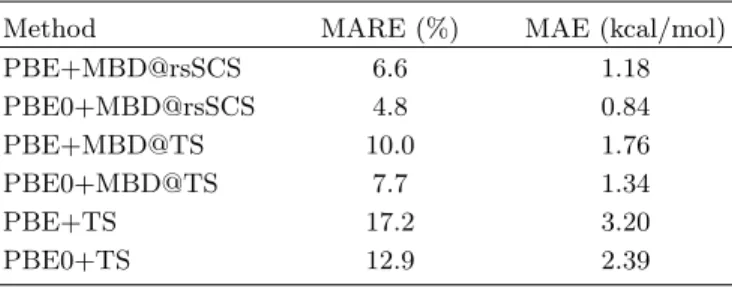
The MAEs and MAREs for various methods are presented in Table V. As noted previously, the pair-wise TS method performs poorly for molecular crys-tals, with a MAE of 2.39 kcal/mol when combined with PBE0. [14, 49] Just as for supramolecular systems, TS overestimates cohesion due to the absence of long-range screening contributions. MBD@SCS yields substantial improvements with PBE0+MBD@SCS having an MAE of 0.94 kcal/mol, [49] below the coveted chemical accu-racy standard of 1 kcal/mol. Range-separation of the electrodynamic screening further improves the perfor-mance, with PBE0+MBD@rsSCS reaching a MAE of 0.84 kcal/mol. As for small molecules, including some exact exchange in the underlying density functional im-proves performance by a significant amount, although the role of many-body vdW contributions is much larger. This may in part be due to a better balance between the modeling of the crystal and the isolated molecules. Delo-calization is inherent in the solid state, in particular for hydrogen-bonded systems, so that self-interaction errors are less of an issue. Using the hybrid functional therefore improves the description of the isolated molecules. In ad-dition, as discussed previously, [11] the “contact area” of these systems is reduced,i.e., there is only limited inter-fragment charge overlap, giving a rather clean separation between short- and long-range effects.
MBD@TS performs markedly better than TS for X23, as was the case for the S12L. However, we can clearly see the importance of the short-range screening that is present in MBD@rsSCS, with the
TABLE V. MARE (in %) and MAE (in kcal/mol) for the X23 database calculated with different vdW-inclusive DFT schemes. The PBE+TS and PBE0+TS values are taken from Ref. [14].
Method MARE (%) MAE (kcal/mol)
PBE+MBD@rsSCS 6.6 1.18 PBE0+MBD@rsSCS 4.8 0.84 PBE+MBD@TS 10.0 1.76 PBE0+MBD@TS 7.7 1.34 PBE+TS 17.2 3.20 PBE0+TS 12.9 2.39
PBE0+MBD@TS MAE being 0.50 kcal/mol larger than PBE0+MBD@rsSCS. In the absence of this screening, MBD@TS overbinds the crystals. This is particularly visible in the highly polarizable adamantane crystal, where MBD@TS predicts a cohesive energy 4.5 kcal/mol larger than that of MBD@rsSCS. At short-range, i.e., within molecules and close fragments, screening of the system can result in strong polarization along chemical bonds, [14] increasing the strength of the long-range cou-pling and screening of the dipole oscillators. This in turn can lead to stronger depolarization and therefore an over-all greater reduction in relative binding energies.
For 21 of the X23 systems a comparison with pair-wise methods can be made using the C21 data of Otero-de-Roza and Johnson. [12, 49] For this dataset, PBE0+MBD@rsSCS achieves an MAE of 0.76 kcal/mol while PBE+MBD@rsSCS has an MAE of 1.07 kcal/mol. In contrast, both B86b+XDM [7, 59] and the vdW-DF2 functional [57] give larger MAEs of 1.13 kcal/mol and 1.53 kcal/mol, respectively. PBE+MBD@rsSCS can be improved to yield chemical accuracy by inclusion of exact exchange (as in PBE0+MBD@rsSCS). How-ever, systematically improving XDM or vdW-DF2 is difficult. B86a+XDM has a negative mean error of
−0.83 kcal/mol, underbinding the crystals. Correctly adding exchange contributions or many-body dispersion effects would in fact worsen its performance, as their ef-fect is to reduce lattice energies even further. Indeed, it has already been seen that adding three-body dispersion energy contributions yields a slightly poorer MAE. [24] Adding higher-order contributions to vdW-DF2, in the form of triple or higher non-local integrals, would raise its computational cost dramatically. The ability to sys-tematically improve the performance of MBD through inclusion of different ranges of screening and many-body contributions (e.g., @TS and @rsSCS) and combination with hybrid functionals is another particular strength of this approach.
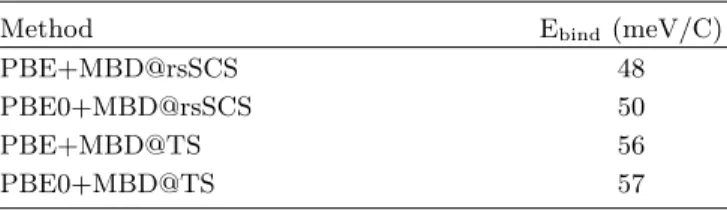
TABLE VI. DFT-calculated interlayer binding energies (in meV per C atom) of bulk graphite at the experimental inter-layer distance.
Method Ebind (meV/C)
PBE+MBD@rsSCS 48
PBE0+MBD@rsSCS 50
PBE+MBD@TS 56
PBE0+MBD@TS 57
F. Graphite Interlayer Binding
As a final example of the performance of the MBD method we consider the interlayer binding energy of bulk graphite with AB stacking at the experimental interlayer equilibrium distance (3.35 ˚A) [60]. Given their highly anisotropic nature, graphite and graphene represent a particularly challenging test case for all dispersion meth-ods. Although graphite does not have a finite gap, only a small fraction of the charge has metallic character. Hence, starting from atomic fragments still represents a reasonable approach to the computation of the long-range correlation energy in this system.
Recently, slow convergence of many-body effects has been observed in graphene, [42] due to the two-dimensional nature of individual sheets of graphene. This suggests that many-body effects will likely play a signif-icant role in governing the binding energy in graphite. This also implies that a large supercell will be required to converge the long-range collective excitations that gov-ern the correlation behavior. For this reason, the long-range correlation energy has been computed by modeling bulk graphite with an 11×11×7 supercell of the unit cell, which corresponds to 3388 atoms. Moreover, interactions with periodic replicas of atoms were considered up to a cut-off radius of 200 ˚A.
The interlayer binding of graphene with MBD is shown in Table VI. MBD@SCS is not reported in Table VI as the isotropization of long-range screened polarizabilities in the MBD Hamiltonian yields an overestimate of the co-hesion of individual graphene sheets. As a consequence, no stability is predicted by MBD@SCS for superposed graphene layers. In contrast, MBD@rsSCS, thanks to its correct RPA treatment of the long-range interaction, avoids the problems related to highly anisotropic sys-tems, and for PBE0+MBD@rsSCS yields an interlayer binding energy of 50 meV per C atom, in excellent agree-ment with an experiagree-mental value of 52±2 meV. [61] Good agreement is also found with the RPA calculation of Dob-son and co-workers, [62] which predicts a binding energy of 48 meV. The difference between PBE0+MBD@rsSCS and PBE+MBD@rsSCS amounts to only 2 meV, i.e., within the experimental error bar. As expected from the results for other extended systems, MBD@TS gives slightly overestimated binding, while PBE+TS severely overestimates the cohesion with an energy of 87 meV.
For two-layer cohesion of graphite, values of 66 and 35 meV were reported for PBE-D2 and PBE-D3, respec-tively. [9] While we can not directly compare with the bulk values calculated here, the PBE-D2 estimate pre-sumably is likely too high, as in the case of PBE+TS. Notably, the PBE-D3 energy appears to be substantially lower. In part this change stems from a reduction of the pairwise component due to a renormalization of the in-teratomicC6coefficients, but a significant contribution is likely due to the inclusion of the three-body ATM energy term. This term has a repulsive character, and could lead to a substantial underestimation of the dispersion energy in the absence of counter-corrections coming from higher than three-body contributions. [11]
VI. DISCUSSION
We now briefly summarize and discuss the applica-tion of the MBD methods to the various benchmark sys-tems. For all but the smallest of the benchmark systems, MBD@rsSCS yields a systematic improvement in bind-ing and cohesion, showbind-ing good applicability for systems ranging from small molecules to complex supramolecu-lar and solid-state assemblies. The sole outlier in this regard are certain systems in the S22 database where underbinding is observed. However, this is likely due to subtle effects and contributions that are poorly described by approximate DFT functionals that do not accurately treat short-range anisotropic interactions. From the good performance of the MBD method for larger, more com-plex systems, it is clear that MBD accurately accounts for the most important long-range contributions. Compari-son with pairwise methods, which neglect the collective many-body nature of dispersion interactions, clearly il-lustrates the importance of many-body contributions in more complex systems, with MBD@rsSCS reaching the uncertainty of the benchmark data for the supramolecu-lar and molecusupramolecu-lar-crystal systems.
The range-separation approach to many-body disper-sion also yields further insight into the role of short- and long-range correlation energy contributions. MBD@TS considers only long-range screening and collective contri-butions to the many-body dispersion energy, and conse-quently overestimates binding. In bulk Si, where long-range collective contributions largely cancel, neglecting short-range screening yields essentially the same polar-izability as the underlying pairwise-additive TS method. This illustrates that an accurate determination of the long-range correlation energy can require accurate mod-eling of correlation effects at all ranges, due to their fun-damentally collective origin. MBD@rsSCS allows one to capture the short-ranged screening contributions and their influence on the long-range correlation energy, while still employing the semi-local DFT correlation at short ranges. This range-separation approach also removes the spurious double counting of long-range screening effects present in MBD@SCS, and further improves on its
per-formance.
In the present work we have employed both a semi-local functional (PBE) [44] and its hybrid variant (PBE0). [45] For small molecules and molecular crystals, the use of a hybrid functional yields systematic improve-ments in the performance of MBD@rsSCS. In the former case this is likely due to a better description of short-ranged correlation, [51] while in the latter case the hybrid functional likely gives a better description of the isolated molecules that the lattice energy is calculated relative to. [14] However, PBE0 yields poorer performance for the supramolecular systems, possibly due to the greater overlap between fragments in these systems, which leads to different contributions than observed in simple dimers or molecular crystals. It is clear that hybrid functionals have a different role in modeling cohesion in the different benchmark systems–a role that apparently influences cor-relation in an indirect manner. It is evident that these hybrid functional contributions must be understood on a more fundamental level, and this is one focus of on-going research. More rigorous range separation includ-ing that of the exchange, or even the use of screened exact-exchange functionals, [31, 58] may offer potential solutions. In this regard we also note that MBD@rsSCS need not be restricted to employing DFT for computing the short-range correlation. The MBD@rsSCS approach could be combined with other range-separated electronic-structure methods, or even more semi- or even fully em-pirical approaches. However, we stress that in combining MBD@rsSCS with DFT we have an approach that yields a robust and transferable description of a wide variety of systems.
As a final note, we emphasize that the computational cost of the MBD approach is largely negligible com-pared to the underlying DFT calculation, requiring only standard matrix operations such as diagonalization, on 3N×3N matrices. There is considerable scope for opti-mization and parallelization of these operations, as well as the potential for straightforward computation of in-teratomic forces (Section IV C). As such, this approach will become suitable for performing ab initio molecular dynamics simulations with an accurate modeling of long-range correlation energies.
VII. CONCLUSIONS
In this work we have developed a highly efficient and accurate method (MBD@rsSCS) for the calculation of the long-range correlation energy in finite-gap systems. This has been achieved in the dipole approximation by mak-ing use of a range-separated electron-electron interac-tion and localized atomic response funcinterac-tions. The range separation enables us to account for short-range correla-tion using a semi-local or hybrid funccorrela-tional, while long-range contributions are accounted for by an effective RPA model based on coupled atomic response functions. The range separation step only requires a single parameter,
which is fitted to accurate quantum chemistry bench-mark data.
Application of this approach to accurate benchmark datasets yields small mean absolute errors superior to pairwise models of dispersion, illustrating the importance of many-body contributions to correlation energies and the ability of MBD@rsSCS to seamlessly account for them. In general, the role of many-body contributions is to reduce cohesion by reducing dispersion interactions. A related method, MBD@TS, which contains only long-range screening contributions to the long-long-range correla-tion energy, yields poorer performance, highlighting the importance of short-range screening and the need for ac-curately balancing short-range and long-ranged contribu-tions to the correlation energy.
Combining MBD@rsSCS with hybrid density function-als, specifically PBE0 in this work, reveals mixed per-formance for the benchmark systems. Whereas PBE0 leads to significant improvements for small molecular dimers and molecular crystals, the description of bind-ing in supramolecular systems is worse. This points to the different role and contributions of exact exchange in the cohesion of different types of molecular systems. The application of more sophisticated treatments for exact exchange [31, 58] may lead to a more fundamental un-derstanding of their role and more uniform overall per-formance.
The MBD@rsSCS method is both accurate and effi-cient, with a computational cost that is negligible with respect to the underlying DFT calculation. With the pos-sibility of an efficient determination of interatomic forces, this method can be applied to a wide range of challeng-ing and complex systems, from molecules to solids, with an accurate and physically motivated description of long-range correlation, even for the study of dynamic proper-ties.
Appendix A: Direct Computation of the Long-Range Correlation Energy from the MBD
Model Hamiltonian
The computation of the many-body dispersion en-ergy EcLR follows from a model of isotropic atom-centered QHOs, which are coupled through a range-separated dipole-dipole interaction. The corresponding MBD model Hamiltonian is defined as: [18, 63]
ˆ HMBD=− N X p=1 ∇2 ξp 2 + N X p=1 ω2 pξ2p 2 + N X p>q ωpωq√αpαqξpTpqξq, (A1) where ξp represents the mass-weighted QHO displace-ment from the pth atomic position, andαp andωp rep-resent the input isotropic dipole polarizability and char-acteristic frequency for the pth atom, respectively, e.g., as determined from the rsSCS procedure. The first two terms in the Hamiltonian represent the kinetic and the potential energy of the individual QHOs. The third is
the two-body coupling among QHOs due to the dipole-dipole tensorT. As discussed in the main text, there are a number of different sets of polarizabilities and frequen-cies that can be used to approximate the response of the system (i.e., TS, SCS, and rsSCS).
As the interoscillator potential energy is bilinear in the spacial displacement variablesξp, the exact ground-state energy can be computed by diagonalizing the 3N×3N(N being the number of atoms) matrix comprised of 3×3 matrices describing the coupling between each pair of atomsiandj:
CMBDij =δijω2i + (1−δij)ωiωj
√
αiαjTij. (A2) The diagonalization of the CMBD matrix leads to a set of 3N eigenvalues λi, corresponding to the squared fre-quencies of 3N “dressed” QHO modes. The interaction energy can then be computed as the difference between the interacting and non-interacting frequencies:
Ec,MBD= 1 2 3N X i=1 p λi−3 2 N X j=1 ωj. (A3)
As already mentioned, under the condition that the dipole-dipole interactionTis frequency independent, the RPA correlation energy for the MBD Hamiltonian ex-actly equals the full MBD interaction energy. [26] As a direct consequence, the MBD model embodies a highly efficient tool for an effective RPA computation of the long-range correlation energy in the dipole limit. We also remark that the present diagonalization procedure
represents a significant simplification with respect to the direct application of the ACFD formula, as it avoids the explicit integration over the frequency variable.
For solids there are two additional considerations required for accurately determining the MBD energy. First, the reciprocal space of the explicit dipole-dipole interactions must be sampled. This can be achieved by performing the MBD calculation on a supercell of the simulation cell. For molecular crystals these supercells are typically of ∼30 ˚A in size in each direction, which is comparable to thek-point sampling of the underlying DFT calculations. [14, 49] Second, to account for the in-teractions of the periodic neighbors of the atoms in the supercell we modify the expression for the elements of theCMBD matrix as follows:
CMBDij =δijωi2+ (1−δij)ωiωj √ αiαj(Tij+ X j0 Tij0), (A4) where the summation over j0 denotes that we consider coupling betweeniand all of the periodic images of thej within a certain spherical cut-off radius (which is typ-ically ∼ 80 ˚A). As noted in the main text, a larger cut-off radius was used for graphite due to the very long-ranged nature of the screening behavior in the con-stituent graphene sheets. [42]
ACKNOWLEDGMENTS
Financial support from the European Research Council (ERC Starting GrantVDW-CMAT) is acknowledged.
[1] K. Burke, J. Chem. Phys.136, 150901 (2012).
[2] P. Hohenberg and W. Kohn, Phys. Rev. 136, B864 (1964).
[3] W. Kohn and L. J. Sham, Phys. Rev.140, A1133 (1965). [4] A. J. Cohen, P. Mori-S´anchez, and W. Yang, Science
321, 792 (2008).
[5] J. Klimeˇs and A. Michaelides, J. Chem. Phys. 137, 120901 (2012).
[6] M. Dion, H. Rydberg, E. Schr¨oder, D. C. Langreth, and B. I. Lundqvist, Phys. Rev. Lett.92, 246401 (2004). [7] A. D. Becke and E. R. Johnson, J. Chem. Phys. 127,
154108 (2007).
[8] K. E. Riley, M. Pitoˇn´ak, P. Jurˇecka, and P. Hobza, Chem. Rev.110, 5023 (2010).
[9] S. Grimme, J. Antony, S. Ehrlich, and H. Krieg, J. Chem. Phys.132, 154104 (2010).
[10] A. Tkatchenko and M. Scheffler, Phys. Rev. Lett. 102, 073005 (2009).
[11] A. Ambrosetti, D. Alf`e, R. A. DiStasio Jr., and A. Tkachenko, J. Phys. Chem. Lett., submitted (2013). [12] A. Otero-de-la-Roza and E. R. Johnson, J. Chem. Phys.
137, 054103 (2012).
[13] N. Marom, R. A. DiStasio Jr., V. Atalla, S. Levchenko, A. M. Reilly, J. R. Chelikowsky, L. Leiserowitz, and A. Tkatchenko, Angew. Chem., Int. Ed.52, 6629 (2013).
[14] A. M. Reilly and A. Tkatchenko, J. Phys. Chem. Lett.4, 1028 (2013).
[15] T. Bj¨orkman, A. Gulans, A. Krasheninnikov, and R. M. Nieminen, Phys. Rev. Lett.108, 235502 (2012).
[16] T. Risthaus and S. Grimme, J. Chem. Theory Comput. 9, 1580 (2013).
[17] R. A. DiStasio Jr., O. A. von Lilienfeld, and A. Tkatchenko, Proc. Natl. Acad. USA 109, 14791 (2012).
[18] A. Tkatchenko, R. A. DiStasio Jr., R. Car, and M. Schef-fler, Phys. Rev. Lett.108, 236402 (2012).
[19] X. Ren, P. Rinke, V. Blum, J. Wieferink, A. Tkatchenko, A. Sanfilippo, K. Reuter, and M. Scheffler, New J. Phys. 14, 053020 (2012).
[20] H. Eshuis, J. E. Bates, and F. Furche, Theor. Chem. Acc.131, 1084 (2012).
[21] J. F. Dobson and T. Gould, J. Phys.: Condens. Matter 24, 073201 (2012).
[22] D. Lu, H.-V. Nguyen, and G. Galli, J. Chem. Phys.133, 154110 (2010).
[23] B. M. Axilrod and E. Teller, J. Chem. Phys. 11, 299 (1943).
[24] A. Otero-de-la-Roza and E. R. Johnson, J. Chem. Phys. 138, 054103 (2013).
[26] A. Tkatchenko, A. Ambrosetti, and R. A. DiStasio Jr., J. Chem. Phys.138, 074106 (2013).
[27] A. Tkatchenko, D. Alf`e, and K. S. Kim, J. Chem. Theory Comput.8, 4317 (2012).
[28] Y. Andersson, D. C. Langreth, and B. I. Lundqvist, Phys. Rev. Lett.76, 102 (1996).
[29] H.-V. Nguyen and S. de Gironcoli, Phys. Rev. B 79, 205114 (2009).
[30] X. Ren, A. Tkatchenko, P. Rinke, and M. Scheffler, Phys. Rev. Lett. 106, 153003 (2011).
[31] J. Paier, B. G. Janesko, T. M. Henderson, G. E. Scuseria, A. Gr¨uneis, and G. Kresse, J. Chem. Phys.132, 094103 (2010).
[32] J. Toulouse, F. Colonna, and A. Savin, Phys. Rev. A70, 062505 (2004).
[33] J. Toulouse, W. Zhu, J. G. ´Angy´an, and A. Savin, Phys. Rev. A 82, 032502 (2010).
[34] S. L. Adler, Phys. Rev.126, 413 (1962). [35] N. Wiser, Phys. Rev.129, 62 (1963).
[36] A. P. Jones, J. Crain, V. P. Sokhan, T. W. Whitfield, and G. J. Martyna, Phys. Rev. B87, 144103 (2013). [37] P. L. Silvestrelli, Phys. Rev. Lett.100, 053002 (2008). [38] O. A. Vydrov and T. Van Voorhis, J. Chem. Phys.133,
244103 (2010).
[39] X. Chu and A. Dalgarno, J. Chem. Phys. 121, 4083 (2004).
[40] Q. Wu and W. Yang, J. Chem. Phys.116, 515 (2002). [41] S. Grimme, J. Comput. Chem.27, 1787 (2006).
[42] V. V. Gobre and A. Tkatchenko, Nat. Commun.4, 2341 (2013).
[43] T. Buˇcko, S. Leb`egue, J. Hafner, and J. G. ´Angy´an, Phys. Rev. B87, 064110 (2013).
[44] J. P. Perdew, K. Burke, and M. Ernzerhof, Phys. Rev. Lett.77, 3865 (1996).
[45] C. Adamo and V. Barone, J. Chem. Phys. 110, 6158 (1999).
[46] P. Jurˇecka, J. ˇSponer, J. ˇCern´y, and P. Hobza, Phys. Chem. Chem. Phys.8, 1985 (2006).
[47] J. ˇRez´aˇc, K. E. Riley, and P. Hobza, J. Chem. Theory Comput.7, 2427 (2011).
[48] S. Grimme, Chem. Eur. J.18, 9955 (2012).
[49] A. M. Reilly and A. Tkatchenko, J. Chem. Phys.139, 024705 (2013).
[50] V. Blum, R. Gehrke, F. Hanke, P. Havu, V. Havu, X. Ren, K. Reuter, and M. Scheffler, Comput. Phys. Commun.180, 2175 (2009).
[51] A. Tkatchenko and O. A. von Lilienfeld, Phys. Rev. B 78, 045116 (2008).
[52] O. A. Vydrov and T. Van Voorhis, Phys. Rev. A 81, 062708 (2010).
[53] D. Bermejo, S. Montero, M. Cardona, and A. Mura-matsu, Solid State Comm.42, 153 (1982).
[54] G.-X. Zhang, A. Tkatchenko, J. Paier, H. Appel, and M. Scheffler, Phys. Rev. Lett.107, 245501 (2011). [55] B. Schatschneider, J.-J. Liang, A. M. Reilly, N. Marom,
G.-X. Zhang, and A. Tkatchenko, Phys. Rev. B 87, 060104(R) (2013).
[56] L. Goerigk, H. Kruse, and S. Grimme, ChemPhysChem 12, 3421 (2011).
[57] K. Lee, E. D. Murray, L. Kong, B. I. Lundqvist, and D. C. Langreth, Phys. Rev. B82, 081101(R) (2010). [58] J. Heyd, G. E. Scuseria, and M. Ernzerhof, J. Chem.
Phys.118, 8207 (2003).
[59] A. Otero-de-la-Roza and E. R. Johnson, J. Chem. Phys. 136, 174109 (2012).
[60] D. D. L. Chung, J. Mater. Sci.37, 1475 (2002).
[61] R. Zacharia, H. Ulbricht, and T. Hertel, Phys. Rev. B 69, 155406 (2004).
[62] S. Leb`egue, J. Harl, T. Gould, J. G. ´Angy´an, G. Kresse, and J. F. Dobson, Phys. Rev. Lett.105, 196401 (2010). [63] W. L. Bade, J. Chem. Phys.27, 1280 (1957).