University of South Florida
Scholar Commons
Graduate Theses and Dissertations Graduate School
2006
Explaining gender differences in salary negotiations
Meisha -Ann MartinUniversity of South Florida
Follow this and additional works at:http://scholarcommons.usf.edu/etd
Part of theAmerican Studies Commons
This Dissertation is brought to you for free and open access by the Graduate School at Scholar Commons. It has been accepted for inclusion in Graduate Theses and Dissertations by an authorized administrator of Scholar Commons. For more information, please contact
Scholar Commons Citation
Martin, Meisha -Ann, "Explaining gender differences in salary negotiations" (2006).Graduate Theses and Dissertations.
Explaining Gender Differences in Salary Negotiations
by
Meisha-ann Martin
A dissertation submitted in partial fulfillment of the requirements for the degree of
Doctor of Philosophy Department of Psychology College of Arts and Sciences
University of South Florida
Major Professor: Joseph Vandello, Ph.D. Michael Brannick, Ph.D. Judith Bryant, Ph.D. Cynthia Cohen, Ph.D. Edward Levine, Ph.D. Date of Approval: October 20, 2006
Keywords: counteroffer, wage gap, diversity, college students, careers © Copyright 2006 , Meisha-ann Martin
Mummy, thank you for always being there for me, believing in me and praying for me. Without you and God this would not have been possible. This manuscript is dedicated to
Table of Contents
List of Tables iii
List of Figures iv
Abstract v Introduction 1
Explanations for the Wage Gap 1
Differential Capital 1
Occupational Choice 3
Effects of Children 5
Household Responsibilities 6
Gender Discrimination 8
Gender Differences in Starting Salaries 9
Gender differences in Salary Negotiations 10
Current Hypotheses 20 Method 22 Overview 22 Participants 22 Materials 23 Pre-Job Questions 23 Salary Expectations 23
Perceptions of the Effectiveness of Stereotypically
Self-Gendered Negotiator Traits 23
Anticipated Opportunity for Negotiation 24
Anticipated Negative Consequences 24
Other Questions 25
Demographic Questions 25
Post-Job Questions 26
Availability of Alternatives 26
Negotiation Style 26
Initial Salary Offer and Final Salary Offer 27
Other Questions 27
Procedure 27
Results 29
Additional Findings 36
Negotiator Traits 36
Importance of Various Aspects of Prospective Job 37
Discussion 39
Limitations and Future Studies 42
References 45 Endnotes 53 Appendices 54
Appendix A: Pre-job Questionnaire 55
Appendix B: Post-job (Emailed) Questionnaire 60
Appendix C: Correlation Between Main Study Variables 65
List of Tables
Table 1 Summary of Regression Results for Variables Predicting of
Starting Salaries (N=85) 34
Table 2 Summary of Regression Results for Variables Predicting of
Starting Salaries in a Mediational Relationship (N=85) 35
Table 3 Mean Rated Importance of Various Aspects of Prospective Job
List of Figures
Figure 1 Distribution of Initial Salary for Males and Females 31
Explaining Gender Differences in Salary Negotiations Meisha-ann Martin
Abstract
The current study explores the effects of gender on salary negotiation behaviors and expectancies and the relationship between these variables and starting salary outcomes. College students from a variety of different majors were surveyed prior to and then approximately two to four months after graduation. Though there was no gender
difference in final salary or difference between initial and final salary offer, men reported using more aggressive and active salary negotiation behaviors. The results also suggest that men may have felt more empowered in the salary negotiation context. They expected higher salaries than women did, anticipated less discomfort and believed themselves to be less emotional in the salary negotiation context. In addition, males and females both considered stereotypically masculine traits as more effective in the negotiation context than stereotypically feminine traits and this difference was even larger for women than it was for men. Despite the above findings, the absence of gender differences in starting salary outcomes may have been caused by the perception that salary was non-negotiable, as few participants in this study made counteroffers. Future studies are needed to expand the number of field studies on gender differences in salary negotiation and to examine the variables above using a more diverse sample.
Introduction
According to the Current Population Survey (CPS) of 2004 administered to men and women in the United States, median weekly earnings for women who are full-time wage and salary workers are only about 80% of median weekly earnings for men who are full-time wage and salary workers. This number has increased from 78% in 2002 and 63% in 1979 (U.S. Department of Labor, 2005). Still, this salary gap persists regardless of how earnings are defined (annual vs. weekly, mean vs. median), across racial/ethnic groups, across educational categories, over the life cycle, within detailed occupational categories and across cultures (Roos & Gatta, 1999).
The reasons for the disparity between the wages of men and women are
undoubtedly complex and multi-determined, and many different reasons have been put forward to explain the gap. The purpose of this dissertation is to examine some of these reasons and explore gender differences in salary negotiation as an additional factor that contributes to the salary gap between men and women in the United States.
Explanations for the wage gap Differential capital
According to Marini and Fan (1997), the most popularly hypothesized and studied explanation for the wage gap is the differences in labor market skills and credentials between men and women. According to this explanation, called the human capital explanation, men and women anticipate different adulthood experiences because of
different socialization experiences. For example, when anticipating what the future holds, men may focus more on career experiences whereas women may focus more on family experiences. These different foci lead women to concentrate more on developing skills that are career unrelated and men to concentrate more on developing skills that are career related (Becker, 1981). The resulting superior market skills and credentials possessed by men help them earn higher wages. Thus, according to this argument, it is not gender per se that accounts for the wage gap, but rather differences in human capital associated with gender. Research on this issue has lent partial support to this idea, indicating that some, but not all, of the gender differences in salary can be explained by differences in skills, credentials and experience.
In order to investigate the human capital hypothesis of gender wage differences, Kilbourne, England, Farkas, Beron and Weir (1994) analyzed data from a national probability sample (National Longitudinal Study) of males and females aged 14-24. The data were collected between 1968 and 1981. Consistent with the human capital
hypothesis, the data showed that the males in the sample had an average of almost one year of job experience more than the women did. This difference in experience accounted for 21%-24% of the salary gap found in the sample. Males also had very little additional education compared to the women (about .1 year), but even this small difference
accounted for 4% of the salary gap.
Women encountered quite a few vocational-related changes in and after the 1980’s (Blau & Kahn, 1997). For one, the salary gap between men and women narrowed.
Women earned, on average, 62.4% of what men earned in 1967 and 1969; by 1991 this number rose to 74% (U.S. Department of Labor, 2005). Secondly, women, on average,
gained more labor market experience relative to men in the 1980s (O’Neill & Polachek, 1993; Wellington, 1993).
Blau and Kahn (1997) examined the education and experience of men and women in a sample of data collected in 1979 and 1988. In addition to capturing the changes that occurred in the gender gap in the 1980’s, this sample of data also improved on the data collected by Kilbourne et al. (1994) by surveying men and women of a broader age range (18-65). Analysis of the data showed that despite increases in the education and
experience of women, women still lagged behind men on these human capital variables and these lower levels of human capital, primarily experience, still accounted for about 30% of the salary gap. These findings are consistent with those of Kilbourne et al. (1994), reviewed above.
Occupational choice
Men and women also tend to choose different occupational paths (Anker, 1997). These choices are related to gender socialization. Women are socialized to be caregivers and so tend to choose occupations that utilize nurturing skills, even though such
occupations are undervalued in the labor market.In contrast, jobs requiring authority, which is a personality trait culturally associated with men, command more of a salary (England, 1992). This effect is consistent even among men and women with similar amounts and types of education (Marini & Brinton, 1984).
Childhood socialization and cultural norms also teach children which jobs are associated with men and which jobs are associated with women. In research on children’s perceptions of gender-typed occupations, Levy, Sadovsky and Troseth (2000)
considered masculine and which occupations are considered feminine. Consistent with societal norms and expectations, young women encounter social pressure to choose careers and jobs that are considered appropriate for women (Eccles, 1994; England & McCreary, 1987; Jacobs, 1999; Reskin, 1993), suggesting that “choice” may be constrained by cultural expectations.
Jacquelynne Eccles spent 15 years studying the issue of occupational choices of men and women. Her model suggests that achievement-related choices (including occupational choice) depend on gender role stereotypes, cultural stereotypes of occupational characteristics, the person’s perception of gender roles, and the person’s expectation of success. Eccles concludes that, even though vocational decisions involve an element of choice, the outcome of the choice is heavily influenced by socialization pressures and cultural norms (Eccles, 1994).
According to Eccles (1994), individuals tend not to consider all the available options when making a vocational decision. They tend not to consider options if they are not aware of an option or if they have inaccurate information regarding the option itself or the possibility of achieving the option. For women, this means that traditionally “male” careers are often not chosen because they are never presented at all or never fully considered as an achievable option based on the cultural stereotype that such careers are inappropriate or difficult to achieve for women. Based on this process, women are funneled into lower paying jobs that are deemed socially and culturally acceptable.
Research supports the occupational segregation explanation for the wage
Morgan (1995) indicates that occupational segregation accounts for up to 40% of the difference in salary between men and women.
Effects of children
As a group, women may be paid less than men because women who have children suffer a salary penalty for having children while men who have children do not. Using the 1982 wave of data from the National Longitudinal Survey of Young Women (ages 28-38), Korenman and Neumark (1992) found that the presence and number of children in the home had a negative impact on the salary of females. In contrast, the presence and number of children in the home had a positive impact on the salary of males. Using 1968-1988 data from the National Longitudinal Survey of Young Women (the NLS-YW), Waldfogel (1997) estimates that the salary penalty for women for having one child is 5% and the salary penalty for having two or more children is over 13%.
According to Waldfogel (1997), the salary penalty suffered by women with children occurs partly because children tend to reduce women’s work experience. The direct effect of children on women’s salaries comes from the actual or perceived reduced productivity that is a result of child bearing and rearing. Some of the salary penalty suffered by women with children can also be attributed to the indirect effects of part-time employment.1 Wages for part-time jobs tend to be lower than wages for full-time jobs and mothers are more likely than non-mothers to hold part-time positions. However, Jacobsen and Levin (1995), Korenman and Neumark (1992) and Waldfogel (1997) all found that controlling for labor market experience eliminated most, but not all, of the salary penalty suffered by women with children. This failure to account for a portion of
the salary penalty suggests that there are other factors that account for the salary penalty suffered by women with children.
According to Taniguchi (1999), the timing of childbearing is another factor to consider when looking at the salary penalty suffered by women with children. Drawing from life course theory and its attention to the timing of life events and their
consequences, Taniguchi maintains that women who first bear children early in life tend to spend less time preparing for their careers. As a result, when they re-enter the
workforce, they are more likely to take low paying jobs. In contrast, women who first bear children later in life avoid interrupting their careers in the critical stages of career-building and so experience a much smaller wage loss.
Taniguchi’s (1999) analysis of 1968-1988 National Longitudinal Survey data supported her hypothesis; women who first gave birth at age 28 or older had significantly higher hourly salaries than did women who first gave birth at an earlier age. In addition, women who first gave birth at age 28 or older earned wages that were not significantly different from wages earned by women who had had no children. This absence of the salary penalty for having children can be partly explained by differences in education; late child bearers were significantly more educated than women who had first given birth at an earlier age.
Household responsibilities
Disproportionate household responsibilities may also help explain the wage gap. Women spend far more time raising children and taking care of the household than do men (Hersch, 1991; Shelton, 1992). Using 1979-1987 data from the University of Michigan’s Panel Study of Income Dynamics (PSID), Hersch and Stratton (1997)
estimated that women spend about 19 hours a week on housework while men spend about 7.2 In addition, there is a significant inverse relationship between the amount of time spent doing housework and wages for women but not for men (Hersch, 1991, Noonan, 2001). Therefore, the disproportionateness of household responsibilities does not fully explain the relationship between women’s household responsibilities and the salary penalty they suffer.
According to Noonan (2001), this relationship can be explained by the different types of household responsibilities typically allocated to men and women. Women tend to be responsible for tasks associated with childcare, like getting children up for school in the mornings, preparing the evening meal and doing the laundry (Berk, 1985; Thompson & Walker, 1989). These types of tasks need to be performed on a regular basis and offer little discretion in when they are performed (Shaw, 1988). As a result, these types of tasks are more likely to interfere with work responsibilities; individuals who perform these types of tasks are less able to arrive at work early or stay late for special training opportunities (Baxter, 1992). In this way, these types of household responsibilities present a barrier to accumulating experience and seniority at work (Noonan, 2001).
Men, on the other hand, tend to be responsible for tasks that do not revolve around daily child care, like household repairs and automobile maintenance (Meissner, 1977).These tasks are usually discretionary and infrequent (Shelton & Firestone, 1988) and so tend to interfere less with paid work (Noonan, 2001).
Using Wave 1 (1987-1988) and Wave 2 (1992-1994) data from the National Survey of Families and Households (NSFH), Noonan (2001) tested the above hypotheses by disaggregating housework into “female”, “male” and “neutral” tasks and using a
fixed-effects regression model to assess the direct fixed-effects of time spent on these different types on tasks on hourly wages. Consistent with the hypothesis, Noonan found that “female” tasks had a significant negative effect on the wages of both men and women. For women, an hour increase in “female” housework was associated with a decrease in hourly salary of 0.5%; for men, this number was 0.4% (no significant difference). “Male” and “neutral” tasks did not significantly impact salaries for men or women. These results suggest that the salary penalty associated with housework for women is a result of the amount and type of housework they perform.
Gender discrimination
Many experts called to testify at a Congress hearing on this subject argued that the wage gap is at least partly due to gender discrimination (Gender-based wage, 2000). The experts pointed to the devaluing of “female” occupations as an effect of gender
discrimination. Empirical evidence shows a negative correlation between salary and the proportion of females in an occupation (O’Neill, 1983). In addition, one study by the Institute for Women’s Policy Research found that when jobs were evaluated using
uniform criteria, comparable jobs paid less when women held them (Gender-based wage, 2000). Even men who work in predominantly female occupations earn less than
comparable workers in other occupations (Blau & Kahn, 1997). Peterson and Saporta (2004) call this tendency to pay lower salaries in occupations dominated by women even though skill requirements and other wage-relevant factors are the same “valuative
discrimination”.
Peterson and Saporta (2004) also argue that society also discriminates against women by matching men and women to different types of jobs at the time of hire and
promoting and dismissing men and women differently. They call this type of discrimination “allocative discrimination.” In support of this point, Goldin and Rouse (2000)showed that the use of screens to conceal the identities of candidates from juries in auditions for symphony orchestras markedly increased female musicians’ chances of success and raised their odds of being hired.
Each of the above theoretical accounts explains the wage gap with respect to the different work experiences of men and women. However, experts point to existence of a wage gap even when men and women work in the same occupation, have the same amount of education, the same amount of job experience and when both the men and women surveyed work full-time.
Gender differences in starting salaries
Another proposed reason for the salary gap between men and women is the difference in starting salaries. This difference accounts for a large proportion of the difference in base pay (Gerhart, 1990). According to Gerhart (1990), differential salary setting is more likely for new hires than for longer tenure employees. Negotiating for initial salary not only increases the salary offered (Gerhart & Rynes, 1991), further salary increases are usually given as a percentage of the salary initially negotiated (Milkovich & Newman, 1987). As a result, any starting salary differences between men and women only magnify with each successive salary increase. This idea was supported by Gerhart’s (1990) examination of the salary difference between men and women. Gerhart found that men and women’s salaries differed even after controlling for year of hire, potential
experience, degree, college major, firm tenure, performance and job title. In addition, he found that the salary disadvantage could be traced to starting salary differences. He
concluded that starting salaries play a major role in the salary differences between men and women.
Of course, noting that there are gender differences in starting salaries only begs the question of why starting salary differences exist in the first place. There are at least two categories of reasons why starting salaries differ for men and women. On the one hand, employers may evaluate women’s qualifications less favorably than men’s qualifications. Due to the subjective nature of evaluating formal qualifications such as degree, grades and experience, this is a juncture where differential treatment of men and women can easily occur and is easily justified (Norton, Vandello, & Darley, 2004; Peterson & Saporta, 2004). In addition, female and male applicants may approach salary negotiations differently.
According to a 1998 report by the Council of Economic Advisors that
summarized many of the available studies of the explained and unexplained portion of the gender pay gap, there is still a significant portion of the wage gap (about 12%) that cannot be explained by human capital differences between the genders or differences in the characteristics of the jobs they hold. Researchers have begun to examine the
consequences of women’s effectiveness at and propensity to negotiate for salary at the time of hire as an additional contributor to the wage gap between men and women.
Gender differences in salary negotiations
Although previous research indicates that women are no less likely than men to negotiate for salary (Gerhart and Rynes, 1991; O’Shea & Bush, 2002), evidence shows that women obtain less salary from salary negotiations (Gerhart and Rynes, 1991).
Gerhart and Rynes (1991) surveyed a total of 205 job-seeking recent MBA graduates (153 men and 52 women) from an Ivy League business school in order to empirically investigate the behaviors they used to negotiate their starting salaries. Gerhart and Rynes found that, although men were no more likely to negotiate for salary than women were, men who negotiated obtained significantly higher increases in salary than women who negotiated. The women who negotiated only received, on average, a 2.7% increase in salary while the men received, on average, an increase of 4.3%. This translated to an increase of $1,231 for women and $1,973 for men.
Thus, differences in starting salary outcomes may be due to the different
negotiation strategies chosen by men and women. A study by Kaman and Hartel (1994) illustrates these differences. Participants were given a hypothetical job description and company information and asked to indicate their planned strategies for salary negotiation by completing a questionnaire on salary negotiation strategies. Women indicated less of a preference for active negotiation strategies such as not accepting the first salary offer and asking for more than they expect the employer to offer than did men. Women also
indicated more of a preference for more traditional and passive self-promotion
negotiation strategies such as emphasizing the relevance of education than did men. A meta-analysis done by Walters, Stuhlmacher and Meyer (1998) offers more information on the difference between how men and women prefer to negotiate. According to this meta-analysis of 62 laboratory studies, women consistently employ more cooperative strategies in the negotiation context than do men. In other words, women tend to avoid conflict and are more easily influenced by attempts at persuasion in the negotiation context.
These negotiation style preferences are consistent with traditional gender stereotypes. Accordingly, in the negotiation context, men are expected to be more assertive, strong and firm against compromise while women are expected to be more emotional, relationship-oriented and accommodating (Kray, Thompson & Galinsky, 2001).
Williams (1993) studied the negotiation strategies used by a group of experienced lawyers who were considered effective by their peers (other lawyers who were familiar with their work). Williams claims to approach his writings on negotiation from a descriptive rather than prescriptive manner. A prescriptive approach outlines how negotiations should be done; a descriptive approach outlines the common negotiation strategies of large numbers of experienced and successful negotiators.
Williams mailed a questionnaire to several lawyers asking them to: describe a lawyer that you have negotiated with in the past that was so effective that you would hire them to represent you if you were involved in a similar case in the future. He also asked for descriptions of average and ineffective negotiators using similar language. Williams then asked the lawyers to describe the behaviors of each type of individual. The result of Williams’ data showed that effective lawyers could display either an aggressive or cooperative pattern.
According to Williams (1993), effective negotiators who use a primarily aggressive approach tend to start negotiations with high demands, claiming as much value for themselves as they possibly can. In other words, they tend to take a win-lose approach to negotiation so, in this case, men tend to think that the negotiation has a clear winner and a clear loser and they want to be the winner. This translates to starting the
negotiation with high demands and trying to outmaneuver the opponent. In the case of salary negotiations, this would mean starting negotiations with a salary higher than the one the employer is expected to offer or pay and focusing on obtaining the highest salary possible from the negotiation.
Effective negotiators who use a primarily cooperative approach, according to Williams (1993) epitomize the spirit of “win-win” negotiating. While they too consider maximizing the outcomes for themselves as important, they are not as concerned with this as aggressive negotiators are. Instead they are more concerned about conducting themselves ethically and making sure the outcome is fair for both parties.
Based on the empirical evidence that women tend to be more accepting of lower salaries and more likely to accept the initial salary offer (Kaman & Hartel, 1994; Tromski & Subich, 1990), women seem to not fit the profile of effective aggressive negotiators. These tendencies may adversely impact women’s salaries because the higher the salary requested by an applicant, the higher the salary offered by the potential employer (Major, Vanderslice & McFarlin, 1984). It is possible that women are effective cooperative negotiators. An effective cooperative negotiator would consider salary negotiations in the broader context and concede some portion of salary for other job related perks in order to make sure the end result is fair for both parties. This approach is not incorrect but this willingness to concede some salary for other benefits may help to explain starting salary differences between men and women.
The “female” approach to negotiation may be unsuitable for maximizing salary outcomes salary negotiation because salary negotiation can be thought of as a distributive or win-lose negotiation in the sense that a gain for one party constitutes a loss for the
other party because there is a set sum of money to be distributed and both parties are attempting to keep as much of it as possible. The employer and the person hired have salary goals that are mutually exclusive. In contrast, integrative negotiation refers to a situation where multiple issues are discussed are negotiated. In such cases, it is possible for both parties to compromise and collaborate to find a win-win solution. Salary
negotiation could also be approached in this fashion if other issues are considered such as vacation and benefits, which is often the case. A cooperative strategy seems to be more consistent with an integrative negotiation. This approach to salary negotiation, while beneficial in the sense that compromise is achieved and both parties experience wins, may not necessarily the best for achieving the highest salary possible. These ideas are consistent with findings from Stuhlmacher and Walter’s (1999) meta-analysis which showed that women fared better in integrative negotiations than in distributive ones and findings from Gerhart and Rynes (1991) and Stevens, Bavetta and Gist (1993) that show that women negotiate lower salaries than men do. In other words, women may negotiate lower salaries because they use an integrative strategy (which they are better at) for salary negotiation and men use a distributive strategy.
Again, it is conceivable that an integrative approach could be successful in the salary negotiation context especially if the definition of success is expanded beyond simply achieving the highest salary possible. This is consistent with Williams’ (1993) findings that effective negotiators can either be cooperative or aggressive and with Fisher, Ury and Patton’s ideas that negotiation is most successful when relationships are considered and taken into account (Fisher, Ury & Patton, 1993). In fact, Williams found that when rated by their peers, negotiators who were primarily cooperative were
considered effective 59% of the time while negotiators who were primarily aggressive were considered effective only 25% of the time. Unfortunately, the stereotypes associated with successful negotiation are more aggressive in nature and so may result in a
disadvantage for women because of the lack of correspondence between “female” traits and the traits generally associated with the stereotypically successful negotiator (Kray,
Thompson & Galinsky, 2001). Activation of a stereotype often leads to behavior
consistent with that stereotype (Bargh, Chen, & Burrows, 1996; Wheeler & Petty, 2001). As a result, the association of gendered stereotypes with negotiation may lead women to under-perform relative to their male counterparts (Kray, Thompson & Galinsky, 2001), possibly because the traits associated with the stereotypically successful negotiator tend to be masculine, not feminine in nature (Kray, Thompson & Galinsky, 2001).
The differences in negotiation approaches are further exacerbated by the fact that women tend to consider negotiation in the broader context of past and future interactions (Kolb & Coolidge, 1991) and use negotiation as a tool to further their acceptance by others (Barron, 2003). As a result, women also tend to be very aware of the relationship between the negotiating parties and the impact of their behavior on future interactions (Kolb & Coolidge, 1991). In contrast, men tend to view negotiation as an isolated incident, not in the context of past and future interactions (Kolb & Coolidge, 1991) and are motivated primarily to further their own interests (Barron, 2003; Williams 1993).This difference in viewpoints may explain women’s preference for a cooperative negotiation style (as discussed above). Women may be afraid that being competitive and aggressive in salary negotiations will harm future relationships. Men, on the other hand, tend to be more task-oriented. They want to resolve the matter at hand and so, unlike women, they
do not focus on the other parties’ feelings or perceptions (Kolb & Coolidge, 1991). This may allow them to more easily adopt the aggressive strategy that seems to work best to maximize salary outcomes in salary negotiations.
Training has proven effective at increasing salary negotiation outcomes for
women thus closing the gap between the salary negotiation outcomes of men and women. Stevens, Bavetta and Gist (1993) provided participants (MBA students) with a self-management training intervention that focused on anticipating performance obstacles, planning to overcome performance obstacles, setting goals to overcome obstacles, monitoring one’s progress, and rewarding one’s goal attainment. In the subsequent mock salary negotiation exercise, women who participated in the training not only negotiated higher salaries than they did before training, they negotiated salaries that were
approximately equivalent to the salaries negotiated by their male counterparts even though men outperformed them prior to the intervention. This study also demonstrated that women set significantly lower salary goals than men. This may help to explain why women tend to negotiate lower salaries than men (Gerhart & Rynes, 1991; Stevens, Bavetta and Gist, 1993).
Gender differences in the reference points used in salary negotiation may be yet another reason why women tend to negotiate lower salaries than men. According to Lewicki and Litterer (1985), there are four reference points used by applicants in salary negotiation. First, there is the applicant target point, which is the salary the applicant hopes to receive; second, there is the recruiter target point, which is the salary the applicant believes the employer will offer; third, there is the applicant resistance point,
which is the lowest salary the applicant will accept; and fourth, there is the recruiter resistance point, which is the highest salary the applicant thinks the recruiter could offer.
Kaman and Hartel (1994) asked participants to indicate their reference points after reading a vignette. Men and women did not differ in their beliefs of what the recruiter would offer (recruiter’s target point). They did, however, differ in terms of the salaries they hoped to receive (applicant target point), the lowest salaries they would accept (applicant resistance point) and the highest salary they thought the recruiter could offer (recruiter resistance point).
These differences illustrate the point that women have lower pay expectations than men and are consistent with the findings of Stevens, Bavetta and Gist (1993) described above. Martin (1989) not only provided additional support for this idea in her study, she demonstrated that gender differences in salary expectation persisted despite subjects’ knowledge of current salary data. Martin, who hypothesized that there would be no gender differences in pay expectations when men and women were provided with the same salary information, suggested that women might have disregarded the salary information because it was an average for men and women. Referring to previous research by Major and Forcey (1985), which indicates that individuals prefer salary information from same gender others, she suggested that women may have disregarded the salary information given and used information they had previously collected instead. The use of same-sex referents would explain women’s lower salary expectations because it has been demonstrated that salary differences exist even when men and women are employed in comparable occupations and other factors such as education level and amount of work experience have been controlled for (Jagacinski, 1987).
These relatively low pay expectations are important to the understanding of why women receive lower salary outcomes from salary negotiations. Given that women tend to be cooperative negotiators (Walters, Stuhlmacher & Meyer, 1998) and so are
motivated to receive fair compensation (Williams, 1993), if their idea of fair compensation is different from that of a man as evidenced by the difference in pay
expectations (Kaman and Hartel, 1994; Martin, 1989; Stevens, Bavetta and Gist, 1993), it stands to reason that women receive lower salary outcomes from salary negotiations. According to Major, Vanderslice and McFarlin (1984), pay expectations are linked to pay requests, which in turn are linked to salary offers. Therefore, for women, low pay
expectations lead to low pay requests and low salary offers.
Kaman and Hartel’s (1994) study also suggested that women perceived less opportunity for negotiation than did men, providing another possible explanation for women’s relative disadvantage in salary negotiations. Kaman and Hartel assessed opportunity for negotiation two different ways. First, they measured the difference between applicant and recruiter target points. This represented how far the participants believed their desired salary outcome would be from that of the recruiter. Second, they measured the difference between recruiter target and resistance points. This represented participants’ beliefs about how far recruiters would move from their initial salary offer.
For both measurements of opportunity for negotiation, there were larger differences for men than for women. In other words, there was a larger difference between what the applicant hoped to receive (applicant target point) and what the recruiter was expected to offer (recruiter target point) as well as between what recruiter was expected to offer (recruiter target point) and the highest possible salary the applicant
believed the recruiter would offer (recruiter resistance point) for men than for women. Larger differences indicate more room to negotiate and smaller differences indicate less room to negotiate since larger differences point to the opportunity to obtain more resources as a result of negotiating.
Women may also be afraid of the consequences of negotiating aggressively for salary. Wade (2001) argues that behaviors that could increase a woman’s initial salary may undermine her ability to function in the job she subsequently undertakes. Because men and women are typically expected to behave in stereotypically appropriate fashions (Johnson, 1976), women who self-promote (stereotypically inappropriate) are less liked than women who self-efface (stereotypically appropriate) while men who self-promote (stereotypically appropriate) are more liked than men who self-efface (stereotypically inappropriate) (Rudman, 1998). Decreased likeability is associated with decreased influence (Rudman & Glick, 1999), especially when women are attempting to influence men (Carli, 1990).
Price Waterhouse v. Hopkins (1989) provides an example of the adverse effects for women who behave in a counter-stereotypical fashion. Hopkins’ evaluations showed that she was an excellent performer; clients were pleased with her work, she was a good project leader, worked long hours and met her deadlines. Still, she was denied partnership because she acted too “macho,” she “overcompensated for being a woman” and they objected to her use of foul language, claiming that it was problematic because she was female. Price Waterhouse’s policy board decided to hold Hopkin’s partnership stating that she could still become a partner if she walked, talked and acted more femininely and if she wore make-up and jewelry and styled her hair. Even though Price Waterhouse was
ordered to pay $371,000 in back pay by the court, there are conceivably other cases that have not or will not be prosecuted. Women who choose not to act more aggressively in salary negotiations may be acting in fear of similar outcomes.
There is yet another reason why women may not benefit as much as men do from salary negotiation. According to Raiffa (1982) and Thompson (2001), the ability to walk away from the current negotiation in order to pursue other alternatives is a key source of power in negotiations. Negotiators with alternative options tend to perceive themselves as having more power in negotiations, make reference to their other options, and perform better in salary negotiations (Kray et al., 2004). It is possible that women achieve lower salary outcomes because they lack (or believe they lack) alternative job offers.
In summary, the research indicates that salary expectations, anticipated opportunity for negotiation, anticipated negative consequences of using aggressive negotiation tactics, availability of alternatives and perception of the effectiveness of stereotypically self-gendered negotiator traits are or could be associated with women’s choice of a negotiation style and, subsequently, their salary outcomes after negotiation.
Current hypotheses
In the present study, I considered all the variables mentioned above in order to explain and predict salary outcomes of men and women. It was expected that salary expectations, anticipated opportunity for negotiation, anticipated negative consequences of using aggressive negotiation tactics, the availability of other alternatives and the perception of the effectiveness of stereotypically self-gendered negotiator traits would all differ by gender and would all independently and significantly predict salary outcomes.
In addition, negotiating style used was expected to mediate the relationship between all predictors and the salary outcomes for men and women. Salary outcomes were
operationalized in two different ways: as starting salaries and as difference between initial salary offer and final salary offer.
Hypothesis 1: Women will have lower salary expectations and perceive less opportunity
for negotiation, fewer alternative job offers and perceive stereotypically self-gendered negotiator traits as less effective than men will.
Hypothesis 2: Women will anticipate more negative consequences of negotiation than
men will.
Hypothesis 3: Salary expectations, perception of the effectiveness of stereotypically
self-gendered negotiator traits, anticipated opportunity for negotiation, anticipated negative consequences of negotiation and availability of alternatives will all independently and significantly predict starting salaries.
Hypothesis 4: Negotiation style will mediate the relationship between the above
variables and starting salaries.
Hypothesis 5: Salary expectations, perception of the effectiveness of stereotypically
self-gendered negotiator traits, anticipated opportunity for negotiation, anticipated negative consequences of negotiation and availability of alternatives will all
independently and significantly predict the difference between initial salary offer and final salary offer.
Hypothesis 6: Negotiation style will mediate the relationship between the above
Method
Overview
This study examined male and female graduating college students’ salary
expectations, perceptions of the effectiveness of stereotypically self-gendered negotiator traits, anticipated opportunities for negotiation and anticipated negative consequences of negotiating counter-stereotypically using a questionnaire that was administered to students 2-4 months before they graduated (see Appendix A). Two to four months after graduation when they found employment, participants were re-contacted with an email survey that assessed the availability of alternatives, negotiation strategies used and initial and final salary offer (see Appendix B).
Participants
Two hundred and thirty seven participants were used for this study. The sample was approximately 58% female (N = 137) and 42% male (N = 100). The median age of
the sample was 23 (SD = 5.95). The sample was mostly White (66.2%), but was also
made up of Blacks/African-Americans (16%), Hispanics (7%), Asians (6%) and other races (3.4%). Fifty-seven percent of the sample had a Business major, thirty-eight percent had an Arts & Science major, eight percent had an Engineering major and one percent had a double major. This coding scheme is similar to those used in other studies that examine college major as a variable (Morgan, Isaac & Sansone, 2001; McLean & Kalin,
1994). Participants who indicated that they did not intend to seek full time employment after graduation were not eligible for this study and their data were not used.
The pre-job questionnaire was filled out by the entire sample (237 participants) and the post-job questionnaire was filled out by 159 participants (response rate: 67%). Of these 159 participants, 102 reported that they had accepted jobs and so were able to fill out the portions of the questionnaire that related to negotiating for salary. The response rate of participants with jobs did not differ by gender χ2(1, N = 102) = .51, ns), 45% of women responded versus 41% of men. Of the participants that accepted jobs, 21% of the jobs accepted were salaried, 56% were hourly, 20% were commission and 2% were unknown.
Materials Pre-job questions
Salary expectations. Consistent with previous research (Martin, 1989; Sumner & Brown, 1996), salary expectations were measured using the following question: “How much money do you expect to earn your first year working full-time (in today’s dollars)?”
Perceptions of the effectiveness of stereotypically self-gendered negotiator traits. Based on a study by Kray, Galinsky and Thompson (2002), Raiffa’s (1982) list of
successful negotiator traits were divided into masculine traits, neutral traits and feminine traits. Participants were given this list of traits (without information about the gender associated with each trait) and asked to rate the extent to which the traits that trait would be effective in the salary negotiation context. Only the list of four masculine traits (α = .49) and the list of four feminine traits (α = .48) were used in analyses.
The perception of the effectiveness of stereotypically self-gendered negotiator traits was assessed by averaging the rated effectiveness of traits stereotypically associated with one’s gender. In other words, a woman’ score on this variable was calculated by finding the average rated effectiveness of the feminine traits, and a man’ score on this variable was calculated by finding the average rated effectiveness of the masculine traits.
Anticipated opportunity for negotiation. Consistent with the approach taken by Kaman and Hartel (1994), anticipated opportunity for negotiation was measured by assessing applicant and recruiter target points. The applicant target point was measured using the following question: “What is the highest salary you can realistically hope to receive your first year working full-time (in today’s dollars)?” The recruiter target point was measured using the following question: “What is the yearly salary (in today’s dollars) you believe an employer will offer?” The greater the difference between the two target points, the greater the anticipated opportunity for negotiation.
Anticipated negative consequences. Because the literature suggests that
anticipated negative future consequences of an aggressive negotiation style would be in the form of punishment for behaving in a counter-stereotypical fashion (Price
Waterhouse v. Hopkins, 1989; Wade, 2001), this variable was assessed using questions that asked about the expectation of being perceived negatively for acting in a way that is gender inappropriate. The questions were based on research that suggests that self-promotion is more appropriate for men and self-effacement is more appropriate for women (Rudman, 1998). Participants were asked to indicate the degree to which they agreed with the following statements (on a scale of 1-5 with 1 being Strongly Disagree, 3 being Neither Agree or Disagree and 5 being Strongly Agree): “I am afraid the prospective
employer will think that I am overbearing if I strongly promote my abilities.” “The
prospective employer will think that I am a strong job candidate if I strongly promote my abilities.” “The prospective employer will be impressed with me if I am modest.” “The prospective employer will think I cannot stand up for myself if I am modest.” Therefore, for women, anticipated negative consequences of behaving in a counter-stereotypical fashion was assessed based on their responses to the two self-promotion items (r = -0.22, p =.001) and for men, anticipated negative consequences was measured using the
modesty items (r = -0.22, p < .001).
Other questions. Participants were also asked to anticipate how comfortable they thought they would feel in the negotiation situation; they were asked to rate the following statement: “I anticipate feeling uncomfortable during the negotiation process.” (on a scale of 1-5 with 1 being Strongly Disagree, 2 being Somewhat Disagree, 3 being Neither agree nor disagree, 4 being Somewhat Agree and 5 being Somewhat Disagree).
Finally, participants were asked to rate the importance of aspects of a prospective job (location, organization’s commitment to diversity, getting a good salary, flexibility of hours, good benefits, sign-in bonus, annual bonus, annual bonuses, stimulating work environment, friendly colleagues, appealing location).
Demographic questions. All participants were asked to provide the following demographic information as part of the pre-job questionnaire: age, gender, race, major, year in college, anticipated graduation date (month/year), type of job that was being sought, parents’ phone number, and email address. The email address was used to contact participants for the second survey. The parents’ phone number was used to make follow up calls to the participants.
Post-job questions
Availability of alternatives. The availability of alternatives was measured using the following directions: “Please list all the job offers you received”; “Please indicate the yearly salary you expected to earn (in today’s dollars) for each of those jobs”; “Please rate each job based on how appealing the job was to you” (on a scale of 1-4 with 1 being extremely unappealing, 2 being somewhat unappealing, 3 being somewhat appealing and 4 being extremely appealing).
Negotiation style. This was measured using an adaptation of a questionnaire that was developed by Kaman and Hartel (1994) based on Lewicki and Litterer’s (1985) model of the negotiation process as well as popular writings on how to negotiate for pay. The scale has 14 items in all and participants were asked to rate each item on the extent to which the statement described their negotiation behavior.
In Kaman and Hartel’s (1994) study, items loaded on five factors – active
negotiation, passive negotiation, aggressive negotiation, avoidance and acceptance; so accordingly, these factors were considered as subscales. For the purpose of this study, the active and aggressive negotiation subscales (7 items, α = .83) were combined to examine the effect of an active/aggressive negotiation style on salary negotiation since, based on previous research, this style is expected to maximize starting salary. Therefore, higher negotiation style scores indicated the use of behaviors that were more active and aggressive and lower scores indicated the use of behaviors that were less active and aggressive in nature.
Initial salary offer and final salary offer. This was measured using the following questions: “For the position you accepted, what was the initial salary offer that was made to you?” and, “What was the final salary offer that you accepted?”
Other questions. Participants were asked to recall behaviors and emotions that occurred in the negotiation. Participants were asked the following question: “Did you make a counter offer? If so, for how much?” They were also asked about the degree of discomfort they felt while negotiating; they were asked to rate the following statement: “I felt uncomfortable during the negotiation process.” (on a scale of 1-5 with 1 being
Strongly Disagree, 2 Somewhat Disagree, 3 being Neither agree nor disagree, 4 being Somewhat Agree and 5 being Somewhat Disagree). Participants were also asked to indicate the extent to which they displayed certain behavioral traits during negotiation. The traits rated were the same traits that were rated for perceived effectiveness in the pre-job survey (α= .82). Finally, participants were asked to indicate the gender of the person they negotiated salary with, whether or not they had coaching on how to negotiate for salary, the number of times they had negotiated for salary in the past, and the amount of experience they had that was related to the job they accepted.
Procedure
Graduating students from the University of South Florida were recruited from a variety of senior-level classes.
The experimenter emailed various professors of senior-level classes to ask for permission to recruit participants from their classes. Once permission was granted, the experimenter visited each class and explained to the class that the study was designed to compare job search expectations and behaviors with job search results and that the
information given will be kept confidential before asking students to participate. Graduating students were asked to complete the pre-job questionnaire and commit to completing the follow-up post-job questionnaire in two to six months and were told that participants who completed both questionnaires would be entered into a raffle for a fifty dollar restaurant gift certificate.
Students who agreed to participate were given the pre-job paper and pencil survey that measured salary expectations, perception of the effectiveness of stereotypically self-gendered negotiator traits, anticipated opportunity for negotiation and anticipated
consequences of using a gender-opposite negotiation style. Demographic questions were also a part of this survey.
Two to four months later, participants were e-mailed the post-job survey that measured differences between initial salary offer and final salary offer, availability of alternatives, behavioral traits exhibited during negotiation, discomfort felt during the negotiation, and negotiation style used. In order to encourage participation, participants were reminded of their initial commitment to participate and that participants who completed both surveys would be entered into a raffle for a $50 restaurant gift card. Participants also received follow up calls as necessary to ensure the completion of the post-job questionnaire.
Results
Hypotheses
The entire sample (237 participants) was used to test hypotheses that involved variables measured in the pre-job questionnaire (salary expectations, perception of the effectiveness of stereotypically self-gendered negotiator traits, anticipated opportunities for negotiation and anticipated negative consequences of negotiating
counter-stereotypically). For the hypotheses that involved variables in the post-job questionnaire (the number of available alternative job offers, negotiation strategies used and initial and final salary offer) only participants who accepted a job and filled out the post-job
questionnaire were used (102 participants; 61 males, 41 females). A correlation matrix of the main study variables can be found in Appendix C.
Hypothesis 1: Women will have lower salary expectations and perceive less
opportunity for negotiation, fewer available alternative job offers and perceive
stereotypically self-gendered negotiator traits as less effective than men will.
Hypothesis 1 was partially supported. Women did have lower salary expectations, perceived less opportunity for negotiation and had less of a perception that stereotypically self-gendered negotiation traits were effective but did not have significantly less available alternative job offers than men did. Salary expectations, opportunity for negotiation and perception of the effectiveness of self-gendered negotiation traits were assessed using the
pre-job questionnaire. Availability of alternatives was measured using the post-job questionnaire.
Based on the pre-job questionnaire, in their first year working full-time, women expected to earn significantly less (M = $34, 677.85, SD = $8,854.64) than men (M = $40,108.08, SD = $11,865.54); t (229) = 3.98, p < .001, realistically hoped to earn significantly less (M = $38,955.41, SD = $12,515.69) than men (M = $52,972.65, SD = $32,111.38); t (118.83) = 4.098, p < .001, and believed an employer would initially offer an amount that was significantly lower (M = $31,671.29, SD = $8,777.38) than the
amount men thought employers would initially offer (M = $36,139.80, SD = $10,485.22)
t (229) = 3.50, p < .001.
Consistent with the approach taken by Kaman and Hartel (1994), women also perceived less opportunity for negotiation. In other words the difference between the applicant target point (the highest salary the applicant can realistically hope to achieve) and the recruiter target point (the amount the applicant believed the employer would initially offer) was significantly smaller for women (M = $6,818.77, SD = $8,010.02) than for men (M = $17,047.63, SD = $30,007.26), t (106.4) = 3.270, p < .01; indicating that women perceived less room to negotiate salary than did men.
Regardless of these findings, based on the post-job questionnaire, females did not have significantly lower initial offers (M = $30,836.61 vs. $31,807.15, SD = $11,055.43 vs. $13,899.76; t (89) = .37, ns) (see Figure 1), final offers (M = $32,708.73 vs.
$32,620.59, SD = $11,906.46 vs. $14,188.23; t (87) = -.03, ns) (see Figure 2) and did not have a larger difference between initial and final salary offers (M = $1,474.63 vs.
35 56 N = GENDER male f emale IN IT O F F 120000 100000 80000 60000 40000 20000 0 214 87 130 121 110
Figure 1. Distribution of Initial Salary for Males and Females.
34 55 N = GENDER male f emale FI N O FF 120000 100000 80000 60000 40000 20000 0 214 Figure 2. Distribution of Final Salary for Males and Females.
Final salary was unaffected by age (r = .04, ns), amount of job experience (r = -.06, ns), number of salary negotiation experiences (r = .17, ns) and coaching experience
(t(84) = 0.57,ns). Salary was affected by gender of the person negotiated with, t(61) = 2.47, p<.05. Participants who negotiated with a male received an average salary of
$36,353.41 (SD = $15,565.76) while participants who negotiated with a female received
an average salary of $29,559.78 (SD = $8,515.20). There was no interaction between
gender of participant and gender of the person negotiated with (F (1, 83) = .86, ns). Based on the pre-job questionnaire, women were also less likely than men to think that traits stereotypically associated with their gender were traits of an effective
negotiator, t(233) = 4.52, p<.001. On a scale of 1 to 5 where 1 was not at all effective and 5 was extremely effective, women rated “feminine traits” an average of 3.70 (SD = 0.51) and “masculine” traits an average of 4.17 (SD = 0.47) while men rated “masculine” traits an average of 4.02 (SD = 0.56) and “feminine” traits an average of 3.6 (SD = 0.56). Both men and women agreed that “feminine” traits were relatively ineffective, t(233) = -1.48, ns. However, women rated “masculine” traits higher on effectiveness than men did, t(235) = -2.33, p <.05.
In addition, men’s ratings of the effectiveness of “masculine” traits were
significantly correlated with the difference between initial and final offer, r = .32, p<.05 while women’s ratings were not, r = -.09, ns, suggesting that men may have felt more empowered in the salary negotiation context.
Based on the post-job questionnaire, men and women did not significantly differ on the number of available alternative job offers, t(101) = 0.44, p>.05; both had an average of 0.40 offers (SD = 0.78 for women and 0.82 for men).
Hypothesis 2: Women will anticipate more negative consequences of negotiation
than men will.
Support for Hypothesis 2 was mixed. On one hand, contrary to the hypothesis, women who answered the pre-job questionnaire anticipated less negative consequences for negotiating in a counter-stereotypical fashion than men did, t(186) = 8.48, p< .001. On a scale from 1 to 5 where 1 was strongly disagree and 5 was strongly agree, both men and women disagreed that employers would perceive them negatively if they behaved in a counter-stereotypical fashion but men disagreed less strongly (M =2.94, SD = 0.93) than women did (M =1.97, SD = 0.77). In other words, men were more afraid that the employer would perceive them negatively if they were modest than women were that employers would perceive them negatively if they strongly promoted their abilities. Both men and women were significantly more likely to disagree that employers would have a negative impression of them if they strongly promoted their abilities (M =1.97, SD = 0.76) than they were to disagree that the employer would think negatively of them if they were modest (M =3.00, SD = 0.89), t(234) = -12.38, p< .001. In other words, both men and women were more afraid of negative consequences if they were modest than if they self-promoted.
On the other hand, in general, and in support of the hypothesis, women did anticipate more general negative consequences of negotiating for salary. While both men and women agreed that negotiating a good salary was important (M = 4.04, SD = 0.88), (t(235) = 0.23, ns), women anticipated significantly more discomfort during salary negotiation (M = 3.48, SD = 1.22) than did men (M = 2.90, SD = 1.36), t(194) = -3.35, p
Hypothesis 3: Salary expectations, perception of the effectiveness of stereotypically
self-gendered negotiator traits, anticipated opportunity for negotiation, anticipated
negative consequences of negotiation and availability of alternatives will all
independently and significantly predict starting salaries.
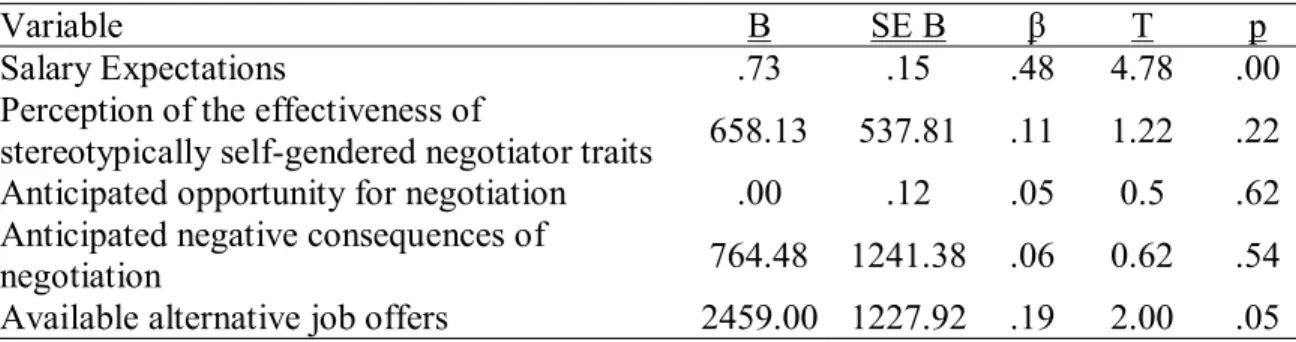
Hypothesis 3 was tested using the portion of the sample that completed both pre and post job questionnaires and was partially supported. Entered together, all the variables predicted 29% of the variance in starting salaries, F(5,80) = 7.87, p<.0001 but only salary expectations and number of available of alternative job offers independently and significantly predicted starting salaries (see Table 1).
Table 1. Summary of Regression Results for Variables Predicting of Starting Salaries (N=85)
Variable B SE B β T p
Salary Expectations .73 .15 .48 4.78 .00
Perception of the effectiveness of
stereotypically self-gendered negotiator traits 658.13 537.81 .11 1.22 .22
Anticipated opportunity for negotiation .00 .12 .05 0.5 .62
Anticipated negative consequences of
negotiation 764.48 1241.38 .06 0.62 .54
Available alternative job offers 2459.00 1227.92 .19 2.00 .05
Hypothesis 4:Negotiation style will mediate the relationship between the above
variables and starting salaries.
Because only salary expectations and availability of alternatives were significantly related to starting salaries, mediation was only tested using those two variables. Entered together, both variables predicted 4% of the variance in negotiation style, F(2,95) = 3.04, p=.05. Negotiation style predicted 5% of the variance in starting salaries, F(1,84) = 5.17, p<.05. Contrary to the pattern of data expected if negotiation
style mediated the relationship between salary expectations, availability of alternatives and starting salaries, when negotiation style, salary expectations and availability of alternatives were all used to predict starting salaries, salary expectations and availability of alternatives remained significant but negotiation style was no longer significant (See Table 2). Therefore, Hypothesis 4 was not supported.
Table 2.
Summary of Regression Results for Variables Predicting of Starting Salaries in a Mediational Relationship (N=85)
Variable B SE B β T P
Salary Expectations .73 .15 .47 4.72 .00
Availability of alternatives 2424.00 1232.27 .18 1.96 .05
Negotiation Style 243.34 205.62 .113 1.18 .24
Although negotiation style was not a mediator as expected, there was a significant gender difference. Men tended to report using more aggressive and active negotiation behaviors than women did, t(97) = 2.16, p<.05. On a scale from 1 to 5 where one was does not describe my behavior at all and 5 was describes my behavior completely, men rated active/aggressive negotiation behaviors an average of 2.16 (SD = 0.84) while women rated the same behaviors an average of 1.80 (SD = 0.81).
Hypothesis 5: Salary expectations, perception of the effectiveness of stereotypically
self-gendered negotiator traits, anticipated opportunity for negotiation, anticipated
negative consequences of negotiation and availability of alternatives will all
independently and significantly predict the difference between initial salary offer
Hypothesis 5 was tested using the portion of the sample that completed both pre and post job questionnaires and was not supported. When entered together, the variables did not significantly predict the difference between initial and final salary offer, F(5,80) = 0.84, ns.
Hypothesis 6: Negotiation style will mediate the relationship between the above
variables and the difference between initial salary offer and final salary offer.
Since the hypothesized relationship between the above variables and the
difference between initial and final salary offer was not found, Hypothesis 6 could not be tested. There was, however, a significant correlation between negotiation style and the difference between initial and final offer. An aggressive/active negotiation style was positively correlated with difference between initial and final salary offer, r = 0.40, p
<.001.
Additional findings Negotiator traits
As discussed above, when men and women were asked to rate the effectiveness of “masculine” and “feminine” negotiator traits on the pre-job questionnaire on a scale of 1-5 where 1 was not at all effective and 5 was very effective, women rated “feminine” negotiation traits an average of 3.70 (SD = 0.51) and men rated masculine traits an average of 4.02 (SD = 0.56).
On the post-job questionnaire, when men and women were asked to indicate which of these same traits they used in the negotiation context, both men and women indicated that they were more likely to use masculine traits than feminine ones, t(101) = 4.98, p<.001. On a scale from 1-5 where 1 was does not describe my behavior at all and 5
was describes my behavior completely, participants rated masculine traits an average of 3.55 (SD = .66) and feminine traits an average of 3.28 (SD = .65). When the traits were examined individually, men and women differed significantly on only one trait. Women reported being significantly more emotional in the negotiation context
(M = 2.65, SD = 1.18) than men did (M = 2.17, SD = 0.97), t(99) = .03, p < .05, even though men and women agreed that emotionality was ineffective in the negotiation context (M = 1.92, SD = 0.96), t(101) = -1.44, ns. Interestingly, emotionality was rated as the most feminine negotiation trait in the Raiffa (1984) study. Neither masculine nor feminine negotiator traits were related to initial offer, (r = .11, ns for masculine traits and .04, ns for feminine traits), final offer (r = .15, ns for masculine traits and .12, ns for feminine traits) or difference between initial and final salary offer (r = .05, ns for masculine traits and .14, ns for feminine traits).
Importance of various aspects of prospective job
On the pre-job questionnaire, participants were asked to rate the importance of various aspects of the job they were seeking on a scale of 1-5 where 1 was not at all important and 5 was extremely important. Participants rated stimulating work environment as most important, sign-in bonus as least important and everything else between somewhat (3) and very (4) important (see Table 3).
Males and females were largely in agreement over the importance of various factors, differing only in their ratings of the organization’s commitment to diversity,
t(234) = -4.29, p< .001, and stimulating work environment t(235) = -2.40, p< .05.
Women rated a stimulating work environment (M = 4.41, SD =0 .66) and the
men did (M = 4.19, SD =0 .73 for stimulating work environment and M = 3.11, SD =1.10 for the organization’s commitment to diversity).
Table 3.
Mean Rated Importance of Various Aspects of Prospective Job (N=237)
Mean SD
Stimulating work environment 4.32 0.70
Good benefits 4.24 0.79
Friendly colleagues 4.20 0.82
Getting a good salary 4.05 0.76
Appealing location 3.75 0.97
Flexibility of hours 3.60 1.01
Organization’s commitment to diversity 3.44 1.05
Annual bonus 3.19 1.05
Sign in bonus 2.63 1.11
Discussion
This dissertation sought to explore reasons for the wage gap between men and women. Specifically, the study examined the negotiation expectations and styles of males and females as they sought employment. Contrary to expectations, women in this sample did not earn significantly less than men did. The national salary gap between men and women was still present at the time of the last population survey; women earned about 80% of the salary earned by men (U.S. Department of Labor, 2005). One explanation for the divergence of the current results is the difference in the sample. The sample used to demonstrate the salary difference between men and women in the last population survey included all men and women over the age of 16. The salary gap could be disappearing starting with younger generations or, perhaps the salary gap now appears only at a later career stage.
These explanations are consistent with a more detailed analysis of Current Population Survey data. The salary difference between men and women was largest among workers aged 45-54 (women earned 73% of what men earned) and smallest among workers aged 16-24 (women earned 93% of what men earned) (U.S. Department of Labor, 2005). In the current sample, the median age was 23.
The lack of a significant gender difference in salary may also be due to the fact that there was very little negotiation on the part of both men and women. To start off with, only 22% of participants made a counteroffer (no significant difference between