Update on Impact Categories,
Normalisation and Weighting in LCA
- Selected EDIP97-data
Heidi K. Stranddorf, Leif Hoffmann og Anders Schmidt
FORCE Technology
Environmental Project
Nr. 995
2005
The Danish Environmental Protection Agency will, when opportunity offers, publish reports and contributions relating to environmental research and development projects financed via the Danish EPA.
Please note that publication does not signify that the contents of the reports necessarily reflect the views of the Danish EPA.
The reports are, however, published because the Danish EPA finds that the studies represent a valuable contribution to the debate on
3
Content
CONTENT 3 PREFACE 7
AUTHORS PREFACE 9
SUMMARY AND CONCLUSIONS 11
SAMMENFATNING OG KONKLUSIONER 15
1 INTRODUCTION TO THE PROJECT 19
1.1 BACKGROUND 19 1.2 THE BASIS OF NORMALISATION AND WEIGHTING IN EDIP
-METHODOLOGY 20 1.3 GUIDE TO THE READER 22
1.4 REFERENCES 24
2 SELECTION OF IMPACT CATEGORIES 25
2.1 COMPREHENSIVE LIST OF IMPACT CATEGORIES 25
2.2 IMPACT CATEGORIES 27 2.3 METHODOLOGICAL INCLUSION OF IMPACT CATEGORIES 33
2.4 WHICH IMPACT CATEGORIES TO CHOOSE? 33 2.5 CONSIDERATION REGARDING CHOICE OF IMPACT CATEGORY 36
2.6 REFERENCES 38 3 DEVELOPMENT OF NORMALISATION REFERENCES FOR
DIFFERENT GEOGRAPHIC AREAS 41
3.1 GENERAL CONSIDERATIONS 42 3.2 GENERAL EXTRAPOLATION METHOD 44
3.3 EXTRAPOLATION APPLIED TO DIFFERENT IMPACT CATEGORIES 51 3.4 RECOMMENDATIONS ON SELECTION OF NORMALISATION
REFERENCES 53 3.5 REFERENCES 54 APPENDIX A: DATA SOURCES 56
4 GLOBAL WARMING 57
4.1 SUMMARY 57 4.2 DESCRIPTION OF THE IMPACT CATEGORY 57
4.3 SUBSTANCES CONTRIBUTING TO THE IMPACT CATEGORY 58
4.4 METHODOLOGY 61 4.5 NORMALISATION REFERENCE 62
4.6 RECOMMENDATIONS FOR FUTURE UPDATE 63
4.7 REFERENCES 63 APPENDIX A: DATA SOURCES 67
APPENDIX B: DATA USED IN THE CALCULATION OF NORMALISATION
REFERENCES FOR GLOBAL WARMING. 69 APPENDIX C: CONSUMPTION/EMISSION OF GREENHOUSE GASSES 71
4
5.1 SUMMARY 73 5.2 DESCRIPTION OF THE IMPACT CATEGORY 73
5.3 SUBSTANCES CONTRIBUTING TO THE IMPACT CATEGORY 74
5.4 METHODOLOGY 76 5.5 NORMALISATION REFERENCE 76
5.6 RECOMMENDATIONS FOR FUTURE UPDATE 78
5.7 REFERENCES 79 APPENDIX A: DATA SOURCES 81
APPENDIX B.1: ALTERNATIVE CALCULATION OF NORMALISATION
REFERENCES 83 APPENDIX B.2: CALCULATION OF NORMALISATION REFERENCES, BASED
ON 1998 INFORMATION 85 APPENDIX C: OZONE DEPLETING POTENTIALS 87
APPENDIX D.1: CONSUMPTION OF OZONE DEPLETING SUBSTANCES 89 APPENDIX D.2: CONSUMPTION OF OZONE DEPLETING SUBSTANCES 91
6 PHOTOCHEMICAL OZONE FORMATION 93
6.1 SUMMARY 93 6.2 DESCRIPTION OF IMPACT CATEGORY 93
6.3 SUBSTANCES CONTRIBUTING TO THE IMPACT CATEGORY 95
6.4 METHODOLOGY 96 6.5 NORMALISATION REFERENCES 98
6.6 RECOMMENDATIONS FOR FUTURE UPDATING 102
6.7 REFERENCES 104 APPENDIX A.1: CALCULATION OF NORMALISATION REFERENCE FOR
DENMARK. 105 APPENDIX A.2: CALCULATION OF NORMALISATION REFERENCE FOR
EU-15 107 APPENDIX A.3: CALCULATION OF A WORLDWIDE NORMALISATION
REFERENCE 109
7 ACIDIFICATION 111
7.1 SUMMARY 111 7.2 DESCRIPTION OF THE IMPACT CATEGORY 111
7.3 SUBSTANCES CONTRIBUTING TO THE IMPACT CATEGORY 112
7.4 METHODOLOGY 113 7.5 NORMALISATION REFERENCE 114
7.6 RECOMMENDATIONS FOR FUTURE UPDATE 116
7.7 REFERENCES 116 APPENDIX A: DATA SOURCES 117
APPENDIX B: EMISSION DATA 119 APPENDIX C: NORMALISATION REFERENCES FOR EU-15 COUNTRIES 121
8 NUTRIENT ENRICHMENT 123
8.1 SUMMARY 123 8.2 DESCRIPTION OF THE IMPACT CATEGORY 123
8.3 SUBSTANCES CONTRIBUTING TO THE IMPACT CATEGORY 124 8.4 UPDATING OF THE NORMALISATION REFERENCE FOR DENMARK 125
8.5 THE NORMALISATION REFERENCE FOR EU-15 128 8.6 THE NORMALISATION REFERENCE FOR SELECTED EUROPEAN
COUNTRIES 132 8.7 WORLDWIDE NORMALISATION REFERENCE FOR NUTRIENT
ENRICHMENT 135 8.8 EVALUATION OF UNCERTAINTIES 136
5
8.9 RECOMMENDATION FOR FUTURE UPDATING 136
8.10 REFERENCES 137 APPENDIX A: IMPORTANT PARAMETERS IN RELATION TO NUTRIENT
ENRICHMENT 139
9 HUMAN TOXICITY 141
9.1 SUMMARY 141 9.2 DESCRIPTION OF THE IMPACT CATEGORY 142
9.3 SUBSTANCES AND DATA SOURCES 142
9.4 METHODOLOGY 146 9.5 NORMALISATION REFERENCES 147
9.6 RECOMMENDATIONS FOR FUTURE UPDATING 154
9.7 REFERENCES 157 APPENDIX A: DATA SOURCES 161
APPENDIX B.1: EXTRAPOLATIONS AND DATA HANDLING 163
APPENDIX B.2: EFFECT FACTORS 169 APPENDIX C: DATA AND CALCULATION OF NORMALISATION
REFERENCES 179 APPENDIX D: DISTRIBUTION OF IMPACT POTENTIALS 199
10 ECOTOXICITY 205
10.1 SUMMARY 205 10.2 DESCRIPTION OF THE IMPACT CATEGORY 206
10.3 METHODOLOGY 206 10.4 NORMALISATION REFERENCE – AQUATIC ENVIRONMENT 207
10.5 NORMALISATION REFERENCE - TERRESTRIAL ENVIRONMENT 217
10.6 NORMALISATION REFERENCES 220 10.7 COMPARISON WITH THE PREVIOUSLY USED NORMALISATION
REFERENCE 222 10.8 EVALUATION OF UNCERTAINTIES 223
10.9 RECOMMENDATIONS 223
10.10 REFERENCES 224 APPENDIX A: EMISSIONS TO THE AQUATIC ENIRONMENT, METALS 227
APPENDIX B.1 EMISSIONS TO THE AQUATIC ENVIRONMENT, ORGANIC
SUBSTANCES - DENMARK 233 APPENDIX B.2: EMISSIONS TO THE AQUATIC ENVIRONMENT, ORGANIC
SUBSTANCES - EU-15 235
APPENDIX C: EMISSIONS TO THE AQUATIC ENVIRONMENT,
ATMOSPHERIC DEPOSITION 237 APPENDIX D: EMISSIONS TO THE TERRESTRIAL ENVIRONMENT,
PESTICIDES 239 APPENDIX E.1: EMISSIONS TO THE TERRESTRIAL ENVIRONMENT,
SEWAGE SLUDGE APPLIED IN AGRICULTURE - DENMARK 241 APPENDIX E.2: EMISSIONS TO THE TERRESTRIAL ENVIRONMENT,
SEWAGE SLUDGE APPLIED IN AGRICULTURE - EU-15 243
11 CALCULATION OF WEIGHTING FACTORS 245
11.1 SUMMARY 245 11.2 DEFINITION OF “WEIGHTING” PROCEDURES 247
11.3 SCOPE OF WEIGHTING PROCEDURE 247 11.4 DIFFERENT WEIGHTING METHODS 247
11.5 GLOBAL WARMING 249 11.6 STRATOSPHERIC OZONE DEPLETION 255
6
11.8 ACIDIFICATION 263 11.9 NUTRIENT ENRICHMENT 267
11.10 ECOTOXICITY 271 11.11 HUMAN TOXICITY 280 11.12 COMPARISON OF EXISTING AND NEW WEIGHTING FACTORS 284
11.13 METHODOLOGICAL CONCERNS 285 11.14 RECOMMENDATION FOR FUTURE UPDATING 286
7
Preface
This report was prepared within the Danish LCA methodology and consensus creation project during the period from 1997 to 2003.
The report is one out of five technical reports to be published by the Danish Environmental Protection Agency and dealing with key issues in LCA. The reports were prepared as background literature for a number of guidelines on LCA, planned to be published by the Danish Environmental Protection Agency during the autumn of 2004 and spring 2005. The reports present the scientific discussions and documentation for recommendations offered by the guidelines. The reports and guidelines developed within the project are presented in the overview figure below.
A primary objective of the guidelines has been to provide advice and
recommendations on key issues in LCA at a more detailed level than offered by general literature, like the ISO-standards, the EDIP reports, the Nordic LCA project and SETAC publications. The guidelines must be regarded as a supplement to and not a substitution for this general literature.
It is, however, important to note that the guidelines were developed during a consensus process involving in reality all major research institutions and consulting firms engaged in the LCA field in Denmark. The advice given in the guidelines may thus be considered to represent what is generally accepted as best practice today in the field of LCA in Denmark.
The development of the guidelines and the technical reports was initiated and supervised by the Danish EPA Ad Hoc Committee on LCA Methodology Issues 1997-2001. The research institutions and consulting firms engaged in the development and consensus process are:
COWI, Consulting Engineers and Planners (Project Management) Institute for Product Development, the Technical University of Denmark FORCE Technology
The Danish Technological Institute Carl Bro
The Danish Building Research Institute DHI - Water and Environment
Danish Toxicology Institute Rambøll
ECONET
8
Guidelines and technical reports prepared within the Danish LCA-methodology and consensusproject LCA guideline: Impact categories, norma-lisation and weighting in LCA Update on selected EDIP97-data LCA guideline: Spatial differentiation in life cycle impact
assessment The EDIP 2003 methodology LCA guideline: State of LCA in Denmark 2003 Introduction to the Danish methodology and consensus project LCA guideline: Geographical, technological and temporal delimitation in LCA Th EDIP 2003 th d l LCA technical report: Market information in life cycle assessment
Determining the system boundaries in LCA - LCA technical report: Reducing uncertainty in LCI. Developing a data collection strategy. LCA guideline: The working environment in LCA A new approach LCA technical report:
LCA and the working environment LCA technical report: Update on impact categories, normalisation and weighting in LCA Selected EDIP97-data LCA guideline:
The product, functional unit, and reference flows in LCA
LCA technical report:
Background for spatial differentiation in life cycle impact assessment
The EDIP 2003 methodology
9
Authors preface
This technical report is a result of a LCA methodology and consensus-making project focusing on normalisation and weighing. The project has involved a large part of the LCA practitioners and interested parties in Denmark. The technical report documents normalisation references with the reference year 1994 and weighting factors with 2004 as the target year. Along with the technical report a guideline (“LCA Guideline: Impact categories, normalisation and weighting in LCA”) has been developed.
The project has been organised as a true consensus-process. First, the project leader in dialogue with the involved consultants and researchers discussed and agreed upon a general data collection process, the idea being to receive
consistent data from a wide range of national and international information sources. However, this approach appeared to be less effective than hoped for, and it was therefore decided to proceed in a less uniform way within different impact categories in order to obtain the requested/necessary data and use them in development of normalisation references. The choices made were presented at two workshops, each providing valuable input to the project group as well as securing a consensus among all interested parties. The following persons have been responsible for the individual chapters: Chapter 2+3: Heidi K. Stranddorf and Leif Hoffmann, dk-TEKNIK
ENERGY & ENVIRONMENT
Chapter 4: Global warming: M.Sc (Chem. Eng) Leif Hoffmann, dk-TEKNIK ENERGY & ENVIRONMENT
Chapter 5: Ozone depletion: M.Sc (Chem. Eng) Leif Hoffmann, dk-TEKNIK ENERGY & ENVIRONMENT
Chapter 6: Photochemical ozone formation: B.Sc (Chem. Eng) Karsten Fuglsang, dk-TEKNIK ENERGY & ENVIRONMENT Chapter 7: Acidification: M.Sc (Chem. Eng) Leif Hoffmann,
dk-TEKNIK ENERGY & ENVIRONMENT
Chapter 8: Nutrient enrichment: Ph.D. (Biology) Jørgen Larsen, Danish Technological Institute
Chapter 9: Ecotoxicity: Ph.D. (Ecotoxicology) Jens Tørsløv, DHI Water and Environment
Chapter 10: Human toxicity: M.Sc (Eng) Frans Møller Christensen, Danish Toxicology Centre & M.Sc (Chem. Eng) Leif Hoffmann, dk-TEKNIK ENERGY & ENVIRONMENT Chapter 11: Weighting: M.Sc (Eng) Niels Juul Busch, Rambøll
The main part of the data collection and calculations have been performed in the period 1998-2001, with small adjustments and re-calculations being made in 2003. Anders Schmidt, FORCE Technology/dk-TEKNIK ENERGY & ENVIRONMENT was responsible for the final editing of the report in autumn, 2003. A special thank is given to Michael Hauschild, Danish Technical University, for his guidance and reviews of the efforts in the project.
11
Summary and conclusions
The report addresses a number of elements that all are related to the impact assessment step in the EDIP methodology:
- It gives a short introduction to some of the key elements in EDIP, e.g. the person equivalent, and the normalisation and weighting steps
- It gives a short discussion regarding choice of impact categories in relation to the recommendations in the ISO 14040 standard series, the
international consensus regarding the applicability of different methods and the possibilities of performing calculations in the LCV programme that has been made especially in order to make EDIP calculations - It describes a number of procedures that makes it possible to establish
normalisation factors for the EU-15 and the World through extrapolation from relatively limited data sets
- It gives a detailed insight into the data base that has been used in the updating of the existing normalisation and weighting factors and to establish new factors for EU-15 and globally.
Regarding the choice of impact categories the report gives an overview of the categories that have been addressed in central LCA documents and method papers. A number of impact categories and the methods used for their assessment is common to all methods, while methods suggested for assessment of impacts on the local scale like human toxicity, ecotoxicity, noise, land use, etc. show marked differences in their approach. The report does not give a final recommendation whether a specific impact category shall be included in the LCA or whether one or the other approach is better. The recommendation is to include a sufficiently wide range of impact categories to fulfil the goal and scope of the LCA. Omission of impact categories should be a conscious and motivated choice, for which the lack of quantifiability for a given category is not necessarily a valid excuse. There are no requirements in the general LCA concept that all results should be quantified, and qualitative assessments can therefore be used to describe areas and issues that would otherwise be neglected. In some cases it will be relevant to develop and apply new methods in order to assess other impact categories than those
traditionally addressed in LCA. This can be very demanding in terms of resources, and the final decision to do so should be determined by the commissioner and the LCA practician.
Another aim of the subproject was to develop new normalisation references for the current 15 member states of the EU (EU-15) and at the Global level – a “World Proxy”. The background for this aim is that in the original EDIP method, normalisation references have only been developed for “Denmark” which can make it difficult to interpret the results of a LCA with a broader geographic scope. With the calculation of additional normalisation references, primarily for the EU-15, the LCA practitioner therefore gets better
possibilities to assess the relative importance of different impact categories in an international perspective.
12
For the EU-15 the new normalisation references for photochemical ozone formation, acidification, nutrient enrichment, human toxicity and ecotoxicity were calculated by using different approaches and information from a broad range of literature sources. For some combinations of impact
categories/compounds/activities, e.g. regarding many of the contributions to human toxicity and ecotoxicity, the normalisation references were calculated by extrapolation from selected national inventories as no consistent database was available. The extrapolation was based on the assumption that there is a linear relationship between the economic activity in a given EU-country and its emissions of a given substance or group of substances. Where possible, a cross reference was made with the few available data in order to give an indication of the uncertainty introduced by extrapolation.
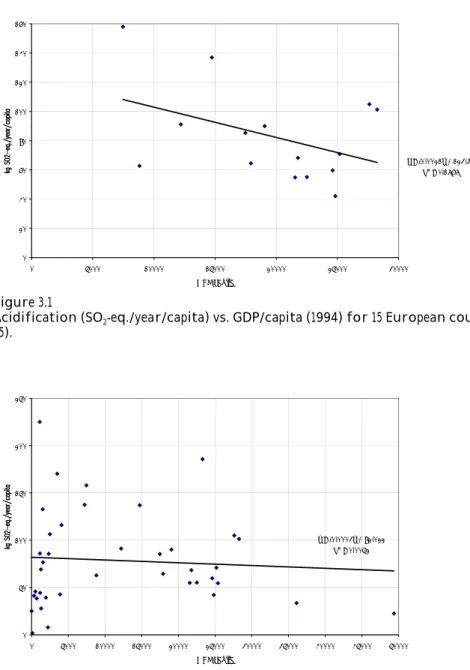
The extrapolation approach used for calculation of global normalisation references was to use the relation between the economic activity in a country/region (measured as the Gross Domestic Product, GDP) and the emission of substances contributing to acidification. Both parameters have a well-founded statistical base for many countries and the correlation between them was considered to be adequate for further calculations. Based on the relationship a general extrapolation was developed, simply scaling the European normalisation reference to the global level, the so-called World Proxy.
The report describes the uncertainties associated with the newly developed normalisation references and recommends that the European normalisation references be used in general to calculate the base case scenarios. The recommendations are described in more detail in the Guidelines from the project, but are primarily based on the assumption that most LCA’s include impact potentials that are found on a broad geographical scale and therefore should be matched by relevant normalisation factors. A final
recommendation, however, is to use Danish normalisations references and the World Proxies in a sensitivity analysis in order to get a better indication of the robustness of the results.
The report gives a detailed insight into the data sources and calculation procedures that have been used in the calculation of each normalisation reference. For each impact category the database is presented in tabular form along with the most important intermediate calculations. This content is probably most interesting for experts in different areas, giving the possibility for other types of calculation, but is of course also a good starting point for future updates.
The last chapter in the report presents new weighting factors for Denmark, EU-15 and the World. This chapter also provides a detailed insight into the basic data, the way the weighting factors have been calculated, and the
associated uncertainties. It is emphasized that the Global weighting factors for impact categories on the regional scale can only be calculated with a relatively high uncertainty, and for the impact categories on the local scale it has not been possible to establish reliable weighting factors. In order to make such calculations, information on current emissions as well as reduction targets must be available for each country/region. It was far beyond the scope of the project to collect and manipulate this very large amount of information, and it is therefore recommended to use the weighting factors for EU-15 in the base case calculations. It is, however, mentioned that especially the weighting
13 factors for local impacts tend to be underestimated, compared to those for the regional impacts. The reason for this is that even for the EU-15 is it difficult to establish the full overview of the single member states’ reduction targets for emissions of single substances or groups of substances.
It is concluded that the results of the project increases the possibility of making a LCA with a broader perspective than the original EDIP method allows. The broader perspective is, however, achieved at the cost of an increased uncertainty and the recommendations of the report and and the associated Guidelines are therefore focused on the use of sensitivity analysis to the extent relevant to fulfil the goal and scope of the study.
15
Sammenfatning og konklusioner
Rapporten indeholder en række elementer der alle har relation til vurdering af miljøbelastninger i UMIP-metoden:
- Den giver en kortfattet introduktion til visse nøglebegreber i UMIP såsom personækvivalenter, normalisering og vægtning
- Den indeholder en kortfattet diskussion omkring valg af
belastningskategorier, set i relation til anbefalingerne i ISO’s standarder om livscyklusvurdering, den internationale konsensus om de enkelte metoders anvendelighed samt mulighederne for at foretage beregninger i et EDB- værktøjet LCV, der er specielt udviklet til at håndtere UMIP-metoden
- Den beskriver en række procedurer, der gør det muligt at udarbejde normaliseringsfaktorer for EU-15 og Verden gennem ekstrapolation fra forholdsvis begrænsede datamængder
- Den giver et detaljeret indblik i det datagrundlag, der er anvendt for at opdatere UMIP’s eksisterende vægtningsfaktorer og udarbejde nye vægtningsfaktorer for EU-15 og på globalt plan.
Omkring valg af belastningskategorier giver rapporten en oversigt over de belastningstyper, som er nævnt/behandlet i en række centrale LCA-dokumenter og metodebeskrivelser. Der er naturligvis en del kategorier og metoder, der er fælles for alle metoder, men omkring vurdering af forskellige former for lokale belastninger som human toksicitet, økotoksicitet, brug af arealer, støj m.v. er der foreslået metoder, der har betydelige forskelle. Rapporten tager ikke stilling til, om en bestemt kategori skal medtages i en LCA eller om den ene eller den anden fremgangsmåde er den bedste. Anbefalingen er, at man inkluderer en så bred vifte af belastningstyper, at formålet med LCA’en kan opfyldes. Hvis man udelader visse
belastningstyper, skal dette være et bevidst og begrundet valg, hvor manglende kvantificerbarhed ikke uden videre bør accepteres som begrundelse. Der er i det overordnede LCA-koncept ikke krav om
kvantificering, og kvalitative vurderinger kan derfor meget vel anvendes til at beskrive vidensmæssige huller. Endelig peger rapporten på, at det i nogle tilfælde kan være relevant at udvikle og anvende metoder til vurdering af andre belastningskategorier end de traditionelle. Her skal man dog være opmærksom på, at dette ofte er tidskrævende/dyrt, men den endelige
beslutning om at inkludere en eller flere nye belastningskategorier bør afgøres i samråd mellem opgavestilleren og LCA-praktikeren.
Et andet formål med delprojektet var at udvikle normaliseringsfaktorer for de 15 nuværende EU-lande og – hvor muligt og relevant – også på globalt niveau. I den originale UMIP-metode er der ”kun” udarbejdet
normaliseringsreferencer for Danmark, hvilket på nogle områder kan give vanskeligheder med at tolke resultaterne. Ved at udarbejde nye
normaliseringsreferencer, først og fremmest for EU-15, får LCA-praktikeren og opgavestilleren bedre muligheder for at vurdere betydningen af de enkelte belastninger i et internationalt perspektiv.
16
For EU-15 blev de nye normaliseringsreferencer for fotokemisk ozondannelse, forsuring, næringssaltbelastning og human- og økotoksicitet beregnet på forskellige måde ved hjælp af tilgængelige data fra en bred vifte af litteraturkilder. For visse stoffer/aktiviteters bidrag til belastninger som human- og økotoksicitet er der dog ekstrapoleret fra enkeltstående nationale opgørelser, idet der ikke findes et konsistent datagrundlag. Ekstrapolationen er foretaget ud fra den basale antagelse, at der er en lineær sammenhæng mellem et EU-lands økonomiske aktivitet og dets udledninger af et givet stof eller stofgruppe. Hvor muligt, er der i sådanne tilfælde krydsrefereret med de få tilgængelige data for at få en indikation af usikkerheden.
De nye globale normaliseringsreferencer er fremkommet ved at anvende relationen mellem et lands/regions (EU-15) økonomiske aktivitet (målt som bruttonationalproduktet (GDP)) og dets udledninger af stoffer, der bidrager til forsuring. Begge parametre har et relativt velfunderet statistisk grundlag for mange lande og det var muligt at vise en god korrelation mellem dem. Baseret på den viste sammenhæng er der udarbejdet en generel ekstrapolationsmodel, der simpelt skalerer fra den europæiske normaliseringsreference til globalt niveau, en såkaldt Verdensproxy.
Rapporten beskriver de – ofte betydelige – usikkerheder, der er ved de ny normaliseringsreferencer. På trods af usikkerheden anbefaler rapporten dog brug af de europæiske normaliseringsreferencer som udgangspunkt i en vurdering. Anbefalingerne, der er mere detaljeret beskrevet i delprojektets vejledning, begrundes i at de fleste LCA’er inkluderer belastningspotentialer, der finder sted i et bredt udvalg af lande og regioner, og at det derfor er mest relevant at bruge normaliseringsfaktorer, der matcher det geografiske
spektrum. Det anbefales dog også at anvende de danske
normaliseringsreferencer og Verdensproxyer i en følsomhedsanalyse med henblik på at fastslå, hvor robuste konklusionerne er.
Rapporten giver et detaljeret indblik i de datakilder og procedurer, der er anvendt ved beregning af alle normaliseringsreferencer. For hver enkelt belastningskategori findes talmaterialet i tabelform, inklusive en lang række mellemregninger. Disse kapitler har mest interesse for eksperter, der for eksempel kan bruge tallene til andre typer af beregninger, men de er naturligvis også et godt udgangspunkt for eventuelle opdateringer.
Rapporten afsluttes med et kapitel, hvori der beregnes nye vægtningsfaktorer for Danmark, EU-15 og på globalt plan. Også dette kapitel giver et detaljeret indblik i de grundlæggende data og de usikkerheder, der er forbundet med beregningerne. Globale vægtningsfaktorer for regionale belastningskategorier behæftet med relativ stor usikkerhed, og for de lokale belastningskategorier har det ikke været muligt at beregne en troværdig vægtningsfaktor. Dette kræver i princippet at der findes oplysninger om både de nuværende udledninger og specifikke reduktionsmål for disse for et givet land eller region. En konsistent indsamling og bearbejdning af sådanne informationer ligger langt udenfor rammerne det nærværende projekt, og det anbefales derfor, at man anvender vægtningsfaktorerne for EU-15 som udgangspunkt i sin vurdering, idet disse er beregnet med en acceptabel sikkerhed. Det skal dog bemærkes, at de europæiske vægtningsfaktorer for lokale belastninger med stor sandsynlighed er underestimerede i forhold til faktorerne for regionale belastninger. Årsagen er, at det selv for ”nærområdet” EU-15 er vanskeligt at skabe et overblik over
17 de enkelte landes reduktionsmål for udledninger af enkeltstoffer og
stofgrupper.
Det konkluderes afslutningsvis, at rapportens resultater giver mulighed for en livscyklusvurdering med et bredere perspektiv end den originale UMIP-metode. Det bredere perspektiv kan imidlertid kun opnås på bekostning af en større usikkerhed, og rapportens og den tilhørende vejlednings anbefalinger fokuserer derfor på, at der bør anvendes følsomhedsanalyser i det omfang, det er muligt og relevant for at leve op til LCA’ens målsætninger.
19
1 Introduction to the project
This report updates and extends the LCA normalisation and weighing data and methods that are presented in EDIP (Environmental Design of Industrial Products) (Wenzel et al. 1997; Hauchild & Wenzel 1998) further.
Normalisation is a methodology used to compare results (e.g. potential
greenhouse effect) to well-known figures and weighting aims to weight or rank different impact categories by using different principles i.e. political goals etc. The fundamental principles in normalisation and weighting are described in details in Wenzel et al. (1997).
This project has had four goals through a consensus process to:
1) Establish a comprehensive list of impact categories and improve the basis for the LCA practitioners choice of impact categories
2) Provide more options for normalisation and weighting of regional and local impact categories
3) Update the existing normalisation reference for a number of impact categories in EDIP
4) Update the weighting factors in EDIP.
1.1 Background
The background for the project is the international standards as well as the theoretical and practical considerations in Wenzel et al. (1997) and Haucshild and Wenzel (1998). The relevant sections from the relevant standards will shortly be introduced below.
1.1.1 The ISO standards of LCA and LCIA
The ISO 14040 standard “Life Cycle Assessment – Principles and
frameworks” presents, as a part of an interactive process, the following steps in a Life Cycle Assessment:
• The Goal and Scope Definition
The goal of an LCA study shall unambiguously state the intended application, the reasons for carrying out the study and the intended audience, i.e. to whom the results of the study are intended to be communicated (for details see ISO 14041 (ISO 1998)).
• Life Cycle Inventory Analysis (LCI)
The phase of the life cycle inventory analysis involves the compilation and quantification of inputs and outputs, for a given product system throughout its life cycle (for details see ISO 14041 (ISO 1998)).
• Life Cycle Impact Assessment (LCIA)
The phase of life cycle impact assessment is aimed at understanding and evaluating the magnitude and significance of the potential environmental impacts of a product system (for details see ISO 14042 (ISO 2000a)).
• Life Cycle Interpretation
The phase of Life Cycle interpretation is where the findings of either the inventory analysis or the impact assessment, or both, are combined consistent
20
with the defined goal and scope in order to reach conclusions and recommendations (for details see ISO 14043 (ISO 2000b)).
The goal and scope definition, the inventory and the interpretation is mandatory while impact assessment is optional.
According to ISO 14042 (ISO 2000a), life cycle impact assessment includes several steps from the Inventory to the Interpretation:
• Life cycle inventory assignment of LCI-results (“classification”), where the impact categories are defined and the exchanges from the inventory are assigned to impact categories according to their ability to contribute to different problem areas.
• Calculation of category indicator results (“characterisation”), where the LCI results are calculated and converted to common units and finally aggregated within each impact category. Together, this results in a numerical indicator result, i.e. the LCIA profile for the product system.
• Normalisation or calculating the magnitude of the category indicator results relative to reference values where the different impact potentials and consumption of resources are expressed on a common scale through relating them to a common reference, in order to facilitate comparisons across impact categories.
• Weighting where weights are assigned to the different impact categories and resources reflecting the relative importance they are assigned in the study in accordance with the goal of the study.
• Interpretation where sensitivity analysis and uncertainty analysis assist interpreting the results of the life cycle assessment according to the goal and scope of the study to reach conclusions and recommendations. In Life Cycle Impact Assessment, the first three steps; assignment of inventory results to impact categories, the characterisation, and the
classification are mandatory, while normalisation, grouping and weighting are optional elements.
1.2 The basis of normalisation and weighting in EDIP -methodology
In EDIP as well as in the ISO standards, the overall advantage of
normalisation is an increased possibility of interpretation of indicator results compared to each other. Further, it also provides an option of control by unveiling extreme indicator results. Finally, normalisation is a preparatory element in the optional element of weighting.
The goal of normalisation is to set a common reference enabling comparison of different environmental impacts.
It is an integral part of EDIP that the impacts are summarised for the area, which actually contributes to the current condition of the environment as it is experienced. For the global impacts it makes no difference where the
environmental exchanges occur. But for regional and local impacts, only the exchanges occurring within the regions or local areas in question contribute to the current and future condition in the environment there. Due to this
reasoning the normalisation and the subsequent weighting should ideally be carried out with normalisation references and weighting factors which, for each individual emission, are representative of the region where the emissions occur. However in the EDIP 1997, the data of the global impacts are available
21
while data for regional impacts, generally, are not available. Instead, EDIP use Danish normalisation references as default values.
In contrast to EDIP 97 it has been chosen to regard human toxicity and ecotoxicity as being primarily regional impacts with the same normalisation reference being applied to all EU-15 countries. It is, however, also possible to use the updated Danish normalisation reference, e.g. in an assessment of specific Danish products or product systems, or as an element in the
sensitivity analysis. The same possibility also exists for most of the other EU-15 countries.
Due to lack of data no regional normalisation references for other regions e.g. Central Africa and the Middle East have been developed. For acidification, normalisation references are provided for EU-15 as well as for the individual countries within EU-15. The individual normalisation references can be found in the current report.
This project has provided a large number of normalisation references for EU-15 countries but some additional work still remains to be done before the ultimate goal, i.e. normalisation references for all relevant regions in the World, can be reached.
A different approach has been taken in a parallel project within the LCA methodology and consensus project, site-characterisation (Hauschild & Potting, 2003). The present report does not discuss the pros and cons of either method, but provides only an update of the original EDIP97 method with respect to normalisation and weighting.
1.2.1 The person-equivalent
The global impact will always be much greater than the impact from a particular region, irrespective of the type of effect to which the impact contributes. Use of global impacts as the normalisation reference for the global impact categories and regional impacts for the regional and the local impact categories will thus give an imbalance in the normalisation, and it will result in global impacts from the product system coming to appear much less than the other impacts, because they are compared with the activity of the population of the entire world, while the others are compared only with the activity of e.g. the Danish population.
To correct this bias and ensure that the set of normalising references
constitutes a common scale for all impact categories, irrespective of whether they are global or regional, the normalisation references are calculated as the background impact over the course of one year per person in the area for which the impact is computed. This gives the normalisation references the unit “impact potential per person per year” for each individual impact category.
1.2.2 Establishing of normalisation references
Normalisation references are established for Denmark, Europe (EU-15), and worldwide. For the relevant areas surveys of emissions contributing to the different impact categories have been established. The normalisation references are calculated based on EDIP (Wenzel et al. 1997):
22
∑ = capita potential impact N i EF * n i mi Normrefwhere: mi is emitted quantity of substance i EFi is the equivalence factor for substance i N is number of capita in the considered area
i.e. for each of the substances contributing to the impact category, the emitted quantity is multiplied with the equivalence factor for the specific substance giving the potential impact caused by the specific substance. The potential impacts by all the contributing substances are summarised and finally divided with the number of capita in the considered area.
The figures used for normalisation in the EDIP methodology are the potential effects caused per capita in a defined geographical area e.g. potential
greenhouse effect per capita per year. 1994 has been chosen as reference year. The actual normalisation references are expressed as kg CO2-eq./capita/year. The potential environmental impact e.g. greenhouse effect is expressed as person equivalents (PE) i.e. relative to the yearly contribution to the
greenhouse effect by one person. In principle, the normalisation methodology allows different impact categories to be compared to each other. The present study develops normalisation references for Denmark, Europe (EU-15) and worldwide.
1.2.3 Weighting
The figures used for weighting in the EDIP methodology are the political reduction goals for the individual substances contributing to the relevant impact category. 2004 has been chosen as the reference year. The actual weighting factors are dimensionless. The weighting factors are linked to the above mentioned normalisation references with regard to the geographical area covered. The present study presents weighting factors for Denmark, Europe (EU-15) and worldwide.
1.2.4 Reference year
In EDIP 1996, 1990 was used as reference year for normalisation, while 1990 and 2000 were chosen as reference years for weighting. In this update, 1994 and 2004 have been chosen as new reference years for normalisation
references and weighting factors, respectively. The reason for choosing 1994 as reference year has been easy availability of compilations of data for most of the countries included in the EU-15 normalisation reference. In the recent years the availability of emission data has increased significantly e.g. by access to databases via Internet, and the delay caused by central compilation of data can be expected to be reduced in the future. Therefore, future updating can be expected to be faster with reference years closer to the actual year.
1.3 Guide to the reader
The report is divided in three parts. The first part deals with choice of impact categories and of normalisation reference. The second part is focused on update and expansion of selected impact categories, and the third part is dealing with update on weighting factors.
23
Part I includes chapter 2 and chapter 3.
Chapter 2 is an overview of five international lists regarding different impact categories. Each impact category is discussed and it is concluded whether the impact category is internationally recognised as well as to which extend characterisation models are agreed upon.
Chapter 3 deals with a global approximation (“world proxies”) of normalisation references. This includes the development of a simple
extrapolation model based on emissions of acidifying substances. This allows the calculation of world proxies of the regional impact e.g. photochemical ozone formation and acidification as well as local impact i.e. human toxicity. Part II includes the update and expansion of impact categories. Each chapter describes shortly the impact category and includes a list of substances
contributing to the impact. The methodology used for calculation of the normalisation reference and the calculated normalisation references for the whole world, EU-15 and Denmark are presented in each chapter. For each chapter, one or more appendices elaborates the content, e.g. by describing relevant data sources and providing detailed figures for emissions of substances in a number of countries.
Chapter 4 deals with global warming. Global warming is a global impact category.
Chapter 5 deals with stratospheric ozone depletion. Stratospheric ozone depletion is a global impact category.
Chapter 6 deals with photochemical ozone formation, Photochemical ozone formation is considered primarily as a regional impact category.
Normalisation references for EU-15 as well as Denmark are presented. Also a world proxy is presented.
Chapter 7 deals with acidification. Acidification is considered as a regional impact category. A normalisation reference for EU-15 is provided as well as normalisation references for the individual countries within EU-15. A world proxy is presented.
Chapter 8 deals with nutrient enrichment (eutrophication). Nutrient enrichment is considered as a local as well as a regional impact category. Normalisation references for Denmark as well as for EU-15 are provided. A world proxy is presented.
Chapter 9 deals with human toxicity. Human toxicity is a local impact category. The chapter offers a normalisation reference for Denmark together with normalisation references for each of the EU-15 countries as well. A world proxy is also presented.
Chapter 10 deals with ecotoxicity. Ecotoxicity is considered to be a local as well as regional impact category. Normalisation references for Denmark and EU are provided in the chapter. Further, normalisation references for each of the individual EU-15 countries is presented along with a world proxy.
Part III includes chapter 11. It presents weighting factors for the seven impact categories
24
The actual normalisation references and weighting factors are presented in tables in the summary in each chapter. The description of data collection, data handling, data sources, and data quality is intended for future update of the figures. The actual weighting factors are also presented in a summarising table.
1.4 References
Hauschild, M. & Wenzel, H. 1998, Environmental Assessment of Products. Volume 2 - Scientific background. First edition. Chapman & Hall, London. ISO 1997, Environmental management – Life cycle assessment – Principles and Framework. ISO 14040.
ISO 1998, Environmental management – Life cycle assessment – Goal and scope definition and inventory analysis. ISO 14041.
ISO 2000a, Environmental management – Life cycle assessment – Life cycle impact assessment. ISO 14042.
ISO 2000b, Environmental management – Life cycle assessment – Life cycle inter-pretation. ISO 14043.
Wenzel, H., Hauschild, M. & Alting, L. 1997, Environmental Assessment of Products. Volume 1 - Methodology, Tools and Case Studies in Product
Appendix A
25
2 Selection of impact categories
The purpose of this chapter is first of all to give an overview of impact categories that are defined in different LCA methodology frameworks. The overview is formed by going through the impact categories defined in
different LCA methodologies. Each impact category is described briefly and it is stated to which extend the impact category is included in the
methodologies. Similarities and differences among the methods are highlighted.
The overview of geographical scaling is presented in a table in which it is indicated if the international consensus also includes the characterisation model.
The chapter also includes an overview regarding recommendations of the selection of impact categories. The overview is based on the same
internationally recognised framework as just mentioned. The chapter is concluded by some general recommendations of when to apply which impact categories.
2.1 Comprehensive list of impact categories
During the recent years different national and international working groups have worked with development of characterisation methods to assign input and output data to different impact categories. The research groups have to a large extent used the work of others as a point of reference, and some persons have participated in the work of two or more groups. The methods have been improved/modified continuously e.g. by adaptation to restricted geographical areas or national conditions. As point of reference for the description and discussion of impact categories the present paper will use lists made by five different groups:
• The “Leiden list” (SETAC-Europe 1992)
• The “Nordic list” (Lindfors et al. 1995)
• The SETAC “default list” (Udo de Haes 1996)
• The “EDIP list” (Wenzel et al. 1996)
• The ISO 14047 list (preliminary) (ISO 1999)
The ISO 14047 list is a draft (ISO 1999). It only includes few impact categories. The purpose of ISO 14047 is primarily to illustrate how to work with the ISO 14040 - 14043 standards and it does not deal with which impact categorise that has to be included in LCA.
26
Table 2-1
Compilation of different lists of impact categories. List → Impact category ↓ The “Leiden list ” SETAC-Europe (1992) The “Nordic list” Lindfors et al. (1995) SETAC, “default list” Udo de Haes (1996) The “EDIP list” (Wenzel et al. 1997) ISO, preliminary list (ISO 1999) Global
warming Global warming CO2-eq. Global warming CO2-eq. Global warming CO2-eq. Global warming CO2-eq. Global warming/ climate change Depletion of stratospheric ozone Depletion of stratospheric ozone CFC-11-eq. Depletion of stratospheric ozone CFC-11-eq. Depletion of stratospheric ozone CFC-11-eq. Stratospheric ozone depletion CFC-11-eq. Stratospheric ozone depletion Photo-oxidant
formation Photo-oxidant formation C2H4-eq. Photo-oxidant formation C2H4-eq. Photo-oxidant formation C2H4-eq. Photochemical oxidant formation C2H4-eq. Photochemical oxidant formation (smog) Acidification Acidification SO2-eq. Acidification SO2-eq. Acidification SO2-eq. Acidification SO2-eq. Acidification Nutrient enrichment - Eutrophication Eutrophication - PO43-eq. - COD (chemical oxygen demand) discharge Eutrophication - N-emissions to air For aquatic systems: - Aggregation of P to water - Aggregation of N to water - Aggregation of N to water plus N to air - Aggregation of N and P to water and air
Eutrophication BOD (biological oxygen demand) discharge - PO43-eq. is suggested Nutrient enrichment - NO3- -equivalents - N-equivalents - P-equivalents Nutrient enrichment Effects of waste heat on water included Ecotoxicity Ecotoxicity - aquatic - terrestrial Ecotoxicological impacts - acute - chronic - wastewater Ecotoxicological
impacts Ecotoxicity - water, acute - water, chronic - soil - wastewater-plants Ecotoxicity Human
toxicity Human toxicity - air, water, soil Human health, toxicological and non-toxicological Human toxicological impact Human toxicity - air, water, soil Human toxicity Occupational health and safety Occupational safety - qualitatively Human health impacts in work environment Work environment - carcinogenicity - teratogenicity - allergy - neurotoxicity - hearing impairments - repetitive work - accidents Odour Critical volume approach is suggested Included in “Habitat alteration…” Odour
Noise Worst case
27
List → Impact category ↓ The “Leiden list ” SETAC-Europe (1992) The “Nordic list” Lindfors et al. (1995) SETAC, “default list” Udo de Haes (1996) The “EDIP list” (Wenzel et al. 1997) ISO, preliminary list (ISO 1999) suggested alteration…” Radiation RadiationWaste Final solid waste (hazardous) Final solid waste (non-hazardous) Final solid
waste Waste - volume waste - hazardous waste - slags and ashes - radioactive waste Waste Resource consumption - water - land use Energy and material - renewable and non-renewable Space requirement Energy and material - scarcity Water Land, including wetland Depletion of abiotic resources Depletion of biotic resources Resource consumption - renewable - non-renewable Habitat alterations and impacts on biological diversity Habitat alterations and impacts on biological diversity 2.2 Impact categories
The considered impact categories will be described briefly below with the impact categories included in the “EDIP”-method for the time being as point of reference (Wenzel et al., 1997). The description is qualitative and it includes an overview of the inventory input or output data that contribute to the specific impact categories. In the description, emphasis is placed on the geographical scaling as well as impact categories that are included.
Interrelationships between emissions, environmental impacts and their various impacts and their consequences differ from one emitted substance to another. To illustrate to examples; emission of CO2 and CH4, is described below. The potential impact of the emission of CO2 is global warming which is considered as a global effect. No matter where CO2 is emitted the potential impact will be the same; global warming. The consequences of global warming can, among others, be; loss of human lives, loss of crops and loss habitats. The potential impact of CH4 could be global warming as well as photochemical ozone formation. The effects of photochemical ozone formation could be local when smog is formed and it can be regional, when CH4 is transported, and ozone is formed.
In LCA geographical scaling is divided in
• global effects,
• regional effects,
• local effect,
28
Global effects and working environmental effects are relatively well defined by name, while regional and local are not very well defined terms. “Local” could be defined as impacts caused by human activity within a radius of 25 km. “Regional” could be defined as impacts cased by human activity outside a radius of 25 km but not effecting globally.
2.2.1 Global warming
Global warming - or the “greenhouse effect” - is the effect of increasing temperature in the lower atmosphere. The lower atmosphere is normally heated by incoming radiation from the outer atmosphere (from the sun). A part of the radiation is normally reflected by the soil surface but the content of carbon dioxide (CO2) and other “greenhouse” gasses (e.g. methane (CH4), nitrogen dioxide (NO2), chlorofluorocarbons etc.) in the atmosphere absorb the IR-radiation. This results in the greenhouse effect e.g. an increase of temperature in the lower atmosphere to a level above normal. The possible consequences of the greenhouse effect include an increase of the temperature level leading to melting of the polar ice caps, resulting in elevated sea levels. The increasing temperature level may also result in regional climate change. Wherever greenhouse gasses are emitted they contribute to the same effect and thus the impact category is considered to be global.
All five lists include global warming as an impact category. The understanding of global warming in the lists is the same and they are generally referring to the same substances like CO2, CH4 and halocarbons as contributors to the impact. N2O is included in the youngest of the lists. Further, there is also an international agreement about the characterisation model.
The impact category is described in more detail in chapter 4 in part II of this report.
2.2.2 Stratospheric ozone depletion
Decomposition of the stratospheric ozone layer is causing increased incoming UV-radiation that leads to impacts on humans, natural organisms and
ecosystems. On humans the impacts can be increased incidence of i.e. skin cancer, cataracts and decreased immune defence. The primary impact on natural organisms and ecosystems is probably a decreased production of plankton in the South Pole region, and this may affect the food chain
dramatically. The stratospheric ozone layer occurs at an altitude from 10 - 40 km, with maximum concentration from 15 - 25 km. The maximal generation of stratospheric ozone (O3) occurs in the top of the stratosphere at the altitude of 40 km as a result of a reaction of molecular oxygen (O2) and atomic oxygen (O). The reaction depends on the UV-radiation used in the decomposition of oxygen and the availability of other molecules used in the absorption of excess energy from the decomposition process. No matter where the contributing substances are emitted they contribute to the same effect, and the impact category is therefore considered to be global.
All five lists include stratospheric ozone depletion as an impact category. Further, they include the same type of substances as contributors. These are halocarbons (CFCs, HCFCs, halons, etc.). There is also international
agreement about the characterisation model. The impact category is described more detailed in chapter 5 in part II of the report.
29
2.2.3 Photochemical oxidant formation
Photochemical ozone formation is caused by degradation of volatile organic compounds (VOC) in the presence of light and nitrogen oxide (NOx) (“smog” as a local impact and “tropospheric ozone” as a regional impact). The biological effects of photochemical ozone can be attributed to
biochemical effects of reactive ozone compounds. Exposure of plants to ozone may result in damage of the leaf surface, leading to damage of the
photosynthetic function, discolouring of the leaves, dieback of leaves and finally the whole plant. Exposure of humans to ozone may result in eye
irritation, respiratory problems, and chronic damage of the respiratory system. UK AEA (United Kingdom Atomic Energy Authority) Environment and Energy Modelling and Assessment Group has been leading in the
development of a “Photochemical Trajectory Model” describing the
photochemical oxidant formation in the atmosphere. The model involves the following factors:
• degradation route for specific substance including information on intermediates and reactions involved in the degradation
• background level of VOCs
• background level of NOx
• residence time of specific substance in air
Depending on the actual location for the emission of the considered VOCs scenarios can be set up and a POCP-value can be calculated for the actual case.
All five lists include formation of ozone as an impact category to be
considered. Substances mentioned in the lists as contributing to the impact are: Alkanes, halogenated hydrocarbons, alcohols, aldehydes, ketones, esters, olefins, acetylenes, aromatics and other organic compounds. There is
international consensus regarding the characterisation model used. The impact category is further described in chapter 6.
2.2.4 Acidification
Acidification is caused by release of protons in the terrestrial or aquatic
ecosystems. In the terrestrial ecosystem the effects are seen in softwood forests (e.g. spruce) as inefficient growth and as a final consequence dieback of the forest. These effects are mainly seen in Scandinavia and in the middle and eastern parts of Europe. In the aquatic ecosystem the effects are seen as (clear), acid lakes without any wildlife. These effects are mainly seen in Scandinavia. Buildings, constructions, sculptures and other objects worthy of preservation are also damaged by e.g. acid rain. The substances contributing to acidification can be transported across boundaries via air. Acidification is rarely or not at all seen in North America. The impact category is considered to regional.
All five lists include acidification as an impact category. SO2 and its potential for acid formation is suggested in all lists as the reference substance. Sulfur oxides, nitrogen oxides, inorganic acids (hydrochloric acid, nitric acid, sulfuric acid, phosphoric acid, hydrofluoric acid, hydrogen sulfide), and ammonia are
30
mentioned as substances contributing to acidification. Inclusion of the impact category as well as the characterisation model is generally agreed upon
internationally. The impact category is further described in chapter 7.
2.2.5 Nutrient enrichment
Nutrient enrichment (eutrophication) can be defined as: enrichment of
aquatic ecosystems with nutrients leading to increased production of plankton, algae and higher aquatic plants leading to a deterioration of the water quality and a reduction in the value of the utilisation of the aquatic ecosystem. The primary effect of surplus nitrogen and phosphorus in aquatic ecosystems is growth of algae. The secondary effect is decomposition of dead organic material (e.g. algae) and anthropogenic organic substances. The
decomposition of organic material is an oxygen consuming process leading to decreasing oxygen saturation and - sometimes - anaerobic conditions. The anaerobic conditions in the sediment at the bottom of lakes or other inland waters may furthermore result in production of hydrogen sulfide (H2S) which may lead to “bottom up” incidents and liberation of toxic hydrogen sulfide to the surrounding water.
The effects of nutrient enrichment of terrestrial ecosystem are seen on changes in function and diversity of species in nutrient poor ecosystems as heaths, dune heaths, raised bogs etc. and they are caused by atmospheric deposition of nitrogen compounds. Nutrient enrichment can be considered as a regional as well as local effect.
Nutrient enrichment is mentioned in all five lists. Nitrogen and phosphorous compounds are mentioned as the main origin of nutrient enrichment.
However, nutrient enrichment is subject for strong development in connection with LCA. Thus, there are plentiful suggestions on how to measure the
potential for nutrient enrichment. The development has moved from measurement of COD, BOD and PO43- towards NO
3
-. The impact category is further described in chapter 8.
2.2.6 Effects of waste heat on water
Only one of the lists suggests effects of waste heat on water as a potential impact category. However, discharge of heat defiantly has effect at the local environment. The single suggestion can not be considered as a basis for international consensus. In all cases, the energy consumption will be part of an LCA but the possibility for better growth conditions will generally not be included. The exception is cases where the growth condition of the close surroundings might be included in the goal and scope of an LCA.
2.2.7 Human toxicity
Human toxicity is a large group of different impacts on humans. Human toxicity includes in principle all substances that are toxic to humans. It is included in all lists. The handling differs from one list to another. In different ways they include threshold values. While it can be concluded that there is some sort of international agreement about inclusion of human toxicity it is obvious that the perfect method is still to be developed. Thus it is also still a
31
challenge to develop one - or perhaps more characterisation models. The impact category is further described in chapter 9.
2.2.8 Ecotoxicity
Ecotoxicity includes in principle all substances that are toxic to the
environment. Often ecotoxicity is divided in two parts: One for terrestrial and one for aquatic environment. The aquatic often has a subcategory concerning wastewater and sludge thereof. Ecotoxicity is in all cases divided in acute and long-term effects. Depending on the environment, e.g. riverine, sea or terrestrial, the impacts can be regional as well as local.
All five lists include ecotoxicity. The Leiden list suggests a method using maximum acceptable concentration values as the starting point. The Nordic list suggests - by referring to the complexity of the subject - that different approaches are used and that all substances that have an effect on the environment are included in LCA studies. As a minimum requirement the Nordic list suggests that all substances are reported. The SETAC list includes ecotoxicity. In the list it is suggested that both possible effects and doses are included. The SETAC list refers to the EDIP as a good - for the time being - approach of handling of ecotoxicity. The EDIP includes ecotoxicity as an integrated part of the tool. The EDIP is both fate and non-fate based. In principle, all substances with an ecotoxicological potential should be included in the tool. For the time being it is mostly developed with respect to heavy metals and a number of organic substances. Tributyltin oxide, used as an ingredient in antifouling paint, is treated separately. As for human toxicity, the characterisation models for ecotoxicity is not developed yet. Many institutions work in this area. The impact category is discussed in more details in chapter 10.
2.2.9 Working environment
Working environment or occupational health and safety are in principle impacts on humans (occupants) while being at job. Impacts can be physical and psychological. It may be impacts due to long term exposure or it may - as well - be impacts due to an accident.
Working environment is mentioned in three of the five lists. The Leiden list proposes to include number of victims by accidents. However, the definition of accidents and victims are not elaborated. The Nordic list defines the working environment more broadly and includes both chemically bound impacts and accidents. The Nordic list suggests inclusion of both a qualitative and a quantitative method. The original EDIP method is a mixture of specific assessment of processes and a general assessment on the sector level. In the suggestion for a revised method (Schmidt et al. 2001), only a sector
assessment is included. By using the developed database it is possible to create an overview of the working environmental impacts in a relatively quick way, but the method is not recommended for detailed working environmental assessment of specific problems.
32
2.2.10 Waste
Waste can be defined as co-products without value for the producer. Depending on the nature of the waste - and the local/regional possibilities - the waste can be handled in different ways, e.g. by incineration or landfilling. The handling of waste differs from one LCA-methodology to the other. Several waste categories have been suggested in the Leiden list, the SETAC default list and EDIP, e.g. solid waste, volume waste, hazardous and non-hazardous waste, slags and ashes and nuclear waste. The Nordic list does not include waste directly, but argues that waste handling is a part of the technical system of the LCA, requiring inputs (e.g. land) and producing output, and therefore the contribution to other impact categories from the waste
management processes should be included. A method for this is currently under development in a Danish project.
Until a suitable method for treating the long-term impacts from waste management has been developed, it is suggested to characterise the waste according to the general methodology used.
2.2.11 Land use
One type of impact that relates to waste management as well as other activities is land use. The impact category is not fully operational in LCA-methodology so far, but the main suggestion is that land use is treated by including both the amount of land used for a given activity and the decrease in aesthetic value that is caused by the activity. It is also possible to include land as just one form of abiotic resources, potentially taking the quality of the land into account. Biodiversity can also be an assessment parameter.
Both the Nordic list and the Leiden list include land use as impact categories. Heijungs (1997) gives an overview of the methods that have been proposed but concludes that none of the proposals are fully satisfying. It is therefore recommended in the present project that land use - if included in a LCA - is treated in a qualitative way.
2.2.12 Resource consumption
The main concern relating to the impact category “Resource consumption” is that use of a given resource leads to a reduced availability of the same
resource for future generations.
Resource consumption can be looked upon from different angles. The most common way is to divide resources into a number of sub-categories in order to give a balanced view of the potential impacts, but the approach differs to some extent in the lists. The Leiden list and the Nordic list divides resources into material and energy resources, while the SETAC default list divide resources into biotic and abiotic resources. The Nordic list and the Leiden list also include land as a separate resource. Further, the Nordic list includes water. A common feature of all methodologies developed so far is that they use a scarcity index for the assessment, taking into account the supply adequacy of a given resource.
33
The methodologies focus on the use of abiotic resources. Biotic (renewable) resources does not receive the same attention, but the problem of a non-sustainable use of e.g. wood from rain forests is acknowledged.
2.2.13 Habitat alterations and impacts on biological diversity
Habitat alterations and impacts on biological diversity is in the Nordic list used to describe a variety of potential impacts. In Lindfors et al.(1995), the heading also covers non-chemical outputs like noise, smell, light, etc with a potential impact that should be considered. Finally, the heading also includes effects of oil spills, introduction of genetically modified organisms and emissions of waste heat to water. However, only a limited number of characterisation methods are assumed to be available.
2.3 Methodological inclusion of impact categories
Based on the five lists above the impact categories have been identified and categorised in groups relating to their geographical scaling and the degree of international consensus that is reached. This is illustrated in Table 2-2.
Table 2-2
Characterisation of impact categories.
Impact categories Geografic scale1 International consensus
G R L W Classsification Characterisation
Global warming x yes yes
Stratospheric ozone
depletion x yes yes
Photochemical oxidant
formation x x yes (yes)
Acidification x x yes (yes)
Nutrient enrichment x x yes (yes)
Effects of waste heat water x no no
Ecotoxicity x x (yes) no
Human toxicity x x (yes) no
Working environment x yes no
Odour x yes no
Noise x yes no
Radiation yes no
Resource consumption x x x yes (yes)
Land use x no no
Waste x (yes) no
Effects on eco-systems no no
G: global, R: regional, L: local, W: work environment.
1. Nielsen PH and Laursen J has recently June 2000 submitted with a substantial input regarding classification and characterisation of noise, integration of external noise nuisance from road and rail transportation in life cycle assessment.
Choices regarding which geographical area to choose for normalisation is dealt with in chapter 3.
2.4 Which impact categories to choose?
LCA is used for many purposes. The commissioner can be authorities, companies, consumer organisations and many other interested parties. The authorities can apply LCA in order to provide environmentally conscious public purchase, community action plans e.g. priority of packaging for beers
34
and soft drinks and for consumer information. Companies can apply LCA in product development, environmental product information and product-oriented environmental policy. (Consumer) Organisations can apply LCA when providing environmental conscious consumption. Thus it is obviously not possible to set up specific guidelines that apply to every purpose of LCA.
2.4.1 Inclusion of different impact categories and standardisation
In the work of standardisation, great efforts have been made in order not to develop different LCA methodologies for different application of LCA; e.g. product development, environmental labelling etc.
Thus, in ISO 14040 (ISO 1997) it is stated that “Definition of the scope of the study include (among others) types of impact and methodology of impact assessment, and subsequent interpretation to be used.” Further it is
mentioned in connection to Life Cycle Impact Assessment that “the level of detail, choice of impacts evaluated and methodologies used depends on the goal and scope of the study.”
ISO 14042 (ISO 2000) provides the following guidance regarding selection of impact categories, category indicator and characterisation models (5.3): “For most LCA studies, existing impact categories, category indicators or
characterisation models will be selected. Whenever impact categories,
category indicators and characterisation models are selected in an LCA study, the related information shall be referenced. …. However, in some cases existing impact categories, category indicators or characterisation models are not sufficient to fulfil the defined goal and scope of the LCA study, and new ones have to be defined. When new impact categories, category indicators or characterisation models are defined, the requirements and recommendations in this subclause also apply”.
The category indicator can be chosen anywhere along the environmental mechanism between the LCI results and the category endpoint(s).
Further, it is stated that “the selection of impact categories, indicators and models shall be consistent with the goal and scope of the LCA study” and “the selection of impact categories shall reflect a comprehensive set of environmental issues related to the product system being studied taking the goal and scope into consideration”
In addition to these general recommendations it is recommended when impact categories are selected that these are environmentally relevant, internationally accepted and that double counting should be avoided. The ISO standard does not elaborate on which impact categories should be included in different applications of LCA.
2.4.2 Inclusion of different impact categories and different methodologies
All lists used in the section about forming a maximum list include
considerations about which impact categories that should be included in LCA studies. Below the approaches recommended in the lists is presented.