Crowdsource Annotation and Automatic
Reconstruction of Online Discussion
Threads
Vom Fachbereich Informatik der Technischen Universität Darmstadt
genehmigte Dissertation
zur Erlangung des akademischen Grades Doktor der Naturwissenschaften
vorgelegt von Emily K. Jamison, M.A. geboren in Minnesota, USA
Tag der Einreichung: 14. December 2015 Tag der Disputation: 17. February 2016
Referenten: Prof. Dr. phil. Iryna Gurevych, Darmstadt Prof. Johannes Fürnkranz, PhD, Darmstadt Prof. Walter Daelemans, PhD, Antwerp
Darmstadt 2016 D17
URN: urn:nbn:de:tuda-tuprints-53850
URL: http://tuprints.ulb.tu-darmstadt.de/5385/ This document is provided by tuprints,
E-Publishing-Service of the TU Darmstadt http://tuprints.ulb.tu-darmstadt.de
This work is published under the following Creative Commons license: Attribution – Non Commercial – No Derivative Works 3.0 Germany http://creativecommons.org/licenses/by-nc-nd/3.0/de/deed.en
Abstract
Modern communication relies on electronic messages organized in the form of discussion threads. Emails, IMs, SMS, website comments, and forums are all composed of threads, which consist of individual user messages connected by metadata and discourse coherence to mes-sages from other users. Threads are used to display user mesmes-sages effectively in a GUI such as an email client, providing a background context for understanding a single message. Many messages are meaningless without the context provided by their thread. However, a num-ber of factors may result in missing thread structure, ranging from user mistake (replying to the wrong message), to missing metadata (some email clients do not produce/save headers that fully encapsulate thread structure; and, conversion of archived threads from over repos-itory to another may also result in lost metadata), to covert use (users may avoid metadata to render discussions difficult for third parties to understand). In the field of security, law enforcement agencies may obtain vast collections of discussion turns that require automatic thread reconstruction to understand. For example, the Enron Email Corpus, obtained by the Federal Energy Regulatory Commission during its investigation of the Enron Corporation, has no inherent thread structure.
In this thesis, we will use natural language processing approaches to reconstruct threads from message content. Reconstruction based on message content sidesteps the problem of missing metadata, permitting post hoc reorganization and discussion understanding. We will investigate corpora of email threads and Wikipedia discussions. However, there is a scarcity of annotated corpora for this task. For example, the Enron Emails Corpus contains no inher-ent thread structure. Therefore, we also investigate issues faced when creating crowdsourced datasets and learning statistical models of them. Several of our findings are applicable for other natural language machine classification tasks, beyond thread reconstruction.
We will divide our investigation of discussion thread reconstruction into two parts. First, we explore techniques needed to create a corpus for our thread reconstruction re-search. Like other NLP pairwise classification tasks such as Wikipedia discussion turn/edit alignment and sentence pair text similarity rating, email thread disentanglement is a heav-ily class-imbalanced problem, and although the advent of crowdsourcing has reduced
anno-imbalanced tasks. As the first contribution of this thesis, we evaluate alternative strategies for reducing crowdsourcing annotation redundancy for class-imbalanced NLP tasks. We also examine techniques to learn the best machine classifier from our crowdsourced labels. In or-der to reduce noise in training data, most natural language crowdsourcing annotation tasks gather redundant labels and aggregate them into an integrated label, which is provided to the classifier. However, aggregation discards potentially useful information from linguistically ambiguous instances. For the second contribution of this thesis, we show that, for four of five natural language tasks, filtering of the training dataset based on crowdsource annotation item agreement improves task performance, while soft labeling based on crowdsource annotations does not improve task performance.
Second, we investigate thread reconstruction as divided into the tasks of thread disen-tanglement and adjacency recognition. We present the Enron Threads Corpus, a newly-ex-tracted corpus of 70,178 multi-email threads with emails from the Enron Email Corpus. In the original Enron Emails Corpus, emails are not sorted by thread. To disentangle these threads, and as the third contribution of this thesis, we perform pairwise classification, using text similarity measures on non-quoted texts in emails. We show that i) content text similarity metrics outperform style and structure text similarity metrics in both a class-balanced and class-imbalanced setting, and ii) although feature performance is dependent on the semantic similarity of the corpus, content features are still effective even when controlling for semantic similarity. To reconstruct threads, it is also necessary to identify adjacency relations among pairs. For the forum of Wikipedia discussions, metadata is not available, and dialogue act typologies, helpful for other domains, are inapplicable. As our fourth contribution, via our experiments, we show that adjacency pair recognition can be performed using lexical pair features, without a dialogue act typology or metadata, and that this is robust to controlling for topic bias of the discussions. Yet, lexical pair features do not effectively model the lexical se-mantic relations between adjacency pairs. To model lexical sese-mantic relations, and as our fifth contribution, we perform adjacency recognition using extracted keyphrases enhanced with se-mantically related terms. While this technique outperforms a most frequent class baseline, it fails to outperform lexical pair features or tf-idf weighted cosine similarity. Our investigation shows that this is the result of poor word sense disambiguation and poor keyphrase extraction causing spurious false positive semantic connections.
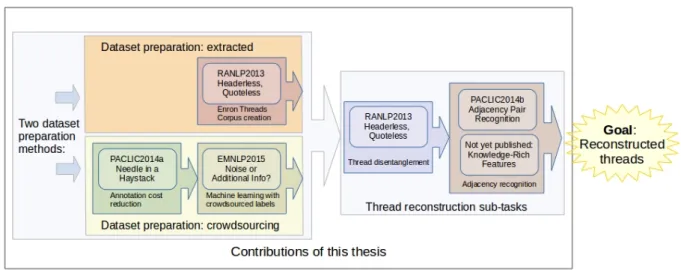
Publications of the contributions are listed in Section 1.3. Figure 1.1 shows an overview of the topics of the contributions and how they are interrelated.
In concluding this thesis, we also reflect on open issues and unanswered questions re-maining after our research contributions, discuss applications for thread reconstruction, and suggest some directions for future work.
Zusammenfassung
Moderne Kommunikation beruht auf elektronischen Nachrichten, die in Form von Threads or-ganisiert sind. E-Mails, Sofortnachrichten, SMS, Kommentare auf Webseiten und in Foren sind aus solchen Threads aufgebaut - diese wiederum bestehen aus einzelnen Benutzernachrichten, die mithilfe von Metadaten verbunden sind und zwischen denen Diskurskohärenz besteht. Threads werden benutzt, um Benutzernachrichten effektiv in einer GUI, wie etwa einem E-Mail-Programm, zu visualisieren. Sie stellen also einen Hintergrundkontext bereit, ohne den einzelne Nachrichten oft nicht verstanden werden können. Allerdings kann es durch eine Reihe von Faktoren dazu kommen, dass eine solche Thread-Struktur verloren geht: Ange-fangen von Benutzerfehlern (z.B. dem Antworten auf eine falsche Nachricht), über fehlende Metadaten (manche E-Mail-Programme erzeugen E-Mail-Header, die nicht die volle Thread-Struktur enthalten; auch Konvertierungen von alten Threads können in fehlenden Metadaten resultieren) bis hin zu absichtlich verschleierter Struktur (etwa durch Benutzer, die es Dritten erschweren wollen, eine Diskussion nachzuvollziehen, und dazu Metadaten vermeiden oder entfernen). Im Bereich Sicherheit benötigen Strafverfolgungsbehörden daher eine automatis-che Thread-Rekonstruktion, um große Mengen an gesammelten elektronisautomatis-chen Nachrichten aus Diskussionen verstehen zu können. Beispielsweise besitzt das Enron Email Corpus, das von der Federal Energy Regulatory Commission der USA während der Ermittlungen beim Energiekonzern Enron zusammengetragen wurde, keine inhärente Thread-Struktur.
In dieser Arbeit verwenden wir Ansätze aus der maschinellen Sprachverarbeitung (Natu-ral Language Processing, NLP), um Threads aus Nachrichteninhalten zu rekonstruieren. Eine solche Rekonstruktion basierend auf den Inhalten umgeht das Problem fehlender Metadaten und erlaubt eine nachträgliche Restrukturierung und damit auch ein Verstehen der gesamten Diskussion. Wir untersuchen Korpora bestehend aus E-Mail-Threads und Wikipedia-Dis-kussionen. Allerdings herrscht eine Knappheit an geeigneten, annotierten Korpora. Zum Beispiel enthält das Enron Emails Corpus keine Angaben zur Thread-Struktur. Aus diesem Grund erforschen wir außerdem Probleme, die beim Erstellen von crowdgesourcten Daten-sätzen und beim Trainieren maschineller Lernverfahren auf solchen DatenDaten-sätzen auftreten.
automatische Klassifizierungsaufgaben für natürliche Sprache anwendbar.
Wir gliedern unsere Erforschung der Rekonstruktion von Diskussions-Threads in zwei Teile auf.
Zuerst untersuchen wir Methoden für die Erstellung eines Korpus, das der Forschung an Thread-Rekonstruktion dienen soll. Wie andere Problemstellungen im Bereich paarweiser Klassifikation in NLP, etwa die Textähnlichkeitsbewertung für Satzpaare oder das Alignment von Sprecherwechseln in Wikipedia-Diskussionen zu Artikeländerungen, ist auch die Wieder-herstellung von E-Mail-Threads ein stark klassen-unbalanciertes Problem. Trotz des Aufkom-mens von Crowdsourcing, das Annotationskosten deutlich reduziert hat, ist die bisher übliche Praxis der Crowdsourcing-Redundanz zu teuer für Aufgaben mit Klassen-Ungleichgewicht. Als ersten Beitrag dieser Arbeit evaluieren wir alternative Strategien, um Crowdsourcing-Redundanz für Annotationen in klassen-unbalancierten NLP Aufgaben zu reduzieren. Wir untersuchen außerdem Methoden, den bestmöglichen maschinellen Klassifikator auf unseren crowdgesourcten Labeln zu trainieren. Um Rauschen in Trainingsdaten zu reduzieren, sam-meln die meisten Crowdsourcing-Annotationsexperimente in NLP mehrere redundante La-bel und aggregieren sie zu einem ganzheitlichen LaLa-bel, das dann an den Klassifikator weit-ergegeben wird. Allerdings verwirft solch eine Aggregation potenziell nützliche Informatio-nen von linguistisch ambigen Instanzen. Für den zweiten Beitrag dieser Arbeit zeigen wir für vier von fünf NLP-Problemstellungen, dass das Filtern von Trainingsdaten basierend auf Inter-Annotator-Agreement von Instanzen die Effektivität des Klassifikators steigern kann, im Gegensatz zu Soft-Labeling, das keine Ergebnisverbesserungen liefert.
Zweitens untersuchen wir Thread-Rekonstruktion, aufgeteilt in die Entflechtung von Threads und die Erkennung von Adjazenz. Wir stellen das Enron Threads Corpus vor, ein neu ex-trahiertes Korpus von 70.178 Threads, bestehend aus jeweils mehreren Mails des Enron E-mail Corpus. Die E-Mails im ursprünglichen Enron EE-mails Corpus sind nicht nach Threads sortiert. Um Threads zu finden und zu entflechten, wenden wir als dritten Beitrag dieser Ar-beit paarweise Klassifikation an. Dazu benutzen wir Textähnlichkeitsmaße auf nicht-zitiertem Text in E-Mails. Wir zeigen zweierlei: i) Textähnlichkeitsmaße, die auf dem Textinhalt operieren, übertreffen stil- und strukturorientierte Maße sowohl in balancierten als auch in klassen-unbalancierten Experimenten. Und ii) obwohl die Effektivität der Features von der seman-tischen Ähnlichkeit des Korpus abhängt, sind inhaltliche Features auch dann effektiv, wenn die semantische Ähnlichkeit kontrolliert wird. Um Threads zu rekonstruieren ist es zusät-zlich notwendig, Adjazenzbeziehungen zwischen Paaren zu identifizieren. Für die Wikipedia-Diskussionen sind keine Metadaten verfügbar; außerdem sind Dialogakt-Typologien, die für andere Domänen hilfreich sein können, hier nicht nutzbar. Als vierten Beitrag zeigen wir anhand unserer Experimente, dass die Erkennung von Adjazenzpaaren unter Benutzung von „Lexical-Pair-Features“ durchgeführt werden kann. Dieser Ansatz ist robust auch bei Berück-sichtigung von Topic Bias der Diskussionen und benötigt weder Dialogakt-Typologie noch
Metadaten. Allerdings bilden Lexical-Pair-Features nicht tatsächlich die lexikalisch-semanti-schen Relationen zwilexikalisch-semanti-schen Adjazenzpaaren ab. Um also lexikalisch-semantische Beziehungen zu modellieren, führen wir als unseren fünften Beitrag Adjazenz-Erkennung mittels extrahier-ter Keyphrases durch, die mit semantisch ähnlichen Termen angereichert werden. Diese Meth-ode liefert bessere Ergebnisse als eine „Most-Frequent-Class-Baseline“, zeigt aber keine Ver-besserung gegenüber Lexical-Pair-Features oder mittels Tf-idf gewichteter Kosinus-Ähnlichkeit. Unsere Untersuchung zeigt, dass dies das Resultat fehlerhafter Word-Sense-Disambiguation und Keyphrase-Extraction ist, was falsche semantische Verbindungen hervorbringt.
Publikationen, die unsere Beiträge behandeln, sind in Section 1.3 aufgelistet. Figure 1.1 zeigt einen Überblick über die Themen der Beiträge und wie sie miteinander in Beziehung stehen.
Abschließend besprechen wir nach den vorliegenden Beiträgen verbleibende ungelöste Probleme und offene Fragen, diskutieren Anwendungen für Thread-Rekonstruktion und zeigen mögliche Wege für weiterführende Arbeiten auf.
Acknowledgements
A dissertation is a group effort, and many people have assisted with this one. I would like to thank Prof. Dr. Iryna Gurevych for affording me the opportunity to conduct this research, for constructing a supportive community of researchers to enable this research, and for providing efficient supervision. I am grateful for Prof. Dr. Johannes Fürnkranz and Prof. Dr. Walter Daelemans for finding the time to evaluate this thesis. This work has been supported by the Volkswagen Foundation as part of the Lichtenberg-Professorship Program under grant No. I/82806, and by the Center for Advanced Security Research (www.cased.de). Additionally, some
prior work has been conducted at Alias-i, with thanks to Dr. Breck Baldwin.
I would like to thank the researchers who have taken the time to either assist me with specific research problems or to read my papers and provide feedback on work discussed in this thesis, including but not limited to, Prof. Dr. Chris Biemann, Prof. Dr. Ulf Brefeld, Dr. Bob Carpenter, Dr. Kostadin Cholakov, Dr. Johannes Daxenberger, Dr. Richard Eckart de Castilho, Dr. Oliver Ferschke, Lucie Flekova, Dr. Ivan Habernal, Silvana Hartmann, Dr. Michael Matuschek, Dr. Christian M. Meyer, Pedro Santos, Christian Stab, Dr. György Szarvas, Prof. Dr. Torsten Zesch, and Hans-Peter Zorn. I greatly appreciate the brainstorming sessions with our many UKP guest visitors, and paper polishing from the anonymous reviewers. I would like to thank the Special Interest Groups DKPro Text Classification and DKPro Core for their community support in developing software used in this thesis, as well as the IT Forensics group of CASED for discussion on the intersection of NLP and IT Security. Additionally, I am grateful to Ilya Kuznetsov for annotation, Erik-Lân Do Dinh for translation, and the friendly UKP System-Admin team for many hours of support.
Approximately 76 researchers have worked at UKP and LangTech during my tenure, and I am so lucky and thankful to have had fascinating lunchtime research discussions with nearly each and every one of you.
I would specifically like to thank Dr. Yannick Versley for many, many years of NLP research encouragement and feedback. Finally, I would like to thank Dr. Graham King for enthusiasm and encouragement of my research journey.
Contents
1 Introduction 5
1.1 Motivations . . . 6
1.2 Contributions and Findings . . . 7
1.3 Publication Record . . . 10
1.4 Thesis Outline and Term Conventions . . . 12
I Experiments in Crowdsourcing Annotation
2 Crowdsourcing NLP Annotation 17 2.1 What is Crowdsourcing? . . . 17 2.2 Types of Crowdsourcing . . . 19 2.3 A Brief History . . . 21 2.4 Demographics . . . 23 2.5 Annotation Tasks . . . 25 2.6 Economic Issues . . . 26 2.7 Label Quality . . . 272.7.1 Spam and Worker Fraud . . . 28
2.7.2 Mistakes . . . 30
2.7.3 Worker Quality . . . 31
2.7.4 Worker Bias . . . 32
2.7.5 Ambiguity . . . 33
2.8 Chapter Summary . . . 34
3 Crowdsourcing Annotation of Class-Imbalanced Datasets 35 3.1 Motivation . . . 36
3.2 Previous Work . . . 37
3.4.1 Baseline Cost . . . 43
3.5 Supervised Cascading Classifier Experiments . . . 45
3.5.1 Instances . . . 47
3.5.2 Features . . . 47
3.5.3 Results . . . 47
3.6 Rule-based Cascade Experiments . . . 51
3.6.1 Results . . . 52
3.6.2 Error Analysis . . . 55
3.7 Chapter Summary . . . 56
4 Text Classification of Crowdsourced Datasets 59 4.1 Motivation . . . 60
4.2 Previous Work . . . 62
4.3 Experiments Overview . . . 63
4.4 Biased Language Detection . . . 66
4.4.1 Results . . . 66
4.5 Morphological Stemming . . . 70
4.5.1 Analysis . . . 71
4.6 Recognizing Textual Entailment . . . 73
4.6.1 Results . . . 74 4.7 POS tagging . . . 75 4.7.1 Results . . . 77 4.8 Affect Recognition . . . 82 4.8.1 Results . . . 83 4.9 Chapter Summary . . . 87
II Experiments in Thread Reconstruction
5 Thread Reconstruction 93 5.1 Overview . . . 935.1.1 Examples of Discussion threads . . . 95
5.1.2 Thread Reconstruction as a Task . . . 104
5.1.3 Alternatives to Disentanglement/Adjacency . . . 105
5.1.4 Pairwise Evaluation . . . 105
5.2 Background . . . 107
5.2.1 Discussion: Related Work . . . 107
5.2.2 Threads: Related Work . . . 108
5.3 Datasets . . . 115
5.3.1 Enron Threads Corpus . . . 116
5.3.2 Gold Standard Thread Extraction from the Enron Email Corpus . . . . 116
5.3.3 English Wikipedia Discussions Corpus . . . 120
5.4 Chapter Summary . . . 121
6 Email Thread Disentanglement 123 6.1 Motivation . . . 124
6.2 Text Similarity Features . . . 125
6.3 Evaluation . . . 127 6.3.1 Data Sampling . . . 128 6.3.2 Results . . . 129 6.3.3 Inherent limitations . . . 132 6.3.4 Error Analysis . . . 133 6.4 Chapter Summary . . . 135
7 Wikipedia Discussion Adjacency Pairs 137 7.1 Motivation . . . 138
7.2 Background . . . 139
7.2.1 Adjacency Pair Typologies . . . 139
7.2.2 Discussion Structure Variation . . . 140
7.3 Related Work . . . 141 7.3.1 Adjacency Recognition . . . 141 7.3.2 Lexical Pairs . . . 142 7.4 Dataset . . . 142 7.5 Human Performance . . . 142 7.6 Features . . . 143
7.7 Experiments without Topic Bias Control . . . 144
7.7.1 Results . . . 145
7.7.2 Error Analysis . . . 146
7.7.3 Feature Analysis . . . 147
7.8 Topic Bias and Control . . . 147
7.9 Experiments with Topic Bias Control . . . 148
7.9.1 Problems with the Chance Baseline . . . 149
7.9.2 Results . . . 150
7.10 Chapter Summary . . . 151
8 Lexical Expansion for Recognizing Adjacency Pairs 153 8.1 Overview . . . 154
8.4 Keyphrases in Wikipedia Discussions . . . 160 8.5 Experiment Design . . . 162 8.6 Features . . . 163 8.7 Results . . . 164 8.8 Error Discussion . . . 166 8.9 Chapter Summary . . . 168
9 Conclusion and Future Work 169 9.1 Summary of Main Contributions and Findings . . . 169
9.2 Applications . . . 172
9.2.1 Law Enforcement Applications . . . 173
9.2.2 Email Client Applications . . . 175
9.2.3 Email ad targeting . . . 175
9.2.4 Discourse Generation Applications . . . 176
9.2.5 Real-Time and Post-hoc Thread Structure Correction Applications . . 177
9.3 Open Issues and Limitations . . . 177
9.4 Concluding Remarks . . . 180
List of Tables 183 List of Figures 187 Bibliography 191 Appendix 211 A Corpora with crowdsource annotation item agreement . . . 211
Contents
Foreword
On June 1, 1880, Mark Twain (1880) published a short story in the magazine,The Atlantic. The story featured an odd linguistic phenomenon created by emerging technology (i.e., the telephone): short pieces of discussion that were not understandable without the rest of the discussion. An excerpt from the story is reprinted below.
A TELEPHONIC CONVERSATION (excerpt)
Without answering, I handed the telephone to the applicant, and sat down. Then fol-lowed that queerest of all the queer things in this world—a conversation with only one end of it. You hear questions asked; you don’t hear the answer. You hear in-vitations given; you hear no thanks in return. You have listening pauses of dead silence, followed by apparently irrelevant and unjustifiable exclamations of glad surprise or sorrow or dismay. You can’t make head or tail of the talk, because you never hear anything that the person at the other end of the wire says. [...] Yes? Why, how did THAT happen?
Pause.
What did you say? Pause.
Oh no, I don’t think it was. Pause.
NO! Oh no, I didn’t mean THAT. I meant, put it in while it is still boiling—or just before it COMES to a boil.
Pause. WHAT? Pause.
I turned it over with a backstitch on the selvage edge. Pause.
Yes, I like that way, too; but I think it’s better to baste it on with Valenciennes or bombazine, or something of that sort. It gives it such an air—and attracts so much noise.
It’s forty-ninth Deuteronomy, sixty-forth to ninety-seventh inclusive. I think we ought all to read it often.
Pause.
Perhaps so; I generally use a hair pin. Pause.
What did you say? (ASIDE.) Children, do be quiet! Pause
OH! B FLAT! Dear me, I thought you said it was the cat! Pause.
Since WHEN? Pause.
Why, I never heard of it. Pause.
You astound me! It seems utterly impossible! Pause.
WHO did? Pause.
Good-ness gracious! Pause.
Well, what IS this world coming to? Was it right in CHURCH? Pause.
And was her MOTHER there? Pause.
Why, Mrs. Bagley, I should have died of humiliation! What did they DO? Long pause.
I can’t be perfectly sure, because I haven’t the notes by me; but I think it goes something like this: te-rolly-loll-loll, loll lolly-loll- loll, O tolly-loll-loll-LEE-LY-LI-I-do! And then REPEAT, you know.
Pause.
Yes, I think it IS very sweet—and very solemn and impressive, if you get the an-dantino and the pianissimo right.
Pause.
Oh, gum-drops, gum-drops! But I never allow them to eat striped candy. And of course they CAN’T, till they get their teeth, anyway.
Pause. WHAT? Pause.
Oh, not in the least—go right on. He’s here writing—it doesn’t bother HIM. Pause.
Very well, I’ll come if I can. (ASIDE.) Dear me, how it does tire a person’s arm to hold this thing up so long! I wish she’d—
Contents
Pause.
Oh no, not at all; I LIKE to talk—but I’m afraid I’m keeping you from your affairs. Pause.
Visitors? Pause.
No, we never use butter on them. Pause.
Yes, that is a very good way; but all the cook-books say they are very unhealthy when they are out of season. And HE doesn’t like them, anyway—especially canned. Pause.
Oh, I think that is too high for them; we have never paid over fifty cents a bunch. Pause.
MUST you go? Well, GOOD-by. Pause.
Yes, I think so. GOOD-by. Pause.
Four o’clock, then—I’ll be ready. GOOD-by. Pause.
Thank you ever so much. GOOD-by. Pause.
Oh, not at all!—just as fresh—WHICH? Oh, I’m glad to hear you say that. GOOD-by. (Hangs up the telephone and says, ”Oh, it DOES tire a person’s arm so!”)
The dawning of the telephone age permitted real-time dialogue whose comprehensibility relied on access to the entire discussion, and yet whose turns could be overheard without such a context. Twain listened to the turns of one speaker, yet could not hear the responses of the other. The discussion made sense to the participants, but was meaningless to the third-party observer.
How can one make sense of a discussion with missing turns? What linguistic information can be utilized from the existing turns to predict the contents of the missing ones?
Twain was early to ponder this problem, and likely had no idea how common it would become: in modern day, nearly all of our web-based discussion, from emails to IRC chats, to forums and discussion boards, to article responses, relies on the structure of the discussion to render the dialogue comprehensible and informative. Without knowing which turn is a reply to which other turn, dialogue becomes as mysterious as this story.
In this dissertation, we confront the problem of incomprehensible isolated discussion turns. Specifically, we work towards putting together the pieces of broken discussion: thread recon-struction.
Chapter 1
Introduction
Modern communication relies on electronic discussion. In 2010, an estimated 32B non-spam emails were sent per day (Radicati and Levenstein, 2013). In 2013, 400M comments and 3.6B comment votes were posted to 40M discussions on the social voting site Reddit (Grant, 2013). In 2012, 17.6B SMS messages were sent per day (strategyeye.com, 2014). Widespread adapta-tion of electronic communicaadapta-tion in the 1990’s has resulted in vast numbers of online discus-sions, known as threads. Emails, IMs, SMS, website comments, and forums are all composed ofdiscussion threads, which consist of individualturns (user messages) connected by meta-data (i.e. subject line, reply-to id) and discourse coherence to messages from other users. Threads are used to display user messages effectively in a GUI such as an email client or forum website, providing necessary context for understanding a single message.
The ubiquity of electronic messaging and discussion threads has rendered thread organiza-tion more important than ever before. A discussion cannot be fully understood if its individual messages are missing, out of order, or are mixed with the messages of other threads. However, a number of factors may result in missing thread structure, from user mistake (replying to the wrong message), to missing metadata (some email clients do not produce/save headers that fully encapsulate thread structure; and, conversion of archived threads from over repository to another may also result in lost metadata), to covert use (users may not use metadata to make discussions difficult for 3rd parties to understand). When metadata is missing, the only solution is to reconstruct the thread structure based on the linguistic content of the messages. In this dissertation, we investigate this problem of thread reconstruction as an NLP task of reconstructing threads using message content alone. Additionally, as an investigation of an under-researched NLP task, we explore crowdsourcing processes necessary to create and use the novel datasets required for discussion thread reconstruction. Thus, this thesis is divided into two parts. In Part I, we discuss our crowdsourcing contributions for corpus annotation and machine learning on crowdsourced labels, towards a goal of corpus production for thread reconstruction experiments. In Part II, we provide background on discussion thread
recon-struction, and we report results of our thread reconstruction experiments, as divided into the subtasks thread disentanglement (separating intermixed turns by their discussions) and adja-cency recognition (identifying reply-to relations among pairs of turns). An overview of these topics can be seen in Figure 1.1.
1.1 Motivations
In this section we discuss high-level research questions addressed by this thesis. Additionally, individual chapters discuss specific research questions relevant to those chapters. The greater applicability of our findings, beyond the immediate question being addressed, is also discussed in the individual chapters.
We are interested in the following high-level thread reconstruction research questions, which we expect will have real-world use:
• Given an unordered bag of discussion turns,
– how can we divide the turns by their discussions?
– how can we assign discussion relations (i.e., reply-to relations) between the turns? • Given an unverified discussion thread,
– how can we identify incorrect discussion relation links between the turns, and suggest better ones?
Additionally, an under-investigated task such as thread reconstruction needs new corpora: • What processes should be used to obtain and learn a model from a crowdsource-labeled
corpus?
These are fundamental questions whose complete answers lie outside the scope of this thesis. However, these questions motivate the specific research questions addressed in Sec-tion 1.2. Eventually, progress on these high-level quesSec-tions will contribute to the following applications, discussed in detail in Chapter 9.2.
• Greater access to human-annotated corpora for the NLP research community. • Better machine learning models trained on crowdsourced datasets.
• The ability to reconstruct discussion threads via only message content, with benefits such as:
– Improved evidence collection by law enforcement – Thread manipulation detection for law enforcement
– Email clients that provide better thread organization and display
1.2. Contributions and Findings
– Improved email client ad search
– Improved chatbot discourse generation
– Software for post-hoc forum, website comment, and Wikipedia discussion thread structure correction
In fact, all of the many varied forms of modern electronic communication, from emails to internet relay chats to Wikipedia discussion pages to social voting sites to news article comment sections to question-answering websites, would all be impacted by technology to identify and track the structure of the discussion. With the increasing ubiquity of electronic text communication, this technological need is becoming more relevant than ever.
1.2 Contributions and Findings
Previously in Section 1.1, we have presented several of the high-level research questions mo-tivating this thesis. In this section, we summarize our most important findings and contribu-tions. We also summarize our novel tasks, corpora, methods, and concepts.
Our findings concerning crowdsourcing processes necessary to create and use the novel datasets required for discussion thread reconstruction:
• Thread reconstruction requires the determination of relations between pairs of discus-sion turns. A corpus made of these pairs of turns isclass-imbalanced, because the nega-tive and posinega-tive classes of pairs have very different prior probability distributions. We show that annotation of a class-imbalanced dataset can be very expensive, due to extra-neous annotations of unneeded common-class (high prior probability class) instances while searching for rare-class (low prior probability class) instances, and we investigate techniques to reduce these annotation costs. In an investigation of annotation affordabil-ity, and using three class-imbalanced corpora, we showed that annotation redundancy for noise reduction is expensive on a class-imbalanced dataset, and should be discarded for instances receiving a single common-class label. We also showed that this simple technique, which does not require any training data, produces annotations at approx-imately the same cost of a metadata-trained, supervised cascading machine classifier, or about 70% cheaper than five-vote majority-vote aggregation. We expect that future work will combine this technique for seed data creation with algorithms such as Active Learning to create corpora large enough for machine learning, at a reduced cost. • The crowdsource labeling of a thread reconstruction dataset will typically result in
re-dundant labels for each instance, so we have explored different techniques to learn the best classifier model from the redundant labels. In an investigation of machine learn-ing with crowdsource-annotated datasets, for five natural language tasks, we exam-ined the impact of informing the classifier ofitem agreement, by means of soft
label-ing (the assignment of multiple partial labels to the same machine learninginstance) and low-agreement training instance filtering(removing certain instances from a train-ing dataset). We found a statistically significant benefit from filtertrain-ing in four of our five tasks, and strongest improvements for linguistically ambiguous cases. The non-benefited task, stemming, had the lowest number of item agreement categories of the five tasks, preventing fine-grained agreement training filtering, which explains why fil-tering showed no benefit. However, we also observed our training strategies impacted some classification categories more than others, increasing sample-selection bias, which negatively impacts model learning. Our findings suggest that the best crowdsource la-bel training strategy is to remove low item agreement instances, although care must be taken to reduce sample-selection bias.
Our findings regarding thread reconstruction:
• We investigated the use of different types of text similarity features for the pairwise classification of emails for thread disentanglement. We found that content similarity features are more effective than style or structural features across class-balanced and class-imbalanced environments. There appear to be more stylistic features of the text uncaptured by our similarity metrics, which humans access for performing the same task. We have shown that semantic differences between corpora will impact the general effectiveness of text similarity features, but that content features remain effective. • In an evaluation of the use of lexical pairs foradjacency recognition, we have shown that
lexical pairs are helpful, outperforming cosine similarity. We have further shown that this benefit is robust to topic bias control. Our error analysis raises intriguing questions for future research, showing that a number of forms of deeper linguistic analysis, such as centering theoretic analysis, stance detection, and lexical semantic modeling may be necessary to reduce the current error rate in metadata-less adjacency recognition. • We evaluated the use of lexical expansion as a source of knowledge-rich features for
adjacency recognition. We found that, despite the intuitive appeal of lexical expansion to represent the topic of a text, lexical expansion fails to outperform simple knowledge-poor approaches such as tf-idf cosine similarity and lexical pairs. Additionally, in a comparison of nouns versus keyphrases as terms to be expanded, we found that choice depends on which machine learning features are used, as well as corpus frequency of names and jargon.
The contributions summarized above can be alternatively characterized as novel concepts, tasks, methods, and corpora.
1.2. Contributions and Findings
Theconcepts introduced and investigated in this work include:
• Crowdsource annotation of a class-imbalanced dataset as a financial/resource concern • Machine learning on crowdsourced labels affected by informational properties of
crowd-sourced labels that remain constant across different natural language tasks
• Lexical pairsas an effective feature-space-reduction from SVM feature auto-combination In our work, we propose several newtasks.
• Metadata-free thread reconstruction, thread disentanglement, and adjacency recognition • Email thread reconstruction from quoted email material viaclustering and segmentation
of quoted emails
• Pairwise thread disentanglement as a content, structural, and style-based text similarity problem
To solve these tasks, we conduct experiments using the following newmethods.
• Automatic adjacency and disentanglement pairwise classification ofemails using only message-content features
• Automatic adjacency and disentanglement pairwise classification ofWikipedia discus-sion turns using onlymessage-content features
• Automatic adjacency recognition usingknowledge-rich features
• Classifier cascade of crowdsourced datasets using only metadata features • Rule-based cascade of crowdsourced datasets using only metadata features
Experiment design is critical to produce meaningful results. In our experiments, we pro-pose the following techniques.
• Controlling of semantic similarity during evaluation of text similarity for email thread disentanglement
• Prevention of information leak between discussion turn pairs from the same discussion thread
• Most-frequent-class baseline calculation that is sensitive to entropy of class balance of source discussion threads
For the work described in this thesis, we produced two corpora, as summarized in Table 1.1. Other corpora used in our experiments are summarized in Table 1.2. The tables provide a reference for the acronyms used throughout this work.
Task-specific research questions motivating the work in Chapter 3, Chapter 4, Chapter 6, Chapter 7, and Chapter 8 are listed at the beginning of their respective chapters.
1https://www.ukp.tu-darmstadt.de/data/text-similarity/email-disentanglement
Corpus Full name Purpose Self-created Availability and License Described in Chap-ter
Etc Enron Threads Corpus Thread disentanglement andadjacency recognition yes yes, publicdomain1 5
Ecd Enron CrowdsourcedDataset Crowdsourcing experiments yes yes, publicdomain1 2
Table 1.1: Self-produced corpora created and used as contributions in this thesis. All corpora are in English.
1.3 Publication Record
We have published the major contributions of this thesis in peer-reviewed conference or work-shop proceedings of major events in natural language processing. The chapters extending these publications are indicated below. A full list of our publications is available in the ap-pendix.
Emily K. Jamison and Iryna Gurevych: ‘Noise or additional information? Using crowdsource annotation item agreement for natural language tasks’, in: Proceed-ings of EMNLP 2015: Conference on Empirical Methods in Natural Language Process-ing (EMNLP 2015), p. 291–297, Lisbon, Spain, 2015. (Chapter 4)
Emily K. Jamisonand Iryna Gurevych: ‘Adjacency Pair Recognition in Wikipedia Dis-cussions using Lexical Pairs’, in: Proceedings of the The 28th Pacific Asia Conference on Language, Information and Computing (PACLIC), p. 479–488, Phuket, Thailand, 2014. (Chapter 7) 3http://www.ukp.tu-darmstadt.de/data/wikidiscourse 4https://sites.google.com/site/amtworkshop2010/data-1 5http://www.pascal-network.org/Challenges/RTE/Datasets/ 6http://sites.google.com/site/nlpannotations/ 7http://www.ark.cs.cmu.edu/TweetNLP 8http://www.lowlands.ku.dk/results/ 9http://nlp.cs.swarthmore.edu/semeval/tasks/ 10http://sites.google.com/site/nlpannotations/ 11Self-created with Bob Carpenter and Breck Baldwin 12http://github.com/bob-carpenter/anno
13I created the Human Intelligence Task (HIT) Layout and Setup for the crowdsource annotation of this corpus.
As per agreement with Johannes Daxenberger, Etp-Gold and corpus annotation guidelines are contributions of only JD’s dissertation.
1.3. Publication Record
Corpus Full name Purpose
Self-created Availability and License Described in Chap-ter Sent-Pairs
30 Sentence Pairs Crowdsourcing experiments no yes, upon
request2 2
Ewdc English Wikipedia Dis-cussions Corpus Adjacency pair recognition no yes, CC-by-SA3 2
Yano2010 AmericanBlog Post CorpusPolitical Biased language detection no yes, licenseunknown4 4
Pascal Rte-1
PASCAL Recognizing Textual Entailment Dataset-1
Recognizing textual entail-ment
no yes, no
li-cense5 4
RteAnno Snow et al.MTurk Annotations2008’s for Pascal Rte-1
Recognizing textual entail-ment no yes, no li-cense6 4 Gim-bel2011 Gimbel et al. 2011’s POS Twitter Corpus
POS tagging no yes, by
CC-BY7 4
Gimbe-lAnno
Hovy et al. 2014’s
Crowdflower
Anno-tations for Gimbel2011
POS tagging no yes, no
li-cense8 4
Sem2007 SemEval 2007 AffectiveText Task Affect recognition no yes, no li-cense9 4
SemAnno Snow et al.MTurk Annotations2008’s for Sem2007
Affect recognition no yes, no
li-cense10 4
Carp2009 MTurk Stems Corpus Morphological stemming joint
11 yes, by
BSD-Simplified12
4
Etp-Gold Wikipedia Edit-Turn-Pair Corpus Crowdsourcing experiments no
13 yes,
CC-by-SA14 2
Table 1.2: Other corpora used in this thesis. All corpora are in English.
Emily K. Jamisonand Iryna Gurevych: ‘Needle in a Haystack: Reducing the Costs of Annotating Rare-Class Instances in Imbalanced Datasets’, in: Proceedings of the The 28th Pacific Asia Conference on Language, Information and Computing (PACLIC), p. 244-253, Phuket, Thailand, 2014. (Chapter 3)
Emily K. Jamisonand Iryna Gurevych: ‘Headerless, Quoteless, but not Hopeless? Us-ing Pairwise Email Classification to Disentangle Email Threads’, in: Proceedings of 9th Conference on Recent Advances in Natural Language Processing (RANLP 2013), p. 327–335, Hissar, Bulgaria, 2013. (Chapters 5 and 6)
Figure 1.1: An overview of tasks and publications of this thesis.
1.4 Thesis Outline and Term Conventions
This section provides an overview of the organization of this thesis. This thesis presents our contributions to discussion thread reconstruction, as well as our contributions to crowd-sourcing processes necessary to create and use the novel datasets required for discussion thread reconstruction. Thus, this thesis is divided into two parts. In the first part, we dis-cuss our crowdsourcing contributions for corpus annotation and machine learning on crowd-sourced labels, towards a goal of corpus production for thread reconstruction experiments. In the second part, we provide background on discussion thread reconstruction, and we present our discussion thread reconstruction contributions. Figure 1.1 provides an overview of this thesis.
Part I In the first part, we explore techniques needed to create a corpus for our thread re-construction research. We investigate crowdsourcing as a cheap and effective source of data annotations.
In Chapter 2, we provide background on the practice of crowdsource annotation. This includes an overview of crowdsourcing including its various forms, a brief history of crowd-sourcing, demographic statistics, tasks that have been successfully crowdsourced, economic issues of the crowdsource labor market, and problems with label quality.
In Chapter 3, we present our contributions on class-imbalanced crowdsource corpus cre-ation. Like other NLP pairwise classification tasks such as Wikipedia discussion turn/edit alignment and sentence pair text similarity rating, many thread reconstruction tasks such as email thread disentanglement are heavily class-imbalanced problems, and although the ad-vent of crowdsourcing has reduced annotation costs, common practice of crowdsourcing re-dundancy is too expensive for class-imbalanced tasks. We evaluate alternative strategies for
1.4. Thesis Outline and Term Conventions
reducing crowdsourcing annotation redundancy for class-imbalanced NLP tasks. Our findings are needed for reducing the cost of annotating thread reconstruction corpora, yet are addition-ally applicable to other class-imbalanced corpus annotation, such as the tasks examined in this chapter.
A crowdsource-annotated thread reconstruction corpus will have redundant labels that must be converted into gold standard annotations. In Chapter 4, we present our contributions on comparing techniques to learn the best machine classifier from crowdsourced labels. In order to reduce noise in training data, most natural language crowdsourcing annotation tasks gather redundant labels and aggregate them into an integrated label, which is provided to the classifier. However, aggregation discards potentially useful information from linguistically ambiguous instances. We show that, for four of five natural language tasks, filtering of the training dataset based on crowdsource annotation item agreement improves task performance, while soft labeling based on crowdsource annotations does not improve task performance. Our findings are needed for learning the best classifier from a crowdsource-annotated thread reconstruction corpus, yet are additionally applicable to the wide range of text classification tasks investigated in the chapter.
Part II In the second part, we investigate thread reconstruction as divided into the tasks of thread disentanglement and adjacency recognition.
In Chapter 5, we provide background on discussion thread reconstruction, and we discuss types of online discussion threads and threading problems. We present the Enron Threads Corpus (Etc), a newly-extracted corpus of 70,178 multi-email threads with emails from the Enron Email Corpus. We also give an overview of the other major corpus we used in our thread reconstruction experiments, theEnglish Wikipedia Discussions Corpus (Ewdc).
In Chapter 6, we present our contributions on email thread disentanglement. In the orig-inal Enron Emails Corpus, emails are not sorted by thread. To disentangle these threads, we perform pairwise classification, using text similarity measures on non-quoted texts in emails. We show that i) content text similarity metrics outperform style and structure text similarity metrics in both a class-balanced and class-imbalanced setting, and ii) although feature perfor-mance is dependent on the semantic similarity of the corpus, content features are still effective even when controlling for semantic similarity.
In Chapter 7, we present our contributions on adjacency recognition. To reconstruct threads, it is necessary to identify adjacency relations among pairs. For the forum of Wikipedia discussions, metadata is not available, and dialogue act typologies, helpful for other domains, are inapplicable. Via our experiments, we show that adjacency recognition can be performed using lexical pair features, without a dialogue act typology or metadata, and that this is robust to controlling for topic bias of the discussions.
In Chapter 8, we present our contributions on the use of lexical expansion for adjacency pair recognition. Lexical pair features do not effectively model the lexical semantic relations
between adjacency pairs. To model lexical semantic relations, we perform adjacency recog-nition using extracted keyphrases enhanced with semantically related terms. While this tech-nique outperforms a most frequent class baseline, it fails to outperform lexical pair features or tf-idf weighted Cosine Similarity. Our investigation shows that this is the result of poor word sense disambiguation and poor keyphrase extraction causing spurious false positive semantic connections.
Typography and Terminology We wish to note the following typographical practices. Im-portant terms are printed in italics at the place where they are introduced or re-introduced. All corpora used in this thesis are named in Small Capital letters.
The following important terms are explained in their respective sections of the thesis, as well as here for convenience.
Class imbalance refers to severely unequal prior class probabilities in the dataset. Common-class instances are members of a class with high prior class probability. Rare-class instances are members of a class with low prior class probability.
Item agreement is the inter-annotator agreement between labels for one machine learn-inginstance, such as one token with five different POS-tags assigned by five different expert annotators.
Soft labeling is the assignment of multiple partial labels to the same machine learning instance, such that the weight of all soft labels of an instance adds up to 1.0; in our work, soft labeling is practiced on a training dataset but a classifier outputs hard labels on the evaluation dataset.
Filteringis the practice of removing certain instances from a training dataset under certain conditions of the instance, such as low inter-annotator agreement of labels on that instance, for machine learning.
A discussion is a conversation between two or moreparticipants (people), in which the participants participate for a total of at least two discussion turns.
Adiscussion turn is an uninterrupted utterance by a participant; examples include a single email or a single forum post.
Thread reconstruction is the general task of assigning relations between discussion turns to organize the turns by discussion and by reply-to relations (relations where one turn is in response to another turn).
Two subtasks of thread reconstruction include thread disentanglement, which identifies which discussion a turn belongs to, andadjacency recognition, which identifies reply-to rela-tions among pairs of turns.
More terminology definitions are available on the topic of crowdsourcing in Chapter 2 and on the topic of thread reconstruction in Chapter 5.
Part I
Chapter 2
Crowdsourcing NLP Annotation
In this thesis, we investigate the NLP task of discussion-thread reconstruction. As a subdo-main of NLP, this task has received less attention than other subdosubdo-mains, and it lacks re-sources. There are few publicly available corpora for studying thread reconstruction. Thus, as frequently happens with understudied NLP tasks, we must build our own corpora.
In Part I of this thesis, we investigate crowdsourcing techniques that are relevant to build-ing and usbuild-ing a crowdsourced corpus for thread reconstruction. These crowdsourcbuild-ing tech-niques are also relevant for many NLP tasks beyond thread reconstruction. We discuss broader applicability with each investigation.
In this chapter, we provide a background on crowdsourcing. Section 2.1 contains an over-view on crowdsourcing, and Section 2.2 discusses various types of crowdsoucing. A brief history of crowdsourcing is provided in Section 2.3. In Section 2.4, we discuss demograph-ics of crowdsource workers, and in Section 2.5 we discuss what annotations tasks have been successful with crowdsourcing. In Section 2.6, we discuss economic issues of the crowdsource labor market. Finally, in Section 2.7, we discuss problems with crowdsourcing label quality, in-cluding spam/worker fraud, worker mistakes (accidental/random), worker quality (systemic), worker bias, and the data-driven problem of ambiguity.
2.1 What is Crowdsourcing?
Crowdsourcing is the use of anonymous persons from the internet to solve specific, internet-based, human-skill tasks. It is an alternative to hiring and training in-house employees, a long-term solution that may not be suitable for short or small tasks.
Yuen et al. (2011a) describes crowdsourcing as a “distributed problem-solving and business production model,” one that “makes use of human abilities for computation to solve problems” (Yuen et al., 2009). Crowdsourcing commonly refers to a micro-task market (Kittur et al., 2008), an online system of very small payments for very brief work tasks, using frameworks
such as Amazon’s Mechanical Turk15,CrowdFlower16, orTaskcn17. The tasks are of a nature that requires human intelligence, such as identifying objects in photos or translating product descriptions. The tasks require little time or expertise, so they offer little compensation per task, frequently USD$0.01 to USD$0.10. The benefit of crowdsource platforms is “the capacity to organize people into economically productive units” (Howe, 2008).
Jeff Howe (2008) described crowdsourcing from a labor market perspective: “ ‘Crowd-sourcing’ is the act of taking a task traditionally performed by a designated agent (such as an employee or contractor) and outsourcing it by making an open call to an undefined but large group of people.” From this perspective, a wider definition of crowdsourcing refers to many collaboratively-built Web 2.0 platforms: Wikipedia18,Yahoo! Answers19, Yahoo’s flickr20, the social bookmarking sites del.icio.us21 and Reddit22, to social games such asTagATune23 and Google Image Labeler24 to creative systems such as theSheep Market25 (Yuen et al., 2011a). YouTube26demonstrates a reward-based participation market: when a contributor’s videos re-ceive less attention, the contributor posts fewer new videos, which results in less attention, until frequently the user stops contributing (Huberman et al., 2009). In addition, variants of the micropayments-for-work-tasks model exist on a larger scale: InnoCentive27and NineSigma28 allow requesting companies to post research and development work tasks, and workers are rewarded $10,000 or $25,000 for inventing a solution for the task, whose in-house development would have cost several times as much, if it was solved at all (Howe, 2006).
A variant of crowdsourcing in which multiple workers submit solutions for single task is theWitkeylabor market (Yang et al., 2008). Witkeys are popular in China and include websites such as Taskcn.com, zhubajie.com, and k68.cn. They are named after the first website to use the model in 2005, Witkey.com. In the Witkey model, the website hosts tasks from requesters, and multiple workers submit solutions for each task. The requester chooses the best solution and pays the reward to that submitter. The website, like most crowdsourcing websites, keeps a small portion of the reward in exchange for hosting the task. DiPalantino and Vojnovic (2009) investigated the reward/participation structure of the Witkey model, and found that, although
15www.mturk.com 16www.crowdflower.com 17www.taskcn.com 18en.wikipedia.org 19answers.yahoo.com 20www.flickr.com 21http://del.icio.us/ 22reddit.com 23http://musicmachinery.com/tag/tagatune/ 24images.google.com/imagelabeler/ 25thesheepmarket.com 26www.youtube.com 27www.innocentive.com 28www.ninesigma.com/
2.2. Types of Crowdsourcing
it is not beneficial to the average worker, participation rates in a task increase logarithmically with the task reward.
In this chapter, we are primarily interested in crowdsourcing as an NLP annotation tool, in which human knowledge and judgment is used to determine ground truth in language tasks. Generally, this requires humans to complete small, independent tasks that use little time or expertise, using an infrastructure such asAmazon Mechanical Turk ( MTurk) orCrowdFlower. In this paradigm, persons posting short webpage-based tasks (namedHITs by MTurk) on the website are calledrequestersand persons doing the work are known asworkers, or in the case of MTurk,Turkers.
2.2 Types of Crowdsourcing
Different crowdsourcing arrangements allow workers to receive various forms of compensa-tion for their work. Different forms of compensacompensa-tion may be: access to website resources; entertainment value from games that collect useful metadata as a byproduct; creative design; altruism; and cash payments.
Information Collection for Access Websites sometimes need to distinguish human users from automatic or bot users. For example, many webmail services offer free email accounts to users. However, their servers would quickly be overwhelmed if bots were permitted to open new accounts. Likewise, many websites display user comments, but they need to prevent au-tomatic postings by advertising bots in order to keep the comments interesting and appealing to humans. To identify human users, websites use aCAPTCHA test: an image of text is dis-played, and the user must correctly enter the text of the image. The image typically displays text that is beyond current OCR capabilities, so when a user correctly enters the text of the image, they prove that they are human. To generate a fresh supply of images, reCAPTCHA, a variant of the text, displays two images: one with known content and the other with un-known content. The user must enter the text of both images. If the user correctly enters the text of the known image, they have proven they are human, and their answer to the second image is presumed to also be correct; the second image will then be provided as the known image to the next user. The reCAPTCHA image labeling system is a domain-specialized form of information collection crowdsourcing (Yuen et al., 2009).
Creative Design Creative tasks have also been accomplished through crowdsourcing (Yuen et al., 2011a). For example, the Sheep Market29 (Koblin, 2009) is a web-based art project in which workers were asked to “draw a sheep facing left”. 10,000 sheep drawings were collected through MTurk, and workers were paid USD$0.02 for their sheep drawing. However, as the
average time drawing a sheep was 105 seconds, and the average wage was USD$0.69/hour (which is well below standard crowdsourcing rates), workers must have agreed to participate partly due to enjoyment of creative design.
In SwarmSketch30, a topic is provided (such as “Atlas Shrugged” or “Debt Collectors”) and each user is permitted to contribute one line towards a sketch of that topic. The One Million Masterpiece project31asks each participant to draw the contents of one digital square, and the squares comprise a giant patchwork collaborative image; users can communicate with their neighbors and change their square’s image at any time. In the Johnny Cash Project32, users submit a drawing that will be used as one frame in a music video for Johnny Cash’s song,Ain’t No Grave, and receive name credit for their contribution.
Altruism Some crowdsourcing paradigms benefit the worker only via a sense of altruism. For example, Nam et al. (2009) interviewed 26 users of the largest South Korean question-answering site, Naver-Knowledge-iN, and found that top answerers cited altruism, learning,
and competency as their motivations for participation. A drawback to this motivation, how-ever, is that participation was found to be highly intermittent. Top answerers also cited the point-system and thank-you messages for increasing participation motivation.
Thousands of crowdsource volunteers looked at 560,000 satellite images in early 2007, try-ing to find the location of computer scientist Jim Gray, who went misstry-ing on a sailtry-ing trip that year. The effort was not successful, but did demonstrate the desire of volunteers to help with a good cause. (Quinn and Bederson, 2011)
Games With A Purpose Games with a Purpose (a.k.a. social games) are a form of online entertainment game, in which the game design allows the host to collect useful metadata generated by the game players. First described by Von Ahn (2006), the games vary in their structure to use different arrangements of data input and output, symmetric or asymmetric verification, and collaborative or competitive interaction between players (Yuen et al., 2009).
One such game is the ESP Game (Von Ahn, 2006). This game was designed to collect labels for images for accessibility applications for the visually impaired. In this game, random pairs of online players are simultaneously shown the same image. Each player tries to guess what label the other player would give the image. The more labels each player submits, the more likely there is to be a match. When a pair of players have both submitted the same label, the game moves on to the next image. Players receive points for each match, as well as a bonus for matching all 15 images in a round. The text string that the two players agreed upon is usually a good label for the image, and it is this data that is collected for the game’s purpose.
30http://swarmsketch.com/ 31www.millionmasterpiece.com/
2.3. A Brief History
Chan et al. (2009) propose a formal framework for the design of social games, listing out the design elements of the game, the characteristics of the human computation problem, and their relationships. They also propose a set of design guidelines derived from the formal model. Jain and Parkes (2009) discuss how game theory can be incorporated into the design of games with a purpose. For example, current game-theoretic models of social games assume that each player’s interests are entirely selfish; however, a more accurate model needs to account for the altruism that crowdsource contributors are known to exhibit.
Eickhoff et al. (2012) combine the concept of games with a purpose, with paid microtask crowdsourcing, and show that the additional gaming motivation of the task permitted col-lection of high-quality annotations at significantly lower pay rates and with less fraudulent work.
Cash Payments Crowdsourcing arrangements motivated by cash payments, such as MTurk, CrowdFlower, and Taskcn platforms, offer the greatest task flexibility of all forms of crowd-sourcing. A wide range of work can be accomplished in exchange for (even tiny) cash pay-ments, such as image labeling, voice transcription, identification of information (such as a company name) in a document, website classification, story rating, product translation, and surveys. While information collection, creative design, and games with a purpose are uniquely tailored to convince workers to contribute data for free, they require labor-intensive task de-sign and are not suitable for many tasks. In contrast, crowdsourcing via cash payment has a lower threshold for task design, enabling data collection for smaller tasks than are feasible with the other forms of crowdsourcing.
Quinn and Bederson (2011) also point out drawbacks of cash motivation. It may drive workers to cheat the system, and the anonymity of most workers may increase the likelihood of dishonest behavior.
While some Turkers work for fun or to kill time (51% of US workers and 62% of Indian workers in November 2009 agreed with the statement “MTurk money is irrelevant to me.” or “MTurk money is nice, but doesn’t materially change my circumstances.” (Ross et al., 2010)), many Turkers work for the money.
2.3 A Brief History
In order to provide a context for our crowdsourcing contributions, we explain historical us-age and goals of crowdsourcing. Our crowdsourcing research contributions are motivated by the recent development of crowdsourcing websites, whose cost-effective usage (Jamison and Gurevych, 2014a) and label learning (Jamison and Gurevych, 2015) is still being determined.
One of the earliest documented crowdsourcing tasks was the Longitude Prize (Wikipedia, 2015a). Prior to the 18th century, sailors could not reliably determine the east-west location
The English Parliament authorized the Longitude Act in 1714, offering a prize of up to £20,000 (£2.81 million today) to anyone who could provide a method that could determine longitude to various specificities. John Harrison, the son of a carpenter (Wikipedia, 2015b), provided the best solutions for the task, and was eventually awarded over £23,000 for his work (Wikipedia, 2015a). At the time, it was a novel concept to issue awards for work regardless of social class background.
A number of other public contests and collective-computation tasks followed, such as the 1916 competition to design a Planters Peanuts logo and the cataloging of words by 800 wor-kers for the Oxford English Dictionary in 1884 (Wikipedia, 2015c). However, it was the devel-opment of microtask labor market websites in the 2000’s, facilitating arrangements between requesters and workers and delivering tasks to workers in their own homes, that led to the explosion in use of crowdsourcing seen today. The term crowdsourcing, developed by Wired Magazine editors Jeff Howe and Mark Robinson in 2005, is a portmanteau of “outsourcing” work to the “crowd” (Wikipedia, 2015c).
The best-known crowdsourcing website, Amazon’s Mechanical Turk, is named after an 18th century hoax (Wikipedia, 2015d). In 1770, Wolfgang von Kempelen, an employee of the Habsburg Court in Austria, built a cabinet with machinery and Turkish-clothed mannequin torso and chessboard, and presented the device as an automatic chess machine, “The Mechan-ical Turk”. Although an investigation of the device appeared to show clockwork-like gears and mechanisms inside the cabinet, the cabinet secretly housed a human chess master, who monitored the game through the chessboard with magnetic game pieces and pulled levers to control the mannequin’s arm movement and make the “automatic” chess moves. The device was built to impress Empress Maria Theresa of Austria, and went on to tour Europe and Amer-ica for over 50 years, playing against a variety of opponents including Napoleon and Benjamin Franklin, before being exposed as a hoax in the 1820’s.
The Mechanical Turk personifies the essence of crowdsourcing: chess, like modern tasks such as image labeling and linguistic annotation, is difficult to automate but easy for humans, and can be accomplished in a machine-like manner by an anonymous human hidden behind an interface.
The Amazon Mechanical Turk platform was launched in November 2005 (Ross et al., 2010). Jeff Bezos, chief executive of Amazon.com, originally created an internal crowdsourcing site to identify duplicate pages for Amazon products. The system worked well, and Bezos launched Mechanical Turk in November 2005 (Ross et al., 2010; Pontin, 2007) so that everyone could use crowdsourcing. By March 2007, Amazon stated that MTurk had over 100,000 workers from 100 countries (Pontin, 2007).
CrowdFlower, an alternative crowdsourcing website, was launched in 2007. In addition to serving as a labor market, CrowdFlower provides tools to enable the requester to clean up messy and incomplete data (Wikipedia, 2015e).
2.4. Demographics
Some other crowdsource websites include CloudCrowd.com (founded before June 2010), RapidWorkers.com, Samasource.org (a non-profit organization to enable impoverished women and youth from developing countries to find work as crowdsource workers), Microwork-ers.com, and Clickworker.com.
2.4 Demographics
In order to understand crowdsourcing as an annotation tool, it is necessary to understand its demographic-based biases, especially in comparison with the alternative, expert labeling by university students. We provide a summary of crowdsourcing demographics below.
When Amazon launched MTurk, it offered cash payments only to workers with a US bank account; other workers were paid with Amazon gift cards. This persisted until circa 2009, when Indian bank accounts became accepted. As a result, 70-80% of early workers were American; they were representative of US internet users (Ipeirotis, 2009).
Ross et al. (2010) surveyed Turkers between March 2008 and November 2009, and found a steady increase in international Turkers, from 8% to 36%, and 46% in February 2010 (Silberman et al., 2010). Ipeirotis (2010) confirmed this, finding in February 2010 that 47% of Turkers were American and 34% were Indian. However, the Indian Turkers do not earn as much as US Turkers ($1.58/hr versus $2.30/hr), because requesters of the highest paying tasks often require a US IP address as proof of English fluency. During this time period, the gender balance shifted from 58% female to 52% female, the percentage of Turkers with household income below $10,000 rose from 22% to 32% across the year 2009, and the average age dropped from 32.9 in November 2008 to 31.6 in November 2009, which all reflected the shift towards Indian Turkers. Additionally, the study found that 27% of Indian Turkers and 14% of US Turkers use MTurk “to make basic ends meet”, and only 18% of workers spend more than 15 hours per week on HITs.
Ipeirotis (2010) found that the majority (65%) of US workers were female. Turkers tend to be stay-at-home parents, unemployed and underemployed workers, and use MTurk as a sup-plementary course of income, and females are over-represented in these categories. Turkers in both India and the US are younger than general internet users, and have more education than the general respective populations. In contrast, 70% of Indian workers are male.
Paolacci et al. (2010) confirmed that most (65%) of US workers were female, and found that US workers have higher education but lower household income than US median; they also note that this demographic pool is much more similar to the US population in general than traditional university subject pools, and that the MTurk non-response error rate is lower than for other internet-based participant pools. Over 50% of Indian Turkers have a Bachelors degree, and 25% have a Masters degree. About 35% of American Turkers have a Bachelors degree, 15% have a Masters degree, and about 5% have a PhD. (Results are self-reported.)
While Paolacci et al. (2010) found that US Turkers have slightly lower incomes than gen-eral US population (45% of the US has a household income below $60K/yr, versus 66.7% of US Turkers), it is worth noting that 33.3% of US Turkers have a household incomeabove $60K/yr, which indicates that many US workers are not dependent on their MTurk wages. About 55% of Indian Turkers have household incomes below $10K/yr. As is typical for their age demo-graphic, most American and Indian Turkers have no children, and many are single.
Paolacci et al. (2010) found that US and Indian Turkers participated in MTurk with similar frequency: most Turkers spent less than 8 hours per week on HITs and completed around 20–100 HITs per week, which corresponds to less than $20/week income. About half of US and Indian Turkers earned less than $5/week from MTurk. About 60% and 70% of Indian and US Turkers, respectively, agreed with the statement, “Mechanical Turk is a fruitful way to spend free time and get some cash (e.g., instead of watching TV)”. About 27% of Indian Turkers and 13% of US Turkers reported, “Mechanical Turk is my primary source of income (paying bills, gas, groceries, etc).”
Goodman et al. (2013) surveyed Turkers from a behavioral research perspective, and in a comparison with traditional community and student samples, found that Turkers are less likely to pay attention to research materials, reducing the statistical power of research from crowdsource origins. Turkers are more likely to use the internet to find answers, and have similar attitudes to students concerning money. They also found Turkers are less extroverted and have lower self-esteem than other participants. Otherwise, they found Turkers to react in similar behavioral ways: present biased, risk-adverse for gains, and show the certainty effect, among other traits.
Berinsky et al. (2012) found that (US) Turkers are often more representative of the US pop-ulation than in-person convenience samples, the typical participant source for political science research. Buhrmester et al. (2011) found that Turkers were slightly more demographically di-verse than internet samples, and much more didi-verse than typical American college sample, the typical source of social science data.
As of 2010, Amazon reported it had 400,000 workers registered, with 50,000–100,000 HITs (tasks to work on) available (Ross et al., 2010). However, Stewart et al. (2015) calculate, using capture-recapture analysis, that in early 2015, the average laboratory was accessing about 7,300 Turkers. Stewart et al. (2015) also calculate that it takes about 7 months for half of that population to be replaced. This means that the hundreds of laboratories using MTurk for experiment pools may be using overlapping pools of workers, or re-using the same workers for multiple experiments. This is concerning, because Chandler et al. (2015) found that effect sizes in experimental studies are reduced when the participants have previously participated in a similar experimental paradigm.
CrowdFlower, another crowdsourcing website, promotes itself as the “world’s largest net-work of on-demand contributors”, with over 5 million net-workers (Zukoff, 2014). Zukoff (2014) found CrowdFlower’s workers come from the US (18%), India (12%), Great Britain (6%), and