Association for Information Systems
AIS Electronic Library (AISeL)
PACIS 2015 Proceedings
Pacific Asia Conference on Information Systems
(PACIS)
2015
A Multi-Dimensional Measurement Model for
Assessing the Pre-Adoption of Open Learner
Models in Technology-Mediated Teaching and
Learning: A Pilot Study
Yongwee Sek
RMIT University, [email protected]
Hepu Deng
RMIT University, [email protected]
Elspeth McKay
RMIT University, [email protected]
Follow this and additional works at:
http://aisel.aisnet.org/pacis2015
This material is brought to you by the Pacific Asia Conference on Information Systems (PACIS) at AIS Electronic Library (AISeL). It has been accepted for inclusion in PACIS 2015 Proceedings by an authorized administrator of AIS Electronic Library (AISeL). For more information, please [email protected].
Recommended Citation
Sek, Yongwee; Deng, Hepu; and McKay, Elspeth, "A Multi-Dimensional Measurement Model for Assessing the Pre-Adoption of Open Learner Models in Technology-Mediated Teaching and Learning: A Pilot Study" (2015).PACIS 2015 Proceedings. 98.
A MULTI-DIMENSIONAL MEASUREMENT MODEL FOR
ASSESSING THE PRE-ADOPTION OF OPEN LEARNER
MODELS IN TECHNOLOGY-MEDIATED TEACHING AND
LEARNING: A PILOT STUDY
Yongwee Sek
1, 2,
1School of Business Information Technology and Logistics, RMIT
University, Melbourne, Victoria, Australia, [email protected]
2
Faculty of Information and Communication Technology, Universiti Teknikal Malaysia
Melaka, Melaka, Malaysia, [email protected]
Hepu Deng, School of Business Information Technology and Logistics, RMIT University,
Melbourne, Victoria, Australia, [email protected]
Elspeth McKay, School of Business Information Technology and Logistics, RMIT
University, Melbourne, Victoria, Australia, [email protected]
Abstract
Visualizing learners’ information through the development of open learner models for improving the effectiveness of teaching and learning has attracted much attention in technology-mediated learning. There is, however, a lack of research in exploring the acceptance of open learner models in the pre-adoption of this model. This paper develops a multi-dimensional measurement model for assessing the pre-adoption of open learner models from the learners’ perspective. A pilot study is carried out to confirm the reliability and validity of the measurement model based on the data collected from 300 respondents using an online survey distributed in a higher education institution in Malaysia. This model provides a useful set of guidelines for educational institutions in developing efficient and effective policies to promote the adoption of open learner models in technology-mediated learning towards improving the performance of technology-mediated teaching and learning.
Keywords: Open Learner Models, Visualization Tools, Multi-dimensional Measurement Model, Technology-Mediated Learning
1
INTRODUCTION
An open learner model (OLM) is a visualization tool for representing a learner’s current level of knowledge and their misconceptions in a specific subject area (Bull & Kay 2010). It is becoming increasing popular for technology-mediated learning (TML) nowadays (Kickmeier-Rust et al. 2014). With the use of an OLM, students are able to create an interactive and collaborative learning environment in which they can share learning resources, compare with each other’s work, and more importantly self-reflect and self-regulate on their own learning (Bull & Kay 2010). The adoption of an OLM can increase the awareness of learners’ knowledge in a specific domain. This increased awareness assists the development of the meta-cognitive skills of learners, such as self-assessment and self-regulation (Bull & Kay 2010). Furthermore, the use of an OLM in web-based educational settings has the potential to enhance the sharing of learning information among learners.
Despite the usefulness of an OLM for improving the effectiveness of teaching and learning in TML, the utilization of these models is not encouraging (Bull 2004; Chen et al. 2007). Individuals’ decisions to adopt these models and their continuance of the intention are often influenced by various technological, personal and contextual factors (Sabherwal et al. 2006; Sun & Jeyaraj 2013). Existing studies try to address this issue mainly from the technical perspective through developing new modes of interactions between OLMs and learners (Bull & Kay 2010) and employing different knowledge representation formats (Hochmeister el at. 2012). Few studies, however, have empirically investigated the factors affecting learners’ intentions to adopt an OLM from the learners’ perspective (Sek et al. 2014b). There appears to be a dearth of studies that offer validated measurement models to assess learners’ intention to the acceptance of an OLM in the pre-adoption of specific technologies.
The purpose of this study is to develop a multi-dimensional measurement model for assessing the pre-adoption of OLMs from the learners’ perspective. A pilot study is carried out to confirm the reliability of the newly developed measurement model. Based on the data collected from 300 respondents using an online survey distributed in a higher education institution in Malaysia, the proposed multi-dimensional model is tested for the construct reliability. This research provides a useful guideline for educational institutions in developing efficient and effective policies that promote the adoption of an OLM in TML towards improving the performance of technology-mediated teaching and learning. The rest of this paper is organized as follows. In Section 2, the related literature is reviewed to establish the theoretical foundation for this study, leading to the development of a research model in Section 3. A description of the research methodology is followed in Section 4. Subsequently, the findings and the research implications of this study are presented in Section 5. Finally in Section 6, the conclusions, the limitations of the study and future research are given.
2
LITERATURE REVIEW AND MOTIVATION
Visualization technologies have rapidly influenced the way students learn. OLMs as a visualization tool for representing a learner’s knowledge in a specific situation is introduced for helping learners to access their learning information such as learning progress, competency, concepts, and misconception (Bull & Kay 2010). The advantage of using this interactive tool is its ability to allow a direct engagement of learners with their own pedagogical models. This openness of the tool not only allows learners to contribute to the development and maintenance of their own content models. It also provides learners with immediate instructional feedbacks. The openness and transparency of these models also provide various stakeholders with opportunities to become involved in this pedagogical practice. These stakeholders include peers, instructors and parents who may wish to inspect the learning status, therefore facilitating teaching and learning collaboration (Bull & Kay 2010).
There are drawbacks associated with the adoption of OLMs (Bull & Kay 2007). One problematic issue seems to be the interaction between OLMs and learners (Chen et al. 2007). Learners may refuse to use an OLM if the representation of their instructional resources is complex and difficult to understand. This discourages the engagement of learners with their OLMs. Learners may become
frustrated and dissatisfied (Tanimoto 2005). Consequently, learners may feel uncomfortable to share or disclose their progress with stakeholders. They may feel shameful when their progress is under the expectation which is known by their peers (Bull & Kay 2007).
To address this issue, many initiatives have been proposed. Chen et al. (2007), for example, portray an OLM to represent animal companions to encourage learners to engage in the learning process. Dimitrova et al. (2000) introduce an interactive OLM for engaging learners to negotiate with the model in the learning process. Brusilovsky et al. (2004) propose an OLM in their QuizGuide system to have additional navigation support to encourage learner’s involvement in learning. These studies are conducted for improving learners’ motivation to utilize OLM in the teaching and learning process. A majority of these studies have focused on the technical issues of an OLM such as the type of interaction and the knowledge representation format. Very little research has been carried out in measuring the adoption of an OLM from the learners’ perspective.
Technology adoption involves a series of decisions and actions that reflect the different cognitive states that individuals move through when adopting a specific technology (Rogers 1995; Karunasena et al. 2012). In the technology adoption process, individuals update, confirm, and change their initial decisions to accept or not to accept the technology. Overall there are three stages in technology adoption including adoption, adoption and post-adoption (Hameed et al. 2012). In the pre-adoption, individuals gain initial knowledge about the technology. Favourable or unfavourable attitudes would be formed towards the technology on which an adoption decision is to be made (Rogers 1995). In the adoption process, individuals make a decision to accept or reject the technology based on the initial perception towards the adoption of the technology (Rogers 1995). In the post-adoption, individuals seek confirmation for their initial decisions and may either reverse their adoption decision or continue to derive the benefits from the technology (Rogers 1995)
Individuals’ initial perception of a technology in the pre-adoption is important for the acceptance of the technology (Hameed et al. 2012; Sun & Jeyaraj 2013). A poorly managed pre-adoption of a specific technology may lead to the failure of the technology implementation in the post-adoption (Yang et al. 2015). Individual beliefs and motivations change over time. As a result, many determinants of the technology adoption often fail to predict the use and the performance of the technology adoption in the post-adoption. This is usually due to the little theoretical understanding of what initially brings potential adopters to adopt specific technologies and how educational institutions could leverage this understanding within a broader instructional teaching and learning environment (Lee 2014). To increase the learners’ acceptance level, instructional technology instructors should identify a wide range of students’ preferences, intentions, and purpose for using TML and should integrate these factors into the development process, preferably at the pre-adoption (Wetzel & Strudler 2005; Tzeng 2011; Lee 2014). This shows that it is crucial to develop valid and reliable measurement models for better understanding the pre-adoption of an OLM.
The identification of the determinants that affect learners’ acceptance of educational technologies is increasingly becoming important in TML. There are several important attempts at developing various measurement models from different perspectives for assessing the acceptance of educational technologies in various TML environments. Lau and Woods (2009), for example, propose a conceptual framework for measuring the acceptance of learning objects in a learning object environment while considering individual, technical, content, and pedagogical issues. Ozkan and Koseler (2009) develop an assessment model based on system quality, services quality, content quality, learner perspective, instructor attitudes, and supportive issues for evaluating learners’ acceptance in a web-based learning environment. Huang et al. (2010) suggest a multi-dimensional measurement model with respect to interaction, immersion, imagination, motivation, collaborative learning, and problem-solving capability for assessing learners’ acceptance in a virtual learning environment. Bhuasiri et al. (2012) develop a measurement model to assess learners’ acceptance of e-learning based on learners, instructors, institution and service quality, infrastructure and system quality, course and information quality, and extrinsic motivation.
The measurement models discussed above, however, have various shortcomings for adequately assessing the acceptance of OLMs. They are not applicable for measuring the acceptance of all educational technologies as the dimensions to assess the acceptance of the educational technologies in a TML environment need to be aligned with the characteristics of the technology and the context (Sun & Jeyaraj 2013). Furthermore, these models are designed to be used for assessing the acceptance of educational technologies that do not involve sharing and exposing of individuals learning information. Such measurement models are therefore inappropriate for measuring the acceptance of educational technologies that involve sharing of personal learning information like an OLM in which individual’s learning progress, knowledge acquire, and competency are exposed. There is a significant amount of research that has been conducted in identifying the dimensions influencing the acceptance of educational technologies. Much of the research, however, is on different TML environments. The research on educational technology adoption in a visualization-based learning environment is still limited, especially in an OLM learning environment. This shows that there is a necessity to develop and empirically validate a new measurement model for assessing the acceptance of an OLM.
3
RESEARCH MODEL
The proposed multi-dimensional measurement model in this study is applicable in assessing the acceptance of OLM in its pre-adoption. In an OLM learning environment, learners are able to utilize this visualization tool to perform engagement activities such as (a) sharing learning information, (b) accessing learning information, (c) comparing learning progresses with peers, (d) tracking learning progresses, (e) improving learners’ understanding in the topics, (f) receiving learning progress alerts, and (g) obtaining feedback and assistance from peers and instructors. To facilitate all these activities in an OLM learning environment, a well-design interface, a simple and easy-to-understand learning information representation and good system functionality are essential.
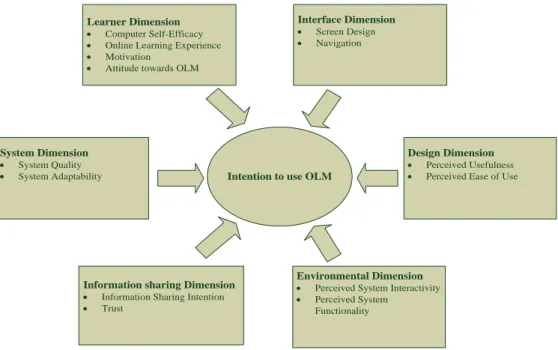
The technology acceptance model (TAM) has been widely cited in existing literature due to its advantages in explaining users’ technology acceptance (Davis 1989). Two keys explanatory factors including the perceived usefulness and the perceived ease-of-use in this model, however, are often insufficient to fully explain the relationship inherent in the adoption of specific technologies (Ma et al. 2005, Duan et al. 2012). Chen et al. (2002), for example, show that using a generic TAM model might result in inconsistent outcomes due to the lack of possible explanatory constructs in a given context. Davis et al. (1989) suggest that additional external constructs need to be included in TAM to improve its explanatory power of the user acceptance of a technology. The proposed additional constructs have to align with the technology, users, and the context (Sabherwal et al. 2006; Sun & Jeyaraj 2013). These additional variables need to cover human, technology and design factors (Legris et al. 2003; Lucas & Spitler 2000). To obtain a better understanding of the dimensions for measuring the acceptance of an OLM from the learners’ perspective, six dimensions including learner, system, interface, design, information sharing, and environment are included in developing a multi-dimensional measurement model, summarized as in Figure 1.
There are always differences existent between individuals in cognitive styles, cognitive controls, personality, belief, perceptions, learning styles, gender, age, and domain knowledge (Chen et al. 2000; Waite et al. 2007). These differences can have an important effect towards the acceptance of TML (Sun et al. 2008). Learners’ impressions towards the adoption of educational technology determine the success of the TML implementation in teaching and learning processes. When learners have a positive attitude towards adopting a technology in teaching and learning, TML could provide a better learning environment for them to learn more effectively and efficiently (Sun et al. 2008). Factors relevant for the learner dimension include motivation, computer self-efficacy, online learning experience, and attitude (Taylor & Todd 1995; Hsu & Chiu 2004; Vandenbroeck et al. 2008; Liu et al. 2010).
The characteristics of a system measured by quality and adaptability are important in determining the acceptance of educational technologies in TML (Chen et al. 2013). These characteristics include system quality and system adaptability. System quality relates to a learner’s belief about the TML performance characteristics (Chiu et al. 2007). These characteristics can be measured by the
functionality, reliability, flexibility, data quality, portability, integration, and importance (DeLone & McLean 2003). System adaptability refers to the ability of the system to provide adaptation on the learning content, up-to-date and accurate information for learners (Tobing et al. 2008).
Intention to use OLM Learner Dimension
· Computer Self-Efficacy
· Online Learning Experience
· Motivation
· Attitude towards OLM
Interface Dimension · Screen Design · Navigation System Dimension · System Quality · System Adaptability Design Dimension · Perceived Usefulness
· Perceived Ease of Use
Information sharing Dimension
· Information Sharing Intention
· Trust
Environmental Dimension
· Perceived System Interactivity
· Perceived System Functionality
The interface of a system allows learners to directly exchange learning information in virtual learning (Hong et al. 2011). A user-friendly interface can increase learners’ motivation to engage in TML by providing them with easy controls navigation, simple displays and information elements that keep them interested, help them to identify their navigation status, and assist them to obtain necessary information (Méndez et al. 2006). Learners’ perceptions during their engagements with TML play a crucial role in determining the success of TML (Cho et al. 2009). Two factors including screen design and navigation are usually used for assessing the performance of the interface (Fenley 2009; Hong et al. 2011). A well designed interface can help learners better engage with a system efficiently and effectively (Hong et al. 2011). Navigation support plays a critical role in determining the active participation of learners in a web-based learning environment. The engagement rate will increase if learners are able to obtain the necessary learning resources easily through navigating the system interface (Fenley 2009). In addition, the availability of navigation aids on the system can also help learner to follow the logical flow of the information (Thong et al. 2002).
Educational technology adoption is affected by learners’ perceived usefulness and perceived ease-of-use with respect to the design of the system (Davis 1989; Sun et al. 2008). The perceived ease-of-usefulness is about the degrees of work improvement in teaching and learning after the adoption of a technology. The perceived ease-of-use is learners’ perception of the easiness in adopting a technology (Sun et al. 2008). Both factors influence learners’ attitude towards the adoption of educational technologies and further affect individuals’ beliefs and behaviours when adopting these technologies. The more the learners’ perceive usefulness and ease-of-use in adopting technology in teaching and learning, the more positive their attitudes are towards the acceptance of TML (Sánchez-Franco et al. 2014).
Information sharing is about the provision and acquisition of information between individuals within an organization (Pai & Yeh 2014). Information sharing intention and trust are critical for facilitating information sharing (Sawhney & Prandelli 2000; Simmons et al. 2012). Information sharing intention is the behaviour of an individual’s willingness in dispersing his or her obtained knowledge and information to others (Sawhney & Prandelli 2000). Trust refers to as the extent to which a learner believes that the information and learning materials available are reliable and credible (Jameson et al.
2006). Trust is the most effective element for improving learners’ confidence and motivation in educational technology adoption in teaching and learning (Simmons et al. 2012).
Information sharing is critical for sustaining interpersonal interactions, communication, negotiation, and collaboration among learners (Wei & Chen 2006). By having access to useful and applicable information, individuals have a greater chance to learn more effectively and efficiently, especially in a collaborative learning environment (Liaw et al. 2008). The success of information sharing in collaborative learning requires an active participation of learners in generating and transferring knowledge, making collaboration an essential and highly valued process (Liaw et al. 2008).
A well designed learning environment in which learners access learning resources, obtain feedback and assistance from instructors, and receive assessments through the use of educational technologies is critical for effective teaching and learning (Lennon & Maurer 2003). A positive TML environment contributes to the success of TML implementation (Sun et al. 2008). Successful outcomes of TML include providing opportunities for interactions, facilitating the exchange of learning information among learners and instructors, synchronous and asynchronous communication, and online assessment (Ozkan & Koseler 2009; Cao et al. 2009).
Web-based learning environments are usually measured by the perceived system interactivity and the perceived system functionality (Cho et al. 2009; Martínez-Torres et al. 2008). The perceived system interactivity refers as the ease of discovering relevant information and easy to move around within the system. Online interactions among learners as well as between learners and instructors increase learners’ participation in learning (Swan 2001). The perceived system functionality is about the perceived ability of an educational technology to provide a flexible access to relevant information. The engagement of learners in a TML environment would increase if learners are able to access their instructional materials at anytime and from anywhere. Furthermore learners would feel more motivated to engage if they can complete their assignments through various types of instructional materials such as text, video, and audio (Seels and Glasgow 1998).
4
RESEARCH METHODOLOGY
The purpose of this study is to develop a multi-dimensional measurement model for assessing the pre-adoption of OLM from the learners’ perspective. To facilitate this, a multi-dimensional measurement model is proposed as above by taking into account the characteristics of an OLM in a TML environment. The proposed multi-dimensional measurement model is tested for construct reliability. A research question is formulated as follows: what are the appropriate dimensions for measuring the acceptance of an OLM in the pre-adoption stage from a learner’s perspective?
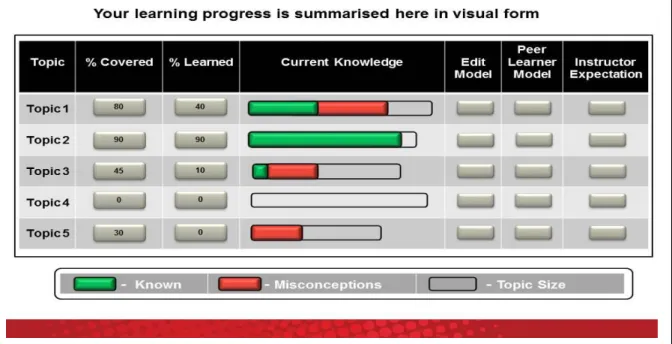
To adequately answer the research question, a quantitative research design with a scenario-based web-mediated prototyping tool shown in Figure 2 is used. Scenario-based web-web-mediated prototyping design is a technique used in human-computer interaction for describing the design specifications and functionality of a prototype information system. It is very useful for studying the initial development of the system where the feedback from learners is considered for the development of information systems (Carroll 2000). This type of scenario-based prototyping is appropriate to be adopted in this study, because there are few OLM programmes available for adoption in Malaysian higher education. In this study, the description of the OLM’s pedagogical features such as presentation format, type of interactions, and interface layouts are made available for each participant. This transparency affords the participants to become aware of the adaptable features available on the OLM.
Surveys are frequently used for gathering information directly from respondents with respect to the views, attitudes and intended behaviours of individuals towards the use of technology (Creswell 2003; Cozby 2004). This technique is appropriate for this study because it uses direct questioning to assess respondents’ attitudes towards their intention to use an OLM. The construction of the survey is based on the previously validated questions designed to reflect an OLM context. The questionnaire consists of three parts. Part one involves in the participant’s profile. Part two is about individual learning
preferences. Part three is related to OLM scenarios that are presented to each participant. The focus of these scenarios is to explore an individual learner’s attitude towards the adoption of an OLM.
The measurement items used in this research are adopted from previous studies in technology adoption shown as in Table 1. A seven-point Likert scale is employed for each statement ranging from one describing strongly disagree until seven to indicate strongly agree. Before administering the pilot study, the survey is reviewed by four experts to ensure the semantics correspondence between measurement items in the item pools and the underlying variables intended to be measured. Several of the original items are revised. The improved survey instrument is based on the constructive comments from the expert review are used to conduct the pilot study.
Convenience sampling is employed in this study because of its statistical approach to capture representative data by selecting voluntary respondents based on their ease of access and availability (Battaglia 2008). The participants are undergraduate IT students, enrolled in the Faculty of Information and Communication Technology (FICT), Universiti Teknikal Malaysia Melaka. This respondent sample is selected because the participants have been exposed to a learning management system (LMS) during their educational coursework. Capturing the online learning experience from these participants provides reliable data regarding their OLM attitudes. This study utilised a web-mediated survey tool called Qualtric to collect data from participants who are introduced to OLM through the scenario-based OLM prototype, using Adobe Captivate 7 (Sek et al. 2014a). The online survey is distributed to 320 undergraduate IT students of FICT. A total of 300 participants or approximately 94% have responded to the survey.
5
FINDINGS AND RESEARCH IMPLICATIONS
This section presents a pilot study for assessing the acceptance of OLM in pre-adoption using the proposed measurement model discussed as above. The study focuses on answering the research question as follows: what are the appropriate dimensions for measuring the acceptance of an OLM in the pre-adoption stage from a learner’s perspective? To answer this question, 320 participants have
selected the online survey for investigating the learners’ acceptance of OLM in their pre-adoption stage. 300 participants have responded to the survey.
To test the reliability of the questionnaire, Cronbach’s alpha is commonly used for testing the internal consistency of the measurement model. It is used to measure the interrelatedness of a set of items in a survey questionnaire. For the data obtained from the pilot study, a reliability test is performed using SPSS 21.0 for Window based on the 300 responses. The Cronbach’s alpha (α) as shown in Table 1 indicates that the average of the Cronbach’s alpha value ranging from 0.827 to 0.921 which is considered as a high level of reliability (Hair et al. 2010). Based on these findings, the internal consistency of the survey instrument is acceptable and reliable.
An exploratory factor analysis is conducted to further examine the factor structure of the 69-item in the proposed measurement model. This factor analysis is used to determine the discriminate validity of the measurement model. Discriminant validity refers to which a construct is truly distinct from other constructs both in terms of how much it correlates with other constructs and how distinctly measured variables represent only this single construct (Hair et al. 2010). A total of 69 items are analysed using factor analysis in SPSS 21.0. The exploratory factor analysis is conducted by using principal component analysis as the extraction method and varimax as the rotation method. The result of the exploratory factors analysis is shown in Table 1.
The summarisation of the range of factor loading for the 69-item as shown in Table 1 indicates that all the items are significantly loaded on the single factor. The significant high factor loadings of all the items on the single factor indicate that there are no cross-loadings for each item within the constructs. This result supports the discriminant validity of the measurement model (Hair et al. 2010). Based on this exploratory factors analysis, fifteen factors are generated. There are motivation, computer self-efficacy, online learning experience, system quality, system functionality, system interactivity, system adaptability, screen design, navigation, trust, information sharing intention, perceived usefulness, behavioural intention, perceived ease-of-use and attitude. The result is congruent with the proposed research model. This result reveals that the proposed measurement model has a high level of reliability and validity for assessing learners’ pre-adoption of OLM.
The validated 69-item of an OLM pre-adoption measurement consists of six dimensions. There are learner dimension, system dimension, interface dimension, design dimension, information sharing dimension, and environmental dimension. These dimensions have been adopted from the studies of various research domains such as the information sharing dimension that is related to knowledge management. The system dimension, interface dimension, design and environment dimensions are from the perspective of HCI while the learner dimension is from the research domain of personality development in psychology and cognitive science. Using the proposed 69-item of an OLM pre-adoption measurement model, future research effort can also develop and examine research hypotheses and theories relating to learner behaviour in the context of visualization-based learning environments. These findings can provide meaningful insights into how to utilize an OLM for a successful visualization-based learning in TML.
The six-dimension, 69-item of an OLM pre-adoption measurement model with desirable reliability provides researchers with a tool for measuring learners’ acceptance towards the pre-adoption of an OLM from the learners’ perspective. This measurement model has potential practical applications in the conceptual-design and development of an OLM, which provides system designers and instructional designers with a practical tool for early evaluation to identify the dimension for the successful implementation of an OLM in TML. The early identification of the dimension that affect the acceptance of an OLM not only helps in predicting learners’ acceptance of an OLM as early as possible in the design and development lifecycle, but is concerned with the risk of learners rejection that may also be reduced, with predictive measures taken into consideration to ensure the successful adoption of an OLM in the future.
This research contributes to the existing TML acceptance literature in the following ways. First, there are few studies which focus on the development of a measurement model for assessing the acceptance of an OLM from the learners’ perspective. Second, many of the TML acceptance studies focus on the
post-adoption stage, very few research has been conducted on the measurement the acceptance of educational technology in the pre-adoption stage (Chen et al. 2008; Karaali et al. 2011). In this study, the identification of the dimension in measuring the acceptance of an OLM has been conducted by collecting data from the learners’ perspective in the pre-adoption stage. The research outcomes derived from this finding will have practical implications for the Malaysian Ministry of Education specifically and more broadly for global educational institutions for developing efficient and effective strategies and policies that promote the OLM adoption in TML.
Constructs Reliability (α) Range of factor loading within construct Sources
Motivation – (6 Items) 0.901 (0.741 – 0.831) Lin,(1998); Stafford and Stern
(2002); Vandenbroeck, Verschelden, and Boonaert (2008)
Computer Self-Efficacy – (5 Items) 0.899 (0.750 – 0.802) Compeau et al. (1999); Murphy
et al. (1989 ); Hsu and Chiu (2004)
Online Learning Experience – (3 Items) 0.913 (0.745 – 0.770) Hartley and Bendixen (2001); Liu et al. (2010)
System Quality – (4 Items) 0.823 (0.731 – 0.767) Lin (2007); Cho et al.,
(2009);Wang and Wang (2009)
System Functionality – (6 Items) 0.847 (0.781 – 0.848) Pituch and Lee (2006); Cho et
al. (2009)
System Interactivity – (4 Items) 0.892 (0.750 – 0.826) Martínez-Torres et al. (2008);
Pituch and Lee (2006)
System Adaptability – (5 Items) 0.849 (0.778 – 0.854) Tobing et al., (2008)
Screen Design – (4 Items) 0.921 (0.841 – 0.864) Cho et al. (2009); Nov and Ye
(2008)
Navigation – (3 Items) 0.831 (0.792 – 0.837) Piccoli et al. (2001); Thong et
al. (2002)
Trust – (7 Items) 0.851 (0.872 – 0.899) Ha and Stoel (2009); Zhou
(2011)
Perceived Usefulness – (6 Items) 0.827 (0.812 – 0.898) Davis (1989); Ngai et al. (2007)
Perceived Ease of Use – (5 Items) 0.877 (0.854 – 0.881) Davis (1989); Ngai et al. (2007)
Attitude – (4 Items) 0.853 (0.815 – 0.841) Taylor and Todd (1995)
Intention to Use – (3 Items) 0.829 (0.860 – 0.872) Davis (1989); Agarwal and
Karahanna (2000); Cheong and Park (2005)
Information Sharing Intention – (4 Items) 0.865 (0.846 – 0.862) Venkatesh et al. 2012;Cheung and Vogel 2013;
Hajli and Lin 2014.
6
CONCLUSIONS, LIMITATIONS AND FUTURE RESEARCH
This paper presents a multi-dimensional measurement model for assessing the pre-adoption of OLMs from the learners’ perspective. The study concludes that motivation, computer self-efficacy, online learning experience, system quality, system functionality, system interactivity, system adaptability, screen design, navigation, trust, information sharing intention, perceived usefulness, perceived ease-of -use, and attitude are the appropriate dimensions for measuring the pre-adoption of an OLM in higher
education institution in Malaysia. This study contributes to the identification of the determinants that influence the acceptance of OLM in pre-adoption stage. It provides a basic framework for assessing the adoption of educational technology in pre-adoption stage, particularly in the visualization-based learning environment.
Research on web-based visualization behaviour is still in the early stage. The measurement models proposed in this study would allow researchers to gain insight into the factors that affect the acceptance of OLM in the pre-adoption stage specifically and more generally in the acceptance of educational technology in a visualization-based learning environment. The results reveal that the proposed measurement model has a desirable reliability and discriminant validity, which is of value not only to OLM developers and instructional educators responsible for the development and implementation of an OLM, but also to researchers interested in developing educational technology adoption theories concerning visualization-based learning.
While this study developed and tested a generic multi-dimensional measurement model for assessing the pre-adoption of an OLM using a reliability test and an exploratory factor analysis, it still has limitations that can be addressed in the future. First, the result from the reliability test indicates that this measurement model is appropriate and valid to be used for assessing the pre-adoption of an OLM from the learners’ perspective. However, the participants of this study are from a university in Malaysia. The actual survey needs to be conducted again with more universities in Malaysia to gain a better understanding of the dimensions that affect the acceptance of an OLM. The data collected from the actual survey can be used to examine the exploratory factors and the confirmatory factors analyses for further measurements and construct validation. Second, this measurement model focuses on assessing the effect of multi-dimensional factors on the pre-adoption of an OLM from the perspective of undergraduate learners only. There are other stakeholders in TML such as post-graduate learners, instructors, system developers and instructional designers whose perceptions are also important for a complete OLM assessment. Different stakeholders have different constraints, needs, and different motivations for using an OLM. Future research should consider these stakeholders to gain a better representation of the issues facing in the OLM implementation success. Finally, a longitudinal study can be conducted to examine how the dimensions being identified in the pre-adoption stage change over time in the post-adoption stage, when the learners have had experience using an OLM.
References
Agarwal, R., and Karahanna, E. (2000). Time flies when you're having fun: Cognitive absorption and beliefs about information technology usage. MIS Quarterly, 24(4).
Battaglia, M. (2008). Convenience Sampling. In Paul J. Lavrakas (Ed.), Encyclopedia of Survey Research Methods. Thousand Oaks, CA: Sage Publications, Inc. pp 149-150.
Brusilovsky, P., Sosnovsky, S., and Shcherbinina, O. (2004). QuizGuide: Increasing the educational value of individualized self-assessment quizzes with adaptive navigation support. In World Conference on E-Learning in Corporate, Government, Healthcare, and Higher Education. 2004(1), 1806-1813.
Bull, S. and Kay, J. (2007). Student models that invite the learner in: The SMILI:() Open learner modelling framework. International Journal of Artificial Intelligence in Education 17(2), 89-120. Bull, S., Dimitrova, V. and McCalla, G. (2007). Open learner models: Research questions (Special
Issue of IJAIED Part 1), International Journal of Artificial Intelligence in Education 17(2), 83-87. Bull, S. and Kay, J. (2010). Open learner models. In Nkambou R., BordeauJ., and Miziguchi R.,(eds),
Advances in Intelligent Tutoring Systems. Springer, 318-338.
Chen, C., Czerwinski, M., and Macredie, R. (2000). Individual differences in virtual environments— introduction and overview. Journal of the American Society for Information Science, 51(6), 499-507.
Chen, Z. H., Chou, C. Y., Deng, Y. C., and Chan, T. W. (2007). Active open learner models as animal companions: Motivating children to learn through interacting with My-Pet and Our-Pet.
Chen, I. Y. L., Chen, N.-S., and Kinshuk (2009). Examining the factors influencing participants’ knowledge sharing behavior in virtual learning communities. Educational Technology & Society, 12 (1), 134–148.
Chen Y.C., Lin, Y.C., Yeh, R.C., and Lou, S.J.(2013). Examining factors affecting college students' intention to use web-based instruction systems: Towards an integrated model. The Turkish Online Journal of Educational Technology, 12(2), 111-121.
Chen, I. J., Yang, K., Tang, F., Huang, C., and Yu, S. (2008). Applying the technology acceptance model to explore public health nurses’ intentions towards web-based learning: A cross-sectional questionnaire survey. International Journal of Nursing Studies, 45(6), 869–878.
Cheong, J. H., and Park, M. C. (2005). Mobile internet acceptance in Korea. Internet Research, 15(2), 125–140.
Cheung, R., and Vogel, D. (2013). Predicting user acceptance of collaborative technologies: An extension of the technology acceptance model for e-learning. Computers & Education, 63, 160-175.
Carroll, J. M. 2000. Five reasons for scenario-based design. Interacting with Computers, 13, 43-60. Cao, Q., Griffin, T. E., and Bai, X. (2009). The importance of synchronous interaction for student
satisfaction with course web sites. Journal of Information Systems Education, 20(3), 331–338. Chiu, C.-M., Chiu, C.-S., and Chang, H.-C. (2007). Examining the integrated influence of fairness and
quality on learners’ satisfaction and web-based learning continuance intention. Information Systems Journal, 17(3), 271–287.
Creswell, J.W. (2003). Research Design: Qualitative, Quantitative and Mixed Methods Approaches. 2nd Edition. CA: Sage Publications.
Cozby, P.C. (2004). Methods in Behavioral Research. New York: McGraw-Hill.
Compeau,D. R., Higgins, C. A.,andHuff, S. (1999). Social cognitive theory and individual reactions to computing technology: A longitudinal study. MIS Quarterly, 23 (2), 145–158
Cho, V., Cheng, T. E., and Lai, W. J. (2009). The role of perceived user-interface design in continued usage intention of self-paced e-learning tools. Computers & Education, 53(2), 216-227.
Davis, F. D. (1989). Perceived usefulness, perceived ease of use and user acceptance of information technology. MIS Quarterly, 13(3), 319–340.
DeLone,W. H., and McLean, E. R. (2003). The DeLone and McLean model of information systems success: a ten-year update. Journal of Management Information Systems, 19(4), 9–30
Dimitrova, V., Self, J., and Brna, P. (2000). Maintaining a jointly constructed student model,
Proceedings of 9th International Conference on Artificial Intelligence: Methodology, Systems, and Applications, Varna, Bulgaria, 221-231.
Duan, X., Deng, H., and Corbitt, B. (2012). Evaluating the critical determinants for adopting e-market in Australian small-and-medium sized enterprises. Management Research Review, 4, 289-308. Fenley, S. (2009). Navigation and Visualisation Techniques in eLearning and Internet Research.
Looking Toward the Future of Technology-Enhanced Education: Ubiquitous Learning and the Digital Native: Ubiquitous Learning and the Digital Native, 55.
Ha, S., and Stoel, L. (2009). Consumer e-shopping acceptance: Antecedents in a technology acceptance model. Journal of Business Research, 62(5), 565-571.
Hartley, K., and Bendixen, L. D. (2001). Educational research in the internet age: Examining the role of individual characteristics. Educational Researcher, 30(9), 22–26.
Hameed, M.A., Counsell, S. and Swift, S. (2012). A conceptual model for the process of it innovation adoption in organizations. Journal of Engineering and Technology Management, 29 (3), 358-390. Hajli, N., and Lin, X. (2014). Exploring the security of information sharing on social networking sites:
The role of perceived control of information. Journal of Business Ethics, 1-13.
Hsu, M. H., Ju, T. L., Yen, C. H., and Chang, C. M. (2007). Knowledge sharing behavior in virtual communities: The relationship between trust, self-efficacy, and outcome
expectations. International Journal of Human-Computer Studies, 65(2), 153-169.
Hu, P. J. H., and Hui, W. (2012). Examining the role of learning engagement in technology-mediated learning and its effects on learning effectiveness and satisfaction. Decision Support
Hu, P. J. H., Hui, W., Clark, T. H., and Tam, K. Y. (2007). Technology-assisted learning and learning style: A longitudinal field experiment. Systems, Man and Cybernetics, Part A: Systems and Humans, IEEE Transactions on, 37(6), 1099-1112.
Hochmeister, M., Daxbock, J., and Kay,J.(2012). The effect of predicting expertise in open learner modeling. In A. Ravenscroft et al. (Eds.), European Conference on Technology Enhanced Learning, Towards Ubiquitous Learning, Springer-Verlag, Berlin Heidelberg, 389-394. Hong, J. C., Hwang, M. Y., Hsu, H. F., Wong, W. T., and Chen, M. Y. (2011). Applying the
technology acceptance model in a study of the factors affecting usage of the Taiwan digital archives system. Computers & Education, 57(3), 2086-2094.
Hair, J.F., Black, W.C., Babin, B.J., Anderson, R.E., (2010). Multivariate Data Analysis, 7th edition, Prentice Hall, Englewood Cliffs.
Hewitt-Taylor, J. (2003). Technology-assisted learning. Journal of Further and Higher Education, 27(4), 457-464.
Huang, H. M., Rauch, U., and Liaw, S. S. (2010). Investigating learners’ attitudes toward virtual reality learning environments: Based on a constructivist approach. Computers & Education, 55(3), 1171-1182.
Hsu, M. H., and Chiu, C.M. (2004). Predicting electronic service continuance with a decomposed theory of planned behavior. Behavior and Information Technology, 23 (5), 359–373.
Juarez Collazo, N. A., Wu, X., Elen, J., and Clarebout, G. (2014). Tool use in computer-based learning environments: Adopting and extending the technology acceptance model. International Scholarly Research Notices, 2014.
Jameson, J., Ferrell, G., Kelly, J., Walker, S., and Ryan, M. (2006). Building trust and shared knowledge in communities of e‐learning practice: collaborative leadership in the JISC eLISA and CAMEL lifelong learning projects. British Journal of Educational Technology, 37(6), 949-967. Karaali, D., Gumussoy, C. A., and Calisir, F. (2011). Factors affecting the intention to use a
web-based learning system among blue-collar workers in the automotive industry. Computers in Human Behavior, 27(1), 343-354
Karunasena, A., Deng, H., and Kim, B. (2013). Structural equation modelling for Web 2.0 based interactive e-learning in Sri Lanka. International Journal of Information Technology and Computer Science, 12 (3), 1: 8.
Kickmeier-Rust, M.D., Bull, S. and Meissl-Egghart, G. (2014). Collaborative language learning in immersive virtual worlds: Competence-based formative feedback and open learner modeling, International Journal of Serious Games 1(2), 67-74.
Liaw, S. S., Chen, G. D., and Huang, H. M. (2008). Users’ attitudes toward web-based collaborative learning systems for knowledge management. Computers & Education, 50(3), 950-961.
Lee, C. S., Goh, D. H. L., Chua, A. Y., and Luyt, B. (2009). Choosing communication portfolios to accomplish tasks: The effects of individual differences. Computers & Education, 53(4), 1167-1176.
Lee, Y.C. (2006). An empirical investigation into factors influencing the adoption of an e-learning system. Online Information Review, 30(5), 517–541.
Lennon, J., and Maurer, H. (2003). Why it is difficult to introduce e-learning into schools and some new solutions. Journal of Universal Computer Science, 9(10), 1244–1257.
Lee, S. Y. (2014). Examining the factors that influence early adopters’ smartphone adoption: The case of college students. Telematics and Informatics, 31(2), 308-318.
Lau, S. H., and Woods, P. C. (2009). Understanding learner acceptance of learning objects: The roles of learning object characteristics and individual differences. British Journal of Educational Technology, 40(6), 1059-1075.
Lin, H.F. (2007). Measuring online learning systems success: applying the updated DeLone and McLean model. Cyber Psychology & Behavior, 10(6), 817–820.
Liu, I. F., Chen, M. C., Sun, Y. S., Wible, D., and Kuo, C. H. (2010). Extending the TAM model to explore the factors that affect intention to use an online learning community. Computers & Education, 54(2), 600–610.
Martínez-Torres, M. R., Toral Marín, S. L., Barrero Garciá, F., Gallardo Váquez, S., Arias Oliva, M., and Torres, T. (2008). A technological acceptance of e-learning tools used in practical and
laboratory teaching, according to the European higher education area. Behaviour & Information Technology, 27(6), 495–505
Méndez, J., Lorenzo, C., Acosta, L., Torres, S., and González, E. (2006). A web‐based tool for control engineering teaching. Computer Applications in Engineering Education, 14(3), 178-187.
Miltiadou, M., and Yu, C. H. (2000). Validation of the online technologies self-efficacy scale. ERIC Document Reproduction Service No. ED 445 672.
Mueller, D., and Strohmeier, S. (2011). Design characteristics of virtual learning environments: state of research. Computers & Education, 57(4), 2505-2516.
Murphy, C. A., Coover, D., and Owen, S. V. (1989). Development and validation of the computer self-efficacy scale. Educational and Psychological Measurement, 49 (4), 893–899.
Nov, O., and Ye, C. (2008). Users’ personality and perceived ease of use of digital libraries: The case for resistance to change. Journal of the America Society for Information Science and Technology, 59(5), 845–851.
Ngai, E. W. T., Poon, J. K. L., and Chan, Y. H. C. (2007). Empirical examination of the adoption of WebCT using TAM. Computers and Education, 48(2), 250–267.
Ozkan, S., and Koseler, R. (2009). Multi-dimensional students’ evaluation of e-learning systems in the higher education context: An empirical investigation. Computers & Education, 53(4), 1285-1296.
Pituch, K., and Lee, Y. (2006). The influence of system characteristics on e-learning use. Computers & Education, 47(2), 222–244.
Pai, F. Y., and Yeh, T. M. (2014). The effects of information sharing and interactivity on the intention to use social networking websites. Quality & Quantity, 48(4), 2191-2207.
Piccoli, G., Ahmad, R., and Ives, B. (2001). Web-based virtual learning environments: a research framework and a preliminary assessment of effectiveness in basic IT skill training. MIS Quarterly, 25(4), 401–426.
Ruttun, R. D., and Macredie, R. D. (2012). The effects of individual differences and visual
instructional aids on disorientation, learning performance and attitudes in a Hypermedia Learning System. Computers in Human Behavior, 28(6), 2182-2198.
Rovai, A. P., Wighting, M. J., Baker, J. D., and Grooms, L. D. (2009). Development of an instrument to measure perceived cognitive, affective, and psychomotor learning in traditional and virtual classroom higher education settings. The Internet and Higher Education, 12(1), 7−13
Rogers, E.M., 1995. Diffusion of Innovations. The Free Press, New York.
Sabherwal, R., Jeyaraj, A., and Chowa, C. (2006). Information system success: individual and organizational determinants. Management science, 52(12), 1849-1864.
Seels, B., and Glasgow, Z. (1998). Making instructional design decisions. Englewood Cliffs, NJ: Educational Technology Publications.
Sek, Y.W., Deng, H., and McKay, E. (2014a). Investigating learner preferences in an open learner model (OLM) program: A Malaysian case study. Proceedings of the 25th Australasian Conference of Information Systems Retrieved from. http://aut.researchgateway.ac.nz/handle/10292/8067 Sek, Y. W., McKay, E., and Deng, H. (2014b). A conceptual framework for enhancing the motivation
in an open learner model learning environment. In e-Learning, e-Management and e-Services (IC3e), 2014 IEEE Conference, 105-110.
Simmons, L. L., Simmons, C. B., Hayek, M., Parks, R., and Mbarika, V. W. (2012). A cultural comparison of trust in elearning artifacts. Decision Sciences Journal of Innovative Education, 10(4), 547-574.
Suh, B., and Han, I. (2003). The impact of customer trust and perception of security control on the acceptance of electronic commerce. International Journal of Electronics and Communications, 7(3), 135–161.
Sun, P. C., Tsai, R. J., Finger, G., Chen, Y. Y., and Yeh, D. (2008). What drives a successful e-Learning? An empirical investigation of the critical factors influencing learner satisfaction. Computers & Education, 50(4), 1183-1202.
Sun, Y., and Jeyaraj, A. (2013). Information technology adoption and continuance: A longitudinal study of individuals’ behavioral intentions. Information & Management, 50(7), 457-465. Swan, K. (2001). Virtual interaction: design factors affecting student satisfaction and perceived
learning in asynchronous online courses. Distance Education, 22(2), 306–331.
Sánchez-Franco, M. J., Peral-Peral, B., and Villarejo-Ramos, Á. F. (2014). Users' intrinsic and extrinsic drivers to use a web-based educational environment.Computers & Education, 74, 81-97. Soller, A. (2001). Supporting social interaction in an intelligent collaborative learning system.
International Journal of Artificial Intelligence in Education, 12, 40–62
Stafford, M. R., and Stern, B. (2002). Consumer bidding behavior on Internet auction sites. International Journal of Electronic Commerce, 7(1), 135–150.
Taylor, S., and Todd, P. A. (1995). Understanding information technology usage: a test of competing models. Information Systems Research, 6(2), 144-176.
Tanimoto, S. (2005). Dimensions of transparency in open learner models, workshop on learner modelling for reflection, to supporter learner control, metacognition and improved communication between teachers and learners, AIED, IOS Press, Amsterdam.
Tobing, V., Hamzah, M., Sura, S., and Amin, H. (2008). Assessing the acceptability of adaptive e-learning system. In 5th International Conference on eLearning for Knowledge-Based Society, 1-10.
Teo, T. (2010). Development and validation of the e-learning acceptance measure (ElAM). The Internet and Higher Education, 13(3), 148-152.
Thong, J. Y. L., Hong, W., and Tam, K.Y. (2002). Understanding user acceptance of digital libraries: what are the roles of interface characteristics, organizational context, and individual differences? International Journal of Human-Computer Studies, 57(3), 215–242.
Tzeng, J. Y. (2011). Perceived values and prospective users’ acceptance of prospective technology: The case of a career eportfolio system. Computers & Education, 56(1), 157-165.
Thurmond, V. A., Wambach, K., and Connors, H. R. (2002). Evaluation of student satisfaction: determining the impact of a web-based environment by controlling for student characteristics. The American Journal of Distance Education, 16(3), 169–189.
Vandenbroeck, M., Verschelden, G., and Boonaert, T. (2008). E-learning in a low-status female profession: The role of motivation, anxiety and social support in the learning divide. Journal of Computer Assisted Learning, 24(3), 181-190.
Venkatesh, V., Thong, J., and Xu, X. (2012). Consumer acceptance and use of information
technology: Extending the unified theory of acceptance and use of technology. MIS Quarterly, 36, 157–178.
Waite, S. J., Wheeler, S., and Bromfield, C. (2007). Our flexible friend: The implications of
individual differences for information technology teaching. Computers & Education, 48(1), 80-99 Wang, W.T., and Wang, C.C. (2009). An empirical study of instructor adoption of web-based learning
systems. Computers & Education, 53(3), 761–774.
Wei, F. H., and Chen, G. D. (2006). Collaborative mentor support in a learning context using a ubiquitous discussion forum to facilitate knowledge sharing for lifelong learning. British Journal of Educational Technology, 37(6), 917-935.
Wetzel, K., and Strudler, N. (2005). The diffusion of electronic portfolios in teacher education: Next steps and recommendations from accomplished users. Journal of Research on Technology in Education, 38(2), 231–243.
Yang, Z., Kankanhalli, A., Ng, B. Y., and Lim, J. T. Y. (2015). Examining the pre-adoption stages of healthcare IT: A case study of vital signs monitoring systems. Information & Management.
Zhou, T. (2011). An empirical examination of initial trust in mobile banking. Internet Research, 21(5), 527 – 540