MILITARY REGIME TRANSITION TO CONSOLIDATED DEMOCRACY IN SUB-SAHARAN AFRICA:
LEARNING FROM THE EXAMPLE OF GOOD PRACTICE IN GHANA
By
Indre Bimbiryte
THESIS
Submitted to
KDI School of Public Policy and Management in partial fulfillment of the requirements
for the degree of
MASTER OF PUBLIC POLICY
MILITARY REGIME TRANSITION TO CONSOLIDATED DEMOCRACY IN SUB-SAHARAN AFRICA:
LEARNING FROM THE EXAMPLE OF GOOD PRACTICE IN GHANA
By
Indre Bimbiryte
THESIS
Submitted to
KDI School of Public Policy and Management in partial fulfillment of the requirements
for the degree of
MASTER OF PUBLIC POLICY
2011
i
ABSTRACT
MILITARY REGIME TRANSITION TO CONSOLIDATED DEMOCRACY IN SUB-SAHARAN AFRICA:
LEARNING FROM THE EXAMPLE OF GOOD PRACTICE IN GHANA
By
Indre Bimbiryte
During the last year the “Arab Spring” is capturing the world’s attention as a positive, albeit violent, fight against autocracy and dictatorships. However, a lack of democracy on the African continent remains high. Ghana is like an island of hope for the neighboring countries which are still ruled by the “iron fists” of their leaders, most of whom cover under the veil of feigned democracy. Having emerged from the military dictatorship, Ghana is an excellent example of a consolidated democracy for other Sub-Saharan nations. Starting as a fake democracy under the rule of Rawlings in the 1990s, Ghana eventually reached gradual democratization. The government has shifted powers already several times through free elections as the Ghanaian population actively took part in its country‘s rule. Free media and civil society continue to ensure the stability of democracy, as well as independent institutions that create steadiness in the process of consolidation. Ethnicity which most of the time creates tensions and remains one of the main issues on the African continent, in Ghana’s case can be seen as a factor that has a potential to further support the overall democratization.
ii
TABLE OF CONTENTS
1. INTRODUCTION 1
2. HISTORICAL BACKGROUND 3
2.1 PERIOD OF DE-COLONIZATION 3
2.2 “THIRD WAVE” OF DEMOCRATIZATION 5
2.2.1.EXTERNAL FACTORS 5
2.2.2.INTERNAL FACTORS 8
3. HYPOTHESIS AND RESEARCH METHODS 12
4. CASE OF GHANA 17
4.1 GHANA UNDER MILITARY REGIME OF RAWLINGS 19
4.2 MOVE TOWARDS DEMOCRATIZATION (1991-1992) 20
4.3 CONSOLIDATING DEMOCRACY IN GHANA 23
4.3.2.INDEPENDENT INSTITUTIONS 27
4.3.3.FREE MEDIA 31
4.3.4.CIVIL SOCIETY 33
4.3.5.ETHNICITY 35
5. ANALYSIS AND LESSONS 37
6. CONCLUSION 41
ANNEX I 43
ANNEX II 44
ANNEX III 45
iii
LIST OF TABLES
1. External and Internal Factors of Democratization in Africa 5
2. Internet User‘s Growth in Ghana 1999-2009 32
1
1. INTRODUCTION
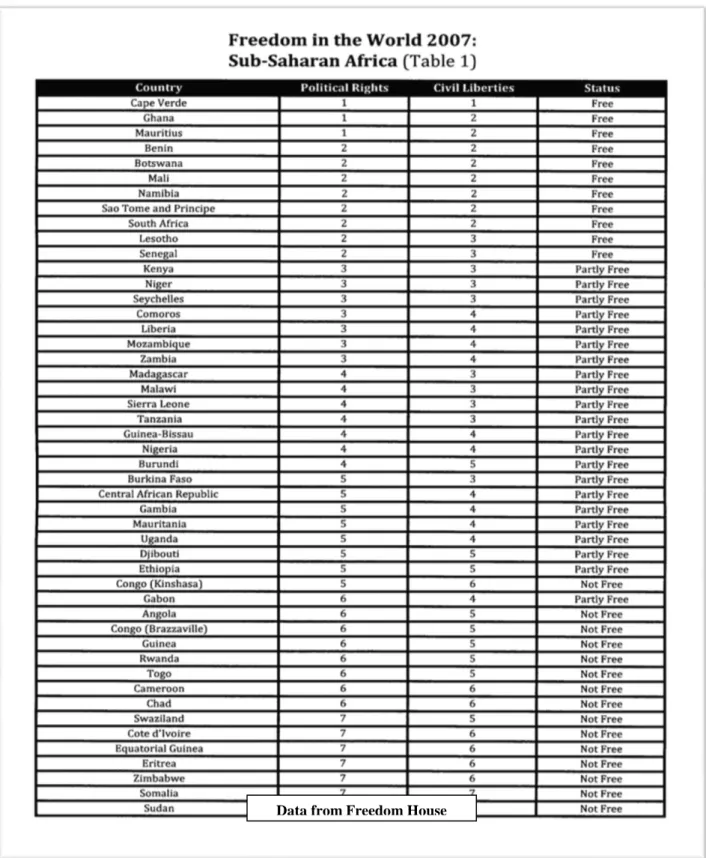
Africa is the second largest continent covering about 22% of Earth‟s surface and second in population in the world (The Africa Guide n.d.). At the same time, it is extremely poor and faces most difficulties. According to the Freedom House data, most African countries (also see: Annex I and II) still cannot be called free as they lack basic political rights and civil liberties1. The continent is continuously ravaged by inner wars and ethnic conflicts. Out of 54 sovereign states only a small fraction can be called democracies (i.e. Benin, Ghana, and South Africa). Taking into consideration the enormous amount of aid that has been given to this continent for more than half a century in form of official development assistance (ODA), NGO support and peace keeping operations, one cannot help but wonder why Africa‟s human rights and standard of living are still at the bottom level and how it is possible to democratize Africa.
Since the 1990s, Africa has experienced a new push for democratization2 which turned out to be not very successful. According to Larry Diamond (1996), at the end of the 20th century the “wave of democratization” ended. The situation today remains uncontrollable and unpredictable. During the last 20 years there can be listed numerous cases of governments‟ change in sub-Saharan Africa, coup d‟état and other political as well as economic instabilities. Therefore, this paper will concentrate on the enabling/limiting factors for military regimes in Africa to be transformed into democracy and for their democracy to be consolidated.
In the first part of the work the historical background of the continent will provide basic background information about the overall military regimes transitions in the region.
1 The political rights issues are grouped into three subcategories: Electoral Process, Political Pluralism and
Participation, and Functioning of Government. The civil liberties questions are grouped into four subcategories: Freedom of Expression and Belief, Associational and Organizational Rights, Rule of Law, and Personal Autonomy and Individual Rights (Freedom In the World 2010).
2 De-colonization period was the time of liberation from foreign rule; while starting from the 1990s – breaking
2
Certain trends will be observed from the 1990s to date. This will help to further distinguish internal/external factors that create the impetus for transition. To add more, such a historical analysis will provide an insight to the general understanding of democratization in Africa and where lies its “Achilles‟ heel.” Afterwards, the hypothesis will be presented as well as a short review of the used methodology. In the mentioned chapter the concept of consolidated democratization will be analysed determining the most influential factors, such as free elections, functioning institutions, viable civil society, and freedom of expression. According to these, as well as using the research methods, a selected case of successful transition in Ghana will be more thoroughly presented. Through the case study method and comparative inquiry, country‟s experience will enable to look more deeply into the hypothetical triggers of the country‟s transition to the long term democracy. Having identified them, the following step will be to distinguish if one country‟s successful experience can be applied to other Sub-Saharan countries in transition.
Limitations are unavoidable as it is impossible to create a panacea for the faults of transitions towards democracy. The main goal of this paper is to establish a pattern which can be witnessed and applied in real life situations in other Sub-Saharan countries facing a military regime change. This paper does not examine how to establish an incentive for the emergence of civil society or environment, suitable for the rule of law. Moreover, it is understandable, that the reasons behind each military regime and its‟ transition differ depending on the historical, cultural, economic, and political backgrounds. It is hard to create a single rule which would work in all cases. On the other hand, I believe (although I do not want to make any generalizations) that Africa within itself has strong connections and faces the common future, thus certain level of common analysis and assumptions can be applied to it as a single unit.
3
2. HISTORICAL BACKGROUND
2.1PERIOD OF DE-COLONIZATION
In the middle of the 20th century Africa was de-colonized. Continent, which was almost entirely3 ruled by colonizers since 1900, received freedom, which also brought hardship and eventually destabilized the region. During the colonial rule, colonizers lavishly used natural resources (such as gold, copper) unlimited. They did not take into consideration cultural differences, geopolitical confusion while making the continent more “civilized” – that was presumed to be “the White man‟s burden” (Decolonization of Africa n.d.). Looking at the political map of Africa, it is visible that country borderlines were drawn by the colonisers without regard to the already established small kingdoms. Due to that, people who belonged to the same tribe, with the same language, heritage and traditions suddenly belonged to three different countries that most often fought in between (today it still is the case for some Congolese tribes as well as many others). Thus, the overall experience of Africa “has been one of colonial brutalization, exploitation and underdevelopment” (Ihonvbere 1997, 289), and this left long term after-effects on countries which were facing newly gained independence after de-colonisation.
Even though the borders as they were set during the colonial rule were more or less accepted, the new states lacked the “indigenous cultural roots for internal legitimacy” (Deng 1998, 139). African states that emerged after colonial oppression were missing a very important ingredient that would further empower their emancipation and self-governance: people did not see themselves as a unity, as a nation. For example, during the British rule in Rwanda, Tutsi ethnic group was promoted to be superior over Hutu and they were given all better governmental positions. It was believed that Tutsi were better “equipped” to rule over
3 „By 1905, African soil was almost completely controlled by European governments, with the only exceptions
being Liberia (which had been settled by African-American former slaves) and Ethiopia (which had successfully resisted colonization by Italy). Britain and France had the largest holdings, but Germany, Spain, Italy, Belgium, and Portugal also had colonies” (Decolonization of Africa n.d.).
4
Hutu (this idea was a false creation of the colonizers). In the end this led to the tragic 1994 Rwanda genocide. Even today the ethnic tensions between the two groups remain high.
At that time anything reminding of colonizers was perceived as evil and undesirable. Democracy, as a creation of Western societies, was one of the “evils.” According to Deng and Lyons (1998), any kind of international interference or offered help was seen as a threat. Eventually, as long as the government, formed in a country, was local, it was accepted by the Organization of African Unity4. Instead of promoting “good governance to those regimes that effectively or responsibly administered given territory” they would let anybody who was in the presidential palace to rule the country “regardless of how (or even whether) the regime governed” (Deng and Lyons 1998, 1). Such a principle created perfect conditions for the military dictators, who ruled uninterrupted by for decades, i.e. Mobutu Sese Seko ruled Congo for 32 years, and Jean-Bédel Bokassa ruled Central African Republic for 19 years5. Military dictators ruled ruthlessly, not taking into consideration local people. As Deng (1998, 137) points out in his article: “African leaders saw human rights and democracy as luxuries to be sacrificed or postponed until their people were sufficiently advanced.” Which in the end happened to be the least important issue to pursue – all interest was concentrated in keeping the power and sharing the recourses with loyal followers.
4 Established in 1963, today it is known as the African Union. South Africa became a 53rd member in 1994.
„The OAU aims to promote the unity and solidarity of African States; ordinate and intensify their co-operation and efforts to achieve a better life for the peoples of Africa; defend their sovereignty, territorial integrity and independence; eradicate all forms of colonialism from Africa; promote international co-operation, giving due regard to the Charter of the United Nations and the Universal Declaration of Human Rights; and co-ordinate and harmonize members‟ political, diplomatic, economic, educational, cultural, health, welfare, scientific, technical and defense policies“ (International Relations and Cooperation n.d.).
5
Today there still is a number of such long term military dictators: Teodoro Obiang Nguema Mbasogo, President of Equatorial Guinea since 1979; Blaise Compaoré, President of Burkina Faso (1987-present), Omar Hassan Ahmad al-Bashir, leader of Sudan (since 1989) and many others (Change.org 2010).
5
2.2“THIRD WAVE” OF DEMOCRATIZATION
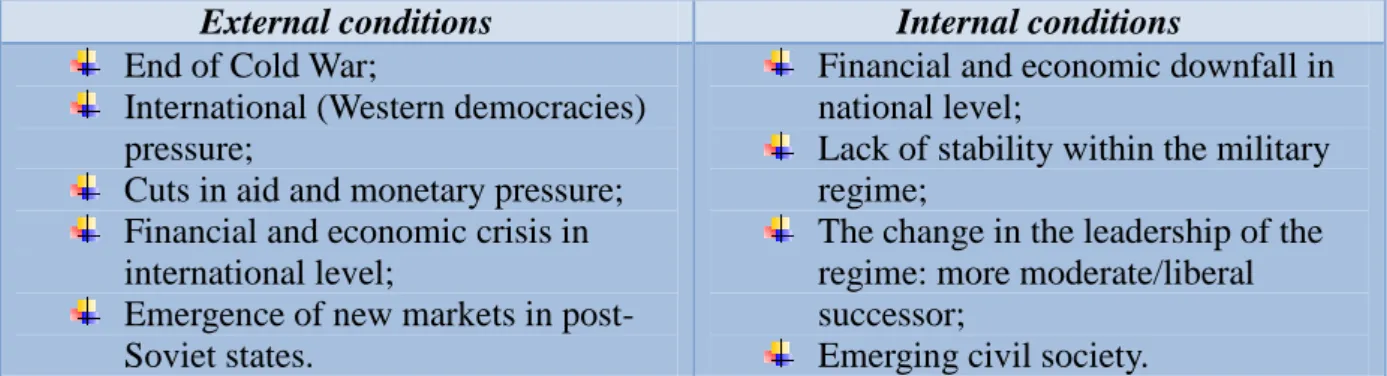
De-colonization was a failed attempt for democracy in most of African countries. As mentioned earlier, it resulted in the emergence of military autocracies. Yet in the 1990s another opportunity originated fuelled by a number of external and internal factors (see the Table No. 1 below). These determinants initiated the transition in the region. Moreover, they influenced the form of the transition itself as well as its success or failure. The following section analyses the triggers of democratization in more detail.
Table No. 1
External and Internal Factors of Democratization in Africa
External conditions Internal conditions
End of Cold War;
International (Western democracies) pressure;
Cuts in aid and monetary pressure; Financial and economic crisis in international level;
Emergence of new markets in post-Soviet states.
Financial and economic downfall in national level;
Lack of stability within the military regime;
The change in the leadership of the regime: more moderate/liberal successor;
Emerging civil society.
2.2.1. External factors
In the literature there are many different opinions as to what brought down the “open”6
dictatorships in Africa, yet everybody agrees on one common factor – end of the Cold War. If before “Africa had been an object of ideological rivalry between the Soviet Union and the United States“ (Deng and Zartman 2002, 107), now new expectations for a whole continent emerged. After the Soviet Union crumbled, communism could no longer be used by African rulers as a pretext7 to oppose the western way of governance. At the same
6
Term „open dictatorship” should be understood as an opposite to military rule under a civilian cover: after the 1990s wave of democratization most military regimes only changed their appearance into civil, yet people behind the „wheel” remained the same. Moreover, most countries which were democratized in the 1990s after some time failed to keep democracy and went back to being authoritarian.
7As already mentioned before, democracy was seen as an invention of former colonizers, thus military dictators
6
time the influence of the World Bank and International Monetary Fund was also growing. It became clear that capitalism (so much despised till then) was going to dominate the markets of the world. Therefore, in order to get their share the developing countries had to “play” according to the rules of the Unites States which emerged as a Cold War winner.
During the Cold War period the West was not interested in what was happening in Africa. With a growing threat from the East and a possibility of a Third World War, developed countries deliberately let slip the brutality of some regimes under their eyes, which at that time were terrorizing their own countries (for example, the ethnic cleansing policy by Idi Amin in Uganda and many others). Once the Soviet Union ceased to be a threat, the West turned back to the Africa. Military dictatorship could no longer be tolerated in the world where democracy was seen as the only possible way of governance of modern society.
Due to international pressure, big cuts in aid, the change was unavoidable. During the decades of their rule dictators managed to extract the last bits of resources of already poverty stricken countries, and were facing huge debts. Money was one more trigger that pushed for a change. As Ihonbvere (1997, 90-91) observed, “Kamuzu Banda (Malawi„s former President-for-life) who had previously declared his country out of the range of the democracy drive was equally compelled by a drastic cut in British aid from 10 million pounds (sterling) to 5 million pounds (sterling) in 1992 to make concessions to prodemocracy agitators,” as well as “Nigeria‟s former strongman politics could ensure continuing Western and donor support for the country‟s industrialization programs.” Yet simply withholding aid does not give the results which are expected by the donors. Eventually it “simply compels the incumbent government to introduce political change on its own term” (Ihonvbere 1997, 309). The regimes were willing to satisfy the party which promised money, while making sure that the power would remain on their side no matter how it would be called: parliamentary democracy, presidential democracy or any other name.
7
Overall, western world focused on pressuring the African governments through monetary actions. It was expected that change to democratic rule and a combination of special programs of recovery, created and supervised by the International Monetary Fund or World Bank specialists, would be the answer to all problems (Ihonvbere 1997). This plan was flawed from the very beginning. First of all, seeing that change is unavoidable, the “typical response of African authoritarian regimes” would be to try to create a custom made “democracy” which would legitimize military rule in the eyes of an outside society and guarantee the flow of aid and grants. In such cases authoritarian regimes would create structures which are similar to democratic yet the posts would be given to former supporters. Such act was simply an “attempt to legitimize the potently illegitimate” (Saaka 1997, 147). Secondly, imposing plans from the top (outside country), which were supposed to help countries to recover, was a pure waste of money and time. It is impossible to make efficient and implementable suggestions without profound understanding of the contemporary situation and the conditions of the countries. In the end, all resources accumulated in puppet ministries and in foreign bank accounts of top leaders and their followers.
Another weak point of such a transition to democracy in Africa was that everything was done for wrong reasons: “in order to satisfy the new political conditionalities of Western governments, bankers, donors and nongovernmental organizations” (Ihonvbere 1997, 290), which suddenly were very much interested in Sub-Saharan continent. Such reasons behind transition were superficial and did not have a long term perspective. This is why eventually most of the 1990s democratization wave countries soon gave up democracy. Democracy per se has to come from the people and should have people‟s support. Democracy of the 1990s in Africa, looking from a wide perspective, was most likely imposed by the international community governments, while regular people remained under the same oppressed conditions not participating in their country‟s life.
8
Overall, the end of the Cold War had two main effects on Africa: first, it created a possibility for the region to recover on its own; secondly (and paradoxically), abandonment by superpowers raised doubts about Africa„s future, economic role, and a possible increase in marginalization (Deng and Zartman 2002). Eastern Europe became the most attractive part of the world for all investments, with comparatively cheap, but well educated labour force. Africa continued receiving a lot of international attention and pressure to democratize, yet not enough of what could be called “moral support” which was needed to make a successful transformation to consolidated democracies.
2.2.2. Internal factors
Parallel to external factors there are several important internal pressures that highly accelerated the transition to democracy in Sub-Saharan Africa. Saaka (1997, 146) claims military regimes faced “sheer weight of time.” As the author notices, regimes had a tendency to ignore the reality or suppress it with further aggressive approach hoping that fear will keep the system stable. Yet the bottom up pressure did not let the regimes to relax: people grew restless of decades of suffering which sometimes under local dictators were far worse than under colonial rule. Ihonvbere (1997, 293) mentions many internal triggers, such as “unemployment, ethnic and religious upheavals, increasing bankruptcies, rising militancy among non-bourgeois constituencies, and restlessness within military and security networks.” The regime was facing dissatisfaction stemming both from inside and outside. The situation was so bad that sometimes the dictator was not able to trust even his main force– military8 – anymore. Moreover, rising number of guerrilla movements also threatened internal stability of dictatorship; therefore “surrendering to democracy” seemed to be the only solution.
Due to the mentioned reasons elections took place almost all around the African continent at one point or the other. Ibonvbere (1997) notices, that in this case it is important
8
It is important to stress that the military was the key actor which brought the dictator to power in the very beginning.
9
to distinguish between what we call democratization and a real democracy. According to him, the military regime easily enacted the transition, but that did not establish full grown democracy. Moreover, he stresses that as democracy was pushed mostly by former colonizers, African countries accepted any agenda (not necessarily these were relevant to the countries‟ conditions and needs, and implementable) of the transition which ensured the constant flow of money. Meanwhile, Western countries concentrated not on enabling the societies, but on pure numbers and market shares, praising the overall economic development of the countries. Civil society, basic human rights were left on the side. “The democratization of national politics in Africa, not the transformation of government as such, was the primary and immediate object” (Prempeh 2008, 111) upon which all efforts were concentrated. Prempeh (2008) further says that even the opposition within countries was motivated not by the reform as such, but more by the idea of the possibility to create their own government. It was like a battle for power shares within the country. People did not seek to establish a democratic country for everybody; democracy was seen simply as a mean to create the government for themselves with the most egoistic goals of profiting.
Joseph (1998) in his article for the Journal of Democracy described an example of Zambia when in 1991 President Kaunda (ruler for 27 years) was forced to give way to democratic polls due to the pressure both from international community and the opposition. The new government was formed by the Movement for Multiparty Democracy, led by Frederick Chiluba. The author observes that although there was a possibility to start a real democracy, “elected government arrested outspoken journalists and civil society activists; detained political opponents; used mysterious bombings as a pretext for imposing states of emergency; and amended the Constitution to ban Kaunda from competing in 1996 elections. In six years Chiluba has taken Zambia back to the worst period of what had been” (Joseph 1998, 6). In Zambian case, the democratic transition means were used to change one
10
authoritarian regime into another. To sum up, for the most of African countries, the 1990s were more like experimenting with democracy, than a real transition to democratic rule.
As there are many unsuccessful examples of transition, at the same time one cannot ignore that there exists a positive trend as well. Benin9 was the first African country which completed a successful governmental change peacefully at the will of its people in March 1991 (Bratton and Van De Walle 1997). Afterwards, there was a sudden upsurge of Sovereign National Conferences in 12 countries (mostly French-speaking). Their civil society members took over the power, organized elections, and created new, more open political systems with newly written and more democratic constitutions (Deng and Zartman 2002).
Other important steps were taken to stabilize the transition of the continent. In 1991 spring various civil groups together with government representatives met in Kampala, Uganda “to discuss security and stability in Africa” (Deng and Zartman 2002, 104). Outcome of this conference was the proposal to create the Conference on Security, Stability, Development, and Cooperation in Africa (CSSDCA). During the meetings, which were held not only in Africa, but also in Europe, participants were encouraged to learn from other experiences, especially the Helsinki process10. Yet at the same time it was acknowledged that the African procedure has to be unique and tailored to its special situation. Deng and Zartman (2002) also emphasize the debates held with African NGOs in order to hear their opinion. Most important outcome of CSSDCA was the Kampala Document, which raised quite a few issues, such as sovereignty, security, stability development and cooperation. For example, it expanded the traditional understanding of security by including individual security: “security of one African country‟s individuals is also relevant for other African countries” (Deng and Zartman 2002, 120). Moreover, Kampala document is based on a belief that only through democracy it is possible to reach economic development. Lastly, “the most revolutionary
9
Even today Benin remains one of the most stable democracies in Africa according to Freedom House 2010 data (scoring 2 points (1 point being the highest) both in political rights and civil liberties.
11
aspect of the Kampala principles … is their penetration into internal affairs of the state” (Deng and Zartman 2002, 139) – it broke the shield of sovereignty, used by many military dictators, as well as imposed responsibility for other countries to be active when there are troubling signs from neighbouring states.
Agreeing on principles was not as difficult as implementing them. The Organization of African Union did not adopt the CSSDCA proposal. As Deng and Zartman suggest (2002), the reasons behind could be a lack of political will; a sceptical approach to something, which was considered to have Western initiative; pressure of time and other. Yet the Kampala Document remains an important creation of African nations outlining the basic principles, rights and obligations, which were drawn out from the regions own experience and understanding. Creation of these principles shows the common understanding of how the transition should be pursued within the region. Most importantly, Kampala document is an African “offspring”, just slightly influenced by outside actors. That gives a certain weight on its provisions/common decisions.
Countries, which emerged as not perfect democracy examples, have a possibility to strengthen their status and improve overall performance, although it might take some time. According to Prempeh (2008, 110), one recent trend showing a certain positive development is limitations on presidential terms: “By the end of 2005, thirty-three African constitutions contained presidential term-limit provisions. Term limits have ended the tenure of fourteen presidents in Africa since 1990.” This shows that it becomes less and less possible for one man to have all power in his/her hands. Pluralism (in whichever form it may be) is becoming a norm in Africa.
12
3. HYPOTHESIS AND RESEARCH METHODS
As it has been discussed in the previous chapter, the overall democratisation of the military regimes in Africa has been a challenging issue. The goal of this paper is to analyse the successful democratization of Ghana and identify the important factors and steps in the transition. Furthermore, I claim that Ghana is an exemplary approach of achieving consolidated democracy, therefore, can be used as a model and be replicated by other Sub-Saharan countries which are still struggling to fully democratize. Ghana through an electoral process had chosen a new democratic government which was encouraged and approved by a public consensus, reached by educated and politically conscious citizens, who, despite being ethnically diverse, unified for a common goal. This hypothetical claim will be addressed through several qualitative11 research methods, chosen as the most suitable for this case.
Firstly, it is important to clarify the understanding of the transition from the military regime to democracy. From several well-known definitions one will be distinguished that will be applied in the paper. This has to be done in the very beginning as it is an important part of the analysis that leads to the testing of the hypothesis. Without understanding this question – what is transition leading to a consolidated democracy – as a starting point, it would be difficult to continue with the rest of the analysis.
A regime transition per se is a change of one set of rules to the other. The transition can be instant and sharp, “when a coercive autocracy collapses and gives way to an elected democracy” (Bratton and van de Walle 1997, 10). Or it can develop gradually, step by step relaxing the “firm fist” and offering a “softer” version of authoritarian rule (Bratton and van de Walle 1997). Transition, which is discussed in this paper, is from military regime to democracy. Such an autocratic rule can be defined as a type of government when the power is
11 Qualitative research is chosen over a quantitative research as the author believes that deeper analysis of other
factors than numbers and statistics is more useful in this case. Although figures also play an important role in the paper, the overall descriptive approach is more revealing; it helps to find the reasons behind the certain actions of politicians and general masses that sometimes cannot be explained by a quantitative approach.
13
in the hands of military. Military based regime is not a new phenomenon. Actually, for the most part of the existence of a “civilized human being” the power was concentrated in the hands of a person who had certain organized forces on his side. Thus democracy as we understand today and which comes from the United States constitution, parliamentarian democracy, born in England, and with the French revolution movement, is extremely young. The 20th century can be considered as a new era for it (especially after the de-colonization and the fall of the Soviet Union, when many countries gained independence or restored it back).
Defining democracy is a widely debated issue without a clear answer as to what are the most important components. According to Schumpeterian theory, elections are the most important factor (Huntington 1991). They undeniably take a major role in contemporary democracy, but they also have to fulfil certain criteria: they have to be competitive, open, and be held periodically with a possibility for all adult population to vote without race or gender discrimination. Such elections are common in developed Western countries, which have a long history of competitive democratic change of government. Yet in the African context elections cannot be the only factor leading towards democratization of the country.
In countries that are in transition elections are often used as a tool for fraud. Usually donor countries “tie” certain democracy conditions to aid. Most of the time the main condition is to establish the government, elected by popular vote. Such a condition can be ineffective. Firstly, the military can fabricate elections and legitimize their power as a civil government. This creates an even bigger problem: for the outside world it becomes harder to criticize and question the regime and its actions, which before were visibly autocratic, yet after elections it can play the “legitimacy” card. Secondly, even if military rulers give in and let elections to take place, once it is obvious that the results are not satisfying, they will
14
simply annul them as, for example, this was the case in Nigeria and Algeria (Gyimah-Boadi 1991).
Elections should be analysed taking into consideration the African context which is very unique and different. Deng (1998, 140) observes: “Because democracy has become closely associated with elections in which Africans tend to vote on the basis of ethnic or religious identity, democracy risks becoming a dictatorship of numbers, with the majority imposing its will on the minority.” Thus even if there are free and honest elections, it may still be not enough to reach the consolidated democracy in Africa. Although for the Western society majority rule is considered to be a norm, it is because Western countries are more homogenous and Western society is more united. In the African case, ethnicity itself is not a limiting factor, but the already existing tensions between the different groups within the country have to be resolved in advance.
Abedeji (1994, 128) claims, that “the kind of democratization that Africa needs goes well beyond the ballot box and tries to avoid some of the limitations of the Northern model of democracy.” According to him, the West does not believe in the democracy which they promote: too much bickering between parties and struggles for power. What Africa needs, according to him, is a democracy, based on mutual understanding and consensus, not the majority rule. Therefore, what is needed in Africa is not only an electoral process, which is prone to fall to the “electorialist fallacy12,” but also an establishment of civil liberties, which would generate the creation of social capital and raise a conscious civil society, able to be an active and efficient participant in elections.
How can one define the successful consolidation of democracy in Africa? What would be the indicators of completed transition? For further analysis, the understanding of consolidated democracy will be borrowed from Linz and Stepan (1996), who propose that
15
consolidated democracy is one that can be perceived by society as the best option and there is no significant struggle to overthrow a democratically elected government, as the needed changes and reforms can be reached through democratic means, as well as conflict resolution through established democratic institutions13. Authors also introduce five factors, which according to them are needed for the consolidation to take place: free and lively civil society, autonomous political society, rule of law, independent state institutions and economic society.
The proposed understanding of consolidated democracy has to be tailored to the African perspective. For example, as it was mentioned, civil society plays one of the main roles in the transition, because precisely on the free and viable civil society democracy is built. Even after the transition, civil society continues to “act as watchdogs for citizens‟ rights” (Gyimah-Boadi 1998, 23). The difficulty in Africa is that the civil society movement is not as developed as in the rest of the world. This is mostly because of the already mentioned ethnical division (as well as other reasons). Moreover, there is a trend for civil society groups to become politicized, especially when the leaders of NGOs are elected into new democratic government and as Gyimah-Boadi (1998, 23) puts it, they dive “into partisan politics.”
As for the creation of the bureaucratic machine, it is important to remember that most of the institutions upon which the new democratic transition is built, were introduced by colonizers. Accordingly, depending who were imperial powers, the system in Africa was either based on a British, or French origin. When the colonizers came, they did not take over lands with an indigenous people living in the huts. They overpowered the already established system which was perfectly functional during the pre-colonization period:
“African political systems, whether empires, kingdoms, centralized states, or stateless societies, were structured in a hierarchy in which the basic unit was the family, extended to the lineage and the clan, with the cluster of lineages and clans constituting territorial entities and ultimately nations. Despite the hierarchical nature of the system, these entities were generally governed by consensus and broad
13 Diamond (1994, 15) also defines consolidated democracy as one where it “becomes so broadly and
16
participation through group representation at the central level and village councils at the local level” (Deng 1998, 143).
Ethnic identities and strong tribal connections will not disappear anytime soon; moreover, assimilation between Africans will not happen within next century (if ever). Ethnic diversity per se is not an obstacle, yet it can be easily manipulated, if it is not properly managed, and create tensions between people. In order to create a working consolidated democracy in Africa, it requires taking into consideration the good practise of pre-colonization society structure: looking into the overall decision making process, examining “indigenous African institutions and value systems and the way they have been used or undermined in order to determine whether they retain elements that could be integrated into the reform process” (Deng 1998, 142). Although it is understandable, that the system, which remains from the colonial period and now is the basis of institutions in emerging democracies, cannot be fully replaced, yet it is possible to transform (upgrade) them so they relate more to the country‟s original political history and traditions.
To sum up, the regime‟s transition to a consolidated democracy is a long and complex process, let alone in the region such as Sub-Saharan Africa. One cannot forget the specific context of the region and has to apply additional conditions to the basic definition of the democratic consolidation, as the general definition is not enough. Therefore, socio-cultural observations, that are unique for Africa, will play an important role in the paper while analysing the topic.
Hypothesis in itself carries a case study implication as it is based on Ghana‟s success model. In order to prove it, one has to carefully study Ghana‟s background, analyse historical information and all other relevant elements. To make this analysis, the descriptive method will be used. This method allows looking at the issues at hand with a more flexible view. Moreover, it allows gathering useful and actual information about the situation that is now in Ghana, as well as how it has changed during the years. Descriptive method allows a wider
17
choice of recourses that can be used while analysing the case – scientific publications, newspapers, various newsletters printed by international or local organizations, and other announcements. The author will concentrate mostly on African sources in order to present the actual situation observed by the locals, as well as official worldwide recognised sources to ensure objectivity of the case. With the help of the already mentioned research methods, the case study of Ghana will be carefully analysed in the next chapter.
18 Ghana regained independence from the British Government in 1957 and today is seen as one of the democracy models in Africa. Freedom House in 2010 World Freedom country report on Ghana evaluated political rights with the highest score – 1, while civil liberties with 2. Last Presidential elections in 2008 and Parliament elections in 2009 were
announced to be fair and competitive. Today the
government faces similar problems as any other democracy does: fight with corruption, solving the problems left after the global financial crisis, development issues, as Ghana is still dependant on foreign aid. Despite that, Ghana can be seen as an example of a consolidated democracy. One could be sceptical as it has been less than 20 years since the Constitution of Ghana entered into force14. Overall, this transition by many scholars15 in early days was deemed to be “pseudo-democratization” (Ihonvbere 1997, 95) rather than the real and fruitful change. Yet it is undeniable that for African region, where regimes change every one or two years, such stability as Ghana enjoys today can be seen as a long term achievement (also see: Annex III).
Further analysis of the case will concentrate on the historical and current events evaluation in the light of Ghana‟s way towards democratic consolidation. Looking through the historical overview gives a perspective of main obstacles that were hindering democratisation in Ghana, as well as how they were undergone, and an opportunity for the real democratisation was created. Based on such research, the key to the question if other
14March 6, 1993.
15Ihonvbere (1997), Saaka (1997) and others.
19
African countries could embrace Ghana‟s experience as an example of a transformation from military regime to a stable and established democracy from an African perspective can be found. Therefore, the hypothetical claim that should surface from this case could be that under similar trends of certain political change and loosening of previously restricted rights, together with continuously growing possibilities for freedom of expression (i.e. unrestricted freedom of press, internet access and other), active civil society, and ascending trust in the newly elected government (during free and competitive elections), other Sub-Saharan countries could become consolidated democracies from still existing autocratic military regimes.
4.1 GHANA UNDER MILITARY REGIME OF RAWLINGS
After gaining independence16 Ghana was established as a democratic country led by Prime Minister Kwame Nkrumah who was overthrown in 1966 by coup d‟état. Between 1966 and 1981 Ghana experienced numerous changes of military rule. In 1981 with another coup Flt. Lt. Jerry John Rawlings came to power. He ruled Ghana for almost 10 years till the transformation towards democracy started.
When Rawlings seized the power, he abolished the 1979 Constitution, which was modelled on the example of Western democracies, dismissed then President Dr. Hilla Limann and his cabinet, dissolved the Parliament and denounced all political parties. Rawlings established Provisional National Defence Council (further – PNDC) which he chaired himself. Through PNDC he could exercise both legislative and executive powers. Rawlings created many additional institutions, such as the National Investigation Committee (fighting corruption and economic crimes), Citizens‟ Vetting Committee (penalizing tax evasion), and Public Tribunals (for other crimes). In 1982 the decentralization of government was
16
20
announced, although the overall power was maintained in the hands of Rawlings (he was appointing the district officers). Ghana was kept under strict control during the decade of military rule (Background Note: Ghana 2010).
Political life was in a vacuum in the 1990s: “Until 1991, the PNDC‟s only real concession was to organize non-party elections to district councils in late 1988 and early 1989” (Gyimah-Boadi 1994, 78). Rawlings imposed strict limitations to everyday life of Ghanaians. Gyimah-Boadi (1994) enlists: imprisonment without trial, confiscation of private property, forcing people into exile, rigid control of media, propaganda campaigns and many others. It was military regime in its strictest sense. The author notices, that although PNDC‟s rule was not as cruel or memorable as some other African military dictators practiced, still it was considerably long. While other African countries were already moving towards democratization, Ghana was still under the “steal fist” of Rawlings.
During the Rawlings rule, Ghana faced multiple issues. First of all, in the early 1990s it had to absorb around one million returnees from Nigeria. In 1985 additional 100.000 were expelled. Secondly, country was hit by one of the biggest droughts in decades, which together with declining foreign aid gave another blow to struggling economy of Ghana. Although overall country‟s economy started improving in 1984-85, the sudden drop of cocoa and gold prices, the main exports of the country, resulted in high inflation (Background Note: Ghana, 2010). Due to these and many other problems military regime was also heavily affected and could not stay in status quo any longer.
4.2MOVE TOWARDS DEMOCRATIZATION (1991-1992)
Ghanaian transition towards democracy, as in the whole African region, was encouraged by similar external and internal factors. Due to the end of the Cold War and the events in Eastern Europe, the West could no longer support autocratic regimes. As Saaka
21
(1997) notices, Ghana was one of the countries that thoroughly followed the IMF and World Bank instructions in the 1970s and 1980s and because of that the country was in friendly relations with Western countries. Ghana received quite a big portion of financial support17. In order that Western countries would keep the aid flowing and in such a way ensure the same pace of Ghana‟s development, the regime change had to take place. Democracy was considered to be the key condition for further cooperation in the following years. The United States and Britain, being the main aid givers, could not ignore the autocratic regimes any longer, and in the 1990s Rawlings was literally pressed to the corner.
Movements inside the country, such as the Movement for Freedom and Justice18, led by Albert Adu Boahen, also did not let Rawlings relax. Through his academic work Boahen broke the so called “culture of silence” which marked the whole Rawlings regime – in 1988 he held and open lecture titled “The Ghanaian Sphinx: Reflections on the Contemporary History of Ghana, 1972–1987” (Professor Emeritus Albert Adu Boahen 2006). Yet at that time the citizens‟ movement was not very strong and vocal.
Combination of internal and external factors forced PNDC towards the return of constitutionalism (Background Note: Ghana 2010):
A special advisory committee – a 258 member Consultative Assembly – was established to draft new Constitution with reference to PNDC proposals; In 1992 April Constitution was approved by national referendum;
On May of the same year political parties could function again in preparation for the coming multiparty elections;
PNDC formed a new party – National Democratic Congress (further – NDC) – in preparation for the coming elections;
17
„Net resources to Ghana under official foreign aid rose from about $270 million in 1984 to $385 million in 1986, and to $480 million in 1990“ (Leechor 1994, 172).
18
22
Presidential elections took place on December 29, 1992;
On January 7, 1993, Flt. Lt. Jerry John Rawlings was inaugurated as a President.
As a result, since 1993 Ghana has been perceived as a democratic republic. Yet as it was observed in the previous chapter, elections per se do not represent consolidation of democracy. Similarly in the case of Ghana 1993 Presidential and Parliamentary elections were a chance for Rawlings to legitimize his power as a ruler of Ghana in a civilian manner while implementing the Western condition to end military rule. According to Ihonvbere (1997, 94), the return to a civil regime was planned by Rawlings from the very beginning as he created an “elaborate agenda to endear himself to the populace, discredit other political actors, and consolidate his control over the resources and institutions of state.” He even used governmental funds to prepare for elections and his campaign.
Opposition parties protested against such visible breaches within the procedure of elections yet continued to participate as it was the choice between two evils. It was the first multiparty election in years; and although small, there was a chance that the government might be interested in a fair process (Saaka 1997). However, after it became obvious that elections were falsely carried out, most of the opposition parties boycotted the following parliamentary elections. The 1992 events were closely monitored by the multiple international monitoring bodies - the Commonwealth Observer Group, the OAU Observer Group, and the Carter Observer Group – but that did not prevent manipulation. Paradoxically, the very same monitoring agencies let slip from their observations the dissatisfaction expressed by the opposition parties.
To add more, right after the establishment of the new “democratic” government, the British Foreign Secretary, Douglas Hurd, and his minister of Overseas Development, Baroness Lynda Chalker, both visited Ghana, “ostensibly to lend international credibility to
23
the new Rawlings government” (Saaka 1997, 165). Other Western countries also expressed their congratulations, and in such a way de facto admitted the Rawlings government as acceptable within the international community. This once more showed that establishment of real democracy in Africa was not the main objective of the West. For them, the main concern was just to keep the façade.
Although the 1992 elections did not create the real change of the government towards democracy, it was an undeniable push for further transition. The 1992 Constitution granted quite wide freedom of speech; forbade any kind of censure and in such a way generated the growth of independent media as well as empowered the general public to start voicing its political opinion. In such a way civil society was encouraged to come out from the underground creating an altogether more active citizens‟ participation. Moreover, the opposition actively used the government institutions – especially the judiciary – to reach the goal of real democratization. Through the Supreme Court of Ghana the government‟s behaviour was constantly questioned (Boafo-Arthur 2008).
4.3CONSOLIDATING DEMOCRACY IN GHANA
If the 1993 elections were not the democratization, how and when did the real consolidation of democracy take place in Ghana? Democracy “rooted” in Ghana due to several factors: each is a celebration of democracy in its own way, and each added to the creation of majority‟s trust in this form of governing. They can be enumerated as the following: elections, independent institutions, free media, organized civil society, and ethnicity. Each will be covered separately, yet keeping in mind the idea that all in one way or in another are interconnected and dependent.
4.3.1. Elections
24
2000 Presidential elections. Although during elections tension remained high19, for the first time in the Ghanaian history power democratically was shifted to a newly elected president John A. Kufour of the New Patriotic Party (further – NPP), who defeated the candidate of NDC‟s party John Atta Mills, picked by Rawlings to be his successor. Kufour was re-elected again in 2004 with a “52, 45% of the vote against three other presidential candidates, including former Vice-President John Atta Mills of the NDC” (Background Note: Ghana 2010). Last Presidential and Parliamentary elections in Ghana were held in 2008, December. This time Mills won in the second round (in the first one none of the eight participating candidates exceeded 50% of the votes). According to the Freedom House Countries at the Crossroads 2010, from all five Presidential and legislative elections which took place between 1992 and 2008 each was an improvement of the previous one. In the last decade, power was transferred two times between the two main parties of the country and because of that Ghana‟s case is almost unique among Sub-Saharan democracies.
Presidential elections which took place in 2000 did not avoid fraud, such as unrealistic percentage of registered voters. Special steps were taken to fight with double registering – checking photo IDs, marking voters fingers with indelible ink. The Electoral Commission played a pivotal role in ensuring the transparency and building trust and belief in the election process between the people. Also, important part was played by the domestic observers which united into a group called Coalition of Domestic Election Observers20 for the 2000 election. Their participation and work ensured more transparent elections as local observers were participating not only on the day of election. They were able to follow the situation, evaluate it and observe long before the elections took place, during them and after. Locals
19
There were many doubts whether Rawlings would step down and abide to the two-term constitutional limit; would he let the winner to take over, or would he deny the results and use military force to get the power back.
20 “CODEO comprises over 20 prominent civic bodies such as the Ghana National Union of Teachers, National
Union of Ghana Students, Nurses and Midwives Association, Civil Servants Association, the Ghana Bar Association, Ghana Legal Literacy Resources Foundation and Trades Union Congress” (Center for Democratic Development – Ghana (further – CDD-Ghana) 1(4) 2000, 4).
25
were more trusted by the Ghanaians, they could evaluate the situation more accurately; therefore, they had more advantages over the international observers. Moreover, it showed how much Ghanaians themselves wanted to be involved in this process and ensure that election indeed represented the real opinion of the population.
Wide coverage of the event by free press was one of the positive indicators: “Ghana Broadcasting Corporation, the largest and most powerful media organization in the country, publishing an elaborate set of guidelines agreed to by the political parties and aimed at allocating equal media access to all presidential candidates” (CDD-Ghana 1(4) 2000, 5). Also it is important to mention the Presidential candidates‟ debate21
– first of this kind not only in Ghana, but also in Africa (apart from South Africa) – which took place on September 27. It was broadcasted live around the world by CNN and the South African Broadcasting Corporation. The fact alone that public was able to hear all opinions and voice their own showed the existence of certain level of democracy, enabling people to pursue even deeper democratization through fairly and openly elected representatives. Although according to the official records the voter turnout was 62 %, Gyimah-Boadi and Mansah (2003, 21) claim that it “was more likely between 76 and 81 percent.” Such high voters‟ turnout is rare even in Western countries that have old democratic traditions. Conversely, in the West people are losing interest in exercising their rights (to vote, to voice their opinion and actively participate in country‟s administration).
As mentioned earlier, the following elections solidified Ghana‟s status as a democracy on its way to real consolidation. The 2004 elections, according to CDD-Ghana‟s “Democracy Watch” (2004), was very peaceful and represented the real opinion of Ghanaians. As NDC got almost 1/3 of Parliament‟s seats, it ensured a “strong opposition, a necessity in a working
21 NDCs candidate Vice President John Atta Mills, did not participate, and it was feared that due to that the
credibility and equality of the debate might be lowered in the eyes of the voters. But as Center for Democratic Development observed, “the event succeeded in providing a common platform for the articulation of alternative perspectives on critical issues facing the nation” (CDD-Ghana 1(4) 2000, 5).
26
democracy” (CDD-Ghana 5(4) 2004, 1). Being a natural rival to NPP it questioned its policy steps, followed how NPP fulfilled their election promises and was playing a role of a pressure group. Overall, that is how it works in a democratic system – having to navigate between different opinions and various needs, only the ones that represent people the best, stay. Apparently, Ghanaian society was not satisfied with the subsequent 4 years of NPP rule, thus in 2008 NDC came to power. Incumbent party was overthrown by an opposition.
The 2008 elections, if compared with i.e. Lithuania‟s, USA, South Africa‟s elections, would still not be perfectly democratic. Campaigning was not so spotless, there were acts of defamation, mistrust between rivals. Moreover, there could be seen limitations in the political sophistication of the constituents. There were many cases when people registered for various reasons which had no connection with the elections, i.e. young people “had gone for new voter ID cards because the cards could also be used for identification in transacting other business in the formal sector (such as opening bank accounts)” (CDD-Ghana 8(2) 2009, 3). Although Ghana has a special body – the National Commission on Civic Education – which, according to the Ghanaian Constitution is responsible for this particular issue, a big gap that still needs to be taken care of remains. On the other hand, having such a body established already shows the understanding and acceptance of the problem itself and search for the means to tackle it.
Simple examples can be taken as a proof of existence of consolidated democracy in Ghana: the acceptance by the rival political powers of their loss in elections and recognition of the winning party. During the 2009 Presidential inauguration ceremony, when Prof. John Evans Fiifi Atta Mills was being inaugurated, the losing candidate Nana Addo Dankwa Akufo-Addo also participated (Ankomah n.d.). For any democratic society in the western world this would seem a completely normal behaviour, yet in Africa it is still rare. It is enough to look at the Ivory Coast, a Ghana‟s neighbour, which recently was a divided war
27
zone as former president Laurent Gbagbo was refusing to step down and give way to the internationally recognized winner of 2010 Presidential election Alassane Quattaras.
All that was mentioned seems to be everyday life examples for any “seasoned” democracy, yet for Ghana (and for Sub-Saharan Africa in general) these little steps forward are the real gains. Although elections looking closely is still not the epitome of perfectness, neither it is in any country. It is important that Ghanaians themselves realise that democracy as such cannot originate overnight. Research of Gyimah-Boadi and Mensah (2003, 28) on this topic shows that “respondents agree with the suggestion the current multiparty electoral system should be given more time.” This general acceptance of not perfectly perfect democracy is a sign of overall consensus among the majority of the population that no matter how hard this road might be, there are no other acceptable options. In the end, democracy is the best possible way of ruling the country. Although at the moment there might be some lapses in the system, it is all fixable in the long run.
4.3.2. Independent Institutions
Another important feature that can be accounted as contributing to the consolidation of democracy in Ghana is governmental institutions. Elections take place once in a few years, while the everyday life of the country is continuously dependent on the apparatus. It has a specific institutional memory and cannot be changed from day one when the new government comes into power. There are multiple laws that oversee important daily business; bureaucratic system has a lot of employees – it all creates a corrupted and inoperative legacy of the previous regime. Yet, despite the system being defective, one has to work with what one has at hand.
The biggest change (as well as a considerable challenge) was felt in 2000 when NPP won the elections. Quite naturally, the first steps by the newly elected government were to re-establish public trust and start implementing Kufuor‟s “zero-tolerance for corruption” policy.
28
The former Deputy Minister of Finance faced trial on the grounds of conspiracy and financial mismanagement. From one perspective it might have looked (and NDC did suggest such an idea) that NPP was trying to avenge and destroy the rivals. Yet it is the principle law that the guilty should not escape punishment. The former member of Ghana‟s government was tried on equal grounds, by a fair trial, and he could exercise his rights to be represented and defend himself (CDD-Ghana 2(4) 2001). Therefore, it cannot be seen as a way of tackling with political opponents. In this particular case that was an execution of justice.
It is important to note that Ghanaian courts have established themselves as independent institutions even when Rawlings was still in power during the 90s. The Supreme Court in the NPP vs. the Inspector General of Police ruled that:
“No permit is needed from police or any other authority for the holding of a procession, demonstration, rally or a public celebration of any traditional custom or cultural performance by any person, group or organization.” (Boafo-Arthur, 2008, 23)
Through this ruling the Supreme Court defended the freedom of assembly, which was in the 1992 Constitution (yet not usable due to the police which banned demonstrations if they were diverted against government). Of course, the other question is if in reality the Supreme Court judgements were realised and if they limited the Rawlings administration. The keynote is that the judicial part of the state‟s apparatus earned peoples‟ sympathies; it remained a trustworthy institution during later stages of Ghana‟s democratisation.
Another important and worth to mention court ruling is the decision to outlaw the December 31st celebration22. Such celebration was deemed to be inconsistent with a democratic Ghana – or at least with such posture that Ghana was taking for the outside world. Naturally, Rawlings was discontented as it was the celebration for his honour - he was the one who organized the coup in 1981. Therefore, the Justices of the Supreme Court, who
22
In 31 December, 1981 the civilian regime of the then President Hilla Limann was overthrown and since then the day was celebrated as a public holiday (Boafo-Arthur 2008).
29
passed that ruling, were under pressure; some of them eventually resigned. Again, the most significant result from all this was that “the outcomes of the court cases assured Ghanaians of the impartiality of the judiciary and of the judiciary‟s preparedness to maintain its autonomy” (Boafo-Arthur 2008, 24). The resistance within the institutions to the autocratic rule showed the possibility to reach for more inclusive goals of democratisation.
Therefore, after the 2000 elections judiciary could get to work with much more confidence and approval that came from the general public compared to any other Ghanaian institution. For example, one of the first moves made by the Supreme Court was taking away some of the decision powers from the President: he could no longer appoint the CEO of state-media (CDD Ghana 1(4) 2000). Such de-centralisation of powers could be interpreted as a mean to create protectors that would prevent the possible misuse of power by the top officers of the country in the future, and a check and balances system. From his side, President Kufuor also took additional steps to ensure the democratisation of governance. He formed an all-inclusive Council of State: three members were traditional rulers, the ethnic diversity was ensured as well as individuals from other political traditions were included (CDD-Ghana 2(2&3) 2001). Council was formed not solely from the incumbent party‟s representatives (what is common in any seasoned democracy – the winners form the Government and tend to implement their political goals), but also with some possibility for the opposition to actively participate and oversee the actions of the Government.
Another important change in the institutional level was the re-establishment of civil-military relations. This is a very tender question for any country that was affected by the military rule. The most important step to be taken is to draw the line between the military and the government, and to ensure that the military will not get involved in the everyday life. As Crawford (2004, 13-14) notices: “Despite over a decade of constitutional rule, there remains a perception of the military as politically partisan, given its close association with both
30
military PNDC and elected NDC governments.” which in the eyes of the people was same dictatorship under different “civilian outfit.” It takes time for the military to reform itself and to re-establish the subordination. The military commanders, who for such a long time were used to being the highest officials making decisions, now faced a tough period, as suddenly they had to give that power back to the people.
In Ghana‟s case, this transition was not an easy one either – at some point the military would still act on their own account and “would not betray miscreants from within” as well as showed little interest in “redeeming public confidence in the institution” (CDD-Ghana 1(4) 2000, 9). Soldiers needed re-orientation of their mission. In the most general, worldwide accepted, sense, the role of military is to ensure country‟s security from any outside threats. Therefore, it has nothing to do with everyday civilian life. For a soldier it has to be a choice as any other career, not just an easy way towards power and easy money. Therefore, after 2000 elections the new government worked considerably on improving the civil-military relations in numerous ways: police took over the civil security, the 64th Regiment23 was sent to the peacekeeping missions abroad, the wellbeing of military service was improved (general amenities in the military compounds, better social security), etc. (Crawford 2004).
In conclusion, not only the institutions were adapting to the democratic changes, but also parties (specifically, the NDC) were affected by the democratisation process. Rawlings was a founder of NDC and also a co-chairman of the party. In 2002, co-chairmanship was abolished leaving Rawlings with the title of the founder, but denying any decisive voice in the party (CDD-Ghana 3(2&3) 2002). At that point his active political career was finished. Even if he remained the main figure of ideology, an influential political personality, he could no longer affect the decisions unilaterally. Thus, more democratised parties could create a more democratic governing body.
23
31 4.3.3. Free Media
Media has also to be heavily accounted for a consolidation of democracy through its active participation in Ghanaian politics. When in 2001 the Criminal Libel Law24 was nullified, journalists could at last truly devote themselves to real and unrestricted journalism as is understood around the world. Agyeman-Duah (n.d.) observes that “in 1990, there were just four state-owned newspapers in addition to the 60-year old Ghana Broadcasting Corporation” in comparison to the recent years when “127 radio stations, 6 TV stations and more than 60 newspapers” were established. Such a sharp increase shows the existence of favourable conditions for the media to thrive.
During the Rawlings rule media was denied the freedom of speech no matter that it was foreseen in the 1992 Constitution (Chapter 5, Section 21). It was the freedom of speech as understood by Rawlings: “You can write anything about civilians, but not military officers” (CDD-Ghana 1(2) 2000, 7), granted very selectively as in any dictatorship, and highly censored. Therefore, the newly found freedom was as a fresh breeze for journalism in Ghana, which suddenly flourished giving a very wide and descriptive coverage of all elections, and at the same time presenting the people with an opportunity to be educated through the media. The government itself became more open to the media and more willing to face it (CDD-Ghana 2(1) 2001). Politics turned out to be the “hottest” issue25
at hand.
One of the most important means of media in Ghana is radio. It is important to take into consideration, that not everybody is literate enough, moreover, has enough money to read newspapers or watch television. People who have access to such means of media mostly live in big cities. Meanwhile, the only accessible way of reaching the local public, settled in
24
Criminal Libel Law restricted journalists as it was seen fit to the Rawlings government; because of that law many journalists (if they were seen to contradict the official policy) were sentenced on criminal grounds.
25 Newspapers even started using political caricatures. In one of such cartoons Mills was portrayed as a dog. In
such way Mills was shown as “a puppet of the Rawlings faction of the NDC” (CDD-Ghana, 3(4) 2002, 1). Actually, this particular article called a lot of attention, some of it requiring to publish an official apology, yet the magazine “stood its ground, defending the cartoon as an expression of free speech that was neither defamatory nor culturally improper” (CDD-Ghana, 3(4) 2002, 2).