NOTE
: THIS IS ONLY A PORTION OF
CAR BUYING GUIDE
Table of Contents
Foreword by Jessie Gruman ... 1
Executive Summary ... 3
About CFAH ... 7
Table of Contents ... 8
Introduction: 21st Century Marketplace ... 9
Research Framework ... 17
Case Studies... 25
Consumer Reports: Car Buying Guide ... 25
eBay ... 65
FDA Nutrition Fact Panels ... 113
U.S. News and World Report: America’s Best Colleges ... 163
Case Study Commentaries ... 209
Margaret Holmes-Rovner, PhD ... 209
David E. Kanouse, PhD ... 225
Stephen Parente, PhD ... 239
Dale Shaller, MPA ... 250
Shoshanna Sofaer, DrPH ... 263
Lessons Learned: Key Variables of Success ... 275
Advancing Healthcare Decision Aids ... 293
Getting Tools Used Research Team Biographies ... 311
Acknowledgements ... 317
GTU research was supported by The Changes in Health Care Financing and Organization (HCFO) initiative, a program of the Robert Wood Johnson Foundation, the California Healthcare Foundation and the Foundation for Informed Medical Decision Making.
CONSUMER REPORTS: CAR BUYING GUIDE
A Case Report for Getting Tools Used
Table of Contents
Background ... 28
Sponsor ... 28
Business Model for the Consumer Reports: Car Buying Guides ... 28
Historic Milestones for the Consumer Reports: Car Buying Guides ... 29
Consumers’ Decision Making on New and Used Cars ... 29
Factors Influencing Decision Making ... 30
Information Sources ... 31
Objectives for Consumer Reports: Car Buying Guide... 32
Audience and Use ... 33
Descriptions of Users ... 33
Figure 1. Select CR Demographic Information ... 34
Descriptions of Nonusers ... 34
Resources ... 35
Outlays ... 36
CU Policy and Tradeoffs ... 36
Figure 2. Select CU Policies and their Implications as Resources or Constraints ... 37
Litigation ... 38 Constraints ... 38 Barriers ... 38 Facilitators ... 39 Tool Design ... 39 Tool Description ... 40 Context of Use ... 41 Adjunct Offerings ... 41 Updating ... 42
Marketing, Promotion and Dissemination ... 43
Positioning ... 43
Pricing ... 43
Figure 3. CR Pricing for its Car Buying Guides by Format and for Adjunct Services ... 44
Placement ... 44
Promotion ... 45
Testing and Evaluation ... 46
Data Sources and Measures (General Approach)... 46
Use of Data (General Approach) ... 47
Testing and Evaluation Efforts Specific to the Consumer Reports: Car Buying Guides ... 47
Impact on Consumer Behaviors ... 48
Impact of Third-Party Car Ratings and Reviews ... 50
Observations from Insiders... 50
Observations from Outsiders ... 51
Appendix A. Key Informants ... 53
Appendix B. Other History Notes ... 54
Background
This case report addresses these four versions of the Consumer Reports: Car Buying Guide. • ConsumerReports.org Car Buying Guide (electronic1
• Consumer Reports New Car Buying Guide (print) ) • Consumer Reports Used Car Buying Guide (print)
• Consumer Reports annual auto magazine issue, published each April (print) Each format offers independent vehicle profiles, test results, ratings, rankings and
recommendations to inform consumers’ purchasing decisions for cars, minivans, sports utility vehicles (SUVs) and pick-up trucks. This report uses “Consumer Reports: Car Buying Guide” to refer to these products.
Other CR publications offer similar car information, but with different packaging. • CR Buying Guide, a compendium summary of CR magazine issues for the year • Quarterly car ratings and pricing guides (black and white)
• Quarterly four-color special-interest magazines, primarily with ratings and reviewsi
The Consumer Reports: Car Buying Guides have national scale because they include a
considerable breadth of new and used vehicles in the U.S. market. The scope is national with the CR readership base of 16 million people and with an average of 50 million media
impressions per year.
Sponsor
Consumer Reports® (CR) and ConsumerReports.org® are published by Consumers Union, which describes itself as an expert, independent nonprofit organization whose mission is to work for a fair, just and safe marketplace for all consumers and to empower consumers to protect themselves. To achieve this mission, Consumers Union (CU) tests, informs and protects. CU began testing products in 1936.
Business Model for the Consumer Reports: Car Buying Guides
To support the car buying guides, which currently offer information on more than 260 new vehicles, CU sells information products and services (such as CR books, magazine
subscriptions, car pricing reports). Donations from individuals are an additional but smaller revenue source. In 2008:
• Subscriptions and other sales generated $229 million, or 92 percent of total revenues.
1 The CR online car buying guide is at
beta new-car selection tool at
• Individual contributions topped $17 million, for 7 percent.ii
To minimize commercial influence, CU refuses outside advertising and free samples for testing (see Figure 2). According to CU, “No other consumer-information site can claim and prove this total freedom from commercial influence.”iii
Historic Milestones for the Consumer Reports: Car Buying Guides
For more than 50 years, the Consumer Reports: Car Buying Guides have provided consumers with detailed information about new and used vehicles.
1936 CU begins testing cars.
1953 CU publishes the first annual CR auto buying guide in its May issue.iv, v
1985 CU expands distribution of Consumer Reports: Used Car Buying Guide when it makes all CR books available in bookstores and other retail outlets.
vi
Mid-1990s CU introduces an interactive, multimedia CD-ROM alternative of the car buying guide. It also directly distributes car ratings and reviews to Internet users through aggregator sites such as Yahoo! and MSN.vii
1997 ConsumerReports.org debuts online, a new age in CR online publishing. 2006 CU creates a beta interactive selection tool on ConsumerReports.org to help
users find new cars that meet their needs and budgets. (See also Appendix B for historical context.)
Consumers’ Decision Making on New and Used Cars
Many consumers experience anxiety when deciding on and buying a car because it is a big-ticket item that is purchased only occasionally. Often, the purchasing process involves negotiating with a dealer or salesperson whom the consumer perceives as having negotiating advantages (such as better information, negotiation skills and leverage). It is a purchase made seriously as a commitment to years of future car payments, taxes, maintenance and operating costs. Most will also spend a lot of time in the vehicle they buy. Because of these high
economic and social stakes, stress levels can be high.viii
Consumers are more likely to consult ratings and information as perceived risk increases on any type of purchase.ix
viii
Car buying is no different, with consumers devoting multiple hours to collecting information from multiple sources and considering numerous criteria. The car-buying process may involve these steps.
• Narrowing choices to a small consideration set. • Test-driving vehicles in the consideration set.
• Selecting which vehicle from the consideration set to buy, perhaps after collecting additional information for comparison.
• Obtaining information about pricing on the selected car. • Determining the potential value of a trade-in.
• Comparing financing options, perhaps getting pre-approved for a loan. • Requesting offers from, comparing and negotiating with dealers or sellers. • Closing the deal.
The decision-making process and criteria for used cars may differ from new vehicles. For new cars, consumers can reasonably expect uniform quality and features for any given
make/model/year. Most expect to buy a new car from a commercial dealer. Used cars offer a much wider selection of models, years and types of sellers. The perceived risk may be higher given the potential for misleading or concealed information about a car’s condition.
Factors Influencing Decision Making
In a 2000 CR survey, consumers ranked the following factors as most important in their decision about which car to buy.
• Vehicle reliability • Model reputation • Driving performance • Vehicle price information • Safety ratingsx
As a big-ticket item, cars also can convey social status. For some consumer groups, this factor may be an important consideration.liv Other factors influencing decision making include
household size and planned use of car (such as commuting, long-distance recreation or teenager transportation). Today’s consumers are more concerned about fuel efficiency, as suggested by a 30 percent drop in SUV sales in this year with its record high gas prices.xi
Surveys have found car shoppers differ considerably in the number of sources consulted and amount of time spent with a source.xii,xiii Consumers go to information sources that provide
Individual characteristics influence decision making, with personal finances weighing
prominently.xviii Consumers with higher educational levels and those with more car-shopping
experience are more likely than others to search for information prior to buying cars or other durable goods.
xviii
xvi Surveys in the early 2000s of new-car buyers in Buffalo, NY, found
consumers with more education and income were more likely to use Internet-based information than others; Internet use was also more common for younger car-buyers than older ones.xvii Studies have also found first-time car buyers behave in slightly different ways
than consumers with prior car-buying experience. For example, first-time car buyers tend to heavily depend on online information sources.
People who are less likely to search for information before buying a car are those who have decided on a car dealer or a manufacturer.xix
Information Sources
In any product line, consumers have little incentive to search for information when they perceive few differences. Information that consumers obtain on big-ticket items has a greater influence on the purchasing decision than for lower priced items.xx
Americans today understand considerable variation exists even within a brand or type of vehicle; thus, many research cars before buying. About one fifth of car shoppers search extensively for car information before buying (such as visiting more than five dealers or spending more than 30 hours).xxi In a J.D. Power and Associates national survey in 2008,
new-car buyers reported spending nearly seven hours on online research to inform their decision.xxii
Common external information sources for consumers include auto manufacturers, dealers, third-party information sources, classified ads, and family and friends. Use of online
information has risen steadily, with surveys suggesting that consumers substituted Internet car information sources for search time at the dealer and use of independent print sources.xxiii Use
of family and friends for information on cars was unchanged by Internet use. Compared to Internet non-users, online consumers:
• Spent more time searching for car information – especially for price along with performance and reliability.
• Considered a wider range of models and dealers than Internet non-users. • Appeared to better informed when they entered the dealership.xxiv,xxv,xxvi
• In the 2003 New Autoshopper.com StudySM, 89 percent of Internet users went online to
Online information can aid the decision-making at several stages in the process.
• J.D. Power and Associates reports in 2007 almost half (47 percent) of new-vehicle buyers using the Internet in their shopping process visited an independent site when initiating
research for their new vehicle, and 46 percent first visited a manufacturer site.xxviii
• More used-car buyers who get information from the Internet are using online sources for
locating the vehicle they ultimately purchase. In 2007, 23 percent of these buyers used an Internet vehicle locator or classified ad service (such as Autotrader.com, CarMax.com, Cars.com, eBay Motors and online classified ad services) to find the vehicle that they purchased. In 2006, just 16 percent used one of these services.xxix
• Based on its national survey of new-car buyers, J.D. Power and Associates has found that consumers’ use of various auto Web sites demonstrates an understanding of their differential benefits. Shoppers describe:
o Independent, third-party sites as being most useful for researching vehicle pricing,
ratings and reviews.
o Manufacturer Web sites as most useful for information about vehicle model
options, features and specifications.
o Dealer sites as most useful for inventory information.xxx
Increasingly, car buyers seek, trust and inform their decision with ratings and reviews by other consumers. Two thirds of used-car buyers who get information from the Internet accessed consumer-generated content. xxxii
xxxiiiError! Bookmark not defined. xxxi, Until the early part of this decade, consumer-generated
content (in bulletin boards and chat rooms) on cars was little used. As consumer reviews became popular for movies, dining and as social networking sites like Facebook took hold, a societal shift occurred. People searching for information on cars began using consumer comments. Concurrently, many car-information Web sites changed designs so consumer-posted comments and blogs were more prominent and accessible.
Objectives for Consumer Reports: Car Buying Guide
The objective of the Consumer Reports: Car Buying Guides is to help consumers “get the right car at the best price,”xxxiv
• Based on extensive testing by experts so it is reliable.
through the provision of the best expert guidance, ratings and reviews, and information. “Best” refers to information:
• Written and organized to be accessible to the average consumer. • Created independently of commercial interests.
Audience and Use
CU’s primary audience for its car buying guides is CR subscribers. CU reports having: • 4.3 million subscribers, placing CR among the top 10 magazines in the U.S., with an
estimated readership base of 16 million.xxxv
• 3 million ConsumerReports.org subscribers, unmatched among other consumer information Web sites. This base continues to grow at a rate of 80,000 new annual subscribers per month.
• Across all of its products, CR has a total of 8.5 million subscribers for its products and services.xxxvi xxxvii,
Also, more people read the CR annual car and truck issue than any other issue; the April 2007 issue sold 345,000 copies.xxxviii
Secondary audiences are consumers who do not subscribe to CR, but who purchase any or a combination of the following products. (See Background section; Figure 3 has pricing
information.)
• Online ConsumerReports.org subscription • Annual CR magazine auto issue at a newsstand
• Consumer Reports: Car Buying Guide books, quarterly car ratings and pricing guides, or colored newsstand magazines
• Consumer Reports: Buying Guide compendium book
Data from external sources indicate the car buying guide on ConsumerReports.orgis a key information source for consumers, but not the leading online source. Auto manufacturers’ Web sites are the most visited source of information.xxiv, xxxix, xl
Seventy to 80 percent of car buyers collect information from third-party Web sites, with Kelley Blue Book and Edmunds receiving more visits than ConsumerReports.org, as recalled by consumers in regional and national surveys.xxiv, xli, xlii, xliii In the 2003 New Autoshopper.com
StudySM, Consumer Reports was an information source for 33 percent of new-car buyers.xliv
Descriptions of Users
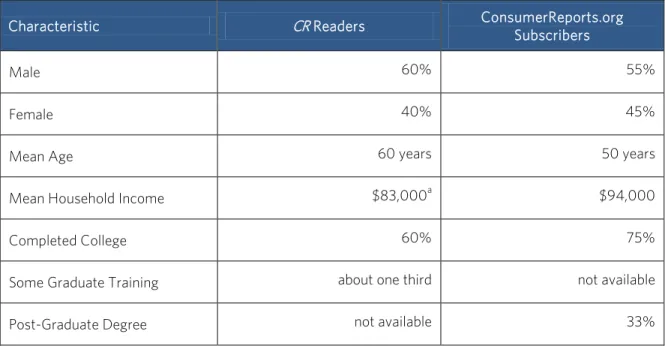
The number of ConsumerReports.org subscribers has grown steadily over time; 100,000 people subscribed in 1998, building to 500,000 in 2000, then 1 million in 2002 and 2.3 million in 2007.xlv, xlvi, xlvii xlviii, Figure 1 presents CU data on its readers and online subscribers, who tend
Figure 1. Select CR Demographic Information
Characteristic CR Readers ConsumerReports.org Subscribers
Male 60% 55%
Female 40% 45%
Mean Age 60 years 50 years
Mean Household Income $83,000a $94,000
Completed College 60% 75%
Some Graduate Training about one third not available
Post-Graduate Degree not available 33%
a Reported for Consumer Reports subscribers (not readers).
Source: Consumers Union. (2007). Consumer Reports Demographic Information. (CU does not have data on:
• Demographics of non-subscribers who use CR car products and services, such as people who buy the annual auto issue at a newsstand or who learn about CR car
recommendations through a news source.
• How people use the Consumer Reports: Car Buying Guides or what influence the CR car information and tools have on their decision making.
• Overall consumer awareness of Consumer Reports: Car Buying Guides.)
The Consumer Reports: Car Buying Guides may be more popular in rural communities, in part because the Cooperative Extension Service, a trusted resource, widely promotes its use.cxl
Descriptions of Nonusers
A significant portion of consumers has a habit of low information search.xlix, l, li
• Have made up their mind on a specific car, make or a dealer, perhaps in part from a long-standing relationship with the manufacturer or dealer.
These persons are less likely to use any third-party source to inform their car purchasing decision. Two other groups of car-buyers who are less likely than others to use Consumer Reports: Car Buying Guides
are consumers who:
• Perceive little benefit in obtaining information on their purchase, so they do not seek it out. Often, this group is an older generation.lii
Nonusers would include some disadvantaged populations with more limited access to information resources than others.liii The digital divide also gets blamed for differences in
consumer use of online information. The divide exists, but has lessened.liv Persons with weak
literacy skills tend to depend more on word-of-mouth from people they trust than information from outside experts.lv
Resources
Consumers value credible and reliable information and are willing to pay the direct and time costs of accessing such information. Americans think of CR as a good source of reliable information and of CU as a nonprofit organization that advocates for consumers in the marketplace and in capitals. Thus, the CU and CR brand of being an impartial information source is the nonprofit’s core asset.lvi, lvii
• The CR brand is familiar, a household name. In 2004, Automotive Industries described CR
as the “best known” of auto consumer survey firms.lviii
Some important aspects (described in more detail later in this section) are as follows.
• A 2007 article in PR Week noted that CR’s “entire brand is built on trust” and that this resource has enabled CU to prosper while other large media organizations have struggled.lix
• CU has built trust by extensively testing products using its own methodologies and consistently emphasizing this practice in its communications.
• Trade journal Design News describes CU testing as objective, noting the nonprofit has removed subjectivity from its tests to the extent possible (such as using a gyroscope to help identify vehicles that could be prone to rollovers).lx
• CU adheres to its policies that purposefully avoid potential conflicts of interest, such as its refusal to accept donations of items to test.
• CU and CR messaging emphasizes their reputation as a trustworthy source of information. • As both a defendant and plaintiff, CU has rigorously defended its product reviews and its
independence.
Another resource is its large, devoted base of individual consumer subscribers. Donations and subscription fees from this base enable CU to:
• Claim financial independence from auto manufacturers and other commercial interests. • Own and operate its 327-acre specialized vehicle testing facility and maintain a sizable
staff of experts to test cars, monitor the industry and communicate with the public. • Keep the CU and CR names familiar through word-of-mouth.
• Augment its CU car test results with information on subscribers’ experiences with used cars and crash tests from the Insurance Institute for Highway Safety and the National Highway Traffic Safety Administration (NHTSA).
Also, CR is adept at providing consumers with content that is useful and relevant to their needs. For example, CR ratings and reviews help users differentiate between major and minor problems, something that J.D. Power and Associates surveys do not.lxi Further, on the oldest
model cars, CR offers 10 years of car data based on its own reviews and data collected from annual surveys of its large subscriber base, whereas J.D. Power covers only three model-years.lxii
By putting CR content online, CU expanded its audience and, in particular, attracted younger Americans. CR also had the advantage of being a widely used print source, which helped it attract Internet users when consumers first began going online for information.
Outlays
CU’s accounting system does not track expenses for the car-buying-guide product line. In general, expenses include:
• Anonymous buyers, who purchase about $3 million of test cars, minivans, SUVs and pickup trucks each year.
• Outlays for operating and maintaining a 327-acre specialized vehicle testing facility in Connecticut (both infrastructure and the actual extensive battery of 50 tests covering thousands of miles over several months). The facility has about 20 full-time equivalent staff.
• Eight full-time equivalent editorial staff members who develop CR auto content.
• Additional car testing data, such as the Insurance Institute for Highway Safety as well as an annual car-reliability survey of CR magazine and Web site subscribers asking about serious problems with their cars in the past year.
• Research staff who monitor and report on the automobile industry and consumer trends. • Design and publication of CR products and services.
• Outlays for updating, operating and improving ConsumerReports.org.
• CU staff in various departments (such as administration, external affairs, copy, publishing and production, marketing, customer relations and public policy and advocacy) support CR
products and services, including the car buying guides.
CU Policy and Tradeoffs
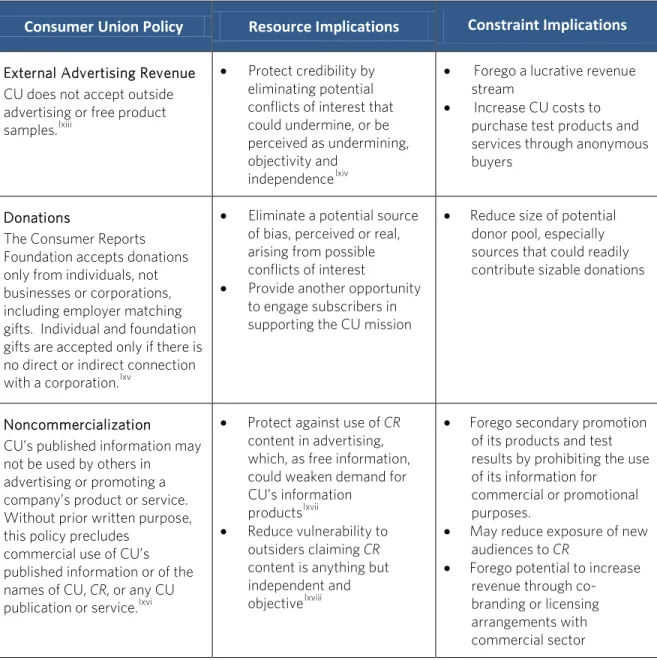
Early in its history, CU adopted several policies that bolster its credibility as an independent, unbiased source of objective information for consumers. Figure 2 presents some of the most important CU policies and describes tradeoffs.
Figure 2. Select CU Policies and their Implications as Resources or Constraints
Consumer Union Policy Resource Implications Constraint Implications External Advertising Revenue
CU does not accept outside advertising or free product samples.lxiii
• Protect credibility by eliminating potential conflicts of interest that could undermine, or be perceived as undermining, objectivity and
independencelxiv
• Forego a lucrative revenue stream
• Increase CU costs to purchase test products and services through anonymous buyers
Donations
The Consumer Reports Foundation accepts donations only from individuals, not businesses or corporations, including employer matching gifts. Individual and foundation gifts are accepted only if there is no direct or indirect connection with a corporation.lxv
• Eliminate a potential source of bias, perceived or real, arising from possible conflicts of interest
• Provide another opportunity to engage subscribers in supporting the CU mission
• Reduce size of potential donor pool, especially sources that could readily contribute sizable donations
Noncommercialization CU’s published information may not be used by others in advertising or promoting a company’s product or service. Without prior written purpose, this policy precludes
commercial use of CU’s published information or of the names of CU, CR, or any CU publication or service.lxvi
• Protect against use of CR
content in advertising, which, as free information, could weaken demand for CU’s information
productslxvii
• Reduce vulnerability to outsiders claiming CR
content is anything but independent and objectivelxviii
• Forego secondary promotion of its products and test results by prohibiting the use of its information for
commercial or promotional purposes.
• May reduce exposure of new audiences to CR
• Forego potential to increase revenue through co-branding or licensing arrangements with commercial sector
CU has been vigilant in upholding these policies. When learning of an action that may violate a policy, CU investigates the usage and contacts the entity to request an immediate end.lxix
When voluntary compliance has not occurred, CU has sued these companies, often with favorable results.lxx
When CU discovers serious errors in its testing methods or reports, the practice is to quickly and publicly apologize, inform subscribers directly through letters and e-mails, and publish a correction in a future magazine issue. In the case of its flawed car seat tests, CU also changed its policies regarding the use of external labs.lxxi
Litigation
During its long history, a few car and other product manufacturers have sued Consumers Union for negative CR reviews; consequences have included negative publicity and the direct and indirect costs of legal defense.lxxii
lxxiii
In more than 12 lawsuits since it was founded, CU has vigorously defended itself in court and in the media. For example, the press frequently published the CR photo of the Samurai tipping in coverage of the Suzuki Motor Corporation lawsuit against the nonprofit. In this and other lawsuits, CU has never paid plaintiffs any money or retracted test results, a factor that has helped it preserve its reputation as an unbiased evaluator for consumers. Notably, in the Suzuki Samurai case, CU clarified the test results and conceded to not mention Samurais in future promotions. For their part, Suzuki ceased to accuse CU of rigging the test of the 1988 Samurai to gain publicity.
Constraints
As described above and in Figure 2, CU policies to maintain independence entail tradeoffs. One constraint is that these policies indirectly restrict CR car content. While other car information Web sites offer consumers ways to solicit pricing from dealers and check inventories, CR tends to provide generalized information.lxxiv
The business model is a related constraint. Full access to CR content requires a subscription, with additional fees required for some adjunct services. Other third-party car Web sites (such as Kelley Blue Book or Edmunds) do not charge for full access to their information because they rely on advertising income and fees from referrals.
lxxvi lxxv For example, J. D. Power and
Associates receives fees from its auto manufacturer clients, dealers, and suppliers. Another constraint is external criticism of CU testing methods and reviews. A few industry engineers, competitors, analysts, and others have raised concerns that CU testing is not as objective or realistic as it could be, but most concerns do not enter the public realm.lxxvii lxxviii,
Barriers
With the advent of the Internet came a proliferation of new information services vying with CR
for consumers’ attention. Online media blurred the lines between commercial marketing and independent content. Web sites like Epinions.com allowed consumers to exchange opinions on products and services. To compete, CU has had to launch new or redesign products and services.lxxix, lxxx
Other barriers include:
• Auto manufacturers have cut traditional advertising, channeling these resources into digital media and search-engine marketing to attract consumers to their Web sites.lxxxi
The result, according to J.D. Power and Associates, is an increase in visitation to auto manufacturers’ Web sites and a steady decline in visitation rates to independent sites. • J.D. Power and Associates also suggests automotive manufacturer sites may have better
navigation, speed and content offerings than independent sites.lxxxii
Economic downturns can affect subscriptions. In 1981, CR subscriptions dropped to 2.6 million from a peak of 3.1 million.lxxxiii lxxxiv
lxxxv lxxxvi
, Rhoda Karpatikan, then-executive director, told the New York Times that the sluggish economy was a primary cause: “People were not buying products. If they aren’t buying products, the last thing they want to buy is a consumer-products
magazine.” With improvements in the economy, along with a series of internal changes, CU rebuilt its subscriber base to a new all-time high of 3.4 million in 1983. By the end of the decade, CR had a circulation of more than 4 million.
Facilitators
As noted elsewhere in this report:
• Differentiation in the car market, consumer concern about safety and fuel efficiency, and economic expansion are three external factors that contributed to consumers seeking information to aid their selection.
• Highly publicized lawsuits against CU have increased CR visibility and educated consumers about safety differences between car makes and models.
Tool Design
CR vehicle profiles, reviews, recommendations and comparative ratings intend to inform consumers early in their decision-making process. Consumer Reports: Car Buying Guides do not help users with information about dealerships or sellers. Over the years, CU has expanded its line of car buying guides so consumers can access CR content in multiple formats and settings.
Tool Description
Based on its ratings, CR has multiple types of rankings and lists because consumers have different priorities. Examples include:
• Top picks.
• Most and least expensive to own. • Most and least reliable cars.
• Best and worst models based on owner satisfaction. • Best and worst used cars.
• Great bang for the buck. • Best for teenagers. • Best in fuel economy.
Print and online ratings and reviews offer these types of summary information. • Pricing
• Overall CR road-test score
• A “CR Recommended” stamp, if applicable • Predicted reliability
• Owner satisfaction • Accident avoidance • Crash protection • Overall miles per gallon
For many of these aspects, CR readers can obtain more detailed comparison tables. In
summary and detailed comparison tables, as well as individual car profiles, CR uses symbols to provide visual cues for readers. Cars that CR recommends have a check () or a check in a circle to denote the recommendation tier. Ratings and test results appear as colored circles with shading variances to help readers readily spot best and worse. The overall vehicle score displays as a bar chart. Buttons with an “i” enable online users to drill down for more details or to access an explanation.
The online car buying guide offers additional features. • Timely information on product recalls
• “Car forums” for subscribers to post their opinions, questions and advice on more than 100 car models and also to read thousands of reviews from other car-owners; some forums are open to non-subscribers
• Through a partnership with the Insurance Institute for Highway Safety, the online version provides access to 250 videos of performance in front- and side-crash tests; CR added commentaries to help viewers interpret videos
The online beta new-car selector offers a customized, interactive search tool. The beta tool enables users to fine-tune their searches by:
• Applying additional filters, based on user-identified needs and budgets, to reduce the number of cars displayed.
• Sorting vehicles by base price, CR recommendation, overall score, and other parameters. • Drilling down to obtain the fine details or readily click to other sections for a specific
vehicle.
• Obtaining side-by-side comparisons of up to 10 vehicles.
Context of Use
Although mobile devices can bring CR car ratings and reviews to the point of purchase, the full set of Consumer Reports: Car Buying Guide information is most accessible when used before entering the dealer. The Consumer Reports: Car Buying Guides are designed to assist consumers who are in the research stage of car shopping.
Adjunct Offerings
In addition to the vehicle profiles, reviews, ratings, rankings and recommendations in its car buying guides, CR offers guidance on buying cars in both its print and electronic guides. CR
says the guidance aims to “take the advantage out of the salesperson’s hands and put you in charge of the buying and negotiating process.”lxxxvii
• Has one format with detailed advice in a sequential format that encourages consumers to do their homework (such as setting a budget, figuring out what kind of car they need, using reliable information to match a vehicle type with their needs and then focusing on the best models) before they go to a dealer.
The guidance:
• Is integrated into various CR print articles.
• Discusses traits to assess when test driving, reasons to get preapproved for financing, tips for negotiating the purchase price and trade-in value, comparison shopping for car
insurance, and a list of tasks to complete before driving the vehicle off the dealership lot. • Provides hyperlinks for online CR users to internal tools (such as CR calculators and
Other adjunct offerings include:
• CR Bottom Line Price reports, which let users compare the manufacturer's suggested retail price, dealer invoice price, and the price that CR suggests offering when starting to
negotiate a specific make/model purchase.
• Ratings and reviews of, recommendations on and buying guidance on a variety of car-related products and services, such as global positioning systems (GPS), auto insurance and extended warranties.
• An interactive game to assess and develop negotiating skills on the 1996 CR Cars
multimedia CD-ROM, in which users could haggle with a dealer and receive an assessment of their performance at the end.lxxxviii
• Concierge telephone service to individuals who donate $1,000 or more to the Consumer Reports Foundation, as part of the benefits of being a President’s Circle donor. Through the service, donors can call CR and have them send information on a given product by fax, e-mail or e-mail.
In addition, Consumers Union state offices in California, D.C., New York and Texas advocate for consumer rights and interests. The nonprofit indicates it has 500,000 consumer e-activists.lxxxix
Updating
• CR publishes its annual car and truck issue each April.
• Every month CR updates the online car buying guide, primarily with the results of that month’s testing group results.
• CR blogs and the Auto News section of the Web site, all of which is written by CR editorial staff, offer supplemental expert information and guidance on timely topics. Car forums change daily as visitors and subscribers post comments and questions.
• CUR constantly tweaks the beta new-car selector as users submit feedback. After the initial launch, CR quickly discovered the original beta tool was too slow to be practical to use because it loaded the entire CR database with car information. Subsequent versions of the beta tool have users pick selection criteria as a first step, which reduces the volume of data that the system uploads and processes for users.
• CR offers Cars Newsletter, which it describes as featuring “the latest car-related trends and news, maintenance information, insight into upcoming tests, and provides the expert, independent, and unbiased autos information and advice that only Consumer Reports can offer.”xc
• CU added an A-to-Z index as an online navigation aid that, in the words of a CU librarian, enables “serendipitous discovery” of other CR content.xci
• As technology changes, CR updates its vehicle test methods and review process.
Marketing, Promotion and Dissemination
In the words of Jim Guest, executive director, CU is “doing more than ever to provide, unbiased, research-based information to consumers – when they need it, where they need it, and how they choose to receive it.”xcii
Positioning
Consumers are more likely to seek out and use information that they perceive is unbiased. For this reason, CU has deliberately positioned CR as a credible, third-party source of objective and unbiased information (for example, it describes CR as the best source of information for
consumers).xciii
• The CR tagline is “Expert. Independent. Nonprofit.©”
• One link to ConsumerReports.org on MSN Autos emphasizes “expert automotive advice.” • In 2007, trade journal Design News quoted Ford spokesman Bill Murray as saying that
Consumer Reports has “‘got enormous credibility with the public and they’ve been building on it for 70 years.’”
• The CR page on Facebook tells readers that “nobody tests the products you buy like Consumer Reports. Consumer Reports and ConsumerReports.org accept no outside advertising, no free test samples, and have no agenda other than interests of consumers. Consumer Reports has no relationship with advertisers on this site.”xciv
Pricing
Subscriptions are the primary route to gaining access to the complete set of CR vehicle profiles and comparative rankings. Figure 3 provides some CR subscription options.
Figure 3. CR Pricing for its Car Buying Guides by Format and for Adjunct Services
Consumer Reports: Car Buying Guides and Adjunct Services Pricing Term
Print-only Consumer Reports® magazine subscription (13 issues, including the
annual auto issue, and two additional CR publications) $26.00 1 year Online-only subscription to ConsumerReports.org® $26.00 1 year Monthly online-only subscription to ConsumerReports.org $5.95 1 month Combination print (CR magazine and two publications) and electronic
(ConsumerReports.org®) subscription $45.00 1 year Newsstand issue for the annual CR auto issue $3.99 n/a
CR New Car Buying Kit
• Unlimited new car price reports with the CR Bottom Line Price, which CR
describes as the price where buyers should start negotiating; subscribers can fully print these or save them online.xcv
• Side-by-side comparisons of vehicles with the ability to filter and sort by ratings, price range or vehicle type.
• Expert technical reports that provide the CU test driver's report that informed the CR ratings.
$36.00 3 months
CR Used Car Buying Kit
• Benefits included in the new car buying kit (pricing = fair market value of used car) except content covers most vehicles from 1997-2007.
• CR reviews and ratings.
• CR list of the most reliable cars.
• CR Generation Comparison that provides a timeline on make and model redesign.
$24.00 3 months
Consumer Reports to Go (for wireless and mobile handheld devices) $14.95 1 year
CU offers some free CR content online, especially product recalls and safety alerts. In most communities, Americans can gain free access to CR through public libraries. Another low-cost option is a monthly digital subscription, available since the late 1990s for short-term access.
xcvii
xcvi,
Placement
The print Consumer Reports: Car Buying Guides are available to non-subscribers at newsstands. The annual CR auto issue and the CR buying guide (which includes auto content as well as content from other CR issues in a given year) is sent by mail to print subscribers.
Beyond its print and online car buying guides, CU places CR car content in these distribution channels to attract visitors to ConsumerReports.org.
• In 2005, CU and MSN Autos (http://autos.msn.com) started a partnership that provides select CR content (“ratings snapshots”). MSN listings with CR content have multiple direct links embedded. A couple links promote and connect to a page on ConsumerReports.org where visitors can buy a CR Bottom Line Price report for a specific vehicle. Other links direct visitors to a CR Web page with a 30-day free online subscription trial for MSN users. MSN pages with CR content have a click-through advertisement to ConsumerReports.org. MSN receives a share of revenues from online CR subscriptions originating with MSN Autos.xcviii
• To develop the CR relationship with the Hispanic market and extend the brand, CU entered a content distribution agreement with Univision Online in 2002. The agreement opened free access to CR article summaries and buying advice on cars and electronics, in English and Spanish, to Univision.com’s visitors.xcix
• Prior to launching ConsumerReports.org in 1997, CUreached online consumers through America Online (AOL), LexisNexis and CompuServe.c In 2002, it had one-way content
distribution agreements with Amazon.com, AOL, Babycenter.com, Computers.com, Dealtime.com, MSN, MySimon.com, Yahoo! and ZDNet.ci The CU content distribution
agreement with Amazon.com, signed in 2000, provided the online retailer’s 25 million customers with free access to CR purchasing advice summaries or the opportunity to buy a full report for $2.95. These distribution channels expanded consumers’ ability to use CR
content in popular online settings and exposed nonsubscribers.cii
• Prior to 1985, CU primarily promoted CR books, such as the Consumer Reports: Used Car Buying Guide, to its magazine subscribers; commercial publishers did the printing. Direct mail marketing also generated some sales. Along with a decision to expand its book publications, CU began publishing in-house and widened distribution by making them available in bookstores and other retail outlets.
ciii
CU uses mainstream news media as an additional distribution channel. For example, it has worked with the media to publicize “not acceptable” ratings and provided photos and
videotapes. It occasionally invites journalists to its vehicle testing facility to learn more about the process.civ
Promotion
CU has been effective in obtaining earned media coverage through traditional and modern outreach. When a new CR issue comes out, the media picks it up right away because many Americans find comparisons of different products to be interesting. People like rankings so they know the standing of their car or another product they own.cv Media coverage creates a
Every day at least one U.S. media outlet features a CU expert or CR content; often CU has multiple impressions per day ranging from national level to small town coverage.cvii On
average, CU and CR have 50 million media impressions each year. This publicity helps keep CR
top of mind as a leading information source.
CU has a syndicated CR newspaper column, television show and a 90-second radio feature. In 1983, 300 newspapers carried the column, and the CR radio feature was heard five times a week in 40 markets.cviii
CU has relied on word-of-mouth marketing to attract new CR subscribers, both print and online. For most of its history, CU policy restricted itself from advertising in other media, including online car retail Web sites; placing its car buying guides in dealerships; or doing other promotions that could be viewed as undermining objectivity. To build its subscriber base now and in the future, CU has a magazine and Web site for children.
In 2008, CR made a policy change and purchased ads on car-buying Web sites, including CarAndDriver.com and Edmunds.com, soon after the release of the April annual car and truck review. The ads encourage consumers to say “no thanks” to extended warranties on new vehicles.cix Others promote the CR car pricing service or other car-related products. The
budget for these limited ads is small.
For MSN Autos Web site users who click through to ConsumerReports.org, CU offers a 30-day free trial with automatic one-year subscription renewal.
Testing and Evaluation
CU monitors the interests and needs of subscribers, readers and consumers for all of CR
products and services. The next two sections highlight the nonprofit’s approach to testing and evaluating Consumer Reports. The third section describes efforts specific to the Consumer Reports: Car Buying Guides.
Data Sources and Measures (General Approach
)
Data sources include:
• An annual CR subscriber survey, which received almost one million responses in 2007.cx
• A survey in the CR magazine that asks readers what they read/did not read, the usefulness of different articles and what other information they want/do not want.
• Other market research, such as nationally representative surveys, provide data to prioritize future product testing.
CU augments its subscriber and donor database with supplemental information from data brokers in order to enhance its marketing and fundraising efforts.cxi
Use of Data (General Approach)
CU uses data from all sources to improve existing CR product lines and develop new ones.cxii
• CU made four major redesigns of ConsumerReports.org in the first four years (1997-2001), primarily so users could readily find the information they wanted as the volume of online
CR content rapidly multiplied. CU used consumer feedback to inform new layouts. CU uses the feedback from the reader survey in CR magazines to inform future content development. Data from the annual CR subscriber survey guide its reviews, reports and advocacy efforts. Some other examples are as follows.
• In recent years, CU refreshed the flagship CR magazine by adding new content, altering layout and organization and creating an updated look.cxiii
• To better serve women pressed for time, CU launched a new magazine, ShopSmart.cxiv
• To enable quick, convenient access to CR content at the point of purchase, CU created
Consumer Reports to Go in 2001. The service provides immediate access to CR ratings and recommendations without any special set up process. CU has expanded the service so users can now download up to 20 individual reports.cxv
• As part of its belt tightening in the early 1980s (when subscription revenue dwindled with a sluggish economy and the postage rate for nonprofit organizations increased
substantially), CU:
o Changed CR magazine paper from glossy to matte paper.
o Reduced issue size from 60 to 52 pages, in part by cutting some features. o Downgraded from second- to third-class mail.cxvi, cxvii
Testing and Evaluation Efforts Specific to the
Consumer Reports: Car Buying
Guides
The annual CR subscriber survey, described in the prior section, collects feedback specific to cars. This survey is the source of what CU calls its annual car reliability survey and the annual car ownership survey (i.e., although these have different public names, they are not separate surveys). In addition to overall CU efforts to collect data that will improve CR offerings and respond to readers’ preferences, CU has the following specific data sources for its line of car products and services:
• Focus groups
• Periodic Auto Pulse surveys throughout the year that capture the consumer mindset about buying cars, car-ownership issues and other topics related to cars (such as the impact of high gas prices on driving practices and other aspects of family finances).
From surveys and focus groups, CU knows readers like ratings, rankings and the CR top picks in various vehicle categories. Recent consumer angst about rising gas prices triggered CR articles on fuel-efficient cars and strategies to improve gas mileage.
CU does not directly research the actual impact of Consumer Reports: Car Buying Guides on the marketplace or individual readers’ decision making. Sometimes CU looks at market research from CNW Marketing Research, Inc. or receives secondhand reports of manufacturers’ data indicating that CR recommendations affect vehicle sales.
Analysts in CU’s strategic planning and information services center help generate ideas for CR
projects and stories by staying abreast of consumer, industry, market and competitor trends. These car market analyses also provide the background context for future CU car testing and
CR articles. This process provides CU with information about:
• Types, sources and content of information consumers are receiving about cars. • Emergence of new consumer information sources on cars.
• Developments that could how alter how consumers shop for cars. • Competitor goals, initiatives and performance.cxviii
For the online car buying guide, CU’s strategic planning and information services center monitors major car Web sites for their offerings and usage, obtains comparative data from Web analytic experts (such as Nielsen NetRatings) and assesses trends in other product categories for implications. The CR auto team receives periodic updates about their online competitors. In December 2002, this analysis helped secure senior management commitment to significantly enhance the CR online car buying guide.cxix
Impact on Consumer Behaviors
There is a direct, strong correlation between CR car recommendations and the cars consumers actually choose and purchase. (CR ratings and reviews often have a similar influence on sales of other consumer products.)cxx For example:
• Automotive Industries quoted a Daimler Chrysler vice president as saying, “’People literally walk into [dealerships] with Consumer Reports in their hands.”cxxi
• Consumers kept buying Samurais at a rate of 6,200 per month even after the Center for Auto Safety asked NHTSA to recall Samurais due to rising injuries and deaths from its rollovers. Upon CR’s announcement that it had given the Samurai a “not acceptable” rating, sales plunged to 2,200 per month. This CR influence on consumer purchases,
however, was tempered when Suzuki deeply discounted Samurais by about 25 percent, resulting in dealers selling 18,500 in just six weeks.cxxii
Across all sources (ConsumerReports.org, auto manufacturer sites, eBay Motors, Edmonds, etc.), consumer use of online car information sources prior to purchase had positive results for consumers.
• Consumers entered dealerships better informed than in the past, strengthening their potential bargaining position.cxxiii cxxiv,
• In the J.D. Power and Associate’s 2003 New Autoshopper.com StudySM, nearly half (49
percent) of new-vehicle buyers said the Internet influenced their make/model choice – up from 40 percent in 2002. Furthermore, 24 percent of buyers indicated that the Internet had a “big impact” on their make/model choice – a 16 percent rise from the prior year. The Internet also impacted the price consumers paid for their new vehicles among 49 percent of buyers, a 41 percent increase from 2002.cxxv
• Among buyers of new cars, both consumers who reported having little time to shop and those who feared the car dealer would take advantage of them were able to reduce their costs by collecting online information ahead of time about the specific car they wanted.cxxvi
Impact on Auto Industry and Market
• In part because of CU’s advocacy efforts with consumers, industry and policy makers, standard vehicle equipment includes seat belts, anti-lock brakes and air bags.cxxvii
cxxviii
Early in its history, CU played a role in shifting horns, bumpers, and trunks from being add-on options to standardized safety features on every car.
• With the launch of a new NHTSA rating program on vehicle stability, agency administrator Ricardo Martinez publicly acknowledged CU, saying the nonprofit “has been a welcome partner that has focused the public’s attention on rollover.” NHTSA’s stability tests had elements in common with those proposed by CU.cxxix
• Press coverage has been high when vehicles receive a “not acceptable” CR rating because of serious safety hazards. Famous examples are the 1995-96 Isuzu Trooper and the 1988 Suzuki Samurai.
• Suzuki Motor Corporation stopped producing the Samurai in 1995, several years after the 1988 model received a “not acceptable” CR rating.cxxx
• Trade journal Design News quoted an anonymous Big Three insider as saying:
[T]he importance of Consumer Reports is recognized most strongly at the highest levels of the automotive industry…. They’re the best in the business, no doubt about it.
This article described “Big Three” CEOs and top engineers visiting the CU car testing site because CR “has extraordinary influence over the car-buying public.”cxxxi
Impact of Third-Party Car Ratings and Reviews
Outside of CR, there is evidence that other third-party sources of car ratings and reviews have influenced the automotive industry.
• After an unsuccessful entry into the U.S. market with Toyopet, Toyota turned to the
fledgling J. D. Power and Associates for help. The firm helped Toyota redesign its products and manufacturing so its next cars, the Corona and then the Corolla, had a better chances of succeeding in the U.S. market because of favorable results on the J.D. Power and Associates quality survey.cxxxii
• Today, according to industry analyst Witzenburg writing in Automotive Industries in 2004, “the entire industry has gotten so good in recent years that the rankings among brands, and gaps between them that used to be meaningful, are far less so today.”cxxxiii
The final sections provide crosscutting insights from CU as well as from outside experts.
Observations from Insiders
As quoted in a 1999 Link Up article, Nancy Macagno, CR director of news media, said, “’Our brand name is what attracts people. It’s such a strong and well-respected brand that people turn to Consumer Reports all the time for information to make big decisions.’”cxxxiv
In a key informant interview, CR autos editor Rik Paul described the key ways CU strives to differentiate its car buying guides and services from other car information sources.
• Content.
o CR providesratings and rankings, with the latter providing easy-to-use lists of best
to worst vehicles. CR readers emphasize they want this content. Other information sources avoid ratings and rankings because they do not want to offend their
advertisers.
o Long-term reliability ratings are a unique feature. Through its car ownership survey,
CR bases used-car ratings on 10 years of data.
• Audience. Many Web sites and publications target car enthusiasts, who tend to be most interested in vehicle performance and sporty looks and features. CR focuses on the average car buyer, aiming to make them feel comfortable using CR car products and services. • Consumer trust in CR. By not accepting outside advertising and by buying its own cars, CU
can claim independence from competing interests. Also, CU is testing “the real thing” – the same vehicles consumers will find in the market.
• Extensive car testing. CU is unmatched in the breadth and depth of its testing. In focus groups, when consumers learn about the extensive testing, they value this advantage.
Observations from Outsiders
• It is hard to isolate the impact of the Consumer Reports: Car Buying Guides from CU. Both have had a major influence on the way Americans approach purchasing. CU provides objective information and has educated people to use it to get more value for their dollar.cxxxv
• The Consumer Reports: Car Buying Guides and other CR products are widely used because they are demand-driven. Their design and content enable consumers to quickly find the information they are seeking.cxxxvi
• To get its car reviews and ratings used, CR had to help Americans understand there are important differences among brands, whether cars or group of products. This task has become more difficult in recent years with cross-branding in the auto industry, with technology exchanges, and cars made in another country, but marketed in US as another brand.cxxxvii
• Consumer Reports: Car Buying Guides, Edmonds and other independent information sources have helped change the way people think about buying a car. In the past, Americans thought they had to personally experience a car, by test driving, to know if they wanted to buy it or not. Their decision-making process was based on subjective knowledge. Now, consumers understand that someone else can evaluate cars objectively, and by obtaining these reviews, they can narrow down their choices to a few and ultimately get better value for their money.cxxxviii
• CU, in general, has succeeded by focusing on reviewing and rating search goods, that is, products with attributes that consumers can evaluate with information prior to purchasing or directly experiencing. Although cars are experience goods (such that consumers must try them out in order to have complete information about all characteristics), consumers can know a lot about a car without directly experiencing it. The Consumer Reports: Car Buying Guides provide comprehensive information on those attributes that can be
accurately and objectively reviewed, helping consumers to narrow their selection set.cxxxix
• The Consumer Reports: Car Buying Guides are a trusted resource for consumers because the content has stood the test of time.cxl
• Use of auto manufacturer and some third-party online sources have matched or bested CR
because they offer consumers information and services they want. cxlii
cxli, For example, non-CR Web sites provide visitors with a full range of options and pricing and the ability to customize a new car, check local inventories, get online estimates, place a bid on a car, obtain referrals, access information on dealers, and more. Dealers, too, have become more sophisticated (such as listing their inventory) to encourage consumers to test drive and
buy from them. Online search optimization also is a factor of why people are using other sources. The commercial sources are using all options available.cxliii
• The CR business model depends largely on subscription revenues, but Americans in the 1990s were accustomed to thinking of the Internet as a free source of information. Thus, CU broke ground in late 1990s by requiring subscriptions to obtain its online car and other product ratings and reviews. Growth in CR online subscriptions (even outnumbering Wall Street Journal Interactive Edition subscriptions in 1999) demonstrated that Americans would pay for content that they view as beneficial. Internet observers credited CU for its pricing scheme that offered reasonably priced options for monthly or annual subscriptions.cxliv,cxlv
• CU has leveraged “consumer’s selective perception,” the phenomenon of consumers looking for information that reinforces their beliefs. CU has used its strategic position to create a virtuous cycle. For example, consumers use CR when selecting a car (or another product). When consumers drive their CR-recommended car, they have a positive experience that they correlate with CR. This experience reinforces the value of CR in consumes’ minds and motivates them continue using CR.cxlvi
Appendix A. Key Informants
The perspectives in this case report have been synthesized from the wide-ranging comments of the people interviewed, the literature and other data sources. They do not necessarily represent the views of the Center for Advancing Health.
With gratitude, the CFAH acknowledges the following individuals who participated in key informant interviews.
• Brenda Cude, PhD, Professor of Housing and Consumer Economics, Housing Research Center, College of Family and Consumer Sciences, University of Georgia
• Myung-Soo Lee, PhD, Associate Dean and Professor of Marketing, Zicklin School of Business, Baruch College, City University of New York
• Douglas Love, Associate Director of Communications, Consumer Reports • Rik Paul, Autos Editor, Consumer Reports
• Brian T. Ratchford, PhD, Professor of Marketing, School of Management, University of Texas at Dallas
• Jane Schuchardt, PhD, National Program Leader, Economic and Community Systems, Cooperative State Research, Education, and Extension Service, USDA
Appendix B. Other History Notes
Compared to today, consumers in the Great Depression and World War II had a small set of vehicles from which to choose. Many Americans had limited awareness of sources of objective information about products and how using that information could help them maximize the value of their money.cxlvii
Over several decades, external developments influenced how Americans shopped for used and new cars.
• In the late 1940s, real per-capita income rose, and more Americans could afford expensive durable goods, including cars.cxlviii
• Since 1953, Americans attained higher levels of education and now perceive themselves as better educated and better informed. This perception of being informed affects how they act as consumers. (Even without more education, the change in perception is what has made a difference in consumer behavior.)cxlix
• The car marketplace became more complicated as foreign manufacturers entered the U.S. market. The car-buying decision became more complex because of the expanded array of options.cl
• The initial entry of Japanese vehicles into the U.S. marketplace in the mid-1950s was a failure, with consumers associating Japanese products, such as Toyota with its Toyopet, with shoddy quality and low safety. This raised consumer awareness about quality and safety differences among cars.cli
• Foreign manufacturers began marketing safety features, which boosted consumers’ consideration of safety in their decision-making process.
Concurrently, consumers became more concerned about product safety in general.
clii
• In the mid and late 1970s, a transformation began in the media environment, which in time altered the economics of information. Historically, a few sources (such as three TV
broadcasting companies) dominated, and consumers often relied on car manufacturers’ brochures from dealers. Cable TV first expanded broadcasting channels. By the early 1990s, Internet-based channels provided quick, free access to a wide range of information and allowed consumers to post their own opinions and experiences. Market dynamics
shifted because consumers could readily acquire information for their decision making that was less accessible before.cliii
Endnotes
i Consumers Union. (2008). Consumer Reports Bookstore. Retrieved Dec. 16, 2008, from
http://www.consumerreports.org/cro/book-store/products-by-category/cars/index.htm.
iiConsumers Union. (2008). 2008 Annual Report. Retrieved Nov. 19, 2008, from
http://www.consumerreports.org/cro/resources/streaming/PDFs/cu-annual-report-2008.pdf.
iii Editors of Consumer Reports. (2008). Frequently asked questions. Answer ID 8. Retrieved on Sept. 8,
2008, from
http://custhelp.consumerreports.org/cgi-bin/consumerreports.cfg/php/enduser/std_adp.php?p_faqid=8&p_created=1083866909&p_sid=TcxO bodj&p_accessibility=0&p_redirect=&p_lva=&p_sp=cF9zcmNoPSZwX3NvcnRfYnk9JnBfZ3JpZHNvcnQ 9JnBfcm93X2NudD0yNTAsMjUwJnBfcHJvZHM9JnBfY2F0cz0mcF9wdj0mcF9jdj0mcF9zZWFyY2hfd HlwZT1hbnN3ZXJzLnNlYXJjaF9ubCZwX3BhZ2U9MQ**&p_li=&p_topview=1.
iv Editors of Consumer Reports. (n.d.). Vintage photo gallery: 1936-1949 Archive. Retrieved on Sept. 8,
2008, from
http://www.consumerreports.org/cro/aboutus/vintagephotos/19361949archive/index.htm.
v Ryan, B. (1993). Made in Connecticut: Public opinion on Detroit. New York Times (Feb. 14), A1.
Retrieved Aug. 25, 2008, from Banking Information Source database. (Document ID: 968983861).
vi McDowell, E. (1985). Consumer Reports books expands. New York Times (Jun. 17: late edition, east
coast), C17. Retrieved Aug. 26, 2008, from Banking Information Source database. (Document ID: 953803261).
vii Huerster, B. (2006). Evolving information service in a Web world: A growth experience at Consumers
Union. Searcher, 14(9), 44-46. Retrieved Aug. 25, 2008, from Sciences Module database. (Document ID: 1149840601).
viii For example, see summary of consumer perceived risk as an influence on consumer purchasing
behaviors in Bland, E. M., Black, G. S., Lawrimore, K. (2007). Risk-reducing and risk-enhancing factors impacting online auction outcomes: Empirical evidence from eBay auctions. Journal of Electronic Commerce Research, 8(4), 236-243. Retrieved Sept. 2, 2008, from ABI/INFORM Global database. (Document ID: 1388674871).
ix McDonough, P., Lising, A., Walpole, A., & Perez, L. (1998). College rankings: Democratized college
knowledge for whom? Research in Higher Education, 39(5), 513-537. Retrieved Oct. 6, 2008, from Academic Search Premier database.
x Klein, L.R., Ford, G. T. (2003). Consumer search for information in the digital age: An empirical study of
prepurchase search for automobiles. Journal of Interactive Marketing 17(3), 29-49. Retrieved Sept. 10, 2008, from ABI/INFORM Global database. (Document ID: 431266361).
xi The article did not specify the time period for the 30 percent decline. Vlasic, B., Bunkley, N. (2008).
General Motors, driven to the brink. New York Times, (Oct. 26). Retrieved on Oct. 29, 2008, from http://www.nytimes.com/2008/10/26/business/26jane.html?ei=5070&emc=eta1.
xii Klein, L.R., Ford, G. T. (2003). Consumer search for information in the digital age: An empirical study of
prepurchase search for automobiles. Journal of Interactive Marketing 17(3), 29-49. Retrieved Sept. 10, 2008, from ABI/INFORM Global database. (Document ID: 431266361).
xiii Ratchford, B. T., Talukdar, D., Lee, M. (2007). The impact of the Internet on consumers' use of
information sources for automobiles: A re-inquiry. Journal of Consumer Research, 34 (1), 111-119. Retrieved Aug. 28, 2008, from ABI/INFORM Global database. (Document ID: 1281742661).