Framework for distributed Workflows, Peer-to-Peer and PLM/PDM collaborations to support
OEMs and SMEs. In: 2nd International CIRP Seminar on Digital Enterprise Technology
(DET04), 1 - 3 September 2004, Seattle, Washington USA.
URL:
This version was downloaded from Northumbria Research Link:
http://nrl.northumbria.ac.uk/28642/
Northumbria University has developed Northumbria Research Link (NRL) to enable users to
access the University’s research output. Copyright
©and moral rights for items on NRL are
retained by the individual author(s) and/or other copyright owners. Single copies of full items
can be reproduced, displayed or performed, and given to third parties in any format or
medium for personal research or study, educational, or not-for-profit purposes without prior
permission or charge, provided the authors, title and full bibliographic details are given, as
well as a hyperlink and/or URL to the original metadata page. The content must not be
changed in any way. Full items must not be sold commercially in any format or medium
without formal permission of the copyright holder. The full policy is available online:
http://nrl.northumbria.ac.uk/policies.html
This document may differ from the final, published version of the research and has been
made available online in accordance with publisher policies. To read and/or cite from the
published version of the research, please visit the publisher’s website (a subscription may be
required.)
A Framework for Distributed Workflows, Peer-to-Peer and PLM/PDM collaborations to
support OEMs and SMEs
W.M. Cheung 1, P.G. Maropoulos1, J.X. Gao 2, H. Aziz 2,
1 Design and Manufacturing Research Group, School of Engineering, University of Durham, South Road, Durham, UK, DH1 3LE
2
Enterprise Integration, Cranfield University Cranfield, Bedford, UK, MK43 0AL
Abstract
The recent development of communication technology and hardware devices has made it possible for messages to reach anybody, anywhere at anytime. One such technology is Peer-to-Peer (P2P) networking. The use of this technology however, is limited to mobile phones and swapping music in the internet for home users. To deploy this development into industry, there is a requirement to improve to sharing information in a collaborative and distributed product developing environment. The aim of this paper is therefore to discuss the development of a framework to enhance the integrity of data sharing and efficiency of network communication for the collaboration of Small and Medium Enterprises (SMEs)and Original Equipment Manufacturers (OEMs). The main technologies used in the framework are the P2P decentralized network together with workflow technology and Product Life Management System (PLM). In addition, the paper is also highlighted the security issues arise to implement the P2P applications within the framework.
Keywords
Peer-to-Peer, Product Lifecycle Management System, Workflows, Collaborations
1 INTRODUCTION
In today’s economy, effective information and data sharing is directly linked to the competitiveness of enterprise. Whether it is a single enterprise or a network of organisations, effective collaboration and data distribution is an important solution. This is particularly true for the smaller companies who find it difficult to meet the cost of the software, the need of high power computer systems and maintenance. In particular, it is a barrier for smaller companies who want to work with larger companies who may require large scale software systems. The aim of this paper is therefore to propose a new framework which directly addresses the collaboration of smaller companies and larger organisations in a manufacturing environment using P2P networking. There are many technologies and software available in the current market for internet-based collaborations. However, the majority of software systems are beyond the smaller companies’ budget, in addition, the software systems may require expensive hardware to make them effective. One example is the Product Lifecycle Management system [1], PLM is an expensive system and mostly operated by large co-operations. One of the main applications of PLM systems is to control product development data more effectively to be maintained within a centralized network throughout its product lifecycle. With the effective use of its native workflow function the system becomes even more adaptable in terms of data transmission across the organisation. Apart from the cost of the software system, there is an additional disadvantage for smaller companies to collaborate with the OEMs; SMEs have to store all relevant product development data within the PLM system deployed by the OEMs. The SMEs in this case do not have the autonomy in such a restricted environment.
This paper will address those issues arising from the independence of SMEs in terms of data sharing and, develop a framework to enhance the integrity of data sharing and efficiency of network communication for the collaboration of SMEs and OEMs. The main technologies used in the framework are the P2P decentralized network
[2] and the workflow function within the PLM. One aspect
of P2P systems is to distribute the main costs of sharing data, computing power, network bandwidth and storage capacity [3]. This is particularly suitable for SMEs without the need for powerful, expensive servers as well as providing autonomy in terms of data sharing with the PLM system used by the OEMs.
2 P2P NETWORKING BASED APPLICATIONS
The application of P2P technology in industry is still in its infancy. However, there is an increasing volume of research in P2P-based applications to address information sharing in different industries. The list of applications presented here is not exhaustive, but highlights some of the more interesting work from different areas of the P2P based research and development community.
SwinDew [4] combined the concepts of workflow and P2P to present an innovative decentralised architecture. The approach enables team members to be supported with coordination by direct communication among peers, which is claimed, to enhance the effectiveness of distributed applications. SWAP [5] is another project which combines two highly successful technologies; semantic web and P2P computing to address sharing knowledge between organisations in a decentralised
network. The approach allows each company to maintain their knowledge structure while exchanging information, which cannot be achieved through a centralised network. The SATINE [6] project provides a component to wrap existing information resources to make them appear as semantically well described Web Services [6]. SATINE provides an easy to use tool for Small and Medium-Sized Enterprises in tourism industry to easily create Web Services from their existing enterprise applications. The wrapped resources will be able to exchange information with other Web Services on a Peer-to-Peer node [2]. But all the projects do not directly address the issues related to the collaborations of SMEs and OEMs in product development. As far as the authors are aware there is no research activity targeting at findings new ways for individuals to communicate with others via the Internet using the P2P approaches which would have a significant impact in the product development processes.
3 BACKGROUND OF TECHNOLOGIES 3.1 Distributed Workflow
Workflow management theory dates back to the late 1980s when diagramming began to be used in a few pioneering organizations to support basic business processes [7]. Plesums [8] states that “workflow is the automation of internal business processes or operations, in whole or part, during which documents, information or tasks are passed from one participant to another for action and tracking its progress according to a set of procedural rules.”
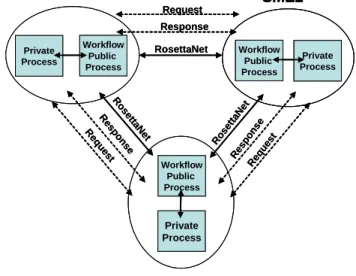
Frequently process workflows are distributed collections of activities that involve groups of individuals at disparate locations. To coordinate these tasks, a process support system should provide for distributed process execution and integration with tools across networks. Traditional workflow adopts a centralised client/server approach to enact processes. This research addresses the issues of applying the native workflow function provided by the PLM system for the OEMs. For a decentralised network this research uses workflows to implement RosettaNet Partner Interface Processes (PIPs) [9]. Figure 1 depicts the solution for distributed workflow for SMEs and OEMs collaboration. The use of WebLogic Integration [9] implements standard RosettaNet PIPs through public workflows (also know as collaborative workflows). A public workflow provides the interface to other collaborative partners, while private workflows are used to interface to back-end systems in order to generate and respond to messages. The following figure shows the process by which PIP workflows pass messages between collaborative partners.
Generally speaking, RosettaNet-oriented workflows process messages as follows:
1. SME1’s private workflow initiates a RosettaNet message. Data is retrieved and formatted into a RosettaNet message structure, the appropriate PIP is determined, and the message is forwarded to the public workflow that implements the SME1’s in the PIP.
2. The public workflow process creates the appropriate RosettaNet message. The message is sent to the public workflow of the OEMs.
3. The OEMs public workflow receives the message, processes the header information, and then passes validated customer information and message content to the appropriate private workflow process.
4. The OEMs private process resolves message content and generates a reply. The reply is processed into a RosettaNet message structure and passed back to the OEMs public process.
5. The OEMs public process creates a RosettaNet reply message and sends it to SME1’s public process.
6. The SME1’s customer public process receives the reply message, processes header information, and then passes validated OMEs information and message content to the appropriate private process. 7. The private process resolves content of the reply
message.
Figure 1: Distributed Workflow Diagram for SMEs and OEMs Collaboration
3.2 Product Lifecycle Management
PLM technology, previously called Product Data Management (PDM), was first introduced in the early 1980's. It is a tool that can be used to support and manage product-related information such as geometry, engineering drawings, product specifications, bills of material (BOM), workflow, project planning and other enterprise knowledge. PLM also can be seen as an integration tool connecting many different areas of product development, which ensures that the right information is available to the right person at the right time and in the right form throughout the enterprise. In practice, a PLM system is used by various personnel in different locations from design to manufacturing.
3.3 Peer-to-Peer (P2P) Technology
3.3.1 Principle of P2P
P2P is not a new concept in the networking world, but its application to the internet is a fairly recent development. P2P applications address the needs of de-centralised organisations to collaborate and share knowledge and files regardless of geographical location. The principle of P2P has been around for a long time, and is today implemented in a number of applications such as instant messaging and file-sharing (www.GNUtela.com).
There are already a number of P2P PDM in existence, primarily aimed at the lower end of the market. The two applications are AutoManager workflow from Cyco
(www.cyco.com) and Columbus from Oasys Software
(http://www.oasys-software.com/). The latter is available
Private Process Workflow Public Process
SME1
Private Process Workflow Public ProcessSME2
Request Response RosettaNet Private Process Workflow Public ProcessOEMs
Reque st Res pons e Ro set taN et R eque st R espons e Ro set taN et Private Process Workflow Public ProcessSME1
Private Process Workflow Public ProcessSME2
Private Process Workflow Public ProcessSME2
Request Response RosettaNet Private Process Workflow Public ProcessOEMs
Reque st Res pons e Ro set taN et R eque st R espons e Ro set taN etfor free, and aimed at AutoCAD users within the construction sector. There is no workflow or process management implemented and, access control is via the standard operating system access control functions. As an example of what can be achieved, Alibre is a P2P CAD/PDM and collaboration tool in one. It uses the STEP standard and combines low cost and fast configuration. The advantages offered by P2P applications are:
- No single point of failure, the network is alive as long as one peer is on-line
- Distributed sharing of bandwidth, storage and processing power, so the system becomes more powerful as more users attach
- Lower running cost due to the lack of servers or high bandwidth central nodes, as well as
- Maintaining individual control of the shared knowledge. P2P groups can be used to create profiles of the peer, and also more importantly of the peer's list of contacts within different domains. These profiles can be used within the network to search for and assess people's competences, interests, and memberships of trusted groups, and can aid in the construction of new relationships based on commonalities and third party assessments. There have been a number of issues that reduce the performance of the system when using a pure P2P architecture. The lack of indexing and routing services in P2P degrades the peer discovery and query functions. In order to leverage the advantages of client/server systems with the independence and interoperability of P2P systems a hybrid system where “super peers” act as peers to the extended P2P network and as a server to the enterprise's internal peer network is used. In addition, rendezvous peers can be assigned to manage some of the peer information assigned to particular peer nets or projects. These hybrid systems have the best potential for high-performance de-centralised services.
3.3.2 The 2-tier Communication Architecture in
P2P Networking
There are several different P2P communications protocols available, the most common ones are:
- JuxtaPose (JXTA) - Napster
- Gnutella
- others (AIM, Red Rover, Publius and Free Haven etc) The applications of these protocols for peer-to-peer systems are usually designed to delivering a single type of network service, for example, Napster for music file sharing, Gnutella for generic file sharing and AIM for instant messaging. For implementation purposes, JXTA was adopted as the protocol for the framework because it is XML-based and open source. Also it was initiated and developed by Sun Microsystems, Inc, and the company is intended to standardise this technology for peer-to-peer networking. JXTA [10] is a set of networking protocols similar to HyperText Transfer Protocol (HTTP)
(http://www.w3.org) and TCP/IP
(http://www.protocols.com). The JXTA layer sits between the networking stack and the application stack, handling peer-to-peer communication. The JXTA platform standardizes the manner in which peers:
- Discover each other - Advertise network resources - Communicate with each other
- Cooperate with each other to form secure peer groups
The framework described in this paper uses the two-tier solution shown in Figure 2 which enables enterprises to establish connections between them in real-time [11]. The first layer uses the JXTA communication protocol for XML-based messaging as well as the “P2P” nodes connectivity. The second layer uses RosenettaNet mainly for distributed workflow and XML-based Electronic Data Interchange (EDI).
Figure 2: The 2-tier Communication
3.3.3 Security Issues in P2P Networking
Security is one of the main challenges to implement in P2P due to the lack of a centralized control server. Current P2P applications are designed mainly for home users to file share for trading music and movies. These applications are not written with information security and offer no encryption for sensitive information.
To address the security issues, Sun Microsystems created an infrastructure called Project JXTA
(http://www.jxta.org), which allows programmers to use a
common library when creating new P2P applications. By providing a robust, secure, interoperable applications programming interface (API). One of the security features in JXTA is the implementation of AuthenticationCredential which allows users or peers to join a peergroup after a set of credentials have been verified. Authenicationcredentials are used by JXTA Membership Services as the basis for applications for peergroup membership. The AuthenticationCredential provides two important pieces of information:
o the authentication method being requested
o Identity information which will be provided to that authentication method.
Furthermore, JXTA also provides developers to implement PasswdMembershipService which allows a Membership Service based on a password scheme.
4 THE FRAMEWORK TO SUPPORT OEMS AND SMES
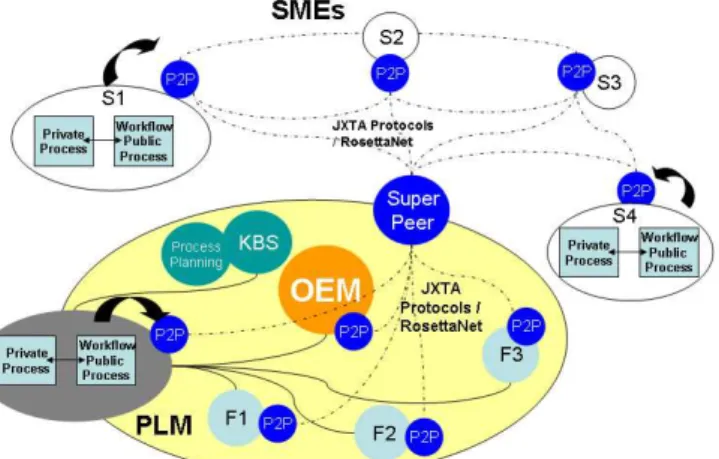
Figure 3 illustrates the framework proposed in this paper. It is used to configure and characterise the product development collaboration processes between SMEs and OEMs or larger organisations. S1, S2 and S3 are referred to as SMEs in the framework. In the OEM schematic representation, F1, F2 and F3 are the internal functions or divisions of the organisation. For example, product design, process planning to marketing. A Process Planning system and a Knowledge-based System (KBS) are used as an example of different type of software deployed within the OEM via the PLM system.
The framework is established using the basic infrastructure of the links using hybrid P2P networking
[12], JXTA communication protocol and RosenettaNet. In
a hybrid P2P system, the control information is exchanged through a central server (SuperPeer nodes). The control server acts as a monitoring agent for all the other peers and ensures information coherence. The
UniquePeerID / PeerAdvertisement / Security Workflow Layer Internet Second Layer - RosettaNet First Layer – JXTA
basic infrastructure builds on already available Open Source P2P solutions. A Workflow technique is being deployed to have better control of data and file sharing in order to distribute information to the right people, at the right time. Information requirements are set out during tasks delegation through out the product development processes. The PLM system used by the OEM is located on a local client/server centralised network. The framework constitutes the foundations of an inter-enterprise collaboration system which has been prototyped and will be shortly tested in a case-study.
Figure 3: Inter-enterprise collaboration using P2P Figure 4 shows an alternative configuration of the framework using SuperPeer nodes as communication connectivity. S1 consists of two subdivisions represents by S1a and S1b which forms its own peergroup. Similarly, S2 and S3 are both have the same configurations.
Figure 4: Alternative Configuration of Inter-enterprise collaboration using P2P
4.1 P2P Implementation
The “P2P” nodes illustrated in the diagram act as information connectivity. Connectivity is achieved using an open source implementation of JXTA. The choice was made partly for the security aspect, but also because JXTA implements a unique but anonymous identification mechanism for peers and rendezvous peers. As well as “advertisement” implemented for all peers that give information on the one peer to other peers. Rendezvous peers can act as managers for peer groups and store the peer advertisement for the group for distribution to other P2P networks. Implementation of JXTA is in standard Java 2.
In the user functions of JXTA, it includes of the following: - user interface queries
- project management of collaborative groups - group chat and instant messaging
Additionally, the systems’ settings enable enterprises and users without static addresses to collaborate using dynamic addressing, as well as the users’ ability to work offline which cannot be done with web-based system.
5 CONCLUSIONS AND FURTHER WORK
Information is often regarded as the most important asset for a company. Technologically and financially efficient methods to transfer and store information are the future strategy for a company to compete globally [13]. With the current issues of P2P security to be remedied, the future of business applications in P2P looks promising. Rather than spend excessive money on expensive hardware and software, businesses could utilise the P2P technology to build a distributed network of workstations. The workstations would each maintain a small chunk of data locally. As a result of this investigation and research, a new framework using P2P networking as the core technology for product development collaboration between smaller companies and larger corporations has been defined. The framework also shows its flexibility that can be adapted into different network configurations. An example case study based on the framework will be the future task to prove that this technology can be used into different network configuration with minimum cost and maintenance as well as providing SMEs the autonomy in sharing data.
6 ACKNOWLEDGEMENTS
The authors would like to acknowledge the support of the Engineering and Physical Sciences Research Council (EPSRC) and the industrial collaborators ArvinMeritor, LSC Group, Mabey & Johnson and PTC. The authors particularly thank Mr. David G Bramall for his contribution to the work described. This paper is presented as part of the Distributed and Collaborative Product Development and Manufacturing Knowledge Management research project funded by EPSRC, Grant GR/R26757 and GR/R35148.
7 REFERENCES
[1] J.X., Gao, H., Aziz, P.G. Maropoulos, and W.M., Cheung, 2003. Application of product data management technologies for enterprise integration. International Journal of Computer Integrated Manufacturing, 16(7-8), pp.491-500.
[2] Julian Bond, “Business uses of Peer to Peer (P2P) technologies”, A Netmarkets Europe White Paper”, Netmarkets Europe, January 2001
[3] Loris Penserini, Lin Liu, John Mylopoulos, Maurizio Panti, Luca Spalazzi, “Cooperation Strategies for Agent-Based P2P Systems”, International Journal of Web Intelligence and Agent System, Volume 1 , Issue 1 (January 2003), Pages: 3 – 21, ISSN:1568-4539.
[4] Yan, J., Yang, Y. and Raikundalia, G. K., "A Data Storage Mechanism for Peer-to-Peer Based Decentralised Workflow Systems", Proceedings of 15th International Conference on Software Engineering and Knowledge Engineering, San Francisco, USA, 1 - 3 July 2003, pages 354-358.
[5] M. EHRIG, C. TEMPICH AND S. STAAB, “SWAP: Ontology-based Knowledge Management with Peer-to-Peer Technology”, 4th European Workshop on Image Analysis for Multimedia Interactive Services WIAMIS, Queen Mary University, London, April 9-11, 2003.
[6] Satine Consortium, “SATINE1: Semantic-based Interoperability Infrastructure for Integrating Web Service Platforms to Peer-to-Peer Networks for Travel Industry”, submitted for European Commission through IST-1-002104-STP SATINE, January 2003
[7] W.M., Cheung, , P.G., Maropoulos, J.X. Gao, and Aziz, H., (2003). Workflow Activity Task Controller: an Approach to Distribute Knowledge and Information in Collaborative Product Development, 12th Symposium of Product Data Technology EUROPE, Manchester Conference Centre, UMIST, 107-114
[8] Plesums C. (2002), “Introduction to Workflow”, extracted from - The Workflow Handbook 2002, published
in association with the Workflow Management Coalition (WfMC), March 2002, 428 pages, ISBN 0-9703509-2-9. [9] Prasad Yendluri, “RosettaNet Implementation Framework (RNIF) 2.0”, © 2000 webMethods, Inc.
[10] Li Gong, “Project JXTA: A Technology Overview”, Published by Sun Microsystems, Inc, October 29, 2002
[11] H. Aziz, J X Gao, P G Maropoulos, WM.Cheung, "Open Standard, Open Source and Peer to Peer tools and methods for Collaborative Product Development", submitted to Journal of Computers in Industry, 2004 [12] Fiorano Software, “A Whitepaper in Super-Peer Architectures for Distributed Computing”, Fiorano Software, Inc. Copyright 2003. All rights reserved.
[13] H., Aziz, J.X., Gao, W.M. Cheung, and P.G., Maropoulos, 2004. A design environment for product knowledge management and data exchange. In Methods and Tools for Co-operative and Integrated Design (pp. 257-266). Springer Netherlands.