Katri Ylönen
TELLING STORIES WITH PERSONAS
Faculty of Information Technology and Communication Sciences Master of Science Thesis October 2020
ABSTRACT
Katri Ylönen: Telling stories with personas M.Sc. Thesis
Tampere University
Master's Degree Programme in Human-Technology Interaction October 2020
___________________________________________________________
Even though the persona method is a well-known tool in the Human-Technology Interaction field for knowing users and their goals, tasks and environments, there are varying opinions about how personas should be developed and used. Many agree that combining personas with scenarios and user stories is useful, but scenarios and user stories can also be defined and used in various ways.
The purpose of my master's thesis is to examine with a literature review different ways to devel-op and use personas together with scenarios and user stories. My thesis aims to gain a broad picture of the topic rather than confirm one, single perspective. I will search for sources in multi-ple places since quantitative research alone cannot provide commulti-plete enough answers to my research questions.
I have divided personas into four types based on my literature review. Manual, semi-automatic and automatic personas are based on mostly user research, but they vary on how many steps in their development are done manually. Expert personas are based on knowledge gathered from stakeholders, literature and other experts. Designers should decide the type of persona based on the purpose of the project and available data and resources. The most important ele-ments in persona description are a photo, name, background information, goals, pain points and story. All personas in the project should be comparable by using the same elements in persona descriptions and same layout in persona documents.
Deciding what sources are included in a literature review and how extensively new sources are searched for are always subjective decisions. Another limitation of my thesis is that it does not cover visual design methods, such as storyboards or user journeys. There is some academic research about personas, scenarios and user stories, but knowledge about this topic could be broadened and deepened by conducting more research on the effectiveness, popularity and usage of these methods. Comparisons of practices between countries and companies would also be interesting.
Key words and terms: persona, scenario, user story, narrative, design methods, literature review
Contents
1 INTRODUCTION ... 1
2 LITERATURE REVIEW ... 4
2.1Definition and process of literature review ... 4
2.2Conducting my literature review ... 6
2.2.1 Preliminary study and first round ... 8
2.2.2 Second round ... 10
2.2.3 Third round ... 13
3 PERSONAS ... 14
3.1Definition and different types ... 14
3.1.1 Manual personas ... 17
3.1.2 Semi-automatic personas ... 19
3.1.3 Automatic personas ... 20
3.1.4 Expert personas ... 22
3.2Usage and benefits ... 23
3.3Criticism and challenges ... 25
3.4Characteristics of successful personas ... 27
3.5Academic research about the effectiveness and usage of the persona method ... 28
3.5.1 Research conducted with statistical significance testing ... 29
3.5.2 Other research ... 30
4 DEVELOPING PERSONAS ... 32
4.1Planning the development process ... 34
4.2Gathering data ... 35
4.2.1 User research ... 35
4.2.2 Gathering data from experts ... 37
4.3Segmenting users ... 38
4.3.1 Manual clustering ... 39
4.3.2 Automated clustering ... 40
4.4Writing persona descriptions... 41
4.5Making persona documents ... 45
4.5.1 Presenting individual personas ... 45
4.5.2 Presenting several personas ... 52
4.6Designing with personas ... 53
5 TELLING STORIES WITH PERSONAS ... 56
5.1Definitions and different types ... 56
5.1.1 Scenario ... 57
5.1.2 User story ... 59
5.1.3 Combining user story and scenario ... 60
5.1.4 UserX Story ... 60
5.2Writing textual narratives ... 61
5.2.1 Similarities in writing scenarios and user stories ... 61
5.3Usage and benefits ... 65
5.4Criticism and challenges ... 68
5.5Characteristics of successful textual narratives... 69
5.6Academic research about textual narratives ... 72
5.7Summary and comparison ... 73
6 DISCUSSION ... 75 6.1Limitations of my thesis ... 75 6.2Further research ... 76 7 CONCLUSION ... 78 REFERENCES ... 80 APPENDICES ... 104
Appendix A: Most important sources ... 104
Appendix B: Sources where I did not have access to a full text version ... 105
Appendix C: Sources that were excluded while writing ... 106
Appendix D: Concepts and methods related to personas... 108
Appendix E: Concepts and methods related to scenarios and user stories ... 111
List of Tables
Table 1. Search strategy for different websites ... 9
Table 2. Search parameters for Andor ... 12
Table 3. Comparison of different personas types ... 18
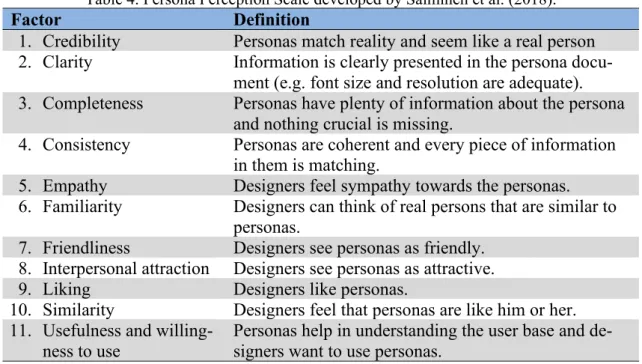
Table 4. Persona Perception Scale ... 28
Table 5. Characteristics of rich and poor scenarios ... 71
Table 6. Quality User Story framework ... 71
List of Figures
Figure 1. Six steps of conducting a literature review ... 5
Figure 2. The summarized process of my literature review. ... 6
Figure 3. An example of a persona document. ... 15
Figure 4. A first example of a traditional persona document. ... 46
Figure 5. A second example of a traditional persona document. ... 47
Figure 6. A first example of a persona document meant for automatic personas. ... 48
Figure 7. A second example of a persona document meant for automatic personas. ... 49
Figure 8. Two examples of introduction posters. ... 50
Figure 9. An example of persona trading cards. ... 50
Figure 10. A first example of a three-dimensional persona document. ... 51
Figure 11. A second example of a three-dimensional persona document. ... 51
Figure 12. A first example of a persona comparison document. ... 52
Figure 13. A second example of a persona comparison document. ... 52
Figure 14. An example of a persona communication constellation. ... 53
Figure 15. An example of a persona ecosystem. ... 54
Figure 16. An example of combining a user story and scenario ... 60
Figure 17. An example of a user story mapping... 67
Figure 18. An example of a scenario exercise ... 68
Figure 19. An example of an empathy map... 109
Figure 20. An example of an identity model ... 110
Figure 21. An example of a storyboard ... 113
Figure 22. An example of a sequence model... 113
Figure 23. An example of a use case ... 114
1
INTRODUCTION
User-centered design (Stephanidis, 2014), service design (Stickdorn, Hormess, Law-rence, & Schneider, 2018) and user research (Parush, 2015, chapter 13) emphasize the importance of knowing real users and their goals, tasks and environments. The persona method is a well-known tool that helps designers know users and tell stories about them. Some designers use them regularly, but others scorn them and feel that personas are a silly distraction from real work. (Goltz, 2014b.) Designers want to achieve various and abstract goals with personas in diverse contexts, so they develop and use personas in multiple ways. Persona method lacks a unified identity and foundational methodology since it does not have a clear definition and instructions on how to use it. (McKeen, 2019.) Persona method has faced much criticism, but some of the criticism is based on false assumptions or misunderstandings about the method (Nielsen, 2014).
The most common ways to write stories for personas are scenarios and user stories (Minichiello, Hood, & Harkness, 2018). Personas, scenarios and user stories can be used alone, but they are most useful when combined (Pruitt & Adlin, 2006, chapter 1; Nielsen 2014; Minichiello et al., 2018; Khanh, Daengdej, & Arifin, 2017). As with per-sona method, people can mean completely different things when they talk about scenar-ios or user stories. None of these methods should be used with rigid rules, but with flex-ible guidelines that are modified to different situations.
Persona method is one of the most abstract methods in the field of user experience (UX), and this abstractness can easily lead to misunderstandings and misuse (Flaherty, 2018). Persona method may seem simple and easily learnable tool, but like any other tool, personas can be used effectively or incorrectly, for good or evil. It is easy to gain a simplified understanding of the method, but mastering the development and usage of personas can take many months. (Goltz, 2014b.) Many people have developed the per-sona method, but there is still much controversy about how perper-sona method is applied, what is included in persona description and should the description be based on assump-tions or data. (Nielsen, 2014.)
The purpose of my master's thesis is to examine with a literature review different ways to develop and use personas together with scenarios and user stories. I chose this topic because personas, scenarios and user stories are well-known but relatively
under-researched methods in the Human-Technology Interaction (HTI) field that raise diverse opinions. HTI field usually utilizes research methods such as experimental research, surveys, diaries, case studies, interviews, focus groups, ethnography and usability test-ing (Lazar, Feng, & Hochheiser, 2010). I chose to do a literature review since I wanted to gain a comprehensive understanding of the topic based on what has already been written. I felt that a shorter literature review done before interviewing UX professionals would not have given me a broad enough understanding of the topic to formulate the best interview questions.
My thesis covers basics about developing and using personas, scenarios and user stories, but also some more specific questions like how often personas should be updat-ed. I will not present exact numbers about how many of my located sources used manu-al or automatic personas or conducted user research since I see that the popularity of the method's conducting details should be a side issue in deciding how to develop personas. Besides, since automatic personas have only been used in recent years, the number of included years in the search affects how many percent of the studies use it. In addition, there are many personas developed and used around the world that are not reported in research or web articles.
My research questions are:
1. How are personas developed and used?
2. How are scenarios developed and used together with personas? 3. How are user stories developed and used together with personas?
I do not have a hypothesis that can be supported or rejected since I aim to gain a broad picture rather than confirm a single perspective. I will search for sources in multi-ple places since quantitative research alone cannot provide commulti-plete enough answers to my research questions. I want to learn what is possible with the persona method when it is tailored to different situations and purposes. If readers are interested in detailed ex-planations about for example how to automatically segment users with cluster analysis, they need to examine my sources. I also only mention briefly how the persona method can be sold to stakeholders.
In my thesis, I often write about designing a product even when the target of design could as well be a service, software or something else. I use the word project when I mean the whole design process revolving around a certain product from beginning to end. For simplicity's sake, I use the word designer when I mean anyone in the design team even if that person has no official training in designing. I use the word stakeholder when I mean anyone who has any kind of connection and interest to the product, wheth-er they are designwheth-ers themselves or their supwheth-eriors, employees from a diffwheth-erent depart-ment, customers or other people.
In Chapter 2 I define a literature review and its general conducting process and tell how I conducted it. In Chapter 3 I define personas, tell about their usages and benefits and what kind of criticism and research there has been about them. In Chapter 4 I will tell about developing personas and in Chapter 5 about scenarios and user stories. In Chapter 6 I will discuss the limitations of my thesis and suggest further research topics. In Chapter 7 I will summarize my thoughts that have emerged while conducting litera-ture review.
2
LITERATURE REVIEW
In this chapter, I will cover the general as well as my process of conducting a literature review. In Chapter 2.1 I will define what a literature review is and how it can be con-ducted. In Chapter 2.2 I will tell how I conducted my literature review in three rounds. 2.1 Definition and process of literature review
A literature review is a systematic inspection of academic literature about a specific, predefined topic. Its goal is to analyze and evaluate research findings, theories and prac-tices so that it can compress extensive information into an unbiased summary. A litera-ture review defines key concepts, sets up theoretical framework and identifies relation-ships between theories and their practical implications. It also identifies and critiques methodological assumptions and research techniques in previous studies and reveals gaps that have not yet been studied. (Efron & Ravid, 2018, 2 – 5.)
I have summarized the six steps of conducting a literature review according to Efron and Ravid (2018) in Figure 1. However, it should be noted that conducting a liter-ature review is usually a dynamic and continuous process. For example, when selected sources are analyzed further, a need for a new search from a different perspective may become clear. (Efron & Ravid, 2018, 6 – 7.)
A literature review can be done as a systematic literature review or as traditional narrative literature review. A systematic literature review is a highly structured, proto-col-driven and objective approach that aims to test a predetermined hypothesis using mostly quantitative research studies. Exclusion and inclusion criteria are explained in detail so that the literature review can be replicated. In a traditional narrative literature review research questions may evolve during the review process and both quantitative and qualitative research is included. Criteria for selecting the sources are not explicitly presented. Even though the search may be extensive, there is no attempt to find all rele-vant literature. (Efron & Ravid, 2018, 18 – 25.)
Literature reviews are usually utilized in natural sciences and medicine, but rarely in the field of HTI or Computer Sciences. Still, the general process of conducting a lit-erature review is the same. No matter what the topic and scope of the litlit-erature review
are, it is important to locate multiple and varying sources, have suitable inclusion and exclusion criteria and synthesize data. (Hincapié-Ramos, 2012; Kofod-Petersen, 2014.) Some argue that systematic literature review might be too rigid for HTI at least in some cases (Hincapié-Ramos, 2012), but others think that a systematic literature review pro-vides extensive data in Computer Sciences precisely because it is more organized (Kofod-Petersen, 2014).
In recent years there have been few other HTI Master's Theses in Tampere Univer-sity (TUNI) that have been literature reviews. Pirinen (2019) examined addictive fea-tures in slot machines and Kuusikko (2017) examined using crowdsourcing in usability evaluations.
1: Choosing a topic
• Select a topic and a suitable scope for it.
• Form a well-defined research question(s).
↓
2: Locating sources
• Identify search terms and keywords.
• Develop search strategies.
• Locate relevant databases and literature sources.
↓
3: Selecting, analyzing and evaluating sources
• Determine which sources will be included in the literature review.
• Summarize sources' contents and themes.
• Evaluate the quality of the sources.
↓
4: Structuring and organizing the literature review
• Assemble the analysis of individual sources into a structured, per-suasive and holistic narrative.
• Construct a logical argument that presents your point of view.
↓
5: Developing a writer's voice
• Decide whether to use active or passive voice.
• Use consistent citation and reference style.
↓
6: Writing, editing and refining
• Write, edit and refine literature review.
• Iterate previous steps if necessary.
2.2 Conducting my literature review
My literature review resembles more a traditional narrative literature review than a sys-tematic literature review. I used multiple types of sources and my topic focused more while conducting my literature review so I ended up excluding some sources that I had previously included. In addition, I did not try to find everything that has been written about personas or their scenarios and user stories since it would have been too broad for my thesis. Nevertheless, I will tell my inclusion and exclusion criteria and aim for ob-jectivity and replicability.
Typically literature review list all sources that say the same thing since it confirms or rejects a hypothesis and makes research results more valid and reliable. I did not have a hypothesis and since so many sources say the same thing about for example personas evoking empathy or agile user stories using a certain format, I have given only exam-ples of references in some cases. I did not include sources that covered my topic only briefly and did not bring anything new for my literature review.
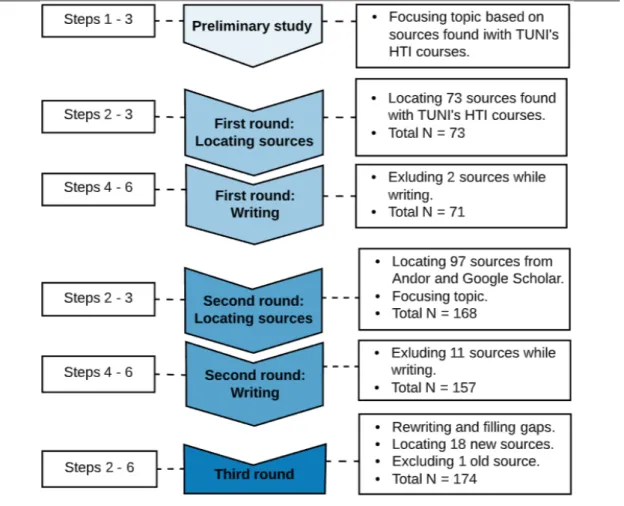
I have summarized in Figure 2 how I conducted my literature review. At first I
fo-Figure 2. The summarized process of my literature review. It shows when I did which steps in Efron and Ravid's (2018) model and how many sources I had in different phases.
cused my topic in a preliminary study, where I did simultaneously steps 1, 2 and 3 from Efron and Ravid's (2018) model. After that I located sources and wrote the literature review in three rounds:
• First round: sources found from TUNI's HTI courses
• Second round: sources found from Andor and Google Scholar • Third round: filling gaps in my literature review
In the first and second round I separately located sources (i.e. steps 2 and 3) and wrote or rewrote the literature review (i.e. steps 4, 5 and 6). I did steps 2 and 3 simulta-neously because I wanted to evaluate and locate sources at the same time. While I locat-ed sources I wrote summaries of them to better perceive what kinds of sources I had gathered so far, but I did not write comparisons between sources or merge their con-tents. I also did not look at references or hyperlinks at this point. I did steps 4, 5 and 6 simultaneous because the structure of written out literature review and my writing style evolved. I did not want to post-pone writing to the very end because writing or rewriting a draft gave me a better understanding of the material I had gathered so far. In the third round I did all steps 2 – 6 simultaneously because I wanted to fill gaps in my literature review one by one and polish it a little bit at a time.
I have listed in Appendices A, B and C different kinds of sources. Appendix A lists my most important sources. I have evaluated sources' importance based on how often I referred to them and how much they gave content and new insights for my thesis. Ap-pendix B lists sources where I did not have access to a full text version and hence I could not include in my literature review. Appendix C lists sources that I included while locating sources but excluded while writing or rewriting the literature review. I exclud-ed sources that were not relevant for my more focusexclud-ed topic. When I was locating sources, I included uncertain sources just in case, which lead to including some unnec-essary sources.
I used books, research articles, blog writings, theses and other types of material in my literature review. While I located sources I noticed that the phrases scenario and user story were sometimes used in different contexts that I mean in my literature review. I included only sources that considered scenarios and user stories as written out, refined textual narratives with a clear purpose that could be used together with the persona method (i.e. narrative where a certain user uses certain product). Regarding scenarios I excluded for example sources that considered scenarios as future scenarios, UML dia-grams or conditional paths that players can choose in a game. Regarding user stories, I excluded for example sources that considered the story as a vague concept where the whole design process is seen as a story.
2.2.1 Preliminary study and first round
I did in January and February 2020 a preliminary study to focus my topic and gain a better understanding of the terms user group, persona, scenario and user story. I located relevant sources from websites and books mentioned so far in TUNI's HTI courses that I had taken. Courses referred typically to a single web article, but I searched for other sources on the same website. I used search functionality in websites and e-books and read books' tables of content. In the preliminary study, I found 25 websites and 5 books that had some information about user groups, personas, scenarios and/or user stories in them.
The preliminary study revealed that very few sources focus on clustering users into user groups. Those sources that I found considered the topic from the perspective of developing personas so I chose to exclude user groups from my topic and concentrate on personas, scenarios and user stories. The preliminary study also confirmed my aim to select diverse sources for my literature review since people's opinions about these methods varied greatly.
I included all the 5 books that I had found in the preliminary study. I only looked at the 7 websites that were mentioned more than one course since they gave many sources and I wanted to limit my workload. I found relevant sources from 5 websites. I searched for new sources on websites as long as I seemed to find new information and perspec-tive to my thesis.
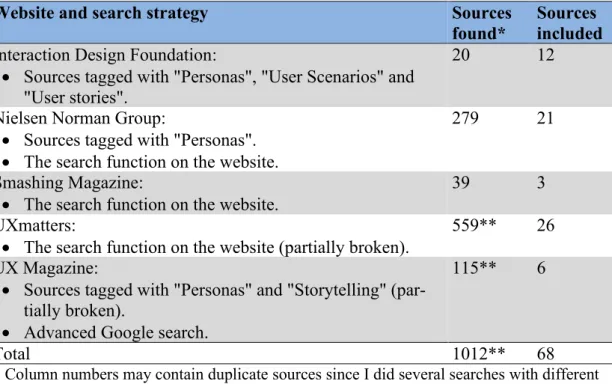
I have summarized in Table 1 how many sources I found and included on different websites. I used mostly search word function on the website to find sources, but if the website had tagged articles I used tags to locate sources. I searched separately with words "persona", "scenario" and "user story" and at least tested if plural search word gave more results than singular. If the search gave more than 100 results, I only looked through the first 100 of them. I read the title and abstract from all of the articles. Some-times I also quickly looked at the contents before deciding whether I wanted to include the article or not. I excluded articles that focused on something other than personas, scenarios and user stories. I included only sources that had stated a publication time. Most included sources had also stated authors name and background information, but three articles in The Interaction Design Foundation had not specified the author. Still, I considered them to be reliable enough to be used as a source.
I evaluated sources based on how recent they were and where they had been pub-lished. Some blog writings had citations and references, but not all. It may well be that not everything written in blog articles without citations was author's original thoughts since they have learned about personas, scenarios or user stories somewhere instead of inventing those methods themselves. Still, I included those sources if they had relevant
content for my thesis since blog articles are typically written in a free format rather than with academic citations and references.
Websites that I used were:
• The Interaction Design Foundation (https://www.interaction-design.org): The Interaction Design Foundation was established in 2002 to create low-cost, high-quality online education about design. Its literature section has books and articles written by well-known authors in the design field. (Interaction Design Foundation [IDF], n.d.)
• Nielsen Norman Group (https://www.nngroup.com/): Nielsen Norman Group was founded in 1998 by Jakob Nielsen and Don Norman. It is a UX research and consulting firm that offers over 1000 free articles and paid reports and books. (Nielsen Norman Group, n.d.) I read only free articles. Plural search words gave the same results as singular. There was no way to order the results, but the most relevant seemed to be in the beginning.
• Smashing Magazine (https://www.smashingmagazine.com/): Smashing Maga-zine is an independent web magaMaga-zine founded in 2006 by Vitaly Friedman and Sven Lennartz to publish reliable, useful and practical articles to web designers and developers. It offers free articles and paid reports and books. (Smashing Magazine, n.d.) I read only free articles. Plural search words gave the same re-sults as singular.
Table 1. Search strategy for different websites and the number of sources found and included in them.
Website and search strategy Sources
found*
Sources included Interaction Design Foundation:
• Sources tagged with "Personas", "User Scenarios" and "User stories".
20 12
Nielsen Norman Group:
• Sources tagged with "Personas". • The search function on the website.
279 21
Smashing Magazine:
• The search function on the website.
39 3
UXmatters:
• The search function on the website (partially broken).
559** 26
UX Magazine:
• Sources tagged with "Personas" and "Storytelling" (par-tially broken).
• Advanced Google search.
115** 6
Total 1012** 68
* Column numbers may contain duplicate sources since I did several searches with different search words.
• UXmatters (https://www.uxmatters.com/): UXmatters is a web magazine founded by Pabini Gabriel-Petit in 2005 to publish articles about UX to experi-enced professionals, newcomers and stakeholders (UXmatters, n.d.). Plural search words gave more results than singular ones, but I used singular ones be-cause those also gave over 50 results. An exception is the search word "user story." For it singular search word somehow lost the results in the next result page, so I also looked through results from a plural search word. There seemed to be something wrong with the search since it sometimes gave a different amount of results when results were sorted by date instead of relevance. The amount of total results also varied depending on which result page I was on without any clear pattern. On different days the number of results sometimes varied to either up or down even when I used the same search parameters. • UX Magazine (https://uxmag.com/): UX Magazine is a free web magazine that
has articles about UX design combined with varying technology and customer experience strategies (UX Magazine, n.d.). It has articles tagged with topics "Personas" and "Storytelling" and amount of articles in brackets next to them, though the number of results on the tag page did not match the number in brackets. There is also search functionality, but it always gives the same results no matter what search word is used. I used the Advanced Google Search where I used a search word "scenario" and limited result to the UX Magazine website. I looked through only the first two pages of Google search results since they revealed only one relevant source.
In the end, I found 73 sources based on TUNI's HTI courses which was a lot more than I had anticipated. It was quickly obvious that I was conducting the first round of locating sources instead of just a preliminary study. While writing the literature review at the end of the first round I excluded two sources that concentrated in something else than personas, scenarios or user stories and did not bring any new ideas or perspectives to my thesis. After completing the first round of writing, I had altogether 71 sources, from which 66 were web articles and 5 books.
2.2.2 Second round
I conducted the second round of locating sources with searches from Andor and Google Scholar in April 2020. I included in total new 97 sources in the second round, from which 78 were found from Andor and 19 from Google Scholar. I will tell shortly in more detail about how I found those sources. Generally speaking in some sources I could determine straight from the title that it did not cover the topic from my perspec-tive. In other sources, I also read abstract and subject or keywords. Sometimes I glanced
through the contents to determine whether or not I should include it. If Andor had marked some source as a book chapter, I also looked at other chapters in the same book and possibly made the whole book my source instead of just a single chapter.
At this point, I decided to focus my topic once more to consider scenarios and user stories only from the perspective of personas since there were so many results. I exclud-ed sources that coverexclud-ed the topic only minimally and focusexclud-ed on other topics. I excludexclud-ed for example research articles that studied something else than personas and only briefly mentioned that they had used personas in the research. While writing the literature re-view I excluded 11 first-round sources that did not give anything new to my literature review or were not relevant to my more focused topic. At the end of the second round I had a total of 157 sources.
Andor
Andor is an online search service that can locate databases and both printed and online library materials that are available in Tampere University Library (Tampere University Library, 2020). At first I experimented by searching separately with words "persona", "scenario" and "user story." They gave an enormous amount of results which did not relate to my topic. For example, they covered climate change scenarios or celebrity per-sonas. I chose to limit most of my searches only to results that have "design*" some-where in the result and to results that have been published since 2010 in English.
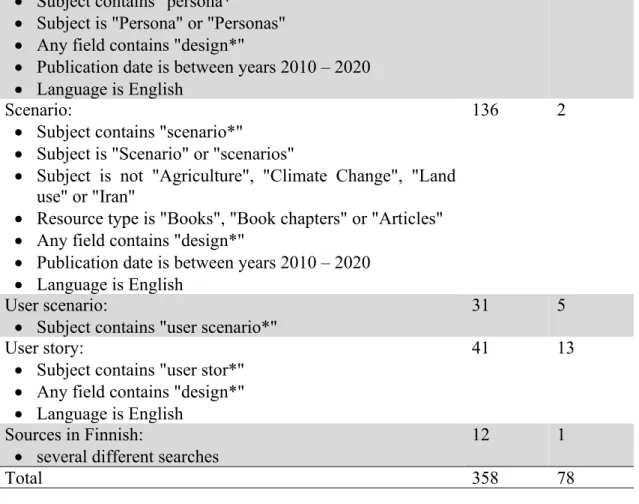
I have explained how I located sources with Andor in Table 2. I ended up using slightly different search parameters for personas, scenarios and user stories since they resulted in a different amount of results and needed different kinds of limitations. I often chose to limit my search by a subject since I assume that sources concentrating on per-sonas, scenarios or user stories would list them as a subject or keyword. This decision will exclude sources that cover those topics but have not listed them as a keyword. Still, I needed to limit my results somehow and the subject seemed like the best way to do it. I found only two relevant sources when I searched for scenarios, so I did another search for user scenarios.
I tried limiting results to only those that are available online as full text, but it did not affect the number of results. In most of my searches, I did not limit result by re-source type because I wanted to have multiple types on re-sources. I limited most of my searches only those that were written in English. Still, few sources had only their ab-stract in English.
I sorted results by relevance but still looked at all of them. Andor listed some result twice if there were more than one version of them available. In some cases later search-es gave duplicate rsearch-esults on sourcsearch-es that I had already included in previous searchsearch-es, but
I only counted them once for Table 2. Two sources that I found when I searched for scenarios or user stories focused more on personas than scenarios or user stories but had not come up when I had searched for personas.
Google Scholar
Google Scholar is an online search service that focuses on searching scholarly literature. It can be used on many disciplines to find varying types of sources, such as articles, theses, books and abstracts. (Google Scholar, n.d.). I used Google Scholar while logged in as a TUNI student on website https://scholar-google-com.libproxy.tuni.fi/ because then Google Scholar could give me access to full texts that are available for TUNI stu-dents.
I used search words "design*" AND ("scenario" OR "persona" OR "user story") and limited results to sources published between the years 2010 – 2020. I did not in-clude patents or citations. I tried many different search words, but I ended up having
Table 2. Search parameters for Andor and the amount of sources found and included from different searches.
Search parameters Sources
found
Sources included Persona:
• Subject contains "persona*" • Subject is "Persona" or "Personas" • Any field contains "design*"
• Publication date is between years 2010 – 2020 • Language is English
138 57
Scenario:
• Subject contains "scenario*"
• Subject is "Scenario" or "scenarios"
• Subject is not "Agriculture", "Climate Change", "Land use" or "Iran"
• Resource type is "Books", "Book chapters" or "Articles" • Any field contains "design*"
• Publication date is between years 2010 – 2020 • Language is English
136 2
User scenario:
• Subject contains "user scenario*"
31 5
User story:
• Subject contains "user stor*" • Any field contains "design*" • Language is English
41 13
Sources in Finnish:
• several different searches
12 1
many thousands of results no matter what search parameters I used. Even the advanced search in Google Scholar does not offer many options for making more detailed search-es.
My chosen search parameters gave in total 1,910,000 results when I sorted results by relevance and 7,740 results when I sorted results by date, so there seems to be some-thing wrong with sorting by date. In the end I used sorting by relevance and I looked through the first 15 pages, which had in total 150 results. There were 6 duplicate sources that I had already included in my search from Andor. I included a total of 19 new sources from Google Scholar. 15 of those could also be found on Andor, but I had not found them previously. 4 sources could only be found on Google Scholar.
2.2.3 Third round
The third round was incoherent since I searched for sources that could fill gaps in my literature review. For example, I searched for first-hand sources about the popularity of persona and scenario methods among designers and to define terms like the future sce-nario and behavior-driven development. I also checked if there are any more master's theses in TUNI that would be good to mention in my thesis. In addition, I looked at ref-erences and hyperlinks in some sources that seemed important and promising, even if I had excluded that source from my final sources. However, it should be emphasized that I did the third round rather quickly. If I had used more time for it, I could have broad-ened and deepbroad-ened my thesis.
I found 18 new sources in the third round. I wrote them into my literature review immediately after locating them so there was no need to separate locating sources and rewriting literature review in this final round. While writing I excluded 1 second-round source. In the end, I had a total of 174 sources in my literature review.
3
PERSONAS
From the 1980s to the beginning of the 2000s software industry used mostly ethno-graphic user profiles to define requirements. At the end of the 1990s and beginning of the 2000s, Cooper and Goodwin formalized the persona method for defining require-ments. (Edeker & Moorman, 2013.) Cooper published in 1999 the book The Inmates are Running the Asylum, which introduced the concept of personas for the first time (Niel-sen, 2014). Following the year 2000 personas have been used for both UX and market-ing design. Usage of personas has been widespread, but many have also criticized the method. (Edeker & Moorman, 2013.) According to Rosala and Krause (2019), 30 % of UX professionals create personas often and 84 % at least sometimes.
In this chapter, I will focus on describing different aspects of the persona method. In Chapter 3.1 I define personas and their different types and in Chapter 3.2 tell about different usages and benefits of them. In Chapter 3.3 I will talk about challenges and criticism concerning personas and in Chapter 3.4 how to ensure the success of personas. In Chapter 3.5 I report academic research about the effectiveness and usage of the per-sona method.
3.1 Definition and different types
Personas are fictitious and specific representations of users (E.g. Pruitt & Adlin, 2006, chapter 1; Nielsen, 2014; Goltz, 2014b; Flaherty, 2018; Dam & Teo, 2020). Personas have also been described as model characters or composite characters (Dam & Teo, 2020) or as snapshots of users (Flaherty, 2016). They are not the same as demographic segments, market segments, user profiles or user groups since they are more personal and memorable (E.g. Jahagirdar & Martin, 2010; Nielsen, 2014; Harley, 2015). Per-sonas offer empathy evoking faces to users and give a human touch to cold facts to help designers focus on designing for target users instead of themselves (Pruitt & Adlin, 2006, chapter 1; Harley, 2015; Dam & Teo, 2020; Garrett, 2011, chapter 3).
Personas demonstrate the needs, attitudes, goals and other characteristics of differ-ent user groups in a relevant context concerning a specific product, service, website or brand. Persona description does not include everything about the user, only relevant
traits in the chosen context. (Brangier & Bornet, 2011; Harley, 2015; Flaherty, 2018; Dam & Teo, 2020.) Organizations usually have multiple personas for different purpos-es. Each product, service, feature set or content of a website can have one or two per-sonas that are primary perper-sonas for that particular purpose. (Harley, 2015.)
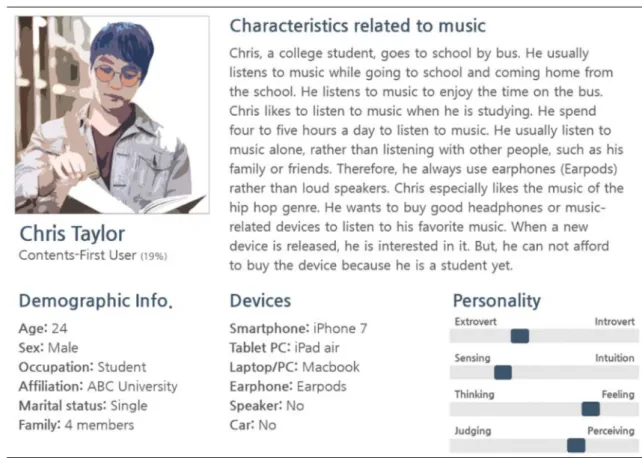
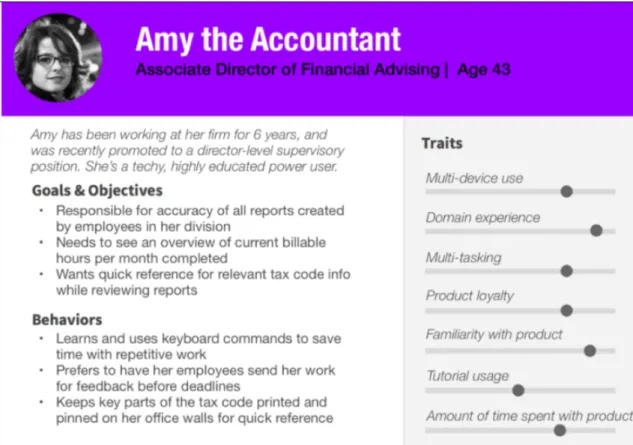
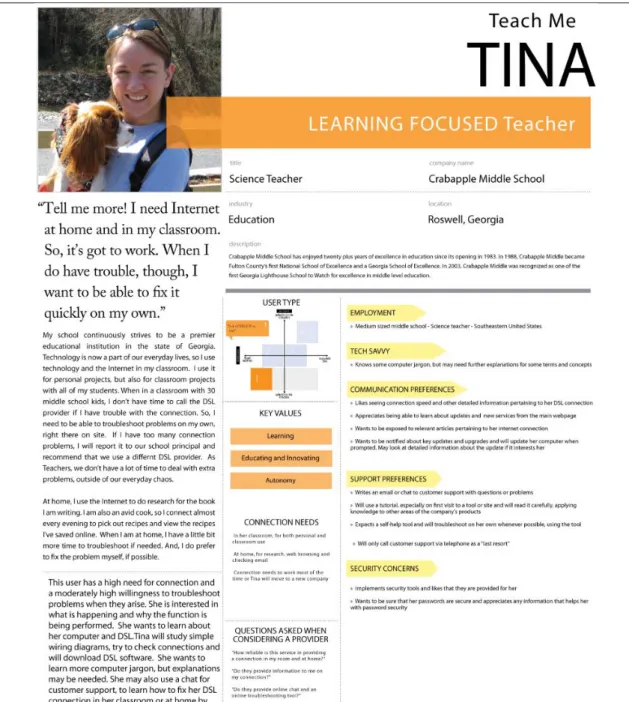
Personas are typically presented as a persona document that has a name, photo and description of persona's identity, values and actions (Brangier & Bornet, 2011; Goltz, 2014b), such as in Figure 3. I will give more examples of different persona documents in Chapter 4.5.
Figure 3. An example of a persona document. (source: Lee et al., 2020)
When designers develop personas, they identify patterns in the data about users' be-havior, needs and goals and use these patterns to create representative, fictional per-sonas (Minichiello et al, 2018; Garrett, 2011, chapter 3). Persona does not represent all members of a group, but rather an average member of group X trying to perform activi-ty Y in context Z (St. Amant, 2018). Still, persona is not the same as a stereoactivi-type, even though poorly made personas may resemble stereotypes (Lepore, 2009; Stickdorn et al., 2018, 40). Some say that persona is an archetype of a real person (Baty, 2009; Harley, 2015; Holtzblatt & Beyer, 2016, chapter 8; Stickdorn et al., 2018, 40), but others say that persona is not entirely the same as an archetype or an actual living human since it focuses on aspects that are relevant in some specific context instead of the whole person
(Nielsen, 2014). Archetype has also been seen as an overly academic and lifeless term to describe a persona (Lepore, 2009).
Including scenarios and user stories in personas makes them more memorable and empathy evoking. Scenarios and user stories help all team members understand diffi-cult, abstract concepts and remember personas' needs and pain points in the same way. (E.g. Khanh et al., 2017; Goltz, 2014b; Nielsen, 2014; Krause, 2019.) Both scenarios and user stories are stories about a certain user using a certain product, but scenarios are several sentences long (E.g. Pruitt & Adlin, 2006, chapter 6) and user stories are only a single sentence long (E.g. Lucassen, Dalpiaz, van Der Werf, & Brinkkemper, 2016). I will define them in more detail in Chapter 5.1.
The persona method is a flexible tool that can be tailored to various situations by changing their focus from users to something else. For example, a marketing persona describes a customer purchasing a product and factors influencing his or her purchase decision (Barlow-Busch, 2006). A manager persona describes manager's behavior with-in an organization (Straker, Mosely, & Wrigley, 2019). An attacker persona describes a person who commits cybercrimes (Tariq, Brynielsson, & Artman, 2012). Personas can also be used to represent a couple (Nielsen, 2014), a family (Dai & Xu, 2013) and even an organization (Ali, Stewart, Boks, & Bey, 2019) instead of a single user.
There have been several classifications for different persona types. Nielsen (2014) separates personas based on user research and data gathered from stakeholders. She separates user research based personas further into goal-directed, role-based and engag-ing personas based on the characteristics and emphasis of the persona descriptions. On the other hand Laporte, Slegers and De Grooff (2012) have separated qualitative and quantitative personas based on what kind of research techniques were used. Personas based on data gathered from stakeholders have been called assumption personas (Pruitt & Adlin, 2006, chapter 3), proto-personas (IDF, 2017), hypothetical personas (Ghosh, 2018), fictional personas (Dam & Teo, 2020) and provisional personas (Goltz, 2014a) since they are sometimes seen as collections of assumptions, stereotypes and expecta-tions that are only suitable for acting as sketch or prototype persona before conducting user research.
I have distinguished four persona types:
1) Manual personas: Personas are created manually and based on mostly qualita-tive user research.
2) Semi-automatic personas: Personas are created semi-automatically and based on mostly user research. Users are clustered with algorithms, but other persona development activities are done manually.
3) Automatic personas: Personas are created completely automatically and based on mostly quantitative user data.
4) Expert personas: Personas are based on mostly data gathered from stakehold-ers, experts and literature.
I have distinguished user research based personas further based on how automated their development is. I felt that there is so big difference in developing and using manu-al, semi-automatic and automatic personas that they should be separated. I did not want to call them qualitative and quantitative personas since that would emphasize too much the chosen user research techniques. I have separated expert personas from research-based personas, but I did not want to call them assumption personas or proto-personas. I believe that if data is gathered from experts that work directly with users, expert per-sonas can provide valuable insights rather than mere assumptions.
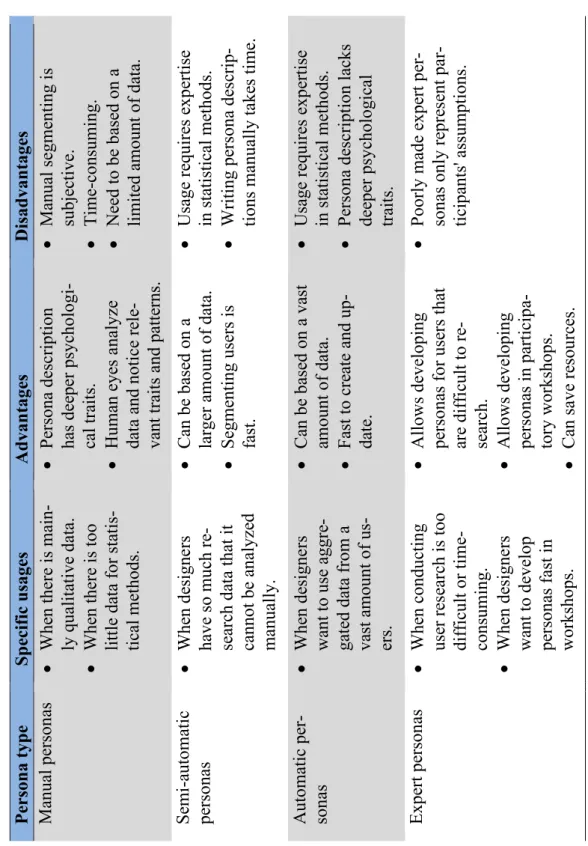
I have summarized in Table 3 the specific usages, advantages and disadvantages of different persona types. Designers should decide the type of persona based on what they want to learn and achieve with the personas and what kind of data and resources are available. It should be noted that my classification is only simplification and aims to demonstrate the versatility of the persona method. Even when manual personas are based mostly on qualitative user research, there can very well be some data from quanti-tative user research or from experts. Designers can also develop personas that are based equally on both user research and data from experts. It is also possible to first create personas automatically from quantitative data and later in another project modify them based on qualitative data.
I have classified studies that I found into different persona types. If a source did not specify how they clustered users from user research data, I have assumed that they did it manually since it is the traditional way of clustering users. If researchers would have used some algorithm for clustering, I presume they would have named it.
3.1.1 Manual personas
By manual personas, I mean personas that are created completely manually and are based on mostly qualitative user research. Everything from user research and clustering users to writing persona descriptions and making persona documents is done manually. In the sources that had prescribed exact information about its user research, manual per-sonas had studied anything from 14 (Strakeret al., 2019; Campos & Paiva, 2011) to 85 participants (LeRouge, Ma, Sneha, & Tolle, 2011).
In the health care field manual personas have helped in designing health care tech-nology for elders to self-manage chronic diabetes (LeRouge et al., 2011) and peripheral arterial disease (Ariaeinejad et al., 2016). In the information technology field they have facilitated designing e-maintenance service (Idoughi, Seffah, & Kolski, 2012), next-generation industrial robots (Björndal, Rissanen, & Murphy, 2011) and personal and
friendly artificial companions (Campos & Paiva, 2011). Manual personas have also identified and communicated varying needs, values and activities among bus passen-gers' (Hildén & Väänänen, 2019) and people with disabilities navigating in the streets (Williams, Hurst, & Kane, 2013). In addition, they have helped in understanding how open company franchise owners are to selling innovative products in their stores
Tabl e 3. C om par iso n of di ff er ent per sona s t ypes and t hei r spe ci fi c usa ges , a dvan ta ges an d di sa dv ant age s. Disad van tage s • Ma nua l segme nti ng is subj ec ti ve . • Time -c onsum ing . • Ne ed to be b ase d on a li mi ted a mount of da ta. • Usa ge r equire s e xp ertise in st ati sti ca l m ethods . • W riting pe rsona de sc rip-ti on s manua ll y take s ti m e. • Usa ge r equire s e xp ertise in st ati sti ca l m ethods . • P ersona d esc riptio n lac ks de epe r psy chologi ca l tra it s. • P oorly mad e e xpe rt p er-sona s onl y re pre se nt par -ti cip ants' assumpt ions. Advan tage s • P ersona de sc riptio n ha s de epe r psyc hologi -ca l t ra it s. • Huma n e ye s a na lyze da ta a nd noti ce re le-va nt t ra it s a nd pa tt erns. • C an be ba se d on a lar ge r amount of da ta. • S egmenting user s is fa st. • C an be ba se d on a va st amount of da ta. • F ast t o c re ate and up-da te. • Allows de ve lopi ng pe rsona s fo r use rs tha t are diff ic ult to re -se arc h. • Allows de ve lopi ng pe rsona s in p artic ip a-tory w orkshops. • C an sa ve re sou rc es. S p ec ific u sage s • W he n ther e is m ain-ly qualit ati ve da ta. • W he n ther e is t oo li tt le da ta f or sta ti s-ti ca l m ethods . • W he n de signe rs ha ve so m uc h r e-se arc h d ata tha t i t ca nnot be a na lyze d manua ll y. • W he n de signe rs wa nt t o use a ggr e-ga ted da ta f rom a va st amount of us-ers. • W he n c ondu cti ng use r r es ea rc h is too diff icult or time -consum ing. • W he n de signe rs wa nt t o de ve lop pe rsona s f ast i n wor kshops. Pe rson a type Ma nua l per son as S emi -a utom ati c pe rsona s Automatic pe r-sona s Expe rt pe rson as
(Straker et al., 2019) and how undergraduate university students use library services (Zaugg & Rackham, 2016).
The advantage of manual personas is that it is the traditional way to develop per-sonas so there are many sources about them. They require no special knowledge about algorithms or have no strict requirements for the amount of data to give reliable results. They also have deeper traits in the persona description, such as persona's pain points and goals that might not be present in automatic personas (Salminen et al., 2020).
The disadvantage of manual personas is that manual clustering requires expertise and is subjective, expensive and time-consuming. Since users are clustered without any algorithm, manual personas need to be based on a limited amount of data so that hu-mans' cognitive abilities are sufficient for findings patterns in the data. (Brickey, Walczak, & Burgess, 2012; Salminen et al., 2020.) Manual segmenting is subjective so designers segment users differently and create different personas from the same data (Korsgaard et al., 2020). In addition, conducting user research to create personas costs resources and since updating personas is slow, they are not responsive to changes in user preferences. User research might also have been too narrow or conducted with a wrong target group or focus. (Jung et al., 2017; An, Kwak, & Jansen, 2016; Edeker & Moorman, 2013; Goltz, 2014b; Skand, 2019; Salminen et al., 2020.)
3.1.2 Semi-automatic personas
By semi-automatic personas, I mean personas that are created semi-automatically and are based on mostly user research data whether it is qualitative or quantitative. When designers create semi-automatic personas, algorithms cluster users automatically, but designers must manually conduct user research, input data into algorithms, add photos, invent names, write scenarios and make persona documents. Designers also need to possibly transform research data into suitable input form for the chosen algorithm since some of them can cluster only qualitative or quantitative data (Brickey et al., 2012). In the sources that had prescribed exact information about its user research, semi-automatic personas had studied anything from 59 (Tu, Zhang, He, Zhang, & Li, 2011) to 360 participants (Lee et al., 2020) and from 8 families (Dai & Xu, 2013) to 6,867 forum posts (Rahimi & Cleland-Huang, 2014).
Semi-automatic personas have helped in designing children's furniture (Dai & Xu, 2013) and an adaptive learning system for hearing and deaf children who have difficul-ties in reading comprehension (Laporte et al., 2012). They have also helped in under-standing the use of media and media-related devices of millennials (Lee et al., 2020) and in designing a sports earphone (Tu et al., 2011) and a motion-sensing game (Zhang, 2019). They have facilitated coordinating, prioritizing and tracking feature requests in
forum posts (Rahimi & Cleland-Huang, 2014) and understanding why, how often and in what ways users give feedback (Almaliki, Ncube, & Ali, 2015). They have also helped in updating previously made personas with new data while studying portable and multi-device applications (Coorevits, Schuurman, Oelbrandt, & Logghe, 2016). There has also been a plan about creating a tool called UX Modeler that would offer designers a plat-form to create and continuously improve semi-automatic personas with the help of sta-tistics about users and their correspondence to existing personas (Wolff & Seffah, 2013), but I did not find any information about implementing those plans.
The advantage of semi-automatic personas is that segmenting users with algorithms fastens the development of personas. They can also identify useful clusters that design-ers would have otherwise missed and lead to more rigorous and detailed pdesign-ersonas. (Korsgaard, Bjørner, Sørensen, & Burelli, 2020.) Automated segmenting can give ob-jective and data-driven clusters, identify latent factors and reduce the complexity of the data by compressing it (Brickey et al., 2012).
The disadvantage of semi-automatic personas is that as with manual personas, user research requires resources and it is possible to end up with biased data if user research was done with a wrong focus or scope. In addition designers might not be aware of the requirements for adequate sample size for analyzing data with statistical methods and end up conducting too small-scale user research. (Jung et al., 2017; An, Kwak et al., 2016; Edeker & Moorman, 2013; Goltz, 2014b; Skand, 2019.) Algorithms require lots of data to give valid results so user research needs to be extensive. Another disad-vantage is that different algorithms segment users differently which ultimately leads to different personas. (Brickey et al., 2012.) Algorithms can identify useless clusters that are not relevant to the project. In addition, manually writing persona descriptions and making persona documents still takes time. (Korsgaard et al., 2020.)
3.1.3 Automatic personas
By automatic personas, I mean personas that created completely automatically with software and are based on mostly quantitative user data. Everything from gathering and analyzing data, clustering users, writing descriptions, adding photographs and making persona documents is done completely automatically. In the sources that had prescribed exact information about its user data, automatic personas had used over 30,000,000 so-cial media interactions from different users. (An, Kwak, et al., 2016; An, Cho, Kwak, Hassen, & Jansen, 2016; Jung et al. 2017; An et al., 2018.)
Automatic personas have helped in getting accurate and fast updatable information about users in several major online social media platforms, such as YouTube, Twitter and Facebook (An, Cho et al., 2016; Jung et al. 2017; An et al., 2018) and different
kinds of players (Salminen et al., 2020). They can also help in planning an online mar-keting campaign if marmar-keting is targeted for real-time optimized personas instead of single users (Jansen, Salminen, & Jung, 2020).
Shiga and Nishiuchi (2013) report making automatic personas to describe the eve-ryday life of users, but they automated writing persona descriptions by filling blanks in previously made persona documents with the results of a Bayesian network analysis of survey answers. Due to this persona descriptions are simpler and poorer than in many other personas. Additionally, authors do not state how the picture was added, so I as-sume it was added manually.
The advantage of automatic personas is that they provide precise numbers describ-ing an abundant number of users and still have a human face. They are accurate, easily manipulated and fast to create and update so they are responsive to changes in user preferences. Automatic personas can also tell how many percent of the entire user popu-lation is represented by a certain persona in real time. The number of resulting automat-ic personas is not decided beforehand so the software can create the optimal number of personas for each data set. Automatic personas are based on aggregated data and pre-serve the privacy of users. They also reflect the needs and behavior of a vast amount of users instead of just the few that have participated in user research. (Jansen et al., 2020; An, Kwak, et al., 2016; An, Cho, et al., 2016; Jung et al. 2017; An et al., 2018; Salminen et al., 2020.) Automatic personas are also more affordable to organizations and they can find latent factors in the research data that humans might miss (Salminen et al., 2020). Utilizing big data saves time and reduces the number of design iteration. It also shortens the product-development cycle because big data gives certainty about cus-tomer preferences. This ensures that products can be released on schedule and tested before release. (Siddiqui, 2020.)
The disadvantage of automatic personas is that their persona description typically lacks deeper traits such as interest, pain points and goals which can hinder feeling em-pathy (Salminen et al., 2020). As with other semi-automatic personas, automatic per-sonas should not be used without expertise in statistical methods. Designers should be aware that the available data affects what kinds of personas are created so if available data is biased, so will be the personas created from it. (An, Kwak, et al., 2016; An, Cho, et al., 2016; Jung et al. 2017; An et al., 2018.) Designers also need to be aware of what is adequate sample size for analyzing data with statistical methods (Jung et al., 2017; An, Kwak et al., 2016; Edeker & Moorman, 2013; Goltz, 2014b; Skand, 2019). Algo-rithms can also identify useless clusters that are not relevant to the project (Korsgaard et al., 2020).
3.1.4 Expert personas
By expert personas, I mean personas that are based on mostly data gathered from ex-perts, stakeholders, literature and previous research. Those sources that I found created expert personas manually, but I see no reason why they could not be created semi-automatically or semi-automatically if there is suitable data available. Personas created in workshops based on mostly participants' own experiences are closest to assumption per-sonas, but I still categorize them as expert personas. It is possible to recruit participants that are domain experts, have extensive knowledge about the users and come from di-verse backgrounds.
Expert personas have been used when conducting user research is too difficult or not possible. Conducting user research with criminals in organized cybercrime (Tariq et al., 2012), non-professional cybercrime attackers (Atzeni, Cameroni, Faily, Lyle, & Flechais, 2011), users inside organizations with secrecy issues like Swedish Defence (Eriksson, Artman & Swartling, 2013) or children with autism spectrum condition (Zubair, Brown, Hughes-Roberts, & Bates, 2019) would be challenging and might not give reliable or usable data for creating personas. Authors have used mostly previous research findings, literature and experts' knowledge as a basis for personas in those studies.
Expert personas have also been used when conducting user research would have been too time-consuming. They have helped in evaluating and improving a personalized learning program fast by allowing designers to interview stakeholders who have had worked with various and diverse students instead of interviewing students themselves (Sankupellay, Mealy, Niesel, & Medland, 2015).
Many expert personas are developed in workshops. They have given more tangibil-ity for general predictions about how urban mobiltangibil-ity and traveling might develop in the future (Vallet, Puchinger, Millonig, Lamé, & Nicolaï, 2020), identified architecturally significant requirements in software (Cleland-Huang, Czauderna, & Keenan, 2013) and helped in designing an information security application (Bhattarai, Joyce, & Dutta, 2016). They have also facilitated co-designing a health service intervention program (Valaitis et al., 2014).
The advantage of expert personas is that they enable developing personas in situa-tions where conducting direct user research would be difficult or it might not provide relevant data (E.g. Atzeni et al., 2011; Zubair et al., 2019). Expert personas suit agile or lean development well since they are fast to create if data is mainly gathered from stakeholders. This facilitates having an early buy-in for the persona method and inspir-ing the organization to be more user-centric. (Bhattarai et al., 2016; Gothelf & Seiden, 2013, chapter 3.) Expert personas save resources and produce correct enough
descrip-tions of users that can be iteratively refined and validated by conducting limited user research later on. Stakeholders can also be educated to be aware of potential bias and limitations in their experiences. (Gothelf & Seiden, 2013, chapter 3; Summers, 2014; Noetzel, 2018; Pruitt & Adlin, 2006, chapter 3.) Even the most critical authors admit that expert personas can serve as quick initial sketches for users' needs if designers acknowledge that they can be biased (Nielsen, 2014; Goltz, 2014a; Ghosh, 2018; Dam & Teo, 2020).
The disadvantage of expert personas is that poorly made expert personas represent only designers' stereotypes and assumptions instead of real users and do not lead to truly user-centered products (Nielsen, 2014; Goltz, 2014a; Ghosh, 2018; Dam & Teo, 2020; Edeker & Moorman, 2013; Goltz, 2014b; Skand, 2019). Still, it should be remembered that this disadvantage does not concern only expert personas. Conducting user research does not definitely and automatically mean that resulting personas are safe from biases and shortcomings. Conducted user research may be flawed, which can lead to flawed personas and results. (Goltz, 2014b.)
3.2 Usage and benefits
Originally personas were used in the software field to define requirements (Edeker & Moorman, 2013). Nowadays personas are used for many different purposes in diverse fields, such as library services (Zaugg & Rackham, 2016), furniture design (Dai & Xu, 2013) and learning programs (Sankupellay et al., 2015). Whatever the field is, persona documents should be posted somewhere clearly visible so that designers can use them as reminders of users' needs throughout the design process (Lior, 2013, chapter 5, chap-ter 8). However, it should be remembered that personas alone do not have all the neces-sary information for the design. Persona description might not include all specialties and details of real life. (Nielsen, 2014.) Also no matter how great ideas personas inspire, some decisions need to be made based on for example technological constraints or what is feasible with given resources instead of what users' would ideally receive (Pruitt & Adlin, 2006, chapter 6).
Personas should be shared and utilized across the entire organization within vari-ous departments, such as product development, marketing, customer support, and sales. Sharing the work for developing personas across different departments distributes initial research costs and makes the whole organization aware of the benefits and return on investment of personas. (O'Connor, 2011.)
Miaskiewicz and Kozar (2011) identified and ranked the benefits of the persona method with the help of product design experts who have used the persona method ex-tensively. The most important benefits were:
1) Focusing product development on users and their goals.
2) Prioritizing product requirements and helping in identifying the right problem that needs to be solved.
3) Prioritizing users and focusing on the most important users.
4) Highlighting and challenging organizational assumptions about users.
5) Helping designers and stakeholders realize how users are different from them-selves and preventing designing for themthem-selves.
Other benefits that were mentioned were establishing a mutual understanding of the users' goals, facilitating teamwork in a multidisciplinary team with various backgrounds and helping in communication. Personas introduce research data to those who did not participate in the data gathering and organize research data into a more colorful and memorable form. They create empathy towards the users intuitively because personas have stories. They guide design decisions and help in evaluating made decisions result-ing in innovative thinkresult-ing, novel solutions and more usable products. Personas also help in evaluating competitors' products, defining product offerings and planning marketing. They can reuse older research data if data is relevant to a new project and data is not outdated or out of chosen focus. (Miaskiewicz & Kozar, 2011.)
Other authors (E.g. Brangier & Bornet, 2011; Guo, Shamdasani, & Randall, 2011; Parush, 2015, chapter 13, chapter 15; Pruitt & Adlin, 2006, chapter 1, chapter 6; Niel-sen, 2014; Harley, 2014, 2015; Dam & Teo, 2020; Goltz, 2014b; Hodges-Schell & O'Brien, 2015, chapter 4) have also stated similar usages and benefits for personas than Miaskiewicz and Kozar (2011). On top of previously mentioned aspects personas give more detailed information than market research and highlight specific characteristics of certain users. Personas also help in designing for future users or less-known users. (Brangier & Bornet, 2011; Nielsen, 2014.) They can also help in designing content, in-formation architecture, navigation, task flows (Guo et al., 2011), product support (Pruitt & Adlin, 2006, chapter 6), instructions, advertisements and button labels while choosing words that are most suitable for users (Lior, 2013, chapter 5, chapter 8). They help in developing and using other design tools such as storyboards or empathy maps (Pruitt & Adlin, 2006, chapter 1, chapter 6). They make statistical terms, broad profiles, abstrac-tions and generalizaabstrac-tions more alive, human and memorable. Personas can also be used to recruit users for usability tests and user research as well as a guide for expert reviews, such as heuristic usability evaluations. (E.g. Nielsen, 2014; Goltz, 2014b; Harley, 2015; Kneale, Mikles, Choi, Thompson, & Demiris, 2017.) They can help in the gamification of UX (Kumar & Herger, 2013, chapter 3). One organization even published personas on their websites to help users navigate on it (Hughes, 2010).
Personas have also been used as a teaching tool. Teaching about the persona meth-od itself can help students understand how expectations and preferences in different
cultural and social groups vary when people use online texts (St. Amant, 2018). Univer-sity teacher playing the role of a client persona for student interviewers can help HTI students prepare for projects, internships and future professional life (Kolski & Warin, 2018). Personas representing people with disabilities have taught students in massive open online courses about accessibility and how it affects designing (Kelle, Henka, & Zimmermann, 2015). Personas have also been used to improve learning systems. Per-sonas and scenarios have facilitated conducting expert reviews evaluating usability and acceptance of an e-learning system (Stojmenova, Lugmayr, & Dinevski, 2013). Several different personas for staff members and students have help in designing an online learning application (Anvari, Tran, Richards, Hitchens, 2019).
3.3 Criticism and challenges
The persona method is not a perfect, golden tool that can be used in every situation or without understanding its weaknesses. It should be used together with other design methods since personas are not suitable for everything. (Pruitt & Adlin, 2006, chapter 6.) I introduce in Appendix D concepts and methods that are related to personas and might work better in some situations.
I will present the general critique and challenges concerning the persona method in this chapter. I have presented critique and disadvantages concerning different persona types in Chapter 3.1. The critique and challenges might not be cited authors' own opin-ions but rather just a notion they have reported.
One common challenge is that people feel the persona method requires too much time and money when compared to the benefit of using it (Edeker & Moorman, 2013; Gothelf & Seiden, 2013, chapter 3). Some workshop participants have felt that creating personas even without any user research takes too much time compared to the benefits (Heck, Rittiner, Meboldt, & Steinert, 2018). Some think that the persona method is an outdated technique since there are newer methods to analyze and predict users' behav-ior, such as web analytics, A/B testing and multivariate testing. Some feel that personas do not work in agile development (Bryan, 2013) or generate too few new design ideas alone (Holtzblatt & Beyer, 2016, chapter 8).
It is difficult or impossible to verify that personas are accurate since they represent an undefined amount of users. Even if personas are validated by gathering feedback from stakeholders, there can be no definitive proof that personas are valid since per-sonas are fictitious and their accuracy cannot be studied scientifically. When persona descriptions get more specific, they represent accurately even smaller user groups. In addition, there is no way to distinguish which characteristics of the persona are indica-tive of users and which are irrelevant. (Chapman & Milham, 2006.)