Towards the Development
of a Definitive Infrastructure Policy
in AP: An Issue Paper
The Government of AP needs to rethink its Infrastructure strategy in the light of current state priority. Unless these are in line with state priorities, the strategies will not work and will perpetually be at cross purposes. The current direction taken by the state appears to point towards the development of rural infrastructure, such as irrigation facility and linkages. The paper attempts to assess the need for these linkages and evolve broad policies to be implemented by these strategies.
P Nair* and Deepak Kumar**
* Consulting Editor, The ICFAI Journal of Infrastructure. ** Associate Consultant, The ICFAI University Press, Hyderabad.
Executive Summary
The purpose of this white paper is to outline the basic approach as to how the infrastructure strategy for AP should be executed. The salient features are as follows:
• Funds are limited. The funds that are available need to see returns, in order to have a regular flow. Therefore it is suggested that each rupee of public money spend should have a direct and tangible result in terms of Agriculture, Industry and Services and such project should be clearly defined.
• The focus should be on linkages. In fact, the strategy should be to spend state money on linkages and try to get the infrastructure for conglomerates from end users, who are clearly definable and able to pay.
• Focus can be on the upgrade of existing assets and expanding the linkages. New infrastructure should be created only when necessary.
• As the focus of the state is now to deploy direct resources to benefit urban and semi urban areas, it is incumbent upon them to develop facilitating institutional and legislative frameworks to support the industrial and above all knowledge sector, which after all are the wealth creators for the state.
• The finances, which are to be raised, could be from any of the following sources: i) End user fees ii) Advertisement and vendor fees iii) Parking fees, one time road tax and such fees iv) Legal fees and property tax v) Opening up of private roads, railway sidings, and other such infrastructure.
• Various methods of attracting funds could be i) Tax holidays ii) Concessional loans iii) Bonds through various schemes iv) Direct loans from multilateral agencies v) Equity investments.
• Investment in basic education and health is a must for AP. Investment in higher education and specialized medical care can best be left to the private sector. In keeping with the privatization of non-core activities, medical distribution for basic medical services should be privatized to the extent possible center.
• The importance of entrepreneurship cannot be overemphasized and attempts should be made to get the entrepreneurs involved in small ways in the totality of infrastructure in the state, through suitable incentive schemes. This is particularly true for infrastructure at the local level. There is a great scope to get people in the rural and semi-urban areas involved through the development of cooperatives. These cooperatives would raise resources, finance stockyards, bridges, rural roads and transportation facilities to enable the farmer to market his produce effectively. It would also generate a feeling in the rural areas, that they are masters of their own future, a key essential in removing rural poverty.
• A number of details have been added on irrigation and arable cultivation in AP, together with some comments on the “knowing-doing” gap, which might be worthy of special attention. All in all, it is imperative that the farming community be encouraged to help themselves through.
a) Self sustained irrigation programs.
b) A viable rural health scheme, linked to rural credit insurance.
c) A viable education scheme, which also includes higher and tertiary education, including courses on agricultural and rural credit, farming and rural infrastructural projects. Marketing and stockyard management, as well as rural transportation should be a key factor. After all, the government can’t do it all !
d) Common resource management, through self-sustaining viable schemes in villages, such as grazing, water, power, agricultural equipment, etc.
There is really no need to change the existing schemes such as APFMIS Act. The rural areas must be encouraged to look after their needs on a self-sustaining basis.
• NABARD, which is coordinating the irrigation financing for the country, has agreed to lend Rs. 60 cr, towards 14 irrigation projects in the state. They are also doing consultancy projects, to examine the delivery mechanisms for agriculture, and how to better them. No less a person than the current Prime Minister has expressed dissatisfaction with the delivery mechanisms for agriculture, and the need to improve and strengthen them, particularly in the rural areas.
• The success of organisations such as Grameen bank, Bangladesh should serve as an example of how rural microcredit can function in an environment such as Bangladesh. If it can work in Bangladesh, one can be fairly sure that it would work in AP and other states.
1. AP: Strengths and Weaknesses
Andhra Pradesh has got a very strong service base. Huge numbers of students get into elite institutions both in India and abroad, particularly in the Engineering stream. Having completed their technical courses, they then go for Management studies. Large numbers of these people are doing extremely well in places like the UK and USA. It takes a fraction of the cost required for industry and agriculture to accommodate them and create suitable enabling infrastructure, to attract this talent back to AP. They would set up independent IT business or persuade their majors to come to AP. This would generate tremendous amount of employment among the youth.
Stress also needs to be laid on infrastructure which would enable to get the highly productive Krishna-Godavari farmer to get this produce to the market place as fast as possible and get the best price possible for his goods. The necessary infrastructure required to be created are— • Bridges across necessary rivers and streams.
• Proper stockyards to store the produce.
• An agricultural stock exchange to allow the farmer or his representative to know the going price for each commodity.
• Internet facilities at each village to access these prices regularly.
• Transportation facilities to bring the produce to the market. This is in addition to the irrigation facilities, pumpsets etc., which need to come in at the preliminary stage.
2. Prioritizing the Export Linked Products
As per the Industrial Policy and Strategy paper prepared for the same, New Industrial Policy 1995 of Government of Andhra Pradesh aims at an overall development of the state, which includes—increased investment in industries, both from inside and outside the state; faster implementation of the projects, successful running of the existing and new industries and improvement in the quality of life of the people of the state. The physical targets are to achieve accelerated rate of industrial growth of 20% per annum and total investment of Rs.1,000 bn during the next five years. There are plans to accelerate food processing and Engineering exports, for which industrial parks are being constructed. Such goods require a very stable power, good storage facilities and good connecting roads to ports/airports.
In fact, institutional mechanism for export facilitation has been a crying need. The State-level committee has been entrusted with the task of scrutinizing and approving specific projects for providing infrastructure facilities for the development and growth of exports. It is also deemed to oversee the implementation of schemes under the assistance to States for infrastructure development for export and allied activities.
3. Methodology: Building on the Inter-linkages
Whenever there is a paucity of funds, the critical issue is a building up of inter-linkages. As per the vision for the next 20 years, roughly Rs.40,000 cr need to be spent per annum
on state infrastructure to ensure a 9-10% growth rate. For a 6% growth rate (which is more realistic) the figure would be around 24,000 cr. Even this is unlikely to be available which means that the projects have to be prioritized. It is suggested that the state focus on linkages through direct funding and allow the other infrastructure to be funded through a mixture of end user fees, other income, Private Capital and the like.
Some sectors are discussed briefly below.
Roads
There is a need to connect villages with all-weather roads. Already, several road building projects are being undertaken with funds from the World Bank and the Asian Development Bank (Cuddapah-Kurnool, etc.,). This needs to be expanded. It follows logically therefore, that many of the urban roads will be built using separately raised resources for which the Urban Local Bodies (ULB’s) need to gear themselves up.
Railways
Rail traffic (both passenger and freight) has a strong positive correlation with economic growth. Hence, a significant expansion in rail facilities will be needed to sustain the targeted growth. There must be a much greater emphasis on goods traffic, as compared to passenger traffic. Proper station facilities and wagons should be provided in the semi-urban and rural areas. Particularly port linked goods traffic must be encouraged.
Telecommunications
Hyderabad has already had explosive growth in Telecommunications and Internet facilities. The issue is now to move this to the towns and villages. Given the nature of the facilities, it is comparatively easier to do this, as there are less political and social problems, than say power or roads. To achieve vision 2020, an explosive growth in telecommunications facilities, including basic services and value added services, will be necessary in terms of basic services alone, to reach the current tele-density of AP. Telecommunications facilities and a highband width network must be provided to the growth corridors for proper IT services to be available and value-added services must be provided in all the major economic centers on a priority basis. But, this is possible in 20 years. Telecommunication equipment is becoming cheaper by the day. The low cost and high quality methodologies have to be deployed.
Ports
Port capacity is essential to boost exports. It is also essential for making the state a logistics hub. Andhra Pradesh will have one mega port (capacity 50-70 mn tn) at Visakhapatnam and 4-6 large ports (capacity 30-50 mn tn) by 2020. These ports must be suited for both bulk as well as containerized cargo. Many of them could act as feeder ports, where one or both of the megaports are the hub ports. The mega port at Visakhapatnam will also fill the need for port capacity on the east coast. Today, there is no major port on this side of the country apart from Chennai and Visakhapatnam; Calcutta/Haldia and Paradip together handle only as much load as Visakhapatnam. Private sector participation in the
development of the Visakhapatnam port is a step in the right direction. In addition to these ports, other feeder ports will be developed for captive use and linked to specific growth engines. Furthermore, since the development of ports is also linked to the development of the entire logistics chain (of which the ports are a part), they will be upgraded as part of the development of this chain. This will include providing adequate road-rail linkages from the ports, sufficient warehousing facilities, speedy customs clearances, and so on.
4. Upgradation of Existing Assets
One of the cheapest ways to augment infrastructure is to build up existing mechanisms and operational procedures to utilize the existing assets fruitfully. Wherever an infrastructure asset exists, the attempt should be to upgrade that asset, rather than replace with a new one.
These could take the following forms • Sub-contracting for better utilization.
• Upgrading critical parts e.g., transformers, cables etc. • Improving the logistics or operating procedures.
• Any other procedure, which does not substantially modify the asset, but alters it for better performance.
• Using linkages gainfully and fruitfully.
Linkages need to be studied and those should be prioritized which give multiple ripple effects at the same time. For example, those junctions, which are interconnected to key areas, should be prioritized. Those roads, which connect the maximum number of key economic areas, should be prioritized. It is in linkages that the best value of per rupee of public money spent can be obtained. The whole strategy is all about prioritizing linkages.
5. Availability of Power: Improving Distribution and Lowering Cost
As part of upgrade it is better to look at improving the collections and billing as well as upgrade of the technology for transmission and distribution. “Tamper-Proof” cables would reduce the amount of theft and a better quality of cable would reduce genuine power losses. A rupee spent here is much more likely to yield dividend as compared to power generation, which has already reached the saturation point.
The issue of theft has also reached a saturation point. Many of the defaulters have been linked to various political parties in the state. It would be difficult for the party functionaries to accost them, as they are linked to many powerful factions controlling votes in the state. Therefore decentralised billing and collection, with stringent legal penalties in case of default is an answer, at least to some extent. The situation is not easy but has to be approached gradually, but definitely. Without definite targets, nothing would happen. Delhi is perhaps the best example of this. They have set a target of 19-20% reduction of theft in five years. It is surprising that the whole issue of distribution and billing was not looked into in depth
earlier, as this is relatively noncontroversial and easy to look at as compared to power generation. The record of power generation in the hands of the Private Sector has not been good, in many countries. It involves an element of monopoly, which gives rise to various oligarchies, whose sole aim is to enrich the shareholder, often at the cost of the general public. It has been an oft-repeated lesson, all around the globe, that is giving leeway to market forces in an essential commodity.
6. Accessibility of Small Towns and Key Industrial Areas to Infrastructure
Drive and the attempt to rapidly develop our small and medium scale industries must be driven by the enterprise of our entrepreneurs. They must be prepared to think longer-term, to venture forth into the competitive world markets. The attraction of foreign investment should not be the responsibility of the Government alone. The private sector too must engage the foreign investor in mutually beneficial partnership and joint ventures for this will help them to integrate more fully into the AP economy. We can ask ourselves to make a sacrifice for our country but we cannot expect foreigners to do it for us.
7. Procedural Streamlining
Is the legal framework supporting the institutional framework?
Generally no. The two are at odds and ends, and are made by different people. There needs to be a common project team with a number of common decision makers. Also, it is high time that India gets its skill mix right, while developing such teams. The way to get this right is to develop a set of working rules, through a genuine participative process, and solidify this into an institutional framework. After this, the lawyers can go to work to get the whole thing together.
The Task Force has recognized that the flow of private investment in infrastructure development is hindered by various factors, of which the significant are:
• Delayed and rigid statutory clearances,
• Opaque procedures for award of projects/concessions, • Frequent Public Interest/Other litigations,
• Inadequate Sector Policies,
• Fiscal incentives and Dispute resolution mechanisms.
To tackle all these issues, there has been an effort to draft an integrated infrastructure policy and a Government order has been drafted for the same.
The policy endeavored to:
• Lay down the framework for PPP and outline the Project Delivery Process. • Enumerate the benefits/incentives available to the developer.
However, it is felt that there would be a much greater deal of integration if the planning and operating bodies would meet together to develop the institutional and legislative framework. Leading players may also be called for the same, as they are the actual practitioners. Then only would there be a suitable legislative framework in place. Otherwise, these frameworks would be largely theoretical and bear no resemblance to the ground reality, which is why they generally do not work.
It is imperative that a two-pronged approach will have to be followed if the strategy of the current administration is to be implemented. As funds are scarce and the rural areas are not able to raise self-generating resources, it would be incumbent upon the major cities such as Hyderabad, Visakhapatnam, Vijayawada, Guntur and Rajamundhry etc., to do so. They are now constitutionally permitted to do the same and in the recent past, the municipalities of 7-8 cities have raised sizeable funds at attractive rates.
Various Methods of Raising Funds
• End user fees.
• Advertisement and vendor fees.
• Parking fees, one time road tax, petrol cess etc. • Property tax, stamp duty, legal fees.
• Private roads, rail lines (could be open to others on payment of a fee). This is particularly suited to the industrial areas.
Various Methods of Attracting Funds
• Tax holidays. • Concessional loans.
• Bonds-plenty of incentives for high performing municipalities to raise tax-free bonds. • Better management and upgrade of existing infrastructure (easier and worth crores in
savings).
• Development of contracting and logistical companies (as in UK in the PFI initiative).
8. Irrigation
Irrigation has been the primary source of agricultural growth in AP, but it has always been accorded top priority by the state. Traditionally, the irrigation sector has been the largest consumer of plan funds next to the power sector. Over the years, the state has been able to create an irrigation potential of 4.84 mn hectares through 15 major irrigation projects, 75 medium irrigation projects, and approximately 12,264 tanks.
Traditionally, individual farmers have irrigated from wells—groundwater irrigates about 2.2 mn ha. Around 11 mn ha, or about 40% of the state’s geographic area, is sown to crops. Half of this is under irrigation. Given that not much has been done in the recent past regarding concrete implementation,there is an urgent need to develop the irrigation infrastructure sector.This would include three issues.
• Upgrade of the existing irrigation infrastructure.
• Promoting schemes which encourage the development of partly and fully owned cooperatives for irrigation.
• Creation of new infrastructure.
It may be noted that infrastructure also includes the entire canal and pipeline network. It should not just be confined to the main irrigation asset.
On the policy side,the state has certainly initiated a number of policy reforms. Water User Associations have been encouraged in the state.
Landholdings in AP
The average land holding size in AP is 1.56 ha, with irrigated farms averaging 0.88 ha. Land distribution in the state is highly skewed. Farms considered small and marginal cover half of the irrigated area. A majority of farmers (79%) work on these marginal farms. Only 6% of the irrigated land consists of farms of more than ten hectares. Marginal farms and such small landholdings often require small schemes to develop them and not larger schemes.These can therefore be substantially self owned.
Irrigation produces nearly two thirds of the cereal crops grown in the state and more than half of the fruits and vegetables. Seventy percent of the irrigated area is under cereal crops, mostly rice. Other food crops cover 14% of the irrigated area; these include chillies, fruits, and vegetables. Oilseeds cover 12%, and the remainder is made up of non-food crops such as tobacco, sugarcane, and cotton.
Irrigation projects in Andhra Pradesh have been divided into three categories based on the size of the irrigated area. Irrigation schemes have command areas of more than 10,000 ha. Medium irrigation projects have command areas ranging from 2,000 ha to 10,000 ha.
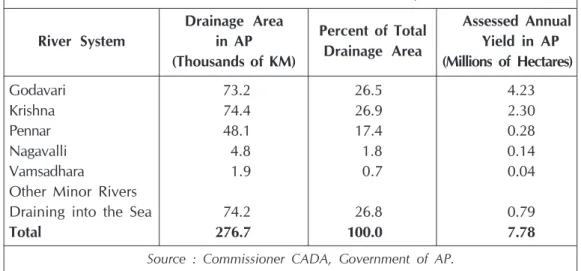
Drainage Area Assessed Annual
in AP Yield in AP
(Thousands of KM) (Millions of Hectares)
Godavari 73.2 26.5 4.23
Krishna 74.4 26.9 2.30
Pennar 48.1 17.4 0.28
Nagavalli 4.8 1.8 0.14
Vamsadhara 1.9 0.7 0.04
Other Minor Rivers
Draining into the Sea 74.2 26.8 0.79
Total 276.7 100.0 7.78
Table 1: Water Resources in Andhra Pradesh (The Major River Systems’ Contribution to AP’s Water Resources)
Source : Commissioner CADA, Government of AP.
River System Percent of Total
Minor irrigation projects have command areas less than 2,000 ha and usually include smaller irrigation schemes such as lift irrigation or schemes with water sources like tanks, diversion weirs, and open head channels. Traditionally, minor irrigation projects and groundwater are under the guidance of the Minor Irrigation Department, while the major and medium irrigation projects are under the Major Irrigation Department.
Structure of the Irrigation Administration in AP
The irrigation sector is under the Irrigation and Command Area Development Department (I&CADD). The administration of the irrigation sector is carried out at three levels. First, the highest level of government oversight comes from the Minister of Major and Medium Irrigation, the Minister of Minor Irrigation, the Principal Secretary of I&CADD, and three to four secretaries, each of whom are assisted by three to four deputy or joint secretaries. The second level is made up of the heads of several departments: The Engineer in Chief of Irrigation and Administration, the Director General of the Water and Land Management, Training, and Research Institute (WALAMTARI), the Commissioner of the Command Area Development Authority (CADA), and the Director of the Groundwater Board.
The third level is responsible for field operations at the district level. One or more districts are under the control of a superintending engineer. A district may have one or more executive engineers heading its irrigation division. Traditionally each irrigation division has three to four subdivisions and is manned by a deputy executive engineer. The assistant engineer subdivides each subdivision into three or more sections. One or more work inspectors may assist each assistant engineer. The lascars are the lowest rung in the Irrigation Department. Lascars work as gatekeepers and assist in the distribution of water.
Performance of the Irrigation Sector
Despite major plan investments in irrigation by the Government of Andhra Pradesh (GOAP), which have increased the irrigation potential, most systems are in disrepair and dilapidated due to inadequate maintenance. This has led to the shrinkage of command areas. Irrigation systems are characterized by low irrigation efficiencies and tail-end deprivation. The Govt of Austria has recently signed an MOU to strength and fund these systems.
Lack of established Operation and Maintenance (O&M) procedures, inadequate funds for O&M, and ad hoc expenditures by the irrigation department have compounded the unsatisfactory performance of most systems. Most of the agency’s O&M funds were being spent on staff salaries; very little was being spent for effective maintenance. This has led to the siltation of major canals and drains and damage to their lined sections. This is where monitoring by NGOs through NABARD or some such arrangement would help.
Irrigation Management Reform
A major component of the reform to the irrigation sector was aimed at giving a greater role to farmers in irrigation management. To determine a suitable framework for increasing
farmer participation, a series of public consultations were conducted throughout the state in most major irrigation commands. This consultative approach marked a dramatic departure from the usual way governments work.
Initially, both farmers and agency staff met the consultations with severe cynicism and indifference. Within the irrigation department, most viewed the current sordid state of affairs as a result of inadequate budgets and increasing political interference. It was felt that adequate infusions of cash for O&M would substantially improve irrigation system performance. Farmers approached the public consultations with a mixture of curiosity and cynicism. While there were great apprehensions toward the new approach, things became clear as several actions followed, one reinforcing the other. This sort of a systematic and persistent approach is what makes the program unique.
These measures would help to guard against water theft, by laying of illegal pipelines.It is stressed once again that whatever can be done in the rural areas should be implemented there,with local expertise. Necessary training should be provided and if required an irrigation training fund should be set up by NABARD/the government.
In general, there has been broad consensus for the creation of WUAs. These associations would be registered under existing laws such as the Cooperative Act or the Societies Act. A confederation of WUAs would then sign a Memorandum of Understanding with the irrigation department. They would decide on mutually agreeable terms regarding water supply, maintenance, and collection of water charges. Pilot schemes in the states of Maharashtra and Gujarat were highly successful.
In Andhra Pradesh, it was decided to create new legislation exclusively to enable participatory irrigation management. Feedback from the public consultations became the main input in drafting the law. The multilateral agencies also played their part. The legislation was subjected to several rounds of discussion among the various stakeholders. The Andhra Pradesh Farmers’ Management of Irrigation Systems (APFMIS) Act was enacted in 1997. The act was the first legislation of its kind in India.
The APFMIS Act
The Andhra Pradesh Farmers Management of Irrigation Systems (APFMIS) Act of 1997 was a revolutionary piece of legislation. It was the first of its kind in India, seeking to bring a paradigm shift in irrigation management. The act contains broad provisions relating to the types of irrigation schemes, tiers of Farmers Organizations (FOs), elections, functions of FOs, resources, and penalties for offenses. Detailed provisions relating to the actual working of WUAs are given in the Rules. Box 1 lists some of the most important features of the law.
The issue is now one of the effectiveness of implementation and there has been no satisfactory, objective monitoring system for the same.
Bring in the NGOs
Beginning in April 1996, a series of public consultations were held in centrally located places in command areas of major projects. These informal discussions gave a tremendous amount of input to the government for use in designing a suitable plan of action. One
of the consensus opinions was that there needs to be a better delivery system, which understands the needs of the farmers better. The NGO’s have traditionally been a very good delivery mechanism in almost every area. There is no reason why the NGO’s cannot be properly trained to play a role in irrigation management. Possibly they could be affiliated to an agency like NABARD/a multilateral agency, from which they could get the necessary training.
One of the important issues is the need to give them a proper framework in which to operate. A suggested set of rules is given in box 2.
9. Role of the Government of India in Irrigation Sector
Agriculture is a state subject. Therefore the most the government of India can do, is to act as a facilitator. The Government of India has begun an aggressive campaign to promote participatory irrigation management through national seminars and workshops in the 1990s. But, the specific mechanics need to be developed. These are not clear. The Hon. PM had
Box 2: The Terms of Reference for NGOs
• Identify a model for creating WUA.
• Evaluate the present system of water supply and suggest modifications. • Establish a methodology for optimizing the use of water by farmers. • Train the farmers.
• Identify incentives for effective functioning of WUAs.
Box 1: Salient Features of the APFMIS Act
• Transfer of power for the management of state-owned assets. • Creation of new autonomous institutions as legal entities. • Areas defined on a hydraulic basis.
• Equity achieved within the structure of a WUA by introducing the concept of territorial constituencies.
• All land holders in possession of land in an irrigation system become WUA members with voting rights.
• One member, one vote. • Elections by secret ballot.
• Functional and administrative autonomy. • Freedom to raise resources.
• Resolution of disputes and compounding of offenses. • Simplified procedures for taking up works.
• Five year tenure for Farmer Organizations.
• Irrigation Department, as competent authority, is made fully accountable to the Farmer Organizations.
• Right to recall an elected member after one year. • Social audit and annual accounts audit.
written to all the state governments recently, seeking their suggestions in developing the delivery mechanisms, for implementing various rural schemes. The Chairman of the Planning Commission has also stressed the need for building better delivery mechanisms. Therefore it appears that the role of the Government of India, through the Planning Commission and other central bodies such as NABARD, would work essentially on strengthening the delivery mechanisms, to ensure better and more effective utilization of funds, allocated for agriculture. The banks, including NABARD, should be encouraged to lend to farmer cooperatives to strengthen their basic irrigation infrastructure. NABARD would undoubtedly put its conditions and this would lead to the overall good of the segment.
The state government decided to extend participatory irrigation management to all parts of the state at one stroke. The GOAP felt that, in order for the reform to be successful, the following were important considerations:
• To ensure equitable distribution of benefits of the reform. • Provide uniform legislation.
• Completely involve the irrigation department and the government.
• Spread the new paradigm across the whole area in the shortest possible time. Without adequate monitoring, this approach to reform ran the risk of ending in disaster. The actions taken by GOAP continuously over a period of time ensured that this would be only a remote possibility. A major constraint for implementing such a major program is the diversity of agro-climatic zones and types of irrigation schemes in the state. Despite the difficulties of implementing a single model across a variety of schemes, the state was committed to giving the farmers a new role in managing irrigation, and all projects, big and small, old and new, were included in the reform.
10. Farmer Organizations
The term Farmer Organization (FO) covers different types of organizations, namely the Water User Association (WUA), the Distributory Committee (DC), and the Project Committee (PC). The primary body is the Water User Association. The number of tiers of Farmer Organizations in an irrigation system depends on the type of the irrigation system. Thus, minor irrigation systems, which are typically less than 2,000 ha, have a single-tier system with one WUA. Medium irrigation systems (2,000-10,000 ha) have a two-tier system, made up of WUAs and a PC. Major irrigation systems (more than 10,000 ha) have a three-tier system, made up of WUAs, DCs, and a PC.
A WUA is created by delineating a portion of the command area under an irrigation system. The managing committee of a WUA includes the WUA president and four to ten territorial constituency members. The area of a WUA is subdivided in order to equitably handle water management, maintenance, and governance. The area covered by a WUA ranges from 60 to 3,500 hectares. WUAs in the delta regions tend to have larger areas of up to 4,500 ha. In areas with rugged topography, WUAs cover about 1,000 ha. In most projects, however, the size of a WUA is around 600 ha to 1,000 ha.
Elections to the WUAs are conducted through a democratic process of secret ballots. The election procedure is akin to the gram panchayat election, so farmers are quite familiar with the election process. The electoral process has several advantages in enabling the election of a leader of choice. Being the first election, the elections were apolitical. Subsequent elections may however be much more vigorously contested.
Each farmer has one vote regardless of the extent of his land holdings. This levels out the representation of large and small farmers. An analysis of the elections shows that nearly half of the elections were unanimous and the other half were contested. Unanimous elections were mostly in the minor and medium irrigation projects, which are mostly homogeneous. Elections in the major irrigation projects, which may be made up of a number or factious villages, were intensely contested. The district administration was fully involved in the process of the election. The total expenditure towards elections was Rs. 110 mn ($2.5 mn).
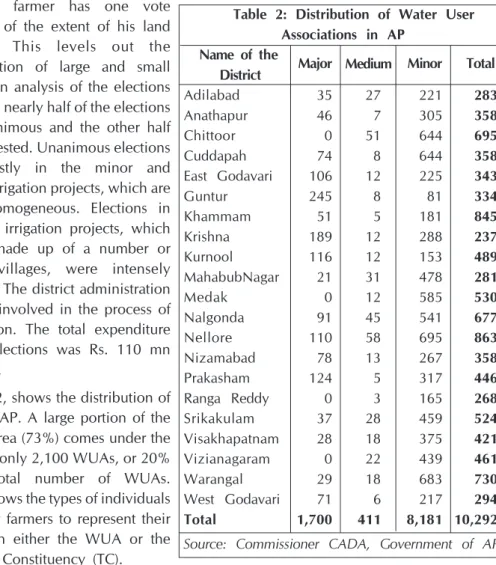
Table 2, shows the distribution of WUAs in AP. A large portion of the irrigated area (73%) comes under the control of only 2,100 WUAs, or 20% of the total number of WUAs. Table 3 shows the types of individuals elected by farmers to represent their interests in either the WUA or the Territorial Constituency (TC).
A large number of WUAs that have been created are responsible for the minor irrigation tanks which are scattered throughout the state. Historically, tank irrigation has been a part of the village polity and hence there has been no major change in the way tanks are managed from before the reform.
The major change in irrigation management has been greater role of the WUAs, rather than the irrigation agency. Another major shift, especially in major and medium irrigation projects, has been the realignment of boundaries. New boundaries are not necessarily contiguous with existing village boundaries. It has been necessary to redraw boundaries on a hydraulic basis and prepare new records.
Table 2: Distribution of Water User Associations in AP
Name of the
Major Medium Minor Total
District Adilabad 35 27 221 283 Anathapur 46 7 305 358 Chittoor 0 51 644 695 Cuddapah 74 8 644 358 East Godavari 106 12 225 343 Guntur 245 8 81 334 Khammam 51 5 181 845 Krishna 189 12 288 237 Kurnool 116 12 153 489 MahabubNagar 21 31 478 281 Medak 0 12 585 530 Nalgonda 91 45 541 677 Nellore 110 58 695 863 Nizamabad 78 13 267 358 Prakasham 124 5 317 446 Ranga Reddy 0 3 165 268 Srikakulam 37 28 459 524 Visakhapatnam 28 18 375 421 Vizianagaram 0 22 439 461 Warangal 29 18 683 730 West Godavari 71 6 217 294 Total 1,700 411 8,181 10,292
Transparency is critical if the organizations are to progress further. To a large extent transactions are captured in the accounting system. There is a need to put in place simple, standardized procedures for accounting and finance. The AP government has already developed a finance module in consultation with chartered accountants.
The AP Model will be complete when the WUAs are federated into project committees. Continued support and training are required. The awareness
base must be expanded to include the farmers. While the awareness of the WUA presidents and managing committee members is quite good, the awareness of the farming committee needs to be made the focus of the training program. Farmer Organizations will become more responsive only when the farming community starts demanding more responsive and equitable service. This constant dialogue would also enable resolution of disputes. Rather than having the irrigation agency undertake capacity building measures alone, it will be far more effective to (1) foster interactions among Farmer Organizations themselves, (2) enlist the assistance of NGOs, and (3) make use of local training institutes.
11. Developing of Indigenous Models for Rural India
Rural India is an invisible market and is an example of a coordination failure. Understanding this is an important step towards the business-model innovation. Rajesh Jain puts it best on the type of business-model innovation needed for this.
Creating disruptive innovations for the bottom of the pyramid requires ecosystems. But how do these ecosystems get created? My next learning is that to bootstrap the process, one entity has to put together the whole solution. Others will join in when they see that entity become successful, but not initially. This means that someone has to take the plunge and demonstrate that there is indeed a business opportunity in which we want others to participate. This is because of two reasons: The customers want a whole solution (the assembled car, and not the sum of the parts), and trying to coordinate and convince various other players and making them see the future through the eyes of the entrepreneur can be extremely difficult.
12. Rural India: A Gap between Know-how and Actual Implementation
Capability
Rural India’s problems range from proper sanitation, electrification, roads, health, education, credit, fuels, agri-services, and market access.
Table 3: Background of Presidents and Territorial Constituency Members in AP
WUA Territorial Background Presidents Constituency
Members Farmers 8,544 39,606 Business 213 438 Public Representatives 183 151 Professionals 58 118 Service Personnel 40 63 Contractors 35 35 Industry 27 54
As I try to search for service providers who will be part of RISC, I realize that there are a host of ideas, individuals and institutions waiting to be tapped. They are waiting to expand, to be copied, to be supported—to be implemented.
The main issue is implementation—A Knowing-Doing Gap. The skills then required to solve rural India’s problems are not of creativity or innovation but execution and management.
Let’s have a cursory glance at the issues surroundering various rural facilities.
Sanitation
The building up of public toilets is a key rural facility. This can easily be done with the help of the NGOs. Various experimental models including the setting up of an SPV headed by a suitable person (preferably an expert on sanitation) could be looked at. The NGOs themselves could be vetted and suitably used for implementing the same. There are a variety of possibilities.
What is highly undesirable, and has failed to stand the test of time, is getting all the work done by the rural bodies and Panchayats. Not only will funding be forthcoming, but these bodies fundamentally lack the expertise and know-how to implement these projects on a large scale. Operations and maintenance is also likely to be a huge problem. For these reasons, it is very appropriate to get experts involved, preferably professionally, and monitor the progress through suitable mechanisms, on a macro scale.
Electricity
The use of solar energy through photo-voltaic cells has not been fully explored. Rural life requires typically very little energy per capita and therefore the employment of suitable technologies could lead to the doing away with the need to develop large-scale distribution systems in rural and remote areas. A suitable solar energy plant(s)in a village could do the tricks. Grants/subsidy could be provided for creating such plants. Cells of 7-10 KVA are easily available at around Rs.2-2.5 lacs.
Rural Credit
A successful example of Micro-credit is the Grameen Bank of Bangladesh–perhaps operating in an environment more difficult than that of India. From very small beginnings, this bank has managed to deliver more than $ 200 mn to the farmers and the rural community at large in very small installments. Grameen Bank provides credit to the poorest of the poor in rural Bangladesh without any collateral. At Grameen Bank, credit is a cost effective weapon to fight poverty and it serves as a catalyst for the overall socioeconomic development. A study should be made of the activities of grameen bank to see how micro-credit could be made available to the rural poor of Bangladesh and the same could be adopted in AP and any other Indian state.
It has long been recognized (mainly by multilateral agencies) that computers and connectivity to rural India would completely change the quality of delivery systems. For
one thing, it would encourage the growth of computer literacy in the rural areas. It would enable agricultural stock exchanges to spring up and further develop the quality of information regarding agricultural prices for various commodities across the country. It would prevent arbitrage in agricultural goods which is the bane of rural India. It would enable the farmers to examine interest rates from various banks and compare and contrast them
13. Rural Cooperatives and Commodity Exchanges
Commodity Exchanges in IndiaCommodity exchanges are an important part of the agri-chain. They provide value in many ways. First, price discovery is easy and thus helps farmers from all over the country. Second, since the farmer can be assured of a sale by participating in a future contract, he is assured of his income. Third, by standardizing the sale and purchase prices, the various agri-outputs’ quality is also increased, as only better performance would assure a proper sale price. Arbitrage oriented marketing comes down.
The commodity exchanges cannot perform the tasks mentioned above unless they have some of the backup infrastructure needed. This includes regulations, standards, warehouses, warehouse receipt system, logistics, cold storage facility, etc. And India is lagging in most of these.
There should be an effort to get these agricultural exchanges going, to enable the farmers to get the best prices available for their commoditities. The availability of Internet in each village would help greatly. Traders would often get the goods picked up, if they know that they are going to get a sufficiently large profit. But the main gain for these exchanges is the knowledge about the actual market prices of various agricultural commodities, so that the middleman does not cheat the farmer.
The Setting up of Rural COOP
Perhaps the key to success in the rural sector is the building up of rural cooperatives. This has been proved, notably in Gujarat, Maharashtra, Sri Lanka and Bangladesh to be one of the most effective mechanisms for dispensing rural services and developing rural infrastructure. But these cooperative mechanisms have failed in many states of India, mainly due to persistent interference and control by the panchayats and other rural authorities, who have no stake in the process.
For this mechanism to succeed, two things are absolutely essential:
• The owners must be the chief stakeholders and end users e.g. farmer in the case of pumpsets, rural artisans in the case of handicrafts etc.
• They must have a major sponsor e.g. Amul in the case of farmer cooperatives in the state of Gujarat. The sponsor could also be a major NGO, non-profit organization or multilateral agency.
Some features of cooperatives are:
• A COOP is owned by the people who rely on it to provide a service. The main benefit is the joint marketing of the goods and services that the villagers do not know how to market themselves.
Unlike a conventional body or group, it minimizes its profits and returns as much money as possible to its grower-members through the purchase of their goods. The rural folk also get a feel of what it is like to run their own enterprise.
What the cooperative does is to give these farmers an outlet they might not otherwise have, especially for those who don’t want to spend the time marketing their produce at farmers’ markets.
Market Access
Market access and guarantee of a sale comes from leveraging strength and gaining access to market information.
When a farmer, working on his own, falls short on a crop, he may lose a customer. When he has an ample supply his only option may be to dump it in the market. TOG evens out those bumps, by having a steady supply from several farmers if one falls short, or buying more if one has a bountiful crop.
Most of all, though, the small farmer gets a market.
Rural Insurance
If you can provide two things, unlimited Credit and Energy, any problem in the world can be solved including making India a developed country.
Micro-finance is one of the services, which is needed for rural India. The micro-credit movements started by Grameen and popularized by many other companies solve a major technical issue of providing “credit without collateral”.
As we (as in Urban dwellers) do not need just a credit card, we also need savings accounts, fixed deposits, investment avenues like Mutual funds, life; health and non-life insurance, there is a need for micro-savings, micro-insurance etc., in rural India.
And here Micro-finance steps in. The IRDA has just woken up to the fact that they are not able to reach the masses and that opening up of the sector to the private players hasn’t helped. (They need to talk to TRAI for some guidance!).The example of grameen, desperately needs to be followed.
All these facilities will help the rural farmer get his credit and such credit can be measured and monitored better, to ensure that the middleman does not dupe him.
14. Privatization Initiatives
It is very clear, that much of the infrastructure in major urban areas will have to be privatized, or at least have major private operations. Otherwise, they would not be able to raise the necessary funds to carry on their ongoing infrastructure projects. Accordingly, various schemes would have to be developed for the privatization (certainly
corporatization) of ports, minor ports, and suitable municipal projects, under the BOT, BOOT, BLMT format etc.
The policy and legislative framework should accordingly be fine-tuned to these requirements. The basic idea is that if the state would like to concentrate most of its direct resources towards the rural and semi-urban sector, it should at least provide suitable facilities for private and multilateral resources to come into the urban sector. In this way, it wins on both counts.
The State Government has taken initiative to invite private entrepreneurs to take up the road projects under BOT scheme. Clear guidelines and BOT policy have been approved by the government based on which projects amounting to Rs.200 crores were already taken up and most of them are being completed. It is proposed to take up long express highways also under BOT.
Water Supply
The state should have a two-pronged strategy, as regards the water supply in the state • Urban water supply forward movement from the “1-2”hour supply per day, mainly
through private initiative.
• Development of the irrigation facilities, through direct and multilateral funding. As per the Central Public Health Environment Engineering Organisation (CPHEEO), the drinking water requirement for towns with a population of more than one lakh is 140 Lt per capita per day (LPCD) and 70 LPCD for towns with a population of less than one lakh. Based on this norm, the assessed demand for water supply in the municipalities (as per the 1991 census) is about 1127 MLD. In 116 towns and Municipal Corporations, the present position is one of ‘supply-shortage’.
The total number of household and public stand post connections is estimated at 6.06 lakh and 0.38 lakh respectively. 59 Water Supply Schemes are under various stages of implementation by the Public Health Engineering Department. HUDCO has recently sanctioned loan assistance for 13 Water Supply Projects. Now it is incumbent on the Government to develop a suitable legislative framework, by which private capital and initiatives flows in to tackle most of these schemes.
15. Development of Services
There is no point in looking at the successful models of the developed countries. There is far more value in looking at the neighbouring states and countries with an environment similar to our own. Thus, Malaysia and China become the obvious international examples. Tamil Nadu has forged a very successful methodology for Urban Services and Gujarat for ports.
The amount of infrastructure backup for services is marginal as compared to the Industrial backup. The state should therefore make an effort to develop the infrastructure, which makes for a vibrant and efficient service sector.The service sector is the basic strength of AP and every effort should be made to develop it. AP has already acquired the reputation of becoming a service friendly center for IT, IT enabled services, Biotechnology,
Call Centers, Clinical Testing laboratories and other allied disciplines. This would yield
maximum tangible results in terms of job creation and rise in the standard of living, besides minimizing the amount of money spent on Infrastructure Development. Traditionally, industry always uses up 4-5 times the amount of hard infrastructure that service sector of corresponding monetary value uses. The question is then, why everybody does not switch to service sector. The answer is Human Capital. Most states in India do not have the human capital to develop a vibrant services economy, AP does.
On the industrial front, Drug and Pharmaceuticals, Cement and Marine products have been a traditional strength of AP. These Industries should be supported but traditionally need less investment in infrastructure as compared to the really heavy industries such as Petrochemicals, Fertilisers, Steel and the like. It is suggested that these be allowed to evolve naturally but not by spending scarce public resources.
The path to empowering the Industry with easy access to quality, uninterrupted and unlimited power has begun. The state should ensure that they should at least create supportive legislative and tax frameworks, which cater to the needs of Industry. This would bring in the necessary private capital.
The state has had brilliant success in the development of ports in Visakhapatnam and attempts should be made to consolidate on this success by developing suitable feeder ports along the way. As far as possible, the operations of these ports should be privatized, though not necessarily the ownership. The development of each port requires large-scale investments but the proper policies would certainly attract a lot of private capital, thereby minimizing the state investment. The state could then concentrate on developing the port linkages and port backup infrastructure. Items like warehousing, stevedoring and logistics could certainly be subcontracted to private companies under the Bid and Tender process. Industrial clusters certainly require linkages and therefore there is a need to suitably plan the industrial parks, taking into account the flow of the business and minimizing the transportation costs.
The most crucial resource of this state is the human intelligence. The state government should therefore place maximum thrust on human resource development. It is pertinent to note that it is this thrust, which will really develop the infrastructure and make better use of the existing infrastructure. The state has so many Polytechnic and Engineering Colleges. How many of these work in the infrastructure sector? There are literally hundreds of Higher Education graduates who could save the state many crores of rupees in infrastructure costs if only an arrangement could be made to get them into the system through contract employment. Subcontracting to various private companies under suitable terms can achieve this. The private companies then absorb this staff, and the work is done without burdening the state exchequer. The trick is to make policy development a dynamic process, such as Malaysia and China have done.
It is pretty clear that with limited resources, the Andhra Pradesh government is really not in a position to execute all the aspects of the strategy plan they had prepared. Therefore they have to look at leveraging state funds to attract more private capital. This is tantamount
to saying that they are putting their “money where their mouth is” but more in a catalytic way to encourage others to fully participate in terms of operation and funding. This alone will result in substantial saving for the government.
16. Industry
AP Industrial Policy 2000-2005 states that infrastructure facilities such as roads, electricity, water, drainage etc., are to be provided at the door step of the proposed industry in the areas identified by the State Government as industrial areas and in areas not so identified, the government will share the cost for the provision of such infrastructure to the extent of 25% or Rs.1 Cr, whichever is less. To this end, an Industrial Infrastructure Development Fund of Rs.100 Cr is being created.
Given the limited resources of the state and the comparative lack of job creation potential per rupee of state funds invested, the state would do best to create an enabling situation to develop industry in the state. This does not mean that industry should be neglected. Far from it, what it means is that the problems of industry should be addressed at the policy level, rather than just providing the actual funding. The industry is mature enough to attract capital on its own provided a facilitating atmosphere is provided, rules and regulation wise. This would free a great deal of money, for the more productive knowledge sector, as far as AP is concerned, without completely neglecting or ignoring the industry.
17. Conclusion
In our Industry there is too little value-added, and too much mechanical assembly and production. There is also a need to counter rising production costs brought about by rising costs of labor, raw material and overheads by improving efficiency and productivity. There is a serious shortage of skilled manpower. All these and such other issues need to be addressed. Small and medium scale industries have an important role to play in generating employment opportunities, in strengthening industrial linkages, in penetrating markets and generating export earnings. They have a crucial role as a spawning ground for the birth of tomorrow’s entrepreneurs.
Small and medium scale enterprises must be assisted to grow bigger. The government needs to devise appropriate assistance schemes and seeks to raise the level of management expertise, technological know-how and skills of the employees in this very important and in many ways neglected sector of our economy.
The SMIs will be one of the primary foundations for our future industrial thrust. The government is fully committed to its healthiest developments. This is essential for AP’s Accelerated Industrialization.
Surplus savings and domestic capital must be more productively channeled into investments.
Entrepreneurs must be spawned. Where necessary, technological and training help must be extended; and infrastructure support must be given.
In our drive to move vigorously ahead, nothing is more important than the development of human resources. What we have between our ears, at our elbow and in our heart is much more important than what we have below our feet and around us. Our people are our ultimate resource. Without a doubt, in the 21st century, AP must give the fullest emphasis possible to the development of this ultimate resource. AP has one of the best educational human resource pools, evidenced by the migration to USA and contribution to various elite Engineering colleges around the country. It is a talent, which must be tapped. Copying states like Maharashtra and Gujarat will only end in futility.
We cannot afford to neglect the importance of entrepreneurship and entrepreneurial development, which goes, of course beyond training and education must ensure the correct mix with regard to professionals, sub-professionals, craftsmen and artisans, and the correct balance with regard to those with competence in science and technology, the arts and social sciences. In the development of human resources, we cannot afford to neglect half the population i.e., the disadvantaged classes. If they are not brought into the mainstream, if their potentials are not fully developed, if they are allowed to be millstones around the national neck, then our progress is going to be retarded by that much. No nation can achieve full progress with only half its human resources harnessed. What may be considered a burden now, can, with the correct attitude and management, be the force that lightens our burden and hastens our progress. Nor can we afford to neglect the rural sector of our economy and society. In the years ahead, we must work for a second rural development transformation, restructuring the villages so as to be compatible in both agriculture and modern industry. Less and less farmers should produce more and more food, thus releasing manpower for an industrial society. AP cannot deregulate if bankers eventually behave like gangsters, if the freedom afforded to enterprise becomes merely license to exploit, without any sense of social responsibility. Privatization must not proceed if those who think only of personal profit without social responsibility defeat its objectives. This is where policymaking and increasing integration with the institutional framework in a manner, which facilitates operations, becomes much important. The best way to do this is to set up common task forces and give them enough time to do the integration.
References
1. AP Vision 2020. 2. www.worldbank.com 3. www.hindu.com
4. Commissioner CADA, Government of AP.
5. Eighth Five-Year Plan (1990-95), AP-F&P (PLG) Department, Volume 11, October 1990. 6. AP Industrial Policy 2000-2005.
7. http://suhitanantula.blogspot.com/2003_06_08_suhitanantula_archive.html#95518440 8. www.ap.gov.in