Instructions for authors, subscriptions and further details: http://redimat.hipatiapress.com
Evaluating the Effects of Professional Development on Urban Mathematics Teachers TPACK Using Confidence Intervals Jamaal Rashad Young1
Jemimah Young1 Christina Hamilton2 Sarah Smitherman Pratt3 1) University of Iowa, USA
2) Huston-Tillotson University, USA 3) Baylor University, USA
Date of publication: October 24th, 2019
Edition period: October 2019-February 2020
To cite this article: Young, J.R., Young, J., Hamilton, C., & Pratt, S. (2019). Evaluating the effects of professional development on urban mathematics teachers TPACK using confidence intervals. REDIMAT – Journal of
Research in Mathematics Education, 8(3), 312-338.doi: 10.4471/redimat.2019.3065
To link this article: http://dx.doi.org/10.4471/redimat.2019.3065
PLEASE SCROLL DOWN FOR ARTICLE
The terms and conditions of use are related to the Open Journal System and to Creative Commons Attribution License (CCAL).
2019 Hipatia Press ISSN: 2014-3621
DOI: 10.4471/redimat.2019.3065
Evaluating the Effects of Professional
Development on Urban Mathematics
Teachers TPACK Using Confidence
Intervals
Jamaal R. Young University of Iowa Jemimah Young University of Iowa Christina Hamilton Huston-Tillotson UniversitySarah Smitherman Pratt
Baylor University
(Received: 02 November 2017; Accepted: 05 October 2019; Published: 24 October 2019)
Abstract
This article presents a practical application of meta-analytic thinking to contextualize the results through direct comparisons to similar studies. The results suggest that the professional development increased mathematics teachers’ perceptions of their pedagogical knowledge (PK), technological knowledge (TK), pedagogical content knowledge (PCK), and technological content knowledge (TCK). The study results also indicate that despite smaller overall effect sizes, the outcomes observed in this urban intervention were not statistically significantly different from most prior research in this area. This is important because interventions in urban schools are often characterized as less successful than other instructional environments. Because of the chosen research approach, the research results have practical as well as empirical implications for the development and delivery of mathematics professional development in urban schools.
Keywords: Technology integration, professional development, mathematics, meta-analytic thinking
2019 Hipatia Press ISSN: 2014-3621
DOI: 10.4471/redimat.2019.3065
Evaluación de los Efectos del Desarrollo
Profesional en la TPACK del Profesorado
Urbano de Matemáticas Utilizando
Intervalos de Confianza
Jamaal R. Young University of Iowa Jemimah Young University of Iowa Christina Hamilton Huston-Tillotson UniversitySarah Smitherman Pratt
Baylor University
(Recibido: 02 Noviembre 2017; Aceptado: 05 Octubre 2019; Publicado: 24 Octubre 2019)
Resumen
Este artículo presenta una aplicación práctica del pensamiento meta-analítico para contextualizar los resultados a través de comparaciones directas con estudios similares. Los resultados sugieren que el desarrollo profesional aumentó las percepciones de los profesores de matemáticas de su conocimiento pedagógico (PK), conocimiento tecnológico (TK), conocimiento del contenido pedagógico (PCK) y conocimiento del contenido tecnológico (TCK). Los resultados observados en esta intervención urbana no fueron estadísticamente diferentes de forma significativa en la mayoría de las investigaciones anteriores en esta área. Esto es importante porque las intervenciones en las escuelas urbanas a menudo se caracterizan por ser menos exitosas que en otros entornos educativos. Debido al enfoque de investigación elegido los resultados tienen implicaciones prácticas para la formación profesional docente.
Palabras clave: Integración tecnológica, desarrollo profesional, matemáticas, pensamiento meta-analítico
he integration of technology in the classroom contributes to the success of all children in mathematics (National Council of Teachers of Mathematics, 2000). Thus, the U.S. government, as well as individual states invests substantial amounts of money to increase student and teacher access to technology. Appropriately, most schools have made considerable increases in their technology infrastructure, as well as the development of educational technology (Alavi & Leidner, 2001; Russell, Bebell, O'Dwyer, & O'Connor, 2003). Consequently, most teachers have access to digital resources and instructional technology. These increases have substantially influenced the technological infrastructure of urban schools; however, professional development has emerged as the new digital divide in urban schools.
Urban mathematics teachers need to receive proper training and continuous feedback to integrate technology to support teaching and learning. The proliferation of educational technology in the United States has provided teachers with more electronic resources than ever before, but some teachers have not received sufficient training in the effective use of technology to enhance learning (Niess, 2005). A national survey of technology implementation in mathematics classrooms found that almost half of American students are in classrooms where teachers lack access to district or school provided professional development on the use of computers for mathematics instruction (Mitchell, Bakia, & Yang, 2007). This lack of professional development can inhibit urban mathematics teachers from transforming their teaching to enhance student learning.
A report by the U.S. Department of Education states that the benefits of technology integration on student achievement remain unseen, despite these investments (Paige, 2005). One explanation for the lack of results on student achievement is that teachers need suitable training to effectively teach with technology. Proper training requires administrative support for the integration of technology in the classroom. Fortunately, educational policy and funding have made it tremendously advantageous for administrators to support technology integration. However, due to budgetary constraints and more pressing issues surrounding urban education many teachers in urban schools receive substantially fewer hours of training to implement technology in their classrooms (Meier, 2005; Wachira & Keengwe, 2011). This lack of training leaves many teachers ill equipped to maximize the affordances of technology integration in their mathematics classrooms. In
order to change this trend, empirical studies must assess the effectiveness of professional development as a means to support technology integration in urban mathematics classrooms.
Bridging PCK and TPACK
Technological Pedagogical Content Knowledge (TPACK) is a viable educational framework for effective teaching with technology (Mishra & Koehler, 2006). Because effective teaching with technology requires educators to understand the affordances and constraints of technology on educational practice, TPACK is a useful framework for educators to better ascertain the affordances and constraints of technology in the classroom (Koehler & Mishra, 2008). TPACK is an educational framework for effective teaching with technology that emphasizes the intersection between technological knowledge and pedagogical content knowledge (PCK). Shulman (1986) championed the need for educators to understand the intersection between content and pedagogy. According to Shulman content knowledge was the amount and organization of knowledge in the mind of the teacher, while pedagogical knowledge was the extension of content knowledge to include subject matter knowledge for teaching (p. 9). While Shulman defines pedagogy as “the knowledge of generic principles of classroom organization and management and the like that has quite appropriately been the focus of study in most recent research on teaching” (p. 14). The intersection of knowledge and pedagogical knowledge is PCK. This type of knowledge includes: (a) the most regularly taught topics in one’s subject area, (b) the most used representations of these ideas, as well as, (c) the most powerful analogies, illustrations, examples, explanations, and demonstrations in the world (p. 9). Shulman further asserts that PCK includes an understanding of what makes the learning of specific “content easy or difficult: the conceptions and preconceptions that students of different ages and backgrounds bring with them to the learning of those most frequently taught topics and lessons” (p. 9). Thus, it is important that teachers understand the complexities of PCK before that can bridge the gap between PCK and TPACK.
TPACK extended the PCK framework to include technological knowledge. TPACK is an educational framework that encompasses many uses of technology in the classroom. However, it is not a universal knowledge
or skill set that can be applied unconsciously. To teach mathematics effectively with technology, teachers must first have strong mathematics PCK to bridge the gap between these two types of knowledge. Strong PCK allows the teacher to investigate how digital tools can enhance their ability to ability to implement their PCK.
Technology Professional Development in Mathematics
The intersection of mathematics content, pedagogy, and technology, as suggested by the TPACK theoretical framework, is complicated for teachers without proper professional development. While professional development in itself is a complex mechanism, technology professional development in mathematics is a more intricate system in regards to technology integration as it relates to edifying the mathematical teaching and learning practices by and for 21st century learners (English & Kirshner, 2016; Mullen & Wedwick, 2008; Ertmer & Ottenbreit-Leftwich, 2010; Van Steenbrugge, Valcke, & Desoete, 2010).
Research has forwarded the claim that PD, in any regard, improves student mathematics achievement (Kutaka, 2017; Hill, Rowan & Ball, 2005; Telese, 2012; Bennison & Goos, 2010; Mouza, 2011). Additionally, literature substantiates the positive effects of math teachers’ technology
professional development on student achievement (Pape et al., 2015). For example, research conducted by Cavaliere (2013) who investigated the 2009 mathematics NAEP scores of fourth grade students, revealed students whose teacher participated in mathematics technology professional development had higher math scores. These findings are similar to those of Wenglinsky (1998) who investigated the math performance of fourth and eighth grade students using the 1996 NAEP assessment. Wenglinsky findings also suggested that math teachers’ professional development in technology correlates to higher student NAEP math scores.
Though technology professional development in mathematics is an advantageous way to move math teachers toward favorable student learning outcomes, research reflects a gap in the outcome of technology professional development in mathematics in retrospect to teachers TPACK. For example, research conducted by Polly (2011) investigated a yearlong technology professional develop in mathematics with the purpose to improve mathematics teachers TPACK. During this professional development
session, teachers explored and experimented with technology-rich tasks related to number sense development. The outcome of these sessions was for the teachers to demonstrate growth in TPACK with the evidence of their re-enactment in their mathematics instruction throughout the upcoming school year. As the researcher followed-up with the participants, he documented that, although the participants were using technology in their lessons, there was no evidence of their professional development experience. Hence, the teachers mostly used technology as a display tool rather than an instructional implementation as taught in the PD. Additionally, in a four-year study into the technology professional development for mathematics teachers, Kim, et al (2013) reported that the teachers’ technology beliefs did not change before,
during, or after the professional development which resulted in their limited use of technology during their mathematics instruction. Given these and other professional development outcomes it is imperative that the effects of professional development efforts in urban schools are placed in the proper context. The use of confidence intervals to support meta-analytic thinking is one means to this end.
Purpose
Meta-analytic thinking allows researchers to systematically benchmark their results by comparing them to prior results from similar studies. Thus, researchers need to explicitly design and place studies in the context of the effects of prior literature (Henson, 2006, p. 622). This shift in empirical thinking promotes replication and allows the researcher to “size up” their results in relation to prior studies. One analytic medium for the comparison of effect sizes is the confidence interval. According to Thompson (2002), confidence intervals for effect sizes are exceptionally valuable because they facilitate both meta-analytic thinking and the elucidation of intervals, via comparisons with the effect intervals reported in related prior studies (p. 25). Further, Cumming and Finch (2001) suggest four reasons to use confidence intervals:
• Confidence intervals provide point and interval information that is accessible and comprehensible, which supports substantive understanding and interpretation.
• There is a direct link between confidence intervals and Null Hypothesis Statistical Significance Testing.
• Confidence intervals support meta-analytic thinking focused on estimation.
• Confidence intervals communicate information about a study’s precision.
In addition, sample size is a reasonable consideration when applying meta-analytic thinking to compare and evaluate technology professional development in urban mathematics classrooms. The application of meta-analytic thinking through the medium of confidence intervals provides a lens to compare effects across large and small samples. Along with strong evidence of affect, confidence intervals also provide two other advantages. First, when sample sizes are considerably small, NHSST may not yield statistically significant results. Unfortunately, the conclusion typically associated with non-statistically significant results is that the effect is not real (Cumming & Finch, 2007); however, confidence intervals allow researchers to place results in a broader context to establish practical and clinical significance. Secondly, because all confidence intervals report both (a) point estimates and (b) characterize how much confidence can be vested in a given point estimates (Zientek, Yetkiner, & Thompson, 2010, p. 425), comparing point and interval estimates to other studies examines precision and quality of the results of this study across other studies.
Confidence intervals provide valuable parameter-estimation capabilities, which are essential for the empirical validation and refinement of the professional development activities in urban schools. Many studies have sought to synthesize the effects of professional development on teacher technology integration through a qualitative lens (Bingimlas, 2009; Earle, 2002; Lawless & Pellegrino, 2007). Studies that employ a meta-analytic lens to examine the effects of technology professional development in urban schools, however, remain elusive. Thus, the purpose of this study was to use meta-analytic thinking to evaluate the results of a three-week professional development on mathematics teachers’ technological pedagogical content knowledge (TPACK). This study was guided by the following research questions:
1. What are the effects of a three-week professional development for urban mathematics teachers on TPACK?
2. How do the effects of a three-week professional for urban mathematics teachers compare to previous interventions to increase teacher TPACK?
Methodology
This study was conducted in four Middle Schools in an urban school district in the Midwestern United States. The district serves a culturally and linguistically diverse population of Hispanic/Latino, African American/Black, and White/European students in descending population rank order. A convenience sample of teachers who were given IWBs as part of the school districts technology initiative were the sample for this study. The teachers taught middle school mathematics grade levels that ranged from sixth through eighth grade. The representation of the teacher participants in this study was as follows: 75% White/ European, 12.5% African American/Black, and 12.5% Hispanic/Latino.
Instrumentation
A modified version of survey of pre-service teacher knowledge of teaching and technology was used. The wording of the survey was modified slightly to reflect in-service rather pre-service teacher dispositions. The pre-service teacher TPACK survey contains items from various content domains and has been shown to be considerable reliable for several different samples. The survey of pre-service teacher knowledge of teaching and technology has an internal reliability that ranges from .80 to .92 (Schmidt, Baran, Thompson, Koehler, Shin, & Mishra, 2009). The individual reliability for mathematics, PK, PCK, TCK, TPK, and TPACK are .85, .84, .85, .86, .80, and .92, respectively. The figure below presents as excerpt of the included survey items. The items were Likert scaled and scored from 1 Strongly Disagree to 5 Strongly Agree.
Data were collected using a one-group within participant’s pretest-posttest design procedure to assess the effects of the professional development on teacher TPACK and Interaction Whiteboard (IWB) use in the classroom. Technology use is nuanced; therefore, teachers must understand the affordances and constraints associated with different types of technology. In the next section the affordances and constraints of the interactive white board (IWB) are discussed, followed by as description of the professional development implementation.
Table 1.
Excerpt TPK and TPACK Survey Items
Technological Pedagogical Knowledge (TPK)
TPK1. I can adapt the use of the technologies that I am learning about to different teaching activities
TPK2. I can choose technologies that enhance students' learning for a lesson. Technological Pedagogical Content Knowledge (TPACK)
TPACK1. I can select technologies to use in my classroom that enhance what I teach, how I teach and what students learn.
TPACK2. I can provide leadership in helping others to coordinate the use of content, technologies and teaching approaches at my school and/or district. TPACK3. I can teach lessons that appropriately combine mathematics, technologies and teaching approaches.
TPACK4. I can use strategies that combine content, technologies and teaching approaches in my classroom.
TPACK5. I think critically about how to use technology in my classroom. The Interactive Whiteboard
The IWB is a large touch screen device connected to a digital projector and computer. The IWB allows the user to create lesson materials in advance or instantaneously during a lesson, quickly retrieve the materials for display, and manipulate the materials on the display for the entire class (Kennewell, Tanner, Jones, & Beaucamp, 2008). The IWB is an information communication technology that offers numerous affordances for increased student engagement and subsequent achievement when compared to the dry erase board. Although dry erase boards and IWB share the same basic function, the affordances and constraints are different. Some shared affordances are that both devices allow educators to present data on a large visible area, the use of multiple colors to accent information, and with the addition of a projector educators can annotate documents. Despite some shared affordances, IWB’s have the additional capabilities of delivering interactive digital learning content and integrating virtual content as well as Information communication technology activities. Because appropriate use
of the IWB involves maximizing its affordances, the IWB alone does not ensure academic progress (Glover, Miller, Averis, & Door, 2007). Specifically, the effectiveness of an IWB is contingent upon the thoughtful and purposeful use of the tool. Within the context of mathematics, instruction the IWB’s affordances and constraints should be acknowledged through TPACK guided professional development.
Professional Development Process.
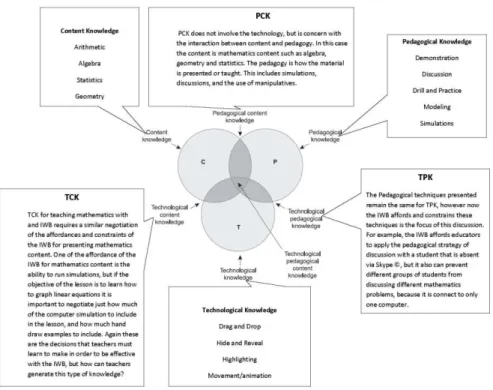
According to Desimone (2011) the core features of effective professional development are: content focus, active learning, coherence, duration, and collective participation. This section describes how these features where achieved in the professional development process for this study. To ensure that these areas remained the focus of the intervention a professional development technology integration framework was developed. This framework was an outline of the tasks and expected outcomes of the professional development. This framework was developed by the primary researcher, one teacher from each campus, the curriculum coordinator, and pertinent school principals. In order to ensure that the core features of effective professional development were in place this was established before the initiation of the professional development and was based on key challenges observed in district-standardized assessments. To promote active learning teacher recorded and submitted one IWB lesson at the end of each week that was reviewed by the researchers. Coherence was one of the strongest elements of the project given the stakeholders represented during the development and implementation stage. Several district initiatives were in place that were also embedded into the professional development such as the utilization of sheltered instruction observation protocols (SIOP) in all lesson actives. This help to prevent teachers from becoming overwhelmed with additional expectations, and supported district and researcher relations. This framework was built on specific mathematics subject matter as the TPACK content knowledge and then identifies the most salient pedagogical and technological intersections as seen in figure 1. Together these procedures and the aforementioned framework were crucial to addresses the core features of effective professional development.
Figure 1. Professional Development Technology Integration Framework Schools received three weeks of professional development with the IWB, two weeks in the fall and one week in the spring. The pretest data were collected before the initial week of professional development, and posttest before the last day of the professional development.
The major threats to validity for this design are maturation and history (Shadish, Cook, and Campbell, 2002). To minimize the maturation threat and the history threat the tie between the pretest and posttest was kept as short as possible.
Data Analysis Procedures
Because the number of participants in this study was substantially small, it was both impractical and analytically unsound to conduct traditional
statistical significance testing. Thus, effect sizes and confidence intervals were used to evaluate the teacher pretest and posttest results in the context of related prior research. Effect sizes provide a magnitude of effect that addresses the practical importance of the results (LeCroy & Krysik, 2007), and given the prevalence of the digital divide between urban and suburban schools, the practical importance of effect sizes becomes paramount. By examining mean difference effect sizes, the influence of the professional development on teacher TPACK was assessed for practical significance. One rationale for reporting effect sizes is that measures of effect size can be compared across studies (Vacha-Haase, Nilsson, Reetz, Lance, & Thompson, 2000). Accordingly, the reasonableness of the results was examined by comparing the results from this study to similar studies. According to convention 95% confidence intervals about the mean difference effect size were calculated.
Statistics, confidence intervals for statistics, and effects sizes are generally easy to obtain with the correct formulas, but the confidence intervals of effect sizes must be estimated through computer-intensive iteration procedures (Thompson, 2007). Statistical packages and other applications can be utilized to perform the appropriate procedures (Algina, Keselman, & Penfield, 2005; Cumming & Finch, 2001; Smithson, 2001). The original pretest and posttest mean, standard deviations, sample sizes, and
p values for each construct from the original studies were collected to use as comparisons to the current data. This information was placed in ESCI®, which then generated the confidence interval data. ESCI® was selected because it runs within Excel, produces estimates based on various inputs, and generates a visually appealing graph that facilitates interpretation and comprehension. Furthermore, ESCI® utilizes Hedges g effect size estimates to calculate mean difference effect sizes based on the pool SD. This method is preferred for comparison purposes given the variation of sample sizes across studies included in the comparative confidence interval plots. Because some studies focused on particular TPACK constructs and excluded others, there were some variations between the numbers of studies presented in each confidence interval.
The effect size results from the professional development are presented in table 1 below. The largest effect size was observed in PK. This construct was measured by three items related to common pedagogical practices for example “I can use a wide range of teaching approaches in a classroom setting (collaborative learning, direct instruction, inquiry learning, problem/project -based learning etc.).” The professional development was least effective in the area of TPK. A small negative effect size was identified for this construct. A representative item for this construct is “I can choose technologies that enhance the content for this lesson.” One explanation for the negative effect size for this construct is that the professional development focused on the use of the IWB, thus teachers were not trained to identify other technological tools.
The effect sizes reported in Table 2 suggest that the professional development successfully increased mathematics teachers TPACK in four of the seven constructs measured. Albeit, the magnitude of the differences varies from negligible to large. Given the duration of the professional development, the number of participants, and the importance of the learning outcomes these increases are considered practically significant, nonetheless. Although the isolated effect size results suggest an overall positive outcome for the professional development, meta-analytic thinking can contextualize the results and provide a broader interpretation of the professional developments effectiveness.
Table 2.
Effect Size Results for Teacher TPACK After three-week Professional Development Factor Mean Difference SD ES CK -0.0625 0.84 -0.074 PK 0.325 0.525 0.618 TK 0.0357 0.9717 0.037 PCK 0.2917 0.6241 0.467 TPK -0.375 0.924 -0.406 TCK 0.125 1.1475 0.109
TPACK -0.042 0.751 -0.056
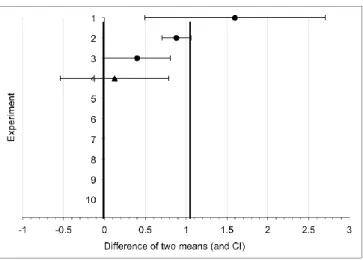
Specifically, meta-analytic thinking can provide a retrospective interpretation of the results, via explicit, direct comparison with prior effect sizes in the related literature (Thompson, 2002, p. 28). Confidence intervals for mean difference effect sizes are presented in Figures 2-7, separated by factors, and Figure 8 shows overall TPACK confidence intervals. The point estimates for the current study are identified by a small triangle, and a circle in each figure identifies all other studies. This was done to easily distinguish between the comparison studies and the present study for interpretation purposes.
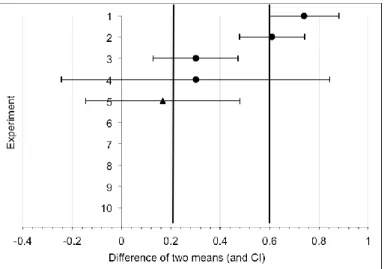
The three primary constructs related to TPACK are CK, PK, and TK. These three constructs are the foundation that the entire framework is built on through the affordances and constraints created by their interaction. The overall confidence intervals for the mean differences in CK were much wider than the intervals for the means of the construct. The confidence interval for the present study was not the widest, but it was the second widest, as displayed in figure 2. Thus, it was the second least precise of the estimates presented in the figure. Standard error is inversely related to sample size, thus as sample size increase standard error will decrease. Accordingly, given the small sample size available in the present study, the error bar width was rather large. The range in mean difference effect sizes in CK after the professional development was approximately between 0.4 and 0.6. Although the point estimate for this study did not fall in this prescribed range, the error bar overlapped with two of the four other studies. This indicates that the results of this study aligned with prior work in the field.
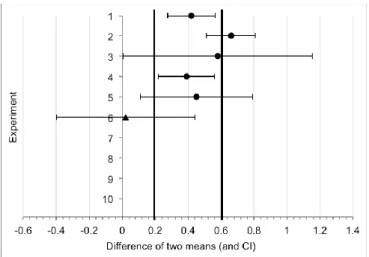
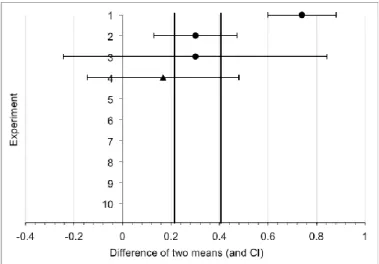
The confidence intervals for PK in figure 3 were similar to those for CK, and the range of mean differences in PK were between approximately 0.2 and 0.4. Confidence intervals for TK, shown in figure 4 were very wide compared to CK and PK confidence intervals, indicating that they were less precise estimates across all studies compared to the previous estimates. The point estimate for TK for the present study was much lower than the other point estimates and the confidence interval intersected zero, indicating that there was little to no difference in the TK means. The overall range of mean differences in TK for the professional development studies were roughly between 0.2 and 0.6. The remaining mean differences are from constructs
that measure the interrelated knowledge teachers received from professional development.
Figure 2. Mean Difference Confidence Intervals for CK after Professional Development
Figure 3. Mean Difference Confidence Intervals for PK after Professional Development
Figure 4. Mean Difference Confidence Intervals for TK after Professional Development
Three constructs capture the intersections of two primary constructs to form a hybrid based on the interactions between the two primary constructs. Figures 5-7 present mean differences in PCK, TPK, and TCK. Aside from one study that had a negative mean difference the overall mean differences for PCK were almost identical point estimates, and the intervals were narrower that the confidence intervals for previous mean differences. Likewise, the range in mean differences for PCK was between 0.2 and 0.4 as seen in figure 5. The range of mean differences in TPK was from approximately 0 to 0.5. The point estimate for the present study was below zero, which indicated that the mean score in TPK after the professional development was less than before. The point estimate for mean difference in TCK was inside the range for the mean difference point estimates in figure 7, between 0 and 1. Further, the confidence interval for the corresponding
point estimate subsumes zero, thus indicating that there was relatively little difference between the pretest and posttest scores on TCK.
Figure 5. Mean Difference Confidence Intervals for PCK after Professional Development
Figure 6. Mean Difference Confidence Intervals for TPK after Professional Development
Figure 7. Mean Difference Confidence Intervals for TCK after Professional Development
Figure 8. Mean Difference Confidence Intervals for TPACK after Professional Development
The mean differences in TPACK measured by the pre-service teacher survey of teaching and technology ranged from .3 to .7. The point estimate for the present study was below zero, thus there was decrease between the pretest and posttest scores on TPACK. In the section that follows a contextualized summary of the results is provided.
Discussion
This research study was guided by two research questions. The first sought to examine the effects of a three-week professional development intervention on the TPACK of middle school mathematics teachers. The professional development increased mathematics teachers’ perceptions of their pedagogical knowledge, pedagogical content knowledge, technological content knowledge, and technological knowledge. The effects of the professional development were largest for the PK construct. This suggest that teachers were more comfortable adjusting content to meet student needs, managing classroom interactions, and implementing a variety of teaching approaches in the classroom after the professional development.
Contrarily, the professional development was less effective at influencing urban mathematics teachers’ general affinity toward technology as represented by the technological knowledge construct. The technological knowledge construct included items such as “I can learn technology easily,” and “I frequently play around with technology.” According to Brinkerhoff (2006) the impediments to technology integration can be categorized by the following: (1) lack of resources, (2) insufficient institutional and administrative support, (3) lack of training and professional development, and (4) attitudinal or personality factors toward technology. The technological knowledge construct is an appropriate measure of attitudinal or personality factors that may impede the integration of technology. This may account for the lack of sizeable growth in this area. Additionally, given that the professional development was situated in the context of the IWB and not general technology use, the relatively small effect size for the technological knowledge construct is reasonable. This can be attributed to
many systemic as well as implementation considerations. Overall, the professional development fostered increased in four of the seven constructs measured. Teacher TPACK, CK, and TPK all decreased from between pretest and posttest measurements.
An item level inspection of the results suggested that the pretest mean item scores were relatively higher for TPACK and mathematics content knowledge. More specifically, the majority of the participants reported scores of at least four on a 5-point Likert scale. The initial high scores limit the ability for participants to grow substantially from pretest to posttest because the initially scores are relatively close to the item “ceiling.” According to Wuang, Su, and Huang (2012), the ceiling effect is a measurement limitation of an instrument whereby the scale cannot determine increased performance beyond a certain level (p. 8). However, this was not the case for the TPK construct. The TPK construct assessed teacher beliefs about their ability to utilize the pedagogical affordances of technology.
Given the substantial increase in the pedagogical knowledge construct, it is feasible that as teachers’ PK increased, they became more aware of the pedagogical constraints of technology do to the technological infrastructure of the district. Much like the landscape of many urban school’s mathematics teachers in this study lacked many resources and ancillary materials necessary to integrate the IWB technology to maximize teaching and learning. Learning to teach and learn with technology requires educators to utilize their intellect, creativity, imagination, and courage (Jacobsen, Clifford, & Friesen, 2002). The contextual variables associated with teaching in an urban school further necessitate the utilization of these skills as the results suggest.
The second research question sought to apply a meta-analytic lens to compare the effects of a three-week professional for urban mathematics teachers to previous interventions to increase teacher TPACK. The results indicate that the effect size point estimates for the current study were lower than the effect size point estimates for similar professional development studies across all constructs. These results suggest that the professional development for urban mathematics teachers was less effective as compared to other studies. The differential effectiveness as measured by the degree of confidence band overlap between studies indicates that for the CK, TK, and PCK constructs only one study had a noticeably larger effect size based visual inspection of the degree of overlap.
The precision and accuracy of the results of the present study fall within the range of the results from similar TPACK professional development studies for all constructs evaluated based on the degree of overlap between confidence bands. This suggests that although technology professional development in urban schools is uniquely nuanced by the effects of the digital divide, urban environments may hinder implementation but do not prevent professional development from influencing teacher TPACK. The confidence interval width is a measure of the precision of the results in this study. For all measures except pedagogical knowledge, the confidence band for this professional development study was not the largest. This indicates that the measurement error from this study was well within the expected range for similar studies. This argument is based on the idea that “comparing confidence intervals from a current study to intervals from previous, related studies helps focus attention on stability across studies… [and] also helps in constructing plausible regions for population parameters” (Wilkinson & The Task Force on Statistical Inference, 1999, p. 599). Appropriately, the confidence band for this study fell with the range of plausible population scores for all constructs measured. Confidence bands completely below or above this range represent effect sizes substantially lower or higher than population estimates. This suggests that the effect of professional development on urban mathematics teachers TPACK is representative of population estimates. The insights and challenges presented in this discussion have important implications for professional development praxis that we present in the next section.
Implications
The inferences drawn from this research are numerous. However, three ideas were the most salient based on the data presented in the current study. These findings are concurrent with literature that details the lack of technology knowledge of the current teaching workforce. Specifically, the fallacy of the digital native has contributed to the lack of emphasis on new teacher training and professional development to support the pedagogical use of technology. Here we provide three specific recommendations to support technology related professional development in urban schools.
1. Technology professional development in urban schools can improve teachers’ pedagogical practices with technology, despite truncated
technology knowledge. A reasonable deduction is that teachers can use technology without knowing it specificities, as often done in teaching mathematics and other STEM content areas. For instance, a teacher can provide mathematical instruction – though arguably not effectively – without having a strong knowledge base; the same can be true with using technology in instruction. Thus, administrators should refrain from not providing technology professional development for staff in urban schools to any perceived or even actualized technology knowledge challenges.
2. Insufficient resources in urban schools contribute to the lack of teacher technology knowledge and attenuate the effects of professional development.
Teachers cannot learn how to use a technological tool if they do not have access to it; which is counterproductive, given national, state, and local increased efforts to include technology into education. Thus, technological policies should be in place or updated to allow for increased access to technology by urban teachers. Further, not only should urban teachers be granted access, but also access to a wide variety of technological tools is at the least generous to improving their technological behaviors.
3. Technology exploration should be encouraged early and often. There must be policies and procedures in place to allow teachers to explore a classroom technology before learning how to use it. For example, we argue that teachers should be afforded an opportunity to become acclimated to the tool before any training begins. Just as students explore new manipulatives or calculators before using them to complete an instructional task, teachers require the same opportunities. Thus, when a new technological tool is introduced to a teacher, exploration time should be taken to allow an opportunity to engage with the tool in a non-threaten manner before they are tasked to learn how to use it for instructional purposes.
Conclusion
The purpose of this study was to assess the effects of professional development on urban mathematics teacher TPACK. The results suggest that technology professional development can be an effective means to increase TPACK for mathematics teachers in urban schools. However, the influences of the urban learning environment on the effects of the intervention cannot be underestimated or unaccounted for in the design and implementation of
the professional development activities. All mathematics teachers face administrative as well as personal challenges that require their attention. However, when schools are under resourced these challenges tend to negatively affect teacher performance. Unfortunately, teacher under performance can have detrimental effects on student learning. To minimize these potential eventualities, we recommend that professional development coordinators provide opportunities for participants to voice their concerns or challenges related to the required tasks periodically and use these data to adjust professional development programming accordingly. Especially, in many urban and rural learning environments that may lack technology infrastructure and resources.
Furthermore, despite lower effect size point estimates for the urban sample, confidence intervals suggest relatively comparable results across most constructs examined. Differences alone suggest that the professional development results were less effective for the urban cohort. Yet, when all studies are considered simultaneously it becomes apparent that the urban cohort mean score increases were not statistically significantly lower than most of the comparable studies. In conclusion, the reporting of effect sizes and confidence intervals facilitated the ability to go “beyond the gap” by placing the scores in a different context. In order to move beyond the fetish of “gap-gazing” or simply identifying performance gaps, it is imperative that researchers begin to utilize meta-analytic thinking as a means to ask better quantitative questions and affect change for all students. Specifically, “the reporting of effect sizes and confidence intervals allows researchers to test the persistence and resilience of results across various samples and geographic regions” (Capraro, 2004, p. 60). The results of this study have domestic as well as international implications for the design, implementation, and evaluation of mathematics professional development, and it is our hope that others will consider meta-analytic thinking as means to contextualize their research results.
References
Algina, J., Keselman, H. J., & Penfield, R. D. (2005). Effect sizes and their intervals: The two-level repeated measures case. Educational and Psychological Measurement, 65, 241–258. doi:
Alavi, M., & Leidner, D. (2001). Research commentary: Technology-mediated learning- A call for greater depth and breadth of research.
Information Systems Research, 12(1), 1-10. doi:
10.1287/isre.12.1.1.9720
Bennison, A. & Goos, M. (2010) Learning to teach mathematics with technology: A survey of professional development needs,
experiences and impacts. Mathematics Education Research Journal, 22(1), 31-56. doi: 10.1007/BF03217558
Bingimlas, K. A. (2009). Barriers to the successful integration of ICT in teaching and learning environments: A review of the literature.
Eurasia Journal of Mathematics, Science & Technology Education,
5(3), 235-245. doi: 10.12973/ejmste/75275
Brinkerhoff, J. (2006). Effects of a long-duration, professional development academy on technology skills, computer self-efficacy, and
technology integration beliefs and practices. Journal of Research on Technology in Education, 39(1), 22-43. doi:
10.1080/15391523.2006.10782471
Capraro, R.M. (2004). Statistical significance, effect size reporting, and confidence intervals: Be reporting strategies. Journal for Research in Mathematics Education, 35(1), 57-62.
Cavaliere, A. (2013). Determining the influence that educational technology professional development has on 4th grade students’ mathematics achievement. Dissertation. St. John’s University,
Queens, NY.
Chai, C. S., Koh, J. H. L., & Tsai, C. C. (2010). Facilitating preservice teachers' development of technological, pedagogical, and content knowledge (TPACK). Educational Technology & Society, 13(4), 63-73. Retrieved from
https://www.jstor.org/stable/jeductechsoci.13.4.63
Cuban, L., Kirkpatrick, H., & Peck, C. (2001). High access and low use of technologies in high school classrooms: Explaining an apparent paradox. American educational research journal, 38(4), 813-834. doi: 10.3102/00028312038004813
Cumming, G., & Finch, S. (2001). A primer on the understanding, use, and calculation of confidence intervals that are based on central and non-central distributions. Educational and Psychological Measurement,
Desimone, L. M. (2011). A primer on effective professional development.
Phi Delta Kappan, 92(6), 68-71. doi: 10.1177/003172171109200616
English, L., & Kirshner, D. (2016). Handbook of international research in mathematics education (3rd ed). New York, NY: Routledge. Earle, R. S. (2002). The integration of instructional technology into public
education: Promises and challenges. Educational Technology, 42(1), 5-13. Retrieved from https://www.jstor.org/stable/44428716
Ertmer, P. A., & Ottenbreit-Leftwich, A. T. (2010). Teacher technology change: How knowledge, confidence, beliefs, and culture
intersect. Journal of research on Technology in Education, 42(3), 255-284. doi: 10.1080/15391523.2010.10782551
Glover, D., Miller, D., Averis, D., & Door, V. (2007). The evolution of an effective pedagogy for teachers using the interactive whiteboard in mathematics and modern languages: An empirical analysis from the secondary sector. Learning, Media, and Technology, 32(1), 5-20. doi:
10.1080/17439880601141146
Henson, R. K. (2006). Effect-size measures and meta-analytic thinking counseling psychology research. The Counseling Psychologist, 34(5), 601-629. doi: 10.1177/0011000005283558
Hill, H. C., Rowan, B., & Ball, D. L. (2005). Effects of teachers’ mathematical knowledge for teaching on student achievement.
American Educational Research Journal, 42(2), 371-406. doi:
10.3102/00028312042002371
Jacobsen, M., Clifford, P., & Friesen, S. (2002). Preparing teachers for technology integration: Creating a culture of inquiry in the context of use. Contemporary Issues in Technology and Teacher Education, 2(3), 363-388. Retrieved from
https://www.learntechlib.org/primary/p/17761/
Jang, S. (2010). Integrating the interactive whiteboard and peer coaching to develop the TPACK of secondary science teachers. Computers & Education, 55(4), 1744-1751. doi: 10.1016/j.compedu.2010.07.020
Kennewell, S., Tanner, H., Jones, S., & Beauchamp, G. (2008). Analyzing the interactive technology to implement interactive teaching. Journal of Computer Assisted Learning, 24(1), 61-73. doi: 10.1111/j.1365-2729.2007.00244.x
Kim, C., Kim, M. K., Lee, C., Spector, J. M., & DeMeester, K. (2013). Teacher beliefs and technology integration. Teaching and teacher education, 29(1), 76-85. doi: 10.1016/j.tate.2012.08.005
Koehler, M. J., & Mishra, P. (2008). Introducing TPACK. In AACTE Committee on Innovation and Technology (Eds.), Handbook of technological pedagogical content knowledge (TPACK) for educators (pp.1-30). New York, NY: Routledge.
Kutaka, T. S., Smith, W. M., Albano, A. D., Edwards, C. P., Ren, L., Beattie, H.L., Lewis, W. J., Heaton, R. M., Stroup, W.W. (2017). Connecting teacher professional development and student mathematics achievement: A 4-year study of an elementary mathematics specialist program. Journal of Teacher Education, 68(2), 140-154. doi: 10.1177/0022487116687551
Lawless, K. A., & Pellegrino, J. W. (2007). Professional development in integrating technology into teaching and learning: Knowns,
unknowns, and ways to pursue better questions and answers. Review of Educational Research, 77(4), 575-614. doi:
10.3102/0034654307309921
LeCroy, W. C., & Krysik, J. (2007). Understanding and interpreting effect size measures. Social Work Research, 31(4), 243-248. Retrieved from https://www.jstor.org/stable/42659906
Mishra, P., & Koehler, M. J. (2006). Technological pedagogical content knowledge: A framework for integrating technology in teacher knowledge. Teachers College Record, 108(4), 1017-1054. doi:
10.1111/j.1467-9620.2006.00684.x
Mitchell, K., Bakia, M., & Yang, E. (2007). State strategies and practices for educational technology: Volume II-Supporting mathematics instruction with educational technology. Washington, DC: US Department of Education, Office of Planning, Evaluation, and Policy Development.
Meier, E. B. (2005). Situating technology professional development in urban schools. Journal of Educational Computing Research, 32(4), 395-407. doi: 10.2190/5KCQ-5VKQ-380X-JYND
Mullen, R., & Wedwick, L. (2008). Avoiding the digital abyss: Getting started in the classroom with YouTube, digital stories, and blogs. The Clearing House: A Journal of Educational Strategies, Issues and Ideas, 82(2), 66-69. doi: 10.3200/TCHS.82.2.66-69
Mouza, C. (2011). Promoting urban teachers’ understanding of technology, content, and pedagogy in the context of case development. Journal of Research on Technology in Education, 44(1), 1-29. doi:
10.1080/15391523.2011.10782577
National Council of Teachers of Mathematics. (2000). Principles and standards of school mathematics. Reston, VA: Author.
National Mathematics Advisory Panel. (2008). Foundations for success: The final report of the National Mathematics Advisory Panel. Washington, DC: U. S. Department of Education.
Niess, M. L. (2005). Preparing teachers to teach science and mathematics with technology: Developing a technology pedagogical content knowledge. Teaching and Teacher Education, 2(3), 509-523. doi:
10.1016/j.tate.2005.03.006
Paige, R. (2005). Toward a new golden age in American education: How the internet, the law and today's students are revolutionizing expectations. Jessup, MD: The US Department of Education. Pape, S. J., Prosser, S. K., Griffin, C. C., Dana, N. F., Algina, J., & Bae, J.
(2015). Prime online: Developing grades 3-5 teachers’ content knowledge for teaching mathematics in an online professional development program. Contemporary issues in technology and teacher education, 15(1), 14-43. Retrieved from
https://bit.ly/2Ms1Wki
Polly, D. (2011). Developing teachers’ technological, pedagogical, and content knowledge (TPACK) through mathematics professional development. The International Journal for Technology in Mathematics Education. 18(2), 83-95. Retrieved from
https://search.proquest.com/openview/200a7047b53cd2404dfde5bb3 c95f4cc/1?pq-origsite=gscholar&cbl=29124
Russell, M., Bebell, D., O'Dwyer, L., & O'Connor, K. (2003). Examining teacher technology use: Implications for preservice and inservice teacher preparation. Journal of Teacher Education, 54(4), 297-310. doi: 10.1177/0022487103255985
Schmidt, D., Baran, E., Thompson, A., Koehler, M. J., Shin, T., & Mishra, P. (2009, April). Technological Pedagogical Content Knowledge (TPACK): The development and validation of an assessment instrument for pre-service teachers. Paper presented at the 2009
Annual Meeting of the American Educational Research Association, San Diego, CA.
Shadish, W. R., Cook, T. D., & Campbell, D. T. (2002). Experimental and quasi-experimental designs for generalized causal inference. Boston, MA: Houghton Mifflin Company.
Shin, T., Koehler, M. J., Mishra, P. Schmidt, D., Baran, E., & Thompson, A. (2009, March). Changing Technological Pedagogical Content Knowledge (TPACK) through course experiences. Paper presented at the 2009 International Conference of the Society for the Information and Technology & Teacher Education, Charleston, SC.
Shulman, L. (1986). Those who understand: Knowledge growth in teaching. Educational Researcher, 15, 4-14. doi:
10.3102/0013189X015002004
Smithson, M. (2001). Correct confidence intervals for various regression effect sizes and parameters: The importance of noncentral
distributions in computing intervals. Educational and Psychological Measurement, 61, 605– 632. doi: 10.1177/00131640121971392
Telese, J. A. (2012). Middle school mathematics teachers’ professional development and student achievement. Journal of Educational Research, 105(2), 102-111. doi: 10.1080/00220671.2010.521209
Thompson, B. (2002). What the future quantitative social science research could look like: Confidence intervals for effect sizes. Educational Researcher, 31(25), 25-32. doi: 10.3102/0013189X031003025
Thompson, B. (2007). Effect sizes, confidence intervals, and confidence intervals for effect sizes. Psychology in the Schools, 44(5), 423-432. doi: 10.1002/pits.20234
Vacha-Haase, T., Nilsson, J. E., Reetz, D. R., Lance, T. S., & Thompson, B. (2000). Reporting practices and APA editorial policies regarding statistical significance and effect size. Theory & Psychology, 10(3), 413-425. doi: 10.1177/0959354300103006
Van Steenbrugge, H., Valcke, M., & Desoete, A. (2010). Mathematics learning difficulties in primary education: teachers’ professional knowledge and the use of commercially available learning packages.
Educational Studies, 36, 59-71. doi: 10.1080/03055690903148639
Wachira, P., & Keengwe, J. (2011). Technology integration barriers: Urban school mathematics teachers perspectives. Journal of science
Education and Technology, 20(1), 17-25. doi: 10.1007/s10956-010-9230-y
Warren, C. (2003). Interactive whiteboards: An approach to an effective methodology. Retrieved from
http://www.virtuallearning.org.uk/whiteboards/An_approach_to_an_ effective_metho dology.pdf.
Wenglinsky, H. (1998). Does it compute? The relationship between educational technology and student achievement in mathematics. Princeton, NJ: Educational Testing Service, Center.
Wilkinson, L. (1999). Statistical methods in psychology journals:
Guidelines and explanations. American psychologist, 54(8), 594-604. Wuang, Y. P., Su, C. Y., & Huang, M. H. (2012). Psychometric
comparisons of three measures for assessing motor functions in preschoolers with intellectual disabilities. Journal of Intellectual Disability Research, 56(6), 567-578. doi:
10.1037/0003-066X.54.8.594
Zientek, L. R., Yetkiner, Z. E., & Thompson, B. (2010). Characterizing the mathematics anxiety literature using confidence intervals as a literature review mechanism. The Journal of Educational Research, 103(6), 424-438. doi: 10.1080/00220670903383093
Jamaal Rashad Young is Associate Professor, at the University of Iowa, USA.
Jemimah Young is Assistant Professor, at the University of Iowa, USA.
Christina Hamilton is Assistant Professor, at Huston-Tillotson University, USA.
Sarah Smitherman Pratt is Assistant Professor, at Baylor University, USA.
Contact Address: Direct correspondence concerning this article, should be addressed to the author. Postal Address: N287 Linqui Center, Iowa, 52242, USA. Email: [email protected]