Interactive Tabletops for Architectural Visualization
Combining Stereoscopy and Touch Interfaces for Cultural Heritage
Bruno Figueiredo
1, Eduardo Castro e Costa
2, Bruno Araújo
3, Fernando Fonseca
4,
Daniel Mendes
5, Joaquim A Jorge
6, José Pinto Duarte
7 1Escola de Arquitectura, Universidade do Minho
2,6
CIAUD, Faculdade de Arquitetura, Universidade de Lisboa
3,4,5,6INESC-ID, Instituto Superior Técnico, Universidade de Lisboa
7http://home.fa.utl.pt/˜jduarte/
1[email protected]
2,7{castroecosta|jduarte}@fa.ulisboa.pt
3[email protected]
4,5{fernando.fonseca|danielmendes}@ist.utl.pt
6[email protected]
This paper presents an interactive apparatus to didactically explore Alberti's
treatise on architecture, De re aedificatoria, as generative design systems, namely
shape grammars. This apparatus allows users to interactively explore such
architectonical knowledge in both appealing and informal ways, by enabling
them to visualize and manipulate in real-time different design solutions. The
authors identify the difficulties on encoding the architectural knowledge of a
parametric design model into an interactive apparatus to be used by laypeople.
At last, the authors discuss the results of a survey conducted to users that
interacted with the prototype in order to assess its ability to communicate the
knowledge of an architectural language.
Keywords:
Alberti, generative design, multi-modal interfaces, shape grammars,
user experience
INTRODUCTION
This paper presents an interactive apparatus to di-dactically explore Alberti's treatise on architecture, De re aedificatoria(Alberti, 2011), as a generative de-sign system. This work belongs to a wider project, Alberti Digital, which aims to determine the influ-ence ofDe re aedificatoriaon Portuguese Renaissance
architecture, making use of a computational frame-work.
We chose to hermeneutically explore the treatise descriptions on sacred buildings andcolumnatio sys-tems by inferring the underlying structure provided by description grammars and shape grammars (Stiny and Gips, 1972).
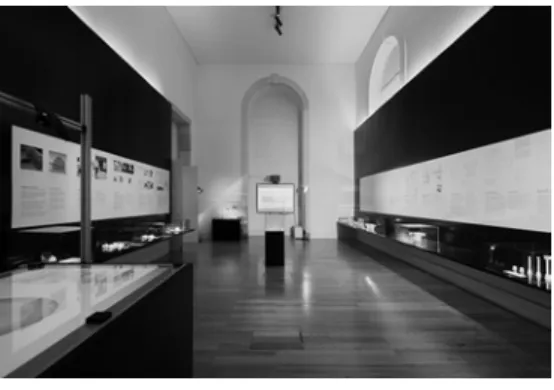
A synthesis of the project outcomes was shown as an exhibition, firstly presented in April 2013, at the Science Museum, University of Coimbra (Figure 1). The exhibition focuses not only on the results achieved, but also on the tools used, and on their de-velopment.
It also features a semi-immersive environment to pedagogically present the knowledge inferred in defining the shape grammars. This interactive appa-ratus allows us to explore the architectonical knowl-edge described on theDe re aedificatoriain appeal-ing and informal ways, by enablappeal-ing the visitors to vi-sualize and manipulate in real-time different design solutions generated interactively.
Simultaneously, the semi-immersive table facili-tated the comprehension of the combinatory, algo-rithmic and computational nature of Albertian ar-chitectural theory, by highlighting explicit relation-ships between the generative model outcomes, as well as the morphology and proportional variations prescribed in the treatise.
Figure 1 Alberti Digital exhibition, Science Museum, University of Coimbra, April 2013 (photo by Do Mal O Menos)
METHODOLOGY
The De re aedificatoria descriptions offer enough knowledge to define an architectural language and a grammar, expressed in algorithmic terms. Accord-ingly, the initial stage of our research included four steps (Figure 2). Since the treatise only contains tex-tual descriptions, our initial task was to read and select parts of the text describing the architectonic components from thecolumnatiosystems and the
temples. The second task was to gather and group the information into parametric schemas that inter-pret those descriptions. This information can be en-coded into a grammar that, through the application of its rules, generates a corpus of solutions that fol-low the treatise's architectonical rules. Finally, trans-lating the grammars into a parametric computational model allows us to visualize the resulting structures. We developed an interactive setup to explore de-sign space prerogatives of the treatise in a fashion ac-cessible to laypeople. We devised a tabletop proto-type to explore 3D virtual models of existing build-ings in stereoscopy, as if they were physical models lying above the tabletop (Figure 5). We also intro-duced the possibility of customizing an entire model of a temple according to the rules in our Alberti shape grammar.
DESIGN DESCRIPTIONS AND DESIGN
COM-PUTATION MODELS: DIDACTIC TOOLS
TO CLASSICAL ARCHITECTURAL
KNOWL-EDGE
Establishing design principles can be a complex pro-cess, it involves (self ) arguing and defining rules of design, using different areas of knowledge (geom-etry, physics, economics and social sciences, etc.). The tradition of classical architecture is an example of this feature where standard systems of naming and segmentation contributed to establish a conceptual framework and its architectural principles. Accord-ing to Mitchell (1990, p.24), this requires a vocabu-lary large enough to differentiate parts, symbolic and functional relationships that enable specifying prop-erties and interrelations of different parts in the de-sign. This vocabulary can either be expressed by as-signing values to variables of a data structure, or by a set of logical principles and their notations, or even through a textual description written in natural lan-guage
Simultaneously, computation can be under-stood as a series of rational, logic, algorithmic, de-ductive and inde-ductive processes, whose structure and systematization explores the possibility of
ob-Figure 2 Diagram representing the steps taken to understand and decode the treatise
Figure 3
Computation tree of the temples shape grammar: to each step of the computation, by the application of a rule, are visible the possible
transformations for the specific left side shape of the rule. (Figueiredo et al, 2013)
taining solutions to a given problem. Although eminently abstract, these structures allow to relate knowledge obtained through cognition, simulation and intelligence-based rules, among others.
This research took into consideration the idea that design descriptions and computation are both transversal tools to engage an architectural design and subsequent language of design. In order to com-municate this principles to a wider public, most of the times codified in representations that only ar-chitects understand, we have proposed an exhibi-tion setup that helped the visitor to grasp the ar-chitectural principles inscribed inDe re aedificatoria. The layout of the interactive stereoscopic visualiza-tion apparatus was structured to explicit the compu-tational and combinatory relations synthesized in the shape grammars and their generative outcomes.
GENERATIVE SHAPE GRAMMAR'S IN
AC-CORDANCE TO ALBERTI'S THEORY
Since the treatise has no graphical information, our first task was to read it and to systematize knowledge that led to the understanding of the column systems and temples architectonical principles. Graphical no-tations were drawn from the translation of our inter-pretation of the text. These notations led to the def-inition of a set of parameters and conditions which allowed for the development of a system of schemas, useful to set algorithms that inform both the shape and proportions from each part and the relations be-tween the parts of the buildings and their interre-lated proportional features.
Departing from this knowledge, a set of shape rules were defined to compose acolumnatiosystems generative shape grammar and a rectangular tem-ples generative shape grammar. In both grammars, by applying their shape rules in a step by step
compu-tation methodology, are generated design solutions within the same language. Figure 3 illustrates this process, a computational sequence, where different options are shown after the use of each rule of trans-formation, but only one is subsequently transformed by the use of the next rule, finally resulting in a design solution for a rectangular temple.
Based on the developed shape grammars, and in order to test them, parametric models were de-veloped in a visual programming interface, imple-mented into computer programs that automatically generate digital models in a CAD application, accord-ing to input parameters (Figure 4). This framework al-lows for real-time visualization of the results of vary-ing parameters. These parametric models are highly detailed and compliant with Alberti's prescriptions encoded in the shape grammars (Figueiredo et al, 2013), and they served as a direct basis for the devel-opment of the virtual reality tabletop application.
INTERACTIVE STEREOSCOPIC
VISUALIZA-TION OF ALBERTI ARCHITECTURAL
MOD-ELS: A DIDACTIC TOOL TO COMPREHEND A
GENERATIVE DESIGN SYSTEM
The technological advances that have been wit-nessed in the last few years allowed the development of new and more interactive applications for all kinds of scenarios. Multi-touch devices and depth sensors like Microsoft´s Kinect are clear examples of these ad-vances, allowing both non-intrusive and inexpensive user tracking. As for visualization, common 3D dis-plays allow users to perceive imagery as if it popped outside the screen. This motivates a fresh look at tabletop interfaces, towards better support of 3D di-rect manipulations in scenarios until recently con-ceivable in the realm of science fiction.
Exploiting the aforementioned technological so-lutions, we developed a tabletop prototype (Figure 5) that consists on a semi-immersive environment based on a stereoscopic multi-touch surface com-bined with a Microsoft Kinect depth camera. This camera (E) tracks the user's head, enabling a real-time personalized 3D perspective view of the contents
shown on the table. While a user moves around the table, the perspective view of the building changes according to his or her movement. A 3D television set (D) combined with a 3D active shutter glasses (B) en-ables stereoscopic visualization, sending 1920x1080 pixel resolution images to each eye 60 times per sec-ond. This setup allows rendering high definition vir-tual objects as if they were lying above the table sur-face. The touch-enabled surface, using a multi-touch frame (C) capable of detecting up to 10 touches, al-lows interacting with virtual models through ges-tures. Figure 4 Sample of design solutions generated by the temples parametric model. Figure 5 Tabletop prototype hardware setup
With this semi-immersive environment, users can explore 3D virtual models of buildings using both hands. To manipulate the content on the stereo-scopic surface the visitor can use several touches to interact with each model at a time. We developed a finger-cluster interaction method, which allows users to move, rotate and uniformly scale the models. By dragging the fingers anywhere along the surface, the model will move in the direction of their movement.
Figure 6
Tabletop prototype operating diagram
To rotate the model along the axis perpendicular to the surface, people need to apply a rotational move-ment via at least two fingers, but they can use their entire hand if they want. By changing the relative position of all fingers a user can uniformly scale the object. If the distance between the fingers and their center changes, the model scale will increase or de-crease accordingly. This technique uses the well-known algorithm Rotate-N-Translate (Hancock et al., 2006), available in almost every modern multi-touch device (Figure 7). Figure 7 Possible interactions through touch: translation, rotation, and scaling
FROM PARAMETRIC MODEL TO THE
TABLETOP INTERFACE
By means of this environment, users can explore 3D virtual models of Alberti buildings. In addition, we included a special model, which is a temple that sup-ports different types of customizations, accordingly to the shape grammar extracted from theDe re aedi-ficatoriatreatise
Similarly to what the generative shape grammars
support, the interactive prototype simulates para-metric variations on generated solutions by consid-ering certain proportional, morphological and stylis-tic attributes in detriment of others, allowing the user to choose, under certain restrictions, the shape rules to be applied.
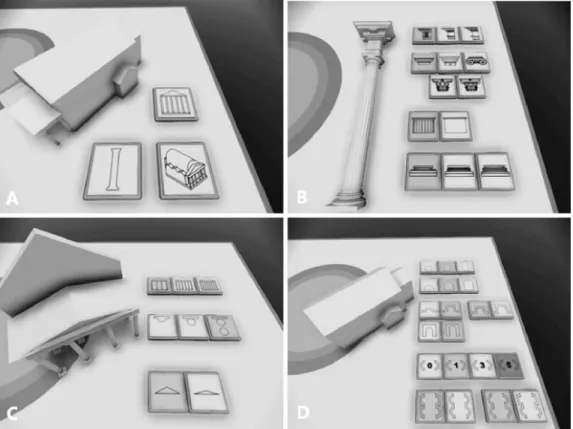
The tabletop prototype, allows people to select different shape rules using a button-based graphical user interface (GUI), which controls certain features of the temple model (Figure 8). Each feature com-bines specific parameter(s) and condition(s), which can be changed within a pre-defined set of values, represented by mutually exclusive toggle buttons. For each feature, only a button can be activated at a time, and some buttons might be disabled depend-ing on selected features. For example, the number of pairs of lateral chapels that compose the temple is a feature, whose values can vary between 0, 1, 3 or 5. However, if the cell proportion (another fea-ture) becomes smaller than 3:1, measuring the rela-tion between the length and the width, the button with value five will be disabled (Figure 8, D) since this proportion does not accommodate five pairs of lat-eral chapels along the longitudinal inner facades.
The set of customizable attributes, or features (Table 1), is divided into three modes, related to three aspects of the temple (Figure 8, A), namely the com-position of thecolumnatiosystem (Figure 8, B), the ar-rangement of the portico located in the main facade
Figure 8 Temple customization: menus (Fonseca, 2013)
(Figure 8, C), and the temple itself morphology and proportions (Figure 8, D).
The main architectural knowledge on temples that Alberti encoded in his treatise translates to the three modes of interaction. Although discrete, they establish interrelations between each other, thus framing an overall architectural language. Different combinations from thecolumnatiosystem parts will affect the portico definition as well as the dimen-sion of the cell, tribune and chapels. Simultaneously, changes to the cell proportions will constrain the width, height and depth of the portico
The layout of the interface was designed to pro-vide people (museum visitors) with a clear under-standing that, by manipulating one architectural
fea-ture, other characteristics will be affected, as well the overall expression of the building, thus affording a better, clearer exploration of the Albertian design space by laypeople.
This network of proportional and morphological dependency represents to a certain extent the idea ofconcinnitas, the basic principle of the Albertian thought, described by Rudolf Wittkower (1973, p.33) as embodying the classical idea of maintaining a uni-form system of proportion throughout all parts of a building.
FEEDBACK FROM USERS
The objective of developing such a prototype was to present an architectural language in a way that
Table 1 Temple customization: features
would engage the exhibition visitors, providing an experience different from the traditional exhibition media. In order to assess the success of this initia-tive, a survey was conducted to users that interacted with the prototype, in which they could express their opinions about that experience. The survey was con-ducted to 27 people, with ages over 19. More than half of the users were between 19 and 24 years old, and two thirds hold a Bachelor degree or higher.
From such survey, which consisted of closed Likert-scaled questions, we were able to gather infor-mation to conclude the following:
• The prototype aroused the immediate curios-ity of 62 % of visitors, leading them to experi-ment with it right away.
• 54% of visitors felt that the application in-terface was easy to use, and only one visitor could not understand how it worked. • All visitors agree that the prototype
undoubt-edly enriches the experience of the museum exhibition, and also agree that this type of ex-perience can be interesting when applied to other exhibitions.
• The interactive table provides an engaging and innovative experience for visitors, thus enriching the exhibition. The visitors agree that such an experience is more interesting than the models and posters also presented at the exhibition.
• The application enables the visitors to visual-ize the buildings in 3D through stereoscopy, and they agree that it enriches the experience. Only 18 % of visitors did not realize that while moving around the table the perspective view of the building changed according to their movement.
We can say that the interactive system was successful as a didactic tool, able to convey a specific architec-tural heritage - architecarchitec-tural knowledge described in theDe re aedificatoria- by allowing users to explore the system generative outcomes within their vocab-ulary and syntax content.
CONCLUSIONS
In implementing Alberti's models into the tabletop prototype, two main difficulties arose. The first dif-ficulty was technological: the application running on the tabletop prototype doesn't match the genera-tive capabilities of the shape grammar formalism, nor of the corresponding parametric model. The solu-tion space generated by combining all the parame-ters in the original models proved too complex to be implemented into the prototype's application. This fact forced the selection of a number of parameters smaller than the ones available in the original shape grammar and parametric model.
Nevertheless, supposing that all the parameters could be implemented, the control of such an sive solution space would require an equally
exten-sive - and complex - user interface, forcing the use of even more modes, with more sets of features, and probably rendering the experience very little engag-ing to the user.
Therefore, the second difficulty was a cognitive one. This emphasizes the need to focus research not only on pushing the technological boundaries of generative design systems, towards the ability to model and visualize more accurately and with more detail, but also on synthesizing the complexity of the Albertian thought in order to communicate their essence to a non-specialist audience.
Current research is pursuing a system that can provide an even deeper engagement of the user. On one hand, tools are being developed that overcome the technological constraints that conditioned the in-terface for the presented prototype. The objective is to extend the manipulation of geometry beyond the combination of objects, towards parametric and rule-based real-time modelling. On the other hand, such modelling is intended to be as user-friendly as pos-sible, taking into account both the cognitive and er-gonomic characteristics of the average user. By com-bining techniques such as virtual reality, motion cap-ture and shape grammars, we aim towards a new generation of interfaces that allow for a smoother in-teraction between designers, namely architects, and their creations.
ACKNOWLEDGEMENTS
This work was partially supported by the Por-tuguese Foundation for Science and Technol-ogy (FCT): doctoral grants SFRH/BD/69910/2010, SFRH/BD/88040/2012 and SFRH/BD/91372/2012, and projects MIVis PTDC/EIA-EIA/104031/2008, Alberti Digital PTDC/AUR-AQI/108274/2008, TECTON-3D PTDC/EEI-SII/3154/2012 and Pest OE/EEI/LA0021/2013.
REFERENCES
Alberti, LB 2011,Da Arte Edificatória, Fundação Calouste Gulbenkian, Lisboa
Araújo, B, Jorge, JA and Duarte, JP 2012 'Combining Vir-tual Environments and Direct Manipulation for Ar-chitectural Modeling',Proceedings of eCAADe 2012, Prague, pp. 419-428
Duarte, JP, Krüger, M, Coutinho, F, Figueiredo, B and Castro e Costa, E 2013, 'Alberti Digital: Investi-gando a influência de Alberti na arquitectura por-tuguesa da contrarreforma', in Brandão, CAL, Caye, P, Furlan, F and Loureiro, MA (eds) 2013,Na Gênese das Racionalidades Modernas: Em torno de Leon Bat-tista Alberti, Editora UFMG, Belo Horizonte, pp. 488-548
Figueiredo, B, Castro e Costa, E, Pinto Duarte, J and Krüger, M 2013 'Digital Temples: A Shape Grammar to Generate Sacred Building according to Alberti’s Theory',Proceedings of Future Traditions, Rethinking Traditions and Envisioning the Future in Architecture Through the Use of Digital Technologies, Porto, pp. 63-70
Figueiredo, B, Duarte, JP and Krüger, M 2013 'Albertian Grammar Transformations: From the treatise to the built work in the design of sacred buildings', Proceed-ings of eCAADe 2013, Delft, pp. 687-696
Fonseca, F 2013,Manipulações no espaço sobre mesas in-terativas com estereoscopia, Master's Thesis, Instituto Superior Técnico: Universidade de Lisboa Hancock, MS, Vernier, FD, Wigdor, D, Carpendale, S and
Shen, C 2006 'Rotation and Translation Mechanisms for Tabletop Interaction',TABLETOP, Adelaide, pp. 79-88
Mitchell, W 1990,The Logic of Architecture: Design, Com-putation and Cognition, The MIT Press, Cambridge, Massachussets
Stiny, G 2011, 'What Rule(s) Should I Use?',Nexus Network Journal, 13(1), pp. 15-47
Stiny, G and Gips, J 1972 'Shape Grammars and the Gen-erative Specification of Painting and Sculpture', In-formation Processing 71: Proceedings of IFIP Congress 71., Amsterdam, pp. 1460-1465
Wittkower, R 1972,Architectural principles in the age of humanism, Academy, London