DEVELOPING AND VALIDATING A NEW
RELIABLE INSTRUMENT FOR ASSESSING OPEN
DISTANCE LEARNING EDUCATORS’ LEARNING
MANAGEMENT SYSTEM - TPACK
by
Michelle Luckay,677475
Protocol Number: 2014ECE005M
A research report submitted to the Wits School of Education, Faculty of Humanities, University of the Witwatersrand in partial fulfilment of the requirements for the degree of Master of Education by combination of coursework and research
Johannesburg
Supervisor: Mr T Waspe
Copyright © 2017 All Rights Reserved
ii
COPYRIGHT NOTICE
The copyright of this thesis vests in the University of the Witwatersrand, Johannesburg, South Africa, in accordance with the University’s Intellectual Property Policy.
No portion of the text may be reproduced, stored in a retrieval system, or transmitted in any form or by any means, including analogue and digital media, without prior written permission from the University. Extracts of or quotations from this thesis may, however, be made in terms of Sections 12 and 13 of the South African Copyright Act No. 98 of 1978 (as amended), for non-commercial or educational purposes. Full acknowledgement must be made to the author and the University.
An electronic version of this thesis is available on the Library webpage (www.wits.ac.za/library) under “Research Resources”.
For permission requests, please contact the University Legal Office or the University Research Office (www.wits.ac.za).
iii
ABSTRACT
Modern-day open and distance learning (ODL) educators are increasingly being called upon to apply different forms of knowledge to integrate web-based learning management systems (LMSs) effectively for teaching and learning. To test this assumption, this study set out to develop and validate a new reliable instrument for assessing ODL educators’ perceived learning management system technological pedagogical content knowledge (LMS-TPACK). Past empirical studies grounded in Mishra and Koehler’s TPACK framework (2006) were examined to construct the self-report survey. Quantitative data were collected from 332 educators. Descriptive analysis, exploratory factor analysis and internal consistency reliability using Cronbach’s alpha coefficients were computed. The findings reveal key LMS-TPACK constructs that have proven to be both valid and reliable. Six out of the seven subscales
used to assess LMS-TPACK were found to be significant, i.e. LMS knowledge
(LMS-K), pedagogical knowledge (P(LMS-K), content knowledge (C(LMS-K), pedagogical content knowledge (PCK), LMS pedagogical knowledge (LMS-PK) and LMS-TPACK, while LMS-CK failed to emerge in the factor structure. Several possible reasons are proposed for the lack or absence of LMS-CK. The resulting Cronbach’s alpha coefficients for the different constructs as well as the overall instrument scale provide compelling evidence for stable internal consistency reliability. Alpha for the entire LMS-TPACK survey was found to be excellent (α = .931). Recommendations are made for improvements to the instrument and directions for future research are highlighted.
Keywords:
Learning management system, technological pedagogical and content knowledge, integration, open distance learning, educators, perceptions, self-report, instrument, validity, reliability
iv
DECLARATION OF ORIGINALITY
I declare that this research report is my own unaided work. It is being submitted for the degree of Master of Education (Educational Technology) at the University of the Witwatersrand, Johannesburg. It has not been submitted before for any degree or examination at any other University.
Name of Candidate: Mrs M Luckay
Student No.: 677475
Protocol No.: 2014ECE005M
Signature: ______________________
v
DEDICATION
As a working wife, mother and student, these last few years have been the hardest and longest journey of my life. What a constant compromise, an endless trade-off between what is most important to me. I guess the only ones who can fully comprehend this struggle are the countless other women who have trodden the same path. One thing is for sure: without the support of loved ones, this journey would not have been possible.
For this reason, this report is dedicated to my husband, Willy Luckay, who not once doubted my ability to do this. No matter how many times I gave up, you hung in there with me to pursue my dream. Thank you my darling.
To my two beautiful children, Nekita and Nicholas, thank you for bearing my tacky irritableness and for understanding when I needed to go to the office to study. If anything, my hope is that you will always remember my strong conviction in education as being the most promising antidote to ignorance and life’s little imperfections.
Finally, to my mom Maureen and late dad, Dennis Haupt,thank you for yourunfailing love and endless inspiration to constantly better myself and to pursue my dreams.
vi
ACKNOWLEDGEMENTS
My sincere thanks and appreciation go out to the following:
First and foremost GodAlmighty, thank you for your blessings and for giving me the strength and wisdom and seeing me through to completion of this master’s
degree.
Mr Tom Waspe, my study supervisor,for your invaluable guidance and
unwavering patience.
Ms Marietjie Coetzee, for helping with the survey layout and getting it online.
Mr Hennie Gerber, for your statistical expertise and assisting me in navigating the
data analysis process.
The University of South Africa (UNISA) and the Whitmore Richards
Postgraduate Bursary Fund for their financial assistance.
My co-workers and friends, especially Prof Jimmy Hendrick, Robert Maungedzo
and Khanyisile Mbatha, who gave of their time and energy to engage with me and
to provide feedback.
And finally, a special word of thanks to all UNISA staff who willingly participated to make the study project possible.
Verily verily I say unto you, that whosoever shall say unto this mountain, be thou removed and cast into the sea, and does not doubt in his heart but believes, it will be
vii
TABLE OF CONTENTS
COPYRIGHT NOTICE……….…… ABSTRACT………... DECLARATION OF ORIGINALITY……….. DEDICATION………... ACKNOWLEDGEMENTS………..…. TABLE OF CONTENTS……….….. LIST OF TABLES………. LIST OF FIGURES………..……. LIST OF ABBREVIATIONS AND ACRONYMS………..ii iii iv v vi vii xii xiii xiv CHAPTER 1
FRAMING THE STUDY………...………. 1.1 INTRODUCTION………. 1.2 A TRANSITIONING ODL CONTEXT – THE CASE OF UNISA…………. 1.3 STATEMENT OF THE PROBLEM………. 1.4 PURPOSE OF THE STUDY……… 1.5 RESEARCH QUESTIONS………... 1.5.1 Main question……….. 1.5.2 Sub-questions………..………… 1.6 RESEARCH ASSUMPTIONS………. 1.7 SIGNIFICANCE OF THE STUDY………... 1.8 SUMMARY………... 1.9 STRUCTURE OF THIS REPORT………
1 1 3 4 5 5 6 6 6 6 7 8 CHAPTER 2
LITERATURE REVIEW AND CONCEPTUAL FRAMEWORK………..….. 2.1 INTRODUCTION………. 2.2 DEFINITION OF CORE TERMS……....………... 2.2.1 What are ICTs?... 2.2.2 What varieties of ICTs are commonly used in distance education?... 2.3.3 What is a Learning Management System (LMS)?...
9 9 9 10 10 11
viii 2.2.4 Learning environments: ODL and ODeL what are they?...
2.2.5 What is blended learning?... 2.2.6 What is flexible learning?... 2.2.7 What is student-centred learning?... 2.2.8 What is meant by student support?... 2.3 AFFORDANCES…... 2.4 LMS AFFORDANCES FOR TEACHING AND LEARNING: A
TAXONOMY AS A MAPPING TOOL FOR DEVELOPING LMS-TPACK….. 2.4.1 Category 1: Content design, use and reuse……….. 2.4.2 Category 2: Interaction……… 2.4.3 Category 3: Web-based instruction…………... 2.4.4 Category 4: E-assessment……….……… 2.4.5 Category 5: Site management and housekeeping………... 2.5 HOW THE AFFORDANCES OF A CURRENT INSTITUTIONAL LMS ARE BEING USED TO SUPPORT ODL……….. 2.6 CHALLENGES ASSOCIATED WITH THE PEDAGOGICAL
INTEGRATION OF LMSs….………... 2.7 THE TPACK FRAMEWORK………...
TPACK Constructs………... 2.7.1 Technology Knowledge (TK)……….. 2.7.2 Pedagogical Knowledge (PK)……….. 2.7.3 Content Knowledge (CK)………... 2.7.4 Pedagogical Content Knowledge PCK)………... 2.7.5 Technological Pedagogical Knowledge (TPK)……… 2.7.6 Technological Content Knowledge (TCK)……….…. 2.7.7 Technological Pedagogical Content Knowledge (TPACK)………... 2.8 CONCEPTUAL FRAMEWORK AND DEVELOPMENT
From TPACK to LMS-TPACK………..……... 2.9 MEASUREMENT OF TPACK………... 2.10 SUMMARY………. 12 13 13 14 14 15 18 18 20 22 24 25 26 29 31 33 33 34 35 35 37 37 38 39 43 46 CHAPTER 3 MEASUREMENT DEVELOPMENT……….……….. 47
ix 3.1 OVERVIEW………. 3.2 VALIDITY………..……….………. 3.3 RELIABILITY……….………. 3.4 SUMMARY……….. 47 48 50 52 CHAPTER 4
RESEARCH DESIGN AND METHODOLOGY………. 4.1 INTRODUCTION………. 4.2 A QUANTITATIVE RESEARCH APPROACH…..………….……….. 4.3 RESEARCH DESIGN...……… 4.4 UNIT OF ANALYSIS………... 4.4.1 Target population……….….. 4.4.2 Sample size……… 4.4.3 Sampling method……….……….. 4.5 ETHICAL CONSIDERATIONS………... 4.6 THE QUESTIONNAIRE……….. 4.7 SCALE DEVELOPMENT (INSTRUMENT DESIGN)………... 4.7.1 Step 1: Conceptualisation: Using theory to clarify constructs………... 4.7.2 Step 2: Literature review………..…... 4.7.3 Step 3: Generating a preliminary item pool……….. 4.7.4 Step 4: Determining the response format of the scale.………... 4.7.5 Step 5: Focus group……….. 4.7.6 Step 6: Expert review and revisions………..………... 4.7.7 Step 7: Pre-testing the questionnaire ……… 4.8 DATA COLLECTION……….. LMS-TPACK Survey………..……….…….. 4.9 DATA ANALYSIS………... 4.10 SUMMARY……… 54 54 54 55 56 56 56 56 57 57 58 59 59 61 63 63 64 64 65 65 66 68 CHAPTER 5
RESULTS AND FINDINGS……… 5.1 INTRODUCTION………. 5.2 DATA ANALYSIS METHODOLOGY ………..
69 69 69
x 5.3 DESCRIPTIVE STATISTICS OF SUBJECTS ………...………… 5.4 PRELIMINARY ANALYSIS………... 5.4.1 Sample size………. 5.4.2 Communality………. 5.4.3 Correlation matrix……….. 5.4.4 Kaiser-Meyer-Olkin (KMO) measure of sampling adequacy……… 5.4.5 Bartlett’s test of Sphericity………. 5.5 VALIDITY……… 5.5.1 Factor extraction……… 5.5.2 Determining the number of factors……… CRITERION 1: Eigenvalue > 1………... CRITERION 2: Cumulative percentage of variance ……… CRITERION 3: Scree plot ……… 5.5.3 Factor rotation……… 5.5.4 Interpretation and construct labelling……… 5.6 RELIABILITY……... 5.7 SUMMARY……….…. 70 72 74 74 77 77 77 78 78 78 78 79 81 82 90 92 103 CHAPTER 6
DISCUSSION, CONCLUSION AND FUTURE RESEARCH………... 6.1 INTRODUCTION………... 6.2 METHODS AND RESULTS……….…….…. 6.3 IMPLICATIONS FOR THEORY AND PRACTICE………... 6.4 LIMITATIONS………... 6.5 RECOMMENDATIONS FOR FUTURE RESEARCH ……….. 6.6 CONCLUSION ……… 104 104 104 106 110 112 113 REFERENCES………... APPENDICES
APPENDIX A: Ethical clearance, Wits…..……….…..…. APPENDIX B: Ethical clearance, College of Agriculture and Environmental Sciences, UNISA………....
115
127
xi APPENDIX C: Ethical clearance, Senate Research and Innovation and Higher
Degrees Committee (SRIHDC), UNISA…..………... APPENDIX D: Invitation to participate in LMS-TPACK survey…………... APPENDIX E: Invitation to participate in focus group discussion………. APPENDIX F: TPACK PowerPoint presentation….………..… APPENDIX G: Focus group pre-discussion items……….…. APPENDIX H: Draft survey for expert review………... APPENDIX I: myUNISA LMS-TPACK self-rating survey……….….. APPENDIX J: Reminder follow-up email……….………. APPENDIX K: Finalised LMS-TPACK instrument………..….
129 130 130 131 133 135 140 146 147
xii
LIST OF TABLES
Table 1: Sequence of steps adapted and used in scale development of
LMS-TPACK questionnaire….………... 58
Table 2: LMS-TPACK constructs and conceptual versus operational definitions………... 59
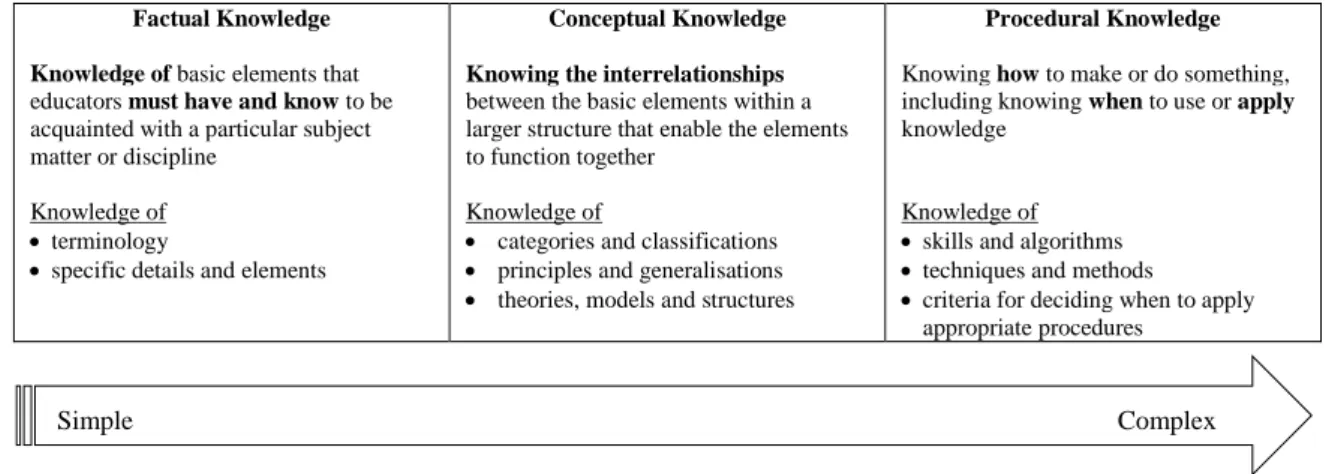
Table 3: Structure of the knowledge dimension ………... 62
Table 4: Item summary for LMS-TPACK survey………. 65
Table 5: Demographic characteristics of LMS-TPACK respondents………... 71
Table 6: Descriptive statistics for educators’ responses on the LMS-TPACK survey………. 72
Table 7: Communality estimates of the LMS-TPACK constructs (SPSS output)……… 75
Table 8: KMO measure of sampling adequacy and Bartlett’s test of Sphericity………... 77
Table 9: Total variance explained (SPSS output)……… 80
Table 10: Pattern matrixᵃ………... 83
Table 11: Structure matrix……… 87
Table 12: Final grouping of Items into LMS-TPACK constructs……….... 92
Tables 13(a) – (d): Item analysis of the construct LMS-TPACK (factor 1)……… 93
Tables 14(a) – (d): Item analysis of the construct CK (factor 2)………. 95
Tables 15(a) – (d): Item analysis of the construct PCK (factor 3)………... 96
Tables 16(a) – (d): Item analysis of the construct LMS-K (factor 4)…………... 97
Tables 17(a) – (d): Item analysis of the construct PK (factor 5)……….. 98
Tables 18(a) – (d): Item analysis of the construct LMS-PK (factor 6)………. 99
Tables 19(a) – (d): Item analysis of the overall LMS-TPACK instrument……... 100
Table 20: Reliability coefficients (Cronbach’s alpha) for each LMS-TPACK construct………... 102
xiii
LIST OF FIGURES
Figure 1: Concept of affordances……….. 17
Figure 2: Taxonomy of LMS affordances for teaching and learning……… 19
Figure 3: Modes of interaction in distance education………... 21
Figure 4: Homepage of myUNISA portal where users log on with a unique
username and password to access specific course or module sites………..….. 27
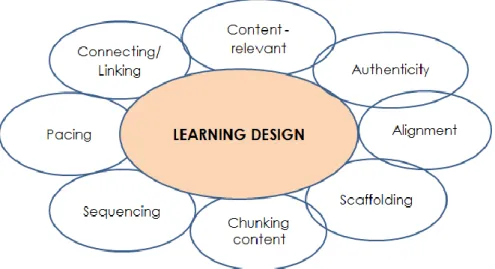
Figure 5: Elements for effective learning design……….. 29
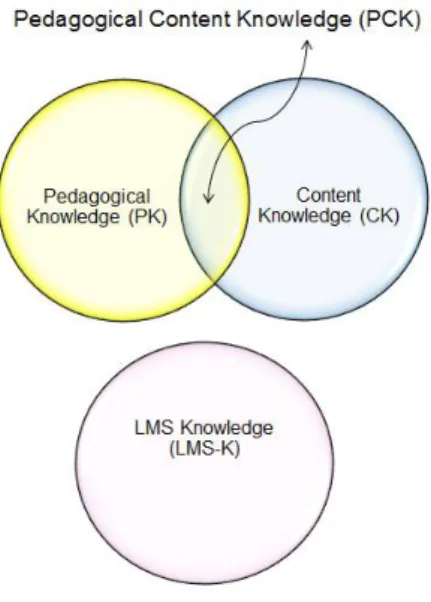
Figure 6: Pedagogical Content Knowledge……….. 32
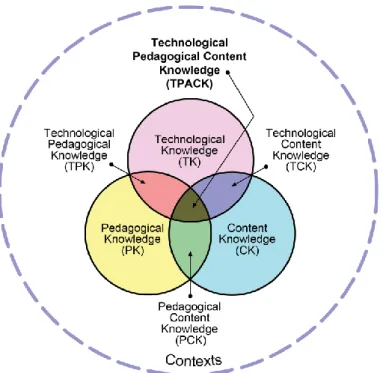
Figure 7: Technological Pedagogical Content Knowledge framework (TPACK)… 34 Figure 8: PCK constructs as initial conceptual basis for LMS-TPACK…………... 40 Figure 9: LMS-TPACK………. 41 Figure 10: Guiding procedures for validity and reliability testing………. 68 Figure 11: Scree plot (SPSS output) indicating that the data have six factors……... 82
xiv
LIST OF ABBREVIATIONS AND ACRONYMS
CK, Content Knowledge
DHET, Department of Higher Education and Training ICTs, Information and communication technologies LMS, Learning Management System
LMS-CK, Learning management system content knowledge LMS-K, Learning management system knowledge
LMS-PK, Learning management system pedagogical knowledge
LMS-TPACK, Learning management system technological pedagogical content knowledge
MOOC, Massive Open Online Course
ODeL, Open distance e-learning/open and distance e-learning ODL, Open distance learning/open and distance learning OER, Open Educational Resources
PCK, Pedagogical Content Knowledge PK, Pedagogical Knowledge
SAQA, South African Qualifications Authority TCK, Technological Content Knowledge TK, Technological Knowledge
TPACK, Technological Pedagogical Content Knowledge TPCK-W, Technological Pedagogical Content Knowledge-Web TPK, Technological Pedagogical Knowledge
UNISA, University of South Africa WCK, Web-content knowledge
WPCK, Web-pedagogical content knowledge WPK, Web-pedagogical knowledge
1
CHAPTER ONE
FRAMING THE STUDY
1.1 INTRODUCTION
Modern-day open and distance learning (ODL) is a transforming feature in higher education, and change has been strongly linked to, if not propelled by, advances in information and communication technologies (ICTs) (Bates, 1997; 2008). Previous modes of distance education, i.e. correspondence courses, radio-based courses and videotaped lectures, are either being revised or replaced by more internet- or web-based learning management system (LMS) modes of delivery (Garrison & Cleveland-Innes, 2010). The push toward open and distance e-learning (ODeL) or online learning1 is happening for a variety of socioeconomic and political reasons, including the need to provide alternative access to quality university education, increase communication and engagement, support remote students and prepare graduates for meaningful participation in a digital world (South Africa. Department of Higher Education and Training (DHET), 2014a and b).
Despite the changing context of ODL, research has shown that the integration of LMS environments in teaching and learning poses challenges to educators (Weaver, 2006; Mostert & Quinn, 2009). The dilemma for distance educators is that while these web-based environments provide a variety of communication, content and assessment tools, many have difficulty integrating LMS as staff are utilising its capabilities to replicate their traditional practices and content. Sife, Lwoga and Sanga (2007) suggest that their apparent failure to integrate LMS is because “their plans appear to be driven by ICTs and not by pedagogical rationale” (para. 25). Nonetheless, Anderson and Garrison (1998), Bates (1997) and Unwin (2007) suggest that successful pedagogical integration of ICTs necessitates a transformation process, where educators have to rethink and
1 The terms ‘e-learning’ or ‘online learning’ describe internet- or web-based teaching and learning that delivers content and supports communication and collaboration between instructor and students (Garrison & Cleveland-Innes, 2010).
2 examine their existing professional roles and competencies and begin to operate differently. If educators are to incorporate ICTs successfully for teaching and learning, many more than minor changes in current practices will be needed.
To respond to the issue of what more is needed for effective integration of ICTs in teaching and learning, Henry and Meadows (2008) propose that “because the online world is a categorically different environment, a particular blend of skills and knowledge is necessary if success is to be found in this domain” (para. 53). Similarly, Mishra and Koehler (2006) believe that thoughtful pedagogical integration of new technologies in teaching can only be realised if educators possess unique knowledge known as technological pedagogical and content knowledge (TPCK). The TPCK
framework, also commonly known as TPACK2, describes the various kinds of
knowledge required by educators for meaningful technology integration in teaching. In so doing, they highlight the complex interplay between technology knowledge, pedagogical knowledge and content knowledge, “while addressing the complex, multifaceted and contextual nature of this knowledge” (Mishra & Koehler, 2006, p. 1017).
Since its inception, TPACK has been widely adopted, fuelling numerous research efforts describing the development and assessment of TPACK (Archambault & Crippen, 2009; Koh, Chai, & Tsai, 2014; Landry, 2010; Lee & Tsai, 2010; Lux, Bangert, & Whittier, 2011; Sahin, 2011). Much of this work has intended to provide empirical evidence for the TPACK framework and its distinct constructs and to validate the reliability of assessment methods and instruments used to measure TPACK (Burgoyne, Graham, & Sudweeks, 2010; Chai, Koh, & Tsai, 2011; Dinh, 2013; Schmidt et al., 2009; Shinas, Yilmaz-Ozden, Mouza, Karchmer-Klein, & Glutting, 2013; Yurdakul et al., 2012). This study aimed to support the development of a new learning management system technological pedagogical content knowledge (LMS-TPACK) instrument for measuring ODL educators’ perceived knowledge and ability to teach effectively using the LMS. More specifically, the research sought to test the validity and
2 The acronym TPCK was later changed to TPACK for ease of pronunciation and to reflect the idea that the three knowledge domains, i.e. technology, content and pedagogy, “should not be taken in isolation, but rather that they form an integrated whole, a ‘Total PACKage’ as it were” (Thompson & Mishra, 2007, p. 38).
3 internal consistency reliability of the instrument within a developing country, in a transitioning ODL context.
1.2 A TRANSITIONING ODL CONTEXT - THE CASE OF UNISA
Historically the University of South Africa (UNISA) established itself as a correspondence distance education institution providing print-based materials as its main form of teaching. By the 1970s radio, audio and video cassette technologies were made available in an attempt to bridge the distance gap between the institution and its students. More recently, the university is a transitioning ODL institution that encourages resource-based learning (UNISA, 2008, p. 2). UNISA’s wide range of learning resources, i.e. print-based materials, radio, audio and videoconferencing, CDs, DVDs, satellite broadcasting, etc., was bolstered in 2006 with the institution’s adoption of the Sakai open-source software platform as its centrally supported LMS. Branded as myUNISA, the access-controlled LMS allows for the online transmission of course content and contains test generators and assessment tools (Malikowski, Thompson, & Theis, 2007). It also boasts synchronous and asynchronous communication features that can be used to facilitate various forms of interaction (Anderson & Garrison, 1998; Coates, James, & Baldwin, 2005).
The shift from ODL to ODeL denotes UNISA’s changeover toward more online or e-learning programmes. The university is growing new online courses, resulting in an increasing need for effective integration of ICTs to support e-learning. Integration of ICTs, more specifically the integration of the myUNISA LMS, has been identified as a significant platform to help UNISA achieve its 2016-2030 Strategic Plans. While the integration of LMS-based teaching has not been mandated, individual staff members have to supplement or blend print-based modules (or in some cases even replace them altogether with fully online courses) together with the use of massive open online courses (MOOCs) and open educational resources (OERs). Moreover, they are encouraged to integrate tools such as online discussions, wikis, blogs, media, social networking applications and e-portfolios in the design and development of quality online distance courses along with innovative digitised teaching methods to meet the needs of 21st century students.
4 1.3 STATEMENT OF THE PROBLEM
Being mindful of the fact that the introduction of the institutional LMS would impact on the traditional roles and competencies of future ODeL professionals (Arinto, 2013; Thach & Murphy, 1995), it was necessary to provide skills training workshops to help educators cope with changes in the design and delivery of hybrid and/or fully online distance courses. As a consequence, development support staff presented a series of professional development workshops focused on isolated technology skills training, teaching educators how to use the myUNISA LMS tools. However, the underlying conception is that “by demonstrating their proficiency with current software and hardware, [educators] will be able to successfully incorporate technology” into their teaching practice (Mishra & Koehler, 2006, p. 1031).
While these presentations led to knowledge about myUNISA tools, they did not lead to significant learning on how to integrate the LMS in a pedagogically sound manner. Rudimentary LMS tools training did not automatically lead to technology integration or good teaching with the LMS as “knowing how to use technology is not the same as knowing how to teach with it” (Mishra & Koehler, 2006, p. 1033). Standalone myUNISA technology knowledge did not adequately address the content-specific issues or online delivery methodologies which are compatible with ODL learning theories that intertwine with LMS application. Instead, distance educators continue to be “confronted with the challenges and questions of how and when to incorporate such technologies for teaching and learning” (Niess, 2011, p. 299).
Despite the many difficulties that have been raised regarding the integration of LMS as an instructional tool, its application has continued to dominate as the preferred technology on the higher education front. This trend has highlighted the importance of assessing educators’ knowledge, i.e. what educators know and understand, and are able to do with regard to teaching in the new online environment. While use and interest in the institutional LMS of myUNISA has increased over the last few years, there is a real need to critically examine integration practices and to take into account the different kinds of knowledge necessary by soon-to-be ODeL educators to ensure meaningful teaching with the LMS. Up until now no institutional audit has been conducted to assess
5 the impacts of training, nor has there been any form of evaluation of current myUNISA knowledge and competences of distance educators. In an effort to guide and improve the understanding of what constitutes successful and/or meaningful teaching with the LMS, it has become necessary to measure the knowledge and abilities for effective LMS integration in the form of a self-assessment tool.
1.4 PURPOSE OF THE STUDY
The study was informed by the researcher’s own experience since joining UNISA in 2008. As a qualified teacher and geography content expert, even after having attended several myUNISA training and staff development workshops, she found it difficult to incorporate the institutional LMS, myUNISA, to design authentic learning experiences while teaching Geography. Integrating the LMS to support distance learning was challenging as it required the researcher to infuse knowledge of the LMS, pedagogy and content (Geography). In addition, the lack of an analytical tool at UNISA prompted the researcher to develop and test the validity and reliability of a new LMS-TPACK measurement instrument. The measuring tool assesses distance educators’ self-perceptions of their LMS-TPACK.
The three adjoining objectives of this research were to: (1) examine Mishra and Koehler’s TPACK constructs (2006) to better understand the various domains of knowledge they address, and (2) identify features that characterise effective teaching with the LMS, especially the knowledge and capabilities that underpin effective LMS teaching within a transforming ODL context. In addition, to assist with the development and validation of a new reliable LMS-TPACK instrument, this study (3) reviewed and adapted numerous self-reporting instruments developed for measuring teaching staff’s TPACK (Archambault & Crippen, 2009; Dinh, 2013; Lee & Tsai, 2010; Lux et al., 2011; Koh et al., 2014; Schmidt et al., 2009; Yurdakul et al., 2012).
1.5 RESEARCH QUESTIONS
The present study focused mainly on LMSs. Thus, the term LMS-TPACK will be used to denote TPACK as it relates exclusively to LMS technology. In particular, this study
6 examined the theoretical constructs of TPACK as they relate to ODL educators and developed a validated LMS-TPACK survey instrument to measure UNISA educators’ self-perceptions of TPACK, i.e. their knowledge and skill to integrate LMS for teaching.
To address the objective of this study, the following research questions were used:
1.5.1 Main question
Is the developed instrument valid and reliable for the purposes of assessing ODL educators’ perceived LMS-TPACK?
1.5.2 Sub-questions
(a) What are the constructs and underlying dimensions that need to be measured to ascertain LMS-TPACK?
(b) Will the measuring instrument developed be valid and reliable for measuring the seven TPACK constructs described by Mishra and Koehler?
1.6 RESEARCH ASSUMPTIONS
The assumptions that underlie this study are that the TPACK framework and its adjoining constructs exist and are quantifiable and that data gathered from the self-report survey are taken to be accurate.
1.7 SIGNIFICANCE OF THE STUDY
While numerous studies have sought to develop and establish valid instruments for assessing perceived TPACK, there is as yet no widely accepted standardised instrument (Albion, Jamieson-Proctor, & Finger, 2010). According to Dinh (2013), “existing survey instruments have mainly been developed for use with pre-service educators in developed countries [and] therefore do not meet the context needs if they are to be applied for educators in developing countries” (p. 2566). What is more, the absence of precise definitions makes it difficult to construct robust instruments for measuring TPACK in a variety of contexts. It has been argued that nebulous boundaries are
7 associated with the TPACK model (Angeli & Valanides, 2009; Archambault & Crippen, 2009; Graham, 2011), that the description of TPACK and its related constructs “are not clear enough for researchers to agree on what is and is not an example of each construct” (Cox & Graham, 2009, p.60). Consequently, Archambault and Barnett (2010) recommend that “more research regarding the validity and applicability of TPACK framework is needed” (p. 1658).
Hence, this study undertook to help improve the current understanding and operationalisation of widely accepted TPACK, particularly its application within a transformative multicultural, multilingual South African ODL context. It is also hoped that since no standardised institutional integration matrix exists, the validated LMS-TPACK instrument can serve as a beginning promising toolkit. A new LMS-LMS-TPACK tool can stimulate reflection and facilitate renewed understandings of the structures of knowledge and skills required to enhance effective pedagogical LMS integration practices. In addition, the LMS-TPACK instrument can offer guidelines of what educators should know and be able to do when integrating LMS functionality in distance e-learning. The effects of ill-prepared educators can hamper teaching and learning and so the results of this study can prove useful to inform policy makers and institutional stakeholders and allow managers and professional development support staff to take appropriate steps in planning for improved LMS integration that promotes student learning.
1.8 SUMMARY
To summarise then, the following conclusions can be drawn: Newer digital technologies are having a profound impact on ODL. ODL institutions are slowly moving away from print and broadcast technologies and to a greater extent adopting and integrating more internet- or web-based LMS tools for teaching and learning. The trend is toward more e-learning. This changing context presents new challenges, impacting on distance educators’ old established ways of doing things. Increasingly, 21st century distance educators are being called upon to integrate LMS technology in teaching. While universities continue to strengthen the move toward e-learning, teaching with LMS
8 technology remains challenging. Numerous studies have revealed that educators require a special blend of knowledge and skill for meaningful integration of technology in teaching (Henry & Meadows, 2008; Mishra & Koehler, 2006). Hence the purpose of this study was to develop and test the validity and reliability of an LMS-TPACK instrument by identifying the kinds of knowledge and abilities that underlie effective distance teaching with the LMS.
1.9 STRUCTURE OF THIS REPORT
The structure of this report is as follows:
This chapter (Chapter 1) begins with an introductory orientation to the study. The problem statement, purpose, research questions and assumptions as well as significance of the study are also contained in this chapter.
In Chapter 2 core terms that underlie contemporary open, distance and e-learning are
identified and defined and the relevant literature is reviewed. The TPACK framework and conceptual framework as well as numerous research efforts attempting to measure TPACK are outlined.
Chapter 3 sheds light on the importance of measurement development, particularly the
guiding principles and techniques as they relate to the issue of validity and reliability.
Chapter 4 gives details of the research design and methodology used for developing the
LMS-TPACK survey, including the instrumentation, data collection and data analysis techniques.
Chapter 5 is a summary of the results and findings from the data collected, while
Chapter 6 presents a discussion and conclusion, and recommendations for future
9
CHAPTER TWO
LITERATURE REVIEW AND CONCEPTUAL FRAMEWORK
2.1 INTRODUCTION
This chapter builds on from the previous one, which provided an introductory orientation to the study. Various facets pertaining to the research problem and way in which the study was conducted were described. What follows here is less of a conventional literature review and more of an elaboration of the conceptual framework. Guided by the research questions, the first part of the chapter starts with a definition of core terms that underline modern-day open, distance and e-learning, including the notion of affordances. Central to this literature are UNISA policy and conceptions that shape existing institutional teaching practice within the context of this study.
While it is not the researcher’s intention to give a technical analysis of an LMS, it would be helpful to give some information for those less familiar with the system. Subsequently, directed by the problem statement and purpose of this report, the literature review covers key facets focusing on the following: (a) LMS affordances for teaching and learning, (b) how the pedagogical affordances of a current institutional LMS (myUNISA) are being used to support ODL, (c) constraints associated with the pedagogical integration of LMSs, (d) Mishra and Koehler’s TPACK framework (2006), (e) the conceptual model as well as (f) earlier research efforts attempting to measure TPACK.
2.2 DEFINITION OF CORE TERMS
According to Lewis (1986), as always, definitions of wide-ranging terms often offer considerable confusion about what they are and what they are not. Influenced by disparate settings, the manner in which a family of phrases associated with open, distance and e-learning are interpreted and practised is often misleading (Guri-Rosenblit, 2005; Rumble, 1989). For the sake of clarity and a common understanding,
10 the researcher reviewed the relevant literature as well as institutional policies to determine how the terms of interest are defined and exercised within the context of this study.
2.2.1 What are ICTs?
Lloyd (2005) cites a useful definition by Toomey (2001), who defines information and communication technologies (ICTs) as “those technologies that are used for accessing, gathering, manipulating and presenting or communicating information” (p. 3). These technologies include hardware, software and internet connectivity, as well as a wide assortment of multimedia tools and resources. For example, ICTs include computers, mobile devices, digital cameras, radio and television, videoconferencing technology, mind mapping software, notetaking software, Assessment Master (online testing software), and so on. While the above definition denotes a broad domain, ICTs are often spoken of in a particular context, such as economics, health or education.
2.2.2 What varieties of ICTs are commonly used in distance education?
ICTs in distance education typically involve a combination of different technologies used as instructional tools. For instance, older technologies such as print-based materials (e.g. study guides, tutorial letters), combined with textbooks and readings are supported by radio and/or television broadcasts and videoconferencing technologies. However, in recent years, there has been an upsurge of interest in how ICTs, particularly internet- or web-based applications, can best be harnessed to help broaden access and improve the efficiency and quality of higher distance education.
Nowadays virtual technologies - whether solely or partially – are increasingly being used to deliver courseware, increase interactions and/or facilitate learning. Arinto (2013), in her analysis of distance education, reports that internet-based technologies involving LMSs are transforming distance education and replacing traditional print-based modes of delivery with more flexible online modes of delivery. Likewise, Yueh and Hsu (2008) also found that instructional activities such as “presenting information,
11 managing course materials, and collecting and evaluating student work can now be completed online using LMS” (p. 59).
2.2.3 What is a Learning Management System (LMS)?
An LMS is defined by Unwin et al. (2010) as being a web-based application that is used to structure, disseminate or access particular learning courses. Similarly, Watson and Watson (2007) describe LMS as:
the framework that handles all aspects of the learning process. LMS delivers and manages instructional content, identifies and assesses individual and organizational learning or training goals, tracks the progress towards meeting those goals, and collects and presents data for supervising the learning process of an organization as a whole. (p. 28)
Other terms used to refer to LMSs include course management systems, instructional management structures, learning platforms and distributed learning systems (Coates et al., 2005). These applications typically include a range of administrative and pedagogical tools used for designing, constructing and delivering online learning environments and can also be used to operate entire virtual universities. What is more, LMS-enabled course sites permit educators and students to share study material, create class notifications, submit and return coursework as well as connect and interact with each other in an online virtual learning environment (Lonn & Teasley, 2009).
While a variety of definitions exist, given the context of this study, this report uses the term ‘learning management system (LMS)’ to refer to a software application used for creating, organising and delivering academic and administrative as well as student support functions online. LMS capabilities include the uploading of digital courseware (e.g. videos, PowerPoint presentations, PDFs, live content), e-assessments and automated marking. Italsoincludes a number ofcommunication tools usedto facilitate active engagement and collaboration and allows instructors to track, monitor and record student learning by accessing detailed statistical reports in a virtual learning environment.
12 2.2.4: Learning environments: ODL and ODeL, what are they?
UNISA definitions
Open distance learning (ODL) is defined as:
a multi-dimensional concept aimed at bridging the time, geographical, economic, social, and educational and communication distance between student and institution, student and academics, student and courseware and student and peers. ODL focuses on removing barriers to access learning, flexibility of learning provision, student-centeredness, supporting students and constructing learning programmes with the expectation that students can succeed. (UNISA, 2008, p. 2)
More recently, the emergence of newer web-based technologies has brought about changes in the design and delivery of courses and has led UNISA management to coin the term ‘open distance e-learning (ODeL)’. The ‘e’ in ODeL implies increased use of ICTs, entailing the integration of existing technologies including the institutional LMS called myUNISA. myUNISA affords new possibilities to enhance organisational and operating systems and represents a change in the primary mode of teaching and learning.
In this study, ODeL is not used synonymously with fully online distance e-learning. ODeL does not imply that UNISA will no longer have face-to-face interaction with students, nor does it mean that the use of text will be completely phased out. Instead, it is recognised that learning can also take place offline when students are not connected to the LMS. As an enhancement of ODL, UNISA’s description of ODeL highlights the convergence of distance education (a method of education provision) and the philosophy of open learning with the adoption of e-learning technologies and pedagogies to support a blended learning approach.
It is important to note that while the concepts formulated here (below) have salience for the instrument development; the instrument will not be measuring knowledge of these different concepts, e.g. blended learning and flexible learning.
13 2.2.5 What is blended learning?
The term ‘blended learning’ is used widely in the teaching and learning literature. UNISA’s ODL Policy (2008) maintains that blended learning is accomplished by employing numerous teaching and learning strategies, mixing an assortment of technologies with face-to-face interaction and applying tangible physical and virtual resources. For example, students engaged in distance learning can be offered both print-based and online learning resources, have e-tutorials and participate in online class discussions that can be enhanced by intermittent face-to-face tutorials at regional learning centres. Tinio (2003) claims that blended learning “was prompted by the recognition that not all learning is best achieved in an electronically-mediated environment” (p. 4). She feels that special attention ought to be given to the diverse needs, capabilities and learning styles of distance students in order to arrive at an optimum mix of instructional and delivery modes to achieve flexible learning.
2.2.6 What is flexible learning?
Many universities are linking the application of ICTs in teaching and learning to the concept of student-centredness and labelling the emergent educational practices as flexible learning. Steeples, Goodyear and Mellar (1994) recognise that a growing diversification and a more heterogeneous student body are reshaping higher education and triggering more responsive forms of education. These changing ICT-augmented teaching and learning patterns are increasingly encouraging students to assume more responsibility and independence and manage their own learning. On the other hand, Taylor (2000) suggests that rather than just using ICTs to disseminate content, the resultant flexible learning environment can be used to accommodate the diverse needs, capabilities and learning styles of students as well as “provide a breadth of opportunities to study, and enhance access for those who are unable to attend the campus regularly” (p. 110). This kind of flexibility allows students to break free from the constraints of timetabled classes at central venues, giving them greater choice over what, when and how they learn. Similarly, Nicoll (1997) believes that this method of teaching denotes “a ‘better’ form for the delivery of learning” (p. 100) that encourages student-centred learning by allowing students to learn and access materials in their own time and space.
14 2.2.7 What is student-centred learning?
Another term that has gained prominence in education is ‘student-centred learning’. UNISA’s definition of student-centredness “requires that students are seen as the main foci of the educational process and they are supported to take progressive responsibility for their learning” (UNISA, 2008, p. 2). The main ideas that underpin student-centred learning appear to be founded on constructivist learning theories, which view learning as an active process in which students construct meaning based on prior knowledge and authentic experiences. That is to say, knowledge is not out there, detached from the student, which the student passively needs to be filled with or given. Instead, constructivists claim that new insights and new experiences are created through active participation, in which students’ prior knowledge and experiences become modified and transformed while learning. Hence, student-centred instructional methods employed should afford students opportunities to actively engage with the environment, content and with others; establish links between students’ prior knowledge, everyday real-life experiences and new knowledge to be constructed, as well as encourage independent and critical thinking (UNISA, 2008).
2.2.8 What is meant by student support?
Student support is a broad term that relates to a variety of services (i.e. academic and non-academic) designed by distance education institutions to help students to achieve their learning outcomes and to gain the knowledge and skills needed to complete their qualification(s) successfully (Simpson, 2013). The varieties of student support include:
in-text support in the form of well-designed well-integrated courseware;
support in the form of tutorials where the learning materials are mediated either through a certain amount of on-site face-to-face contact with tutors and/or online or e-tutorial support accessible to all students, irrespective of geographic location;
support in the form of generic and/or personalised feedback that could take the form of test scores, written or spoken comments to formative assessments, so that if necessary, corrective action can be taken;
15 support in the form of practical work orexperiential learning, linking learning to the place of work; inthis way, students are provided with on-the-job training and an opportunity to observe, manipulate and master the application of theory in a real-life setting such as a laboratory, etc.
harnessing appropriate ICTs to help broaden support to students, i.e. print, satellite broadcasting, radio and television, SMS, email, radio, social networking tools, etc., including myUNISA LMS (UNISA, 2008).
Core terms associated with open, distance and e-learning as used within the context of this study have been defined in this section. These concepts as formulated above are more of a conceptual framework than a literature review per se, and the analysis and interpretations of these concepts are relevant for the development of a scientific instrument. The next paragraphs deal with the notion of affordances, which centres on how ICTs in distance education, especially the virtual teaching environment, is perceived by educators, i.e. what knowledge the user has of LMS, including all actions that are possible.
2.3 AFFORDANCES
Online learning environments, particularly those associated with the use of LMSs, are increasingly being described in terms of affordances. Boyle and Cook (2004) and John and Sutherland (2005) suggest that the term is generally used to draw attention to the pedagogical opportunities of ICTs. Norman (1988) defines affordances as:
the perceived and actual properties of the thing, primarily those fundamental properties that determine just how the thing could possibly be used… Affordances provide strong clues to the operations of things. Plates are for pushing. Knobs are for turning. Slots are for inserting things into. Balls are for throwing or bouncing. When affordances are taken advantage of, the user knows what to do just by looking: no picture, label, or instruction needed. (p. 9)
16 Most notably, Norman (1990) elucidates that affordances are not solely derived from the invariant or unchanging properties of the object or tool, but are also shaped by perceived properties, that is, a knowledge or understanding of how the inherent properties can possibly be used. Once the perceived and actual properties become unified, an affordance arises as a connection that holds between the entity and the person that is acting on the entity. Contrary to Norman’s theory of affordances is John and Sutherland’s conceptualisation (2005); they deny that there is anything innate in technology that instinctively ensures learning. Instead, they believe that effective teaching and learning with technology can only come about when meaningful integration of technology, pedagogy and content takes place within particular learning environments.
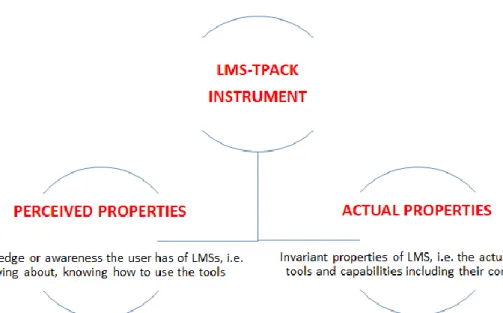
Drawing from what has been articulated above; the concept of affordances proves useful for the development of the LMS-TPACK instrument. In accordance with Norman’s conceptualisation of affordance (1998), this study concurs that LMS affordances arise as a connection that holds between the LMS and the educator that is acting on the LMS. Affordance therefore centres on two main features: (1) perceived properties of LMSs, e.g. knowing how LMSs can or should be used to enhance pedagogy, content and ultimately learning, and (2) invariant properties of LMSs, i.e. the actual inherent features, tools and capabilities of LMSs, including their constraints. See Figure 1, an illustration of the application of Norman’s conceptualisation of affordances to LMS which represents a useful approach to developing LMS-TPACK.
17
Figure 1: Concept of affordances (adapted from Norman, 1998)
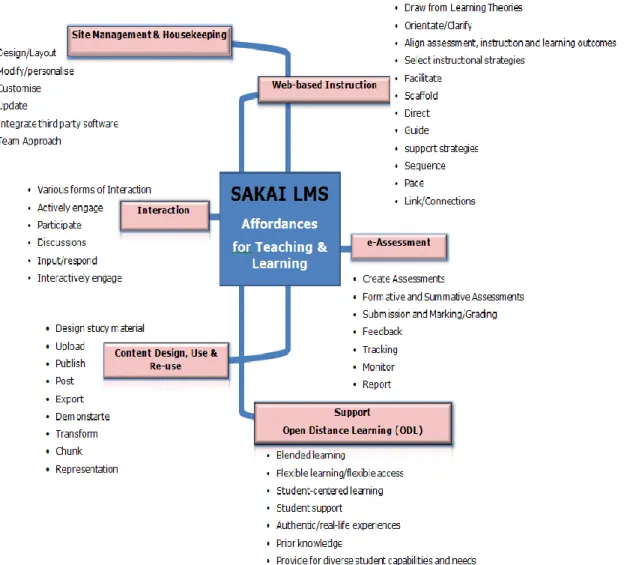
In the next section the notion that LMSs have affordances is explored. The literature on current uses of LMSs, including Sakai suite (SAKAI, 2016), was reviewed and analysed to identify key properties or features and establish common themes under discussion. From this analysis the different LMS affordances were mapped to particular uses and placed in given domains. Mapping refers to the activity of representing connections among the affordances of LMSs, pedagogy and content. A taxonomy of Sakai LMS affordances was framed to depict the arrangements of and relationships between the actual properties of LMSs, particularly what educators can do (actions possible) with an LMS as a powerful teaching tool. The taxonomy provides a description of each category and serves as a mapping tool for the development of LMS-TPACK.
It is argued that an explicit formulation of LMS affordances can improve educators’ knowledge of the different functional properties of LMSs that enable educators’ “know how” of the different features that might be used to support teaching and learning more effectively. It is also believed that any one affordance can offer both opportunities and constraints.
18 2.4 LMS AFFORDANCES FOR TEACHING AND LEARNING: A
TAXONOMY AS A MAPPING TOOL FOR DEVELOPING LMS-TPACK
The literature documents several prominent LMS features and categorises the ways in which learning platforms are being used to support pedagogical actions.
Malikowski et al. (2007) have identified five categories of LMS features for higher education application: (1) transmitting course content, (2) creating class discussions, (3) evaluating students, (4) evaluating courses and instructors, and (5) creating computer-based instruction. Similarly, Griffin and Rankine (2010) arrange the affordances of LMS tools for academics into functional quadrants: (1) communication and collaboration, (2) content and resources, (3) evaluation and assessment, and (4) site management. They acknowledge that differentiating between LMS teaching and administration tools is no simple task.
For the purpose of this study, the researcher deemed it useful to illuminate and define categories and features associated with the Sakai LMS suite (see Figure 2). These categories are: (1) content design, use and reuse, (2) interaction, (3) web-based instruction, (4) e-assessment, and (5) site management and housekeeping. A description of each category is provided below. Also see Figure 2.
2.4.1 Category 1: Content design, use and reuse
This category refers to the combined capabilities associated with creating, using, reusing, storing and delivering digital content by means of an LMS.
Schramm (1977) believes that learning is shaped more by the contents in the learning materials than by the kind of technology used to deliver instruction. Online content, according to Cole (2000), must be appropriately designed to engage the student and promote learning. Kozma (2001), on the other hand, argues that even though it is not the technology per se that influences learning; particular attributes of technology are needed to influence learning.
19 In an analysis of the effects of LMSs on university teaching practices, Coates et al. (2005) found that these online platforms are simplifying the development of digital study materials, making it possible to design, structure and deliver virtual content. Even though particular limitations are imposed by these systems, “staff are able to develop interactive web pages, upload and integrate digital resources” (p. 22). Malikowski et al. (2007), Singh, Mangalaraj and Taneja (2010) and Dobozy and Reynolds (2010) highlight that LMSs are commonly used by instructors to transmit course content. This, they claim, is usually made available to students in the form of electronic word processor files, PowerPoint presentations and HTML files, and typically includes study guides, course outlines, exam examples, readings and assignments as well as lecture/class notes and multimedia files such as slides and videos.
Figure 2: Taxonomy of LMS affordances for teaching and learning (adapted from Sakai Learning Management Features, SAKAI, 2016)
20 In another study, Mlitwa (2007) observed how these online learning environments “support flexible storage and display options, and provide a simple yet powerful publishing format” (p. 7). Singh et al. (2010, p. 302) report that LMS platforms allow instructors to post information about course supplementary materials, deadlines and events to a course website by means of announcements or they can even send automated email messages directly to the class. Malikowski et al. (2007) demonstrate how LMSs allow electronic data such as portfolio usage, statistics, marks, etc. to be exported out of a central database and later used to generate predefined reports in various formats. For example, data can be imported into word processor or Excel spreadsheets and the “statistical tools can show if students have viewed information that an instructor transmitted or how students have interacted” in the LMS (p. 150).
Griffin and Rankine (2010) highlight that LMSs allow educators to “design units in small, reusable chunks that can be independently reused or repurposed as necessary” from semester to semester (p. 516). Tinio (2003) found that the internet and related technologies and tools, when used appropriately, can facilitate the transformation of content. She claims that teaching with networked technologies means focusing on how the different tools can be used to teach across the curriculum. This includes the use of presentations, demonstrations and the application of games, simulations, multiple visualisations and graphical representations online of obscure abstract concepts, as well as combining “text, sound, and colourful, moving images to provide challenging and authentic content that will engage the student in the learning process” (p. 7).
2.4.2 Category 2: Interaction
This category refers to the assortment of interactive tools embedded in LMS environments intended for connecting users, creating discussions and structuring interactions that can contribute to learning.
Interaction has been documented as a vital component in education and is believed to be key to effective learning (Holmberg, 1995; Moore, 1989). In distance education where direct face-to-face contact is limited or non-existent, different technologies, including LMSs, are used to facilitate various forms of interaction to support and enhance
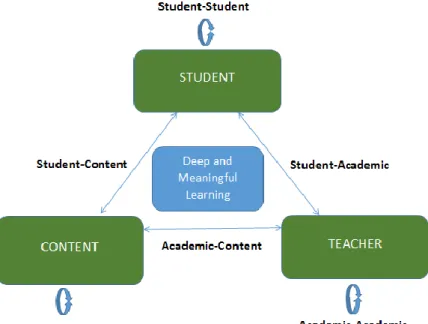
21 meaningful learning, e.g. interaction between student-student, student-lecturer/tutor, student-content and student-interface (Anderson & Garrison, 1998; Anderson, 2003; Hillman, Willis, & Gunawardena, 1994). See Figure 3, Anderson’s modes of interaction in distance education (2003).
Figure 3: Modes of interaction in distance education (adapted from Anderson, 2003, p. 133)
Lonn and Teasley (2009) explored the uses of LMSs and found that these online applications contain tools that provide for interaction among students and educators as well as among peers. They point out that LMS functionalities are increasingly affording the varieties of online engagement preferred nowadays by students, such as discussion forums, blogs and wikis. This view is in line with Hillman et al. (1994), who considered the interaction that occurs when students manipulate and use these intervening technologies to “communicate with the content, negotiate meaning and validate knowledge with the instructor and other [students]” (pp. 30-31).
According to Vovides, Sanchez-Alonso, Mitropoulou and Nickmans (2007), these virtual environments provide features that allow students to participate in synchronous and asynchronous interactions with their peers and with the educator. Similarly, Schroeder, Minocha and Schneider (2010) claim that the interactive capabilities of
22 LMSs allow students to collaborate and learn interactively. More specifically, they point out that blogs afford students opportunities to disclose their experiences and to offer each other support, which is particularly important in the absence of face-to-face contact in distance education.
Northrup (2001) and Muirhead and Juwah (2004) in Woo and Reeves (2007, p. 16) identify several functions of web-based interaction in the learning process, including affording students opportunities to interact with the content and to make inputs to and respond in the learning process. Neo (2005) notes that students who use the collaborating features of constructivist online learning environments are more likely to interactively engage in seeking out knowledge and information as well as “take an active part in their own learning process” (p. 7).
2.4.3 Category 3: Web-based instruction
While the objective of any instructional approach is to advance learning, an LMS can be used to create web-based instruction as an alternative medium to enhance distance education and to offer blended courses, i.e. combine print, online, face-to-face and other media (Morgan, 2003). Examples are given in the next paragraphs of online instructional strategies by applying the unique functionalities inherent in an LMS.
Ally (2004) in Anderson (2008) encourages educators to “tacitly or explicitly know the principles of learning and how students learn” before designing study materials for distance online learning (p. 18). He claims that distance educators must be able to draw from sound proven learning theories such as behaviourism, constructivism and cognitivism when developing online learning materials. He also believes that when designing online learning materials, any one or combination of learning theories can be used as each holds its own accounts of the benefits of using technology for teaching and learning. Moreover, Ally argues that “to select the most appropriate instructional strategies” the online educator must know the different philosophies of learning, i.e. strategies to motivate students and cater for diverse needs and capabilities, facilitate various forms of interactions and provide scaffolding during the learning process (Anderson, 2008, p.18, Collins, 1996).
23 An instructional strategy such as scaffolding represents the integration of various support strategies used to help students accomplish complex tasks. These can be given in the form of tutorials, hints and reminders, links and frequent feedback, as well as monitoring students’ learning. These offer powerful enhancements to the teaching and learning transaction. Vovides et al. (2007) point out the powerful built-in features and functionalities of current LMSs that can provide for a wide range of scaffolding to students online. For instance, LMS capabilities allow educators to plug into a vast
selection of supplemental materials through Rich Site Summary/Really Simple
Syndication (RSS) feeds. In this way an educator can direct and guide students to appropriate web-based course-related content to access current news, online publishers, libraries, etc. without having to visit the actual source or site (Singh et al., 2010, p. 302).
Oliver, Herrington and Omari (1996) caution that while online learning environments offer a popular and useful instructional medium, the use of “electronic learning materials can easily conceal information and content they contain” (p. 3). They maintain that it is important at the onset of the design process to orientate students to allow for free easy movement in the virtual learning space. Ally (2004) in Anderson (2008) highlights that a number of online strategies can be used that enable students to process the learning materials efficiently. These include:
sequencing the learning materials appropriately to promote learning. This could
take the form of simple to complex tasks, a notion akin to Vygotsky’s zone of proximal development (1978). Vygotsky highlighted the importance of support, interaction and mediated learning and claimed that the help or assistance from a more experienced knowledgeable other, be it a teacher or peer(s), can provide the support needed to master complex tasks.
chunking or organising the content, e.g. splitting or breaking the content up into
several smaller segments to facilitate processing.
pacing the learning so that students are able to move independently through a
course based on individual competencies or time availability and master the content.
24
linking or connecting current meanings and context andthe new information to
be learnt, which can enhance learning, particularly when the associations between related information are made explicit and recognised (Anderson, 2008).
2.4.4 Category 4: E-assessment
This category describes an LMS’s ability to support multiple e-assessment practices used as a part of instruction to enhance the learning process.
Opportunities for assessing student understanding and mastery of content represent an essential part of the learning process. If clearly aligned from the outset, different assessment strategies (e.g. formative, summative assessments) can meet a variety of instructional and learning outcomes (Biggs, 2011; Shepard, 2000).
Malikowski et al. (2007) report that the LMS quiz generator represents the most common tool utilised to create multiple assessments online (e.g. tests and quizzes, surveys, self-assessments and timed assessments). These assessments comprise question pools usually supplied by textbook publishers and contain a variety of question types that can be directly imported into the LMS, including closed/open-ended questions, “multiple choice, matching, ordering, arithmetic, long answer, short answer, fill in the blank, and true and false” (p. 161). Sclater (2008) identifies how these centrally hosted systems allow for the electronic “submission and marking of assignments online” (p. 7). Similarly, Griffin and Rankine (2010) highlight that LMSs’ automated marking capabilities enable prescribed comments to be inserted into written assignments before marked scripts are returned to students online.
In 2003, Morgan examined how a faculty in the University of Wisconsin utilised the LMS to design feedback online, reporting elements likely to lead to self-correction and improvement. They made use of the LMS as a way to enhance the amount and variety of feedback and to improve the promptness of feedback back to students. An important feature of this feedback was the use of comments in the online grade book. Jurado and Pettersson (2011), on the other hand, found that LMS course tools were “primarily used to monitor and document the educational process” (p. 4) and, when manipulated, can be
25 used to “provide reports to management” (Aydin & Tirkes, 2010, p. 593). Additionally, Simonson (2007) reports that LMSs make it far easier to “track student performance” (p. vii) and permit instructors to view and log system usage by users, events and resources effortlessly (Sclater, 2008).
2.4.5 Category 5: Site management and housekeeping
This category refers to the logistical and configuration activities necessary for designing and managing an LMS-based teaching and learning environment. A particular toolset serves as a means to structure the platform for learning events and to match a particular or a combination of pedagogical theories.
According to Coates et al. (2005), LMSs combine an array of administration and pedagogical tools to support the design and delivery of online learning environments. Although the online feel and appearance of the system can be customised, they claim that “LMSs are not pedagogically neutral technologies, but rather through their very design, they influence and guide teaching” (p. 27). Vovides et al. (2007) point out that current LMSs incorporate a selection of tools that allow instructors to a certain degree to modify and personalise the look and feel of the online learning space. In another study Alario-Hoyos and Wilson (2010) analysed the integration of external third-party tools in LMSs such as Facebook, AutoCAD, GIS and DrGeo, and found that the ability to extend existing LMS platforms enhanced the flexibility and customisation of systems, as well as supported a wider range of learning situations. Griffin and Rankine (2010) assert that “the design and on-going management of these online environments rest largely on the knowledge and skills of academic staff” (p. 505).
With LMS applications available today, it is really simple to get course content online. But as previously described in Category 1, online content must be appropriately designed to engage the student and promote learning. This is why several universities and colleges, including UNISA, implement a team approach to curriculum and learning development. For Oblinger and Hawkins (2006), the design and delivery of online courses require several varied skills - skills that are not likely to be found in one particular person. Although academics who teach the programme are the ultimate