Experience based Master Program
of Systems Engineering
Year 2014 – 2018
HBV - Faculty of
Technology and
Maritime Science
Buskerud and Vestfold
University College
Post box 235, 3603
Kongsberg, Norway
+4732869500
[email protected]
Document history
Date
Sign
Editions
5 March, 2013
Kjell Enger
1.0
12 March, 2014
Yang Yang ZHAO
1.0
Table of contents
General description ... 3
Learning Outcome ... 4
Admission requirements ... 5
Qualification awarded ... 5
Access to further studies ... 6
Learning Strategy ... 6
Final examination ... 6
Examination and assessment regulations ... 6
International programs ... 7
ECTS faculty co-ordinator ... 7
General description
Systems Engineering is a relative new engineering discipline. The international organization
INCOSE
1defines systems engineering as:
“Systems Engineering is an interdisciplinary
approach and means to enable the realization of successful systems. It focuses on defining
customer needs and required functionality early in the development cycle, documenting
requirements, then proceeding with design synthesis and system validation while considering
the complete problem: operations, cost and schedule, performance, training and support, test,
manufacturing, and disposal. Systems Engineering integrates all the disciplines and specialty
groups into a team effort forming a structured development process that proceeds from
concept to production to operation. Systems Engineering considers both the business and the
technical needs of customers, with the goal of providing a quality product that meets user
needs.”
The need for building systems engineering competence in Kongsberg has evolved from the
growing need by larger industry enterprises for interdisciplinary understanding in order to
develop increasingly complex solutions for their customers. To achieve this they need senior
personnel with long experience and an interest in a holistic approach to systems development.
Because this experience-based knowledge takes decades to develop, there are few experts in
this field; a situation which creates a significant bottleneck for further innovation and
development of the industry. The purpose of systems engineering education is to shorten the
time needed to become a systems engineer. In the past, engineers became systems engineers
after 10-25 years of practical experience. The challenge is to shorten this to 5-10 years. This
can be done by building on a bachelor in engineering and offering students courses in systems
engineering theory in addition to the necessary work experience. Thus the program itself is
part-time but candidates are expected to take up part-time positions in a relevant industrial
enterprise. This is necessary in order to comply with the program’s learning strategy.
The program is divided into three main phases:
The systems engineering core (30 ECTS) will establish a common systems
engineering platform for students from different monodisciplinary domains. From this
common platform, the courses will progress to more advanced systems engineering
topics.
The elective phase (30 ECTS) where the students may choose to continue with
systems engineering and/or apply their systems engineering knowledge to specific
technical elective courses according to their background and competence
.
The elective
courses are grouped into domains which are chosen for their strong international status
within industry in Norway and Kongsberg. Other domains may be added later.
Students have the opportunity to choose elective courses from different domains. In
this phase, students are encouraged to study abroad as exchange students at one of our
partner universities. It is also possible to combine courses given at HBV with foreign
exchange courses.
The final phase sums up the knowledge acquired through studies and practical
experience from industry with the 30 ECTS master project.
Learning Outcome
General
After the successful completion of this program, the students have become junior systems
engineers. A junior systems engineer is a broad technical engineer who is capable of making
multidisciplinary designs. In order to be able to make system designs that meet the needs of
the stakeholders the junior systems engineer is able to use his insights in the fields of ethics,
work-life, business, market, applications, processes, and organizations. The junior systems
engineer should be able to develop into a full systems engineer within five to ten years.
Master of System Engineering
Knowledge
The candidate should after completing the degree have acquired a broad overview of the field
of Systems Engineering and detailed knowledge of important subjects, as defined by the core
courses. Further, the candidate should via the electives and thesis work obtain knowledge in
subjects chosen by their individual needs and interests.
Skills
The candidate is expected to be able to apply theoretical knowledge of systems engineering to
problems encountered in his work and as part of an engineering team.
Competence
The candidate should be qualified to embark on the road to becoming a highly qualified
systems engineer, with the capability of supervising complex endeavors in private or public
enterprises.
Attitude
The attitude required when participating in a course and later practicing the learning will
depend on the stage the student are in the learning and practicing. Typical attitudes will be
To be critical, constructive, context aware, human oriented
To strive for continuous improvement
To strive for fitness-for-purpose, leadership, and stakeholder satisfaction
Master of System Engineering Majored in Subsea Production
Knowledge
The candidate should after completing the degree have a holistic view of customer needs,
regional preference, equipment and functional requirements for Subsea Production System
(SPS) and the capability to apply system engineering in SPS. The domain specific package of
modules in this major will comprise the following:
Subsea Production Architecture
Subsea Production Control System
Subsea Production Safety System
Subsea Production Systems Life Cycle Cost and Management
Skills
The student shall have the skills to lead structured systematic work in Subsea field
development in projects, studies and proposals with some guidance from senior personnel.
Competence
The student shall have the competence to structure the overall system work and evaluate
alternative solutions, equipment and operations.
Attitude
The student shall strive for fitness-for-purpose, leadership, stakeholder satisfaction and be a
valued team member.
Prerequisite
The major in subsea production requires the basic knowledge of Subsea. The knowledge may
be from relevant work experience or the Subsea Fundamentals course done as part of the
bachelor or in preparation for the major (in which case this course is not for credit).
Admission requirements
Admissions are regulated in the standard HBV demands for master programs
(http://www.hbv.no/academic-programmes/full-degree-programmes/engineering-programmes/master-in-systems-engineering/).
The systems engineering group has a dedicated person to handle admissions.
Applicants must fulfill the academic requirements and have a grade average of C or
above. Part-time applicants with sufficient relevant practical experience may have a
lower grade point average.
The applicants need to have at least two years of relevant professional experience in
order to be admitted to the program.
Academic requirements:
Bachelor of Engineering following or equivalent to the Norwegian curriculum for a bachelor
of engineering program (Link to curriculum at
http://www.uhr.no/organisering/nasjonale_rad/nrt/sentrale_dokumenter
)
Equivalent education in science and engineering may qualify for admission. Such evaluations
will be made on an individual basis.
Applicants over the age of 25 with sufficient competence may be admitted in accordance with
circular F-55-00 from the Ministry of Education.
Applicants must document English language skills to be on a level equivalent with that of the
Norwegian secondary school system.
Through our cooperation with foreign universities, we offer the students to spend one
semester abroad. Full time attendance for one full semester at a foreign university gives the
students 30 ECTS.
Qualification awarded
Access to further studies
Students who graduate from the program with additional 30 ETCs of elective courses and
who fulfill the requirements set by the Stevens Institute of Technology can be accepted for
PhD studies there. PhD opportunities at other universities in Norway and/or abroad will be
made available at a later date.
Learning Strategy
Teaching methods will be focused on providing students with relevant real-life cases and
opportunities for systematic reflection on the connections between the academic content of
the program and their experiences as part-time workers in industry. A combination of lectures,
group work, project work and supervision are used.
The key concept is
Industry as a laboratory.
The two roles which the industrial partners have
defined for the program are, firstly to provide students and teachers with challenging
problems and, secondly, to serve as a laboratory for the students in which they can test the
knowledge and competence they acquire during the program. Students and teachers will
receive input and inspiration through having direct contact with industry. This will enable
them to generate general and consolidated knowledge on the basis of single domain industrial
problems and solutions.
The main delivery method is a number of 5 day intensive theoretical course organized as an
intensive week course. 10 weeks of project work, which will be the first step towards applying
the theories and working on reflection, will follow immediately after the first course week.
Final examination
Evaluation and grading is based on the student’s individual and teamwork performance in all
courses. The grading scale is from A to F. Details of the evaluation method and duration is
given in each course specification. If a course evaluation comprises two or more parts of an
examination, project assignment or similar, the proportion awarded to each part is given as a
percentage. A pass grade must be obtained for each part. Compulsory laboratory work,
exercises and assignments must be approved before the student can take the final examination
in a course.
During written examinations students are allowed to use any type of calculator except those
equipped with wireless communication. No other examination aids are permitted.
The criteria for assessment are based on group reports and individual reports with a focus on:
1.
How the theory is applied in the project
2.
Reflections made on the theory and the project.
Each course will have its own set of individual assessment criteria. Courses requiring
well-defined skills and knowledge will be assessed on the basis of a written or oral examination.
Examination and assessment regulations
International programs
Foreign exchanges and elective courses may be undertaken at any reputable university with
the approval of HBV.
Erasmus and Norplus programs will be available at a later stage.
ECTS faculty co-ordinator
Dr. Yang Yang ZHAO
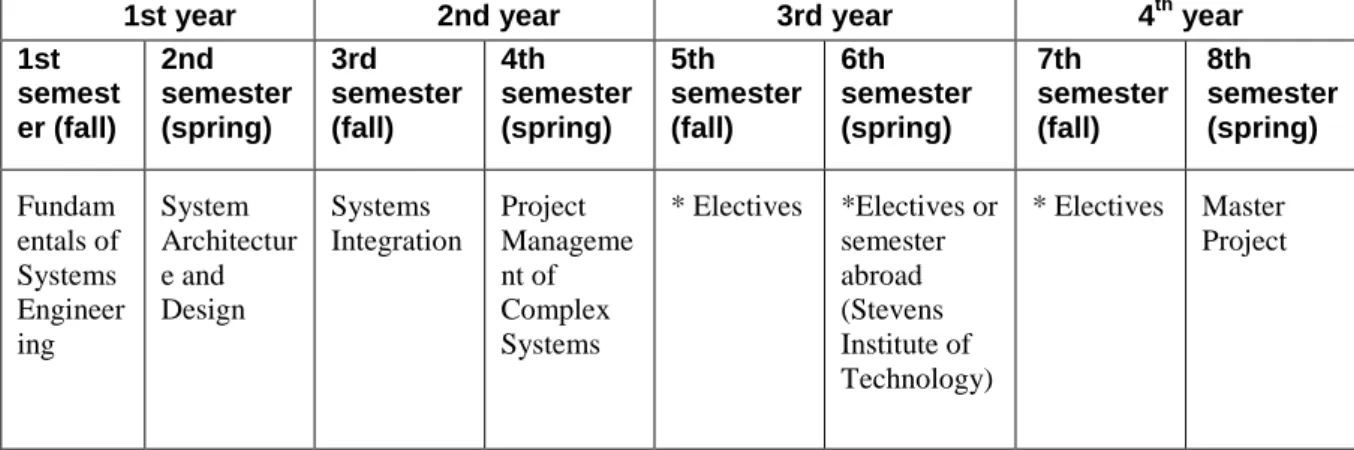
Course structure
Table 1. Course structure for SE experience based master
1st year 2nd year 3rd year 4th year
1st semest er (fall) 2nd semester (spring) 3rd semester (fall) 4th semester (spring) 5th semester (fall) 6th semester (spring) 7th semester (fall) 8th semester (spring) Fundam entals of Systems Engineer ing System Architectur e and Design Systems Integration Project Manageme nt of Complex Systems * Electives *Electives or semester abroad (Stevens Institute of Technology) * Electives Master Project
*Elective courses: Choose the equivalent of 30 ECTS. Each course is worth 7.5 ECTS. All
students are encouraged to take one or more courses abroad. Special admission requirements
may apply.
Systems engineering electives offered at HBV:
o
System Modeling and Analysis
o
Robust Engineering.
o
System Supportability and Logistics
o
Advanced System Architecting
o
Lean Product Development
o
Knowledge Based Development
o
Human Factors
Industrial domain electives offered at HBV:
o
Subsea Life Cycle Cost and Management
o
Subsea Systems Architecture
o
Subsea Autonomy and Control Systems
o
Technical Safety for Subsea System
Depth electives offered at HBV:
o
Advanced Materials
o
Elective courses from Embedded System Department
Business and management electives at HBV:
o
Elective courses from Industrial Economy Department
*Elective courses are offered when appropriate from HBV term schedules and the number of
applicants. The selected electives in the above list are automatically accepted and no explicit
permission is required. Further courses can be taken abroad as an exchange student. Besides
the offered course packages by Stevens Institute of Technology in the overseas semester, a
selected elective that deviates from the above list needs approval by the faculty- Prof. Gerrit
Muller or Associ.Prof. Yang Yang Zhao. The aim of the course approval is to ensure the
course is fit with the master program, at master level and with appropriate amount of ECTS.
Table 2. Course codes, weights and assessment methods
Course Course
Code
ECTS Assessment/ Assessment Scale
1
stsemester
Fundamentals of Systems Engineering SEFS6102 7.5 Project reports /A – F
2
ndsemester
System Architecture and Design SEAD6102 7.5 Project reports /A – F
3
rdsemester
Systems Integration SESI6202 7.5 Project reports / A – F4
thsemester
Project Management of Complex Systems SEPM6102 7.5 Project reports /A – F
5
thsemester
Advanced SystemArchiecturing
System Supportability and Logistics
Subsea Production Systems Architecture Subsea Production Technical Safety SESA6201 SESL6201 SSSA6201 SST 6201 7.5 Various / A – F
6
thsemester
Knowledge Based Development System Modeling and AnalysisLean Product Development Robust Engineering Advanced Materials Human Factors Subsea Production Life Cycle Cost and Management
Subsea Production Control Systems SEKD6202 SEMA6201 SELD6202 SERE6301 SEPD6201 SEHF6202 SSCC6201 SSCS6201 2*7.5= 15 Various / A – F
7
thsemester
Advanced System ArchiecturingSystem Supportability and Logistics
Subsea Production Systems Architecture Subsea Production Technical Safety SESA6201 SESL6201 SSSA6201 SSTS6201 7.5 Various / A – F
8
thsemester
Master Project SEMP 6301 30.0 Master project report / A – FThe above table is based on the traditional 4-year study plan. The part-time students may have
the flexibility to adjust the study plan based on their working conditions, such as how many
courses to take in each semester. Each course is worth 7.5 ECTS. A total of 30 ECTS of core
course, 30 ETCs of elective courses and 30 ETCs master project must be taken to complete
the master study.
Master Program of System Engineering
Syllabus
Template version 1.0: 10th of April 2014
SEFS 6102
FUNDAMENTALS OF SYSTEMS
ENGINEERING
7. 5 ECTS
Language of instruction: English
Master of System Engineering –Core course Semester: AUTUMN
1. LEARNING OUTCOME
Knowledge
After completing the course, the student:
has an understanding of the Systems Engineering discipline and is able to use its core principles
and processes for designing effective systems.
is able to determine customer needs and to distinguish between the needs and solutions domains.
is able to translate customer needs into requirements.
is able to design systems that solve identified needs or perceived market opportunities effectively
and efficiently throughout the entire system's operational life.
is able to understand the concepts of verification and validation, as well as their implications in the
systems process.
is knowledgeable of, and confident with, the main systems engineering models.
is able to analyze the system requirements to make the system reliable, supportable and
maintainable throughout the system’s life cycle.
has advanced knowledge within the field of systems engineering.
has thorough knowledge of the theories and methods in systems engineering.
can apply knowledge to new areas in the field of systems engineering.
can analyze academic problems on the basis of the history, traditions, distinctive character and place in society of the field of systems engineering.
Skills
After completing the course, the student:
can analyze and deal critically with various sources of information and use them to structure and formulate scholarly arguments.
can analyze existing thories, methods and interpretations in the field of systems engineering and work independently on practical and theoretical problems.
can use relevant methods for research and scholarly and /or artistic development work in an
independent manner.
can carry out an independent, limited research or development project under supervision and in accordance with applicable norms and research ethics.
General competence
After completing the course, the student:
can analyze relevant academic, professional and research ethical problems.
can apply his/her knowledge and skills in new areas in order to carry out advanced assignments and projects.
can communicate extensive independent work and masters language and terminology of the field
of systems engineering.
can communicate about academic issues, analyses and conclusions in the field of systems
can contribute to new thinking and innovation processes.
2. COURSE CONTENTS
The course addresses the following issues:
Concept and origin of systems engineering; differences with other engineering disciplines.
Overview of the Systems Engineering Process. Definition of systems engineering as a process
that transforms a functional need into the set of requirements that enable system design and development.
Concept and type of stakeholders. Techniques for eliciting the requirements from the
stakeholders.
Definition and types of requirements. High-level requirements versus detailed requirements. The
need domain and the solution domain.
System Capabilities and Characteristics. System scope, context diagrams, use case scenarios,
checklists, input/output matrices and quality function deployment.
Developing a Functional Architecture. Transforming detailed requirements into necessary
functions, and evolving from functions to system elements and system structure. Functional, allocated and physical architectures.
Integration, verification and validation. Verification of requirements and validation of the system as a solution to a need or opportunity. Integration of system elements; integration strategies. Reviews as part of the systems process: business requirements review, system requirements review, system design review, preliminary design review, critical design review, etc.
Fundamentals of Life Cycle Analysis. The concept of operational effectiveness, introduction to
supportability engineering processes, and integrating life-cycle considerations into the system design process.
Systems Engineering Management Plan. Purpose and content of the SEMP as the overarching
document that governs a systems engineering endeavour.
3. TEACHING METHODS
The course combines lectures, discussions of papers and the performance of a project in teams to develop an understanding of key systems engineering concepts and principles. Participants will be exposed to numerous case studies and illustrative examples. The team project will allow students to integrate their knowledge and to apply it in practice. The course is designed to facilitate the sharing of experiences among the professionals who participate in the program.
4. PREREQUISITES
Master’s degree entry level.
5. ATTENDANCE
Full attendance during the intensive course week is obligatory. Maximum amount of hours that can be missed is 4, duly justified and never on Friday (day of team project presentations).
6. ASSESSMENT METHODS
Continuous Assessment None
Final assessment 20% group project report
80% individual report from project
Assessment type/scale A-F
Aids allowed All
7. LITERATURE/READINGS
Author Year Title Publisher
Alberto Sols 2014 Systems Engineering - Theory and Practice Forthcoming
8. NAME OF LECTURERS
Professor Alberto Sols
9. OTHER INFORMATION
Template version 6.0: 19th of March 2012
SEAD 6102
SYSTEM ARCHITECTURE AND
DESIGN
7. 5 ECTS
Language of
instruction:English
Master in Systems Engineering–Core course Semester: SPRING
1. LEARNING OUTCOME
Knowledge
Knowledge of systems architecting process
Knowledge of architecture modeling
Skills
Be able to create an IDEF0 functional model of a systems architecture;
Be able to create a SysML model of a system architecture;
Be able to analyze the relationship between early architecture decisions driven by customer
requirements and the concept of operations. General competence
Be able to do functional analysis, decomposition and system requirements flow-down;
Be able to do functional analysis, decomposition and system requirements flow-down.
Attitude
To be aware of the roles of the system architect on a systems engineering project;
To understand the notion of modeling to reason about the problem, understand the complexities, and to communicate the architecture with others.
2. COURSE CONTENTS
This course includes an introduction to system architecture; the strategic role of architectures; an architecture metaphor; technology, business, and organizational trends that are increasing system complexity; and the importance of architecture to system integrators.
It provides a review of SE fundamentals, reviewing the systems engineering process from customer needs to system requirements; benefits of a disciplined systems engineering process; introduction of the hands-on case study which students will model during the class.
Presented material provides instruction on developing the functional architecture and includes an overview of the architecture process and developing a logical architecture; scenario tracing. Also covered is a module on functional architecture trade-offs, extending the decomposition process; architectural considerations and trade-offs.
The functional architecture is then traced to the process of developing the physical architecture to include an interface architecture. Material is presented to discuss the distinction between functional and physical architectures; developing a physical architecture that implements a logical design; the role and importance of interfaces; specifying an interface architecture.
The notion of a complete system model emerges. This includes integrating functional and physical views into a comprehensive system model, linking requirements to models and the flow-down of requirements to every level of the system design; building and using executable functional models. In class exercises reinforce the functional architecting process.
Object oriented approaches, to include the OMG Systems Modelling Language (SysML) are presented. The SysML diagrams are presented, and in class exercises reinforce the use of SysML. SysML exercises use the Astah SysML tool.
Other topics include: Architecture Assessment; Architecture Frameworks – Characteristics of a good
architecture, architectural metrics, examples of system architectures and trade-offs; Object-oriented design and its relation to functional decomposition; the Zachman, DoDAF and other frameworks for describing system architectures.
Presentation of in-class work are conducted as necessary.
3. TEACHING METHODS
The course will comprise a combination of lectures and readings to develop an understanding of key systems engineering concepts and principles. Participants will be exposed to numerous case studies and illustrative examples. In class exercises, performed in small teams allow the students to integrate their knowledge and apply it in a team environment. The course is designed to facilitate the sharing of experiences among the professionals who participate in the program.
4. PREREQUISITES
SEFS 6102 Systems Engineering Fundamentals
5. ATTENDANCE
Full attendance during the intensive course week is obligatory.
6. ASSESSMENT METHODS
Continuous Assessment
Ongoing in-class team project. Class and project participation is mandatory.
Final assessment
An individual practicum model and report created over the 10 week homework period accounts for for 90%.
Individual 3-5 pages paper reviewing one of the provided papers counts for 10%.
Assessment type/scale
A-F
Aids allowed
7. LITERATURE/READINGS
Author Year Title Publisher
Henderson, R. Clark, K.
1990 Architecture Innovation: The
Reconfiguration of Existing Product Technologies and the Failure of Established Firms Administrative Science Quarterly, 35 (1990): 9-30 Gorbea, C. Fricke, E. Lindemann, U.
2008 THE DESIGN OF FUTURE CARS IN A
NEW AGE OF ARCHITECTURAL COMPETITION Proceedings of the ASME 2008 International Design Engineering Technical Conferences & Computers and Information in Engineering Conference IDETC/CIE 2008 Kannenberg, A. Saiedian, H.
2009 Why Software Requirements
Traceability Remains a Challenge
CrossTalk The Journal of Defense Software
Engineering, July/August 2009
Krutchen, P 1995 Architectural Blueprints—The “4+1” View
Model of Software Architecture
IEEE Software 12 (6), November 1995, pp. 42-50 Eriksson, M. Borg, K. Borstler, J.
2007 Use Cases for Systems Engineering—An
Approach and Empirical Evaluation
Systems Engineering, Vol. 11, No. 1, 2008 Tyree, J. Akerman, A. 2005 Architecture Decisions: Demystifying Architecture IEEE Software, March/April 2005 Boehm, B. Lane, J.
2007 Using the Incremental Commitment Model
to Integrate System Acquisition, Systems Engineering, and Software Engineering
CROSSTALK The Journal of Defense Software
Engineering, October 2007
Reed, K. 2004 To installers of car stereos, auto systems
sound fishy Integrated wiring cuts into business
The Boston Globe, August 23, 2004
Platt, J. 2011 Career Focus: Systems Engineering IEEE-USA today’s
engineer, 09.11
Delgatti, L. 2013 SysML Distilled: A Brief Guide to the
Systems Modeling Language
Addison-Wesley Professional ISBN-13: 978-0321927866
8. NAME OF LECTURERS
Professor Robert Cloutier
9. OTHER INFORMATION
Template version 1.0: 10th of March 2014
SERP 6102
REFLECTIVE PRACTISE
7. 5 ECTSLanguage of
instruction:English
Master of System Engineering –Core course– only for industry master program
Semester: All three years
1. LEARNING OUTCOME
After successfully completing this course, the student will have gained: Knowledge
Knowledge of reflection methods, learning cycle
Knowledge of communication, framework for domain knowledge, academic writing
Skills
Be able to reflect on work and education
General competence
Be able to develop themselves from student into a professional employee
Attitude
To be critical, constructive, context aware, human oriented
To strive for continuous improvement
2. COURSE CONTENTS
The module will provide subjects every semester during the three-year program.
Reflection
My Role and Style
Critical Thinking
Domain knowledge
How to apply SE in my daily work?
Cultural differences (preparation for international semester)
Project cultural differences (international semester)
Communication
From Student to Systems Engineer
Academic writing
3. TEACHING METHODS
Reflection notes
Presentations for fellow students and colleagues
Workshops
4. PREREQUISITES
None
5. ATTENDANCE
Students must complete compulsory coursework.
6. ASSESSMENT METHODS
Continuous Assessment Portfolio assessment Assessment type/scale Pass/Fail Aids allowed All7. LITERATURE/READINGS
Author Year Title Publisher
G. Muller 2009 Workshop Reflective Practice;
Course Information
www.gaudisite.nl
G. Muller 2009
- 2011
Workshop course material http://www.gaudisite.nl/BUCmaste
rSE.html
INCOSE 2009 Guide to the Systems Engineering
Body of Knowledge -- G2SEBoK: A comprehensive guide and a singular resource for understanding the extent of the practice of
Systems Engineering.
www.incose.org
8. NAME OF LECTURERS
Professor Gerrit Muller
9. OTHER INFORMATION
Template version 1.0: 10th of March 2014
SESI 6202
SYSTEMS INTEGRATION
7. 5 ECTSLanguage of
instruction:English
Master of System Engineering –Core course Semester: AUTUMN
1. LEARNING OUTCOME
After successfully completing this course, the student will have gained: Knowledge
Knowledge of systems integration process
Knowledge of testing, risk analysis, integration planning
Skills
Be able to understand and implement the technical and business process issues involved in
systems integration.
Be able to use state of the art theories and practices of several integration aspects with a special
focus on interface management and testability.
Be able to use system integration in a life cycle concept of the projects.
General competence
Be able to develop a systems integration plan.
Attitude
To be aware of limits in knowledge, skills, and competences of the development organization
To take uncertainties and unknowns as starting point to find potential problems early in integration.
2. COURSE CONTENTS
Defining Systems Integration and test
Integration planning and monitoring
Product structure, components and interfaces
Testing principles and methods, test environments, diagnosis, interaction with integration
Management and organization of systems integration
3. TEACHING METHODS
Lectures, plenary discussions, group work on cases and projects.
4. PREREQUISITES
SEAD 6101 System Architecture and Design
Full attendance during the intensive course week is obligatory.
6. ASSESSMENT METHODS
Continuous Assessment Class participation is mandatory. Final assessment
Individual project report from 10 weeks post-course homework period counts for 100%. Assessment type/scale
A-F
Aids allowed All
7. LITERATURE/READINGS
Author Year Title Publisher
M. A. Mische 1998 Defining Systems Integration
CRC Press
8. NAME OF LECTURERS
Lecturer from Stevens Institute of Technology or Embedded Systems institute, the Netherlands
9. OTHER INFORMATION
Template version 1.0: 11th of March 2014
SEHF 6201
HUMAN FACTORS IN SYSTEM
ENGINEERING
7.5 ECTS
Language of
instruction:English
Master of System Engineering – System engineering elective course
Semester: AUTUMN
1. LEARNING OUTCOME
After successfully completing this course the student should:
have an understanding and in depth knowledge of Human Factors Anthropometric and
Environment
capacity for developing Task Analysis data in design outputs, including Human Error analysis
solid knowledge of developing Human System Integration for systems.
Specifically, the student will have the following qualifications: Knowledge
of human factors in system engineering and system life cycle and interaction between humans and
technical system components.
of human cognition (visión, hearing, memory, perception), anthropometry, communication and
cultural differences, how to apply.
of methods and tools for applying Human Factors in the system design
of standards, codes and regulations that apply in human factors design.
Skills
can design and supply the human activities and processes required to support the technical
system.
determine system requirements
verify system design meets human factors standards
write system goals and objectives
perform task analysis
specify user requirements for hardware and software
General competence
can define the overall objectives of human factors in systems engineering.
can communicate extensive independent work and masters language and terminology of the field
of human factors in systems engineering
can communicate about academic issues, analyses and conclusions in the field of human factors in
systems engineering, both with specialists and the general public
can contribute to new thinking and innovation processes
2. COURSE CONTENTS
The course has the following outline:
1. Introduction (importance of Human Factors, history)
2. HF in System Engineering (involving HF in SE, proceed in parallel with system development)
a) Overview of HF
b) HF in Life Cycle
d) HF Requirements (product, performance and process requirements)
3. Human Factors
a) Human Cognition (Vision, Hearing, Memory, Perception)
b) Ergonomics, Anthropometry
c) Communication and cultural differences
d) Working Environment (stress, fatigue, performance, teams, work shifts)
e) Environment (Noise, Vibration, Thermal, etc)
f) Human Error
4. Human Factor Requirements
a) Stakeholders
b) HSE
c) Reliability
d) Maintainability
e) Training
5. Human Factors Methods and Tools
a) Standards, Codes and Regulations
b) Human Errors identification, Tools and Methods
6. Human Factors Engineering Design
a) Human System Interfaces
b) Human Factors Integration
c) Motor skills and Manual Controls
3. TEACHING METHODS
The course combines lectures, discussions of papers and the performance of a project in teams to develop an understanding of key systems engineering concepts and principles. Participants will be exposed to numerous case studies and illustrative examples. The team project will allow students to integrate their knowledge and to apply it in practice. The course is designed to facilitate the sharing of experiences among the professionals who participate in the program.
4. PREREQUISITES
Master’s degree entry level.
5. ATTENDANCE
Full attendance during the intensive course week is obligatory. Maximum amount of hours that can be missed is 4, duly justified and never on Friday (day of team project presentations).
6. ASSESSMENT METHODS
Continuous Assessment None
Final assessment
20% group project report
80% individual report from project
Student must achieve pass grades in both the group and individual reports in order to pass the course.
A-F
Aids allowed All
7. LITERATURE/READINGS
Author Year Title Publisher
A. Chapanis, 1996 Human Factors in Engineering Design Wiley, New york
M. S. Sanders and E. J. McCormick
1993 Human Factors in Engineering and Design McGraw Hill
8. NAME OF LECTURERS
Industry Professor João Pedro Gonçalves
9. OTHER INFORMATION
Template version 1.0: 24th of March 2014
SEKD 6202
Knowledge Based Development
7. 5 ECTSLanguage of instruction: English
Master of System Engineering – System engineering elective course
Semester: AUTUMN
1. LEARNING OUTCOME
Specifically, the student will have the following qualifications: Knowledge
Define the nature and topology of Knowledge and KM
Explain how to formulate a social and technical Knowledge Management framework or Roadmap
Identify major requirements and issues for designing Enterprise knowledge architecture and
system
Focus on the human aspects and leadership for effective Knowledge management process within
organizations
Identify technologies that are most useful for capturing/acquiring, capitalizing, organizing,
distributing, and sharing Knowledge within an organization
Formulate strategy to capitalize corporate knowledge and to delineate knowledge map with a
special focus on social network analysis, Best practices, Communities of Pratice, ect..
Grasp an understanding of the value of innovative social networking technologies in the context of
knowledge flow (Social software-Web2.O- Narrative games- Facebook-Twitter, …)
Define the proper metrics measuring the impacts of KM projects ( Balance scorecard. Quality
functional deployment, etc)
Link Knowledge management processes with the innovation management capability
Skills
ability to focus on real business problems
ability to work individually and in group
ability to present front an audience
ability to synthesise
ability to carry out indendant study and to critically review reserach papers
General competence
can analyze relevant academic, professional and research ethical problems
can apply his/her knowledge and skills in new areas in order to carry out advanced assignments and projects
2. COURCE CONTENTS
Engineering business constitutes a segment, where knowledge is considered as an important development asset. This sector is facing various challenges ranging from short time project delivering, cost reduction to environmental issues. Knowledge Industry management, aims at improving the ability of firms to execute business, manufacturing and logistic functions in a more effective way. Furthermore, managers are increasingly being called upon to help manage the knowledge in their organization, beyond conventional information processing. This course explains how organizations,
groups, and individuals handle their knowledge in all forms, in order to improve organizational performance.
This course will present social approaches and the latest technologies to organize, categorize, search and capitalize the corporate knowledge. New Knowledge management systems called social software will be as well presented. Those tools are ranging from Web-blog, WEB2.0, Wiki, groupware, topic maps, and digital game to sophisticated knowledge server. Socio-technical impacts of new social software will as well be discussed. The underlying objective is to enable the learning behavior in organization.
Understanding Knowledge Management (KM):
This course will introduce you to the basic concepts and terminology of Knowledge and Knowledge Management (KM). This seminar will present the main enablers of knowledge management (People, Processes and Technology) and will explain the benefits that KM can bring to your organization. KM strategies: This lecture will present the various strategies that can be applied to implement KM in your organization. Each organization should design a customized KM strategy aligned with their business strategy.
The Human aspect of KM: This course will present the key role of humans in KM. It will cover the main human factors to take in consideration in order to facilitate knowledge sharing and to reduce knowledge hoarding. Concepts of organizational culture as well as the key components required to evolve to a knowledge sharing culture will be presented. Issues like KM and HR, management styles, reward systems, storytelling will be addressed.
KM Processes: This lecture will present the various steps involved with capturing tacit and explicit knowledge, codifying it and sharing it. It will cover some of the techniques used for knowledge identification and for knowledge mapping in order to embed knowledge in the organization processes. The IT aspect of KM: This lecture will explain the enabling role of Information Technology in KM and will present various technologies and tools that can be implemented in order to facilitate the flow, archival and retrieval of Knowledge. This seminar will cover some of the IT pitfalls to avoid. Value of the Social Technologies such as Web2.0, social software, Facebook, Linked, Twitter will be as well discussed
KM Roadmap: This lecture will introduce the stages required to implement KM in your organization. A step-by-step approach will be presented illustrated by case studies. Participants will design their own KM roadmap all along the seminar.
KM Metrics and Measurements: This seminar will emphasize the need to implement indicators and metrics in order to measure the progress and success of a KM initiative. Various metric types will be presented.
Communities of Practice (CoP), Best practices: This seminar will present the core concepts of Communities of Practice and creation of best practices processes and will explain how they can facilitate knowledge sharing and collaboration across the enterprise. Success stories will be shared. KM & Innovation: This seminar will present what fuels innovation as well as the role of KM in innovation. Both product/service innovation and business processes innovation will be covered.
3. TEACHING METHODS
Standard lecture + case studies (film)+ Guest talks given by Leading experts within Knowledge
Management field
Knowledge Café
4. PREREQUISITES
None
5. ATTENDANCE
Full attendance during the intensive course week is obligatory. Maximum amount of hours that can be missed is 4, duly justified and never on Friday (day of team project presentations).
6. ASSESSMENT METHODS
Continuous Assessment
Mandatory written individual and/or group deliverables during the course, assessed as approved/not approved. Individual or group Project works.
Final Assessment
Project work should lead to papers/report that will be assessed. Assessment Type/Scale
A-F
Aids allowed All
7. LITERATURE/READINGS
Author Year Title Publisher
Aurilla A. Arntzen
2012 Leading Issues in Knowledge
Management Research
Academic Publishing International
8. NAME OF LECTURER
Professor Aurilla Aurélie Arntzen
8. OTHER INFORMATION
Template version 1.0: 14th of March 2014
SELD6202
Lean Product Development
7. 5 ECTS Language ofinstruction:English
Master of System Engineering –System engineering
elective course Semester:AUTUMN
1. LEARNING OUTCOME
Knowledge
The course will give the student knowledge of the following topics:
Building sustainable and competitive enterprises through organization, leadership, strategies and
operational practices for efficient and effective New-product development (NPD);
The basic principles of lean and their translation to functional areas outside manufacturing;
Lean product development fundamentals, the understanding of value (creation) and strategies to
integrate the production and the knowledge value streams as a means to mitigate project risks;
Seeing lean product development as a system within the total enterprise/business system, and
understanding the main components and characteristics of such a framework;
Insight into the most common tools for applying the lean concept to NPD, including risk mitigation,
knowledge management, systematic problem solving and visual planning and management;
Taking the concept from theory to industrial practice; including research state-of-the-art,
implementation strategies and local demonstrator cases (from select companies). Skills
The student shall master the following:
To apply the gained insight into NPD as the heart of a sustainable business system, in organizing
for efficiency and effectiveness.
To be able to apply systems thinking in assessing value creating activities, and converting this capability into prioritizations both at individual, team and company levels.
To deploy the lean concept to information and knowledge processes.
To manage the use of an assortment of product development and lean tools for ‘doing-the-right-
things-right’.
To exert research/theory in industrial practice by identifying improvement opportunities and
establishing implementation strategies based on gap analysis and prioritizations. General competence:
The student shall on a general basis understand new product development and its relationship, interplay and interrelationship with other parts of the enterprise/business system. Based on this competence s/he shall be able to participate in systematic NPD improvement initiatives at company, team and individual levels. Developing a fundament for better communication between different functional areas, and organizational levels, is a primary goal in this course.
2. COURSE CONTENTS
Lean enterprise – systems thinking, including
o Business system, organizational structures, models, operations, culture (in brief); benchmarking
NPD performance and best practices
o New product development and engineering ‘schools’ (in brief); the lean principles and its applications NPD; lean framework; governance vs. guidance; research cases and industrial best-practice
Lean product development toolbox, including
o Risk mitigation and prioritization (Pugh); knowledge management; problem solving;
communication: visual boards, planning and management
Industrial lean product development cases, including
o Up to four cases from local/Norwegian companies sharing their experience in implementing lean
into product development, successes and failures
3. TEACHING METHODS
Subject oriented lectures and tutorials. Class discussions and project assignments
Mandatory written individual and/or group deliverables during the course. Project topics/problems will be offered and/or proposed by individual and/or group.
4. PREREQUISITES
SEFS 6102 System Engineering Fundamentals (not required, but an advantage) Introduction of business management (not required, but an advantage)
5. ATTENDANCE
Party voluntary
6. ASSESSMENT METHODS
Continuous Assessment
Mandatory written individual and/or group deliverables during the course, assessed as approved/not approved. Must be approved prior to final exam.
Final Assessment
Mandatory oral presentation (Powerpoint) of a self-elected topic, which is central in the curriculum during the first week of gathering. Pass or fail criterion is applied.
Project assignment where the students submit a written report on a selected topic within Lean Product Development at the end of the semester. The report is graded according to the scale below, and counts 100% on the final grade.
For the students who is taking this course for 10 ETCs, in addition to the above, the students make a
written report on the self-elected topic for additional 2.5 ETCs, which is to be submitted as a ‘mini project’ and structured as a report (maximum 20 pages) within 2 weeks after the first week of gathering. Pass or fail criterion is applied.
Assessment Type/Scale A-F
Aids allowed
No aids allowed at final exam, except advanced calculator.
Author Year Title Publisher
T. Welo 2013 Textbook/compendium specifically made for
this course (approx. 200 pps)
* Relevant articles and research papers are required to read or texbooks recommended for reading will be defined during the course.
8. NAME OF LECTURERS
Professor Torgeir Welo
9. OTHER INFORMATION
Template version 1.0: 10th of March 2014
SEMA 6201
SYSTEM MODELLING AND ANALYSIS
7.5 ECTS Language ofinstruction:English
Master of System Engineering –System engineering elective course
Semester: AUTUMN
1. LEARNING OUTCOME
After successfully completing this course, the student will have gained: Knowledge
Knowledge of CAFCR framework and its submethods
Knowledge of modeling, quantification, credibility, accuracy, and working range
Knowledge of need analysis, dynamic behavior, qualities
Skills
Be able to understand and use the CAFCR framework and its
Be able to develop models of a system based on facts with limited accuracy and credibility and
based on this model be able to make decisions supported by facts being explicitly aware of accuracy, credibility, and applicability of the facts.
Be able to analyze and make system design decisions with focus on the usage and life cycle
contexts of the system. General competence
Be able to develop and analyze systems in their context by modeling.
Attitude
To strive for understanding, fitness-for-purpose, and stakeholder satisfaction.
2. COURSE CONTENTS
The course is based on the extended CAFCR framework. The CAFCR model is a
decomposition
of
an
architecture
description
into
five
views:
The
Customer’s objective view (
what
the customer wants to achieve) and the
Application
view (
how
the customer realizes his goals) capture the needs of the customer. The
what
and
how
aspects
of the customer’s view provide the justification (
why
) for the specification and
the
design.
The Functional view describes the
what
of the product, which includes (despite its name) the
non-functional
requirements.
The
how
of the product is described in the conceptual and realization views.
The CAFCR model is extended in the life cycle context with all creation and product life
cycle considerations.
The course provides an overall modelling approach from fact-finding to decision-making:
Gathering inputs based on market research or from measurements; setting up
experiments.
Modelling the usage context and modelling the life cycle context; frequency of change,
impact of change.
Integration of multiple models and their results to reason about decisions and to support
decision-making.
Analysis of error propagation, accuracy, credibility, and working range of the model
itself, of the system design and of the system in its context.
3. TEACHING METHODS
Lectures, plenary discussions, group work on cases and projects.
4. PREREQUISITES
Core knowledge of Systems Engineering
5. ATTENDANCE
Full attendance during intensive week is obligatory. Students must participate in group work on cases.
6. ASSESSMENT METHODS
Continuous Assessment None
Final Assessment
Team project report from 10 weeks post-course homework period counts for 80%. Individual project report from 10 weeks post-course homework period counts for 20%.
Students must achieve pass grades in both the team and the individual reports in order to pass the course. Assessment type/scale A-F Aids allowed All
7. LITERATURE/READINGS
Author Year Title Publisher
G. Muller 2007 System Modeling and Analysis: A
Practical Approach
http://www.gaudisite.nl/SystemMo delingAndAnalysisBook.pdf
G. Muller 2005 CAFCR: A Multi-view Method for
Embedded Systems Architecting; Architectural Reasoning Explained
http://www.gaudisite.nl/Architectur alReasoningBook.pdf
8. NAME OF LECTURERS
Professor Gerrit Muller
9. OTHER INFORMATION
Template version 1.0: 10th of March 2014
SEPD 6201
ADVANCED MATERIALS AND
SELECTIONS
7.5 ECTS
Language of instruction: English
Master in Systems Engineering–Depth elective course– Specialisation in Product Design
Semester: AUTUMN
1. LEARNING OUTCOME
Knowledge The student
has fundamental knowledge about physical and mechanical properties and application of both
metallic , non-metallic materials, and composites as construction materials, and ideal sources;
has fundamental knowledge about surface science and applications;
has fundamental knowledge about strengthening of materials and selections.
Skills The student
is able to classify some important light metal alloys as well as polymers and composite materials according to their composition, physical and mechanical properties;
is able to adapt a design based requirements in order to meet the desired properties specifications;
is able to select and modify the design and production parameters in order to reduce the chances of
failure in a product. General Competence The student
can optimize the design and temperature a product is manufactured based on composition of the
material;
can differentiate between varieties of composites, based on their mixing proportion and matrix- fiber composition and properties;
can select the most suitable manufacturing technique in order to meet the properties specification of
the product.
2. COURSE CONTENTS
Light metals: Alloys of Aluminium, Magnesium, Titanium and copper. Polymers, Ceramics, Composites. Rules of mixture. Dislocations and surface defects. Surface science, Dispersion strengthening by phase transformation and heat treatment, Aging. Martensite and shape-memory alloys. Material Selection: General concept, Material Properties for Design. Software practice.
3. TEACHING METHODS
Lectures, tutorials, working with material selection software, literature research and report in a publishable form.
4. PREREQUISITES
A full Bachelor degree with in one the following disciplines: Chemical Eng., Mechanical Eng. Metallurgical Eng. Materials Science& Design Eng. Physics and/or similar areas.
5. ATTENDANCE
Students must complete compulsory course work and must attend all the lectures.
6. ASSESSMENT METHODS
Continuous Assessment
There are two compulsory assignments, each weighing a sum of 25% of the total marks and to be delivered at the before the specified deadlines.
Final assessment
Evaluation of the all the assignments will include a final viva voice (oral exam) which will determine the total marks obtained.
Assessment type/scale A-F
Aids allowed Nothing
7. LITERATURE/READINGS
Author Year Title Publisher ISBN no
D. Askeland and Pradeep P. Phule
2005 The Science and
Engineering of Materials, 5.edition
Thomson-Engineering 0-53-455396-6 M. F. Ashby and D. R. Jones,
1988 Engineering Materials 2 Pergamon Press
0-08-032531-9 Kalpakjian
and Schmid
1999 Manufacturing Engineering and
Technology
Prentice Hall International
0-13-017440-8
*Software Material Selection: CES EDUPack 2005.*Here lists some links of pre-reading and more might be announced later:
http://www.succeed.ufl.edu/content/Russ%20VIMS/Vims.html http://www.composites-by-design.com/index.htm
http://www.mrl.columbia.edu/ntm/Chapter1.html
8. NAME OF LECTURERS
Professor Mehdi G. Mousavi
9. OTHER INFORMATION
Course Timetable:
Date Module
Day 1 Light metals: Alloys of Aluminium, Magnesium, Titanium and copper.
Day 2 Polymers, Ceramics, Composites, structure, properties, types and synergies. Rules of mixture, Processing methods
Day 3 Dislocations and surface defects. Surface sciece, Dispersion
strengthening by phase transformation and heat treatment, Aging, Applications and processes, Martensite and shape-memory alloys.
Day 4 Material Selection: Material Properties for Design, case studies and
software practice.
Template version 1.0: 10th of April 2014
SEPM 6102
PROJECT MANAGEMENT OF
COMPLEX SYSTEMS
7. 5 ECTS
Language of instruction: English
Master of System Engineering –Core course Semester: SPRING
1. LEARNING OUTCOME
Knowledge
After successfully completing this course the student:
is able to analyze and use the project as a tool to meet a set of requirements.
is able to develop their project manager’s role as the application of knowledge, skills, tools, and techniques through the five phases of initiating, planning, executing, controlling and closing work in a project.
is able to decompose the project scope in tasks, arranged in a work breakdown structure, and to select the most appropriate technique for planning the performance of those tasks.
is able to practice the tools and methodologies useful for effective management of systems
engineering and engineering management project.
is able to use advanced concepts of project management and understand the building blocks for managing complex systems.
is able to do the follow-up of the project regarding technical progress, costs, quality and schedule.
is able to understand and implement proper business ethics in their project manager role.
has advanced knowledge within the field of project management
has thorough knowledge of the theories and methods in project management
can apply knowledge to new areas in the field of project management
can analyze academic problems on the basis of the history, traditions, distinctive character and place in society of the field of project management
Skills
After successfully completing this course the student:
can analyze and deal critically with various sources of information and use them to structure and formulate scholarly arguments
can analyze existing thories, methods and interpretations in the field of project management and work independently on practical and theoretical problems
can use relevant methods for research and scholarly and /or artistic development work in an
independent manner
can carry out an independent, limited research or development project under supervision and in accordance with applicable norms and research ethics
General competence
After successfully completing this course the student:
can analyze relevant academic, professional and research ethical problems
can apply his/her knowledge and skills in new areas in order to carry out advanced assignments and projects
can communicate extensive independent work and masters language and terminology of the field
of project management
can communicate about academic issues, analyses and conclusions in the field of project
management, both with specialists and the general public
2. COURSE CONTENTS
The course addresses the following issues:
Concepts of project and of project management. The iron triangle: technical performance, cost,
schedule. Benefits and obstacles of project management; basic concepts of project management; defining roles of leadership in a project.
Bounding project scope: creating the project charter. Project taxonomy; implications in project
management of the classification of a project.
Work breakdown and organizational structures. Work breakdown structure; organizational
structures; selecting the organizational form.
Concept of task planning. Main planning techniques: Gantt charts, PERT and CPM diagrams, and
critical chain.
Leading and managing the project team. The difference between management and leadership;
power and the influencing of behaviour; sources of authority; team-building and conflict resolution techniques; successful motivation practices; effective leader communications; the Belbin roles.
Project control. Concept of project balance scorecard and of key performance indicators. Earned
value analysis; change control, and configuration management.
Concepts of risk and risk management; risk mitigation strategies. Concepts of quality and quality
management.
Fast-tracking projects: concept, reasons for fast-tracking, and main strategies for so doing.
Evaluating, directing, and closing out a project. Independent assessments; project close-out;
lessons learned.
Business ethics – The importance of ethics in the PM profession.
3. TEACHING METHODS
The course combines lectures, discussions of papers and the performance of a project in teams to develop an understanding of key project management concepts and principles. Participants will be exposed to numerous case studies and illustrative examples. The team project will allow students to integrate their knowledge and to apply it in practice. The course is designed to facilitate the sharing of experiences among the professionals who participate in the program.
4. PREREQUISITES
Master’s degree entry level.
5. ATTENDANCE
Full attendance during the intensive course week is obligatory. Maximum amount of hours that can be missed is 4, duly justified and never on Friday (day of team project presentations).
6. ASSESSMENT METHODS
Continuous Assessment None
Final assessment 20% group project report
80% individual report from project
Student must achieve pass grades in both the group and individual reports in order to pass the course. Assessment type/scale
A-F
Aids allowed All
7. LITERATURE/READINGS
Author Year Title Publisher
A. J. Shenhar and D. Dvir Muller
2007 Reinventing Project Management Harvard Business Press
8. NAME OF LECTURERS
Professor Alberto Sols; Industry Professor Jan-Eirik Korssjoen