Projects, their quality at entry - and challenges in
the front-end phase
Knut Samset
When news about a project hits the headlines, the public and media seem to be more concerned about its immediate outputs than with the long-term outcome of the investment. The bulk of planning resources are used to help do things right – not to do the right thing. The initial concept tends to remain largely unchallenged during the front-end phase and ends up as the chosen one – regardless of how inept it might turn out to be. This introductory chapter looks at some features common to major projects and the above paradoxes, and suggests that more resources and efforts need to be used in the earliest stage of the front-end phase in order to improve a project’s
strategic performance. It argues that absence of information should not be an excuse, but a challenge. The basis for choosing the concept can be improved considerably by systematically drawing on lessons from the past, intuition, surveys, public hearings, the use of expert judgement, stochastic estimation, scenario techniques, etc,. combined with available factual information.
Features of a project
A project is a restricted undertaking assigned to produce a specified output within an agreed time limit and budget. It is undertaken in order to solve a problem or respond to certain needs in society. Projects are considered unique in the sense that even when the objectives and outputs are the same they may differ in varying degrees, since the context in which they operate and the uncertainty to which they are exposed differ from project to project. Projects are temporary in the sense that they have a definite beginning and end. They may involve a single person or many thousands of people. They may require less than a hundred hours to complete or several million hours. Projects may involve a single unit of one organization or may cross organizational boundaries.
The tasks that projects are assigned to solve are defined in terms of more or less precise and realistic objectives. Being a temporary arrangement, and because the undertaking is more or less unique, uncertainty is often greater than normally expected within permanent organisations. Because of the uncertainty associated with planning and implementation, the extent to which a project will attain its goal is also uncertain.
There are several reasons for the increasing use of projects today. One is that many tasks in society are so huge and complex that individual organisations lack the competence or capacity to carry them out alone. Another is that a project focuses on and visualises the task, and therefore has a motivating effect on everyone involved; responsibilities are clarified and the different
parties are made accountable. Moreover, the project is an expedient way to transfer risk from the financing to the implementing party. It is also a convenient way to organise, which allows participants to pool resources and co-operate towards a common goal.
Nevertheless, there are numerous examples of projects that have involved high additional costs for society, both during and after they have been implemented. Cost overrun and delays are common. There seems to be a contradiction between the increasing use of projects and the fundamental problem that many of them appear to be failures in the public view.(Morris and Hough, 1991; also Flyvbjerg et al, 2003). Occasionally news about a project hits the media headlines. This happens when costs exceed budget or a project is significantly delayed. However, these are highly restricted and premature measures of a project’s success. Judged in a broader perspective, a successful project is one that also significantly contributes to the fulfilment of its agreed objectives. Moreover, it should have only minor negative unintended effects, its objectives should be consistent with needs and priorities in society, and it should be viable in the sense that the intended long-term benefits resulting from the project are achieved. These requirements were first formulated for US-funded international development projects by the USAID in the 1960’s. They were subsequently endorsed by the UN, OECD and the European Commission. In essence, they demand that five requirements or success factors are fulfilled: efficiency, effectiveness, relevance, impact and sustainability. These are tough requirements that go far beyond the issues usually covered by the media, nor do they seem to be the main concern of many planners and decision-makers (Samset, 2003). What is termed efficiency represents only the immediate indications of a project’s success in delivering its outputs. Clearly, there are many examples of projects that score highly on efficiency, but subsequently prove to be disastrous in terms of their effect and utility. There are also numerous projects which fail to pass the efficiency test but still prove to be tremendously successful both in the short and the long-term.
Tactical and strategic performance
The distinction when applying the success criteria above is the project’s tactical and strategic performance. Success in tactical terms typically would be to meet short-term performance targets, such as producing agreed outputs within budget and on time. These are essentially project
management issues. Strategic performance, however, includes the broader and longer-term considerations as to whether the project would have sustainable impact and remain relevant and effective over its lifespan. This is essentially a question of getting the business case right, by choosing the most viable project concept.
One example of a project that is viable in strategic terms but inefficient tactically is the University Hospital in Oslo, Norway, which was completed in 2000, a year behind schedule and with
considerable cost overrun. Newspapers printed comprehensive coverage of developments during the construction phase, and a public inquiry was subsequently commissioned to establish the reasons for the problems. Clearly, cost overrun was considerable in absolute terms, but in relative terms it was equivalent to only a few months’ operational costs for the entire hospital, and was therefore insignificant from a lifetime perspective. The overall conclusion after a few years of operation was that the University Hospital was a highly successful project.
More serious by far is when a project fails in strategic terms, even if it successfully produces intended outputs. Strategic failure means that the choice of concept turns out to be the wrong one. It could be the wrong solution to the problem in hand, or a partial solution only. In some cases the project might create more new problems than it solves, so that these outweigh the benefits. In some cases the initial problem no longer exists once the project is completed. One such example
is an on-shore torpedo battery built inside the rocks on the northern coast of Norway in 2004. The facility is huge and complex, designed to accommodate as many as 150 military personnel for up to three months at a time. It was officially opened as planned and without cost overrun. However, only a week later it was closed down by Parliamentary decision. Clearly, a potential enemy would not expose its ships to such an obvious risk. The concept of permanent torpedo batteries was reminiscent of the Second World War, and had long since been overtaken by political, technological and military development, when the decision to build was taken in 1997, years after the Cold War was called off. What was quite remarkable was that this problem, which can only be characterised as strategic failure, got little attention in the media, possibly because the project was a success in tactical terms.
Uncertainty and time
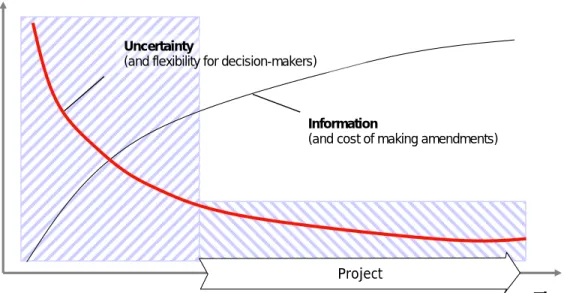
Projects are exposed to uncertainty in varying degrees and this is often used to explain their failures. Uncertainty characterises situations where the actual outcome of a particular event or activity is likely to deviate from the estimate or forecast value. Uncertainty may have many and various causes, related to the situation itself: the design of the project, the time perspective, available information, the implementation of the project, etc. (Ritchie and Marshall, 1993). Obviously, decision-making becomes difficult when uncertainty is high. Availability of relevant information reduces uncertainty from the decision-maker’s point of view. It is widely believed that uncertainty is highest at the initial stage, when the project concept is conceived, and that it tends to reduce rapidly as information accumulates over time. This is illustrated in Figure 1. It follows that the utility of adding information is at its highest in the earliest stage. The decision- maker’s flexibility and cost of making amendments is visualized with a mirroring graph.
Decision-makers can juggle with different ideas and strategic solutions to a problem in the initial stages, but once decisions have been made, essential choices become locked, and it is more difficult and expensive to change the overall design. Therefore, major issues such as agreeing on the most effective solution to a problem and the choice of concept need to be dealt with as early as possible - later on is too late. Less essential issues such as avoiding major cost overrun can be handled later, for example when the final budget is agreed.
In Figure 1, the distinction is made between the front-end and the implementation phase. The graph suggests that the potential to reduceuncertainty and risk is largest up-front, and decreases substantially when the project is implemented. It is a paradox therefore that most of a project’s planning resources may be spent on detailed planning and engineering, while too little is usually spent on getting the idea right from the start.
Front end phase Uncertainty
Time Implementation phase
Information
(and cost of making amendments) Uncertainty
(and flexibility for decision-makers)
Project
Figure 1 Uncertainty vs. available information in a project. In general, uncertainty is highest at the outset and reduces as time passes and relevant information is generated.
Where projects fail strategically, it is likely that the problem can be traced back to decisions in the earliest phases, when the initial idea was conceived and developed. What happens during the front-end phase is therefore essential for a project’s success. A study by the World Bank based on a review of some 1125 projects concluded that 80 per cent of the projects with a satisfactory “quality-at-entry”1 were successful, while only 35 per cent of those with an unsatisfactory quality-at-entry achieved success. (World Bank, 1996) Improved front-end management is therefore likely to pay off in a wider life cycle perspective, as evinced by the IMEC study (Miller and Lessard, 2000). One way of improving quality-at-entry is by challenging initial ideas and applying simple analyses, extracting and making use of previous experience from similar undertakings, and consulting with stakeholders.
In most cases the key issue at the earliest stage is to shed sufficient light on the underlying problem that provides the justification for the project, and the needs that the project is meant to satisfy. Detailed information about possible alternative solutions is less relevant. This illustrates what seems to be a major dilemma, since most projects originate as one specific solution to a problem, while the problem itself may not be analysed sufficiently, and alternative solutions may not have been considered at all. Typically, the preferred concept originates in the mind of one individual, based on intuition and experience, rather than systematic analysis of problems, needs, requirements, etc. Most of the information generated is associated only with the initially
identified solution. A second dilemma is that this information, which may be very detailed and specific, tends to lock decisions into the initially preferred concept – to the extent that this will inevitably be the one that is finally chosen. It is all too rare that alternative concepts are identified and analysed to the extent that they get a fair trial in the subsequent decision process.
1
Quality-at-entry was used as an indicator to characterize the identification, preparation and appraisal process that the projects had been subjected to upfront.
This is a book about decisions and their implementation in the earliest phase of a project. This is when fundamental choices are made, when uncertainty is at its highest, freedom to choose is at its optimum, and available information is most restricted. Adding information, therefore, makes sense - but only to a certain degree. The crucial issue is not the volume but what type of
information is needed. Some available information might not be relevant in the decision-making process, and some information that is needed will not be available until later.
This seems to indicate a paradox. Contrary to the idea depicted in Figure 1 the amount of
available information upfront might not be the issue. In the initial phase of a project the priority is to establish an overall perspective, and to analyse the problem in its context, considering the needs and priorities of stakeholders, users and affected parties, in order to come up with a sensible strategy. Opportunities and risks should also be considered. Experience suggests that creativity, imagination and intuition can be more valuable at this stage than large amounts of data. Therefore, lack of information in the earliest phase may not necessarily be a problem: it can even be a strength. Many planners have learnt that in the early phase of a project it can be an advantage to operate primarily with qualitative expressions and only to a very limited degree with
quantitative data. Only relevant, or “scant” information should be used to help identify the most viable concept for the project.
Information, validity and time
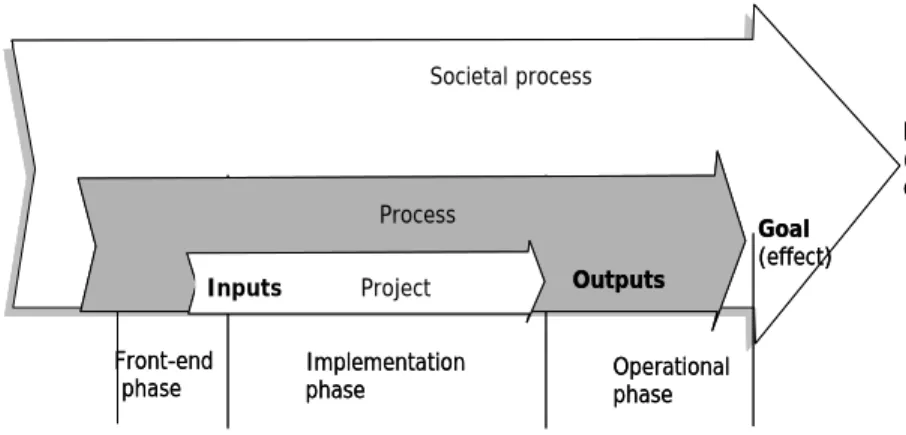
Investment projects are initiated for a purpose. The output of a project could be a road, an airport or an IT-system. It should have an effect, e.g. improved traffic flow or productivity. It should also produce long-term benefits in, say, economic terms. Figure 2 illustrates three separate processes and their corresponding objectives and suggests that there are three major planning perspectives in all projects. The project itself is a focused and restricted intervention that represents the first link in an intended chain of cause and effect. Outputs should deliver against, and be measured against, the project’s defined goal. There should eventually be long-term effects as expressed in the project purpose. The project idea needs to be considered carefully upfront in the light of these three perspectives. This does not always happen. Too many projects are designed within a perspective essentially restricted to the delivery of the outputs, with few considerations regarding its immediate effects. In those cases where the long-term strategic effects are being considered, it is often the case that what is expressed as the project’s purpose is overly ambitious and beyond its reach. This creates a problem during implementation, since the agreed objective provides unclear guidance. The same problem occurs upfront. Overly ambitious objectives give no guidance for selecting a viable concept. The long-term objective will need to be restricted to the effects that can be attributed to the project after it has been implemented. In order to succeed in strategic terms, planners need to have a broad and long-term perspective. This is necessary to allow different concepts to be considered. For instance, the need to improve traffic flow on a specific road will require a road project. But the answer to the economic problem caused by traffic congestion could involve entirely different concepts, e.g. improving parking facilities in the suburbs for commuters, increasing tariffs for rush-hour traffic, improving the commuter train service, re-routing the traffic permanently, etc. While a broader perspective allows more concepts to be considered, it also makes deliberation more difficult. Planners will have to try and look deeper into the future, and the absence of valid information will be more noticeable. Uncertainty will be higher and conclusions more hypothetical and tentative. The problem is amplified by the fact that the front-end phase in large investment projects, particularly public schemes such as roads, airports, hospitals, and defence projects extends over several years.
As the result, the entire decision process becomes a stepwise sequence of analyses and decisions, and the outcome uncertain.
Purpose (long-term effect) Societal process Purpose (long-term effect) Societal process Front-end
phase Implementationphase Operationalphase Front-end
phase Implementationphase Operationalphase Goal (effect) Process Goal (effect) Process Outputs Project
Inputs Project Outputs
Inputs
Figure 2 Three planning perspectives on a project
Project life cycle and stakeholders
The front-end phase commences when the initial idea is conceived, and proceeds to generate information, consolidate stakeholders’ views and positions and arrive at the final decision as to whether or not to finance the project. In other words the initial idea is transformed into the choice of concept. This may take years, even decades in some large public investment projects. The key stakeholder during the front-end phase is the commissioning party, who is supposedly attempting to arrive at a rational choice2 of concept, in dialogue, and sometimes in opposition, with other stakeholders. Such decisions will clearly have implications for the planning and implementation of the project, but more so for its effect and utility. The project management perspective should be secondary upfront, and the focus should be on the justification and potential benefits of the anticipated project, as seen in the operational perspective. Once this is agreed, subsequent decisions during the front-end phase are likely to have a more restricted effect on the choice of concept, focusing more on issues to do with budgeting, planning and implementation, and thereby entering the realm of project management issues.
The more fundamental challenges would typically be to deal with problems such as tactical budgeting, whereby responsible agencies at various levels tend to underestimate costs in order to increase the chance of obtaining government funding for a project. Another challenge is to increase the likelihood that the most relevant project concept is chosen; yet another is to ensure a transparent and democratic process, avoiding adverse effects of stakeholder involvement and political bargaining. Challenges are abundant and complex.
The implementation phase commences once the decision to finance is made, and includes detailed planning, mobilization of resources and implementation, resulting in the delivery of the project’s outputs. The main stakeholders are the contractors, while the commissioning party’s involvement depends largely on the contractual arrangement. The contractors have a restricted view of the project and their motivation is to deliver the agreed outputs according to specifications, while at
2
Rational choice in the sense that it is based on reason, and that maximizing utility is a main concern.
the same time making a profit. For the contractor, the initial choice is of limited significance: his responsibility is to implement whatever he is commissioned to do.
The operational phase commences once the outputs have been delivered, set in operation, or are being used. The main stakeholders are termed the“users”. Decision-makers are responsible for the operation at this stage and will have to make do with what has been produced, with limited possibilities to make strategic changes. The users are just the passengers on the ride, and largely detached from the foregoing decision processes with no possibility to influence.
In a typical case the three groups of decision-makers have different interests and perspectives on the project. They operate in separate sequences without much interaction. There is, of course, a need for some sort of alignment of interests, and in many projects the contractors and users may be able to influence decisions during the front-end phase to a limited extent.
Decisions and performance
A technocratic model for decision-making prescribes that decision and analysis should follow in a logical and chronological sequence that will eventually lead to the selection and go-ahead of the preferred project, with no unforeseen interventions or conflicts, as illustrated in Figure 3. In reality, the process may seem somewhat anarchic. It may be complex, unstructured, and affected by chance. Analysis may be biased or inadequate. Decisions may be affected more by political priorities than by rational analysis. Political priorities may change over time. Alliances and pressures from individuals or groups of stakeholders may change. The amount of information is large and may be interpreted and used differently by different parties. The possibility for disinformation is considerable.
This more complex type of decision-making is more in agreement with democratic principles than the technocratic expert-driven rationalistic process. However, the early selection of a concept tends to survive decision-making, regardless of which process is adopted. This makes a strong case for proper research to identify the most viable concept upfront. However, time factor, complexity and lack of predictability also imply that the outcome of rationalistic planning upfront tends to alter over time.
Exact quantitative information tends to be more affected by time than the choice of concept. On the one hand it is obvious that the higher the precision, the more rapidly information is outdated.3 It is tempting to speak of the “half-life of information”. For instance, exact information about the demand in a fast-developing market will have limited value after months, or even weeks. On the other hand, there are many examples to suggest that qualitative assessments tend to remain valid for much longer. Consider the assessment of users’ fundamental preferences within a market segment. While it might not be possible to make a valid prediction of the actual demand three years into the future, it may be judged that demand will continue for a long time and can therefore be relied upon in strategic planning upfront.
Restricted quality of information upfront may not be a major problem, since the need for precise information is low. It increases as the time for detailed planning approaches. In other words, the utility of exact information tends to reduce with the time-span. The opposite seems to be more of a problem: when decision-makers are confronted with an abundance of detailed information at an early point in time it may result in what is referred to as “analysis paralysis”.
3
We need of course to make a distinction between lasting information, for example physical data on the one hand, and less durable information such as economic estimates on the other hand.
D1 D1 D2D2 D3D3 D4D4 Decision process Analytic process A1 A1 A2A2 A3A3 Project Project
start deliveryProject
Planning and
implementation Operationalphase
Front-end phase
selection of project concept. The challenge upfront will be to identify what is essential, and restrict the amount of information that needs to be communicated. This will improve
communication and the likelihood that information will be used, whilst retaining the flexibility that is necessary in an ongoing democratic decision-making process. The Pareto principle, also termed the 80/20 rule, can be applied to illustrate the need for information upfront. The idea is that in a chain of cause and effect, only a fraction of the causes will be the root of most of the consequences. To identify and visualize these few will be the main challenge.
With the limitations mentioned above regarding decision-makers’ ability and willingness to make so-called rational decisions, it is essential to provide the best possible information as a basis for the key decisions. There is no single formula for what is the best decision basis. The UN/OECD model mentioned earlier is one example of a simple generic model that can be applied. This model requires that available information provides qualified answers upfront as to whether the anticipated project will be cost-effective, if its objective is pointing in the right direction and can realistically be achieved, whether the overall impact will be acceptable, and if its long-term utility can justify the investment. It can be applied to the two examples mentioned earlier:
(1) The torpedo battery project evolved out of a front-end phase that lasted for more than a decade. After it was decided to go ahead, the project was implemented and completed as planned, within budget and with a cost comparable with similar projects elsewhere. The project was therefore considered successful if judged on its efficiency alone. The effect of such a facility would be measured in terms of its defence capability or ability to deter. However, the torpedo battery will have no such effect since the facility will never be in operation. It terms of its
effectiveness, therefore, the project failed completely. The reason for this is that the project is no longer relevant since the political scenario and warfare technology have changed over recent decades and the anticipated military threat no longer exists. The project had some short-term
impact in terms of local enterprise and employment, but the long-term effects will be negligible. The project is not sustainable, since the government is not willing to pay for operations. It is unlikely that the facilities can be realized at a price that covers investment costs, or utilized in a way that generates sufficient income. Taken together, the five success criteria above provide a solid basis to conclude that the project is most unsuccessful.
(2) In the case of the national University Hospital, there was considerable cost overrun during construction and also one year’s delay. Efficiency was therefore less than expected. However, there is no doubt that the project is relevant. It is the main national hospital, which provides some highly specialized and state of the art expertise not found elsewhere in the country, and it also serves as a key educational institution. It has proved to operate effectively. One of its secondary effects is that of urban development in the city centre on the vacated premises after it was moved to the periphery. The project therefore scores highly on effectiveness, relevance and impact. In terms of its sustainability, there is no doubt about the commitment of government to secure operational funding in the future. Additional costs inflicted during construction were marginal in a wider time perspective and have little effect on its future economic viability. On this basis the conclusion is that the project is highly successful.
The above decision model is widely used to evaluate projects mid-term or ex-post. It can also be applied in the earliest phase when ideas and concepts are being considered. However, not all success criteria can be operationalised and substantiated with reliable estimates or information upfront. Much will have to be based on judgement, and weak or uncertain information. Some of the information needed does not exist. The possibility to predict is limited or non-existent. This applies especially to assessments regarding the efficiency and effectiveness of the anticipated
project in the future. However, the key success criteria in any project are those that express the justification and long-term viability, in other words the project’s relevance and sustainability. Ensuring that a project is relevant is essentially a question of aligning its objectives with needs and priorities that justify the undertaking on the one hand, and what can realistically be expected as its effects on the other. These are issues associated with needs, strategy, market demands, utilisation, etc. Securing sustainability and avoiding adverse impacts is essentially a question of understanding the complexity of the contextual situation in which the project is implemented and operated. This includes its institutional setting, market demands and restrictions, stakeholders’ needs and priorities, and technological and environmental opportunities and challenges.
Experience suggests that in many cases it may be possible to make at least reasonable qualitative assessments of a project’s relevance and sustainability at an early stage. Such conclusions have often proved to remain valid during the front-end phase and beyond. Since they are fundamental success factors, the assessments should be updated and reviewed regularly throughout the front-end phase.
The conclusions regarding the two projects above were made in retrospect. Taking a second look at these projects from the ex-ante position suggests that the success criteria can also be applied upfront. The main problem with the torpedo battery was that it was not relevant. That is why it was closed down immediately, and therefore will not fulfil its objectives. In this case the assessment of relevance is essentially one of establishing a realistic military scenario. This has changed over many years since the Second World War. However, there is no doubt that there was sufficient information to foresee the relevance of the project a decade before the final decision to go ahead was made. The Cold War had been called off. The use of missile technology renders permanent installations like the torpedo battery obsolete. Even if these facts were not entered into the equation upfront it should have been done later, and reviews of the project’s relevance been made at regular intervals - especially in view of political developments such as the downfall of the Soviet Union.
Based on this insight in retrospect, and projecting backwards to see to what extent the problems could have been foreseen at the time when the concept was decided, the conclusion is obvious: In this case there are no excuses. Current military technology and the political scenario should have excluded the concept altogether.
Regarding the University Hospital, it was evident at an early stage that the project was relevant
and would be sustainable, and that this would be the case throughout the front-end phase and beyond. This provided a solid foundation for further planning and decision-making. With this type of certainty upfront, most projects would probably succeed in the long term.
Projecting backwards in this case gives a different answer. Here the strategic decisions were sound. What went wrong had to do with emerging new technologies and added responsibilities, which were captured during the engineering phase, after the budget was decided, and
subsequently required additional funding and time. These are minor issues, and it would not be feasible to suggest that initial decisions should be able to capture problems at this precision level.
Qualitative versus quantitative information
What is of interest in these examples is not the conclusions, but the principle that decisions need to be based on a foundation of assessment and intuition. The solidity of assessment depends on the selection of decision criteria, and the underlying information used to substantiate these. Each decision criterion needs to be substantiated with a number of parameters or indicators, producing
an information hierarchy. In the example above, the decision model comprised five decision criteria (or two in the ex-ante situation).
This principle applies, regardless of the type of information used. It can be factual or
judgemental, quantitative or qualitative. For the assessment at the highest level of the hierarchy to be useful and trustworthy, the selected decision criteria need both to capture the essential aspects that ought to be considered, and be sufficiently comprehensive. Underlying supporting
information needs to be valid and reliable. Reliability is a question of whether you can trust the information, this being determined by the quality of sources and the way it is collected. Validity is a term used to express the extent to which an indicator provides information that corresponds to what is to be measured. The type of indicators chosen will determine the validity of the
assessment. Using several indicators at the disaggregate level helps improve validity at the aggregate level, providing that each indicator is valid.
Take the national University Hospital as an example: Measuring the effectiveness of the project will require indicators that are relevant to the production of health services, e.g. the capacity of the hospital and the degree to which the capacity is utilized, the comprehensiveness of health services, the quality of these services, etc. Further down in the information hierarchy these indicators can be disaggregated into several more detailed indicators so that the aggregate will provide a more precise assessment of the effectiveness of the hospital. Utilization of capacity, for instance, can be expressed in terms of the utilization of hospital beds, of polyclinic services, of different types of medical equipment, of personnel, etc.
What characterizes such an information hierarchy is that it contains a mixture of qualitative and quantitative information. The gradient is towards qualitative information at the higher levels and more towards quantitative information at the bottom. When considering such a model along a timeline, in this case the different stages of a project’s front-end phase, it is obvious that the information hierarchy will not be deeply rooted at the earliest stage of the process, for the simple reason that information does not exist. Assessment will have to rely heavily on judgement. Reliability will be severely restricted. The challenge will therefore be to ensure validity, by selecting the right type of indicators. As the decision process progresses, the information hierarchy will extend according to what information is available, which to an increasing degree will be factual and quantitative.
The absence of factual information is often used as an excuse for not seeking information up- front, rather than as a challenge to try and improve the basis for major decisions. The potential for improvements is substantial. A study of some 250 projects concluded that the main problems encountered were caused by uncertainties that were largely predictable (Samset, 1998). One explanation might be that successes and failures tend to repeat in projects with similar goals and characteristics. Taking the accumulated lessons of success and failure from such projects as the lead when looking for information relevant to the design and appraisal of an anticipated project may therefore be highly worthwhile. Surprisingly, this is rarely done even when such information is easily accessible.
Analysts and decision-makers tend to underestimate the value of judgemental information. Expert judgement, whether based on intuition, experience, collective focus group sessions, or a combination of these has proved to produce surprisingly accurate forecasts (Bazerman1994). Experiments from cognitive psychology (Goodwin and Wright, 1996), suggest that people are usually better at guessing the outcome of future events than answering general knowledge questions; that groups can generate better assessments of probabilities than individuals working alone by sharing knowledge and experience; and that assessment improves when complex events
are broken down into more simple events. Learning from the past and from experience is useful in the attempt to understand future developments. For professional use in designing projects, a systematic approach and an open-mindedness allows alternative concepts to be considered. This is utilized in methods such as Delphi techniques, successive stochastic estimation, Monte Carlo simulation, etc., which have produced estimates that in many cases outperform what is achieved by deterministic methods, and at a much lower cost.
The ability to predict is nevertheless limited. In general, future events are predictable only to a limited extent. Some events can be predicted in quantitative terms on the basis of assessments of past trends. In a situation which is predictable to some extent, uncertainties may cause only minor deviations along the general direction indicated by trends in the past. Other events occur more spontaneously and represent qualitative changes or discontinuities. Sudden changes in the economy, a new technological breakthrough, an act of terrorism, a change of government or management may suddenly change the general picture altogether. Often, neither the timing nor the effect of such events can be predicted or understood before they occur. Uncertainty therefore depends not only on the amount of information which is actually available to the decision-maker, but also on the nature of the process itself. In many cases vital information is by definition not available beforehand to shed light on development before it actually happens.
These are some of the reasons why certainty in decision-making is a rare occurrence that can be expected only when the time perspective is short and the outcome is highly predictable. In the transition from uncertainty to strategy, the decision is likely to be affected by the weaknesses inherent in the prediction itself and the decision-maker’s personal bias. In the transition from decision to outcome, prediction is likely to be affected by a number of unforeseen, confounding events - some of which may be unpredictable, critical events that may alter the direction
altogether - and, ultimately, the involved parties’ effort to make the prediction itself come true. Predictability in itself is neither a necessity nor an objective in decision-making. Too often the prediction becomes a prescription. It is no longer explorative, but normative, in the sense that it shifts the decision-maker’s focus from finding the best solution to employing his resources and skills to make his own idea or prescription come true. This is one reason why many projects fail in the long run.
The cost of information
Information collected to shed light on future events will always be incomplete. A common definition of the term “uncertainty” that links this phenomenon to decision-making is that uncertainty is an expression of the lack of information to make the right type of decision (Galbraight, 1979). Information, then, becomes the main agent to reduce uncertainty. This is a narrow and inconclusive definition, but the assumption that uncertainty is highest at the outset when information is most limited, is a tremendous motivation for investing in information at an early stage, on the assumption that this will reduce uncertainty, as illustrated in Figure 1. The result could be wasted resources, where broad and often expensive pre-studies may provide masses of information beyond what is useful for the appraisal of a perceived project. Again, it is the quality and not the quantity of information that counts.
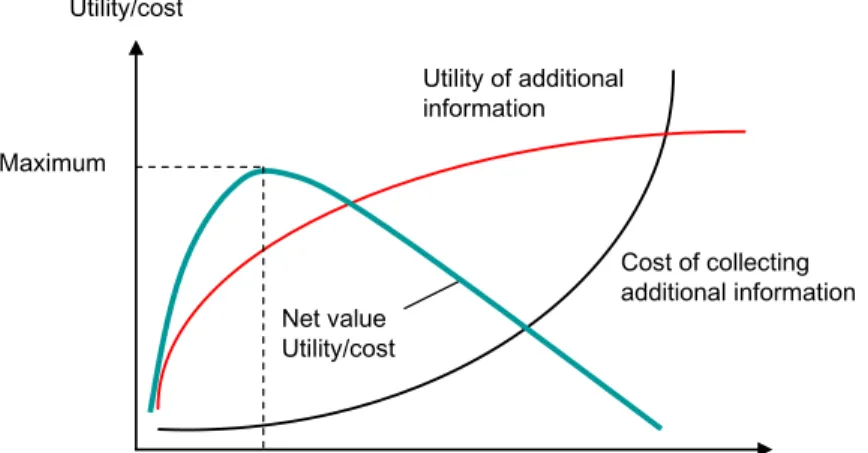
The cost of collecting information on a specific topic usually increases progressively with the amount of information collected, as indicated in Figure 4. This is because more information requires more in-depth studies or more wide-ranging information searches. On the other hand, the gain in utility of additional information tends to decrease. This is because there is usually a
critical amount of information that is needed to get the necessary insight in a situation. Additional information will be of limited use. Maximising the utility/cost-ratio will set a limit to the amount of information that is useful.
Amount of information Utility of additional information Maximum Utility/cost Net value Utility/cost Cost of collecting additional information
Figure 4 Cost and utility of information when additional information is collected to improve management of a project. As a general rule, the gain in utility tends to decrease and cost tends to increase. Consequently, in terms of cost efficiency, there is a limit to the amount of information that should be collected.
This emphasises the need to invest in relevant information at the earliest stage of a project, while at the same time limit the search to what is useful for decision-making at this stage. A targeted search for information regarding the main uncertainties likely to affect the project is more cost- effective than an unguided search, since it makes it possible to increase the share of relevant information and reduce the total amount. Assuming that success and failure is largely repetitive in the same type of projects, and that the uncertainties causing major problems in projects are largely predictable, the chance is that a pre-study guided by accumulated experience from similar projects could produce cost-effective and relevant information.
The second aspect that illustrates the utility of investing in information becomes evident when the project is seen in a lifetime perspective, as illustrated in Figure 5. The diagram depicts the size of cash-flow during the main phases of a project. In most projects the bulk of planning resources are invested in detailed planning after the decision to go ahead. The purpose is to improve tactical performance during implementation, in terms of reduced costs and shortening the implementation period. These are vital measures to ensure success both in the short and the long-term. However, as discussed earlier, cost overrun and reduced progress are marginal problems in many projects when seen in a lifetime perspective. They represent the project manager’s focus on a project, which is the most restricted one. The utility of investing in planning can be considerable in absolute terms, but marginal in relative terms, i.e. as compared with the accumulated economic result during the operational phase.
Front end Implementation Operation Planning Planning Construction Tactical perspective Strategic perspective Decision to
go ahead Project handover Termination
Initial idea
Construction
Figure 5 Investments in information during the front-end and planning phase, aimed to improve the tactical versus strategic performance of a project, respectively.
Seen from a strategic perspective, it makes much sense to invest in improving the basis for decision-making during the front-end phase. This is likely to positively affect the long-term economic result and utility of the project. Compared with current practice in most projects, a small investment upfront can be highly cost-efficient if it can improve long-term utility - the more so, because the investment needed is likely to be minor compared with what is invested in detailed planning.
This is of course not a question of either/or, but of doing both. The challenge is to ensure that the project succeeds both tactically and strategically. Resources invested upfront aim to improve strategic performance and long-term utility, i.e. “quality-at-entry.”
The difference between the two projects discussed in this chapter is that the University Hospital was successful in strategic terms but less so tactically. The torpedo battery was a complete failure in strategic terms. When that happens it does not make much difference if tactical performance is excellent.
References
Bazerman Max (1994). Judgment in Managerial Decision Making. John Wiley & Sons, Inc.: New York
Flyvbjerg B., Bruzelius N ., Rothengatter W (2003). Megaprojects and Risk. An Anatomy of Ambition, Cambridge University Press
Henden Gisle (2004) Intuition and its Role in Strategic Planning. PhD Thesis, BI Norwegian School of Management: Oslo
Marshall D and Ritchie, B (1993) Business Risk Management, Chapman & Hall: London. ISBN 0-412-43100-9
Miller Roger and Lessard Donald R (2000) The strategic Management of Large Engineering Projects: Shaping institutions, Risk and Governance. Cambridge Mass.: MIT Press
Mintzberg Henry (1994) The Rise and fall of Strategic Planning. Prentice Hall: UK
Morris PWG and Hough GH (1991) The Anatomy of Major Projects. A Study of the Reality of Project Management. John Wiley & Sons Ltd: Chichester, UK
Samset Knut (2003) Project Evaluation. Making Investments Succee. Tapir Academic Press: Trondheim
Samset Knut (1998) Project management in a high-uncertainty situation. Uncertainty, risk and project management in international development projects. PhD dissertation, Norwegian University of Science and Technology: Trondheim, May 1998
World Bank (1996) Evaluation results 1994. The International Bank of Reconstruction and Development: Washington DC
Wright George and Ayton Peter (1987) Judgmental Forecasting. John Wiley & Sons Ltd: Chichester, UK
Goodwin, Paul and Wright, George, (1996), Decision Analysis for Management ]udgment, ]ohn. Wiley & Sons, Inc., London. UK